When you’re a volunteer board member, the term “fiduciary duty” carries a lot of weight. And nowhere is that duty more tangible than in how you handle the community's finances. This is why picking the right accounting software is one of the most critical decisions an HOA board will make. It’s about more than just numbers; it's about building trust with homeowners, ensuring transparency, and securing the long-term financial health of your association.
Many boards start out trying to make a generic tool like QuickBooks work. It rarely ends well. Community association accounting is a different beast entirely, with specific needs like fund accounting, per-unit assessments, and compliance tracking that off-the-shelf software simply isn’t built for. That’s why specialized platforms like AppFolio, Vantaca, and CINC Systems exist—they’re designed from the ground up for the unique financial world of HOAs and COAs.
Choosing The Right HOA Accounting Software
As an HOA board member, your primary responsibility is to protect and enhance the value of the community for every homeowner. Choosing the right software isn't a simple IT decision—it’s a cornerstone of good governance that directly impacts your association's financial stability and the trust your neighbors place in you.
This guide is designed for busy HOA board members. We’re not going to just list features. We’re going to give you a clear framework for making a smart decision that serves your community and your fellow homeowners for years to come.
We’ll focus on what really counts for homeowners and the board:
- Delivering complete financial transparency to every resident.
- Making complex financial tasks manageable, especially for volunteer treasurers.
- Protecting your community’s reserve funds and long-term investments.
A Homeowner-First Approach To Your Decision
The best software doesn't just serve the board; it empowers the entire community. Think of it less as a ledger and more as a central hub for running a successful and transparent association. When you evaluate options, put yourself in your homeowners' shoes. How will this platform make their lives easier and build their confidence in the board's management?
Key Insight: The right platform shifts the board's role from constantly putting out fires to being proactive community leaders. It automates the administrative grunt work, freeing you up for strategic planning, capital projects, and improving resident engagement.
A modern system can dramatically improve the homeowner experience. When residents have a dedicated portal for paying dues, checking their account history, and accessing community documents, it cuts down on endless email chains and phone calls. This frees up the board's valuable time and fosters a sense of transparency and trust. For more background on how these platforms work, you can explore guides on community association management software and the benefits they bring. And for a broader perspective, this post on choosing accounting software offers valuable general principles.
Quick Look At Top HOA Accounting Software Solutions
For boards that need a fast recommendation, these platforms are top contenders based on specific community needs and management styles. This table should give you a solid starting point for your research, focusing on benefits for both the board and the homeowners.
| Platform | Best For | Key Benefit for the Homeowner & Board |
|---|---|---|
| AppFolio | Large, self-managed communities | All-in-one functionality with a great homeowner portal simplifies life for everyone. |
| Vantaca | Communities using management companies | Delivers unmatched financial transparency between the board, manager, and homeowners. |
| CINC Systems | Boards prioritizing homeowner communication | Integrated communication tools keep residents informed and engaged in their community. |
Ultimately, the goal is to find a solution that becomes a partner in building a financially secure, well-run, and harmonious community. This guide will give you the tools to do just that.
It’s a story we see all the time. A new board takes over, looks at the finances, and reaches for a familiar tool. Why not use something like QuickBooks? After all, it's a household name, seems affordable, and gets the job done for small businesses, right?
But this is one of the first and most costly mistakes a board can make. It often leads to a real operational nightmare, creates legal risks for the association, and slowly chips away at the trust between the board and the homeowners you serve.
These general business platforms are designed for one thing: for-profit businesses. They just aren't built to handle the unique financial world of a homeowners association. Trying to force it to work means creating messy manual workarounds and losing the transparency your community deserves.
The Critical Flaw: It Can't Do Fund Accounting
The biggest deal-breaker with generic software is its complete inability to properly handle fund accounting. This isn't just an industry best practice; it's a legal requirement for HOAs. You must keep your operating funds and reserve funds completely separate. No exceptions.
Your operating funds are for the day-to-day—landscaping, pool maintenance, utilities. Your reserve funds are the community’s long-term savings account, set aside for major projects like replacing a roof or repaving the roads, ensuring the community's future value.
Generic software sees all income as one big pot of money. Forcing it to separate funds involves complicated, error-prone spreadsheets and manual entries. It’s a ticking time bomb for compliance issues and financial mismanagement.
An HOA's financial health depends on its ability to clearly distinguish between daily operational cash and long-term reserve investments. Using software that co-mingles these funds is a direct threat to your fiduciary responsibility and the stability of every homeowner's investment.
This isn't just about good bookkeeping. It’s a legal duty. Proper fund accounting proves the board isn't dipping into long-term savings to cover short-term expenses, which is essential for protecting your community's future and maintaining homeowner trust.
More Work for the Board, More Confusion for Homeowners
On top of the fund accounting disaster, generic software piles on other problems that create more work for volunteer board members and leave homeowners frustrated.
- No Individual Member Ledgers: These programs simply aren't made to track finances unit by unit. Good luck cleanly managing dues, special assessments, and late fees for each homeowner. You'll quickly find yourself drowning in disconnected spreadsheets.
- Manual Violation & Fee Tracking: There's no built-in way to issue a violation and have the fine automatically appear on a homeowner's account. This makes the collections process clunky, inconsistent, and unfair.
- Opaque Homeowner Statements: Trying to generate a clear, easy-to-read statement for each homeowner is next to impossible. The result? Confused residents, endless questions, and payment disputes that erode community morale.
The industry is moving away from these makeshift solutions for a reason. The HOA software market is expected to jump from USD 6.03 billion in 2026 to USD 9.15 billion by 2032. This growth is driven by the need for platforms that can cut manual accounting errors by up to 40% and truly protect a community's financial health. You can see the full market trend in 360iResearch's detailed analysis.
Ultimately, choosing the right accounting software means picking a tool designed for the job, one that empowers the board and serves the homeowners.
When you're evaluating HOA accounting software, it's easy to get bogged down in feature lists. But your job as a board member isn't just about basic bookkeeping. It's about protecting your community's financial health, making life easier for homeowners, and building a foundation of trust.
This means you need to look past generic accounting tools and demand features built specifically for the unique rhythm of association life. These are the non-negotiables that separate a truly great platform—one that serves both the board and the homeowners—from one that just gets by. Let's break down what your board absolutely needs to look for.
Automated Dues and Assessment Collection
Consistent cash flow is everything for a well-run community, ensuring that shared amenities are maintained and property values are protected. If you're still relying on paper checks and manually tracking payments, you're creating unnecessary work and opening the door for delays and mistakes. Modern HOA software should completely transform this process for the benefit of everyone.
The key is an integrated online payment portal. This gives homeowners the convenience and flexibility they expect—letting them pay dues with a credit card, debit card, or a direct bank transfer (ACH). Look for a system that also allows residents to set up recurring auto-payments. This single feature dramatically cuts down on late payments and the time your volunteer board spends chasing them.
A self-service homeowner portal isn't a "nice-to-have" anymore; it's essential for a modern community. It gives residents 24/7 access to their account history, lets them check and pay balances, and frees up volunteer board members from constantly answering routine financial questions. This transparency builds trust.
Robust and Transparent Financial Reporting
To make smart decisions, your board needs to generate and, more importantly, understand the association's key financial reports. You also have a fiduciary duty to share this information with homeowners to maintain transparency and confidence in the board's leadership.
Your software must be able to produce HOA-specific, accrual-based reports with just a few clicks. The essentials include:
- Balance Sheet: A straightforward snapshot of your association's assets, liabilities, and fund balances, showing the community's overall financial position.
- Budget vs. Actual: This is your go-to report for monitoring spending and ensuring you’re on track, providing accountability to all homeowners.
- Accounts Receivable Aging: This report instantly shows you who is behind on payments so you can address delinquencies fairly and consistently before they become a major problem.
These reporting capabilities are central to proving you’re governing responsibly. The entire accounting software market, valued at USD 21.16 billion in 2025, is shifting to the cloud for exactly this kind of accessible, powerful reporting. In fact, top-tier HOA software is already proven to cut annual accounting costs by up to 25% through automation alone. You can dive deeper into these trends by reviewing the full research on the accounting software market.
Dedicated Reserve Fund Tracking
Managing your reserve funds for future repairs and replacements is one of the board's most critical fiduciary duties to protect every homeowner's investment. This is where generic business software completely falls short for HOAs.
Your accounting platform must have dedicated functionality to track reserve funds separately from your operating funds. This isn't just good practice; it's a legal requirement in most states. The software should let you automatically allocate a portion of each homeowner's dues directly into the reserve account and provide crystal-clear reports on the health and growth of those long-term savings. Without this, you're risking the community's biggest financial obligations and eroding homeowner trust.
Before you even start looking at demos, it's crucial to have a clear checklist of what your association and its residents truly need. Too many boards get distracted by flashy features and forget to check for the core functionalities that keep a community running smoothly and transparently.
We've created a simple checklist to help you stay focused during your evaluation process. Use it to compare different platforms and ensure your final choice aligns with your board's fiduciary responsibilities and your community's operational needs.
Essential HOA Accounting Feature Checklist
| Feature Category | Must-Have Functionality | Why It Matters for Your Homeowners & Board |
|---|---|---|
| Homeowner Accounts | Online payment portal (ACH/credit card), auto-pay setup, and homeowner access to payment history. | Boosts on-time payments, reduces board workload, and improves resident satisfaction and trust. |
| Financial Reporting | One-click generation of Balance Sheet, Budget vs. Actual, and A/R Aging reports. | Essential for transparent financial oversight, informed board decisions, and audit readiness. |
| Dues & Assessments | Automated billing, late fee calculation and application, and special assessment tools. | Ensures consistent cash flow for community services and enforces rules fairly for everyone. |
| Fund Accounting | Strict separation and tracking of Operating Funds vs. Reserve Funds. | A legal and fiduciary necessity. Protects homeowner investments for long-term projects. |
| Accounts Payable | Digital invoice processing, vendor payment tracking, and check printing/digital payment capabilities. | Streamlines vendor management, creates a clear audit trail, and prevents payment errors. |
| Bank Reconciliation | Direct bank feed integration or simple tools to reconcile bank statements against accounting records. | Guarantees financial accuracy, helps spot discrepancies quickly, and saves hours of manual work. |
| Budgeting Tools | Ability to build, import, and track the annual budget against actual performance. | The foundation of your community's financial plan. In-software tracking is non-negotiable for accountability. |
| Security & Access | Role-based user permissions (e.g., Board Member vs. Property Manager vs. Accountant). | Protects sensitive financial data and ensures users can only see and do what's appropriate for their role. |
This checklist isn't exhaustive, but it covers the absolute must-haves. A platform that can't confidently check every one of these boxes is likely not the right fit for a modern, well-governed community association. Keep this list handy as you move forward.
Figuring out which accounting software is right for your HOA isn’t about finding one magical "best" platform. It’s about matching the software’s strengths to how your community actually operates. A self-managed board has different needs than one that partners with a management company, and that's the lens we'll use for this comparison.
The real goal here is to find a system that makes life easier for everyone involved—from the volunteer treasurer to the homeowners paying their dues. You need something that streamlines finances, keeps residents in the loop, and can grow with your community.
This decision tree gives you a great visual of the non-negotiable features every HOA needs to look for, all of which benefit the homeowners directly or indirectly.
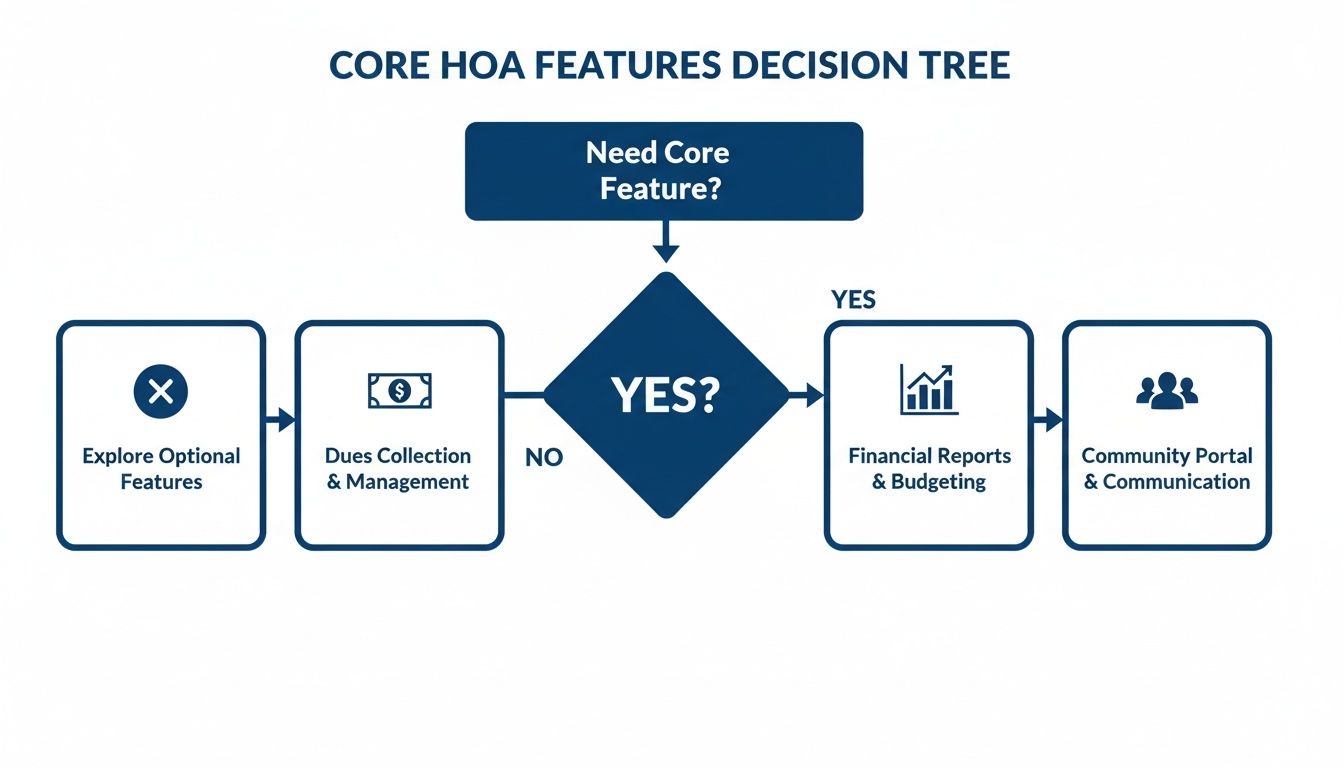
Think of it this way: convenient dues collection, transparent financial reporting, and a helpful homeowner portal are the three pillars of a positive community experience. Everything else is built on that foundation of trust and efficiency.
Scenario One: The Large, Self-Managed Community
If you're a larger HOA running the show yourselves, an all-in-one platform like AppFolio is almost always the right call. The biggest headache for self-managed boards is trying to juggle disconnected systems—one for accounting, another for violations, and a third for resident emails. This creates confusion for homeowners and administrative chaos for the board.
An integrated solution brings all those jobs under one roof. When a violation fine is logged, it automatically posts to the homeowner’s account. When an announcement about a special assessment is sent, it’s done from the same system used to collect the funds. This unity eliminates manual data entry and cross-checking spreadsheets.
The game-changer here is operational unity. A single system eliminates the endless task of reconciling data between different programs, cutting down on errors and giving volunteer board members back dozens of hours every month to focus on improving the community.
The homeowner experience gets a major boost, too. Instead of fumbling with multiple logins, residents get a single, clean portal to pay dues, submit architectural requests, or pull up community documents. It’s simpler, more convenient, and more empowering for everyone.
Scenario Two: The Board and Management Company Partnership
When your board hires a professional management company, your software needs to do a different job. You're not looking for an all-in-one tool for yourselves; you need a system that creates total transparency and seamless collaboration between your board, your manager, and your homeowners. This is where platforms like Vantaca and CINC Systems really stand out.
These systems are built from the ground up to connect all the key players. The management company handles the daily accounting and operations inside the platform, but the board gets real-time, read-only access to every financial report, bank reconciliation, and vendor invoice. This provides the critical oversight needed to fulfill your fiduciary duty without micromanaging.
The leaders in this space, like CINC Systems (serving over 50,000 communities) and Vantaca (serving 6.5 million homeowners), are designed to make managers far more efficient—by up to 35%. For a board, that’s huge. It can free up about 20% of your manager’s time from answering routine homeowner questions, letting them focus on bigger-picture initiatives that benefit your community.
Feature Matrix: Top HOA Accounting Software
To help you compare your options at a glance, here’s a breakdown of how the leading platforms stack up based on the scenarios we've discussed, always keeping the homeowner experience in mind.
| Platform | Best For (Use Case) | Key Differentiator | Reporting Strength | Homeowner Experience |
|---|---|---|---|---|
| AppFolio | Large, self-managed HOAs needing a unified system for accounting, communications, and violations. | All-in-one platform that creates a single point of contact for homeowners and board members. | Good for internal board use and standard homeowner reports. | Excellent. A single, user-friendly portal for all resident interactions. |
| Vantaca | Boards working with a management company, prioritizing transparency and manager efficiency. | A "system of action" that connects the board, manager, and homeowners with real-time data. | Exceptional. Deep, real-time financial transparency for board oversight and homeowner trust. | Very Good. Streamlined for action items like payments and maintenance requests. |
| CINC Systems | Boards partnering with a management company, focused on collaboration and scalability. | Portfolio management focus that boosts manager efficiency, improving service to your community. | Strong. Provides robust, board-level financial reports for oversight. | Good. Solid portal for payments, documents, and communication. |
This matrix highlights the core philosophy of each tool. Your choice really comes down to who needs to use the software and what best serves your community's unique management model.
Since HOAs operate as nonprofit corporations, your board's fiduciary responsibilities have a lot in common with nonprofit governance. As you evaluate your options, checking out a guide on the best accounting software for nonprofit organizations can offer some great perspective on platforms that excel at fund accounting and transparent reporting.
At the end of the day, the right software depends entirely on your management model. If you're self-managed, you need a powerful, all-in-one tool. If you work with a pro, you need a collaborative platform that gives you clear, unfiltered oversight and empowers your manager to better serve the community.
A successful switch to new accounting software doesn't just happen. It all comes down to a clear, organized plan that prioritizes a smooth transition for homeowners. For board members, overseeing this change is one of your most important duties—it ensures the community’s finances are protected and daily operations continue without a hitch.
A well-planned implementation minimizes headaches for residents and starts showing the value of your investment right away.
The real work starts long before you ever "go live." It begins with serious preparation and data cleanup. Think of it like prepping your house for a major renovation; the more you organize beforehand, the smoother the entire project will be. The board’s first job is making sure all current homeowner and financial data is accurate and complete. This is the foundation you’ll build your new system on.
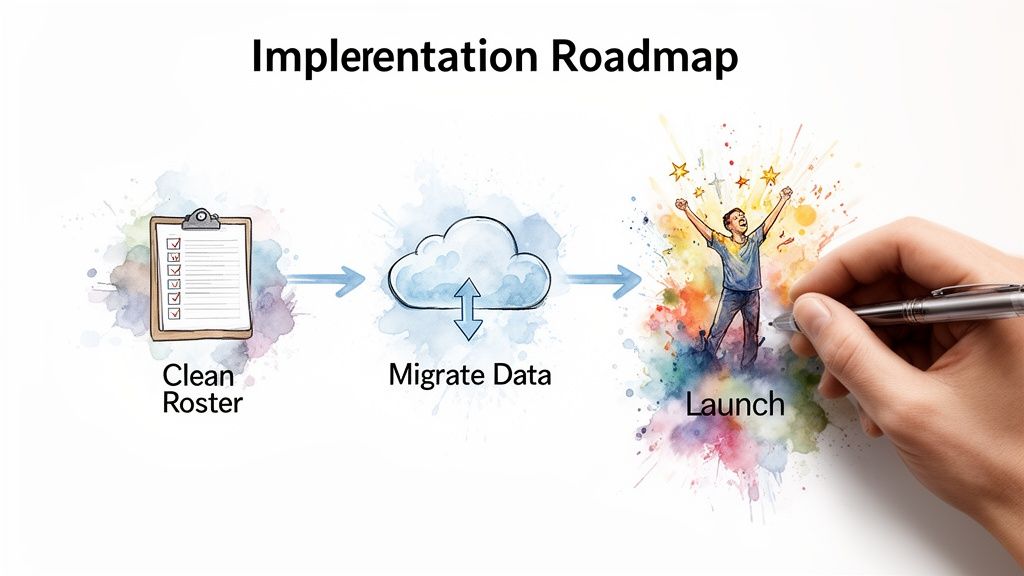
Creating A Clean Slate For Migration
Before you even think about moving data, the board needs to go through your existing records with a fine-toothed comb. This step is absolutely non-negotiable. It’s the only way to avoid bringing old problems and incorrect information into your shiny new system.
Here are the key tasks to tackle before launch:
- Homeowner Roster Audit: Go through every owner's name, unit number, and contact information. Outdated records are a primary cause of communication failures and late payments, leading to homeowner frustration.
- Financial Data Organization: Pull together several years of financial history. This includes past budgets, balance sheets, and reserve study reports. You’ll need this for historical context and to maintain transparency.
- Open Balances Reconciliation: Make sure all open accounts receivable (unpaid dues) and accounts payable (unpaid vendor bills) are accurate. This ensures a seamless financial transition for both homeowners and vendors.
By dedicating real time to data cleanup upfront, you avoid the classic "garbage in, garbage out" trap. A clean migration means your new software starts with reliable, trustworthy information, which immediately builds confidence with your homeowners.
Managing The Migration And Rollout
The actual data migration is like a financial transplant—moving your community's financial DNA into the new platform. Your new software provider will typically handle the technical side, but the board’s active involvement and oversight is essential to ensure it's done right for the community.
You should be prepared to hand over several key financial documents to your vendor. These are the blueprints they need to set up your association's finances correctly from day one.
Critical Data for Transfer:
- Chart of Accounts: This is your financial framework. It must be configured properly from the start to separate operating funds from reserve funds.
- Current Year Budget: The new system needs your approved budget to generate accurate "Budget vs. Actual" reports right out of the gate, demonstrating fiscal responsibility.
- Reserve Fund Balances: The exact balance of your long-term savings must be transferred to maintain compliance and financial transparency for all homeowners.
We strongly recommend a phased rollout to make the transition easier on everyone. Start by getting the core accounting functions—dues collection, financial reporting, and vendor payments—running perfectly. Once those are stable, you can introduce secondary features like homeowner portals or violation tracking. This approach helps the board and homeowners adapt without feeling completely overwhelmed.
This is also where a professional community association manager can be a lifesaver. They’ve been through these transitions before and know how to navigate the common pitfalls, ensuring a smooth process for the entire community.
Questions Your Board Must Ask Before Signing a Contract
Choosing the right accounting software for your HOA is a huge decision. But the platform’s features are only half the story—the partnership with the vendor is just as critical. Before your board signs any contract, it has a fiduciary duty to look past the sales demo and ask tough, practical questions that protect the interests of every homeowner.
The answers you get will tell you everything you need to know about the partnership you’re really entering into. Committing to a new system is a major undertaking that affects every single homeowner and your board's ability to govern effectively. The right questions will expose potential hidden costs, gaps in service, and security risks, making sure you pick a partner who is genuinely invested in your community's future.
Uncovering The True Cost And Service Level
A slick sales presentation can easily gloss over the details that matter most to a volunteer board and the community's budget. Your job is to dig deeper into the day-to-day reality of using the software and working with the company. A vendor’s transparency here is a strong sign of their character.
Start by zeroing in on the onboarding process and the total cost of ownership for the association:
- Onboarding and Training: "What does the full onboarding process look like for a volunteer board with varying technical skills? Is training live or pre-recorded, and is there any extra cost for follow-up sessions?"
- Complete Fee Structure: "Can you provide a complete, itemized breakdown of all potential fees? We need to see everything, including setup, data migration, ongoing support, and especially all homeowner payment processing fees for both ACH and credit cards."
These questions shift the conversation from shiny features to the practicalities of implementation and budgeting, which is essential for responsible financial stewardship.
The most important questions aren't about what the software can do, but what the company will do when you need help. A vendor's policies on support, security, and data ownership are a direct reflection of their respect for your community and its members.
Verifying Security and Support Guarantees
Your community's financial and personal data is one of its most valuable assets. Protecting it isn't optional—it's a core board responsibility. When a critical financial issue pops up—and it will—your board needs to know that help is just a phone call or email away.
Probe their commitment to security and support with these pointed questions:
- Data Security and Recovery: "How is our community's data secured, encrypted, and backed up? What is your documented disaster recovery plan, and how quickly can you restore our data in an emergency?"
- Guaranteed Support: "What are your guaranteed support response times for critical issues, like a system outage during assessment collection? What are your standard support hours for our community's time zone?"
Asking these questions helps you fulfill your board’s duties. Understanding your HOA board responsibilities is the first step in asking the right questions to protect your community’s interests. If a vendor is unwilling to provide clear, contractual answers on these topics, that should be a major red flag for any board.
Frequently Asked Questions About HOA Accounting Software
When your board starts looking into accounting software, a lot of questions come up. It's a big decision that directly affects your community's finances, the board's own efficiency, and the trust you've built with your fellow homeowners. We've compiled straightforward answers to the questions we hear most often from board members just like you.
How Much Should an HOA Expect to Pay for Accounting Software?
The price for HOA-specific software can vary quite a bit, but it’s almost always priced based on the number of units in your community. Most boards should budget for somewhere between $0.50 to over $2.00 per unit, per month.
But the sticker price rarely tells the whole story. It’s absolutely critical that the board asks for a detailed quote that spells out every single potential cost. Make sure you ask specifically about one-time setup fees, data migration charges, and any transaction fees for homeowner payments (like ACH and credit card processing). Knowing the total investment is essential for responsible budgeting on behalf of the community.
Can Our HOA Manage Its Own Accounting Without a Professional Manager?
Yes, you certainly can. Many of the best software platforms are built specifically for self-managed communities. They often feature easy-to-use dashboards and support teams dedicated to helping volunteer boards. With the right system, a dedicated treasurer can confidently handle everything from collecting dues to paying vendors and running financial reports for the community.
The real question is about your board's capacity. If you have volunteers with the time to learn the system and manage it consistently, self-management can be a great, cost-effective choice that gives the board direct control. For larger or more complex associations, it's often more efficient to partner with a management company that has already mastered a top-tier system, freeing up the board for more strategic work.
What Is the Biggest Mistake Boards Make When Choosing Software?
The most common—and most expensive—mistake we see is when boards try to use generic business software like QuickBooks. These tools simply weren't built for the unique needs of community associations. They lack critical features like true fund accounting, violation tracking, and integrated homeowner portals. This path almost always leads to compliance headaches, messy spreadsheets, and hours of frustrating manual workarounds that ultimately harm homeowner trust.
Another major misstep is focusing only on the monthly subscription price instead of the long-term value to the community. The right software saves countless volunteer hours, improves cash flow by making payments easier for homeowners, and boosts overall resident satisfaction. Those benefits will far outweigh a small difference in the monthly fee.
How Long Does It Take to Implement New HOA Software?
A typical implementation can take anywhere from 30 to 90 days. The exact timeline really depends on the size of your association, how clean your existing financial and homeowner data is, and the overall complexity of the move.
The process usually involves cleaning up your roster of homeowners, migrating your financial history, setting up the new system to match your community's rules, and then training the board. Having a clear plan and a responsive software vendor is essential for making the transition smooth and timely for everyone in the community.
Navigating the world of HOA accounting can feel complex, but you don't have to do it alone. As a leader in community association management since the 1970s, Access Management Group has partnered with associations to protect, preserve, and enhance their investments. Our team uses state-of-the-art software to provide unmatched financial oversight and a superior homeowner experience. Learn how we can support your board and your community at https://accessmgt.com.