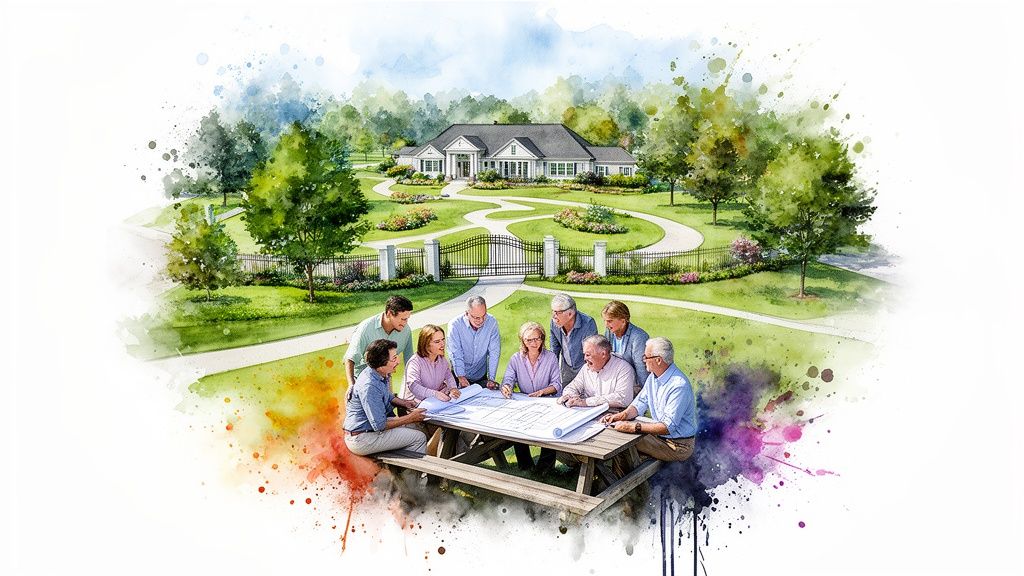
Ever wonder how a brand-new neighborhood can pop up with a resort-style pool, pristine parks, and impressive entry gates already in place on day one? For homeowners and HOA boards, the answer is critical to understanding your community's value and finances: it’s often the work of a Community Development District (CDD).
Understanding what a CDD is and how it functions is not just trivia—it's essential knowledge for effective community leadership and protecting your home investment. The CDD is the silent partner responsible for the very foundation and lifestyle you bought into.
Your Community's Infrastructure Partner
A CDD isn't your HOA. Think of it as a separate, special-purpose government entity created specifically to finance and manage the big-ticket infrastructure for a new community. When a developer lays out plans for a large-scale neighborhood, the cost of building roads, sewer systems, clubhouses, and tennis courts can run into the millions.
Instead of the developer paying for all this upfront and rolling it into sky-high home prices, they can establish a CDD to handle the job, which directly benefits you.
The Financial Engine of Your Neighborhood
So, how does a CDD work for your benefit? The CDD issues tax-free municipal bonds—a form of long-term loan—to fund the construction of the entire community’s framework. This gives the developer the capital needed to build out all those desirable, high-quality amenities right away, making your community attractive from the moment you move in.
Your CDD fee, which shows up as a line item on your annual property tax bill, is simply your home’s portion of that loan repayment. It also covers the ongoing maintenance of the infrastructure the CDD built, ensuring the amenities remain a valuable asset.
For an HOA Board Member: A CDD is the "builder" of the neighborhood's major systems and amenities. Your HOA is the "rule-keeper" that protects property values and ensures community harmony. Clearly explaining this distinction is a key leadership responsibility.
This setup offers real, tangible benefits for you as a homeowner and for the community your board governs:
- Immediate Access to Amenities: You get to enjoy the pool, parks, and clubhouse from the day you move in, not years down the road.
- Enhanced Property Values: Well-maintained, top-tier amenities make the whole community more attractive to future buyers, helping protect your investment.
- Spreading the Cost: The cost of those multi-million dollar facilities gets spread out over decades (usually 20-30 years) and across every home, making it far more manageable than if it were included in the initial home price.
A Cornerstone of Modern Communities
This financing model has become the go-to method for development, especially in fast-growing states. For example, Community Development Districts in Florida have seen massive growth since being formally established in 1980. By 2021, the state had 763 active CDDs—more than its total number of cities and counties. The housing boom in the early 2000s pushed this trend into overdrive, with 354 new CDDs established in just five years. You can check out the full report on CDD growth in Florida to see just how much this model has shaped the state.
As an HOA board member, getting a firm handle on this concept is the first step toward effective leadership. When you can clearly explain the CDD’s role to residents, it demystifies their fees and allows your HOA to focus on its own distinct responsibilities. Understanding that the CDD is your partner in infrastructure empowers everyone to better appreciate the community you’ve all invested in.
How CDD Fees Impact Your Household Budget
For many homeowners, that "CDD" line item on the annual property tax bill can be a real head-scratcher. It’s crucial to understand what this fee covers—both for managing your own household budget and for board members who need to explain community finances to residents.
The key is knowing that your Community Development District fee isn’t one single charge. It’s actually a combination of two distinct parts: a bond assessment and an Operations & Maintenance (O&M) assessment. Once you and your board understand this two-part structure, you’ll have a much clearer picture of the total cost of ownership in your neighborhood and be better equipped to answer resident questions.
The infographic below breaks down the simple, three-step process of how a CDD finances and builds the amenities you enjoy every day.

As you can see, the district secures funding, builds the infrastructure, and then delivers those finished amenities for everyone to use.
The Bond Assessment: Your Community's Mortgage
Think of the bond assessment as the mortgage payment for your community's big-ticket items. When the developer first planned your neighborhood, the CDD took out a long-term loan (by issuing bonds) to fund everything from the main roads and sewer systems to the clubhouse and pool. Your bond assessment is simply your household's share of that loan repayment.
Here’s the fantastic news for homeowners: it has an end date. Most CDD bonds are structured with a term of 20 to 30 years. Once that bond is finally paid off, this part of your annual assessment disappears completely, which means a lower property tax bill for you.
For board members, this is a critical point to communicate to residents. It makes it clear that a large chunk of the fee is a temporary investment that built long-term value, not a forever tax.
The O&M Assessment: Keeping the Community Running
While the bond pays for building the amenities, the Operations & Maintenance (O&M) assessment pays for keeping them running. This is the ongoing, operational piece of your CDD fee, and unlike the bond, it does not go away.
This O&M portion covers all the recurring expenses needed to maintain the lifestyle you bought into. This includes things like:
- Landscaping and mowing for all common areas and parks.
- Pool cleaning, chemicals, and staffing.
- Electricity for streetlights and community buildings.
- Upkeep of stormwater ponds and drainage systems.
- Management and administrative costs for running the district.
The O&M fee can fluctuate a bit each year depending on the community’s budget and needs. It’s the cost of making sure your amenities stay safe, clean, and enjoyable for everyone. Because CDD fees are collected as a form of special assessment tax, it’s helpful for homeowners and board members alike to understand how they function.
Key Takeaway for Homeowners: The bond portion of your CDD fee pays off the initial construction debt and will eventually end. The O&M portion covers ongoing upkeep and is a permanent part of living in the community.
For HOA and COA presidents, being able to distinguish between these two costs is vital. It allows you to draw a clear line between the HOA's financial duties and the CDD's responsibilities. Understanding this split helps your board create its own budget more effectively, avoiding any overlap and ensuring both entities work together in financial harmony. For more tips on improving your community's financial health, check out our other articles on HOA financial management.
Distinguishing Between Your CDD and Your HOA
"So, who fixes the pothole on the main road versus the one in my driveway?" It's a classic question for anyone living in a planned community. The answer gets right to the heart of the difference between a Community Development District (CDD) and your Homeowners Association (HOA).
For homeowners who want quick solutions and boards aiming to run things smoothly, getting this distinction right is essential.

While a CDD and an HOA often operate in the same neighborhood, they are completely separate entities with different jobs. Confusing the two can lead to misdirected complaints, delays, and a lot of frustration. For an HOA board, making this distinction crystal clear for residents is a pillar of good governance.
The CDD Is Your Public Works Manager
Think of the CDD as a specialized, small-scale government body, a lot like a city’s public works department. Its main purpose is to finance, build, and maintain the large-scale public infrastructure that serves the entire community. The CDD is the "builder" that creates the neighborhood's framework.
Its responsibilities are broad and foundational. They typically cover:
- Major Roadways: The main arteries and collector streets running through the community.
- Water Management Systems: Stormwater drains, large retention ponds, and other vital drainage infrastructure.
- District-Wide Amenities: The primary clubhouse, large community pools, expansive parks, and trail systems open to everyone.
- Utilities: The underlying water and sewer lines that connect the community to regional services.
If a major road needs repaving or the community-wide irrigation system fails, the CDD is the one to call. Its focus is on the bones of the community.
The HOA Is Your Neighborhood Harmony Keeper
On the other hand, your HOA is a private, non-profit corporation governed by a set of legal documents. Its role isn’t to build infrastructure but to preserve the community's look and feel, enforce its rules, and manage specific HOA-owned properties. The HOA is the "rule-keeper," protecting property values and ensuring neighborhood harmony.
This means the HOA’s work is focused much closer to your front door. You can learn more about the core HOA board responsibilities in our detailed guide, but in short, the HOA handles things like:
- Covenant Enforcement: Making sure homes and yards are kept up according to the community's architectural guidelines (think paint colors or lawn care).
- HOA-Owned Property: Managing smaller, private amenities like a small neighborhood park or a gate that's exclusive to a certain section.
- Community Rules: Overseeing regulations on parking, noise, and trash disposal.
- Social Activities: The HOA is also often the group that organizes community events and social get-togethers.
Homeowner Tip: A CDD is a governmental body responsible for public infrastructure, while an HOA is a private corporation focused on property-specific rules and aesthetics. Knowing which to call saves everyone time and ensures issues are resolved faster.
CDD vs HOA at a Glance
The most common point of confusion comes up when a resident simply doesn’t know who to contact. A pothole on the main thoroughfare is a CDD issue; a neighbor's overgrown lawn is an HOA matter.
To help clarify these roles for your board and residents, here is a direct comparison.
| Aspect | CDD (Community Development District) | HOA (Homeowners Association) |
|---|---|---|
| Primary Function | Finances, builds, and maintains large-scale public infrastructure like roads, water systems, and main amenities. | Enforces covenants, maintains aesthetic standards, and manages specific HOA-owned properties. |
| Governing Body | A public Board of Supervisors, elected by residents or appointed by the developer. Governed by state Sunshine Laws. | A private Board of Directors, elected by homeowners. Governed by corporate bylaws and covenants. |
| Funding Source | Bond assessments (for construction debt) and O&M assessments (for upkeep), collected on the annual property tax bill. | Regular dues or assessments paid directly by homeowners to the association. |
| Scope of Authority | Broad, public-facing authority over district-owned infrastructure and assets that serve the entire community. | Focused authority over individual properties and private common areas as defined in the governing documents. |
| Simple Analogy | Acts like a mini-municipality or "public works manager." | Functions as a "neighborhood harmony keeper" that protects property values. |
By understanding—and clearly communicating—these differences, your HOA board can empower homeowners to direct their concerns to the right place. This clarity allows your board to focus on its core mission without getting bogged down with issues that fall under the CDD's jurisdiction. Ultimately, it creates a more efficient, responsive, and harmonious living environment for everyone.
How Your Board Can Partner with the CDD for Community Success
For an HOA board, treating the Community Development District (CDD) as a separate, untouchable entity is a major missed opportunity. To truly protect homeowner interests and enhance property values, your board must view the CDD not as a rival, but as a critical partner.
Engaging with the CDD’s Board of Supervisors is a strategic move that gives your community a powerful voice in decisions that impact its core infrastructure and financial future.

This partnership allows your board to influence how CDD funds are spent, ensure maintenance meets your community's standards, and align long-term goals. A strong, collaborative relationship transforms your HOA from a passive observer into an active participant in shaping your neighborhood for the better.
Understand the Transition of Power
One of the most important moments for a CDD community is the transition of its Board of Supervisors. Initially, the developer appoints board members, which makes sense while they are overseeing the initial build-out. As the community matures and more homes are sold, however, control gradually shifts to the residents.
Over time, seats on the CDD board transition from being developer-appointed to resident-elected. This is a critical turning point for your community. It means the homeowners you represent—your friends and neighbors—can run for and hold positions on the very board that governs the community's major infrastructure.
An HOA Board's Golden Opportunity: By encouraging qualified residents to run for the CDD board, you can ensure that the people making decisions about millions of dollars in infrastructure spending are directly accountable to the homeowners you serve.
This shift ensures the community's long-term interests are prioritized over the developer's exit strategy. Resident involvement, championed by the HOA, becomes a powerful tool for good governance.
Appoint an Official HOA Liaison
A simple but highly effective first step for your HOA board is to appoint an official HOA-CDD Liaison. This person's sole responsibility is to bridge the gap between the two organizations, ensuring the HOA is always representing homeowner interests.
The liaison's duties should include:
- Attending All CDD Meetings: They act as the eyes and ears for the HOA, taking detailed notes on budget discussions, proposed projects, and maintenance schedules.
- Reporting Back to the HOA Board: After each meeting, the liaison provides a concise summary to your board, flagging any items that require the HOA's attention or input on behalf of residents.
- Building Personal Relationships: This individual can build rapport with the CDD District Manager and Supervisors, opening informal lines of communication that are invaluable for resolving issues quickly.
This single point of contact prevents miscommunication and ensures your board is always informed and ready to advocate for the community.
Strategies for Effective Collaboration
Beyond appointing a liaison, your board can pursue several proactive strategies to forge a strong partnership. The goal is to move from a reactive stance to one of mutual planning and shared objectives, all for the benefit of the homeowners.
Successful collaboration tactics include:
- Request Regular Joint-Planning Sessions: Propose quarterly or semi-annual meetings between the HOA board and the CDD Board of Supervisors. Use these sessions to discuss long-range plans, upcoming capital projects, and areas of overlapping interest, like landscaping contracts or security services.
- Align Capital Improvement Plans: If the CDD plans to resurface the main road in five years, your HOA should know about it. Aligning your respective capital improvement and reserve studies prevents costly conflicts and ensures a cohesive community aesthetic that homeowners expect.
- Share Resident Feedback: Your HOA is on the front lines of resident concerns. Systematically collect and present this feedback to the CDD board to help them make more informed decisions about maintenance priorities and service levels that directly impact residents.
By becoming a proactive partner, your board can directly influence CDD decisions to ensure they align with the community's real needs. To learn more about fostering strong leadership within your association, explore our articles on community governance. This partnership is the ultimate safeguard for the property values you are tasked to protect.
Navigating Common CDD Challenges Effectively: A Guide for Boards & Homeowners
Even the best-run Community Development District (CDD) can create headaches for homeowners and their HOA boards. The key is knowing how to handle these common issues, transforming your board from a bystander into a true advocate for your residents.
When problems like fee hikes or a lack of communication arise, a clear, solutions-focused plan is your most effective tool. Your board can take the lead in getting answers and holding the CDD accountable to the people it serves: the homeowners.
Addressing Sudden O&M Fee Increases
One of the most common concerns for homeowners is a sudden jump in the Operations & Maintenance (O&M) portion of the CDD assessment. While the bond part is fixed, the O&M budget can change annually based on vendor contracts, repairs, and service levels.
If you or your residents see a sharp increase, your first move should be investigation, not alarm. Here’s an action plan for your board:
- Get the CDD Budget: A CDD is a government entity, which means its budget is public record. Your board can formally request a copy from the District Manager.
- Analyze the Line Items: Put the new budget side-by-side with last year's. Zero in on any big jumps. Is landscaping way up? Security? Pool management?
- Ask Smart Questions: Don't just show up to a meeting asking, "Why did fees go up?" Be specific and prepared. For example: "We noticed the landscaping contract increased by 15%. Was this contract put out for a new bid, and what extra services are residents getting for that money?"
This data-driven approach shows you’ve done your homework. It positions your HOA board as a serious partner focused on responsible spending, not just a group of angry residents.
Tackling a Perceived Lack of Transparency
Sometimes, it can feel like the CDD is making decisions in a vacuum. Homeowners might be confused about maintenance schedules or have no idea what projects are on the horizon. Your HOA board can step in to bridge that information gap.
Your Right to Know: A CDD is a public governmental body, meaning its records, budgets, and meeting minutes are open to residents under state Sunshine Laws. Your right to information is legally protected.
When transparency becomes an issue, here’s how your board can guide the community:
- Request Public Records: Make a formal request to the District Manager for documents. Ask for meeting minutes, vendor contracts, and long-term capital improvement plans.
- Attend and Report Back: Have your HOA liaison attend every CDD meeting. Their job is to create a simple, easy-to-read summary for residents that you can share in the HOA newsletter or on your community portal.
- Share What You Find: Present the information you’ve gathered in a factual, neutral tone. The goal is to educate residents and build trust, not to pick a fight.
Taking these steps helps ensure every homeowner in the cdd community development district feels informed and heard. But when financial oversight is truly poor, the consequences can be severe. Since 2000, a staggering 232 CDDs have faced financial emergency conditions, with 149 of those hitting that status during the Great Recession alone.
You can read a detailed report on the financial stability of special districts to see just how critical strong management is for protecting property values. These numbers aren't meant to scare you—they’re meant to highlight just how important your board's role is in keeping a watchful eye on the CDD's financial health on behalf of all homeowners.
Frequently Asked Questions About Your CDD
Diving into the details of a community development district (CDD) can feel a little overwhelming, but it doesn't have to be. Whether you're a homeowner looking for some clarity or a board member trying to give accurate answers to your neighbors, we've got you covered. This is your quick-reference guide to the real-world questions we hear every single day.
Our goal here is to empower you and your board with practical information you can use immediately. Let's clear up the confusion for good.
Will My CDD Fee Ever Go Away?
This is probably the most common question homeowners ask, and the answer is an important one: yes—part of it will! Your total CDD fee is made of two separate parts: the bond assessment and the Operations & Maintenance (O&M) assessment.
The bond portion is like a mortgage on the community's infrastructure (roads, parks, clubhouse). It has a fixed term, usually 20-30 years. Once that bond is paid off, that part of your annual fee completely disappears, which means a lower property tax bill.
The O&M portion, however, is ongoing. This covers the yearly costs to keep everything running—landscaping, pool service, and utility bills for common areas. This part of the fee ensures the amenities that support your property values stay in top shape and will continue as long as you live in the community.
Who Do I Contact with a Problem: The CDD or HOA?
Knowing who to call saves everyone time and a lot of frustration. The right contact depends on the nature of the problem and where it's located.
Here's a simple rule of thumb for homeowners and board members:
- Contact the CDD for: Issues with large-scale, public infrastructure. This includes main roads, district-wide parks and trails, the community pool, and the stormwater management system. The CDD's District Manager is your go-to person for these matters.
- Contact the HOA for: Anything related to your own property's appearance, covenant enforcement, or amenities owned exclusively by the HOA. This covers lawn maintenance rules, a neighbor's unapproved fence, or an issue at a small, private neighborhood-only park.
In short: Think of the CDD for the big public stuff and the HOA for property-specific rules and neighborhood harmony. Directing your concern to the right place from the start gets it resolved much faster.
Can I Attend CDD Board Meetings?
Absolutely. And as an engaged homeowner or board member, you absolutely should! Because a CDD is a governmental body, its board meetings are required by state Sunshine Laws to be open to the public. This transparency isn't just a courtesy; it's a fundamental right for every resident in the district.
Attending these meetings is one of the best ways to stay informed. You'll hear directly about budget talks, learn about upcoming projects, and have a platform to voice your own opinions or concerns to the CDD's Board of Supervisors. Meeting schedules and agendas are almost always posted on the CDD's official website.
How Does a CDD Affect Selling My Home?
The existence of a CDD is public record and must be disclosed to potential buyers when you sell. For smart sellers and their real estate agents, this can be a powerful selling point, not a drawback.
A well-managed CDD often signals a stable, well-planned community with high-quality amenities that help protect property values. The key is transparency. You must clearly communicate both the remaining bond balance and the annual O&M fees to prospective buyers.
This ensures your buyer understands their full financial responsibility and avoids any last-minute surprises. Some sellers even choose to pay off the remaining bond balance at closing to make their home more attractive and affordable to a wider pool of buyers.
This model of using specialized districts to build and maintain community assets is part of a bigger picture. Nationwide, there are 6,225 similar community-based development organizations (CBDOs) that produce 123,000 housing units annually and have built nearly 3,500 commercial and community facilities. This just shows how these districts help protect and grow real estate investments, much like how great management strengthens an association. You can learn more about the impact of community-based organizations from recent industry research.
By getting a handle on these common questions, you and your board are in a much better position to educate your community and successfully manage the unique landscape of a CDD.
Partnering with an expert management company can make navigating the complexities of your CDD and HOA responsibilities far easier. Access Management Group has assembled a team of the most educated and elite Community Association Managers in Georgia, dedicated to helping your board protect, preserve, and enhance your real estate investments. If your association is ready for a proactive management partner, visit us at AccessMgt.com to learn how we can help.