A resident emails the board at 11:40 p.m. after music, shouting, or repeated footsteps have kept the household awake. The accused homeowner says the gathering was ordinary and insists nobody warned them about a problem. The board is left with two competing accounts, incomplete information, and pressure to act immediately.
That situation is familiar because HOA noise complaints affect the most personal parts of home life. Noise can interfere with sleep, relaxation, remote work, and a homeowner's ability to enjoy the property. In communities with shared walls, stacked units, or closely spaced homes, sound transmission can make an ordinary activity disruptive to another household.
Boards also face a fairness problem. Moving too quickly can produce an unenforceable violation, while moving too slowly can convince the complaining homeowner that the association doesn't care. The workable answer is a consistent process that begins with clear rules, builds an objective record, and gives both sides a meaningful opportunity to be heard.
Why HOA Noise Complaints Frustrate Homeowners and Boards
A late-night complaint rarely arrives as a clean legal question. It comes from a tired homeowner describing a child who could not sleep, barking that interrupted a meeting, or music that continued after quiet hours. The board may understand the resident's frustration while still needing to determine whether the sound violated the governing documents, a local ordinance, or neither.
Noise complaints are a recurring compliance issue, not an unusual exception. A 2026 industry statistics roundup reports that noise represents 8% of the most frequently cited HOA violations nationwide, placing it behind several other common categories but still making it a material share of association enforcement activity (HOA violation statistics). That context helps presidents and managers decide whether the community needs a defined intake and enforcement process.
The homeowner impact is immediate
California-focused HOA guidance describes noise complaints as among the most common and frustrating community issues because noise directly affects a resident's ability to sleep, relax, work, and enjoy the home they purchased (California HOA noise complaints fact sheet). A board should take that disruption seriously, even when the alleged source seems minor to someone who was not present.
Impact alone does not establish a violation. The complaint must connect the disturbance to an applicable rule and include enough information to distinguish a recurring problem from an isolated annoyance. A single report may support acknowledgment, a courtesy conversation, or monitoring. It usually does not support a fine without additional evidence, proper notice, and an opportunity for the accused homeowner to respond.
Practical rule: Treat every complaint respectfully, but do not treat every complaint as a proven violation.
Consistency protects both sides
Homeowners lose trust when the board handles similar incidents differently. One resident may receive a warning for late-night construction while another receives a fine for a comparable disturbance. Even if the original noise was real, inconsistent treatment creates a selective-enforcement dispute.
A documented process gives the HOA president a defensible explanation to both households. The board can identify what was reported, which rule applied, what verification occurred, and why it selected the next step. It can also explain what the association can and cannot do instead of promising immediate relief that the governing documents do not support.
The strongest enforcement sequence begins with clear quiet-hours language and a consistent intake method. It then moves through verification, notice, and an opportunity for discussion or mediation before fines are considered. Formal enforcement should follow only when the record supports the violation and the governing documents authorize the remedy. That approach protects the homeowner seeking relief without presuming guilt on the homeowner accused of creating the noise.
What Counts as a Noise Violation in Your HOA
Before a board enforces a noise rule, it should identify the exact standard it intends to apply. “No excessive noise” may provide a useful nuisance covenant, but it gives residents and directors less guidance than a rule describing prohibited conduct, quiet hours, or measurable sound limits.
Start with the governing documents
Review the declaration, CC&Rs, bylaws, rules, and enforcement policy together. Look for:
- Nuisance language: Does the declaration prohibit conduct that unreasonably interferes with another owner's use and enjoyment?
- Quiet-hours provisions: Does the rule identify a specific period when amplified sound, parties, equipment, or construction receive heightened scrutiny?
- Use restrictions: Do the documents address pets, flooring, mechanical equipment, home businesses, or activities that may create recurring sound?
- Enforcement procedures: Does the policy require notice, a cure opportunity, a hearing, internal dispute resolution, or mediation before a fine?
One HOA guide identifies common quiet hours as 10:00 p.m. to 7:00 a.m. or 8:00 a.m., but the correct window remains the one authorized by the community's documents and applicable law (HOA noise restriction guidance). A board shouldn't copy another community's hours without confirming that its own rulemaking authority supports the change.
For a practical document audit, organize the association's current declarations, bylaws, rules, and amendments through its HOA governing documents. The purpose isn't to create a harsher rule. It's to make the existing standard understandable before the board asks a homeowner to comply.
Separate nuisance from ordinary living sounds
A nuisance analysis generally focuses on substantial, unreasonable, and recurrent interference, not the mere existence of sound. The relevant facts include duration, frequency, intensity, location, timing, and the effect on use and enjoyment. A child occasionally running across a floor may be irritating, but repeated amplified music during quiet hours presents a different enforcement question.
Some communities use sound limits in addition to nuisance language. One guide cites residential thresholds commonly around 55 dB during the day and 45 dB at night (HOA noise complaint guidance). Those figures aren't automatically applicable to every association. If a community uses decibel standards, the board should understand the approved measurement method, equipment, location, duration, and relationship to local ordinances.
Local law matters too. An HOA rule may supplement a municipal noise ordinance, but it doesn't replace statutory requirements or grant the board unlimited authority. Before enforcement, confirm whether the alleged conduct violates a community rule, a local standard, or both.
How to Receive and Document Noise Complaints the Right Way
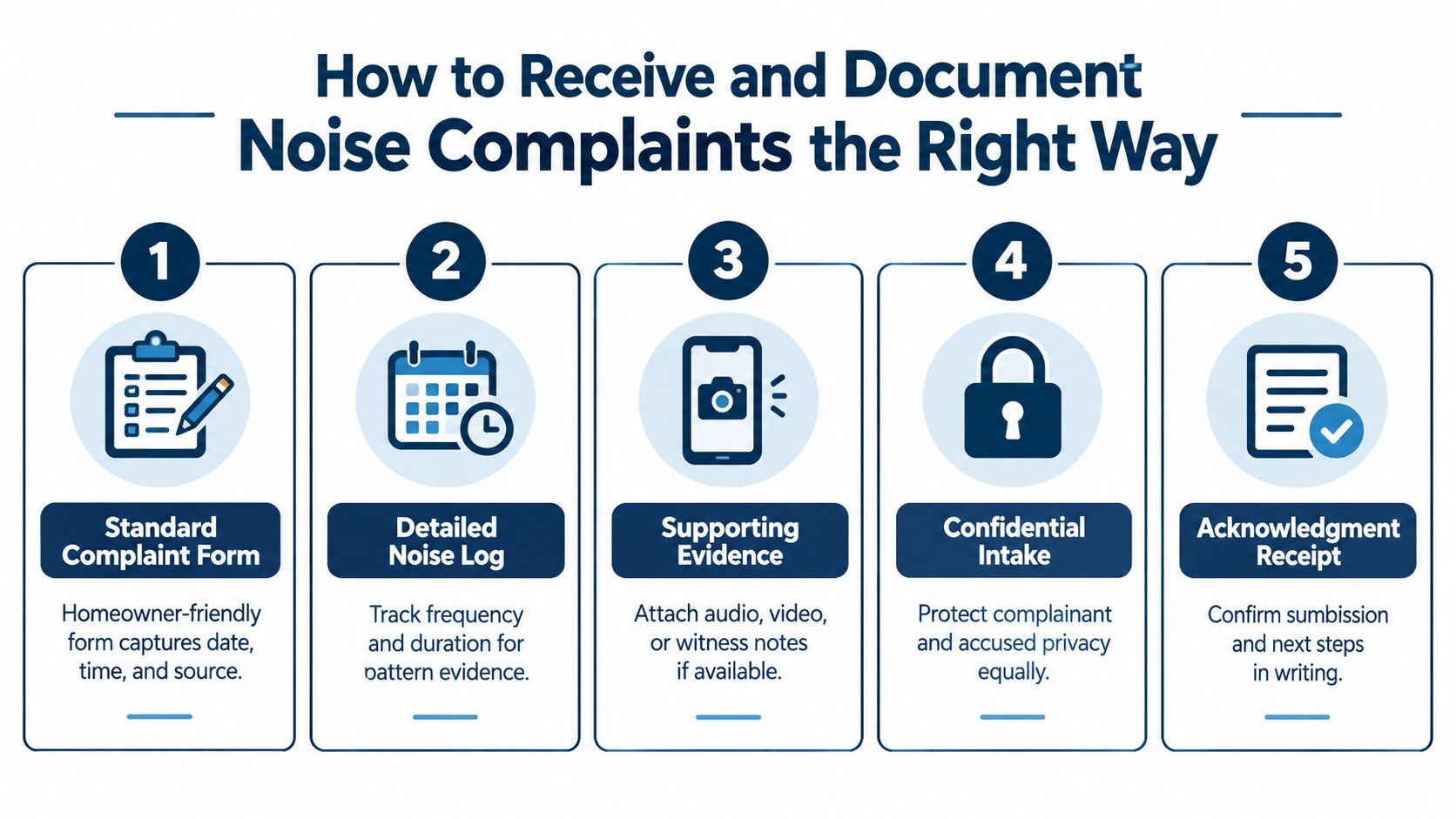
A clear intake process helps a homeowner report a problem after a difficult night and gives the association facts it can evaluate. Keep the form simple, but require enough detail to identify a possible pattern and apply the community's quiet-hours rule consistently.
Ask the complainant to record the date, start time, end time, duration, source location, type of sound, perceived intensity, and effect on use and enjoyment. “Loud all night” provides little to investigate. “Music heard through the bedroom wall from late evening until after quiet hours” is more useful, provided it accurately describes the homeowner's experience.
Build a neutral complaint record
The form should identify the reporting unit and contact information, while explaining how confidentiality will be handled. The accused homeowner also deserves privacy. Broadly sharing a complainant's name, recordings, or personal commentary can intensify a neighbor dispute and create a separate governance problem.
Written intake preserves details that a conversation may lose. A phone call can alert the manager to an urgent concern, but management should follow up with a written request for dates, times, and supporting information. Mark which details came from direct observation and which are assumptions about the source.
For the file: Record what the resident heard and experienced, not conclusions about the neighbor's motives.
Audio, video, witness notes, correspondence, and a contemporaneous log may support the report. Each item still needs context. A short recording can show that sound existed, but may not establish its duration, source, or whether it crossed the association's enforcement threshold.
Set expectations at intake
Acknowledge receipt in writing and identify the next step. Explain whether management will review the documents, request more information, contact the other household, inspect common areas, or consult counsel. Do not promise a violation before the board verifies the facts and confirms that the conduct fits the governing rule.
Use a log that records:
- Frequency: How often the sound occurs.
- Timing: Whether incidents fall inside quiet hours.
- Duration: How long each occurrence continues.
- Location: Where the sound appears to originate and where it is heard.
- Impact: Whether it interrupts sleep, work, conversation, or ordinary use.
- Corroboration: Whether another person, recording, or inspection supports the account.
A documented pattern gives the board a stronger basis for mediation, a warning, or formal enforcement than a series of informal calls. Many communities seek multiple incidents before issuing a violation notice. The board should treat that practice as an evidence guideline, not an automatic legal requirement. The governing documents and applicable law control, and mediation may resolve the issue before fines create a larger dispute.
How to Investigate Noise Complaints Fairly and Consistently
Investigation begins with the rule, not the emotion attached to the complaint. The manager or board should compare the reported conduct with the exact CC&R provision, quiet-hours rule, enforcement policy, and applicable local ordinance. If the documents don't contain a usable noise standard, the association may have limited enforcement authority and may need to focus on voluntary resolution or rule clarification.
Verify before concluding
Start by checking whether the reported times match restricted hours and whether the described activity falls within the rule. Construction, mechanical equipment, pets, parties, music, footsteps, and impact noise may require different questions. A board shouldn't treat a complaint about a barking dog exactly like a complaint about flooring impact in a shared-wall condominium.
Speak with the complainant separately. Confirm what was personally observed, how often it occurred, where it was heard, and what records exist. Then contact the accused homeowner without presenting the allegation as an established fact. Ask whether there is an activity, appliance, pet, guest pattern, or building condition that could explain the report.
A neutral site check can help, especially when the source is uncertain. The board may need to consider whether sound is traveling from another unit, a common area, a mechanical system, or outside the community. Sound-monitoring equipment may provide useful information, but a reading is only meaningful if the governing documents or ordinance establish how it should be interpreted.

Apply the same threshold every time
One isolated annoyance usually deserves a different response from a documented recurring disturbance. Legal guidance emphasizes that nuisance analysis generally requires a record of substantial, unreasonable, and recurrent interference, rather than a single irritation (navigating nuisance claims). The board should document why the evidence meets, or fails to meet, that threshold.
Before issuing a fine, confirm whether state law or the governing documents require internal dispute resolution, mediation, a hearing, or another procedural step. The board should also review whether its notice identifies the rule, the conduct, the evidence, the corrective action, and the homeowner's rights. For issues that involve threats, repeated targeting, or possible neighbor harassment, the board should separately review applicable neighbor harassment laws, rather than labeling every conflict a noise violation.
Enforcement and Resolution Options That Actually Work
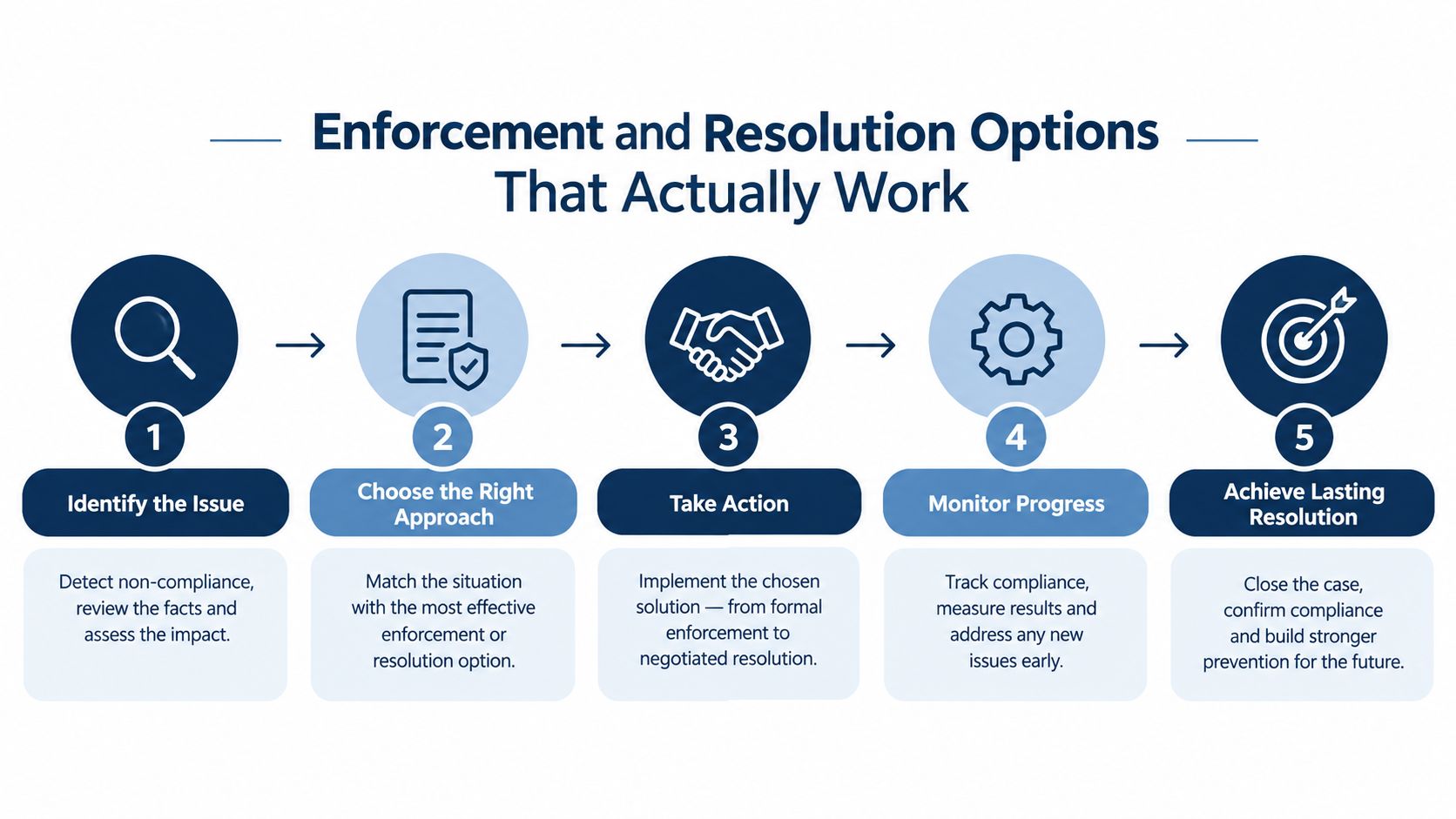
Noise enforcement works best as an escalation ladder, not an automatic fine. The board should choose the least forceful step that can reasonably correct the conduct, then move upward when the behavior continues or the evidence shows a serious recurring problem.
A courtesy contact may be appropriate when the homeowner appears unaware of the impact and the initial report doesn't yet establish a pattern. A written notice becomes more appropriate when the board can identify a rule and documented conduct. A hearing and fine require strict compliance with the association's procedures and applicable law.
Match the response to the record
| Situation | Recommended Action | Why It Fits |
|---|---|---|
| A first report with incomplete details | Acknowledge the complaint and request a written log | The board needs facts before deciding whether a violation occurred |
| A documented incident that appears to breach a clear rule | Courtesy contact or written warning | The homeowner receives notice and an opportunity to correct the conduct |
| Repeated incidents supported by dates, times, and impact | Formal violation notice with the required cure period | A pattern provides a stronger basis for enforcement |
| A continuing dispute with conflicting accounts | IDR or mediation | A neutral process can clarify facts and produce a practical agreement |
| Repeated noncompliance after notice and procedure | Hearing and authorized fine or further remedy | Escalation is supported by notice, an opportunity to respond, and a record |
Written violation notices often provide 10 to 14 days before a fine or hearing under many governing documents, although the controlling period is the one in the association's documents and applicable law (HOA conflict-resolution guidance). The notice should be specific enough for the homeowner to understand what must change.
Board discipline: Don't use a fine to compensate for an incomplete investigation.
Mediation often beats a prolonged enforcement fight
Mediation or internal dispute resolution can address practical causes that a fine won't fix. A neutral discussion may identify a schedule for music, a pet-management plan, a floor-covering solution, a relocation of equipment, or a communication channel for future incidents. It also gives both households a chance to discuss the effect of the noise without turning the board into an ongoing referee.
The retrieved neutral guidance reports HOA mediation settlement rates in the 70% to 80% range, while another local source cites 75% of disputes resolved within three months through free county mediation services (HOA noise and nuisance policies). Those figures don't guarantee a result in any particular dispute, but they support using early neutral intervention where it is permitted and practical.
A board should pause or avoid fines when the governing documents require ADR first, when the source remains uncertain, or when the parties' accounts conflict and a neutral facilitator could narrow the dispute. Formal enforcement remains appropriate when the rule is clear, the evidence is strong, required procedures are complete, and the conduct continues.
For boards that need a structured record of notices, evidence, and follow-up, HOA violation management guidance can help managers keep the enforcement file organized. The objective is not more notices. It's a process that homeowners can understand and the association can defend.
Preventing Future Noise Issues and Protecting Community Harmony
Prevention starts with rules residents can understand before a dispute begins. A board should publish quiet hours, explain how nuisance language works, identify prohibited activities, and tell homeowners how to submit a complaint. New-owner packets should address shared-wall living, flooring, pets, parties, equipment, and construction etiquette in plain language.
The board also needs realistic expectations. An HOA can investigate and enforce its documents, but it may not be able to guarantee silence or resolve every sound transmission problem quickly. Clear communication prevents the manager from promising an outcome that depends on evidence, notice, homeowner cooperation, building conditions, or local law.
Make compliance easier than conflict
A short resident notice can remind homeowners to place speakers away from shared walls, notify neighbors about gatherings, use rugs or pads where appropriate, control recurring pet noise, and schedule construction within permitted hours. Those measures don't replace enforcement, but they can prevent ordinary activities from becoming recurring disputes.
Neighbor-to-neighbor communication may solve a first incident when it is safe and respectful. The association shouldn't require direct contact where a homeowner fears retaliation or harassment. In those cases, management can receive the complaint, protect privacy, and use the formal process.
Noise prevention also reflects the wider principle of minimizing avoidable friction in shared communities. Boards reviewing exterior projects or boundary questions may find a resource such as FenceScape's Ottawa-Gatineau fence bylaws guide useful for understanding how clear local rules can support better neighbor relationships, even though fence requirements and noise standards address different issues.
A practical 30-day board checklist
- Audit the documents: Confirm that quiet hours, nuisance language, notice periods, hearings, fines, and ADR requirements are clear.
- Standardize intake: Adopt one complaint form and one noise log for every household.
- Train the manager: Require neutral acknowledgments, consistent evidence requests, and documented follow-up.
- Publish expectations: Explain what the HOA can investigate, what it can't guarantee, and how privacy is handled.
- Review recurring cases: Identify building conditions, pet patterns, equipment, or communication failures that a fine won't solve.
- Measure consistency: Compare similar complaints to ensure the board applies the same threshold community-wide.
A homeowner-first board doesn't ignore noise, and it doesn't punish based on frustration alone. It creates a fair path from report to resolution, then improves the rules and communication habits that keep the next complaint from occurring.
Access Management Group helps HOA and COA boards organize complaint intake, evidence review, notices, and follow-through for recurring community issues such as noise. Visit Access Management Group to discuss a practical management process that protects homeowners while giving the board a consistent enforcement record.