A newly elected HOA president often starts with good intentions and an overflowing inbox. A resident wants an answer about a roof leak, a vendor is waiting for direction, the next board meeting needs an agenda, and the governing documents seem to assume that everyone already knows the rules. The role can feel personal because neighbors bring their frustrations directly to you, but the work is procedural.
The most useful way to understand the duties of an HOA president is to see the president as an orchestrator and procedural steward. You guide the board's work, keep decisions within its authority, help residents understand the process, and make sure authorized actions are carried out. You aren't a lone executive with unlimited power, and you shouldn't have to carry every operational task yourself.
Stepping Into the HOA President Role
On Monday morning, Elena receives the governing documents from the outgoing president. By lunchtime, she has found a half-finished agenda for the next board meeting. Before the day ends, a homeowner emails about water entering through a roof near an upstairs bedroom and asks why nobody has approved repairs.
Elena ran for the position promising better communication and faster maintenance. Those promises still matter, but the first week reveals a different kind of work. She has to find out whether the roof issue was already reported, whether the manager has inspected it, whether the association has an active maintenance contract, and whether the board has authority to approve the proposed remedy. A quick answer feels satisfying. A documented process protects the homeowner and the association.
The emotional adjustment can be harder than the paperwork. A volunteer president may feel pressure to prove competence immediately, especially when neighbors expect the new officer to fix longstanding problems. Resist that pressure. Your first responsibility is to understand the documents, the open work, the board's current priorities, and the manager's scope before making commitments.
The first week should create orientation
Start with a practical handoff:
- Collect the governing documents: Read the declaration, bylaws, rules, policies, recent resolutions, and any management agreement.
- Review unfinished business: Compare the prior minutes with the open agenda, pending contracts, maintenance reports, and homeowner communications.
- Confirm the communication path: Learn where residents submit service requests, violations, architectural applications, and general questions.
- Meet the officers and manager: Ask what each person owns, what remains unresolved, and which deadlines are approaching.
- Build a decision calendar: Mark meetings, budget work, elections, inspections, contract renewals, and required notices.
The Ontario Condominium Authority's guide to governing condominiums describes a president who collaborates with directors and the condominium manager, identifies priorities, develops agendas, calls meetings, chairs them, supports onboarding, oversees reporting, and helps implement resolutions. That model captures the practical shift from an informal volunteer chair to a structured governance role.
Your first ninety days will teach residents what to expect from the entire term. A president who documents requests, follows the agenda, and communicates realistic next steps establishes trust even when the answer isn't immediate. Leadership continuity also improves when responsibilities and knowledge are deliberately transferred, which is why leadership succession planning belongs on the board's long-term calendar.
What the President Actually Does and Does Not Do
A homeowner asks the president to cancel a violation notice. A vendor asks for approval to start extra landscaping work. At the next meeting, directors expect clear options and a proper vote. These situations test the same principle: the president orchestrates the board's process, while the board acts as the association's decision-making body.
The president may prepare an agenda with the secretary, chair the meeting, recognize speakers, call for votes, communicate an approved decision, and sign a contract after the board authorizes it. The president may also coordinate with the community manager, officers, committees, vendors, and residents. Those duties keep the work organized, but they do not give the president authority to replace the board.
A promise made before authorization can create a real problem. If the president tells a landscaping vendor that a new contract is approved before the board votes, the association may face confusion about scope, cost, or expectations. If the president promises a homeowner that a rule will be waived because of personal circumstances, the president may also create an unequal enforcement issue. Authority should come from the governing documents, a board resolution, or a duty the board is legally permitted to assign.
Process is the president's source of authority
Use the role like a conductor uses a score. The president keeps the parts coordinated and the sequence clear, while the board makes the decisions the association must follow.
The president generally can:
- Set and organize the agenda with the secretary.
- Preside over board and membership meetings.
- Guide discussion and call motions and votes.
- Communicate decisions the board has approved.
- Sign contracts and other formal instruments that the board authorized.
- Coordinate officers, committees, vendors, and management.
- Follow up to confirm that board resolutions are being carried out.
The president generally cannot act alone to hire or fire staff, approve spending beyond assigned authority, waive rules selectively, impose enforcement consequences, or bind the association to a new contract. State law and the association's documents determine the exact boundaries.
| President's Role: Authority vs Limits | President Can (Alone) | President Cannot (Alone) |
|---|---|---|
| Meeting leadership | Prepare the agenda and chair the meeting | Decide an issue merely by placing it on the agenda |
| Communication | Explain an approved board decision | Announce a policy the board has not adopted |
| Documents | Sign an authorized instrument | Create an obligation without board authority |
| Operations | Coordinate with management and vendors | Direct work outside the approved scope |
| Enforcement | Move a properly presented matter through the process | Fine, waive, or selectively enforce a rule personally |
Sample HOA bylaws may describe the president as the association's chief executive officer, meeting chair, and officer responsible for carrying out board orders. They may also permit the president to sign leases, mortgages, deeds, checks, or promissory notes after the board approves the underlying action, as shown in sample HOA bylaws. In that setting, “chief executive officer” describes an officer function. It does not erase the board's collective authority.
Keep the association's governing documents for an HOA available during meetings. They help the president distinguish between organizing a decision and making one, so discussion can stay orderly without confusing procedural leadership with voting power.
Running Meetings With Confidence and Order
Meeting leadership is the president's highest technical responsibility. The president turns board authority into valid action by keeping the meeting properly organized, ensuring the right people can participate, calling votes clearly, and preserving an accurate record.
Build an agenda that can carry the meeting
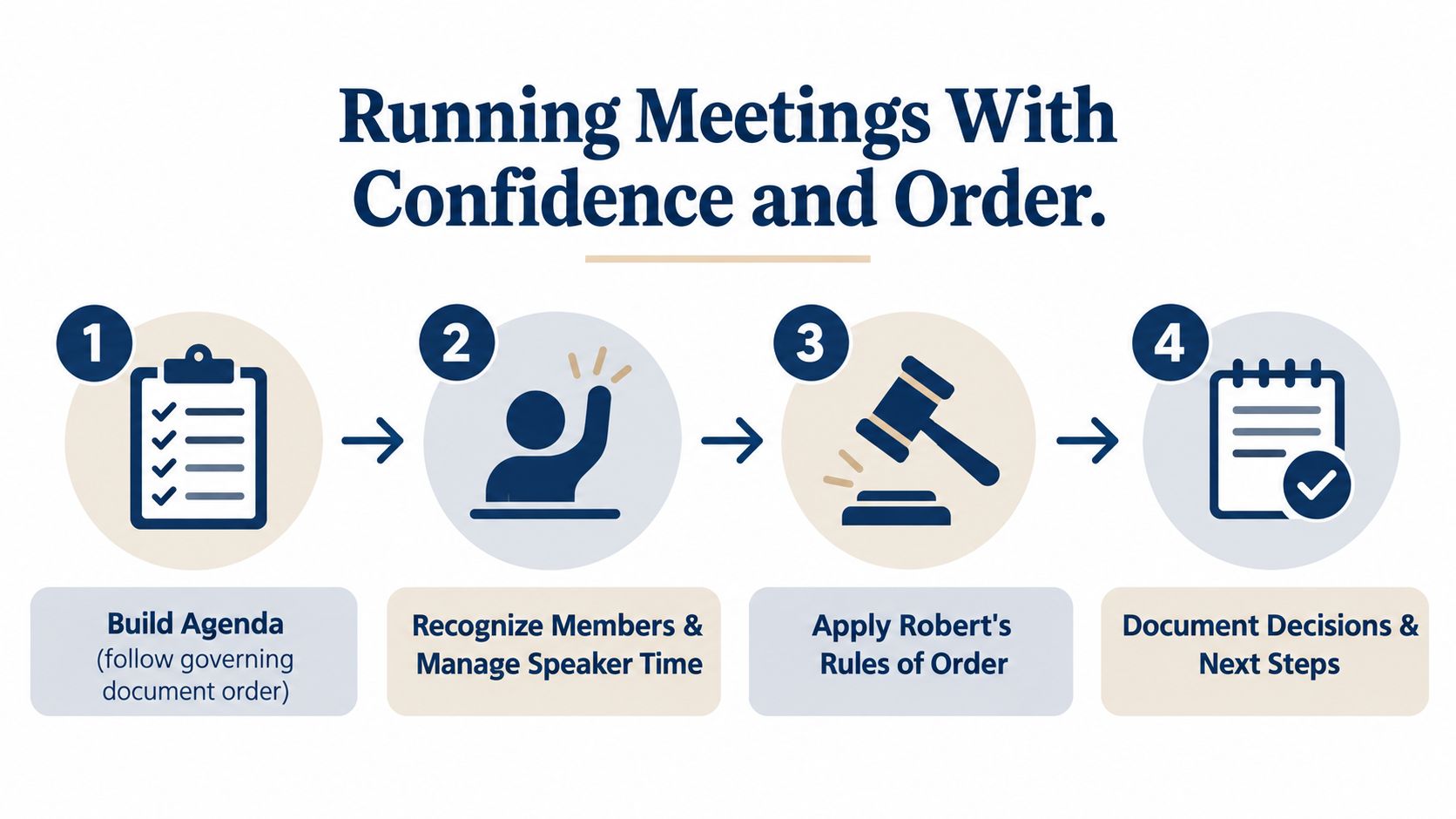
Start with the governing document order, required notices, unfinished business, new business, reports, and owner comment periods. Coordinate with the secretary and manager so supporting materials arrive before the meeting. An agenda should help directors prepare, not merely list topics.
Suppose a homeowner wants to discuss the same parking concern for the third consecutive meeting. Recognize the owner during the designated comment period, allow a fair opportunity to speak under the adopted rules, and then explain what action is available. If the board already voted, the president can place a follow-up item on a future agenda when new information exists, but shouldn't reopen settled business informally from the chair.
The president also controls the speaking queue. Recognize one speaker at a time, keep comments connected to the pending matter, and prevent personal accusations from replacing evidence. Orderly participation protects member trust because residents can see that the same process applies to supporters, critics, directors, and vendors.
Apply parliamentary procedure consistently
Use Robert's Rules of Order or the parliamentary authority identified in the bylaws. The president should state the motion, confirm who made and seconded it when required, invite discussion, call the vote, and announce the outcome. Don't summarize a vote vaguely as “the board seemed to agree.” The minutes should show the action taken and, where required, the vote result.
Quorum deserves attention before substantive business begins. A common rule is that a majority of directors constitutes a board quorum unless the articles or bylaws provide otherwise. In one five-member example, three directors form the quorum, and vacancies may not automatically reduce the number needed. If attendance falls below quorum during a meeting, table the unfinished vote and record that the board couldn't transact further business.
Practical rule: If the association can't prove who was present, what was moved, and what was approved, later enforcement or contract disputes become harder to defend.
Executive session requires the same discipline. Record that the board entered executive session, identify the permitted general subject when appropriate, and record resulting action after the board returns to open session. Don't place privileged legal advice, personnel details, or private owner information in public minutes.
A clean record supports enforcement defensibility, fiscal accountability, and member confidence. The president's board meeting process should make those outcomes routine rather than accidental.
Financial Oversight and Legal Execution
A president may sign a check, contract, or other document without being the person who decided to spend the association's money. The board makes the substantive decision within the budget, governing documents, and applicable law. The president's job is to confirm that authority exists, then carry out the approved action.
Review financial reports with the treasurer. Compare actual activity with the approved budget, verify that operating and reserve funds are identified correctly, and request supporting documents when an invoice does not match the approved scope. Co-signing checks or approving routine disbursements is appropriate only when the governing documents and board policies allow it. Unbudgeted spending requires board action unless a valid emergency provision applies.
The same control applies to legal documents. Before signing a vendor contract, deed, lease, mortgage, promissory note, or governing-document amendment, confirm that the board has reviewed the proposal, checked funding, insurance, authority, and conflicts, and adopted a motion or resolution. The secretary records that action. The president then signs the authorized instrument, while the manager or designated officer tracks performance and renewal.
The signature completes the decision. It does not create the decision.
Suppose a president signs a roofing contract after receiving an attractive proposal but before a board vote. Once work begins and the scope changes, owners may ask who approved the commitment. The association then has to address authority, payment, insurance, and bylaw compliance. Sensible work can still create a difficult record when the approval process was skipped.
Reserve funds need separate attention. Florida law provides that reserve funds and interest remain in the reserve account and may be used only for authorized reserve expenditures, unless a majority vote at a meeting with quorum approves another use in advance. Before authorizing payment, the board must classify the expense as reserve or operating work. Reserves are not a convenient second checking account. The restriction is summarized in guidance on HOA spending authority in Florida.
Owners may also ask whether association fees connected to a home office are deductible. That answer depends on tax facts outside the president's governance role. Information about home office HOA fee write-offs can help an owner frame the question for a qualified tax professional.
Delegation That Keeps the Role Sustainable
A president who answers every vendor call, chases every architectural violation, reviews every invoice, and handles every homeowner complaint will eventually become the association's bottleneck. The board may appreciate the responsiveness at first, but the arrangement blurs authority and makes the community dependent on one volunteer.
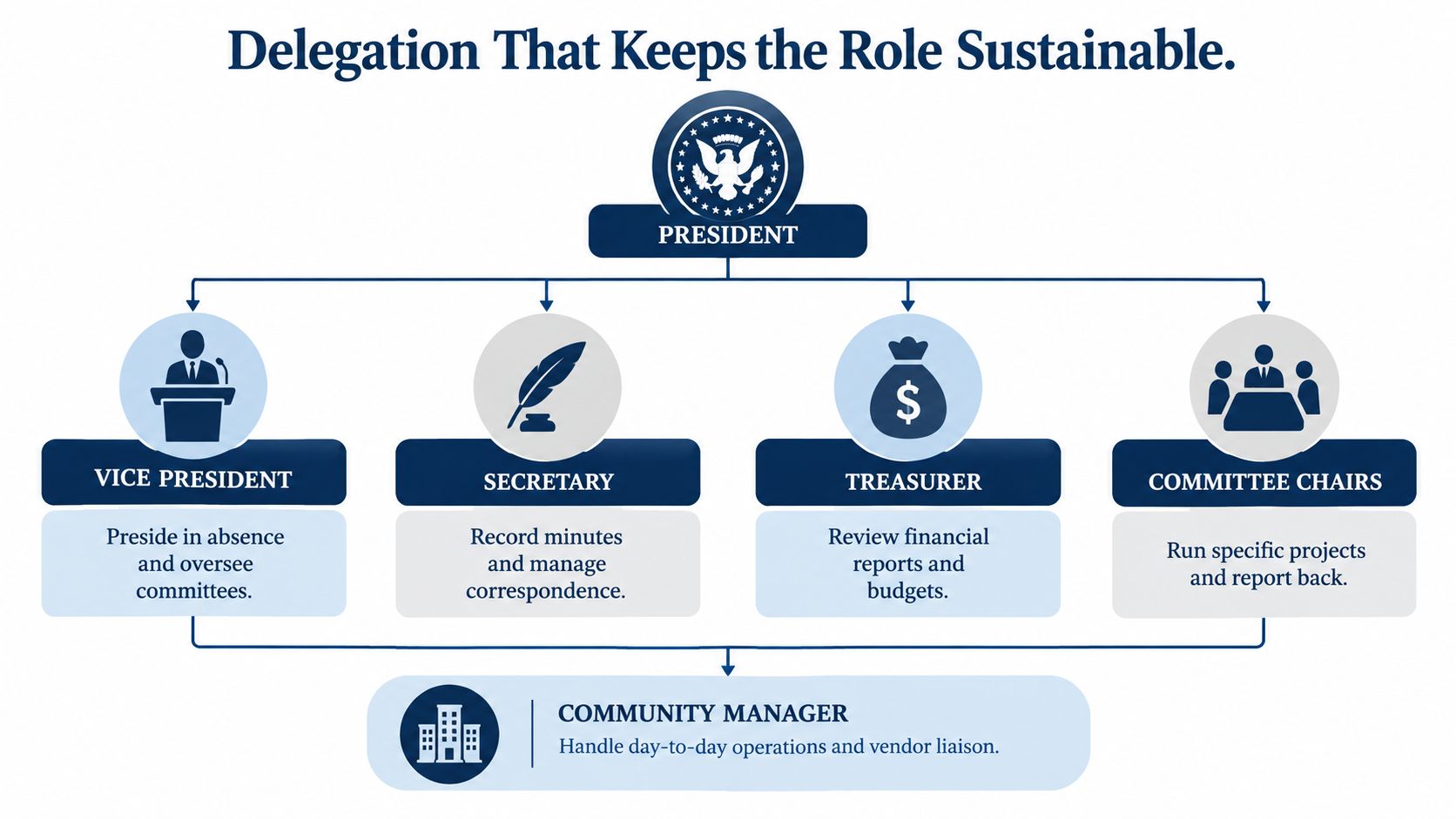
Delegation works when each assignment has a clear boundary. The board sets policy and approves significant action. Officers carry out duties assigned by the governing documents or board. Committees handle defined project work and report recommendations. The community manager handles day-to-day operations within the management agreement.
Match work to the right role
The vice president can preside when the president is absent and oversee assigned committees or projects. The secretary manages notices, correspondence, and minutes. The treasurer reviews financial reports, budgets, and account activity. Committee chairs gather information, manage project tasks, and bring recommendations back to the board.
The manager may receive maintenance requests, coordinate inspections, communicate with vendors, prepare meeting materials, and administer approved processes. That doesn't mean the manager replaces the board. It means the manager works within a defined scope, while the board remains responsible for policy and oversight.
Put delegation in writing. A committee charter should state its purpose, membership, reporting schedule, spending limits, and matters reserved for board approval. The manager's scope of work should identify service standards, communication channels, financial responsibilities, and vendor authority. Written assignments survive an election better than verbal promises.
A sustainable president doesn't hold every task. They make sure every necessary task has an accountable owner.
This structure also benefits homeowners. Residents know whether to report a roof leak to management, ask the secretary about records, contact an architectural committee, or bring a policy concern to the board. Clear routing reduces delays and keeps individual directors from making inconsistent commitments.
Emergencies, Misconceptions, and Gray Areas
A pipe bursts above a hallway, water is spreading, and the next board meeting is days away. The president's first question is practical: can the association act now? In a genuine emergency, the answer may be yes, but only within a narrow boundary.
Immediate action can be justified when waiting would increase an imminent threat to life, safety, or property. The president might call an emergency plumber for a major active leak or arrange urgent work after a dangerous equipment failure. The role is to stabilize the situation, not take over the association's entire decision-making process. Record the facts, authorize only the work the emergency requires, notify the other directors, and ask the board to ratify the decision afterward.
A dripping faucet, a disagreement about landscaping, or an owner asking for faster service normally follows the regular management and board process. Treating every inconvenience as an emergency can bypass controls and create inconsistent commitments.
Management usually handles routine coordination when the management agreement assigns that work. The manager may dispatch vendors, collect proposals, set schedules, and report results. The president should work within that arrangement, rather than directing tasks outside the manager's scope or avoiding board approval thresholds.
Several common assumptions cause trouble:
- The president can't fine alone: Enforcement must follow the governing documents, required notices, hearing procedures, and the board's authority.
- The president can't hire or fire alone: Personnel and vendor decisions belong to the board unless a valid delegation provides otherwise.
- Agenda control isn't voting control: The president can guide what comes up for discussion, while each director still has one vote.
- A tie doesn't automatically belong to the chair: Any tie-breaking vote depends on applicable law, the bylaws, and the association's adopted parliamentary authority.
- A vice president acting in the president's place isn't creating new power: The vice president acts only within authority supplied by the documents or by board action.
The most useful emergency habit is a brief written record. Note when the problem was observed, what condition created the risk, which vendor was contacted, what limited action was approved, the expected cost if known, and when the board will review it. That record gives directors facts for ratification and shows homeowners why quick action was taken.
Small Associations Versus Professionally Managed Communities
The title stays the same while the daily reality changes sharply depending on who handles operations. In a small self-managed association, the president may draft notices, chase delinquent assessments, coordinate vendors, inspect common areas, and answer homeowner emails personally. In a professionally managed community, those tasks usually move to the manager, leaving the president focused on policy, oversight, meetings, and resident leadership.
| President's Role: Self-Managed vs. Professionally Managed | Duty Area | Small Self-Managed Association | Professionally Managed Community |
|---|---|---|
| Agenda preparation | The president and secretary collect reports and build the agenda | The manager prepares materials with officer input |
| Homeowner complaints | The president often receives and routes questions | The manager handles routine requests and escalates board matters |
| Vendor coordination | The president may request proposals and supervise access | The manager coordinates vendors within the agreement |
| Check approval | Officers follow the association's internal signing policy | The manager prepares payment documentation for authorized approval |
| Property walk-throughs | A director or president may attend personally | The manager may inspect, document, and report conditions |
| Enforcement administration | The board may handle notices and follow-up | The manager administers the adopted process for board review |
Neither model removes the president's fiduciary responsibility. Self-management increases the president's administrative workload and exposure to inconsistent communication. Professional management reduces those tasks but creates a different responsibility, contract oversight. The president must understand what the manager is authorized to do, what requires board approval, and how performance is reported.
Technology can also shift the boundary. For example, a community evaluating an HOA gate access system should ask who owns resident enrollment, emergency access, vendor support, and data administration. Those questions belong in the board's policy and contract review, even when a manager handles daily requests.
Place your community on the spectrum. If the president is spending most of the week on administration, the board may need clearer delegation, a revised management scope, or professional support. If a manager is already performing those functions, the president should avoid duplicating the work and instead concentrate on governance quality.
A First 90 Days Checklist and Quick FAQ
A new president may enter the first meeting with a full inbox, unfinished projects, and several directors expecting immediate answers. The first ninety days should turn that uncertainty into a working governance system. Use the sequence below as a guide, then adjust it to the bylaws, state requirements, management agreement, and board priorities.
A workable onboarding sequence
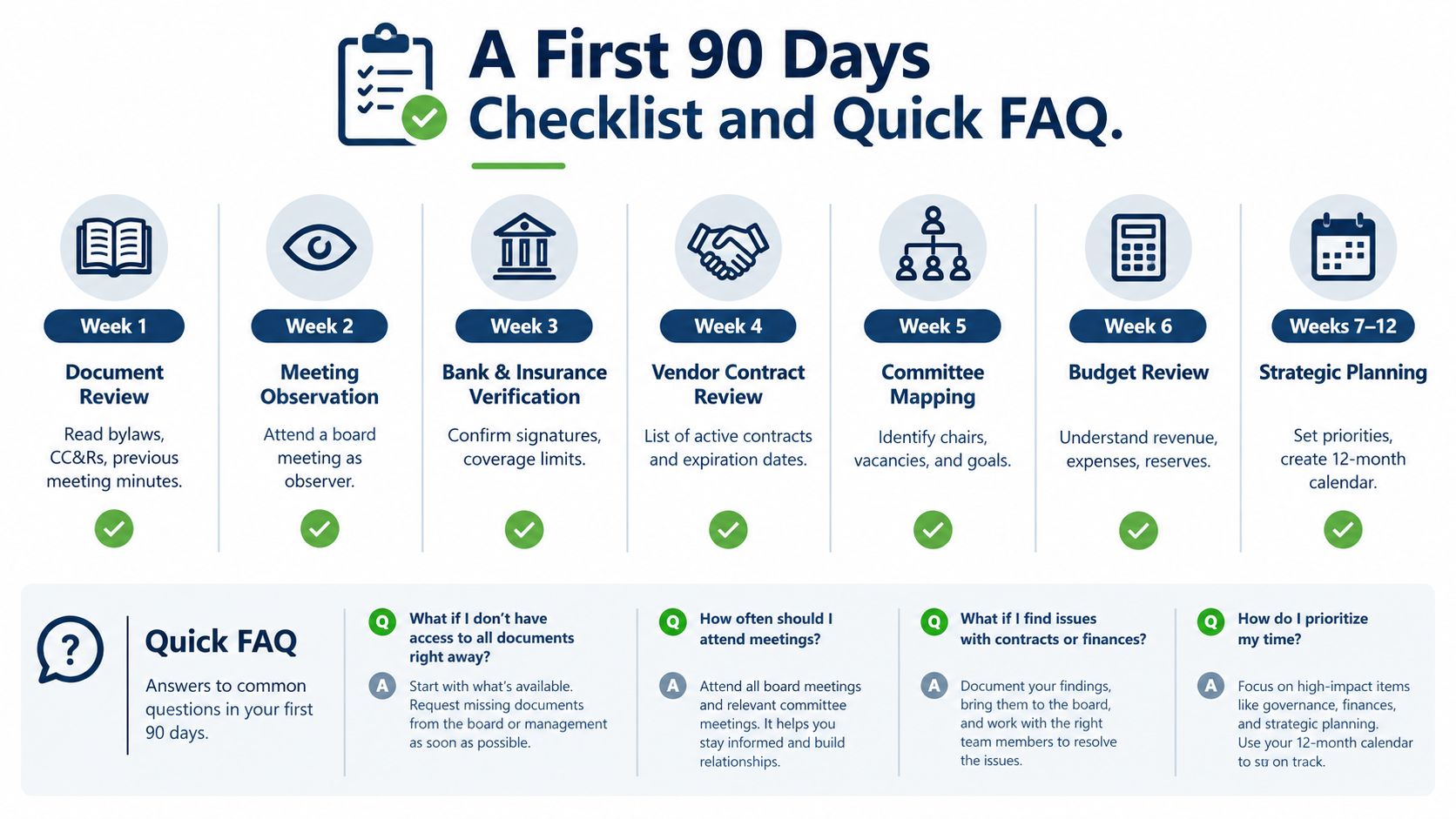
- Week 1, document review: Read the bylaws, declaration, rules, recent minutes, resolutions, contracts, insurance information, and current financial reports. Mark provisions that affect notices, authority, voting, and officer duties.
- Week 2, meeting observation: If the transition allows it, attend a board meeting as an observer. Note how the chair handles motions, owner comments, executive sessions, and minutes.
- Week 3, bank and insurance verification: Confirm authorized signatures, account access, fidelity coverage, Directors and Officers coverage, property coverage, and applicable limits.
- Week 4, vendor contract review: List active contracts, renewal terms, service scopes, performance concerns, and expiration dates. This gives the board a calendar for decisions rather than last-minute renewals.
- Week 5, committee mapping: Identify committee chairs, vacancies, current projects, and reporting expectations. Each assignment should have a clear handoff back to the board.
- Week 6, budget review: Understand assessment revenue, operating expenses, pending obligations, and reserve classifications. Ask which items are routine operations and which require planned reserve funding.
- Weeks 7 through 12, strategic planning: Set board priorities, create a twelve-month calendar, schedule owner communications, and identify decisions that need professional advice.
Questions new presidents ask
Can the president vote on every motion? Usually, the president is a director and votes under the same rules as other directors, unless the governing documents or applicable law provide a different procedure. The chair manages discussion fairly while retaining the voting rights attached to the office.
What happens with a tie vote? Do not assume the president breaks it. Check the bylaws, state law, and adopted parliamentary authority. If no tie-breaking rule applies, the motion generally fails, and the board may revisit it through a properly noticed process.
Can the vice president act for the president? Yes, when the president is absent or unable to serve and the documents or board action authorize the substitution. The vice president takes on the applicable chairing function, not unlimited authority.
Can the president speak for the board publicly? The president can communicate an adopted position or explain the board's process. Personal views should not be presented as board policy. Protected executive-session information should remain confidential, and the president should not commit the association to action the directors have not authorized.
How can a president who is not performing be removed? Follow the bylaws and applicable law. The board or membership may have authority to remove an officer, while removal from the director position may require a separate procedure. Confirm notice, quorum, voting, and meeting requirements before acting.
Quorum rules require the same care. One example requires a majority of directors unless the governing documents say otherwise, so a five-member board would need three directors in that example. Member-meeting rules can differ. Florida condominium law uses 30 percent of total membership as quorum unless the bylaws provide otherwise, while a California sample bylaw uses 33 1/3 percent of voting power unless another governing document or state law changes the rule. Review the documents before announcing that official business can proceed.
After the initial transition, establish a recurring rhythm. Review minutes before approval, maintain an action list, monitor the calendar, document delegated work, and perform an annual self-audit of contracts, insurance, reserves, records, and authority.
Access Management Group can support meeting and administrative work for an HOA president, including agenda preparation, official minutes, financial reporting, budget support, reserve tracking, and assessment-payment monitoring. A board seeking clearer procedures and management support can visit Access Management Group to discuss its community's needs.