A board meeting can turn tense quickly when an owner asks a simple question: Who has authority to approve this change, how many votes are needed, and did we give proper notice? One director points to the bylaws, another checks the declaration, and a homeowner wonders why the answer isn't obvious. The problem usually isn't a lack of good intentions. It's an unclear or outdated operating framework.
Bylaws for condominiums give owners and directors a shared process for making decisions, holding meetings, electing leaders, managing money, and responding to disputes. They work like the community's operating manual, helping protect daily living while giving a board president confidence that decisions rest on more than custom or personal preference.

Introduction to Bylaws That Protect Your Condominium Community
A well-run condominium depends on predictable answers. Owners need to know how elections work, when meetings occur, how votes are counted, and which responsibilities belong to the association. Directors need the same clarity before approving a contract, adopting a budget, or responding to a violation.
Bylaws provide that structure. They aren't merely a packet of formal language stored in a file cabinet. In many condominium regimes, they define the association's operating framework, including officer titles, board powers, selection and removal procedures, compensation, meetings, quorum, and voting. They must also remain consistent with the governing statute and the declaration.
Practical rule: If the board can't identify the authority and process for a decision, it should pause before acting.
Confusion often starts when residents treat bylaws as a complete list of lifestyle rules. A rule about pool hours, parking, or pets may appear in rules and regulations or in the declaration and CC&Rs. Bylaws usually answer a different question: How does the association make and enforce decisions about the community?
This distinction benefits everyone. A homeowner can challenge an action more intelligently, and a board president can explain the reason for a decision without relying on “we've always done it this way.” Clear documents also make transitions easier when new directors take office or when a professional community manager begins supporting the association.
Virginia offers a useful historical example. The Virginia Condominium Act replaced the older Horizontal Property Act on July 1, 1974, and it provides that bylaws governing association-based management must be recorded at the same time as the declaration. The Virginia code also notes later statutory changes, including provisions revised in 2019 and one section repealed effective July 1, 2023. These developments show why bylaws should be treated as legal governance instruments that can require review as statutes change. Virginia Condominium Act history and provisions
The pages that follow move from the basic meaning of bylaws to document hierarchy, common provisions, state-specific requirements, amendment procedures, and fair enforcement. The aim is simple: help homeowners understand their protections and help board presidents make careful, defensible decisions.
What Bylaws for Condominiums Are and How They Work
Think of a condominium as a house with several layers. State law is the foundation, the declaration establishes the property itself, and the bylaws provide the operating instructions for the association. If the foundation limits what the association may do, a bylaw can't authorize the board to ignore that limit.
The bylaws generally govern the association as an organization. They explain who serves on the board, how officers function, how meetings are called, how owners vote, what constitutes quorum, and how directors may be removed. They also may address committees, assessments, records, insurance, and amendments.
A practical document hierarchy
The four layers have different jobs:
State condominium law establishes mandatory requirements and default rules. It may control when bylaws must be recorded, what they must contain, and how voting or quorum works if the documents are silent.
Articles of incorporation create the association as a legal entity. They may identify the association's legal name, registered agent, or other corporate details.
The declaration and CC&Rs establish ownership, common elements, owner obligations, maintenance responsibilities, and use restrictions. They help answer what an owner may do with a unit or shared property.
The bylaws explain how the association operates day to day. They answer who calls a meeting, who presides, how directors are elected, and what vote authorizes association action.
A bylaw is therefore not automatically superior to every other document. It must fit within the law and remain consistent with the declaration and corporate documents. If a provision conflicts with mandatory statute, the statute controls. If the bylaws appear to conflict with the declaration, the board should obtain advice from counsel familiar with condominium law before relying on either interpretation.
Why recording matters
In major condominium markets, bylaws may be recorded with the founding documents. That makes them part of the condominium's chain of title rather than a private policy that a board can casually replace. Florida law, for example, addresses recorded condominium documents and requires certain bylaw content and procedures. Florida condominium statutory framework
For an owner, the practical lesson is important. Before disputing a board decision, locate the current recorded bylaws, the declaration, applicable rules, and the governing state statute. Before approving the decision, the board should perform the same check.
How Bylaws Relate to CC&Rs and Articles of Incorporation
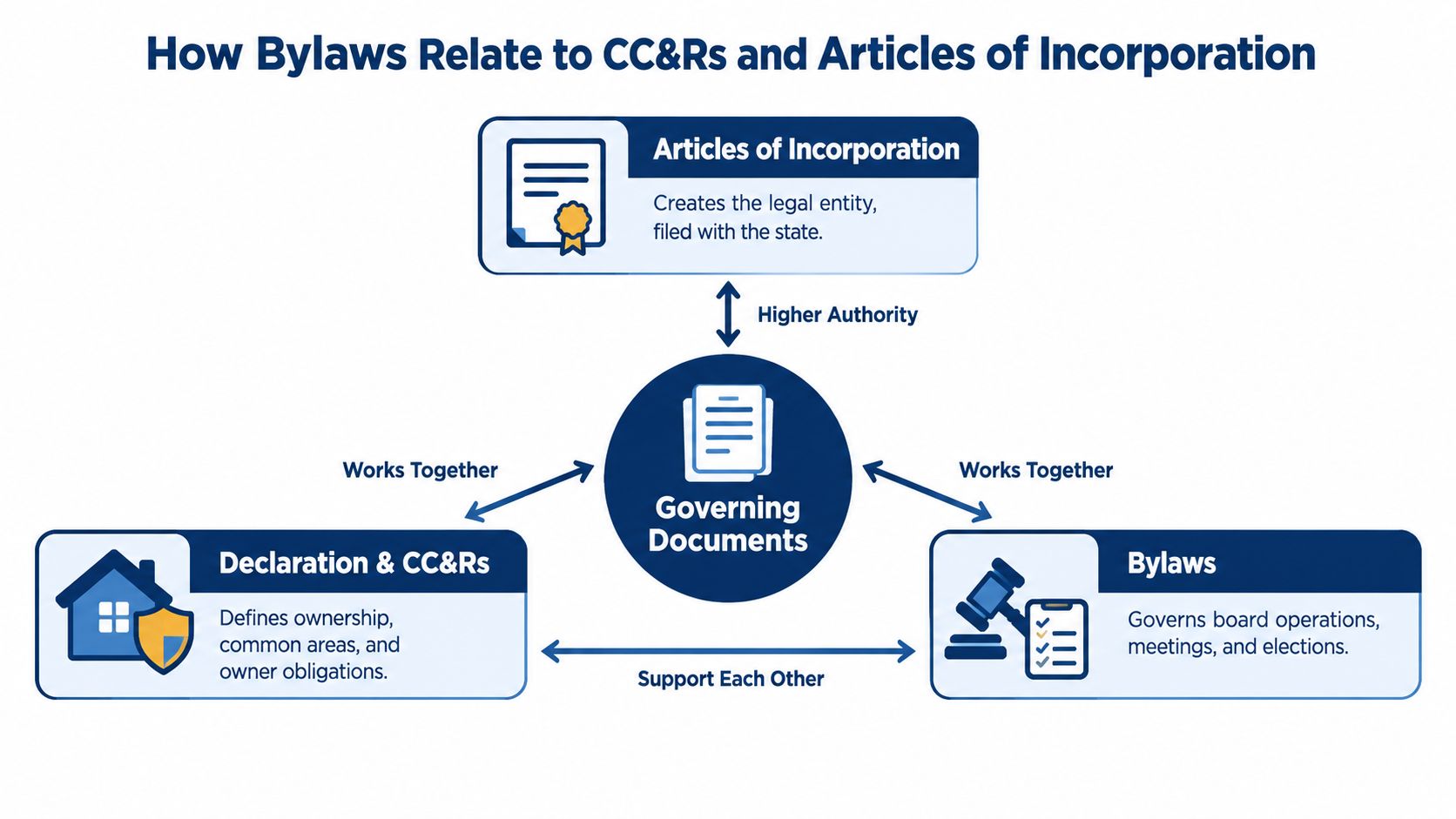
Owners often use “the bylaws” as shorthand for every governing document. That shortcut creates trouble because each document answers a different kind of question. The easiest way to separate them is to ask whether the issue concerns the association's existence, the property and owner obligations, or the association's daily procedure.
Start with the question, then find the document
Use this comparison as a first filter:
| Document | Primary Purpose | What It Controls |
|---|---|---|
| Articles of Incorporation | Creates the association as a legal entity | Corporate identity, filing details, and certain corporate powers |
| Declaration and CC&Rs | Establishes the condominium property framework | Units, common elements, owner obligations, use restrictions, and property responsibilities |
| Bylaws | Governs association operations | Board structure, officers, meetings, elections, quorum, voting, and amendments |
Suppose an owner asks whether the association can restrict storage on a balcony. That question may involve the declaration, a rule governing common elements, or another recorded restriction. If the question is whether the board can adopt the rule at a particular meeting, the bylaws and meeting provisions become relevant.
Suppose the board wants to hire a managing agent. The bylaws may state whether that authority exists and how the decision must be approved. Colorado law illustrates the level of detail that can matter. Colorado condominium bylaws must address items such as the board's number, election of board managers from unit owners, term structures, removal, board powers and duties, management hiring, owner meetings, vote allocation, quorum where it differs from a majority, and the vote required for binding decisions. Colorado condominium bylaw requirements
What happens when documents conflict
A board shouldn't resolve a conflict by choosing the language it prefers. First, identify the provision in question. Next, compare it with the declaration, articles, and statute. Finally, ask qualified counsel to determine whether the language is mandatory, permissive, outdated, or invalid.
For a broader document overview, owners and directors can review the governing documents guide for HOA communities. The same discipline applies to condominiums: classify the question before deciding which document controls.
A clear document map also improves communication. Instead of telling a neighbor, “The bylaws prohibit that,” a president can explain, “The declaration addresses the use restriction, while the bylaws explain how the board adopted the related policy.” That answer is more precise and less likely to turn a procedural disagreement into a personal dispute.
Common Provisions Every Condominium Board Should Understand
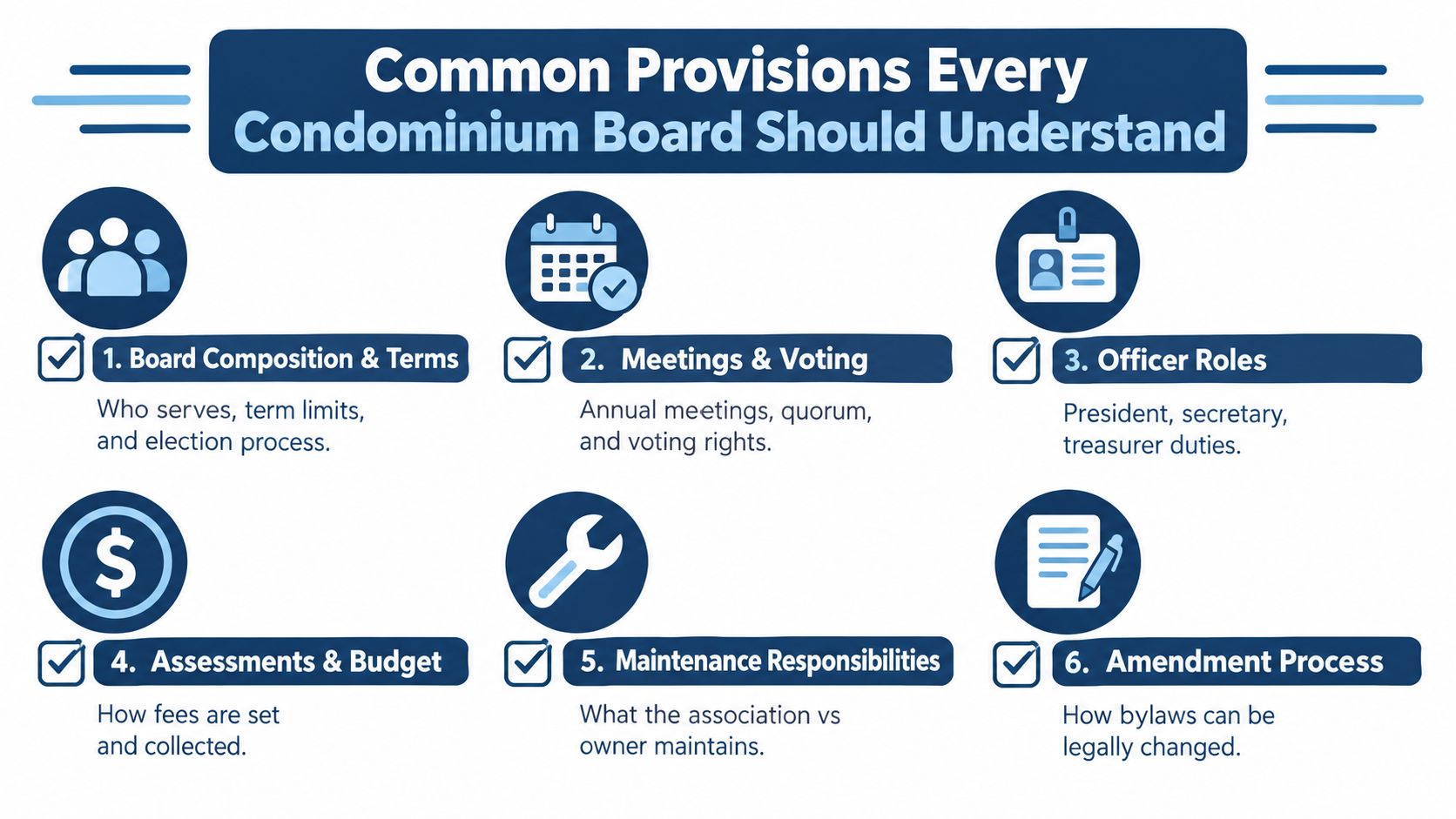
A complete set of bylaws should let a new director understand how the association functions without guessing. The details differ by jurisdiction and community, but several subjects appear repeatedly because they determine whether board action is authorized and whether owners receive a fair process.
The governance mechanics
Board composition and terms should identify the number of directors, eligibility, election method, term length, vacancies, and removal. Florida provides a concrete example. Its law sets a default board size of five members, unless the condominium has five or fewer units. A board should never assume that a structure copied from another community fits its own statute. Florida condominium governance rules
Officer duties give practical meaning to titles such as president, secretary, and treasurer. The president may preside over meetings, the secretary may maintain records, and the treasurer may oversee financial reporting, but the exact authority should come from the governing documents and applicable law.
Meeting notice, quorum, and voting determine whether the association can act. Quorum is the minimum participation needed for a meeting to conduct valid business. Voting provisions should identify voting interests, proxies, absentee or electronic voting where permitted, and the approval threshold for each type of decision.
A board should also review committees, management authority, and delegation. A committee can gather facts or make recommendations, but it may not possess the authority to bind the association unless the governing documents and board action provide that authority.
Money, property, and long-term obligations
Assessments and budgeting provisions explain how the association funds operations and capital work. Maintenance language should distinguish the unit owner's obligations from the association's responsibility for common elements. Insurance provisions should identify coverage responsibilities without assuming that the association's policy replaces an owner's individual coverage.
Reserve funding deserves special attention. Manitoba requires every condominium corporation to maintain a reserve fund for repairs and replacements that aren't annual in nature. Alberta requires a capital replacement reserve fund and a reserve fund study and plan on a recurring five-year cycle for many corporations. Michigan requires bylaws to provide for a reserve fund for major repairs and common-element replacement, with a fund of at least 10% of the current annual budget on a noncumulative basis, restricted to those major repairs and replacements. Manitoba reserve fund requirements
These rules connect paperwork to physical assets. Narrow reserve language helps prevent operating cash and capital reserves from being mixed, while a documented planning cycle gives owners a clearer explanation for contributions and projects.
For voting questions, boards should also consult a practical guide to proxy voting rules. Good proxy administration protects the integrity of elections and owner decisions.
State Specific Requirements That Shape Your Bylaws
A condominium board shouldn't borrow a bylaw template from another state and assume the language will transfer. Statutes use different defaults for board size, quorum, amendment procedures, reserve funding, meetings, and recordation. The document must match the jurisdiction where the condominium exists.
Compare the local defaults
Florida provides several useful examples. For condominiums created on or after October 1, 1994, Florida law requires the bylaws to include a limited power allowing the association to convey part of the common elements to a condemning authority for public purposes, including utility easements or right-of-way expansion. Florida also sets a default quorum of a majority of voting interests for member meetings unless the bylaws provide a lower number. If the bylaws don't provide an amendment method, approval by at least two-thirds of the voting interests can amend them. Florida quorum and amendment provisions
Virginia takes a different approach to quorum. A unit-owner meeting has a quorum when more than one-third of the votes are present at the start, but the bylaws may require a larger quorum or set a smaller one no lower than 10 percent. For executive board meetings, the default quorum is one-half of board votes unless the condominium instruments require more. Virginia condominium quorum rules
Reserve obligations vary just as sharply. The Manitoba, Alberta, and Michigan examples described earlier show why a board should compare not only its reserve budget but also the wording, restricted uses, study cadence, and amendment history.
A homeowner-friendly review process
Use a statute review as a control exercise, not as a one-time rewrite:
- Confirm the jurisdiction: Identify the state law and condominium chapter that govern the association.
- Check recorded documents: Verify that the board is using the current recorded bylaws and declaration.
- Mark mandatory provisions: Separate rules the association must follow from optional statutory defaults.
- Test the mechanics: Review elections, director eligibility, meeting notice, quorum, voting, proxies, records, and amendments.
- Review capital planning: Compare reserve language with statutory funding and study requirements.
- Obtain legal review: Ask association counsel to identify conflicts before the board proposes changes.
- Explain the result: Give owners a plain-language summary that distinguishes a statutory correction from a discretionary policy choice.
This process protects owners from surprises and helps directors avoid treating a familiar template as authority.
How to Draft and Amend Bylaws With Confidence
A board should amend bylaws when the current document is incomplete, conflicts with law, creates recurring ambiguity, or no longer reflects how the condominium operates. It shouldn't amend them because a provision feels inconvenient. A good revision makes authority clearer while preserving owner rights and consistency.
Build the record before changing language
Begin by collecting the recorded bylaws, declaration, articles, prior amendments, relevant statutes, and meeting records. Create a comparison showing the current wording, proposed wording, reason for the change, and any related provision that may also need revision.
Invite owner questions before the final vote. A short explanation works better than a legal document delivered without context. Tell residents what problem the change addresses, what stays the same, and whether the proposal affects meetings, elections, assessments, maintenance, or enforcement.
The board should then work with condominium counsel. Legal review matters because a sentence that appears harmless may conflict with a mandatory statute or a declaration provision. If the project involves extensive records, drafting coordination, or document comparison, a virtual legal assistant can support administrative work under appropriate professional direction. That support doesn't replace legal advice.
Follow the approval and recordation path
Read the existing amendment clause first. It may specify who can propose an amendment, the notice required, the voting threshold, and whether a board, owners, or another party must approve it. If the bylaws are silent, the governing statute may supply a default, as Florida law does for amendment approval.
Use a clean version-control system. Keep the original, proposed redline, final adopted text, approval record, and recorded copy together. Florida's 2025 statutes continue to require bylaw amendments to be recorded to be valid, so board approval alone isn't enough where that law applies. Florida 2025 condominium statute
Modern statutory overlays also deserve a separate review. Florida's 2025 reforms, including HB 913, added transparency, inspection, reserve, and enforcement obligations that can sit above older bylaws. An outdated document may therefore mislead owners even when no one intended to misstate the rules.
After adoption and recording, publish the effective text, summarize the practical changes, update meeting and election calendars, and train directors and management staff. Drafting ends only when the people who use the bylaws understand them.
Enforcing Bylaws Fairly and Keeping Your Community in Compliance
Enforcement earns trust when owners can see that the board follows the same process for everyone. A board president shouldn't treat a bylaw as a weapon for winning an argument. The president should use it as a consistent procedure for protecting shared property, owner rights, and the association's legal position.
Start with the text. Confirm that the provision applies to the conduct, that the board has authority to enforce it, and that the rule doesn't conflict with a higher document or mandatory law. Then document the facts, send clear notice, allow the response or hearing opportunity required by the governing documents and law, and keep the decision tied to evidence rather than personalities.
Make consistency visible
A practical enforcement file should show:
- The rule: Identify the exact provision and provide understandable wording.
- The facts: Record dates, photographs, correspondence, and relevant reports.
- The notice: Explain the alleged violation, requested correction, and response process.
- The decision: Record the board's action and the reason for it.
- The follow-up: Confirm compliance or apply the next authorized remedy.
Graduated remedies may resolve a problem without escalating conflict, but the board must use only remedies authorized by the governing documents and applicable law. Owners who want a plain-language overview of the process can review common homeowners association violations.
Compliance also needs a calendar. Schedule periodic reviews of the bylaws, statutory changes, insurance responsibilities, reserve planning, meeting procedures, election materials, and director training. A professional community manager can help maintain records, track deadlines, organize notices, and keep the board focused on documented authority.
Owners and directors serve the same community, even when they disagree. The strongest boards explain decisions, invite questions, correct mistakes promptly, and use the bylaws to create predictable treatment rather than unnecessary friction.
Access Management Group helps HOA and COA boards with governance administration, financial management, records, meetings, and homeowner communication. Visit Access Management Group to discuss how professional community management can help keep your condominium's bylaws organized, current, and consistently applied.