Your annual meeting is tonight. The room is set, the ballots are printed, and the board is ready to move a major repair project forward. Then check-in starts, and the count comes up short. A few owners are traveling. A few forgot. A few meant to come and didn't. Without quorum, the meeting stalls and the association pays for the delay in time, cost, and frustration.
That's where proxy voting rules stop being a technical topic and become a governance issue. For homeowners, proxies can preserve their voice when life gets in the way. For the board, proxies can mean the difference between a valid meeting and another expensive reschedule. For the president, proxies can either support orderly decision-making or create a mess if the board applies the wrong rules.
In Georgia communities, the biggest mistake I see is simple: people mix up member proxies with director proxies. Those are not the same thing. A homeowner's right to appoint a proxy for a membership vote is one question. A board director's ability to hand off a board vote is a completely different question. If you blur that line, you can invalidate action your board thought was proper.
Why Proxy Voting Matters for Your HOA
A missed quorum can derail routine business, but it becomes much more serious when the community needs action on a budget issue, a capital project, or an election. The practical value of a proxy is that it lets an owner participate without physically attending. For communities with busy families, rental owners, frequent travelers, or aging residents, that matters.
The broader participation problem isn't unique to HOAs. During the 2023 proxy season, institutional investors voted over 80% of their shares, while retail investors voted only about 30% according to the Council of Institutional Investors governance guide. HOA members behave much more like retail investors than institutions. They're busy, they may not follow every agenda item closely, and many won't attend unless the issue feels urgent.
What a proxy fixes
A properly used proxy helps with more than turnout.
- Quorum support: Many associations need owner participation just to open the meeting and conduct business.
- Continuity: The board can keep projects, elections, and approvals moving instead of postponing everything to a later date.
- Access for owners: Homeowners still get representation even when work, childcare, illness, or travel prevent attendance.
Practical rule: If your association struggles to reach quorum, the answer usually isn't more pressure on owners. It's a cleaner notice package, a simpler proxy form, and a better collection process.
What a proxy doesn't fix
A proxy won't cure poor planning. If the form is vague, if the meeting notice conflicts with the governing documents, or if the board accepts proxies it shouldn't, you can still end up with a challenged vote.
That's why a customer-focused approach matters. The process should first help homeowners understand what they're signing, help the board administer the meeting fairly, and help the president avoid shortcuts that create legal risk later.
The Foundation of Proxy Voting Explained
A proxy is written authority from one person to another. In HOA practice, that usually means an owner authorizes someone else to appear and vote for that owner at a specific membership meeting. The owner is the principal. The person holding the proxy is the proxy holder or agent.
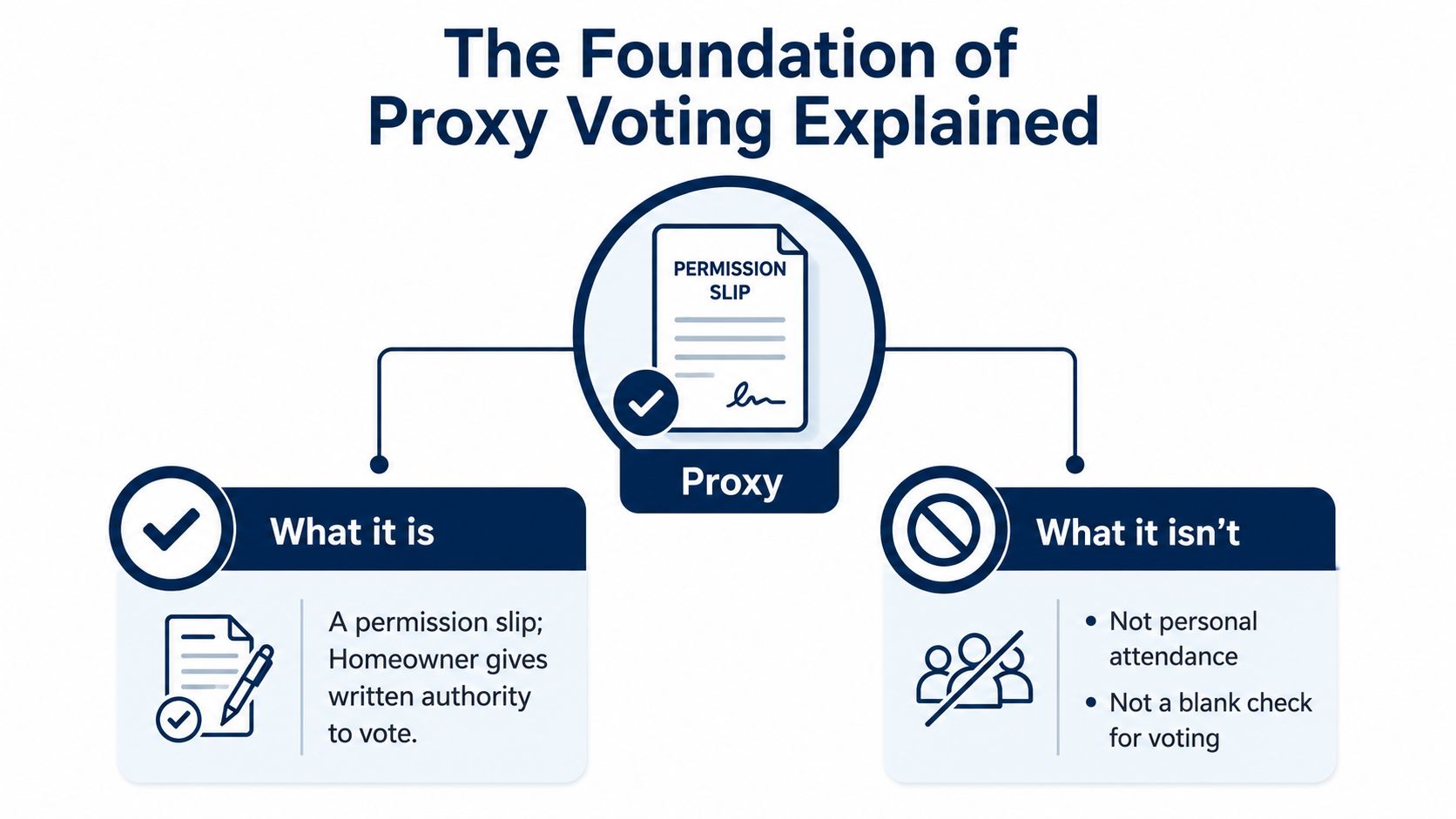
Think of it as a permission slip, not a transfer of ownership and not a blank replacement for attendance. The owner keeps the underlying rights. The proxy holder only has the authority described in the form and only within the limits allowed by law and the association's documents.
General proxies and directed proxies
Most proxy forms fall into one of two practical categories:
- General proxy: The owner authorizes the proxy holder to vote on eligible matters using the holder's judgment.
- Directed proxy: The owner gives voting instructions, such as voting for a named candidate or for or against a specific proposal.
A new board president should check the governing documents carefully before deciding which form the association will use. Some communities do better with directed proxies because they reduce arguments about intent. Others use general proxies mainly to secure quorum and allow representation when the agenda may shift within the scope of the notice.
The mistake that causes the most trouble
Here is the distinction that matters most: owners may be able to vote by proxy at membership meetings, while directors usually may not vote by proxy at board meetings.
Under Robert's Rules of Order, adopted by approximately 90% of U.S. HOAs, proxy voting by board members is automatically prohibited unless state law or the bylaws explicitly allow it, as summarized in this proxy voting overview. That rule catches many new boards off guard. A director who can't attend often asks to “send a proxy.” In many associations, that is not allowed.
A homeowner can often appoint a proxy for a member vote. A director usually can't send someone else to act as a board member in that director's place.
This is why your review of the association's governing documents matters before every election cycle and annual meeting. The declaration, bylaws, and meeting rules may permit owner proxies in one setting and bar director proxies in another. If the board treats those as interchangeable, the minutes may record action that won't hold up if challenged.
The Legal Framework Governing Your Community
Proxy voting rules don't come from one page or one sentence. They come from a hierarchy. If you want to stay compliant in Georgia, start at the top and work down.
The order of authority
Use this framework every time:
- State law
- Your declaration and bylaws
- Your adopted parliamentary authority, if any
- Board policies and meeting procedures
State law sets the baseline. Your governing documents can add detail and restrictions if they don't conflict with that baseline. Parliamentary procedure fills in gaps when the law and documents are silent.
A useful comparison comes from Texas. The Texas Property Owners' Association voting guidance explains that state law requires associations to allow members to vote by at least one of three methods: proxy, absentee ballot, or electronic ballot. That example matters because it shows how statutes establish a floor that local rules must respect. A board can organize the process, but it can't write around a controlling statute.
How that applies in practice
In Georgia, your first question isn't “What did we do last year?” It's “What do the statute and our documents permit for this type of meeting and this type of voter?”
That means you should separate at least three issues:
- Member meeting authority: Can owners vote by proxy for elections, quorum, amendments, or special matters?
- Director meeting authority: Can a board member who is absent delegate voting power?
- Form requirements: Does the association require a dated, signed, meeting-specific proxy, and does it distinguish between quorum-only and voting proxies?
Where boards go wrong
Boards usually make mistakes in one of two ways. They either assume proxies are always allowed because “owners have always used them,” or they assume proxies are never allowed because “board members can't send them.” Both shortcuts ignore the hierarchy.
If a bylaw provision and a meeting habit conflict, the habit loses.
When the president, manager, and association attorney all read the same documents through the same hierarchy, proxy administration becomes much easier. When they don't, you get avoidable disputes at the registration table.
A Step-by-Step Guide to Managing Proxies
A clean proxy process starts long before the meeting is called to order. Most disputes don't begin with counting. They begin with forms that were drafted poorly, delivered late, or reviewed too casually.
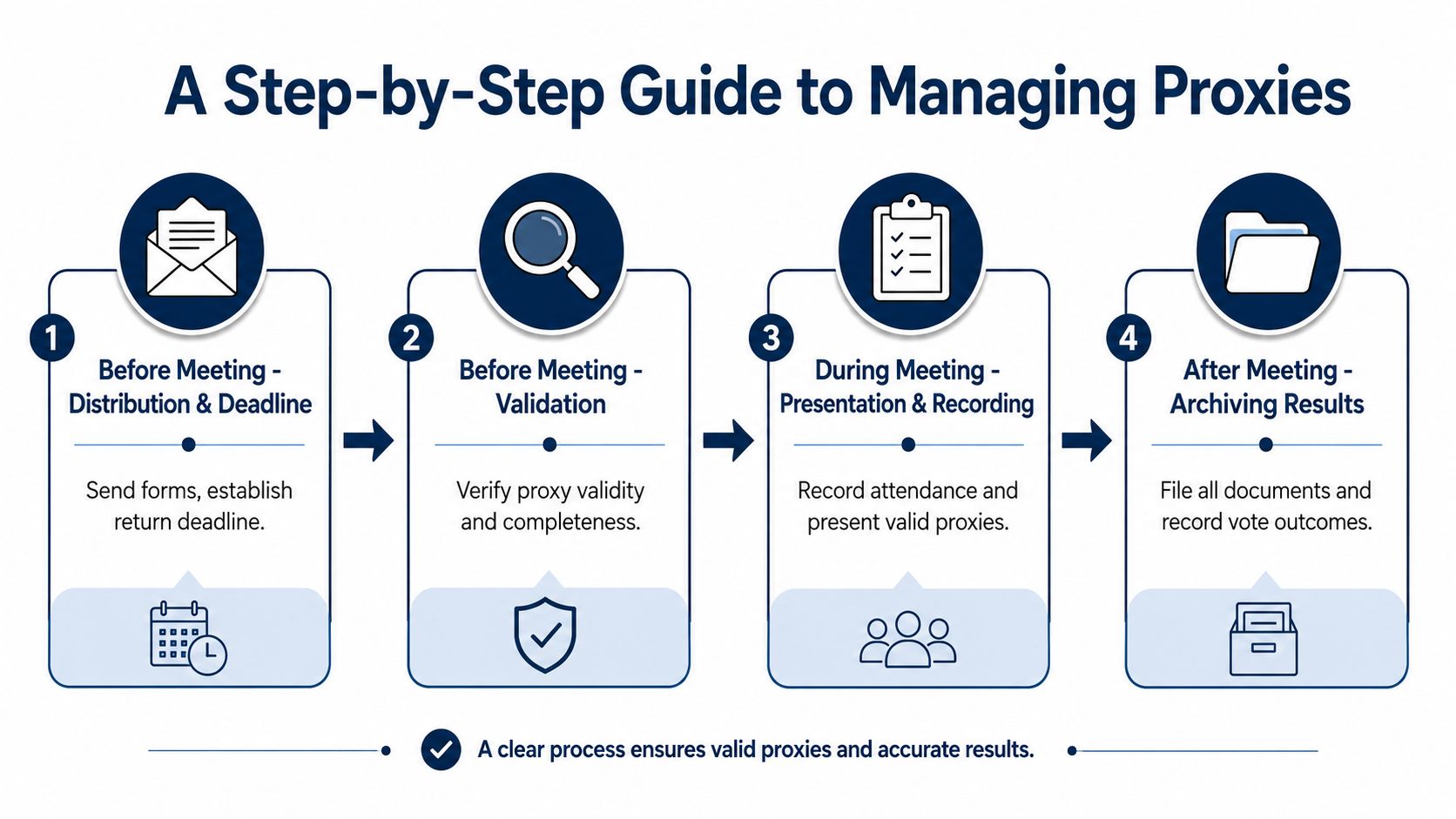
Before the meeting
Start with the form itself. Keep it plain, specific, and consistent with the bylaws and notice packet. If your association uses a custom form, don't let it drift year after year without review.
A workable proxy form usually includes:
- Owner identification: Name, property address, and any lot or unit identifier the association uses.
- Meeting reference: The exact meeting date and whether it covers an annual or special meeting.
- Scope of authority: Whether the proxy is for quorum only, general voting authority, or directed voting.
- Execution details: Signature and date. If your documents require more, include that too.
Send the proxy with the meeting notice, not as a separate afterthought. Owners are more likely to return a form when the agenda and instructions are in front of them at the same time. Pair it with a clear deadline and a single point of return by mail, hand delivery, email if allowed, or portal upload if your documents permit that format.
If your board needs a better planning framework for meeting packets, use an organized HOA meeting agenda template so the notice, agenda, and proxy form all line up.
At the registration table
The board should know before the meeting who will verify proxies. In many communities, that's the manager, secretary, or an appointed inspector of elections. What matters is consistency.
Check every submitted proxy for the basics:
- Is it signed?
- Is it dated?
- Does it identify the correct meeting?
- Does it conflict with another submission from the same owner?
- Does the owner still appear eligible to vote under the association's records?
This step should happen before the vote begins whenever possible. You don't want arguments on the floor while ballots are being counted.
Don't wait until nominations close or the vote starts to discover that half the proxy stack is incomplete.
During the meeting
When the meeting opens, announce whether quorum has been reached using in-person attendance plus valid proxies. Then record that determination in the minutes. If the proxy form gives voting authority, the proxy holder votes within the scope of that authority when the relevant motion or election comes up.
A few operational rules keep things clean:
- Record proxy holders clearly. You should know who is carrying each valid proxy.
- Separate quorum-only proxies from voting proxies. Mixing them creates avoidable counting errors.
- Honor owner appearance. If the owner appears in person and votes, the owner's participation usually supersedes the proxy.
- Count methodically. Tabulate proxy votes with in-person votes under the same standards.
After the meeting
Close the loop immediately. Mark which proxies were accepted, rejected, revoked, or superseded by owner attendance. Attach the tally sheets to the election file and preserve the original proxy forms with the meeting materials.
This isn't glamorous work, but it's what makes the result defensible.
Common Proxy Pitfalls and How to Avoid Them
Most proxy disputes aren't dramatic. They come from small defects that could have been prevented with better paperwork and tighter meeting controls. The board president should treat proxy review the same way the treasurer treats reserve reports. It's routine, but it carries risk if handled casually.
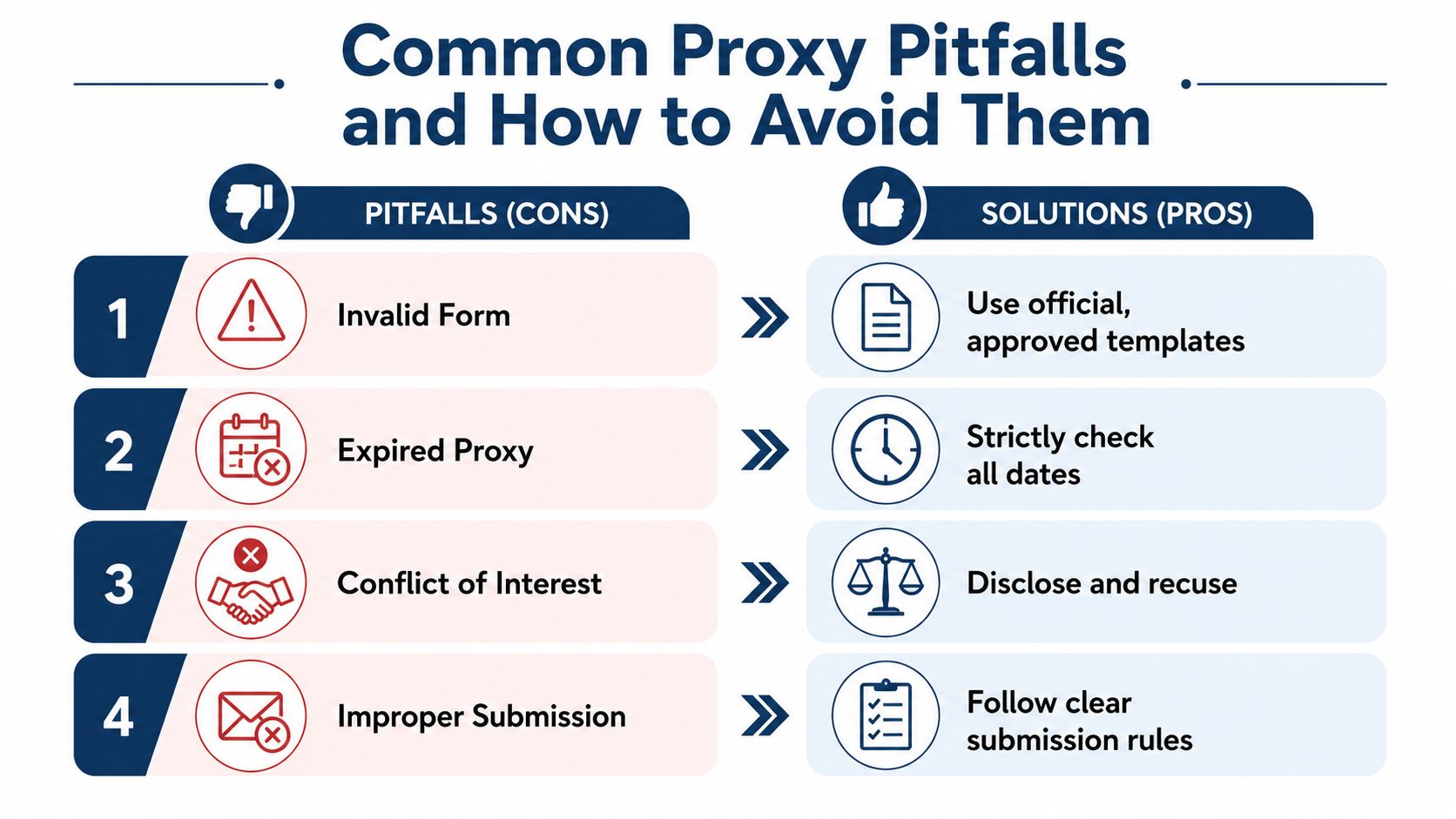
The defect that looks minor but isn't
Technical details matter. In Nevada, for example, a valid HOA proxy must be dated for a specific meeting, and if it lacks an agenda list, it can only be used to establish quorum rather than cast votes, as explained in this state-by-state HOA proxy overview. The lesson for Georgia boards is practical, not geographic. A small omission can change what the document does.
That's why “close enough” is a bad standard for proxies. If your form is sloppy, the vote may be challenged even if the underlying result probably would have been the same.
Situations that regularly create conflict
A few repeat offenders show up in community meetings:
- Undated forms: If the board can't tell when the owner executed the proxy, it may not know which version controls.
- Ambiguous authority: A form that doesn't say whether it is quorum-only or voting authority invites argument.
- Owner appears in person: Once the owner attends and votes, the proxy should not continue as a second vote.
- Proxy holder ignores directions: A directed proxy is not a suggestion. It is an instruction.
The safest proxy is the one that leaves no room for interpretation at the check-in table.
Proxy Management Do's and Don'ts
| Do | Don't |
|---|---|
| Use one approved form for the meeting packet | Mix old and new forms from prior years |
| Require complete signatures and dates | Accept incomplete forms because the owner is “well known” |
| Match the proxy to the specific meeting | Assume a general authorization carries forward indefinitely |
| Track revocations and owner attendance | Count both the owner and the proxy |
| Separate quorum proxies from voting proxies | Treat every proxy as authority to vote on every matter |
| Document rejections and reasons | Discard defective forms without a record |
The best way to avoid a challenge
The board should use official templates, publish clear return instructions, and train whoever checks owners in. The president should also resist pressure to “just count it” when a form is missing a key requirement. Being flexible in the moment often creates more conflict later than a calm, documented rejection.
Special Considerations for Georgia Associations
Georgia boards need to read proxy voting rules through Georgia law first, then through the association's declaration and bylaws. That sounds obvious, but many communities rely on old habits or a generic template pulled from another state. That's where trouble starts.

Focus on the governing stack
For a Georgia HOA or COA, the practical review should start with these questions:
- What entity law applies? Many associations operate as nonprofit corporations, and condominiums may also have condominium-specific statutory requirements.
- What do the bylaws say about member voting? Some documents expressly authorize proxies and define their scope.
- What do the bylaws say about directors? Many communities frequently discover that owner proxies and director voting are treated very differently.
- Do your documents permit electronic delivery or electronic voting tools? If they do, the proxy procedure should align with that authority.
The board president should not assume that a form acceptable for owner quorum at the annual meeting is also acceptable for board action at a regular board meeting. Those are different legal events.
What to watch for in Georgia practice
Georgia communities often inherit forms and procedures from prior management, prior counsel, or a prior board. Before using them again, confirm that the form matches current bylaws, current notice practice, and current meeting procedures. If your community has recently updated governance procedures or is working through broader statutory changes, review that impact carefully through a Georgia-specific lens such as this discussion of Georgia Senate Bill 406 and HOA governance.
A few habits help:
- Use meeting-specific proxies. That avoids arguments about whether a prior authorization still applies.
- State the purpose clearly. If the proxy is only for quorum, say so.
- Keep owner voting and board voting separate. They are governed differently and should never share one catch-all form.
- Ask counsel when the documents conflict. Georgia associations shouldn't guess when the statute and the bylaws seem to point in different directions.
Plainly put, Georgia compliance is less about fancy process and more about disciplined reading of the correct documents.
Recordkeeping and Preventing Future Disputes
The meeting doesn't end when the last ballot is counted. From a risk-management standpoint, it ends when the association can prove what happened and why. That means your minutes, proxy file, sign-in records, and vote tally all need to tell the same story.
What the file should show
Keep a complete meeting record that includes the notice, agenda, proxy form used, owner submissions, attendance records, tabulation worksheets, and the final result recorded in the minutes. If a proxy was rejected, note the reason. If an owner revoked a proxy by appearing and voting, record that too.
This protects homeowners as much as it protects the board. Clear records let an owner see that the process was fair. Clear records also let the president respond calmly if someone later claims the election was mishandled.
Good records don't just preserve evidence. They lower the temperature of future disputes because the association can show exactly what it did.
Why written policy matters
A common blind spot for HOA boards is fiduciary responsibility around voting process. Some boards mistakenly think federal corporate proxy advisor rules apply to their internal HOA proxy forms. They generally don't, but the broader focus on transparency still matters. The discussion of executive actions affecting proxy advisor conflicts underscores a wider governance lesson: boards should adopt and follow clear written proxy policies so their own decision-making is transparent and defensible.
For Georgia associations, that means one practical habit. Write the procedure down, use it consistently, and save the paper trail.
If your board wants experienced guidance on elections, meeting administration, and Georgia community governance, Access Management Group brings decades of association management experience focused on protecting homeowners, supporting boards, and helping HOA and COA presidents lead with confidence.