A condo is under contract, the movers are being scheduled, and then the title company asks for the condo resale certificate. The association's records aren't ready, the buyer hasn't received the packet, and closing suddenly depends on a document that seemed like routine paperwork.
That situation is avoidable. A resale certificate gives the buyer a clearer view of assessments, rules, reserves, insurance, and association obligations. It also protects the seller, board, and community by creating a reliable record of what was disclosed before ownership changes.
Introduction to Condo Resale Certificates and Why They Matter
A condo sale transfers more than four walls and a deed. The buyer also joins a community association with shared expenses, governing documents, maintenance duties, and financial obligations. If those details are unclear, the buyer may hesitate, a lender may request more information, or the closing team may pause to verify the records.
The resale certificate protects several parties at once. Buyers can review costs and restrictions before completing the purchase. Sellers gain a written record of what the association reported at the time of sale. Boards and association managers can provide consistent information, reduce misunderstandings, and show that requests were handled through an established process.

Washington shows how timing can affect buyer and seller risk. Under Washington's condominium resale certificate framework, the seller must provide a current certificate before closing, and the buyer receives a 5-day rescission window after receiving the documents. The association must supply the certificate upon request, so the process depends on an organized response rather than a casual exchange of records.
Why a missing certificate creates closing risk
A delayed packet can affect more than the closing date. The buyer may have a statutory right to cancel during the applicable period, while the seller may face uncertainty about financing, possession, moving plans, or negotiated settlement terms. An incomplete or outdated response can also raise liability concerns for the board and association.
The certificate works like a checkpoint before ownership changes. It brings together current information about assessments, fees, litigation, insurance, reserves, and rules, helping each party identify questions early. It does not promise that the building has no problems. It gives the buyer a structured chance to understand the community and gives the association a clearer record of what it disclosed.
Homeowner-first principle: Early, complete disclosure protects the buyer's decision, the seller's transaction, and the association's credibility.
What a Condo Resale Certificate Is and How It Protects Homeowners
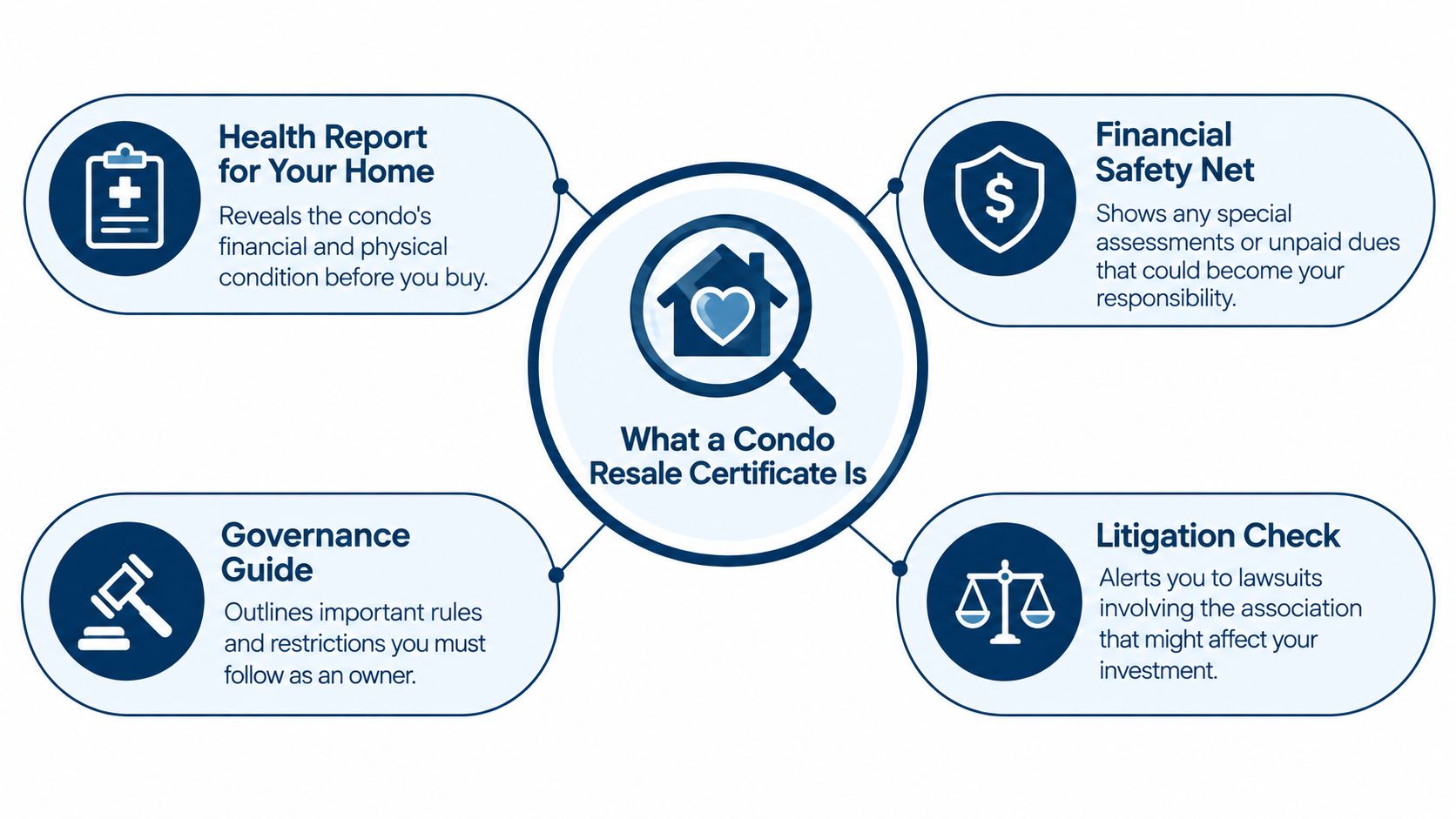
Think of a condo resale certificate as a health report for the association connection attached to a home. A home inspection focuses on the unit's physical condition. The resale certificate focuses on the shared community obligations that can follow the buyer after closing.
It may identify current assessments, unpaid charges, special assessments, reserve information, insurance coverage, lawsuits, judgments, approved capital projects, and restrictions on ownership or use. The exact contents depend on state law and the association's governing documents, so the phrase doesn't mean precisely the same thing everywhere.
The certificate and the full resale package
People often use “resale certificate” and “resale package” as if they mean the same thing. They may be closely connected, but the certificate is generally the association's formal disclosure, while the package can include supporting records such as the declaration, bylaws, rules, budget, financial statements, meeting materials, and insurance documents.
That distinction matters when a buyer asks whether something was disclosed. A document may appear as an attachment rather than inside the certificate itself, but it can still be part of the official information delivered for review. Buyers should ask for the complete package and confirm which documents the association is treating as the current official disclosures.
Protection for each participant
For a buyer, the certificate can reveal obligations that aren't visible during a showing. A unit may look affordable until the buyer learns about a special assessment, transfer fee, restriction on leasing, or unresolved association lawsuit.
For a seller, accurate association information reduces the chance that the buyer will claim important facts were withheld. The seller should still review the packet and ask questions about anything that appears inconsistent with personal records.
For a board, the certificate creates a repeatable disclosure process. The board isn't promising that the community has no financial or physical challenges. It's helping ensure that the association communicates its records in the manner required by applicable law.
Lenders and title professionals often request these materials because the association's financial condition, insurance, restrictions, and litigation can affect the buyer's ability to obtain financing and the property's transfer. A complete response helps those professionals evaluate the transaction without relying on scattered emails or outdated owner files.
What Is Inside a Condo Resale Certificate Package
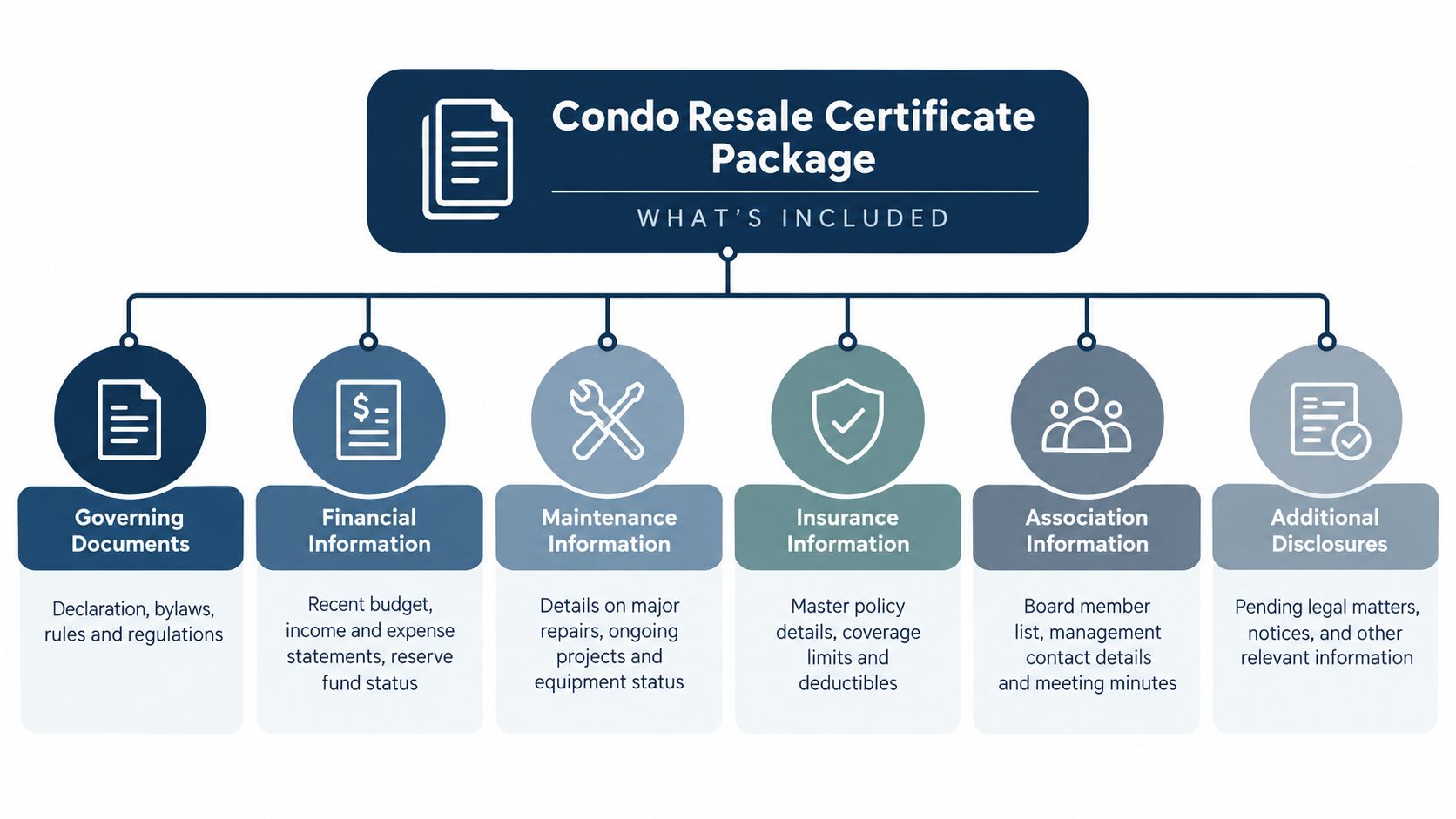
A resale package can feel overwhelming because it combines legal, financial, and operational information. The easiest way to read it is to group the contents by the question each group answers: What will ownership cost? What rules apply? What risks could affect the community?
Financial information
Look first for the current operating budget, regular assessments, unpaid common expenses, special assessments, reserve balances, approved capital expenditures, and other fees. These items help the buyer estimate both recurring costs and possible near-term obligations.
Texas provides a detailed example. Under Texas Property Code Section 82.157, the certificate includes the current operating budget, current periodic assessments, unpaid common expenses or special assessments, other unpaid fees, approved capital expenditures for the next 12 months, reserve balances, unsatisfied judgments, pending suits, and insurance coverage.
The buyer should compare the current assessment with the budget and reserve information. A low assessment isn't automatically good if the association is postponing maintenance or has limited reserves. A higher assessment may reflect stronger funding. The certificate gives the facts, but the buyer must interpret them in context.
Governance and ownership rules
The declaration, bylaws, rules, and amendments explain how the community operates. They may address leasing, pets, parking, renovations, architectural approvals, use of common areas, voting rights, transfer restrictions, and rights of first refusal.
Boards and sellers should provide the current versions, not personal copies saved from an earlier purchase. The association's governing documents for an HOA should match the records maintained by management and the board.
Risk indicators
Meeting minutes, insurance details, litigation disclosures, violation records, and reserve materials can show issues that don't appear in a basic budget. A pending lawsuit may affect financing or future expenses. An open violation may need to be corrected before or after closing. Insurance information can reveal coverage limits and deductibles that affect the community and individual owners.
Key takeaway: The package isn't a prediction of the future. It's the association's documented snapshot of current obligations, rules, finances, and known risks.
Completeness matters because a buyer can only make an informed decision from the information delivered. If a board knows that a required attachment is missing, it should correct the package rather than assume the buyer will discover the omission later.
Who Issues the Certificate and How Boards and Managers Handle Requests
The association issues the resale certificate, but the seller usually starts the request. A community association manager often prepares the package from accounting, governance, insurance, and maintenance records, then sends it through the association's approved process. The certificate works like a shared closing checklist. Missing or outdated information can delay the sale, weaken buyer confidence, and create questions about the association's records.
A title company, closing attorney, or buyer's representative may coordinate the order. The purchase contract determines who pays, and sellers commonly cover the charge as a closing expense. The parties should confirm that responsibility in writing rather than rely on local custom.
A practical request path
The seller or closing representative submits the request. Include the unit address, owner information, available buyer or closing details, and requested delivery date.
The manager verifies the account. Staff review assessments, violations, balances, transfer charges, and other unit-specific records.
The association assembles its records. Current materials are collected according to the applicable requirements and the association's process.
The certificate is reviewed and issued. The association or authorized manager signs or certifies it as required by state law.
The buyer and closing team receive the package. Record the delivery date because it may affect the buyer's review or cancellation rights.
Washington requires the association to furnish a signed resale certificate within 10 days after a unit owner requests it, under RCW 64.90.640. Texas also requires delivery within 10 days after a written request. Its certificate must be prepared no earlier than three months before delivery, under Texas Property Code Section 82.157. These examples show why a board should track the request date, preparation date, and delivery date separately.
What boards should control
Boards should decide who responds, where current records are kept, how requests are logged, and who reviews unusual disclosures. A manager should not have to rebuild the association's financial position from disconnected spreadsheets and old emails. Clear ownership of each task reduces closing risk and gives the board a record if a deadline is questioned.
A community association manager coordinates these operational details, communicates with owners and closing professionals, and maintains the request trail. Directors remain responsible for oversight, while management staff handle the process assigned to them.
Access Management Group uses CondoCerts to generate closing packages. Its process allows closing letters or condo questionnaires to be requested through the Access Management Group CondoCerts portal.
Fees Timelines and Legal Rules Across Different States
A resale certificate can protect a closing only when its fee, timing, and contents match the association's state law. State law controls the timing, required content, fee limits, and buyer remedies, so a process copied from another state can create errors for both the seller and the board.
| State | Fee Cap | Delivery Deadline | Buyer Cancellation Window |
|---|---|---|---|
| Washington | $275 | 10 days | 5 days after receipt |
| Texas | $375 fee cap | 10 days after written request | Not stated in the verified Texas data |
| Virginia | $136.64 electronic, $163.97 paper, plus up to $54.66 for an update | 14 days unless expedited delivery is agreed | Not stated in the verified Virginia data |
Washington has more than one condominium framework. Under its older framework, the seller must provide a current certificate before closing, and the buyer has 5 days to rescind after receiving it, as described in Washington condominium resale guidance. Washington's newer WUCIOA framework requires delivery within 10 days, as stated in the Washington statutory text. The newer regime is being phased in across associations by 2028, while older condominiums remain under the original 1990 act.
That difference matters at the board table. A director reviewing a request must first identify which statutory framework governs the association, rather than relying on a familiar form or deadline.
Texas applies a freshness rule. The certificate must be prepared no earlier than three months before delivery, and the association must provide it within 10 days after a written request. Its required information includes assessments, unpaid charges, reserves, capital expenditures, judgments, lawsuits, and insurance. A stale package can therefore give the buyer an inaccurate view of the association's finances.
Virginia treats the certificate as a settlement-related financial snapshot. Virginia State Bar guidance identifies delivery within 14 days of the request unless expedited delivery is agreed. The package addresses current assessments, fees, financial information, and known post-closing manager fees.
State-specific planning reduces closing risk. Sellers should request the packet early enough to correct missing or outdated information. Boards should confirm the applicable deadline and fee restrictions before approving the response. Buyers should record the receipt date and ask their attorney or closing professional how cancellation rights apply.
For planning around homeowners association fees for condos, confirm which charges belong to the association, the unit owner, or the closing parties under the contract.
Common Misconceptions and Costly Mistakes to Avoid
“It's just a formality”
A resale certificate can affect the buyer's decision, financing review, and closing schedule. Washington's statutory structure makes that clear because the buyer can cancel before delivery and for 5 days afterward, as explained in Washington resale certificate guidance.
Treating the document casually can harm everyone. A buyer may miss an assessment. A seller may face a delayed closing. A board may have to answer questions about an incomplete disclosure that should have been corrected before delivery.
“Every state uses the same document”
They don't. Texas, Virginia, and Washington use different statutory frameworks, and each requires different content, timing, or fee treatment. California has also added a required copy of the latest exterior element inspection report to the resale disclosure package, according to California Civil Code Section 4525.
Local rules can change the closing strategy. A process that works for one association may provide the wrong deadline, the wrong fee, or the wrong set of attachments for another.
“My old copy is good enough”
Current information matters. Budgets change, assessments are approved, insurance renews, lawsuits develop, and boards adopt rules. Texas requires preparation no earlier than three months before delivery, which demonstrates why freshness is part of compliance rather than a cosmetic preference.
“The buyer only needs the balance due”
An account statement is narrower than the full resale certificate. It may show what the owner owes, but it won't necessarily explain reserve balances, governance restrictions, litigation, insurance, or approved capital projects.
A prevention checklist
- Order early: Sellers should submit the request as soon as the transaction becomes serious, not when closing is imminent.
- Verify completeness: Managers and boards should compare the packet against the applicable statute and association checklist.
- Review dates: Buyers should confirm that budgets, assessments, insurance records, and other time-sensitive materials are current.
- Ask about gaps: If meeting minutes, reserve information, or litigation disclosures appear incomplete, request clarification in writing.
- Document delivery: The sender and recipient should preserve the delivery date and the exact package delivered.
How Homeowners and Boards Can Ensure a Smooth Condo Closing
A smooth closing begins with treating the resale certificate as a shared protection tool. The seller should identify the association and manager, submit the request early, confirm the fee, and review the completed package for obvious errors. The buyer should read the financial and governance disclosures, record the delivery date, and obtain professional advice before any applicable cancellation period expires.
Boards have a different responsibility. They should keep current governing documents, budgets, insurance records, meeting minutes, assessment information, and litigation disclosures organized so staff can respond accurately. Directors should also understand which information belongs in the formal certificate and which supporting records should accompany it.
A practical closing checklist looks like this:
- Seller: Request the certificate, confirm account balances, and ask for an update if the closing date moves.
- Buyer: Review assessments, reserves, insurance, lawsuits, restrictions, and transfer charges.
- Board: Confirm that the manager has authority, current records, and a documented response process.
- Manager: Track the request, verify unit-specific information, assemble required attachments, and document delivery.
- Closing team: Reconcile fees, assessments, credits, and any required updates before settlement.
The larger goal is trust. Accurate disclosures protect and preserve the association's real estate investment while giving homeowners and buyers a fair basis for decisions. When a packet raises a legal or financial concern, the safest response is to involve the appropriate attorney, lender, title professional, or community association specialist rather than guessing.
Access Management Group can help associations coordinate resale certificates, closing letters, condo questionnaires, accounting records, and community management workflows. Visit Access Management Group to discuss a process that supports homeowners, boards, and timely condo closings.