Serving on your condo board is a significant commitment. As a board member, you're responsible for protecting property values, managing complex budgets, and fostering a community where homeowners can thrive. Finding a great condo association management company isn't just about hiring a vendor—it's about finding a strategic partner dedicated to making your community and your role on the board successful.
Why Your Condo's Success Hinges on the Right Management Partner

Let's be honest: volunteering for your condo board is a demanding role. You're balancing resident communications, vendor oversight, and long-term financial planning—all while managing your own life and career. It's a heavy lift for any volunteer board, especially as legal and financial complexities grow.
This is precisely where a professional management partner becomes an invaluable asset for your board and community. We're not just talking about an outsourced service for sending notices or collecting dues. A true partner is a dedicated ally who helps your board navigate challenges, strengthens your community's financial health, and ultimately improves the living experience for every homeowner.
More Than Just a Vendor
Think of a top-tier management company as a direct extension of your board. They provide the systems, expertise, and daily support that empower you to focus on the big picture—strategic decisions that enhance the community—instead of being buried in operational details.
A strong partnership delivers clear benefits for the board and homeowners alike:
- Expert Guidance: A good partner knows the ins and outs of state and local laws, financial best practices, and effective governance. This expertise protects the board from costly mistakes and gives homeowners peace of mind.
- Financial Stability: From drafting accurate budgets and overseeing collections to planning for major capital projects, they ensure the association remains on solid financial footing, protecting every owner's investment.
- An Enhanced Community Experience: By professionally handling maintenance, enforcing rules fairly, and streamlining communication, they help create a more harmonious and enjoyable living environment for all residents.
The need for this professional oversight is growing. The number of community associations is expected to climb from around 373,000 at the end of 2025 to as many as 377,000 by 2026. That means roughly 80 million Americans will rely on their associations and management partners to protect their homes.
A thoughtful, well-researched selection process is the single most important decision your board can make for the long-term health of your association. This choice directly impacts property values, resident satisfaction, and the board's own effectiveness.
The key person who executes these duties is the community association manager. In the sections ahead, we’ll guide your board through how to find, vet, and successfully onboard the perfect management partner for your community's unique needs.
Creating Your Community's Management Blueprint

Before your board interviews a single condo association management company, it’s crucial to look inward. The first step is a practical self-assessment to get a crystal-clear picture of what success truly means for your board and homeowners.
This internal audit serves as your blueprint. It ensures you’re searching for a partner who will solve your actual problems, not just offer a generic service package.
Start by being honest about your board's pain points. Are resident communications falling through the cracks? Are maintenance requests lingering for weeks? Is your board constantly struggling to get accurate, timely financial reports? Listing these frustrations helps define exactly what you need a new management partner to improve.
Defining Your Core Service Needs
Every community is unique. A mid-sized building facing a major roof replacement has vastly different priorities than a new development establishing its governance. An association with high delinquencies needs a firm with strong financial systems, while another dealing with rule violations needs a partner skilled in fair enforcement and conflict resolution.
To help your board define what you really need, work through these key areas:
- Financial Management: Are you looking for basic bookkeeping, or do you need comprehensive support with drafting annual budgets, analyzing reserve studies, and managing collections effectively and respectfully?
- Administrative Support: How much day-to-day administrative work can a partner take off your board's plate, such as preparing for meetings, keeping official records, and handling homeowner correspondence?
- Maintenance & Operations: Do you just need someone to dispatch vendors, or are you looking for a proactive partner to manage contracts, oversee projects, and conduct regular property inspections?
- Communication & Technology: Is a modern online portal for payments and announcements a must-have for your residents? Exploring modern customer communication strategies will help you find a partner who can keep your community well-informed.
Think of this blueprint as your board's scorecard. It will keep you aligned and focused on what truly matters during the selection process, ensuring you choose a partner that meets your specific needs.
Choosing Your Condo Management Service Model
A management company’s service model directly impacts your community’s budget and the level of support your board receives. To help you decide which model best fits your association, here’s a quick comparison.
Choosing Your Condo Management Service Model
| Service Model | Best For | Pros | Cons |
|---|---|---|---|
| Full-Service Portfolio Management | Most small to mid-sized condos; budget-conscious communities. | Cost-effective; provides access to a wide range of expertise and proven systems. | The manager is not on-site daily; success depends on strong communication and technology. |
| Full-Service On-Site Management | Large, complex, or high-end communities with significant amenities. | A dedicated on-site manager provides immediate response and high-touch service for residents. | Significantly higher cost; the manager's focus may be narrower than a portfolio team's. |
| Financial/Accounting Only | Small, self-managed associations with active, hands-on boards. | Low cost; offers professional financial oversight and reporting to ensure accuracy. | The board retains all responsibility for maintenance, owner communication, and vendor management. |
Understanding these models is key to finding a sustainable partnership. An on-site manager might sound ideal, but if your budget better supports a portfolio model, your board will be better served by focusing on companies that excel in that structure.
Knowing what technology powers these services is also crucial. You can get a better sense of available tools by exploring different community association management software platforms. By defining your needs first, you can confidently vet companies that are a genuine match for your community.
Verifying Credentials and Financial Acumen
Once you’ve created a shortlist of potential partners, it's time to dig deeper. This stage is about moving beyond the sales pitch to verify that a management company has the qualifications and financial savvy to protect your community's assets and support your board's fiduciary duty.
Think of this as an exercise in building trust. Your board needs to feel confident that you are placing your community's future in capable hands.
A great place to begin is with the fundamentals. Ask for proof of qualifications and verify them yourself.
- State Licenses: Ensure the company and its managers hold all required state licenses to operate legally. This is a non-negotiable first step.
- Professional Certifications: Look for managers with designations like CMCA (Certified Manager of Community Associations), AMS (Association Management Specialist), or the prestigious PCAM (Professional Community Association Manager). These credentials demonstrate a commitment to professional education and ethical standards.
- Insurance Coverage: Request to see their certificates of insurance, including general liability, a fidelity bond (to protect your association's funds from theft), and workers' compensation. This coverage protects your association from liability.
Assessing Financial Management Capabilities
While credentials provide a baseline, a company's approach to financial management is where the strength of the partnership is truly tested. This is critical, as rising costs and complex budgets are the new normal for nearly every association.
The average annual budget for an HOA is around $1.2 million, with reserve funds often making up 30% of that total. With costs for everything from insurance to maintenance on the rise, a management company’s ability to navigate these financial waters is more valuable than ever.
A management company's financial acumen is the bedrock of your association's long-term stability. The right partner uses sophisticated tools and deep expertise to turn financial data into actionable insights for the board, empowering you to make informed decisions.
Your board should ask pointed questions to understand their financial processes, which is a core part of fulfilling one of your key HOA board responsibilities: your fiduciary duty.
- Accounting Software: What platform do they use? Ask for a demonstration to see how financial reports are generated and how easily board members can access real-time data.
- Budgeting Process: How do they assist boards in creating and adhering to the annual budget? What is their process for analyzing reserve studies and helping you plan for future capital projects?
- Delinquency Handling: What are their specific strategies for managing delinquent accounts? A firm, fair, and well-documented process is a sign of an experienced and professional partner.
Your evaluation should also touch on their internal efficiency. For example, finding out if they use automated accounts payable systems can reveal how well they manage vendor payments and maintain financial order. A company that invests in modern, efficient systems is better equipped to serve your board and community, ensuring bills are paid on time and financial records are impeccable.
Asking the Questions That Reveal a True Partner
This is where your board’s preparation pays off. You've reviewed proposals, and now it’s time to sit down for interviews. A slick presentation can hide underlying issues, so your board's goal is to see past the sales pitch and discover if a company is a genuine partner, not just another vendor.
Frame the interview as a conversation designed to uncover their real-world problem-solving skills, communication philosophy, and whether their company culture aligns with your community's values. You need to ask questions that require them to draw on actual experience.
Here are a few powerful questions to get beyond canned answers:
- "Walk us through a time you helped mediate a difficult disagreement between board members. What was the situation, and what was your specific role in reaching a resolution?"
- "Describe a major capital project you managed that encountered an unexpected problem. How did you communicate this to the board and homeowners, and what steps did you take to get the project back on track?"
- "How do you use technology to make life easier for our homeowners and our board's work more efficient?"
Listen carefully to how they answer. A top-tier condo association management company will respond with specific, detailed examples from their experience, demonstrating their competence and transparency.
What’s Their Approach to Technology?
In modern community management, technology isn't a luxury; it's essential for delivering excellent service to your board and residents. The best companies continuously seek tools that automate tedious administrative tasks, freeing up their managers to focus on what truly matters—strategic financial planning, proactive community support, and building relationships.
The use of AI and automation is growing for a reason. In the last year alone, AI tool adoption in property management jumped from 20% to 58%. A major driver is the need to handle communication more efficiently, as some managers spend up to 20% of their day just answering homeowner questions. You can learn more about these 2026 community manager trends and why this shift is so important.
A company that hasn’t invested in modern technology is signaling that its managers will be bogged down in paperwork instead of focusing on your community. Probe their tech stack to ensure you’re partnering with a firm built for the future.
Red Flags to Watch For in the Interview
Knowing what to look for is only half the battle; your board also needs to recognize warning signs that could signal future problems.
Keep an eye out for these red flags:
- Vague, Canned Answers: If a candidate defaults to buzzwords instead of specific examples, it may indicate a lack of hands-on experience.
- A Cookie-Cutter Approach: Be wary of any firm that presents a one-size-fits-all plan without first asking detailed questions about your community’s unique challenges, goals, and culture.
- Overpromising: If a proposal sounds too good to be true, it probably is. A trustworthy partner will be honest about potential challenges and transparent about what they can—and cannot—do for your community.
- Dodging Financial Questions: Any hesitation to openly discuss their fee structure, accounting software, or delinquency process is a major red flag.
The interview is your board’s best opportunity to see how a company operates behind the marketing gloss. By asking smart questions and watching for these warning signs, you can confidently choose a management partner truly invested in your community’s success.
You’ve done the hard work—interviewing candidates and checking references. Now comes the final, critical phase: reviewing the contract and planning for a smooth transition.
Many boards, exhausted from the search, rush this step. However, a hasty review can lock you into years of frustration, while a well-planned transition sets the stage for a strong partnership from day one.
Think of the management agreement as the legal foundation of your relationship. Your board, alongside your association's attorney, must review every line. Pay close attention to the scope of services. A vague term like "meeting support" can cause problems later. Does it mean they will prepare and distribute board packets, or simply attend to take minutes? The difference could lead to unexpected "a la carte" fees.
Scrutinizing the Management Contract
A thorough review of the contract protects your community from surprise costs and future headaches. Your board must dig into these three areas:
- Fee Structures: Is the price truly all-inclusive, or will you face extra charges for every stamp, copy, or after-hours emergency call? A professional condo association management company provides a transparent proposal that clearly outlines every potential cost.
- Termination Clauses: How do you exit the contract if the partnership isn't working? Understand the "for cause" and "without cause" termination clauses. A standard "without cause" clause allows either party to end the agreement with 30 to 60 days' notice, giving your board necessary flexibility.
- Indemnification: This clause determines who is responsible for legal fees if a lawsuit arises. Ensure it is fair. Your association should never be liable for a management company's own negligence.
Rushing the contract review is one of the biggest mistakes a board can make. Taking the time now to clarify language and negotiate fair terms will prevent future disputes and protect your association's funds.
This entire selection process comes down to three core principles: identifying your problems, clearly communicating your goals, and ensuring the right technology is in place.
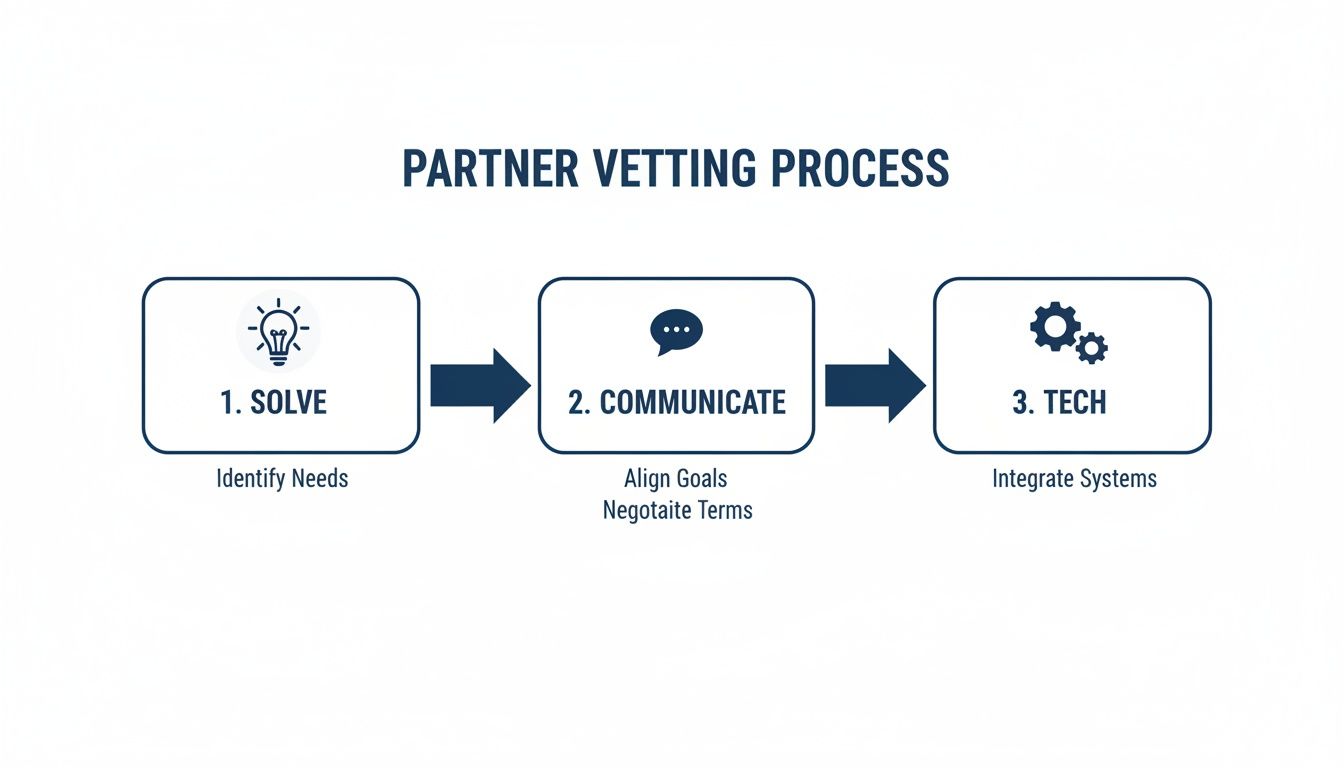
As you can see, solving your community's pain points, aligning on goals, and integrating systems are all interconnected. A successful partnership requires all three.
Planning a Seamless Transition
Once the contract is signed, the focus must shift to the handover. A detailed onboarding plan is critical to prevent disruption for homeowners and ensure no tasks are missed. A good management company will lead this process, but the board's active involvement is vital for success.
Your transition checklist should cover these essentials:
- Financial Data Migration: The careful transfer of all accounting records, homeowner ledgers, bank accounts, and reserve funds.
- Vendor Contract Handover: Your new manager needs copies of all current vendor agreements, contact information, and service schedules to ensure continuity.
- Homeowner Communication Plan: The board and new management should draft a joint announcement introducing the new company, providing contact details, and explaining any new processes for paying dues or submitting maintenance requests.
- Official Records Transfer: All official records—from meeting minutes and governing documents to resident files—must be securely migrated into the new company's system.
A smooth transition depends on great communication. By proactively informing homeowners about the change and setting clear expectations, you build a foundation of trust that strengthens the partnership from day one.
Common Questions from Condo Boards
Choosing a partner to manage your community is a significant decision, and it’s natural for board members to have questions. Here are our straightforward answers to the most common inquiries we hear from condo boards considering a condo association management company.
This isn't a sales pitch; it’s about sharing our experience to address the real-world concerns that your board faces.
How Much Does Condo Association Management Cost?
The honest answer is: it depends. The cost is driven by your community's size, its location, and the specific services your board needs.
For a full-service management plan, you’ll typically see pricing based on a per-unit, per-month model, which can range from $20 to over $50 per door. If you only need financial services, the cost will be lower.
A word of advice: be skeptical of unusually low bids. These often come with hidden fees for services you'd assume are included, like after-hours emergency calls or board meeting preparation. A quality company will always provide a transparent, detailed proposal that clearly outlines what’s included. No surprises.
The biggest mistake a board can make is choosing a management company based solely on price. A low bid often means an overworked manager with too many properties, leading to slow communication and reactive service. This ultimately costs more in the long run through deferred maintenance, homeowner frustration, and board burnout.
The best value comes from a partner with proven expertise, robust systems, and a genuine commitment to your community's success.
How Should We Measure a New Company's Performance?
Don't wait for problems to arise to evaluate your new management company. Performance measurement should begin on day one. A great first step is to sit down with your new manager and establish clear Key Performance Indicators (KPIs) that align with your community’s goals.
These KPIs provide objective data, removing guesswork from performance reviews.
Here are a few metrics every board should track:
- Financial Reporting: Are monthly financial reports delivered on time and consistently accurate?
- Homeowner Responsiveness: What is the average response time for homeowner inquiries submitted through the portal or by phone?
- Maintenance Turnaround: How quickly are routine maintenance requests addressed and completed?
- Project Management: Are capital improvement projects completed on schedule and within the board-approved budget?
We recommend scheduling regular review meetings—quarterly is a great cadence—to go over these metrics together. This keeps communication open and allows you to address small issues before they become large problems, ensuring a productive partnership for years to come.
At Access Management Group, we believe a successful partnership is built on trust, transparency, and a shared commitment to enhancing your community. With decades of experience and a team of Georgia's most elite Community Association Managers, we provide the expert guidance and state-of-the-art systems your board needs. Let us help you protect, preserve, and enhance your real estate investment. Learn how we can support your condo association.