When you buy into a community with a homeowners association, you're not just buying a property; you're entering into a partnership with every other resident. At the heart of this partnership are the community's rules and regulations, often called the Covenants, Conditions, and Restrictions (CC&Rs).
An HOA violation is simply any action that goes against these agreed-upon rules. These aren't just arbitrary dos and don'ts. They are the essential framework that protects property values, promotes community safety, and ensures a consistent, high quality of life for everyone who calls it home.
A Partnership for Community Success

It helps to think of your HOA’s governing documents as the playbook for a winning team. Every single person—from the newest homeowner to the most seasoned board member and the HOA president—has a part to play in reaching the same goal: a thriving, harmonious neighborhood.
The rules in this playbook aren't meant to be restrictive. They’re there to create a fair and predictable environment where every resident’s investment is secure. A violation is just a step outside that playbook, whether it's something small like leaving a trash can out a day too long or something bigger like building a deck without approval. For homeowners, board members, and presidents alike, addressing these isn't about punishment; it's about getting everyone back on the same page and protecting the community's shared standards.
The Three Pillars of a Healthy HOA
Running a successful HOA isn't a one-way street. It truly hinges on a three-way partnership. Understanding each role turns potential conflict into simple, correctable moments, benefiting everyone involved.
- Homeowners: As the foundation of the community, your role is to understand the community’s rules and be a considerate neighbor. By maintaining your property according to the CC&Rs, you directly boost the neighborhood's appeal and protect your own investment, as well as your neighbors'.
- The Board of Directors & President: As elected volunteers, you have the important job of upholding the rules fairly and consistently on behalf of the entire community. Your duty is to act in the best interest of all homeowners, making decisions that protect property values and enhance the living experience for everyone.
- The Management Company: As the board's professional partner, a management company handles the day-to-day administrative work. This means sending violation notices, providing expert guidance, and ensuring the board’s decisions are both effective and legally sound, which frees up the board to focus on big-picture governance.
This team effort is what shifts the dynamic from an "us vs. them" mentality to a shared mission of community excellence. It ensures that rule enforcement is handled with impartiality, professionalism, and efficiency, which benefits homeowners through fairness and the board through reduced liability.
To give both homeowners and board members a clearer picture, let's break down the typical lifecycle of a violation.
Anatomy of an HOA Violation
| Stage | What It Means for Homeowners | What It Means for the Board & Manager |
|---|---|---|
| The Initial Action | A rule is unintentionally or intentionally broken (e.g., overgrown lawn, unapproved paint color). | A resident, board member, or manager observes and reports the potential violation in a standardized way. |
| First Notice | You receive a friendly, informal reminder or a formal warning letter explaining the issue and how to resolve it. | The manager issues a courtesy notice, clearly stating the violation, the required fix, and a reasonable timeline. |
| Follow-Up & Fines | If the issue isn't resolved, you may receive a second notice, possibly with a fine, and information about your right to a hearing. | The manager conducts a follow-up inspection. If the violation persists, a formal notice of fine is sent per the CC&Rs. |
| Hearing | You have the right to appeal the violation and fine by requesting a hearing to present your side of the story to the board. | The board schedules and holds a hearing, creating a forum to listen to the homeowner's perspective and ensure a fair process. |
| Resolution/Legal Action | The issue is resolved, or if it continues, the board may place a lien or take legal action to protect the community's interests. | The board either confirms the homeowner has fixed the issue or consults legal counsel for next steps, guided by the CC&Rs. |
This process is designed to be corrective, not punitive, giving everyone a chance to get things right before the situation escalates.
More Than Just Rules: Protecting Your Investment
Ultimately, this entire framework of rules and violations is about protecting what is likely your single largest investment: your home. A well-managed HOA keeps a neighborhood desirable for decades. This goes beyond just keeping things looking nice; it also means making sure the community complies with local laws and statutes. For example, many property line issues involve complex local codes, where understanding fence regulations like the Line Fences Act can be critically important.
When homeowners, board members, and the president all see the CC&Rs as a tool for collaboration, everyone wins. If you want to dive deeper into these foundational rules, you can explore our complete guide to the governing documents of an HOA. A shared understanding is the bedrock of a successful community.
Preventing the Most Common HOA Violations
The best way to deal with homeowners association violations is to stop them before they ever start. Shifting from a reactive to a proactive mindset is a win-win: homeowners avoid the stress and expense of fines, and the board and president foster goodwill throughout the neighborhood.
By getting ahead of the most frequent issues, residents and board members can take simple steps to keep the community running smoothly. This isn't just about keeping the peace; it's about smart financial management. Unaddressed violations can impact property values and lead to costly enforcement, a lose-lose for the entire community.
The reality is that nearly 95% of associations grapple with at least one rule-breaking incident annually. While a minor slip-up might only cost $20 to $50, serious or repeated offenses can quickly escalate into hundreds or even thousands of dollars. Understanding these common tripwires is the first step toward a more harmonious and valuable community for everyone.
Master Your Landscaping and Property Maintenance
Curb appeal is the first thing anyone notices, making landscaping and exterior upkeep a top priority for most HOAs. A neglected lawn or peeling paint can trigger a violation notice faster than almost anything else. These rules aren't there to be a nuisance; they exist to protect the shared aesthetic and, ultimately, everyone’s property values.
For homeowners, the key is simply building a routine. An annual home maintenance checklist is a fantastic tool for staying on top of tasks and preventing problems before they begin.
For board members and the HOA president, the best tool is clear, timely communication. Sending out friendly, seasonal reminders can dramatically reduce landscaping violations.
- Spring Reminder: As things warm up, send a notice about lawn care standards, refreshing mulch in flower beds, and trimming back any winter-worn shrubs. This helps homeowners plan ahead.
- Fall Reminder: Distribute a simple checklist for leaf removal, gutter cleaning, and preparing yards for the colder months. This positions the board as a helpful partner.
This kind of proactive outreach feels helpful, not heavy-handed, and encourages cooperation from the start, saving the board time and homeowners stress.
A Guide to Architectural Changes and Modifications
Hands down, one of the most serious and costly violations involves unapproved architectural changes. Putting up a new fence, building a deck, or even painting your front door without getting the green light can lead to steep fines and—worst of all—an order to tear out the work at your own expense.
The architectural review process is not meant to be a roadblock. It’s a safeguard to ensure that all changes are safe, structurally sound, and align with the community’s established design standards, thereby protecting the investment of all residents.
For Homeowners: Submitting a Request That Gets Approved
- Read the Guidelines First: Before you even dream of paint swatches or call a contractor, dig into your HOA's architectural guidelines. Know the approved materials, color palettes, and setback requirements inside and out.
- Provide Detailed Plans: A vague, one-line request is a recipe for rejection. Instead, include professional drawings, a list of materials, paint color samples, and a project timeline. The more detail, the better.
- Explain the "Why": Briefly describe the purpose of your project. Giving the architectural review committee (ARC) context helps them understand your goal and may even lead to constructive suggestions.
For Boards & Presidents: Your goal is to make compliance easy. A clear, accessible application and a predictable review schedule go a long way in reducing homeowner frustration and ensuring consistent application of the standards.
Navigating Parking Rules and Trash Can Etiquette
Parking and trash bins might seem like small details, but they are two of the biggest sources of daily friction in any HOA. These rules are crucial for safety, emergency vehicle access, and basic community cleanliness. Common violations include parking commercial vehicles in driveways, monopolizing guest spots, or leaving trash cans out on the street long after pickup day.
A little bit of planning from both homeowners and the board can prevent these constant headaches.
| Common Violation | Homeowner Prevention Tip | Board Communication Strategy |
|---|---|---|
| Guest Parking Misuse | Before your guests arrive, give them a heads-up on the rules and a map of designated visitor parking. Never use guest spots for your own cars. | Post clear, well-maintained signs in guest parking areas. A friendly reminder in the community newsletter benefits everyone. |
| Improper Vehicle Parking | Got a boat, RV, or work truck? Check your CC&Rs for the rules on storage. Most HOAs require these vehicles to be stored out of sight, not in the driveway. | During new resident onboarding, specifically cover the rules on recreational and commercial vehicles to set clear expectations from day one. |
| Trash Can Visibility | Set a reminder on your phone to bring your bins in on the evening of collection day. Store them in the garage or behind an approved screen. | Twice a year, send a friendly email blast about the trash can policy, tying it directly to improving curb appeal for the entire neighborhood. |
Ultimately, preventing violations is a partnership. When homeowners are informed and boards communicate proactively, the community’s rules stop feeling like restrictions and start feeling like a simple roadmap to a beautiful, well-maintained place to live.
How The Violation Enforcement Process Works
Getting a letter about a homeowners association violation can be unsettling for a homeowner, but it’s almost never personal. For the board and president, it’s the first step in a structured process that must be followed to ensure fairness and consistency for all residents. The real goal is always to get the issue corrected—not to punish anyone.
For board members, having a consistent, well-documented enforcement policy is your best protection against claims of unfair treatment. For homeowners, knowing how the process works makes it less intimidating and more transparent. This clarity, often facilitated by a professional community association manager, is the bedrock of a healthy community.
Step 1: Initial Observation And Verification
It all starts with an observation. This might happen during a scheduled community inspection, come from a resident who reports an issue, or be noticed by a board member.
But an initial report doesn't automatically equal a violation. The first and most important step for the board or manager is verification. They must confirm that the issue actually breaks a specific rule in the community’s governing documents. This simple check prevents misunderstandings and ensures action is based on facts, not hearsay.
This flowchart breaks down the typical path for common violations, from landscaping and parking to unapproved home modifications.
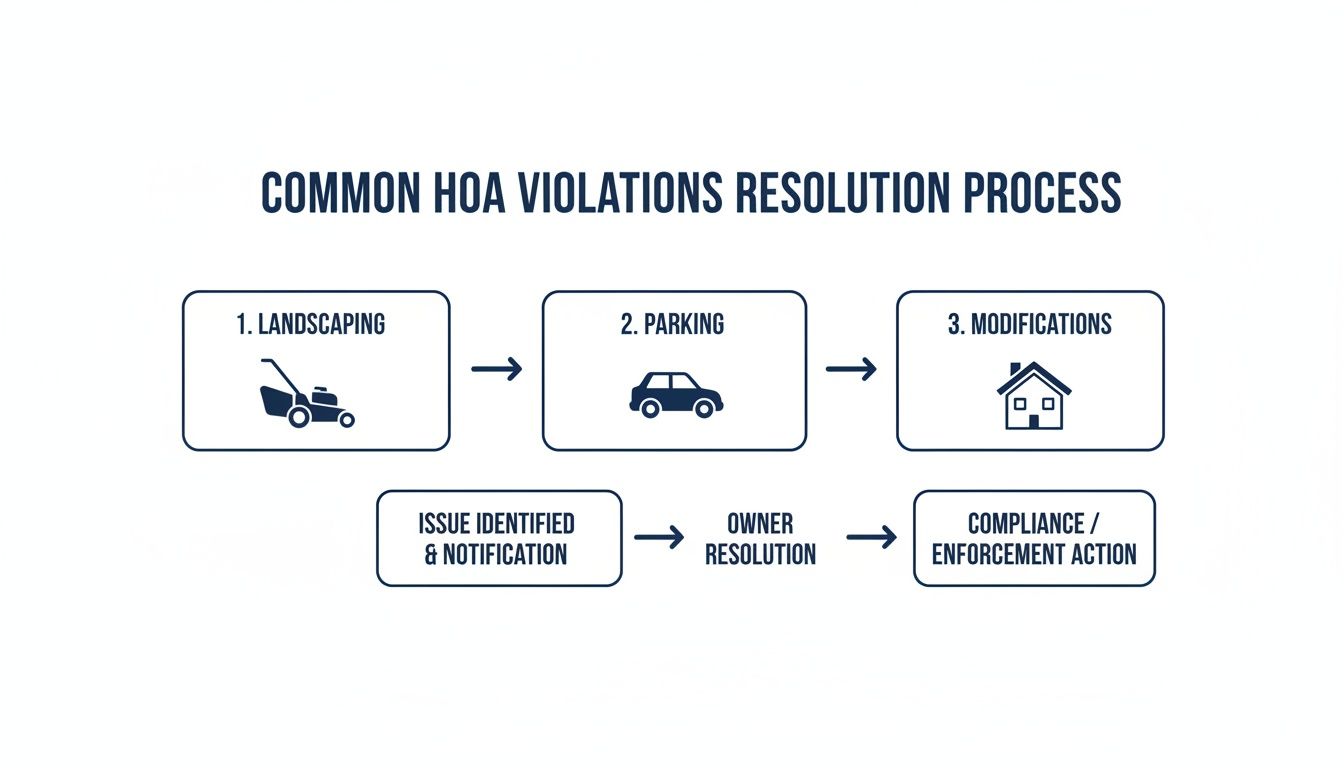
As you can see, a single issue goes through several stages, starting with verification and notice, long before any penalties are ever on the table.
Step 2: The Courtesy Notice Or First Warning
Once a violation is confirmed, the process usually begins with a soft touch. Instead of jumping straight to fines, most associations send a courtesy notice or a friendly warning letter first.
This first letter is really about education and partnership. Many homeowners, especially if they’re new, might genuinely not know they’ve overstepped a rule.
A courtesy notice is the best way to achieve compliance without creating conflict. For the homeowner, it’s a no-penalty chance to fix the issue. For the board, it shows a commitment to working with residents, not against them. The notice should clearly state the specific violation, point to the rule in the CC&Rs, and give a reasonable deadline to fix the problem.
This approach shows the association is a partner in keeping the community looking great, not an adversary.
Step 3: Formal Notice And Potential Fines
If the friendly notice is ignored and the deadline passes, the process gets more serious. The next step is a formal notice of violation. This letter has a more official tone and is often sent via certified mail to provide proof of delivery, which protects both the homeowner and the association.
This formal notice restates the original violation, the missed deadline, and usually includes the first fine according to the association's official policy. Crucially, this is where the homeowner’s right to due process kicks in. The notice must inform the homeowner that they have a right to request a hearing to dispute the violation or the fine.
Step 4: The Hearing And Final Resolution
If a homeowner requests a hearing, the board is obligated to schedule one. This is the homeowner’s opportunity to tell their side of the story, provide evidence, or explain any special circumstances. The board’s job is to listen with an open mind before making a final decision.
After the hearing, the board discusses the issue and delivers a written decision.
- If the board sides with the homeowner, the violation is dropped, and any fines are removed.
- If the board upholds the violation, the fines stick, and a new, non-negotiable deadline for fixing the problem is set.
Failing to comply even after this final step can lead to more serious actions. This could mean more fines, having access to amenities like the pool or clubhouse suspended, or even legal action, which we’ll cover next.
Understanding Fines, Liens, and Legal Action
When courtesy notices and warnings for homeowners association violations don't resolve an issue, the board has a fiduciary duty to take the next step. This move toward fines, liens, and potential legal action isn't about being punitive; it's about protecting the community's interests and upholding the agreed-upon rules for everyone.
For homeowners and board members alike, it’s beneficial to view these tools as mechanisms for ensuring fairness and bringing a property back into compliance when cooperation has failed, not as revenue generators.
In Georgia, a board’s authority to fine and place liens comes directly from the community's CC&Rs and is guided by state laws like the Georgia Property Owners' Association (POA) Act. This framework ensures the process is handled fairly, protecting both the homeowner's rights and the board's legal standing.
How Fines Are Structured and Implemented
Fines are the first financial tool used for ongoing violations. The goal is simple: create a financial incentive for a homeowner to fix an issue they’ve ignored. A well-designed fine policy is never a profit center; it's a mechanism to regain compliance.
Most associations use a progressive fine schedule, where the penalty grows the longer a violation continues. This demonstrates the board's focus on finding a solution, not just collecting money.
- First Fine: A modest, initial fine is applied once the formal warning period has passed without a resolution.
- Recurring Fines: If the issue persists, more fines can be added daily, weekly, or monthly, as spelled out in the CC&Rs.
- Caps and Limits: Your governing documents will almost always set a maximum fine amount for a single violation or over a specific time period.
For this system to be effective and legally defensible, it must be transparent and applied uniformly to every resident. A board that plays favorites with fines erodes community trust and invites legal challenges.
The Power of an HOA Lien
If fines start piling up and go unpaid, the board may need to place a lien on the homeowner's property. A lien is a legal claim filed against a property title for an unpaid debt. It essentially puts a red flag on the property that tells lenders and potential buyers that the association is owed money.
A lien is one of the most powerful tools an HOA has. It effectively prevents the homeowner from selling or refinancing the property until the debt to the association—including all fines, late fees, and legal costs—is paid in full.
This step is never taken lightly. Under Georgia’s POA Act, associations have a statutory right to place liens for unpaid assessments and other charges. Before filing one, the board must follow strict notification rules to ensure the homeowner is fully aware of the debt and the consequences.
The financial pressure from fines and liens can understandably cause friction. In fact, research shows that communities with frequent disputes over enforcement often see 20–30% higher member dissatisfaction. This tension is exactly why a fair, transparent, and legally sound process is so critical for maintaining community harmony. You can read more about the connection between enforcement and resident satisfaction on nar.realtor.
Legal Action and Foreclosure: The Ultimate Last Resort
In the rarest and most extreme situations, an association might have to pursue legal action. This could mean suing a homeowner to force them to fix a violation (seeking an injunction) or, as an absolute final option, foreclosing on the property to satisfy the lien.
Foreclosure is the most serious action an HOA can take. It’s reserved for cases where a significant debt remains unpaid and every other attempt to work with the homeowner has failed.
It’s an expensive, complicated, and deeply unpleasant process for everyone involved. That's why boards and management companies work so hard to resolve violations long before this stage, always prioritizing communication, hearings, and payment plans to avoid such a drastic outcome.
Your Rights and Responsibilities as a Homeowner

When a violation notice shows up in your mailbox, it's natural to feel frustrated or even singled out. But remember, living in an HOA is a two-way street. Just as the board has a formal process for enforcing the rules, you have guaranteed rights to make sure you’re treated fairly.
This protection is called due process, a core principle that shields you from random or unfair decisions. At the same time, being a member of the community means you have responsibilities, too. Understanding both sides of this equation is the key to handling homeowners association violations constructively.
Knowing Your Fundamental Rights
When you're accused of a violation, the process has to be fair. These rights aren’t just polite suggestions; they are typically spelled out in your community's governing documents and backed by Georgia law. Think of them as your procedural shield.
- The Right to Formal Notice: You must get a written notice that clearly states the alleged violation. It should tell you exactly which rule was supposedly broken, what you need to do to fix it, and a reasonable deadline.
- The Right to Review Evidence: You have the right to see the proof the board is using against you. This could be anything from a time-stamped photo to a neighbor's complaint or an inspector’s report.
- The Right to a Hearing: Before a fine can stick, you have an absolute right to a hearing with the board. This is your chance to show up and tell your side of the story in a formal setting.
The hearing isn't a courtroom trial, but it’s your best opportunity to advocate for yourself. It’s where you can share your perspective, present your own evidence, and give the board a chance to reconsider based on information they didn't have before.
Preparing for Your HOA Hearing
If you choose to appeal a violation and ask for a hearing, preparation is everything. You'll achieve a much better outcome by walking in calm and prepared with facts than by showing up with an emotional outburst.
Your goal is to build a logical case. Start by gathering any documentation that backs you up, such as:
- Photographs and Videos: Take clear, dated photos or videos that prove your property is in compliance or that document any extenuating circumstances.
- Emails and Letters: Pull together all correspondence you’ve had with the board or the management company about the issue.
- Neighbor Statements: If a neighbor can confirm your version of events, a short, signed statement from them can be incredibly persuasive.
When you present your case, be respectful and stick to the facts. Remember, the board is made up of your neighbors who are volunteering their time. A professional and organized approach will always be better received.
Fulfilling Your Community Responsibilities
While your rights are powerful, they come with a matching set of responsibilities as a member of the community. Most issues never escalate to a formal hearing because homeowners make good-faith efforts to stay in compliance.
These responsibilities are straightforward: read your governing documents, maintain your property, and communicate with the board constructively. This system of checks and balances is more important than ever. The number of community associations in the U.S. has skyrocketed from just 10,000 in 1970 to an estimated 373,000 by 2025, now covering 78.1 million residents. With this kind of growth, it’s vital for homeowners and boards to work together to make the violation process fair and effective.
You can dive deeper into these trends by checking out the Foundation for Community Association Research's statistical review.
A Proactive Playbook for HOA Boards in Georgia
The best HOA boards and presidents we work with in Georgia don't spend their time putting out fires. They’ve learned how to prevent them. A proactive mindset is the most effective tool for reducing homeowners association violations and creating a neighborhood people are happy to call home. It changes the board’s job from policing neighbors to partnering with them.
This isn't about being more lenient or cracking down harder. It’s about being smarter with policies and more open with communication. When you are consistent, clear, and fair, you build trust, save time, and create a community where residents feel respected, not just regulated.
Building a Foundation of Consistent Communication
Most violations don’t happen because people are trying to break the rules. They happen because homeowners simply don't know the rules. Good, regular communication is your first and best tool for prevention. Friendly, consistent outreach keeps guidelines top-of-mind and positions the board as a helpful resource.
- Community Walkthroughs: Schedule regular, consistent community walkthroughs. This simple practice ensures every area gets the same review and prevents any resident from feeling unfairly targeted.
- Informative Newsletters: Use your monthly or quarterly newsletters for seasonal reminders. A quick note about pool rules in May or a guideline for holiday lights in November can head off dozens of potential violation letters.
- Accessible Documents: Make it incredibly easy for homeowners to find the CC&Rs and architectural guidelines on your community website. If a resident can check the rules in 30 seconds, they’re far more likely to follow them.
When you communicate proactively, you create an environment where following the rules is the easiest option for everyone, benefiting both homeowners and the board.
Establishing a Fair and Defensible Fine Policy
Even with perfect communication, violations will still occur. When they do, your fine policy needs to be fair, clearly documented, and legally solid. The Georgia Property Owners' Association (POA) Act gives boards the authority to levy fines, but that power comes with a major responsibility: due process for the homeowner.
A transparent fine policy is your shield against claims of selective enforcement. It must be applied uniformly to every resident, every single time, without exception. This protects the board from liability and ensures every homeowner is treated equally.
Your policy must spell out the entire process, starting with a simple warning and then moving to modest, escalating fines. Just as important, it must clearly state the homeowner's right to a hearing. For a more detailed look at the board's duties here, our guide on HOA board responsibilities is an essential read for effective leadership.
The Power of Professional Management and Technology
For a volunteer board, trying to track violations consistently is a huge and often thankless job. This is exactly where a professional management partner and the right software make all the difference. A dedicated community manager serves as an objective third party, ensuring inspections, notices, and follow-ups are handled exactly as your policies dictate.
Modern community management software backs this up by creating a clear, defensible record of every single violation. It logs photos, all correspondence, and important dates, giving you a complete chronological history for every case. That documentation is your protection if a violation ever has to go to a hearing or legal action, shielding the board and the association from liability while proving that every homeowner is treated the same.
Frequently Asked Questions About HOA Violations
Dealing with homeowners association violations can bring up a lot of questions for homeowners and board members. Based on our years of experience, we've put together answers to some of the most common inquiries we receive, offering clarity for everyone in the community.
What if My Neighbor Has the Same Violation but I Got the Notice?
This is a classic, frustrating scenario. The simple answer is to focus on your own property first. While boards are required to enforce rules consistently, you likely don't know the full story with your neighbor—they may have already received a notice, have an approved extension, or be on a different timeline.
The best course of action for a homeowner is to contact the management company or board to address your specific violation. You can politely ask if the rule is being enforced across the community, but the conversation should center on bringing your own property into compliance. For boards, this highlights the importance of consistent enforcement to maintain credibility and trust.
Can the HOA Really Fine Me Without a Warning?
It is extremely unlikely and generally against best practices. Georgia law and most governing documents outline a clear process that must start with notification. This usually looks like a courtesy letter for a first-time, minor issue, followed by a formal "Notice of Violation" with a clear deadline to fix it. Fines are a tool used only after those initial warnings are ignored.
Crucially, the board must give you an opportunity for a hearing before any fine can be levied. A fine without any warning is not just bad practice; it often goes against an association's bylaws and state law, putting the board at legal risk.
Do I Have Any Power to Fight a Violation I Think Is Unfair?
Yes, you absolutely do. This right is called due process. If you believe a violation notice was issued by mistake, is inaccurate, or is fundamentally unfair, you have the right to appeal and ask for a formal hearing with the board of directors.
To prepare for the hearing, gather your evidence—photos, emails, and even statements from neighbors can be helpful. When you present your case, stay calm and stick to the facts. The board has a duty to listen and consider your perspective before it makes a final decision. This hearing process is a critical check and balance that protects homeowners and reinforces the board's commitment to fairness.
At Access Management Group, we believe clear communication and fair, consistent processes are the foundation of a successful community. If your HOA board is looking for expert guidance to manage violations effectively and foster a positive environment for all residents, visit us online at accessmgt.com to learn how our experienced team can help.