As a dedicated HOA or COA board member, you know that sound financial management is the cornerstone of a thriving community. When we talk about the best HOA accounting software, we're really talking about a system that delivers three key benefits for your residents and your board: streamlined dues collection for homeowners, seamless bank integration for the treasurer, and crystal-clear financial reporting for everyone. These features are game-changers, saving your board precious volunteer hours and, just as importantly, building homeowner trust. While big names like Buildium, AppFolio, and PayHOA often lead the conversation, the right choice is always the one that best serves your community's unique character and needs.
Finding the Right Financial Tools for Your Board
As a board member, one of your primary responsibilities is to protect and grow your community's property values. Solid financial management is the foundation of that responsibility—it’s a principle that ensures every homeowner's investment is secure. Picking the right HOA accounting software isn't just about administrative convenience; it's a strategic move that safeguards the financial health of your community and provides peace of mind for both the board and the residents you serve.

The right platform brings transparency to your finances, makes dues collection simple for homeowners, simplifies how you pay vendors, and helps your board craft budgets that are both accurate and easy for residents to understand. In this guide, we'll break down what "best" really means for a community like yours. We’ll focus on the features that give your volunteer board back precious hours, reduce the risk of human error, and foster a sense of trust and confidence throughout your community. To properly serve your homeowners, selecting a comprehensive and efficient finance management software is a must.
Why Good Software Is Essential for a Healthy Community
The move to specialized software isn’t just a passing trend—it's a direct response to the increasing complexity of running a community association responsibly. The global market for HOA software is expected to jump from USD 6.03 billion in 2026 to USD 9.15 billion by 2032.
This growth reflects a fundamental need. With over 370,000 HOAs in North America, boards need tools that ensure accuracy and efficiency. The best platforms can reduce accounting mistakes by up to 40%, improve on-time dues collection, and free up countless hours for volunteer board members to focus on community-building, not just bookkeeping.
For a board, the right software transforms financial management from a complex chore into a strategic asset. It provides the clarity needed to make informed decisions that directly impact property values and resident satisfaction.
The Key Benefits for Your Community
When your board implements a good system, the positive effects are felt far beyond the boardroom. It creates a foundation of trust and operational excellence that benefits every single homeowner.
- Total Financial Transparency: Homeowners gain straightforward access to financial reports, giving them a clear picture of how their dues are being put to work to maintain and improve the community.
- Painless Payments: Secure online portals make paying dues simple and convenient for residents. This leads to fewer late payments and less stressful follow-up for the board.
- Spot-On Budgeting: With automated tracking and reporting, your board can build precise budgets, manage reserve funds confidently, and plan for future capital projects that enhance property values for everyone.
- Smoother Operations: When accounting is integrated with other management tools, it makes fulfilling all your HOA board responsibilities that much more efficient, allowing you to better serve your neighbors.
Defining Your Community's Unique Accounting Needs
Before your board looks at a single software demo, it's crucial to get a crystal-clear picture of what your community actually requires. Jumping into the selection process without this step often leads to choosing a platform that's either too complicated or not powerful enough for your needs.
A small, self-managed community has vastly different accounting needs than a large condominium association juggling extensive amenities and dozens of vendor contracts. This initial evaluation creates a practical scorecard, allowing your board to make a confident and objective decision that best serves your homeowners. It ensures you focus on solving your real financial challenges, not just on flashy features you’ll never use.
Key Questions to Guide Your Board
Start by asking a series of targeted questions. The answers will become the foundation of your software requirements, ensuring you choose a tool that empowers your board and benefits the entire community.
- How many units are in your association? This number directly impacts pricing, which is almost always on a per-unit basis, and determines if a system can handle your volume of transactions and communications.
- How complex is your budget and reserve fund? If you manage multiple reserve funds for major projects like roof replacements or pool repairs, you need software with robust fund accounting to keep everything separate, compliant, and transparent for homeowners.
- How many vendor contracts do you manage? A community with a single landscaping contract has simple needs. One managing payments for security, maintenance, legal, and pool services requires a much more capable system to ensure vendors are paid on time.
- What level of financial reporting do homeowners and the board need? Consider what your board needs for monthly meetings versus what homeowners need for annual updates. Does your state have specific reporting mandates to ensure transparency?
Identifying Your Non-Negotiable Features
With your community’s profile defined, you can pinpoint the essential, must-have features. These are the core functions that drive financial health and build trust with residents. The accounting segment of the HOA software market is now a USD 300 million industry for a reason—it delivers results. The right platform can slash manual data entry by 60% and cut delinquency rates by 25-30%. You can discover more insights about these market trends on Strategic Revenue Insights.
For an HOA board, a non-negotiable feature isn't just a "nice-to-have"—it's a function that directly addresses a major pain point, saves volunteer hours, and reduces financial risk for the entire community.
Your must-have list should include these four fundamentals that benefit both the board and homeowners:
- Automated Dues Reminders and Collection: The system must automatically send dues reminders and process online payments via ACH or credit card. This is non-negotiable for maintaining consistent cash flow and making life easier for residents.
- Secure Online Payment Processing: Homeowners expect a secure, simple portal for making payments. This feature alone drastically reduces the treasurer’s administrative burden and improves the resident experience.
- Integrated Bank Reconciliation: Look for software that connects directly to your association’s bank accounts. This automates reconciliation, ensures your books are always accurate, and provides a clear audit trail.
- Customizable Financial Reports: Your board needs the ability to generate GAAP-compliant reports—like a Balance Sheet, Income Statement (Budget vs. Actual), and Accounts Receivable Aging—with just a few clicks to share with homeowners.
By clearly defining these needs upfront, your board transforms the software selection process from a daunting chore into a strategic evaluation for the community's benefit.
Once you’ve nailed down your community’s specific accounting needs, it’s time to look at the software that can get the job done. This isn't just a list of features; think of it as a focused breakdown for volunteer board members. We’ll show you how each of these platforms actually performs in the real world of community association management.
We're going to look at some of the top contenders for 2026: Buildium, AppFolio, PayHOA, and CINC Systems. For each one, we’ll give you a quick briefing on its accounting strengths, what kind of community it’s built for, and how easy it is to use for volunteers who aren’t professional accountants.
Buildium: An All-In-One Platform for Growing Communities
Buildium is a familiar name because it does a little bit of everything—from accounting and resident messages to tracking maintenance orders. It’s a solid choice for boards that want one system to handle all of their community's operations.
Its biggest strength is that it’s so comprehensive. The accounting module is strong, handling automated dues collection, bank reconciliation, and the kind of financial reports your board needs for meetings. The budget vs. actual reports are especially useful for giving you and your residents a clear, immediate picture of your community's financial standing.
- Best Fit For: Small to mid-sized associations (50-500+ units) that need more than just basic bookkeeping and want a platform that can scale up as they grow.
- The Learning Curve: Because it’s packed with features, expect a bit of a learning curve. That said, Buildium provides plenty of training resources to help board volunteers get comfortable.
- Key Accounting Feature: The violations module is a standout. It links fines directly to homeowner accounts, which helps simplify and automate what can often be a difficult collections process.
AppFolio: A Premium Solution for Larger Associations
AppFolio is a top-tier platform you’ll often see used by professional management companies and larger, more complex associations. It’s built to handle sophisticated accounting and provides a very clean user experience for both managers and residents.
Where AppFolio really shines is in managing financial complexity with transparency. Its reporting tools are incredibly powerful, letting boards create custom, detailed reports that will satisfy even the most rigorous oversight. The platform’s bank integrations are also top-notch, giving your board real-time data for unmatched accuracy.
- Best Fit For: Larger HOAs and condo associations (200+ units) with complex budgets, multiple reserve funds, and a long list of vendors to manage.
- The Learning Curve: Despite its power, AppFolio has a modern, clean design. It makes navigating complicated financial data surprisingly simple, even for board members without a finance background.
- Key Accounting Feature: It includes built-in corporate accounting features, a major benefit for boards managing multiple associations under a single umbrella, ensuring clean and separate financials for each.
For boards overseeing large capital projects or managing intricate reserve studies, AppFolio’s advanced reporting and analytics provide the deep financial insight necessary for strategic, long-term planning that protects homeowners' investments.
PayHOA: The Go-To for Self-Managed and Smaller HOAs
PayHOA was built from the ground up for smaller and self-managed communities. It zeroes in on the essentials—collecting dues, tracking expenses, and basic financial reporting—without the overwhelming complexity of the bigger systems.
The main draw here is simplicity and affordability, making it a responsible choice for smaller budgets. PayHOA gives a volunteer treasurer all the necessary tools in a package that’s easy to get running and even easier to manage day-to-day. You get online payments, automated reminders, a simple general ledger, and clear reports for homeowners.
- Best Fit For: Perfect for smaller, self-managed associations (usually under 100 units) where ease of use and a friendly price point are the top priorities.
- The Learning Curve: This is PayHOA’s home run. The interface is incredibly user-friendly, making it a great starting point for board members with zero accounting software experience.
- Key Accounting Feature: A volunteer board can get a small community’s finances up and running online in a fraction of the time it takes with more complicated platforms, delivering immediate value.
No matter which platform you’re looking at, paying your vendors on time is critical for maintaining good relationships and ensuring community services run smoothly. Strong Accounts Payable software capabilities are a must-have for paying your landscapers, maintenance crews, and other contractors accurately.
CINC Systems: A Banking-Centric Powerhouse
CINC Systems comes at things from a different angle. It’s known for its deep, direct integration with banking services. The entire platform is built around a powerful accounting core, making it an excellent choice for communities that prioritize maximum financial automation and accuracy.
CINC’s defining feature is its real-time, seamless connection with partner banks. The system automates just about everything, from processing lockbox payments to performing daily bank reconciliations. This can dramatically cut down on the manual work your treasurer has to do, freeing them up for more strategic tasks.
- Best Fit For: Mid-sized to large associations that want to put their banking and accounting workflows on autopilot, ensuring the highest level of financial integrity.
- The Learning Curve: The interface is functional and built for accounting, so it might not feel as slick or modern as some of the others. But for financial tasks, it’s clear and very effective.
- Key Accounting Feature: The automated lockbox payment processing is a game-changer for homeowners who prefer to pay by check. It ensures dues are posted to their ledgers with incredible speed and accuracy.
HOA Accounting Software Feature Comparison for Board Members
To help your board see how these platforms stack up at a glance, we've put together a table comparing the features most important to a community's financial health and operations.
| Feature | Buildium | AppFolio | PayHOA | CINC Systems |
|---|---|---|---|---|
| Online Dues Payment | Yes | Yes | Yes | Yes |
| Auto-Late Fees | Yes | Yes | Yes | Yes |
| Financial Reporting | Robust, with budget vs. actuals | Advanced, highly customizable | Simple and straightforward | Comprehensive, accounting-focused |
| Bank Reconciliation | Automated | Real-time, seamless integration | Manual/Semi-automated | Fully automated with partner banks |
| Vendor Management | Yes | Advanced, with AP automation | Basic | Yes, integrated with accounting |
| Violations Tracking | Integrated with homeowner ledgers | Yes, with communication tools | Basic | Yes |
| Budgeting Tools | Yes | Advanced | Yes | Yes |
| Mobile App for Board | Yes | Yes | Yes | Yes |
This table gives you a quick snapshot, but remember to think about your community’s specific situation. A feature that’s a "must-have" for a large condo association might be unnecessary for a small, self-managed HOA.
Of course, these accounting tools are often part of a larger suite of products. To get a better sense of the overall landscape, you can learn more about other types of community association management software that frequently integrate with these platforms.
Ultimately, the best HOA accounting software is the one that fits your community's size, budget, and the technical comfort level of your volunteer board. Use these briefings as your guide, and you’ll be well on your way to choosing a solution that protects your community’s financial health for years to come.
Matching Software to Real-World HOA Scenarios
Feature lists are great, but they don't tell you how a platform will support your board and residents in real-world situations. A software's true value emerges when you apply it to the day-to-day challenges your community actually faces. It’s about moving past specs on a page and figuring out which tool will genuinely make the board's job easier and life better for homeowners.
So, instead of just comparing features, let's walk through a few common scenarios we see HOA and COA boards encounter all the time. By matching these real-life challenges to the right software, your board can make a more practical choice for your community’s financial health. The goal is to find a system that solves your most pressing problems, not just one that checks a bunch of boxes.
This decision tree breaks down the three core questions your board needs to ask: How many units are you managing? What specific features do you truly need to serve your community effectively? And what's a responsible budget?
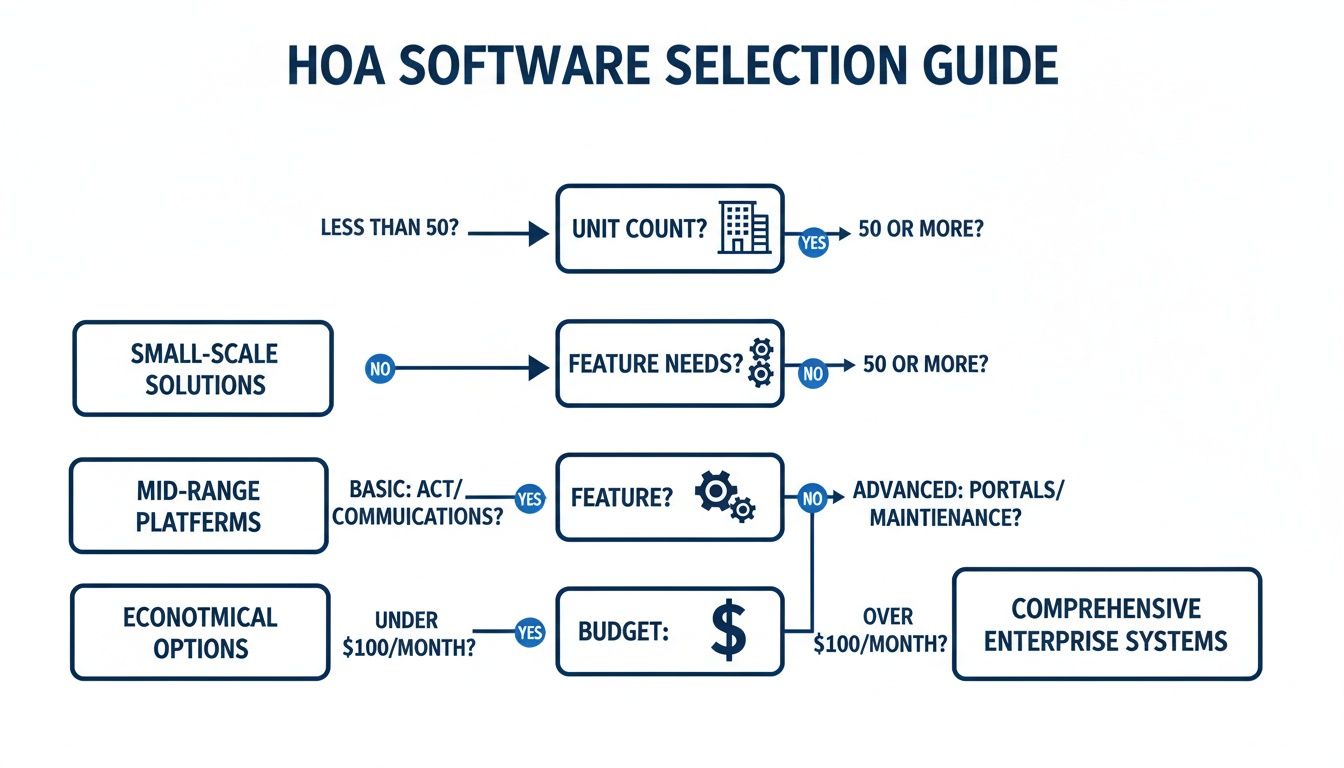
Ultimately, these three factors—size, complexity, and cost—are what will point your board toward the right software for your association.
Scenario One: The Small, Self-Managed HOA
The Situation: You're on the board of a 45-home HOA. It's self-managed, and your treasurer is a dedicated volunteer who knows basic finances but isn't a trained accountant. The board's goal is to collect dues efficiently, pay the landscaper and utility bills on time, and provide simple monthly reports to show every homeowner where their money is going.
The Challenge: Your board is currently tracking everything in a spreadsheet. Chasing down late payments with email reminders is a constant chore for the treasurer, and creating the monthly reports takes hours and often contains small errors. This creates unnecessary work and can erode homeowner trust.
Software Recommendation: A streamlined, user-friendly platform like PayHOA is a perfect fit here. It's built for exactly this kind of environment.
- Why It Works: PayHOA is all about simplicity. The interface is clean and intuitive, so a volunteer treasurer can get up and running quickly. The automated dues reminders and online payment portal will immediately solve the board's biggest administrative headache and make payments easier for residents.
- Board and Homeowner Benefit: The board gets a professional, automated system that cuts the treasurer's workload dramatically. Financial transparency improves overnight because accurate reports are just a few clicks away, which goes a long way in building trust and confidence with homeowners.
Scenario Two: The Mid-Sized Community with Growing Pains
The Situation: Your community has grown to 175 units. Your board is now managing a modest reserve fund, a handful of regular vendors, and you're starting to deal with more covenant violations. You need more than just a simple payment collector—you need real budgeting tools and a fair, consistent way to track violation fines.
The Challenge: Your current basic payment tool can't keep up. Your board is juggling multiple systems for accounting, violations, and homeowner communications, and things are starting to fall through the cracks, causing confusion for residents and the board.
Software Recommendation: For this stage, a balanced, all-in-one solution like Buildium offers the right mix of power and usability.
- Why It Works: Buildium gives your board a complete accounting module with key features like bank reconciliation and detailed budgeting. But the real win is how it connects accounting to other management tasks, like its violations module that can automatically and transparently link fines to homeowner accounts.
- Board and Homeowner Benefit: This integration is a huge time-saver for the board. When a violation fine is issued, it automatically posts to the homeowner's ledger, which simplifies collections and provides a clear record. The board gets one unified dashboard to see the community's financial and operational health, leading to better-informed decisions.
For a growing community, the best HOA accounting software is one that bridges the gap between simple bookkeeping and comprehensive management. It provides the tools to handle increasing complexity without overwhelming volunteers, ensuring smooth operations for everyone.
Scenario Three: The Large, Complex COA
The Situation: You're the president of a 400-unit condo association with major amenities—a pool, a clubhouse, and a fitness center. Your budget is complex, with several large reserve funds earmarked for future capital projects. The board needs incredibly detailed, customizable financial reports to meet strict auditing requirements and demonstrate fiduciary responsibility to homeowners.
The Challenge: Spreadsheets are out of the question. Even basic software can't handle the fund accounting or provide the deep financial insights your board needs for strategic planning and proper oversight of homeowner funds.
Software Recommendation: When you're at this level, your board needs a powerful, enterprise-grade platform like CINC Systems or AppFolio.
- Why It Works: These platforms were built with a heavy focus on accounting and banking integrity. CINC Systems, for instance, is a powerhouse at automating financial workflows through its deep bank integrations. AppFolio is known for its advanced, highly customizable reporting capabilities that provide ultimate transparency.
- Board and Homeowner Benefit: The board gets institutional-grade tools to manage complex finances with confidence. You can effectively oversee large reserve funds, generate audit-ready reports on demand, and make data-driven decisions about major capital projects, ensuring you are fulfilling your fiduciary duty to all homeowners and protecting their investments.
Making the Switch: Your Guide to a Painless Software Transition
Picking the right HOA accounting software is a huge step for your board, but that's just the beginning. A smooth, well-planned transition is what turns those shiny new features into genuine time savings for your board, clearer financials for homeowners, and a stronger sense of trust in your community.
A successful rollout depends on a solid plan and clear communication with your residents.

We've put together a practical checklist to help your board navigate the implementation without the usual headaches. Following these steps will help you sidestep common mistakes and ensure your new system starts delivering value from day one for both the board and your homeowners.
Getting Your Financial Data Ready
The first, and most critical, part of this process is data migration. This is where you move your association's financial history from its old home—whether that's spreadsheets or another software—into your new platform. Getting this right is non-negotiable for ensuring a seamless transition for every homeowner.
You don't need to bring over every last scrap of data. Focus on getting the essentials right. Your board should start by gathering these key records:
- Current Year's Budget: This becomes the baseline for all your budget-versus-actual reports.
- Active Homeowner Roster: Make sure every name, email, phone number, and unit detail is correct before you import it.
- Homeowner Ledger Balances: The current balance for every single homeowner. Double-check every outstanding due and credit for accuracy.
- Chart of Accounts: Your existing list of all income and expense categories.
A clean data migration is the single biggest predictor of a successful software transition. Taking the time to validate every homeowner balance and clean up historical data now will save your board and residents months of painful reconciliation work and confusion later.
Setting Up Your New System
Once your data is prepped and ready, it's time to mold the new software to fit your community's rules and processes. This is where your board customizes the platform to start automating tasks and providing new conveniences for homeowners.
- Set Up Your Chart of Accounts: The first thing your board will do is recreate the community's chart of accounts inside the new software. This ensures every dollar is categorized correctly right from the start.
- Configure Assessment Rules: Next, you'll define your dues structure. Set the exact assessment amounts, lock in the due dates, and create the rules for how and when late fees are automatically applied, per your governing documents.
- Integrate Bank Accounts: Connect the software directly to your HOA’s operating and reserve bank accounts. This is the crucial link that powers automated bank reconciliation—a feature that will save your treasurer an incredible amount of time and increase accuracy.
Training the Board and Talking to Homeowners
With the technical side handled, it’s time to focus on the people. A new system is only as good as the people using it, so solid board training and crystal-clear communication with residents are key to a smooth launch.
Your communication to homeowners should be simple, positive, and sent out well in advance. Frame the change around the benefits they'll actually care about.
- Introduce the New Online Payment Portal: For most homeowners, this is the biggest win. Give them simple, step-by-step instructions on how to sign up and make their first online payment.
- Highlight Better Transparency: Let them know that the new system will give them much easier access to their own account history and the community's financial reports.
- Provide Clear Support Channels: Tell residents exactly who on the board to contact if they run into issues or have questions. Being proactive with support builds a ton of goodwill and stops frustration before it starts.
Knowing When to Partner with a Management Company
Even the best HOA accounting software is just a tool. It’s an incredibly powerful one, but it still depends on your volunteer board to run it, interpret the data, and make the right calls for the community. So, what happens when the day-to-day financial management starts to feel like a full-time job?
There often comes a tipping point where the demands of managing the community’s money—even with great software—outgrow the time and expertise a volunteer board can realistically offer. This is when bringing in a professional management company isn't just a good idea; it's a strategic move for the long-term health and value of your community.
A dedicated management firm doesn’t replace your software; they leverage it as experts. More importantly, they bring human expertise to the table—the kind of experience that turns financial data into smart advice for the board and takes the administrative grind off your plate, allowing you to focus on governance.
Signs It Is Time to Seek a Professional Partner
How do you know you've hit that tipping point? The signs are usually pretty clear. When your board's workload becomes unsustainable or the financial risks feel too high to handle alone, it’s time to call in professionals to protect the community's interests.
If your board is wrestling with any of these situations, it’s a strong signal that you need support:
- Complex Delinquencies: Routine late fees and friendly reminders aren't cutting it anymore. When your board is facing the possibility of placing liens or taking legal action, a professional manager knows how to navigate these tough, sensitive issues legally and effectively on behalf of the community.
- Large-Scale Capital Projects: Planning a major project like a full roof replacement or repaving streets is a massive undertaking. It involves complicated vendor contracts, huge budgets, and meticulous financial tracking that can easily overwhelm a volunteer group.
- Ensuring Legal Compliance: State and local laws governing HOAs are always changing. A management company’s entire job is to stay on top of these changes, protecting your association from costly fines and legal headaches.
Partnering with a management company isn’t about giving up control. It’s a strategic decision to delegate the operational complexities so the board can focus on what it does best: governance, long-range planning, and building a better community for everyone.
The Value of Expert Oversight
Ultimately, hiring a management company is an investment in professional expertise and peace of mind for the entire community. A skilled community association manager handles the daily financial tasks, from preparing monthly reports and paying vendors to answering homeowner questions about their accounts.
This frees up your board to focus on the big picture—making key policy decisions, setting the community’s vision, and enhancing property values for all residents. You get the confidence of knowing your association's financial health is in expert hands, backed by powerful technology and years of industry experience. It’s a partnership that lets your board lead, knowing all the details are being handled with professional precision.
Answering Your Final Questions on HOA Accounting Software
Choosing the right software is a big decision for any board, with a direct impact on homeowners. To help you make a confident, well-informed choice, we've put together answers to some of the most common questions we hear from board members just like you.
Think of this as the final check-in before you invest in a platform that will protect your community’s financial health for years to come.
How Much Should We Expect to Pay for HOA Accounting Software?
The price tag can vary quite a bit, mostly depending on your community's size and the specific features you need. For smaller, self-managed HOAs, simpler platforms can start as low as $40 to $50 per month.
For more robust systems, you'll often see a per-unit pricing model, which can run anywhere from $0.50 to over $2.00 per unit each month. It's absolutely critical for the board to get a detailed quote that spells out every potential cost—one-time setup fees, data migration charges, and any extra fees for premium support—so you understand the true total investment on behalf of the homeowners.
Can Board Members Use This Software Without an Accounting Degree?
Absolutely. In fact, the best platforms are built specifically for volunteer board members who are not financial experts. Their top priority is making financial management accessible and straightforward.
The most effective HOA software is designed to turn complex accounting jobs into simple, guided steps. You should look for clean dashboards, automated reports, and intuitive navigation that lets any board member manage the community’s money with confidence and transparency.
These systems almost always come with great training resources, like video tutorials, detailed help guides, and support teams ready to walk your board through any questions. This helps everyone get up to speed and feel proficient in no time.
What’s the Toughest Part of Switching Accounting Systems?
Without a doubt, data migration is the biggest hurdle. Moving years of financial records, homeowner information, and outstanding balances from an old system or a pile of spreadsheets has to be done perfectly to avoid disrupting services or causing billing errors for residents.
A sloppy migration can cause chaos. The best way to avoid this is to work hand-in-hand with your new software provider's implementation team. Your board must double-check all the data for accuracy before you go live and, just as importantly, keep homeowners in the loop on the transition timeline to manage everyone's expectations.
Navigating the complexities of HOA finances requires the right tools and, often, the right partner. At Access Management Group, we leverage state-of-the-art software and decades of expertise to provide elite management services that protect and enhance your community's value. Discover how our professional oversight can empower your board by visiting us at https://accessmgt.com.