What exactly is a condo association management company? At its core, it's a professional firm your board hires to manage the day-to-day operations, finances, and administrative legwork of your community.
They are your strategic partner in making sure the association runs smoothly. Their job is to keep the community well-maintained, financially sound, and compliant with all the rules and regulations—all of which ultimately protects and boosts the property values for every single homeowner.
Your Guide to a Thriving Condo Community

Serving on a condo association board is a significant commitment. Your neighbors have entrusted you with what is likely their largest investment, and you’re now responsible for everything from complex budgets to maintaining shared amenities. It's a tremendous amount of pressure for a volunteer position.
This is where a professional management company becomes an invaluable asset. Think of them not just as a vendor, but as the operational arm of the board. They take on the heavy lifting of daily tasks, freeing you up to focus on the big-picture governance and long-term vision your community needs to thrive.
Here’s a quick breakdown of what they can handle for your community.
Core Responsibilities of a Condo Management Company at a Glance
| Service Category | What It Means for Your Board and Homeowners |
|---|---|
| Administrative & Governance Support | They handle communications, help enforce rules fairly, and run efficient board meetings. Your board gets expert guidance, not a pile of paperwork. |
| Financial Management | They manage the budget, collect dues, handle delinquencies, and prepare financial reports. You get clear financials for confident, transparent decision-making. |
| Site & Maintenance Management | They oversee repairs, manage vendors, and conduct property inspections. Common areas stay beautiful and functional, protecting property values for everyone. |
| Community & Resident Services | They act as the main point of contact for homeowners, resolving issues and answering questions. Board members can enjoy being neighbors, not 24/7 problem-solvers. |
A good manager handles the details so the board can lead effectively, ensuring a better living experience for all residents.
The Growing Need for Professional Management
Running a community association is becoming more complex every year. New laws, rising operational costs, and higher homeowner expectations are making the job of a volunteer board member more demanding than ever. This is precisely why professional management is shifting from a luxury to a necessity for well-run communities.
The numbers reflect this reality. Planned communities are a massive part of the housing market, with community associations now home to nearly 80 million Americans. The industry is only getting bigger, with projections showing as many as 377,000 associations by 2026. You can explore more data on this industry growth to see just how widespread this model has become.
A professional partner brings key advantages that immediately benefit board members and homeowners:
- Expertise and Compliance: They are experts in association management. A good manager stays current on changing state and local laws, helping your community avoid costly legal mistakes.
- Financial Stability: They have proven systems for budgeting and collecting dues, providing the clear financial reports the board needs to make smart, informed decisions on behalf of the community.
- Vendor Management: They come with a network of vetted, insured contractors. They know who to call and can often negotiate better pricing for maintenance and repairs, saving the association money.
- Reduced Board Burnout: This is a major benefit. By handling the administrative work and resident communications, they save the board's energy and goodwill, allowing members to serve more effectively.
Key Insight: The true value of a great management company is how it empowers the board. You shift from being reactive problem-solvers, constantly putting out fires, to becoming proactive community leaders. When they handle the daily details, you’re free to focus on what really matters: enhancing property values and making your community a better place to live for everyone.
This guide will break down the services these companies offer, how they structure their fees, and how you can choose the right partner for your community's future. Our goal is to empower your board to make a great decision for all homeowners.
When serving on a condo association board, it’s easy to think of a management company as just who you call when a pipe bursts. While they certainly handle that, their real value to homeowners and the board goes so much deeper.
A great management company is the operational engine that protects your community. They work behind the scenes to safeguard property values, keep finances healthy, and ensure your community remains a wonderful place to live.
Their work supports the board—and by extension, every homeowner—in four essential areas.
Financial Management and Stability
This is one of the most critical roles a management company plays. They are the guardians of your association's financial health, ensuring every homeowner's investment is protected. This is more than sending dues notices; it's about acting as your community’s dedicated finance department, professionally overseeing every dollar.
Here’s what that looks like in practice for your community:
- Budgeting and Reporting: They’ll work with the board to draft the annual budget, then track every expense against it. You'll receive clear, easy-to-read monthly financial statements, providing the transparency needed to make confident decisions.
- Dues and Collections: They manage the entire assessment collection process, from invoicing to payment processing. Crucially, they also handle the difficult task of pursuing delinquent accounts according to the association's policies. This frees the board from having to chase down their own neighbors for money.
- Reserve Fund Analysis: A proactive manager ensures your reserve fund is properly funded for future major projects, like replacing a roof or repaving the parking lot. This forward-thinking planning helps you avoid hitting homeowners with large, unexpected special assessments.
Administrative and Governance Support
Volunteer board members can easily get buried in administrative work. There are meetings to schedule, records to maintain, and endless emails. A management company lifts that burden, allowing your board to focus on governance and strategic planning. They provide the operational backbone for your association.
Key Takeaway: An effective management company handles the "business" of the association so the board can focus on being community leaders. They ensure meetings are productive, records are immaculate, and rules are applied consistently and fairly.
They organize board meetings, prepare agendas, and take official minutes to create a proper legal record. As experts in your governing documents and state law, they provide vital guidance to keep the association compliant and steer you clear of costly legal mistakes. This also includes managing official communications and keeping all association records secure and organized for homeowner access.
Site and Maintenance Management
Nothing signals a healthy, thriving community like a well-maintained property. The management company is responsible for overseeing the association's physical assets, ensuring common areas are safe, functional, and attractive. This is a key part of what’s known as property management and directly impacts every resident's enjoyment and property value.
Their hands-on site management duties involve:
- Coordinating Maintenance: They serve as the central hub for maintenance requests, dispatching approved vendors for everything from a simple plumbing fix to ongoing landscaping.
- Vendor Negotiation: They use their extensive network of vetted, insured contractors to get competitive bids for services and major projects. This ensures your association gets quality work at a fair price, without the board having to vet companies from scratch.
- Regular Inspections: The best managers don’t wait for things to break. They are on-site regularly, conducting inspections to spot potential problems early. This proactive approach helps prevent small issues from becoming expensive emergencies, saving the association money and headaches.
This hands-on approach doesn't just save money; it directly improves the quality of life for every resident.
Resident Relations and Communication
One of the most challenging parts of serving on a board is enforcing rules with your neighbors. A management company acts as a neutral, professional third party, which is essential for maintaining community harmony. They become the primary point of contact for homeowner questions, concerns, and complaints.
By taking charge of rule enforcement, they ensure violations are handled fairly and consistently, following the procedures in your governing documents. This removes the "neighbor vs. neighbor" tension and places the responsibility with a professional entity.
This buffer allows board members to maintain positive relationships within the community while ensuring the rules that protect everyone’s investment are upheld. This specialized role is a huge reason why so many boards hire a dedicated community association manager to professionalize their operations.
Once your board has decided to seek professional help, the next big question is: what level of support do you really need? Not all management companies offer one-size-fits-all services, nor should they. The right partnership for your condo association depends on your community’s size, your board’s volunteer capacity, and your budget.
This decision typically comes down to two main options: full-service management or a more focused financial-only agreement. Let's break down what each provides so your board can determine the best fit for your community.
The Full-Service Management Approach
Think of full-service management as hiring an operational partner for your entire community. This comprehensive option means the management company handles nearly every aspect of day-to-day operations. It’s the perfect fit for boards that want to delegate the operational grind and focus their time on strategic governance that benefits all homeowners.
A typical full-service agreement covers the four pillars of community management:
- Financial Administration: From creating budgets and collecting dues to preparing financial reports and planning for your reserve fund.
- Administrative Support: This includes organizing board meetings, keeping official records, and helping ensure the association stays compliant with state law.
- Site Management: Overseeing all maintenance, coordinating with vendors like landscapers and roofers, and conducting regular property inspections.
- Resident Relations: Serving as the main point of contact for homeowners, answering questions, and handling rule enforcement fairly.
This model is a lifesaver for larger communities, associations with significant amenities like a pool or clubhouse, or boards where members have limited volunteer hours. While it's a larger investment, the return comes from preventing board burnout, accessing better pricing through professional vendor networks, and reducing your association's legal risks.
The Financial-Only Management Model
A financial-only manager, on the other hand, is like hiring a dedicated CFO for your association. This specialized service is designed for self-managed communities that are comfortable handling maintenance and resident communications but need an expert to ensure the finances are managed professionally. This à la carte approach is becoming more popular as boards seek expert help where it's needed most.
The real benefit of a financial-only model is gaining professional-grade accounting and fiscal discipline without the cost of a full-service contract. It ensures dues are collected on time, bills are paid, and your financial records are always clean and transparent for the board and homeowners.
With this option, the management company focuses entirely on your condo association's financial health. They will take over dues collection, pay vendor invoices, manage bank accounts, and prepare monthly financial statements for the board. This frees the treasurer from a huge burden and provides the financial transparency every healthy community needs. The board retains control over all maintenance, vendor selection, and homeowner communication.
This flowchart can help your board visualize which path might be the right one for your community.
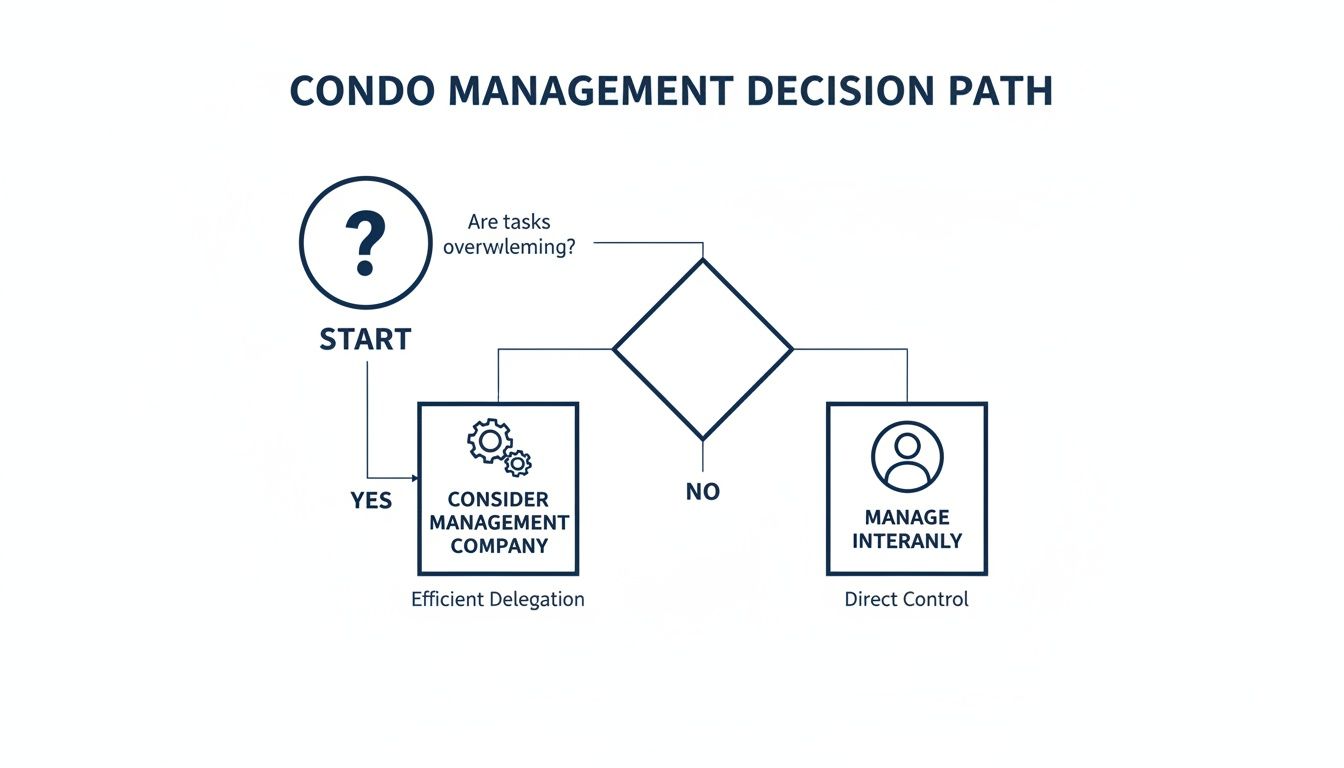
To make it even clearer, here’s a direct comparison of the two models.
Full-Service Management vs Financial-Only Management
| Feature | Full-Service Management | Financial-Only Management |
|---|---|---|
| Dues & Collections | Yes, handles all billing and collections. | Yes, handles all billing and collections. |
| Financial Reporting | Yes, provides comprehensive monthly reports. | Yes, provides comprehensive monthly reports. |
| Vendor Payments | Yes, processes all invoices. | Yes, processes all invoices. |
| Maintenance Coordination | Yes, oversees all repairs and projects. | No, this is handled by the board. |
| Vendor Bidding & Contracts | Yes, manages the entire process. | No, this is handled by the board. |
| Resident Communication | Yes, serves as the primary point of contact. | No, this is handled by the board. |
| Rule Enforcement | Yes, handles violations and notices. | No, this is handled by the board. |
| Board Meeting Admin | Yes, prepares agendas and minutes. | No, this is handled by the board. |
| Best For | Boards with limited time, larger communities, or properties with extensive amenities. | Self-managed boards that need expert financial oversight but can handle day-to-day operations. |
Ultimately, choosing the right model starts with an honest conversation among your board members. Where are your strengths? Where are the gaps? If daily tasks are causing burnout, a full-service plan is a smart investment in your board's well-being and the community's future. By weighing these options against your community's unique needs, you'll find a partner that feels less like a vendor and more like a true extension of your team.
The Role of Technology in Modern Condo Management

Gone are the days of overflowing binders, complex spreadsheets, and manual tracking. A modern condo association can't thrive that way. Today, leading condo association management companies use technology to make community operations more efficient, transparent, and responsive for everyone involved.
For board members and homeowners, this shift from manual to digital is transformative. It turns clunky, time-consuming processes into simple, on-demand actions. The result is less frustration, saved time, and a better living experience for all.
Empowering Residents with Digital Tools
The best management firms provide an online resident portal, which acts as a central hub for the community. Think of it as a secure, 24/7 digital front desk that empowers homeowners to manage their affairs on their own schedule.
This technology directly benefits residents, allowing them to:
- Pay Dues Instantly: Homeowners can securely pay assessments online, set up recurring payments, and view their full account history with a few clicks. No more mailing checks or wondering if a payment was received.
- Submit Maintenance Requests: A resident can report an issue like a leaky faucet or a broken gate in minutes through a simple online form, even attaching photos. The system then tracks the request from start to finish, so they are always aware of the status.
- Access Important Documents: Governing documents, meeting minutes, community rules, and financial reports are organized in a secure digital library, available anytime, anywhere.
Key Insight: A resident portal is more than a convenience; it's a powerful tool for building transparency and trust. When homeowners can easily find information and manage their accounts, they feel more connected and informed, which strengthens the relationship between the community, the board, and management.
This level of self-service access frees up your board from fielding routine questions, allowing you to focus on strategic community leadership.
Streamlining Operations for the Board
For any volunteer board, technology is your greatest ally. It automates repetitive tasks, helps ensure rules are applied fairly, and provides oversight tools that give you a clear view of community operations. This allows you to step away from the daily grind and focus on what you signed up for: strategic governance.
The demand for these tools is clear. The homeowners association software market was valued at $2 billion in 2025 and is projected to skyrocket to $6 billion by 2033. This growth shows how much boards value integrated platforms that combine accounting, communication, and maintenance into one seamless system. You can read more about the rapid expansion of HOA software and its industry impact.
A management company armed with the right tech gives your board:
- Automated Violation Tracking: This is key to fair and consistent rule enforcement. The system can send notices, track deadlines, and create a clear, factual record for every violation, removing subjectivity from the process.
- Digital Communication Platforms: Urgent news, like a water shut-off or a storm warning, can be sent instantly to every resident via email, text, or a portal notification.
- Financial Dashboards: Board members get real-time access to financial data. You can check budget performance, see delinquencies, and review vendor spending, all of which leads to faster, smarter decisions on behalf of the community.
When you choose a management partner that invests in modern tools, you're not just hiring a manager—you're upgrading your community's entire operating system. You can learn more about how the right community association management software can truly transform your operations. It’s an investment that saves money, reduces volunteer burnout, and ultimately creates a better community for every single homeowner.
Choosing one of the many condo association management companies is a monumental decision for your board. This isn't just about hiring a vendor; it's about selecting a partner who will directly impact your community's financial health, daily operations, and the quality of life for every resident.
To see beyond the sales pitches, you need to ask specific questions that reveal how a company truly operates.
We've created a checklist of questions, broken down into the four areas that matter most to a board and its homeowners. Use this as your guide during interviews to ensure you find a partner that genuinely aligns with your community's needs and goals.
Experience and Reputation
A management company's history says a lot about its ability to serve your community effectively. You're looking for a team with a proven track record, especially with communities similar to yours. Their experience is the single biggest indicator of how well they'll handle your unique challenges.
Start by digging into their background with these questions:
- How many years have you been managing condo associations in our local area?
- Can you provide examples of communities you manage that are similar to ours in size (number of units) and amenities?
- Who would be our dedicated community manager? What is their specific experience, and do they hold professional certifications like CMCA or PCAM?
- Could you provide references from board members at three communities you currently manage so we can speak with them directly?
A confident, well-established company will welcome these questions. Vague responses or hesitation should be considered a red flag.
Financial Practices and Transparency
Solid financial management is the bedrock of a healthy condo association. Your board needs a partner with airtight processes for handling your community's money. Your goal is to find a team that prioritizes transparency, proactive planning, and the protection of homeowner funds.
Key Insight: The way a company discusses finances reveals its core values. You want a partner who views financial management as a strategic responsibility to protect and grow property values, not just a bookkeeping task.
Assess their financial discipline with these questions:
- What is your process for handling delinquent assessments? At what point do you recommend legal involvement?
- How do you ensure association funds are kept separate and safe? Do you use separate bank accounts for operating and reserve funds for each community?
- Can you walk us through a sample monthly financial report? We need to see how you present budget vs. actuals, the balance sheet, and income statements.
- How do you assist the board with long-term reserve planning to help prevent surprise special assessments?
Their answers should give you a clear picture of how they’ll protect your association’s assets and empower the board to make sound financial decisions.
Technology and Communication
In today's world, good technology is a must-have for running a community smoothly and keeping residents informed. The right software saves the board countless hours, gives homeowners the self-service tools they expect, and keeps communication lines open and transparent.
Probe their tech stack and communication strategy:
- What specific software platform do you use for community management? Does it include an online portal for residents?
- What can homeowners do in the resident portal? Can they pay dues, submit maintenance requests, and access documents themselves?
- How do you handle urgent communications, like an emergency water shut-off, to ensure all residents are notified?
- What tools do you use for tracking violations to ensure enforcement is always fair and consistent?
A company that has invested in modern, user-friendly technology demonstrates a commitment to providing excellent service to both the board and the residents.
Service Level and Responsiveness
Finally, it’s crucial to get specific about what you're actually paying for. A great partnership is built on clear expectations. This is where you define response times, how problems are solved, and the manager's role in supporting the board.
Ask these direct questions about service delivery:
- What is your guaranteed response time for board questions and resident inquiries?
- How often will our assigned manager be on-site to conduct property inspections?
- How do you handle after-hours emergencies? Who is on call, and what does that process look like?
- What services are included in your standard monthly fee, and what would be considered an additional cost? Please provide a detailed list.
By asking these pointed questions, your board can move past the sales pitch and make a well-informed decision. The goal isn't just to fill a role, but to find a true management partner who will help your community thrive for years to come.
Building a Successful Partnership with Your Management Company

Selecting a condo association management company and signing the contract is the beginning of a long-term business relationship. The most successful partnerships are built intentionally, right from day one, on a foundation of clear communication and mutual trust.
A great manager serves as a trusted advisor, but any partnership is a two-way street. For it to succeed, the board must also do its part to facilitate a smooth start and a truly collaborative environment.
Setting the Stage for a Smooth Transition
The initial onboarding period is critical. This is when your new management partner learns the unique character and needs of your community. A proactive board can make a significant difference by having key documents ready to go.
Before your new manager starts, gather these items for a clean handoff:
- Governing Documents: Your CC&Rs, bylaws, and all community rules.
- Financial Records: The current budget, recent financial statements, your reserve study, and bank account details.
- Resident Information: A complete, up-to-date roster of all homeowners and tenants.
- Vendor Contracts: All active agreements with landscapers, maintenance crews, and other contractors.
- Legal and Insurance: Copies of your association's insurance policies and information on any pending legal matters.
Providing this information promptly helps your manager get up to speed quickly, ensuring no disruption in service for your homeowners. This initial effort pays dividends by establishing a relationship built on organization and efficiency.
Fostering Effective Collaboration and Communication
Once the transition is complete, the real work of building an effective day-to-day relationship begins. A disorganized flurry of emails and calls only leads to missed details and frustration. The best partnerships rely on structure.
Key Takeaway: A successful partnership isn’t about just offloading tasks. It’s about creating a system where the board governs and the manager executes, with both parties working together toward the same community goals.
To achieve this, establish clear communication channels. The first step is to designate a single board liaison. This person becomes the primary point of contact for your community manager, preventing conflicting directions from multiple board members. This simple move is vital for clarifying the many HOA board responsibilities and ensuring everyone is aligned.
From there, schedule regular performance reviews and check-in meetings. These sessions, whether monthly or quarterly, create dedicated time to discuss operational issues, review financials, and plan for the future. They provide a formal space to address concerns, celebrate successes, and ensure the board and management company remain perfectly aligned on community goals.
Ultimately, the bond between a condo board and its management company is one of the most significant factors in a community’s success. When you build it on transparency and a shared purpose, your manager transforms from a vendor into an invaluable strategic partner. They become the expert your volunteer board needs to navigate complex challenges, turning your vision for a stable and harmonious community into reality.
Frequently Asked Questions About Condo Management
As a board member, it's natural to have questions when exploring professional management. It's a major decision for your community. Getting clear, straightforward answers is key to moving forward with confidence. Here are some of the most common questions we hear from boards like yours.
How Much Do Condo Association Management Companies Typically Cost?
This is often the first question, and the answer is: it depends. The cost is shaped by your community's size, its specific needs, and your location. For a full-service management plan, the industry standard is a "per-door" fee.
You can generally expect that fee to be between $20 to $60+ per unit, per month. If you're looking for a more budget-friendly option, a financial-only package can be an excellent starting point. The most important thing is to request a detailed proposal that clearly outlines what’s included and, just as importantly, what is not, to avoid any surprises.
Can a Small Condo Association Afford a Management Company?
Absolutely. In fact, many management firms, especially boutique companies, specialize in scalable services designed for communities of all sizes. A financial-only plan can be the perfect entry point, providing professional accounting and collections oversight without the cost of a full-service contract.
Consider this: a good manager often pays for themselves. They can negotiate better rates with vendors, make your dues collection more effective, and help you avoid costly legal or maintenance mistakes. It's less of an expense and more of an investment in protecting property values and your board's valuable time.
What Is the Single Biggest Benefit of Hiring a Professional Manager?
If we had to choose just one, it's the value of having an experienced, objective third party handle rule enforcement and finances. This immediately de-escalates sensitive issues. It's no longer a "neighbor-versus-neighbor" conflict; it becomes a professional business matter.
This strategic shift allows the board to step back from the uncomfortable day-to-day enforcement and focus on what you signed up for: governance, big-picture planning, and being a good neighbor. It’s the fastest way to reduce volunteer burnout and add a critical layer of liability protection.
How Do We Handle the Transition to a New Management Company?
Any reputable management company will have a clear, tested process for this and will guide your board every step of the way. They should provide a simple checklist of the documents they’ll need, such as your financial records, existing vendor contracts, governing documents, and a current resident list.
From there, the management company takes the lead. They will handle the crucial task of notifying all homeowners about the change. They will introduce the new team and roll out new procedures for paying assessments or submitting maintenance requests, ensuring the switch is as smooth and seamless as possible for everyone in the community.
At Access Management Group, we partner with associations to protect, preserve, and enhance their real estate investments. Our team is ready to answer your questions and show you how our experience can benefit your community. Learn more about our services.