You're standing at the kitchen table with a stack of county mail, HOA notices, and one tax bill that feels higher than it should. For a lot of Georgia homeowners, that's the moment the Georgia homestead exemption stops being a line in a code book and becomes a real household issue. It's not just a tax form, it's part of the basic homeowner checklist, especially if you live in a community with monthly assessments, an HOA board, or a COA that's trying to help residents keep carrying costs predictable.
What the Georgia Homestead Exemption Actually Means for Homeowners
A homeowner in a Georgia neighborhood usually notices the homestead exemption only after someone else mentions it, a neighbor, a closing attorney, or a board member who has been through the process before. Then the question hits: is this a rebate, a discount, or something else entirely? The plain answer is that it's a property tax reduction tied to your primary residence, not a check in the mail and not a one-size-fits-all savings coupon.
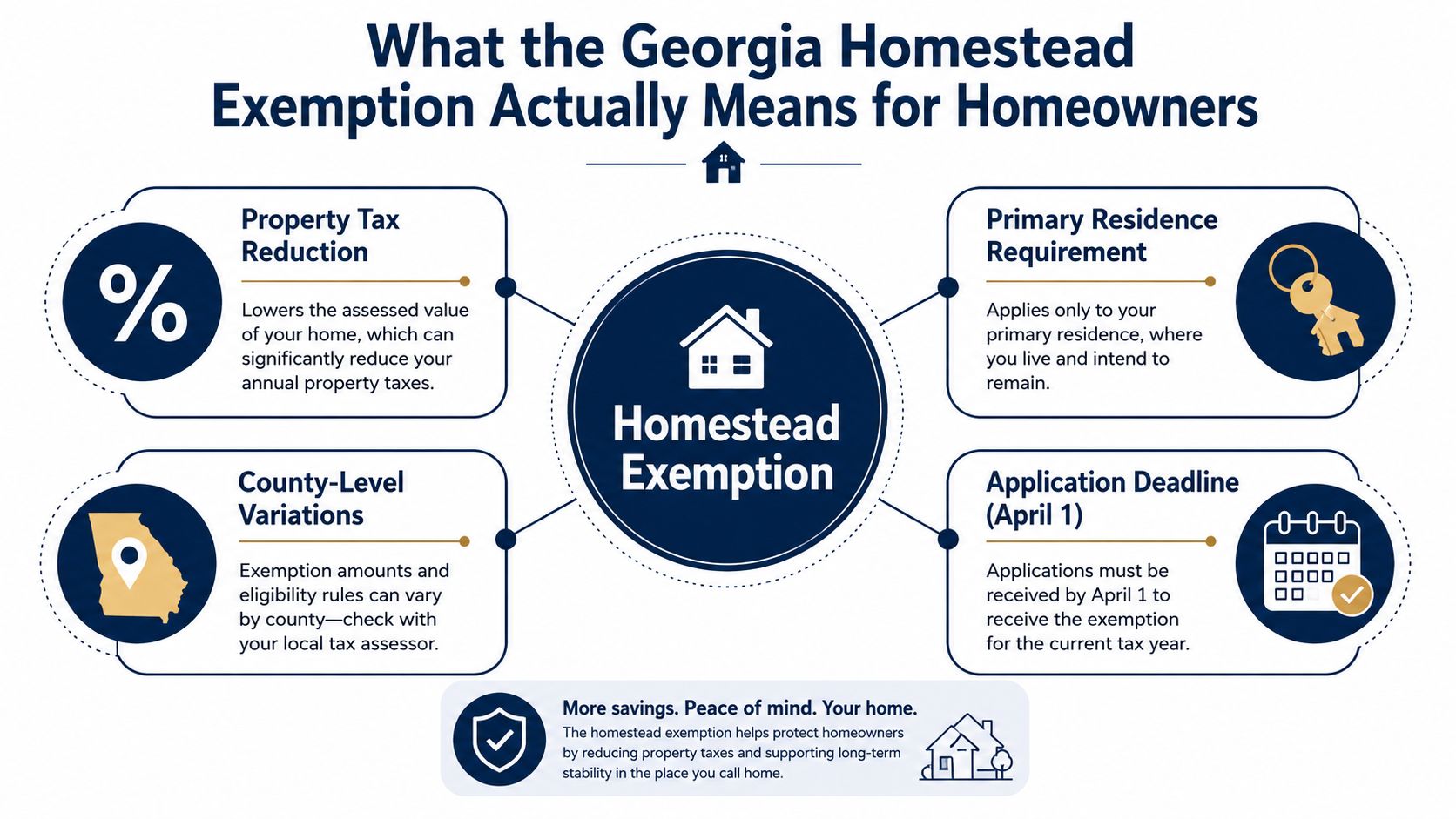
Georgia's standard homestead exemption has long protected owner-occupants, and the home has to be the owner's legal residence as of January 1 of the tax year and occupied as the primary residence, according to the Georgia Department of Revenue's guidance on property tax homestead exemptions. That matters in real life because a townhome owner pays county taxes and HOA assessments separately, and trimming the tax side can make the monthly budget less tight.
Practical rule: if the home isn't your actual residence, the homestead exemption usually isn't the right tool.
The filing process also lives at the county level, not in a single statewide office. If you've ever compared notes with a neighbor and found different rules, that's part of the reason. For homeowners who also juggle insurance, escrow, and association dues, a useful outside resource is Georgia insurance agency support, especially when you're trying to keep the whole household file organized.
The three questions that matter most are simple. Am I eligible? What does it save me? How do I file it correctly? Everything else in this guide builds from those three answers.
Eligibility Rules and the Real Dollar Value
Georgia's standard homestead exemption looks simple at first glance, but the mechanics matter. Under O.C.G.A. § 48-5-44, it covers up to $2,000 of assessed homestead value from state, county, and school ad valorem taxation, and Georgia generally assesses residential property at 40% of fair market value. That means the exemption works on the assessed value side, not as a flat cash rebate, which is why the savings feel modest compared with the home's full market price. Georgia's homestead statute makes that structure clear.
How the qualification test works
You need two things at the same time. First, you have to own the property. Second, it has to be your primary residence on January 1 of the tax year. If either side of that test fails, the standard exemption usually doesn't fit.
That's also why joint ownership creates confusion. A married couple may both live in the home, but the exemption still tracks the homestead itself, not a separate claim for each spouse. In practice, homeowners should think in terms of one homestead exemption per home, not a stack of duplicate exemptions.
A simple worked example
Take a Georgia home with a fair market value of $200,000. Under the 40% assessment rule, the assessed value is $80,000. The standard exemption removes up to $2,000 from that assessed value, leaving $78,000 taxable before local millage is applied. The actual tax savings then depends on the county and school rates on the bill.
Bottom line: the exemption is real, but it's structurally small unless a local add-on or another category applies.
For residents who are trying to keep track of household mail and neighborhood notices, browse direct mail targeting advice can be useful when a board or manager wants to communicate the right reminder to the right homes without creating confusion.
The Major Exemption Categories and Their Amounts
Georgia homeowners often use “homestead exemption” as a catch-all phrase, but the state has several different categories with different triggers. That's where a lot of people get tripped up. One homeowner may qualify for the basic exemption, while another may fall into a senior or veteran category and receive a much larger benefit.
| Georgia Homestead Exemption Categories at a Glance | ||
|---|---|---|
| Exemption Category | Amount | Key Eligibility Trigger |
| Standard homestead exemption | Up to $2,000 of assessed value | Owner-occupied primary residence on January 1 |
| Senior-citizen homestead exemption | Varies by statutory category | Qualifying senior homeowner, with county and state rules applying |
| Disabled veteran exemption | At least $32,500 in one category, and a separate $60,000 exemption plus an annual additional amount in another statutory category | Qualifying disabled veteran status and ownership of the homestead |
| Local or school-district add-on exemptions | Varies by locality | Local adoption and filing rules |
The disabled veteran rules are especially important because they aren't just a minor add-on. Georgia law provides a separate statewide senior-citizen homestead exemption and additional exemptions for disabled veterans, including a $60,000 exemption plus an annual additional amount set by the U.S. Secretary of Veterans Affairs, according to the statutory guidance in Georgia's exemption law.
Why neighbors can have different savings
Two homes can sit on the same street and still produce different tax outcomes. One owner may only have the standard exemption. Another may qualify for a senior category or a veteran category. A third may live in a county or district with a local exemption layered on top.
That's why “my neighbor said theirs dropped a lot” doesn't tell you much by itself. The category matters, and so does the local tax setup. If you're helping residents as a board member or manager, that's the cleanest way to explain why one bill can look very different from another even when the homes seem similar.
Practical rule: always separate the statewide standard exemption from any local or special-category exemption before you estimate savings.
The New Statewide Floating Exemption Under HB 581
Georgia's homestead system isn't standing still. House Bill 581 introduced a statewide local homestead exemption discussion in 2024, and the big idea was to cap annual increases in homestead property values for local maintenance-and-operation tax purposes. That shift matters because it moves the conversation away from a fixed-dollar subtraction and toward a limit on assessment growth, which is a very different experience for long-term homeowners.
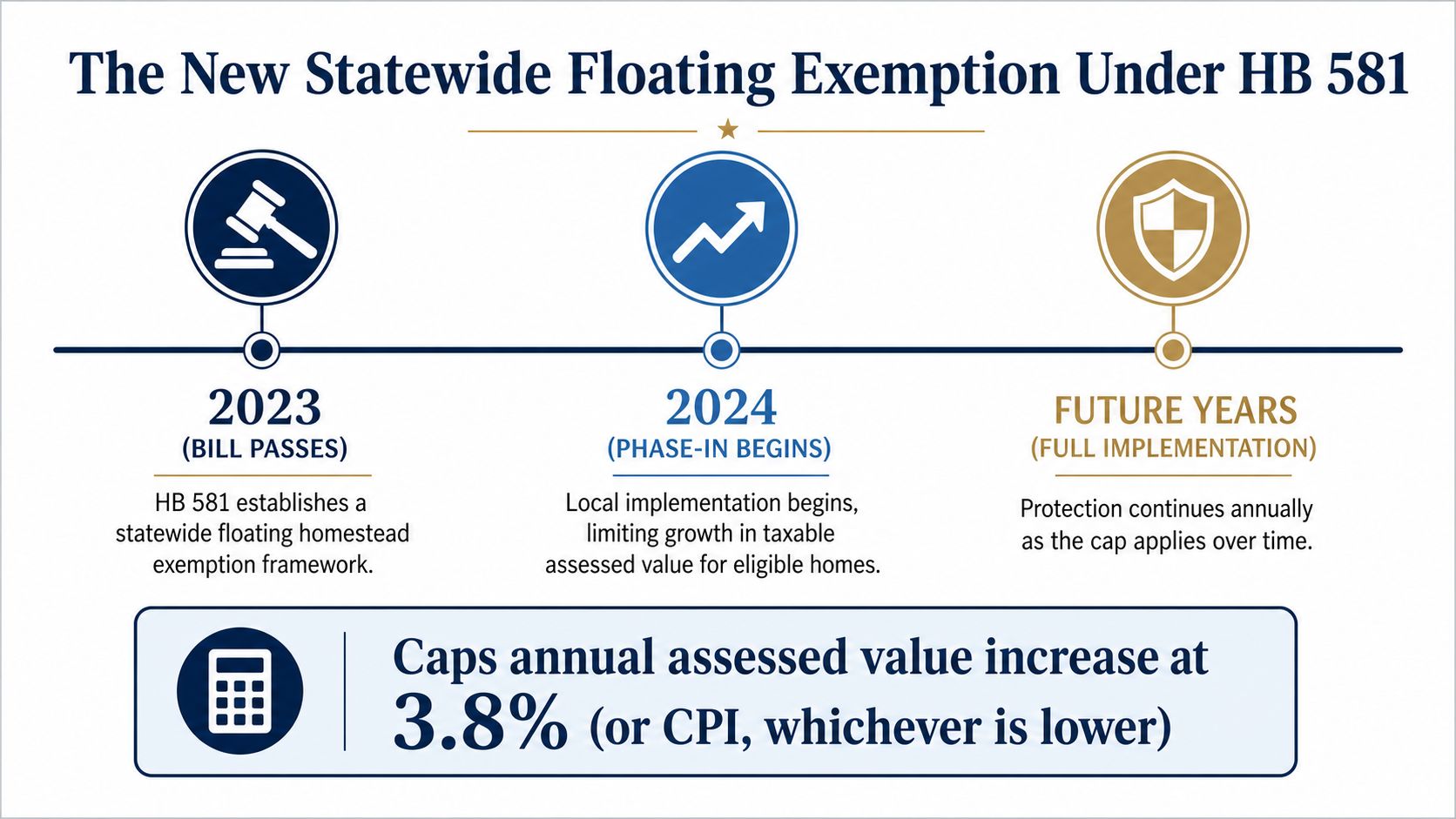
The opt-out process is the detail homeowners usually miss. Under the framework summarized by legal and policy sources, school districts could not begin opting out until January 1, 2025, and they had to complete the process by March 1, 2025, using public notice, at least three public hearings, and a filed resolution with the Secretary of State. A good background refresher on how assessment systems work in general is BatchData's guide to property taxes, especially if you want to understand why assessed value and millage rates matter so much in the first place.
What homeowners should watch for
The critical nuance is that the floating exemption is not identical to the old fixed-dollar homestead deduction. It's designed to help manage taxable value growth, and the practical effect depends on whether your county or district participates.
The other point that gets missed is scope. The FAQ tied to HB 581 says the exemption applies to all millage rates except bonded indebtedness. In plain English, that means some parts of the bill can still move even when the cap is active.
If you live in a fast-growing metro area, that distinction is everything. A homeowner can hear “homestead exemption” and assume the whole bill is shielded, but that's not what the new framework means. The right question is whether the local government opted out, and which portions of the bill still sit outside the cap.
Filing Your Application Step by Step
A homeowner often means to file, then life gets in the way. Boxes still need unpacking, county mail lands in a kitchen drawer, and the deadline passes before anyone sits down with the paperwork. The easiest fix is to treat the homestead exemption like any other recurring homeowner task, the same way you would review an insurance renewal or skim the association's annual budget packet.
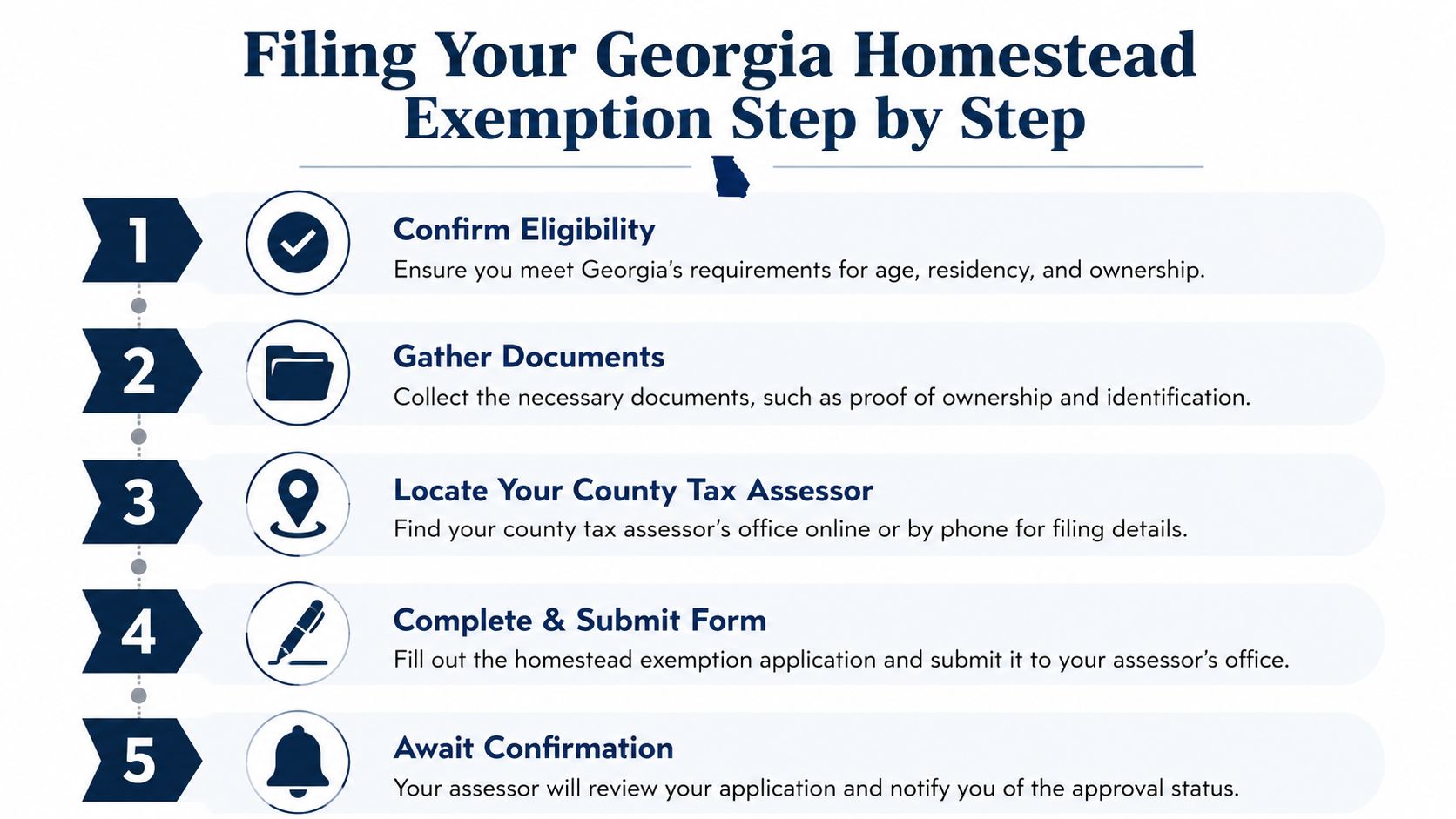
Georgia's filing deadline is generally April 1 for the current tax year. The application goes to the county tax commissioner's office, or in some counties the tax assessor's office, according to Georgia Department of Revenue guidance on homestead exemptions. That deadline is the part people miss. The rest is paperwork and follow-through.
A clean filing workflow
- Confirm eligibility. Make sure the home is your legal residence and your primary home on January 1.
- Gather documents. Bring the paperwork the county asks for, usually proof of ownership and proof of residency.
- Find the right office. Some counties route filings through the tax commissioner, others through the tax assessor.
- Submit the application. File before the deadline and keep a copy for your records.
- Save the confirmation. If the county approves it, store the notice with your property records.
Board-friendly reminder: once the exemption is in place, it often renews automatically if ownership and occupancy stay the same.
That automatic renewal helps, but it can also make residents assume nothing else ever needs attention. Homeowners should still keep a copy of the approval and compare it against the bill each year. If a board wants to help residents avoid missed filings, this checklist is easy to print in a newsletter or post on a resident portal.
A board can also make the filing process feel less mysterious by pointing residents to county forms, office contacts, and clear reminders about what proof to bring. In communities where ownership paperwork changes often, that small service can prevent a lot of confusion later. For residents sorting title questions at the same time, homeowners association liens are another reason to keep property records organized and easy to review.
What Happens When Your Situation Changes After Filing
The hardest exemption problems usually show up after the filing, not during it. A homeowner moves out for a job transfer, adds a spouse to title, places the property in a trust, or inherits the home after a probate process, and suddenly the old assumption about “it's already filed” stops being safe. That's where the county records and the home's actual occupancy need a fresh look.
Georgia says the standard exemption renews automatically only as long as the owner continuously occupies the home under the same ownership, and counties require applicants to file with local tax officials rather than through a single statewide process, as noted on Georgia's homestead exemption application page. If you're also sorting out ownership records, a useful parallel issue is how homeowners association liens can affect title clarity and property paperwork.
Changes that deserve a second look
- Moving out: if the home is no longer your primary residence, the exemption can be at risk.
- Changing title: a deed update can change who is eligible to claim the homestead.
- Adding a spouse: title changes should be checked against county filing rules.
- Placing the home in trust: trust documents often need to be reviewed before assuming the exemption stays intact.
- Inheriting the property: probate records, wills, and title history may affect who can file next.
Georgia Legal Aid points out that ownership questions can involve deeds, probate records, wills, and trust documents, and that's exactly why the post-filing side matters so much for homeowners and association boards. A resident may think the exemption is automatic forever, but the county still cares about who owns the property and who lives there.
Practical rule: if the ownership paper changes, or the real-life occupancy changes, assume the exemption should be reviewed.
How HOA and COA Boards Can Help Residents
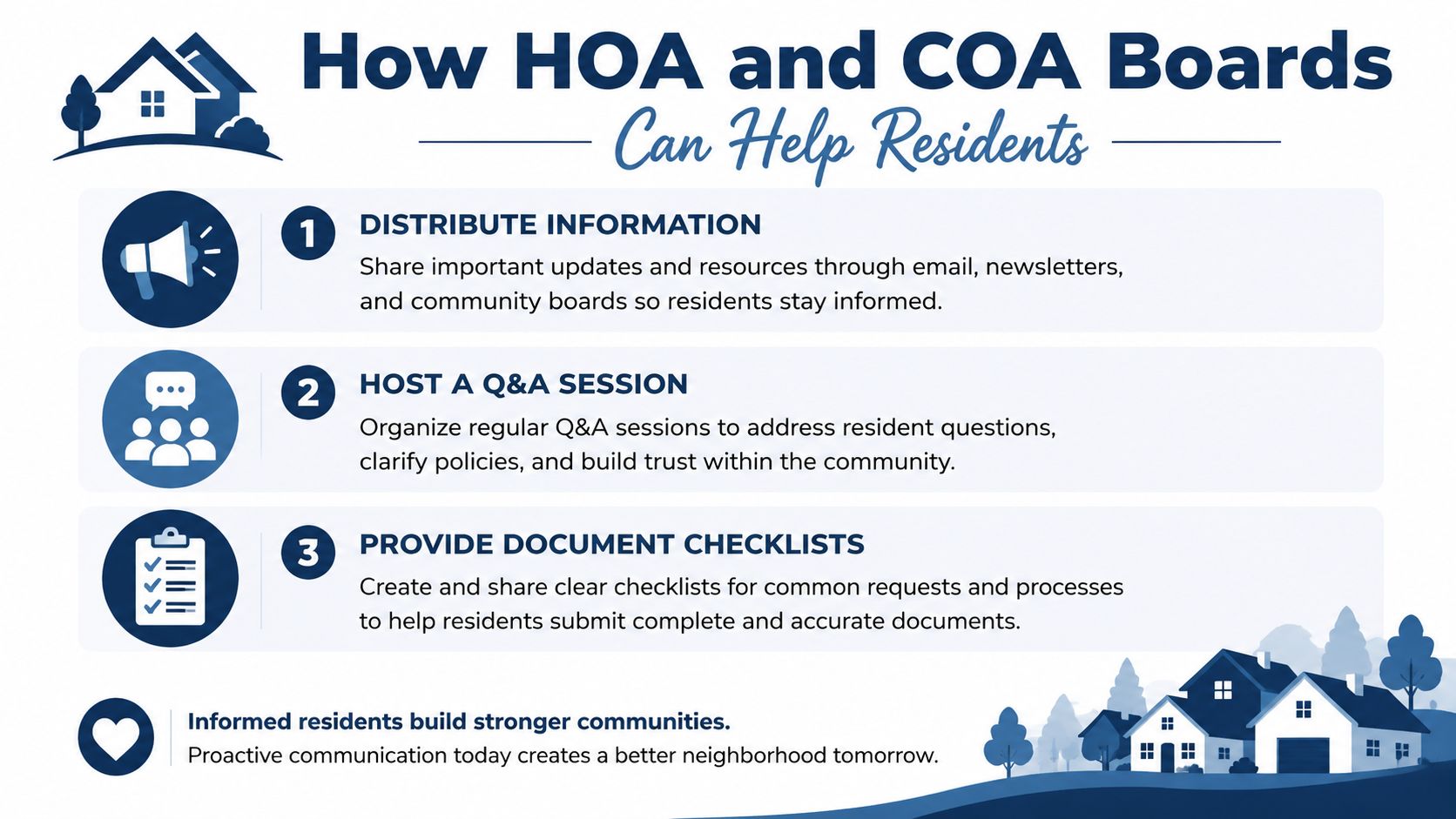
Boards don't file homestead exemptions for residents, but they can make the process far less confusing. That's a meaningful service because homeowners often hear about the exemption at the wrong time, after the deadline, after a title change, or after a bill has already gone out. A board that shares clear guidance is helping residents protect cash flow, and that supports the whole community.
Practical ways boards can step in
- Distribute information. Put a short exemption reminder in the annual newsletter and on the resident portal.
- Host a Q&A session. Invite residents to ask about filing dates, ownership changes, and county office contact points.
- Provide document checklists. Give residents a simple list of what to bring when they file.
- Track local updates. Have the management team watch county-level changes and school-district notices so residents aren't surprised.
The value here is not theoretical. A homeowner who understands the exemption is less likely to miss a deadline, lose eligibility after a title change, or assume the wrong office handles the filing. That helps the board too, because fewer residents show up frustrated after the fact.
If your association wants a deeper framework for how board communication should work, HOA board members can use this kind of resident education as part of a broader governance rhythm, not as a one-off notice.
Practical Next Steps and Common Questions
A homeowner in a Georgia subdivision can do everything right on paper and still miss the benefit if one detail is off. The practical move is simple, confirm the home is your primary residence, check whether you fit the standard, senior, or veteran category, file by April 1, and keep an eye on any change in ownership or occupancy. If your county adopted or opted out of the newer floating exemption framework, review how that affects the bill before you assume last year's setup still applies.
That same habit helps HOA and COA boards too. A short reminder in a resident packet or portal note can keep people from filing late, sending paperwork to the wrong office, or losing the exemption after a deed change. If your community wants a simple homeowner reference hub, homeowner resources can help keep the right documents and reminders in one place.
Quick FAQ
Does the exemption apply to rentals? Usually no, because the standard exemption is tied to a home occupied as the owner's primary residence.
Can I have homestead exemptions in two states? No, not for the same primary-residence purpose. The key question is where your legal residence is claimed and where the home is occupied.
How do I know it's active on my bill? Check the county tax bill and the records tied to your property account. If the exemption does not appear, contact the local tax office and ask them to confirm the filing status.
What if the county denies it? Ask for the reason in writing, compare it against your ownership and occupancy records, and correct the application if the issue is documentary. A clean paper trail makes the next review easier.
For official follow-up, keep these resources handy. The Georgia Department of Revenue explains the state framework, and your county tax commissioner's office can confirm how local filing works in your area. If you want a practical homeowner reference hub with broader association guidance, homeowner resources can also help residents and boards keep the right documents in one place.
If you're a homeowner, board member, or HOA president trying to keep tax issues from turning into avoidable budget problems, review your county filing status now and make homestead exemption education part of your annual community calendar. If your community wants a partner that understands both resident communication and association administration, contact Access Management Group today and put a clearer homeowner support process in place.