The first HOA budget meeting usually feels less like a meeting and more like a test. One treasurer is staring at last year's spreadsheets, another board member wants to keep dues flat, and homeowners are already asking what happened to the reserve money. That tension is exactly why a homeowners association budget template matters, not as a form to fill out, but as a financial map that helps the board make calm decisions before the fiscal year starts.
A strong budget gives the community a clearer path through routine costs, long-term repairs, and homeowner expectations. It separates operating money from reserve money, which matters because reserves are meant for major capital repairs, not day-to-day bills. That simple discipline helps boards calculate assessments from actual needs, explain decisions to owners, and avoid treating a roof, paving, or system replacement like a surprise.
Beyond the Spreadsheet Why Your HOA Budget Matters
A new treasurer often opens the first draft and sees a dozen competing pressures at once. Insurance is up, landscaping has crept higher, and a board member wants to know whether the reserve contribution can be pushed down “just for this year.” That's when the budget stops being an accounting document and becomes the community's financial roadmap.
The budget protects more than cash flow
A board that builds a careful budget is really protecting three things at once, property values, predictability, and trust. Owners may not read every line item, but they feel the results when common areas are maintained, vendor bills are paid on time, and the board doesn't spring a special assessment out of nowhere.
The most important distinction is between operating income and expenses on one side and reserve funding on the other. Industry guidance says reserve planning should use a 30-year horizon and target a reserve fund that is above 70% funded as outlined in current HOA budget guidance. That's not bookkeeping trivia. It's how boards keep long-term repairs from colliding with routine operating costs.
Practical rule: if the board keeps using reserves to make the annual budget look comfortable, the budget can still be underfunded even when it appears balanced on paper.
A structured budget also gives the board a repeatable process. Instead of debating every expense from scratch, directors can review line items, compare actuals to the plan, and adjust before the year begins. That makes the treasurer's job easier, but it also makes the HOA easier to govern.
The Core Components of an HOA Budget Template
A usable homeowners association budget template starts with two separate buckets, operating and reserve. That separation isn't cosmetic. It reflects the difference between keeping the community running this month and paying for major repairs that belong to the future.
The operating side covers recurring revenue and routine expenses. The reserve side covers capital replacement and long-term planning, which is why it should stay distinct even when the board feels pressure to use every dollar for short-term relief. If you want a clean primer on how those numbers fit together in association accounting, the structure described in this HOA accounting overview is a useful companion reference.
Common line items to include
| Category | Examples |
|---|---|
| Income | Regular assessments, late fees, other operating income |
| Utilities | Water, electricity, gas, waste removal |
| Maintenance | Landscaping, janitorial, repairs, pest control |
| Administration | Office supplies, legal services, accounting, postage |
| Insurance | Property, liability, directors and officers coverage |
| Management | Property management fees |
| Reserves | Roofs, paving, major systems, long-term capital replacements |
| Contingency | Unplanned repairs, seasonal surprises, contract overruns |
The cleanest budgets are easy to read because each line item has a purpose. Homeowners don't need a dense ledger, they need to know where their dues go and why the board is asking for that amount.
Operating funds and reserve funds serve different jobs
Operating income is the money the association uses for normal service. Reserve funding is the money set aside for capital repairs that shouldn't be paid from this month's landscaping line. When boards blur those categories, they usually create one of two problems, either they underfund reserves or they make assessments harder to defend.
That's why a template should not treat reserve contributions as a leftover amount after everything else is paid. They belong in the plan from the beginning, tied to the reserve study and visible to the board before approval. A community that sees reserves as optional is usually just postponing the hard conversation.
Gathering Data and Forecasting Your Expenses
The biggest mistake in first-year budgeting is building next year's numbers from a single prior budget and calling it good. A more defensible approach starts with actual financial history, because the budget should reflect what the association really spent, not what everyone hoped it would spend.
Start with actuals, not guesses
Pull the last two to three years of actual income and expense data, then compare each line against the prior budget to see where the association consistently runs hot or cold. That is where significant insights emerge. Utilities, insurance, landscaping, and contract renewals often reveal patterns that a single year can hide.
A defensible budget should also include a bad-debt allowance of about 2% to 5% of assessment income and a contingency buffer of about 3% to 5% for unplanned expenses as recommended in budgeting guidance. Those buffers matter because associations rarely collect every dollar perfectly and rarely execute every expense exactly as planned.
Use vendor timing and contract changes to your advantage
Vendor renewals can move the budget in ways owners never see. A landscaping contract with an escalation clause, a utility adjustment, or an insurance renewal can all shift next year's spend before the first invoice is even paid. The treasurer should ask which contracts are expiring, which services are seasonal, and which expenses are likely to rise even if the association does nothing differently.
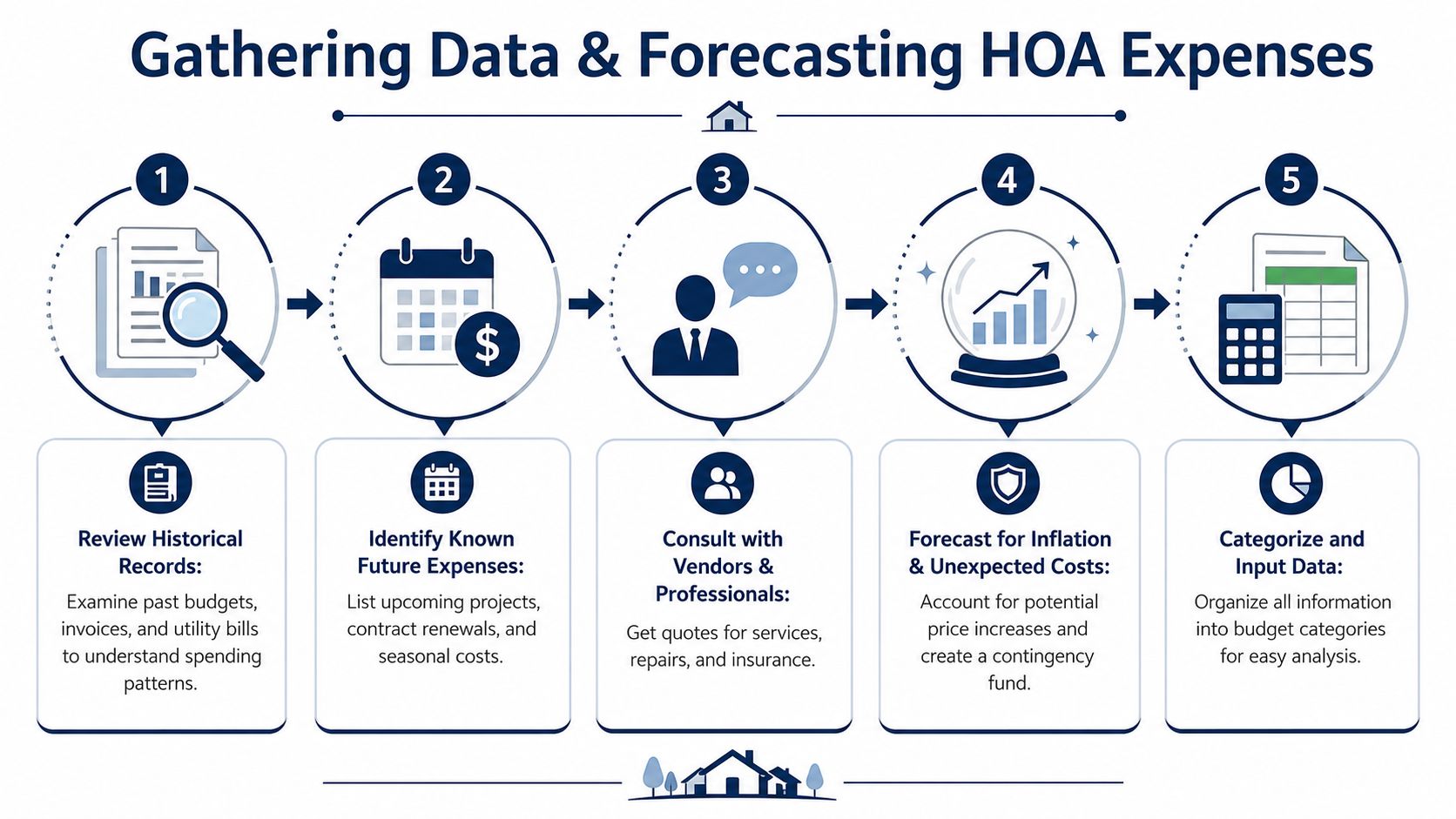
A practical forecasting workflow looks like this:
- Review historical records for actual spending patterns and recurring overruns.
- Flag known future obligations such as contract renewals, seasonal services, and major projects.
- Ask vendors for updated pricing before the budget is locked in.
- Adjust for inflation and contract terms where the association can't control the increase.
- Load the numbers into categories so the board can see where the money is going.
The point is not to predict everything perfectly. The point is to keep the budget conservative enough that the board doesn't have to explain a midyear shortfall as though it came out of nowhere.
Treat the forecast like a living estimate, not a wish list. If a line item keeps overrunning, the budget should admit it.
Planning for the Future with a Reserve Study
Boards feel the pressure most sharply when reserve funding competes with the desire to keep dues low. That pressure is real, but it's also where communities get into trouble. A budget can look balanced and still be structurally weak if the reserve contribution is treated like a negotiable extra instead of a core obligation.

Why reserve discipline matters
A reserve study gives the board a roadmap for major repairs and replacement timing, then helps translate that roadmap into annual funding decisions. The board should treat it as a planning tool, not a document to file away after approval. Professional guidance also recommends a reserve study refresh cycle of at least every three years as noted in reserve study guidance.
A significant risk is deferred maintenance. When a board keeps reserves artificially low to reduce dues pressure, it may win short-term approval and create long-term pain. That pain usually shows up as larger special assessments, more emergency decision-making, and a harder sell to future buyers.
For a more detailed explanation of reserve study basics, this overview of HOA reserve studies is a helpful reference point.
A “balanced” budget isn't automatically a healthy budget. If reserves are the pressure valve, the association is borrowing peace of mind from the future.
What boards should look for in the reserve plan
The reserve study should identify major components, estimate useful life, and guide how much should be contributed now to prepare for future replacement. Boards don't need to become engineers, but they do need to ask whether the annual contribution still matches the study and whether the study itself is current enough to be reliable.
That conversation is where good governance happens. A treasurer who can explain why reserves are funded the way they are gives the board a stronger position in front of owners. A treasurer who can't explain it usually ends up defending a decision that feels improvised, even when it isn't.
Calculating Assessments and Gaining Board Approval
Once the expenses and reserve contributions are set, the next question is simple. How much does each owner need to pay? That calculation should be visible, not hidden behind a lump sum that only the treasurer understands.
Turn the budget into an assessment
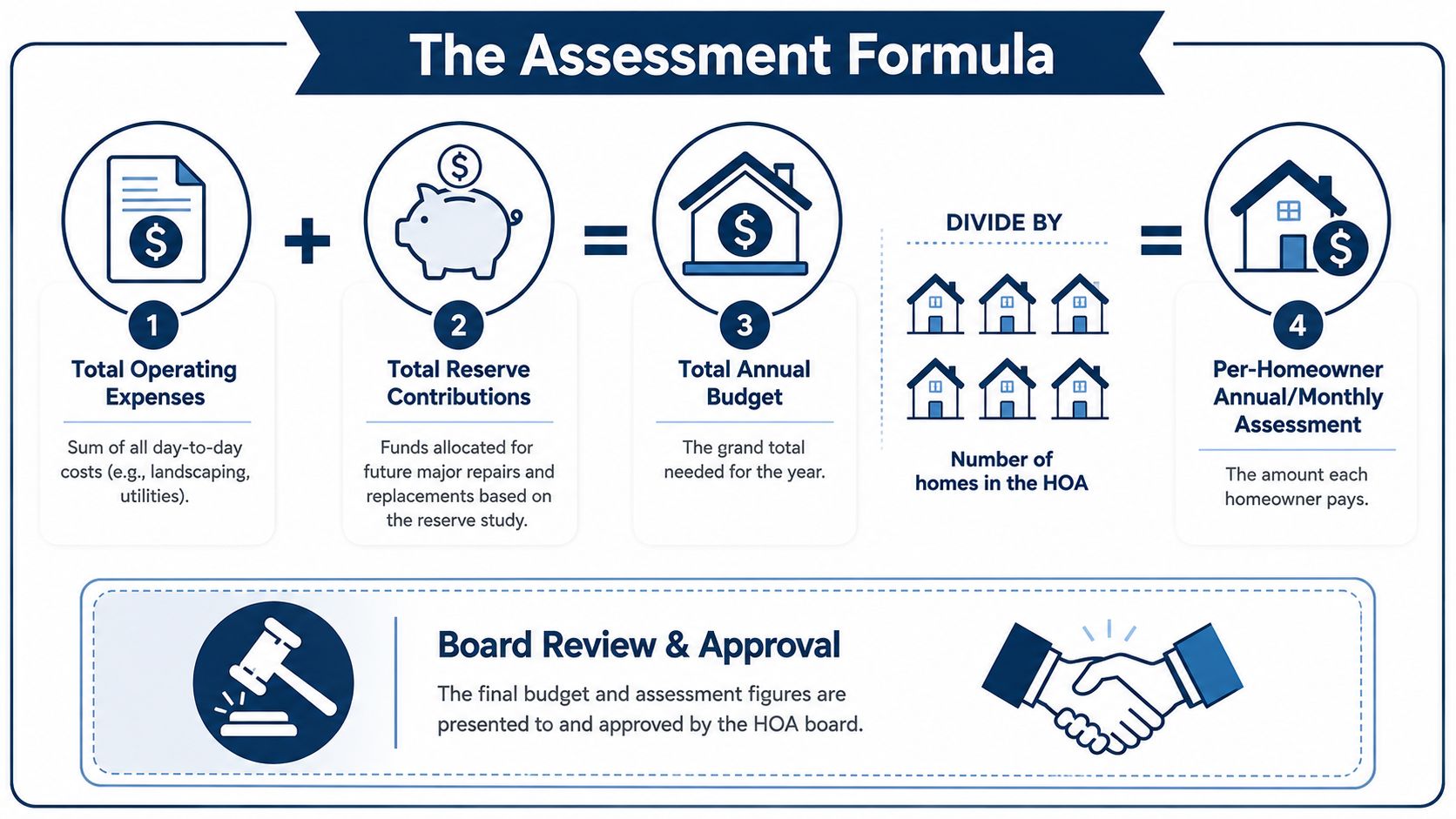
The basic formula is straightforward, (Total Operating Expenses + Total Reserve Contribution – Other Income) / Number of Units / 12 months = Monthly Assessment. That structure keeps the math consistent and helps the board explain where the dues number comes from.
For a deeper look at how homeowner dues fit into the overall financial picture, this assessment resource is a useful companion. The key is not the formula alone, it's the board's ability to trace every part of it back to documented assumptions.
Review the budget before the vote
A board should never approve a budget without a side-by-side comparison of the proposed numbers against prior-year figures. Material changes should be explained line by line, especially where a category moved because of vendor pricing, insurance renewal, or reserve funding needs. That kind of variance analysis is what makes the board's decision defensible.
Some decisions may also require owner approval. If a regular assessment increases by more than 20% over the preceding year's regular assessment, or if a special assessment exceeds 5% of the budgeted gross expenses for that fiscal year, owner approval is typically required under published HOA budgeting guidance.
The board should check those thresholds before it announces the final numbers. A late surprise is bad governance, even when the math is sound.
If the board can't explain a dues increase in plain language, homeowners will assume the budget is either confusing or incomplete.
Communicating the Budget to Homeowners Effectively
An approved budget that no one understands is a missed opportunity. Homeowners don't need accounting jargon, but they do need a clear explanation of what changed, why it changed, and what the board gave up, if anything, to keep the budget workable.
Make the comparison easy to read
The most effective homeowner packet shows three columns, last year's budget, last year's actual spending, and the new proposed budget. That format gives residents context instead of a single number dropped into an email with no explanation. It also lets them see whether a line item changed because the board planned differently or because the community spent more than expected.
A strong summary should call out major cost drivers in plain language, not generic labels. If insurance is driving the increase, say so. If landscaping needs more attention because the contract changed, say that too. The more specific the explanation, the less likely homeowners are to assume the board is padding the numbers.
This homeowner communication guidance aligns with that approach, especially the recommendation to present the budget next to prior-year budget and actuals as a comparison.
Say what the budget protects
Homeowners are more willing to support a dues change when they understand what it prevents. A budget that funds reserves properly can reduce the chance of a large future assessment. A budget that keeps utilities, maintenance, and insurance on track helps protect the value of the property they already own.
That framing matters because trust is built through clarity, not volume. If the board keeps the explanation short, specific, and comparative, the annual meeting usually gets easier. If the board sends out a dense spreadsheet with no context, it invites frustration.
The best budgets don't just balance. They help the community understand how financial discipline protects the place they live in every day.
If your board is building its first budget or tightening an existing one, partner with Access Management Group for practical support that helps your homeowners, your board, and your president make confident, transparent financial decisions.