A homeowner emails the board about a disputed fine. At the same time, another owner's assessment is overdue, and a director wants to know whether the association can record a lien. The manager asks whether the community is governed by the Georgia Property Owners' Association Act, and nobody can find the recorded declaration that answers the question.
That situation is common because HOA laws in Georgia don't come from one universal rulebook. A community's recorded covenants, its corporate documents, the optional Georgia Property Owners' Association Act, and the new Georgia Property Owners' Bill of Rights Act can all affect what a board may do. The safest board decision starts with identifying the governing framework, then following the required notice, voting, recordkeeping, and enforcement process.
Why HOA Laws in Georgia Matter to Every Board Member
A late assessment rarely stays a simple accounting issue. If the board sends a demand to the wrong address, skips a required notice period, or relies on a remedy that the community never adopted, the unpaid balance may remain due while the association loses valuable enforcement power. A disputed architectural fine can create the same problem if the owner never receives a meaningful opportunity to respond or the board fails to document why it imposed the fine.
Georgia's legal framework has three important layers:
- Recorded covenants and corporate documents. These establish the community's private rules, assessment authority, architectural standards, voting provisions, and enforcement procedures.
- The optional Georgia Property Owners' Association Act. The Act is codified at O.C.G.A. §§ 44-3-220 through 44-3-235 and contains 17 statutory sections. It applies only when the recorded declaration affirmatively elects to place the community under the Act (Georgia Property Owners' Association Act overview).
- The 2026 Georgia Property Owners' Bill of Rights Act. Senate Bill 406 was signed on May 12, 2026, after legislative approval of 155–10 in the House and 51–0 in the Senate (Bill of Rights Act timing and requirements).
The third layer adds statewide registration requirements and new procedural protections, but it doesn't erase the recorded declaration. A board still has to know what its covenants say, whether the POAA applies, and which provisions of Senate Bill 406 are already effective.
Start with the governing documents
Before the next meeting, pull the recorded declaration from the county land records. Look for an affirmative election under the POAA, then compare the declaration with the bylaws, articles of incorporation, rules, collection policy, and fine schedule.
Practical rule: Never assume that a community has POAA authority because it calls itself an HOA. Confirm the election in the recorded declaration before using a statutory remedy.
Board members also owe duties of care, loyalty, and good faith regardless of whether the community opted into the POAA. Informal shortcuts create exposure most often around meetings, assessments, fines, owner records, and financial decisions. A careful board doesn't need to treat every disagreement like litigation, but it does need a repeatable process that shows owners received fair notice and directors acted from reliable information.
The Georgia Property Owners' Association Act Explained
A board approves a lien, sends a collection notice, and later learns that the community never elected to operate under the Property Owners' Association Act (POAA). The unpaid assessment may still be valid, but the board may have used a statutory remedy it did not have. That distinction can affect the notice, lien, foreclosure process, and cost of correcting the file.
The POAA operates through the community's recorded declaration. County land records, rather than a former director's recollection or the neighborhood's use of the term “HOA,” provide the reliable starting point. The declaration should be reviewed alongside the bylaws, articles of incorporation, rules, collection policy, and fine schedule.
Once the recorded documents support POAA coverage, the Act can supplement the community's private covenants with statutory tools. Depending on the facts and the requirements followed, those tools may address assessment liens, foreclosure procedures, member-meeting defaults, and association records. A community relying only on its covenants may still enforce valid restrictions and collect authorized assessments, but its authority and procedures come primarily from those documents and applicable general law. The statutory framework is summarized in the Georgia POAA statutory framework.
Apply the right authority to the right action
The board should create a document trail before approving collection or enforcement. Start with the specific action, then identify the authority supporting it:
- Assessment: Does the declaration authorize this charge? If so, what statutory remedy, if any, is available?
- Notice: Which address, delivery method, timing, and content apply to the proposed action?
- Decision: Can the board act on its own, or do the governing documents require a membership vote?
- Enforcement: Does the restriction clearly cover the alleged violation, and has the association followed its adopted process?
- Records: Can the association produce the declaration, minutes, owner ledger, notices, photographs, correspondence, and other supporting documents?
This checklist prevents a common mistake: treating a correct conclusion as permission to skip the required procedure. An owner may owe an assessment, or a violation may be real, while the association's notice or decision process remains defective.
| Governance Area | POAA-Applicable Association | Covenants-Only Association |
|---|---|---|
| Authority | Recorded declaration, the POAA, and other governing documents | Recorded covenants, bylaws, corporate documents, and applicable general law |
| Assessments | The documents and applicable statutory provisions may support collection and a statutory lien | Collection rights depend primarily on the recorded documents and applicable law |
| Liens and foreclosure | The POAA may supply procedures when its conditions are met | The association must identify authority and procedure outside the POAA |
| Meetings | Statutory default notice rules may apply when the documents do not control | The declaration, bylaws, and corporate documents provide the procedure |
| Enforcement | Statutory tools may supplement covenant enforcement | Enforcement depends on the restrictions and adopted procedures |
For board work, the safest sequence is straightforward: locate the recorded declaration, confirm the governing framework, identify the authority for the proposed action, and match every notice to the applicable rule. If the documents conflict or the election is unclear, pause the remedy and obtain Georgia legal advice before the association creates a larger authority problem.
The 2026 Property Owners' Bill of Rights Act
A board preparing its next violation notice may face two questions at once: does the declaration authorize the action, and does the new Georgia Property Owners' Bill of Rights Act add a compliance step? Senate Bill 406 was signed into law on May 12, 2026, with provisions taking effect in stages (Georgia Senate Bill 406 effective dates).
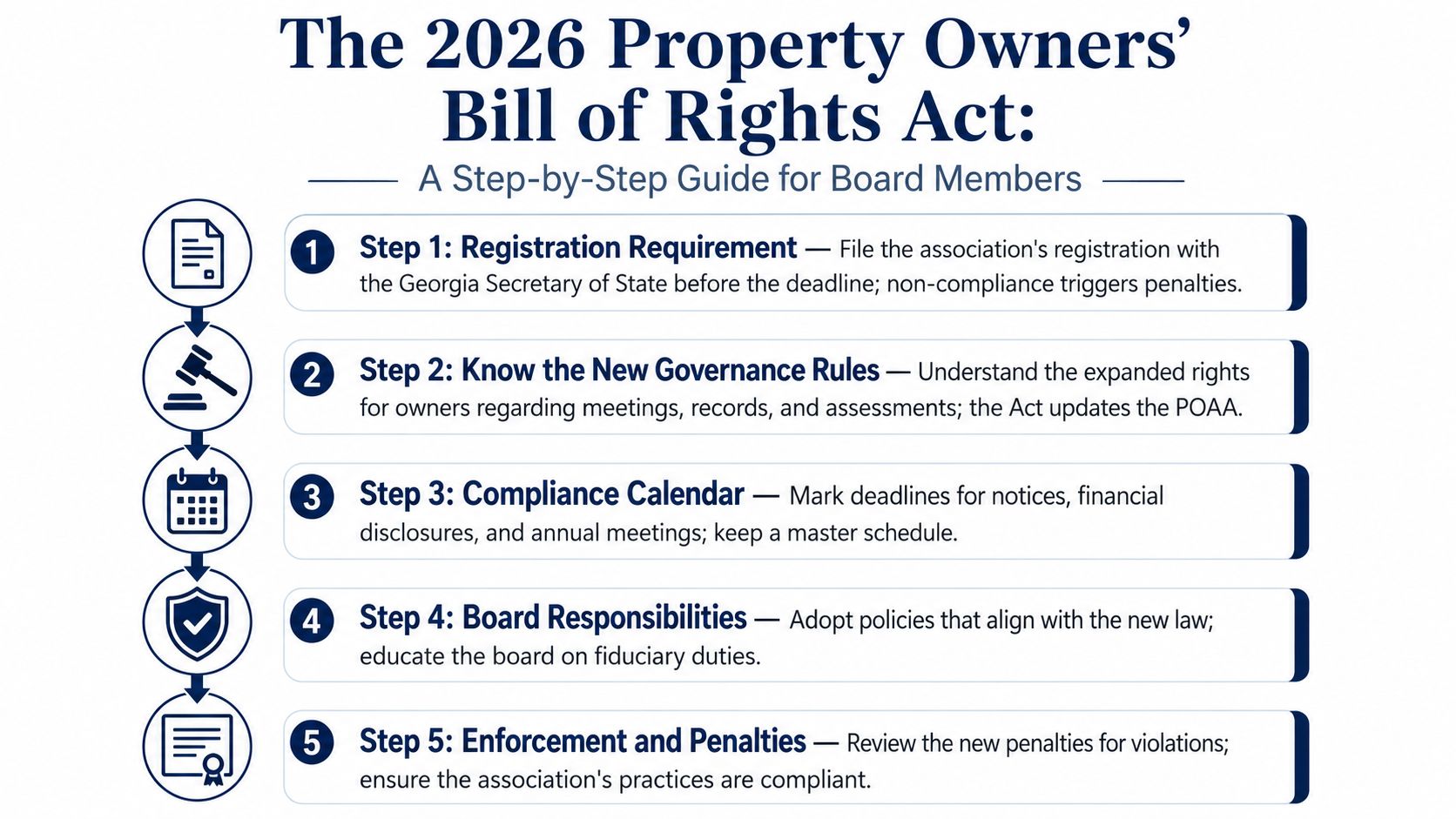
Registration becomes a central operating task. The law requires homeowners' associations to register with the Georgia Secretary of State, and an association may not operate under the POAA without registration. The board should identify the association's name, contact information, and the officer or managing agent who will receive official correspondence. Assign responsibility for maintaining the registration record so it remains current through director and management changes.
The timeline creates two compliance tracks:
- July 1, 2026: The attorney-fee and reasonableness provisions apply to actions filed on or after this date. Fee recovery is limited to amounts proportionate to the work performed.
- January 1, 2027: Most remaining provisions, including the registration requirement and other compliance duties, are scheduled to take effect on this date. Boards should treat it as a forward-looking deadline and complete the needed setup before then.
The practical risk is broader than an incomplete form. A noncompliant association may lose the ability to collect fines, issue liens, or begin foreclosure proceedings. Registration should therefore operate like a control on the association's checklist, verified before enforcement files advance.
Prepare the board's compliance file
Before the applicable dates, the president and directors should:
- Confirm whether the community is governed by the POAA.
- Review the declaration, bylaws, collection policy, fine schedule, and records policy.
- Update collection notices and attorney-referral procedures.
- Confirm the Secretary of State registration process and responsible contact.
- Train directors, committee members, and managers on the revised workflow.
- Add effective dates and recurring duties to the board's compliance calendar.
The Bill of Rights sits alongside existing association authority. Recorded covenants still define community restrictions, and the governing documents still guide board action. The revised workflow adds registration verification, updated notices, and a documented review before fines, liens, foreclosure, or attorney-fee requests proceed. A board can preserve its existing files while adding those checkpoints.
For a board-focused explanation of the legislation, review Georgia Senate Bill 406 and the new era of HOA governance, then ask Georgia counsel to confirm how the association's documents and active enforcement files fit the new requirements.
Meetings, Notices, and Records the Right Way
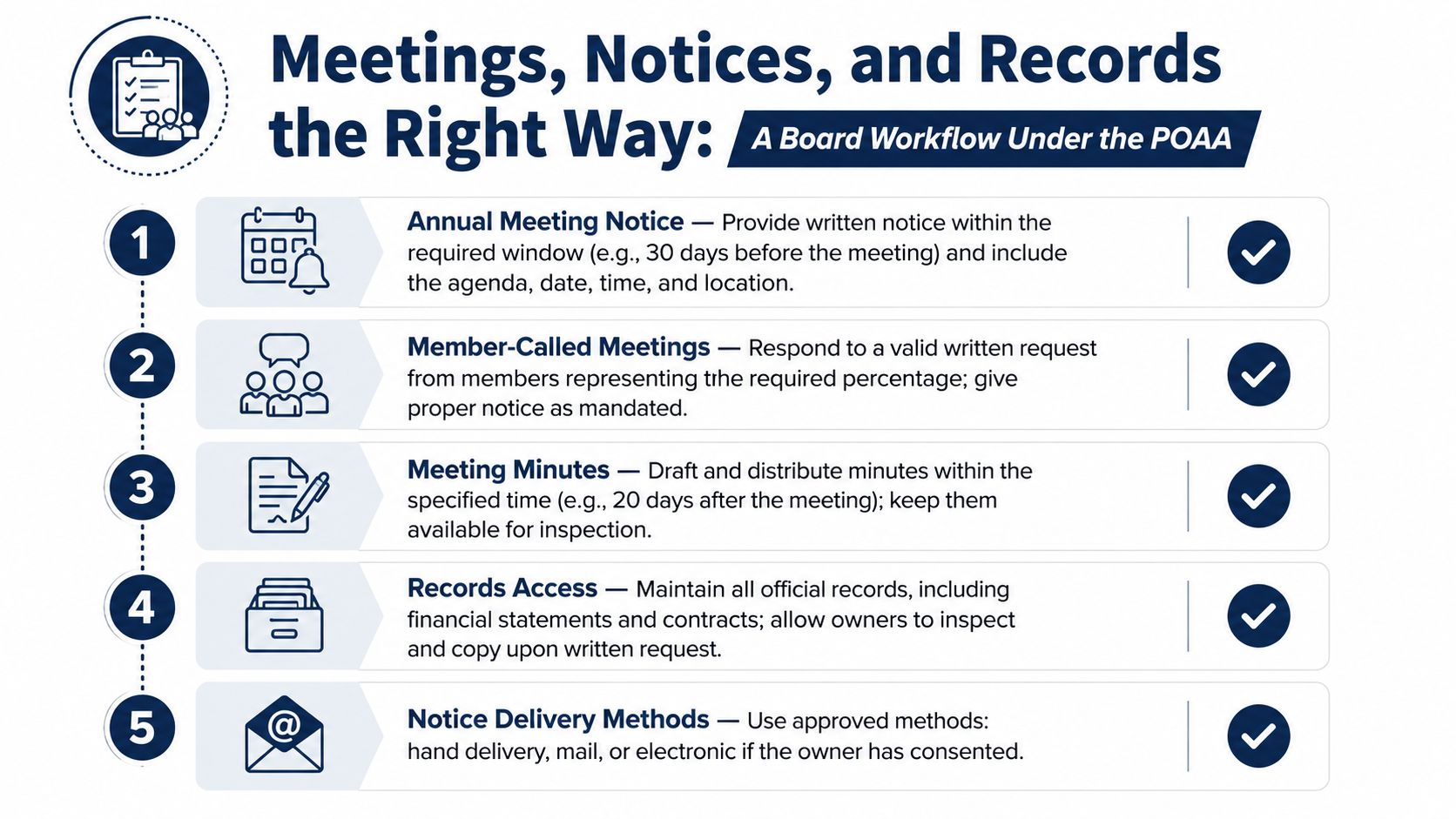
A defensible meeting begins before the notice goes out. Under Georgia's POAA default rules, annual or regular member meetings require 21 days' notice, while other member meetings require 7 days' notice. A special-meeting notice must state the purpose of the meeting (Georgia HOA meeting and notice rules).
That distinction matters because member meetings and board meetings aren't interchangeable. A membership vote may require a specific notice window, agenda language, quorum, and voting method. A board meeting still needs an organized agenda, accurate minutes, and a clear record of the motion and vote, even when the governing documents impose fewer notice details.
Build a repeatable meeting file
Use one file for each meeting, whether electronic or paper:
- Before the meeting: Confirm authority, notice recipients, delivery method, agenda, supporting documents, and expected quorum.
- At the meeting: Record attendance, quorum, motions, abstentions, conflicts, vote totals, and any owner comment permitted by the governing documents.
- After the meeting: Prepare minutes promptly, approve them through the proper process, preserve the final version, and store the notice and exhibits with the minutes.
Records requests deserve the same discipline. Financial statements, contracts, invoices, minutes, ballots, and correspondence should be organized so the association can identify responsive documents without searching through personal email accounts. Redact private information when appropriate, but don't use confidentiality as a blanket reason to withhold ordinary association records.
A clean record answers three questions: What did the board know, what authority did it use, and why did it choose this action?
Quorum is a document-specific issue. For Georgia condominiums, the default membership quorum is more than one-third of the association's votes at the start of the meeting, unless the condominium instruments or bylaws provide otherwise. For condominium board meetings, the default quorum is one-half of the board's votes, unless the governing documents require a larger percentage (Georgia condominium quorum statute).
The board should verify whether the community's declaration or bylaws change those defaults. A vote taken without quorum can be challenged even when every director believed the underlying decision was sensible.
Assessments, Liens, and Foreclosure in Georgia
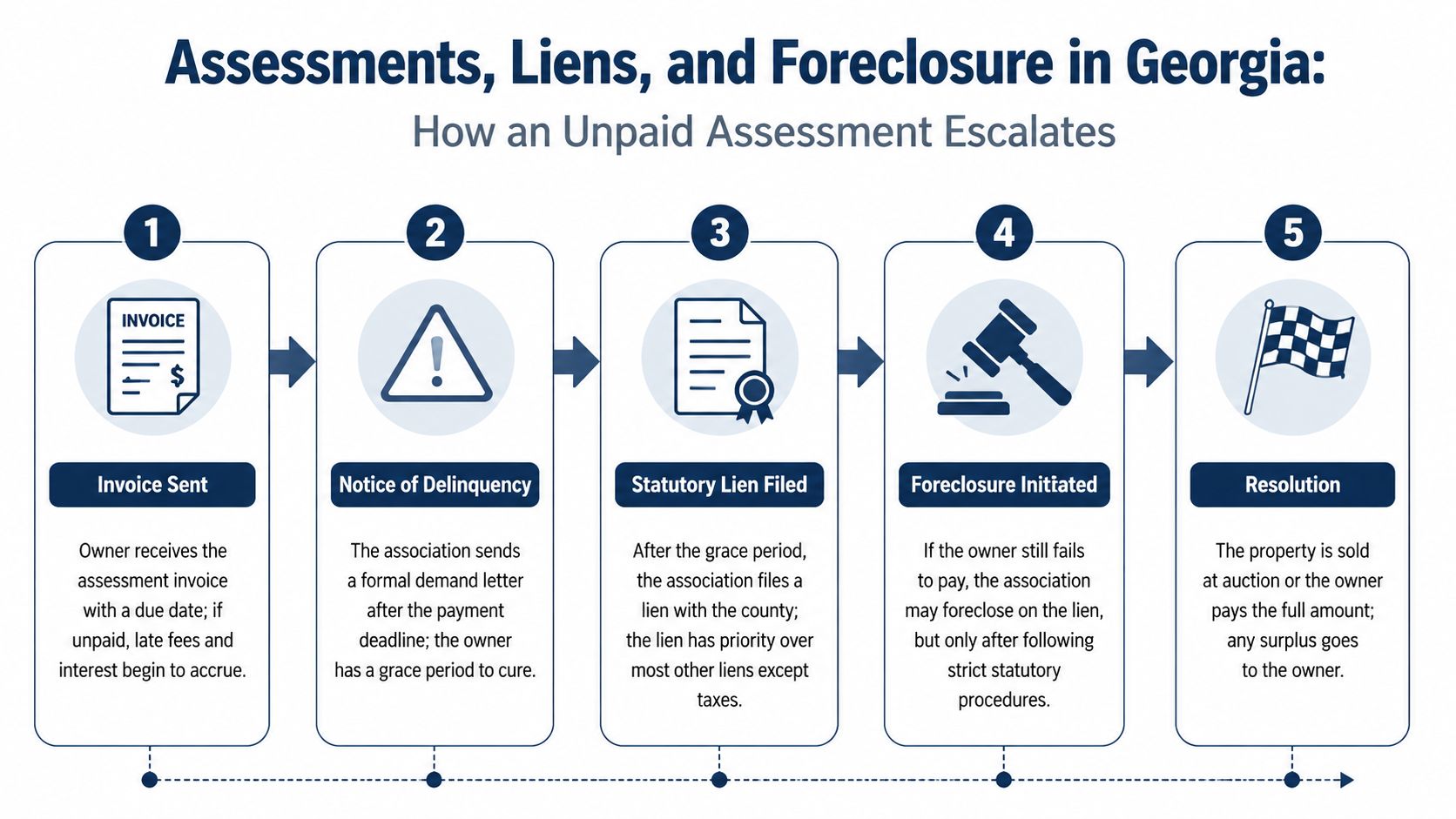
In a POAA-governed community, an assessment becomes the owner's personal obligation and a statutory lien when it is due. The association doesn't need to file a separate claim of lien to create that statutory lien, but foreclosure still requires strict process controls (Georgia statutory assessment lien and foreclosure provisions).
The collection file should show the charge, due date, ledger, late charges and interest authorized by the governing documents, all notices, delivery evidence, and payments received. If the account moves toward foreclosure, the association must provide at least 30 days' notice after sending the notice by certified mail or statutory overnight delivery. The lien is foreclosable only when the debt reaches at least $2,000 under the POAA (Georgia HOA foreclosure notice requirements).
A $1,800 account illustrates the boundary
Suppose an owner's verified delinquency is $1,800. The amount remains a debt, and the statutory lien can still exist in a POAA-governed community. The association should send the required notices, maintain the ledger, and offer the owner a clear way to confirm the payoff amount.
But the $2,000 foreclosure threshold has not been met. The board shouldn't treat the lien's existence as permission to foreclose. It should continue lawful collection activity, check whether later authorized assessments or charges change the balance, and obtain legal review before choosing a remedy.
The notice is not a ceremonial letter. It's the gate that protects the association's rights and the owner's opportunity to cure. A wrong address, incomplete amount, defective delivery, or incorrect timing can undermine foreclosure even though the owner still owes the underlying balance.
Review every file before escalation
- Verify the ledger: Separate assessments from fines, fees, interest, payments, and credits.
- Confirm authority: Match every charge to the declaration, adopted policy, or applicable statute.
- Check delivery: Preserve certified-mail or statutory-overnight-delivery records and return receipts.
- Calculate carefully: Confirm whether the debt meets the statutory foreclosure threshold.
- Escalate deliberately: Obtain counsel's review before filing a lien-related foreclosure action.
For a practical discussion of how an association lien affects collection work and property transactions, see Georgia homeowners' association liens. The board's strongest position comes from an accurate account and a complete process file, not from sending increasingly aggressive letters.
Enforcement, Fines, and Dispute Resolution Options
Covenant enforcement should be proportional, consistent, and documented. Most boards should begin with a courtesy notice or violation notice that identifies the rule, the observed condition, the requested correction, and the response deadline established by the governing documents.
A fine should come later, not because the board wants to punish an owner, but because the association needs a fair opportunity to correct the record. The owner should receive the notice required by the declaration, fine policy, and applicable law, along with an opportunity to respond or attend a hearing when required. The board should consider the response, identify the facts it relied on, and record the decision without turning the minutes into an argument.
Match the response to the dispute
A maintenance violation, an assessment delinquency, and an architectural disagreement may all arrive in the same inbox, but they shouldn't follow the same workflow. Architectural authority usually comes from recorded covenants and architectural guidelines. Assessment collection follows the financial provisions discussed earlier. A fine must be tied to an authorized rule and an adopted enforcement process.
| Method | Typical Trigger | Statute or Authority | Practical Limit |
|---|---|---|---|
| Courtesy or violation notice | Alleged covenant or rule violation | Recorded covenants and adopted rules | Doesn't resolve a disputed fact by itself |
| Hearing before a fine | Owner contests the violation or proposed fine | Governing documents, fine policy, and applicable POAA provisions | Board must consider the response and follow notice requirements |
| Mediation | Parties need a negotiated solution | Voluntary agreement or applicable dispute provisions | Requires both sides to participate constructively |
| Non-binding arbitration | Documents or parties select a structured neutral process | Governing documents or agreement | Outcome may not be final without further action |
| Small Claims Court | Straightforward money dispute within that court's jurisdiction | Georgia court rules and underlying assessment authority | Not suited to every title, injunction, or complex covenant matter |
| Superior court | Larger, complex, equitable, or property-rights dispute | Georgia civil procedure and governing documents | More formal, expensive, and counsel-intensive |
Mediation can be useful when the owner disputes the facts but wants a practical resolution. Small Claims Court may fit a limited money dispute, while superior court is more likely to be appropriate when the association seeks complex relief, addresses title issues, or faces a substantial covenant challenge. The board shouldn't select a forum based only on frustration or the age of the account.
Keep communications professional. Don't threaten foreclosure when the statutory threshold or registration requirement hasn't been verified, and don't describe a board decision as final if the documents provide an appeal or hearing path. A consistent process protects homeowners from arbitrary enforcement and protects directors from the appearance that they singled out a particular owner.
Financial Transparency and Fiduciary Responsibilities
Financial transparency isn't separate from fiduciary responsibility. A board can't approve a responsible budget if it can't explain the ledger, reserve position, contracts, assessments, and expected capital needs to the owners.
Georgia's POAA gives owners, mortgagees, buyers under contract, and prospective lenders a way to request a written payoff statement for past-due assessments, late charges, and interest by delivering the request to the association's registered office. The Act also requires detailed financial records and annual reporting. Georgia doesn't impose a statewide reserve-study or reserve-funding formula comparable to some other major markets, so reserve policy generally depends on the declaration, the budget, and the board's documented fiduciary judgment (Georgia HOA financial and information rights).
That doesn't make reserves optional as a governance concern. It means the board must explain how it reached its decision. Keep operating and reserve funds properly separated, review contracts before approval, disclose conflicts, and document why a special assessment or capital project is necessary.
Use a financial decision checklist
Before a financial vote, ask:
- Do we have a current ledger and supporting invoices?
- Does the declaration authorize the charge or expenditure?
- Have directors disclosed conflicts of interest?
- Are reserve needs documented separately from routine operating expenses?
- Did owners receive the notice or information the governing documents require?
- Can the board explain the decision in the minutes without relying on undocumented conversations?
The board, not the manager, owns the duty to act in good faith and with reasonable care. A manager can maintain records, prepare reports, and administer a policy, but directors approve the budget, authorize contracts, respond to owner concerns, and make the final governance decisions.
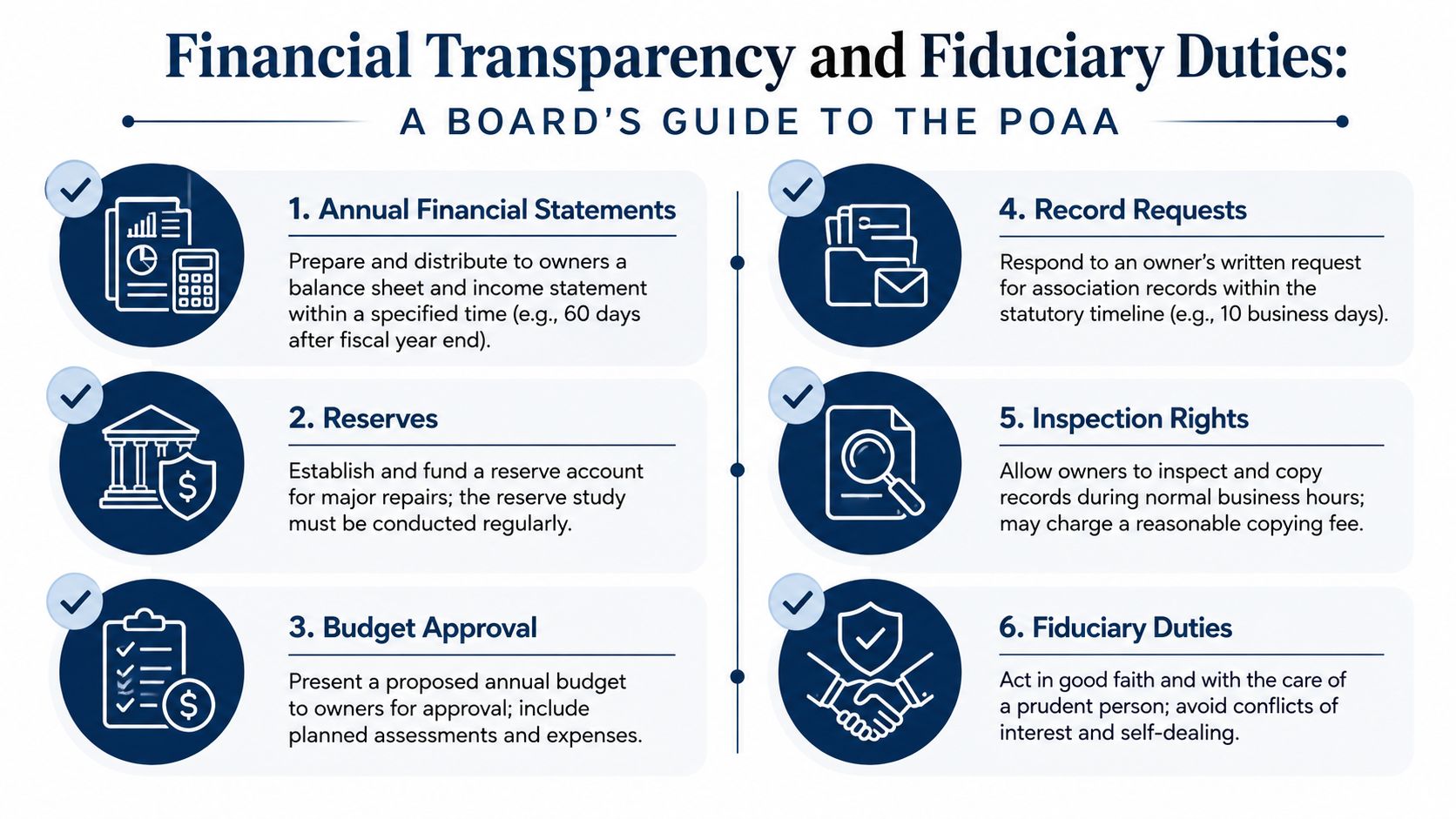
A board member who wants a deeper legal orientation can review these fiduciary duty resources for Georgia from Morgan & Morgan Attorneys at Law P.C. For day-to-day treasury controls and board oversight, the guide to HOA treasurer responsibilities can help turn broad duties into recurring tasks.
The annual financial calendar should include budget preparation, owner communication, board adoption, reserve contribution review, financial statement preparation, and a documented response process for records requests. Before each vote, apply one rule: identify the authority, verify the facts, consider the owners' interests, disclose conflicts, and preserve the reasoning in the records.
Access Management Group helps HOA and COA boards organize management, accounting, records, compliance calendars, and owner communication around the governing documents and Georgia's changing requirements. Visit Access Management Group to discuss a management structure that gives your board a clearer process for assessments, meetings, financial oversight, and Bill of Rights preparation.