A new director joins the HOA board with good intentions, then discovers that the first meeting includes a budget question, a delinquent account, a vendor dispute, and an owner demanding an explanation for a rule violation. Without an orderly introduction, that volunteer is expected to make consequential decisions while still trying to understand the governing documents.
That's why HOA board of directors training should begin with homeowner protection. A useful program gives directors a shared decision-making framework, records what they learned, and creates practice opportunities before a difficult enforcement, financial, or emergency issue reaches the agenda.
Why HOA Board Training Protects Homeowners First
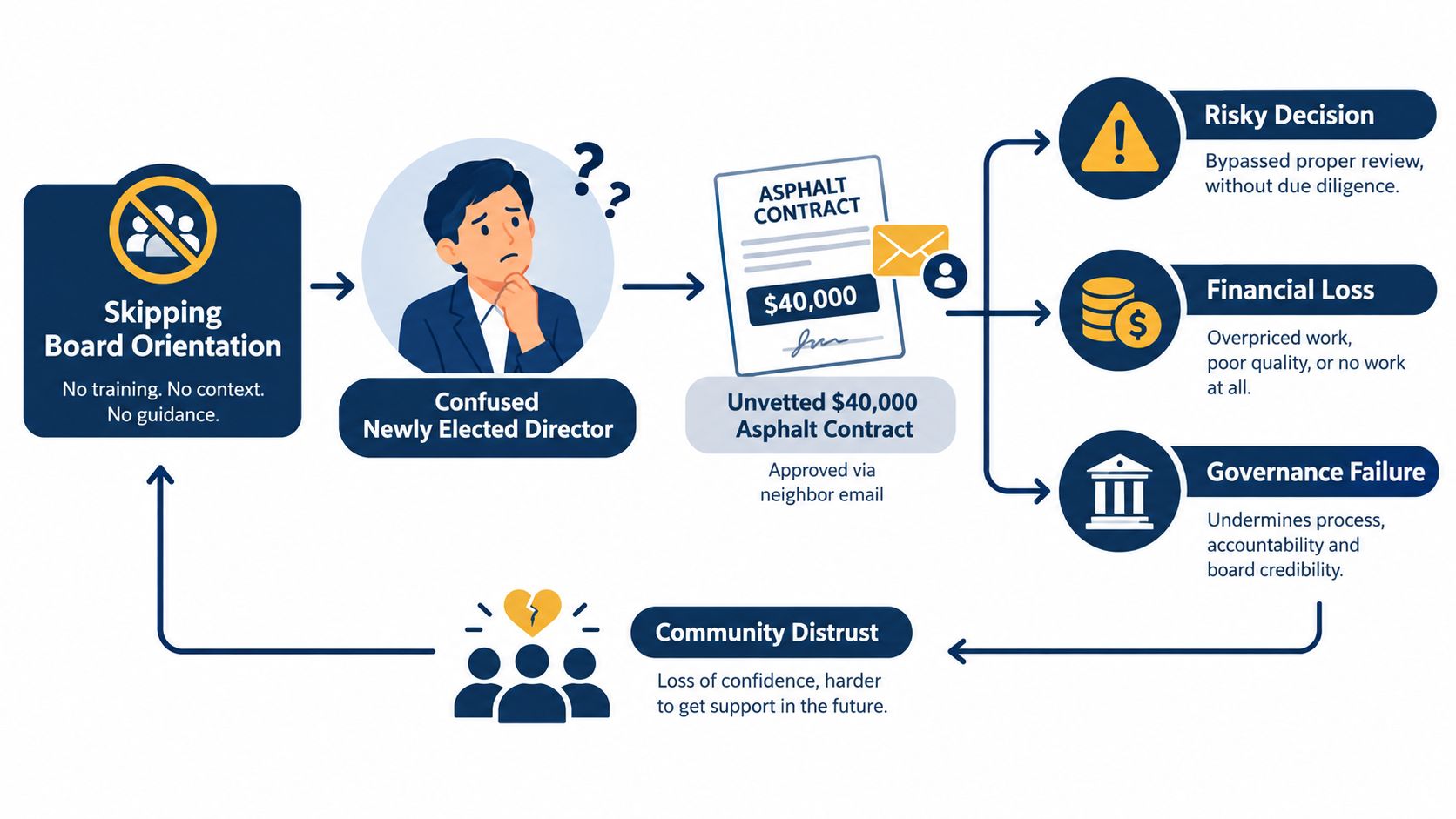
A newly elected director skips orientation, approves a $40,000 asphalt contract after a neighbor forwards an email, and then receives calls from homeowners asking what happened to their reserve contribution. The problem isn't necessarily bad intent. The problem is that nobody showed the director how to compare bids, verify authority, review reserve objectives, or document the board's reasoning.
Homeowners feel the consequences first. Inconsistent enforcement can create Fair Housing complaints. A contract approved without bid documentation can expose the association to disputes over favoritism or inadequate oversight. Weak reserve planning can leave owners facing a special assessment when a major component fails.
Practical rule: Treat training as a control system for association decisions, not as a benefit reserved for directors.
Put the same baseline in front of every director
A documented onboarding process should give each board member the same core information:
- Fiduciary duties: Explain the duty to act in the association's interests, use reasonable care, and avoid personal decision-making.
- Governing documents: Identify the declaration, bylaws, rules, plat, policies, and applicable statutes, then show which document controls a particular question.
- Meeting procedure: Cover notice, agendas, quorum, motions, votes, executive sessions, and minutes.
- Financial oversight: Show directors how to read reports, distinguish operating expenses from reserves, and ask about variances.
- Compliance records: Keep signed acknowledgements, certificates, attendance records, and assessment results in an organized board file.
A role-specific checklist helps the president assign learning without turning every meeting into an improvised tutorial. A standing calendar then gives the board a predictable opportunity to address legal updates, financial controls, reserves, enforcement, and communication.
The same governance principle applies beyond associations. A practical discussion of best practices for care providers can also help presidents think about orientation, accountability, and documented oversight in organizations serving people with complex needs.
Training won't make a volunteer an attorney, engineer, or accountant. It will help that volunteer recognize when the board needs professional advice, ask better questions, follow the right procedure, and preserve the reasoning behind a decision. That converts good intentions into defensible governance, protecting homeowners, the association's books, and directors personally.
What Every Board Member Must Learn and Why
Training requirements depend on the jurisdiction, the type of association, and the director's appointment or election date. Florida provides one of the clearest major-market examples. Under Florida's community association education guidance, directors elected or appointed on or after July 1, 2024 must complete education for newly elected or appointed board members within 90 days. HOA associations with fewer than 2,500 parcels must provide at least 4 hours of annual continuing education, while associations with 2,500 or more parcels must provide 8 hours annually. The association must retain each director's written certification or educational certificate for 5 years.
Florida's new-director curriculum includes financial literacy and transparency, recordkeeping, levying fines, and notice and meeting requirements. Those subjects matter because they connect directly to owner assessments, official records, enforcement decisions, and the public conduct of board meetings. Ontario offers a different North American benchmark, requiring condominium directors to complete training within 6 months of election or appointment, as summarized in this overview of condominium board certifications.
The core should be broader than the statute
Even where education is voluntary, a complete program should cover:
- Governing documents and authority, so directors know whether a proposed action is permitted.
- Fiduciary duty and the business judgment rule, including conflicts of interest and director liability.
- Open meetings and records, including how to preserve communications and respond to requests.
- Collections and foreclosure limits, with attention to statutory notice and due-process requirements.
- Fair Housing basics, especially consistent treatment, reasonable accommodation questions, and neutral enforcement.
- Reserve funding, including the distinction between operating money and long-term capital obligations.
- Vendor oversight, from scope definition and bid review to insurance and contract approval.
A director should be able to connect each subject to a real decision within the first several months. A collections module should explain what happens when an owner requests a payment arrangement. A meeting module should address a proposed vote that wasn't properly noticed. A reserves module should help directors question whether a contribution recommendation reflects the association's obligations.
California illustrates why presidents shouldn't copy another state's checklist without checking local law. A 2026 California HOA legal Q&A reports that California has no general mandatory prerequisite for HOA board service, and that candidates or directors only need to be HOA members. That's materially different from Florida's certification model.
| Jurisdiction Type | Example States | Required Topics | Enforcement |
|---|---|---|---|
| Mandatory or structured | Florida, Nevada, and California condominiums are highlighted as statutory examples in industry guidance | State-defined education, certification, financial and governance subjects | Deadlines, certificates, retention duties, or service consequences may apply |
| Time-bound condominium model | Ontario | Director education within the statutory period | Completion deadline under the condominium regime |
| Voluntary or document-driven | Texas and many Mountain West communities | Governing documents, board policy, or voluntary programs determine the baseline | Enforcement usually depends on internal policy, governing documents, or broader legal duties |
For a broader risk-control perspective, presidents can review guidance on legal risk management for small businesses, then translate the same discipline into association governance. Directors should also receive a written explanation of HOA board member responsibilities before they vote on association business.
Core Curriculum Modules for a Complete Program
A strong curriculum does more than list legal subjects. It ties every module to a decision the board will make.
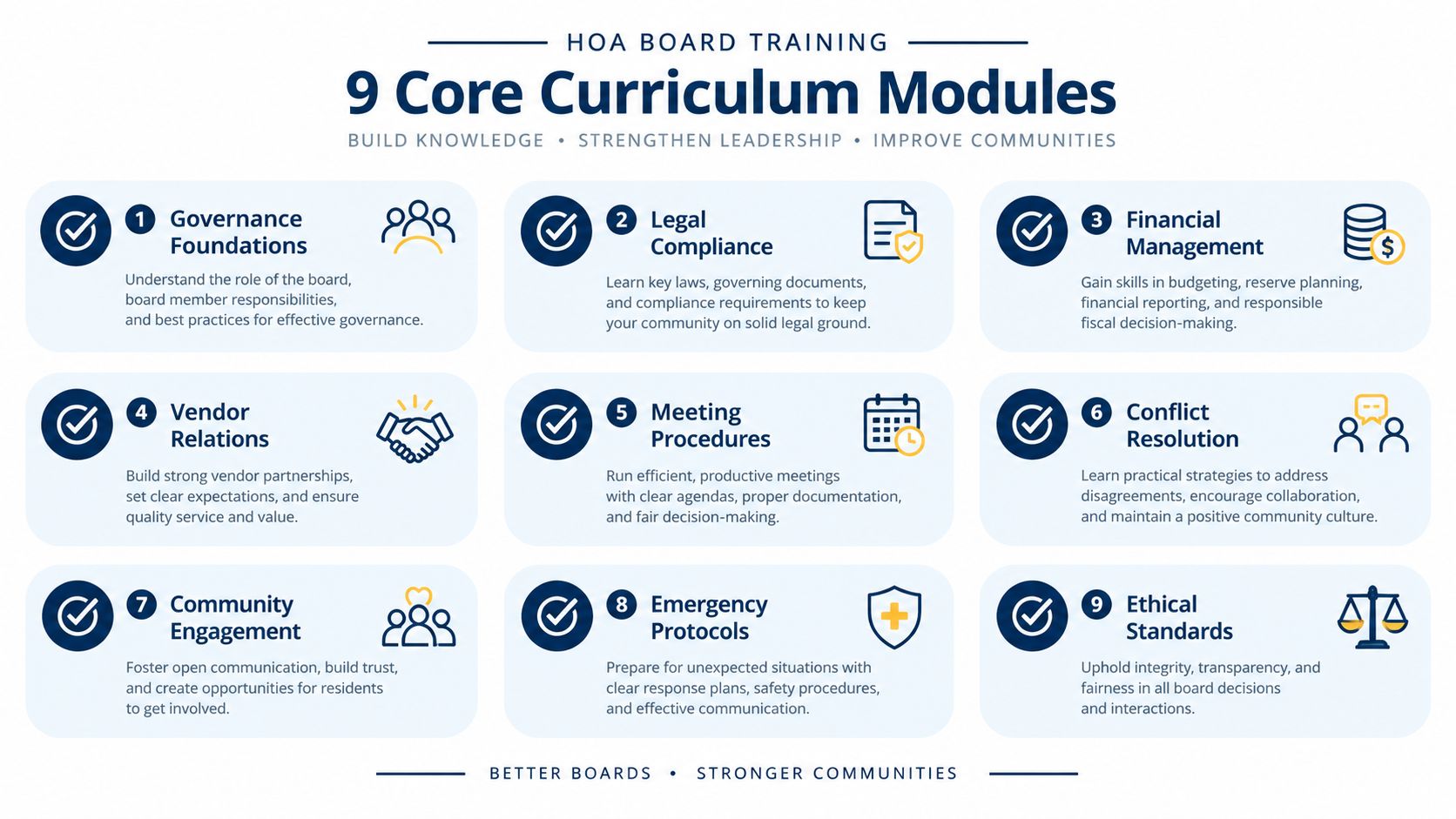
Nine modules that belong in the program
1. Governance foundations. Start with the articles of incorporation, bylaws, declaration, plat, rules, and amendment process. Give directors a practical exercise: locate the document that authorizes a proposed restriction or capital project.
2. Fiduciary and legal responsibilities. Explain fiduciary duty, the business judgment rule, conflicts of interest, confidentiality, and D&O exposure. A director should know when to disclose a personal connection to a vendor and when to leave the discussion.
3. Financial oversight. Review the bank reconciliation cycle, signing authority limits, budget-to-actual reports, delinquency reporting, and audit triggers. The board doesn't need to perform the accounting, but it must know what questions to ask. A resource on accounting for homeowners associations can support this part of the orientation.
4. Reserve planning. Distinguish operating expenses from capital expenses, connect component condition to funding decisions, and introduce the use of a reserve study every 3 to 5 years. The workshop should end with directors explaining why deferring a contribution can affect future owners.
5. Meeting craft. Teach agendas, quorum, motions, plain-English use of Robert's Rules, executive-session boundaries, and minutes that accurately capture action without becoming a transcript.
6. Vendor management. Cover scopes of work, RFPs, three-bid norms, references, insurance verification, contract terms, change orders, and performance documentation. The board should practice choosing the strongest proposal, not automatically the cheapest.
7. Enforcement and dispute resolution. Walk through notices, hearings, evidence, consistent application of rules, internal appeals, and ADR options. Directors need to separate a neighbor's history from the facts in the current file.
8. Insurance and operational risk. Include property coverage, liability, crime policies, D&O coverage, cyber coverage, deductibles, claims reporting, and incident documentation.
9. Communication and homeowner engagement. Set expectations for email retention, response channels, meeting communications, social media policy, records access, and communicating unpopular decisions without personal attacks.
The modules can be delivered as a compact initial course, then reinforced through shorter refreshers. The practical sizing question is how much time each association needs for discussion, documents, and exercises. A board with a complex capital program will need more reserve and vendor practice than a small, self-managed association with limited common elements. Record the planned hours, the instructor, the attendees, and the decisions used in each exercise.
The First 30 to 90 Days Onboarding Sequence
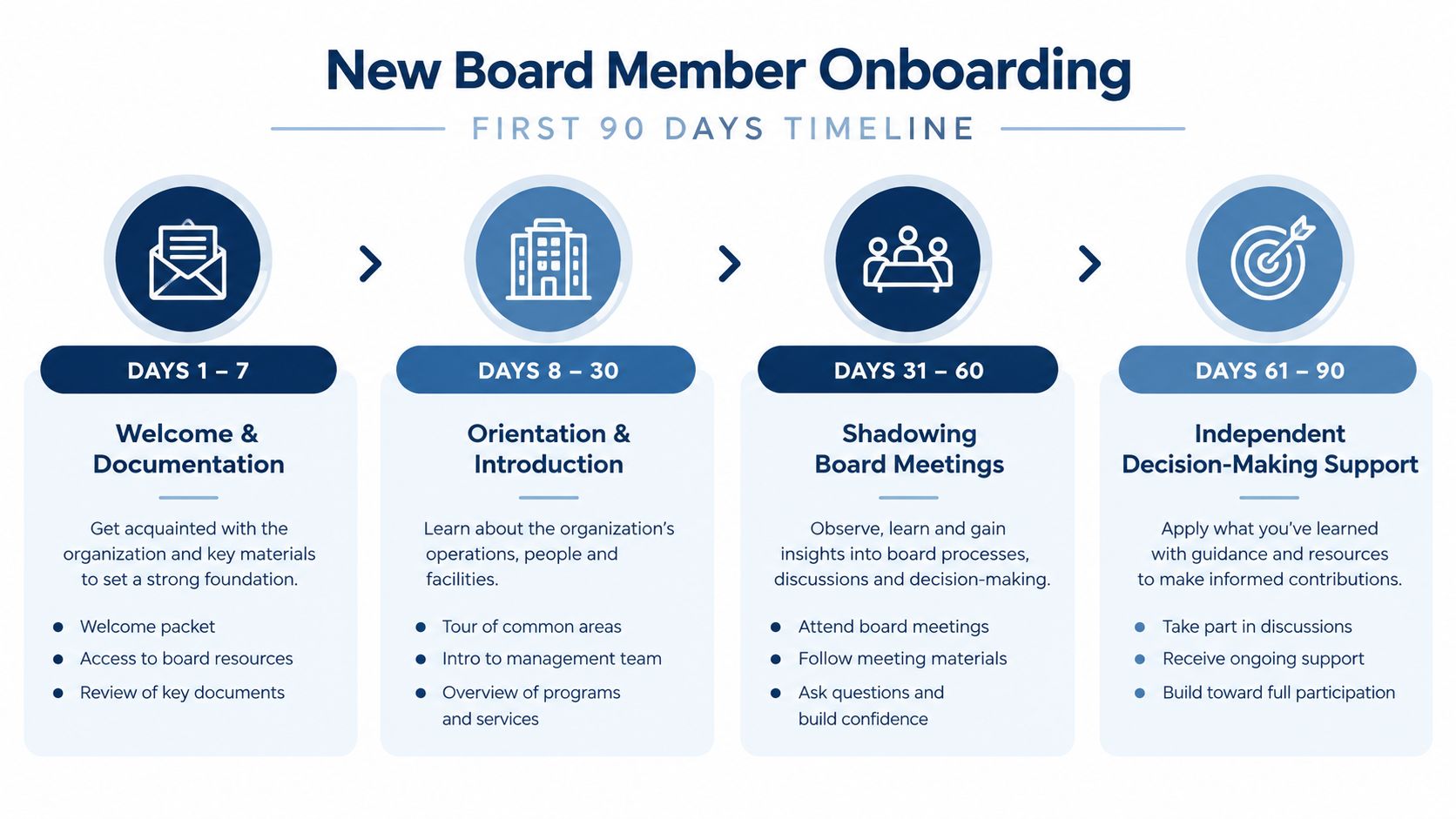
New directors learn faster when the association gives them a sequence instead of a digital folder full of disconnected documents. The president or community manager should assign an owner to every step and record completion as it happens.
Days 1 through 7
Deliver a welcome packet containing the governing documents, current budget, recent financial statements, recent meeting minutes, active contracts, insurance information, reserve study, project list, board calendar, contact directory, and records-retention policy. Add a signed acknowledgement of fiduciary duty and a short initial self-assessment asking the director to rate confidence in finances, meetings, enforcement, documents, and vendor oversight.
The director should tour common areas with the manager or maintenance lead. That walk makes the budget tangible. It also gives the new member a chance to see the components discussed in reserve reports rather than treating them as abstract line items.
Days 8 through 30
Pair the new member with a mentor director, but limit the mentor's role to explaining process rather than coaching a preferred outcome. The director should shadow one committee meeting, attend a management-company handoff call, and complete a baseline knowledge quiz based on the association's own documents.
The board president should schedule a short check-in at the end of the first month. Ask what remains unclear, which documents conflict in appearance, and which pending decision needs additional preparation.
Days 31 through 60
The new director can lead a small portion of a board meeting, such as presenting a committee update or summarizing a maintenance issue. Assign the first committee report with a defined format: issue, governing authority, options, cost implications, recommendation, and unresolved questions.
A useful guide to running a board of directors meeting can reinforce the mechanics, but the director should still practice with the association's own agenda and notice rules.
Days 61 through 90
Have the director sit through a full reserve study review, identify one component risk, and explain the board's available choices. Complete a 60-day check-in template covering document familiarity, participation, conflicts, financial questions, and training still required. At the 90-day review, file the self-assessment, quiz result, signed acknowledgement, attendance record, mentor notes, and any required certificate together.
That file protects continuity. When leadership changes or an audit request arrives, the association can show what the director received, completed, and discussed instead of relying on personal recollection.
Scenario-Based Workshops That Build Real Judgment
Lectures explain rules. Scenarios reveal whether directors can apply them under pressure.
The enforcement file
A long-time homeowner receives a third architectural violation notice and threatens litigation. Participants receive the declaration, architectural guidelines, prior notices, photographs, hearing policy, correspondence, and enforcement history.
The president assigns roles to the homeowner, hearing panel, manager, and directors. The group must answer whether the rule applies, whether notice was adequate, whether comparable cases were handled consistently, and whether the board has authority to impose the proposed remedy. The written decision memo must state the facts, governing authority, findings, action, appeal rights, and communication plan.
The roof bids
Three roof proposals fall within $4,000 of one another, but their references differ sharply. The packet includes the RFP, scopes, bid forms, insurance certificates, references, reserve information, and proposed contracts.
One director plays the treasurer, another the project chair, and another a contractor reference. The exercise asks whether the scopes are comparable, whether the reserve plan supports the work, whether a reference concern requires follow-up, and whether a director has a conflict. The memo should explain the selection criteria and identify conditions for approval, such as contract review or proof of coverage.
The public reserve dispute
Two directors publicly disagree about increasing the reserve contribution during an open meeting. Participants review the budget, reserve study, meeting policy, minutes, and communication policy. They must decide how the president manages the discussion, what belongs in the motion, and how the board explains uncertainty without turning disagreement into personal conflict.
The emergency call
At 9 p.m., a water main breaks. The emergency packet contains the emergency policy, vendor contacts, insurance instructions, utility information, communication templates, and incident log. The manager handles vendor dispatch, the president coordinates board communication, and directors track authorization and records.
Each workshop ends with a debrief. Ask which facts were missing, which assumptions created risk, where a professional should be consulted, and how the final decision would appear to an owner who wasn't in the room.
A scenario is successful when directors can explain not only what they decided, but why the documents and facts supported it.
Choosing the Right Delivery Format for Your Community
Format affects participation, discussion quality, accessibility, and the strength of the completion record. There's no universal winner. A board with working directors and frequent turnover needs a different arrangement from a large planned community preparing a major capital project.
| Format | Cost per Director | Retention | Documentation | Best Fit |
|---|---|---|---|---|
| In-person | Higher logistical commitment | Strong for discussion and practice | Attendance, signed forms, and physical or digital materials | Large planned communities and complex project periods |
| Live virtual | Moderate logistical commitment | Strong when discussion is active | Attendance logs, recordings where permitted, certificates, and chat records | Geographically scattered condominium boards |
| Self-paced online | Lower scheduling burden | Depends on completion discipline and interactivity | Completion reports and certificates | Rural or budget-constrained associations |
| Hybrid | Requires coordination across formats | Strong when live sessions reinforce online learning | Requires a consolidated tracker | Communities seeking recurring education with limited meeting time |
In-person sessions work well for role-play, document review, and difficult conversations. They also cost more in travel, room scheduling, and volunteer time. Live virtual cohorts remove travel barriers, but a facilitator must prevent the session from becoming a passive presentation.
Self-paced training gives directors control over timing. Its weakness is predictable: a director can click through material without discussing how a rule applies to the community's own records. Hybrid training addresses that weakness by pairing online fundamentals with an annual live workshop and shorter refreshers.
Florida's rules can constrain the choice because some mandated education must use approved course providers and specified certificate formats. The association should confirm the current requirements before enrolling directors, then file each certificate in the official board records. A recording alone isn't a substitute for the required completion evidence.
Building a Sustainable Training Cycle With Refreshers and Resources
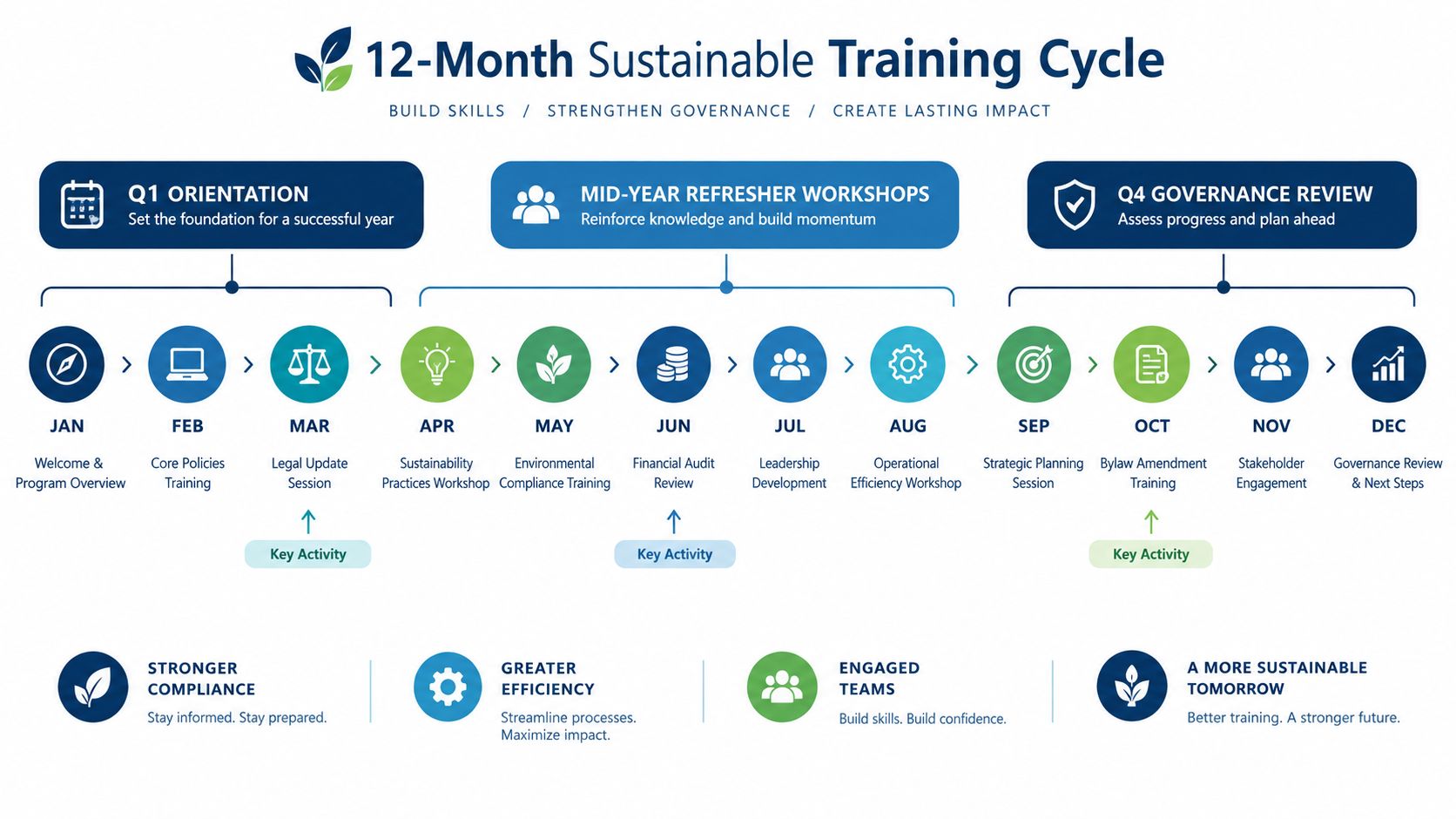
The board should treat education like preventive maintenance. A new-director orientation handles immediate gaps, scenario workshops build judgment, and refreshers keep the board aligned when laws, policies, projects, or personnel change.
A practical 12-month rhythm
Use the annual calendar to assign one manageable subject each month:
- January: New-director orientation and governing-document review.
- February: Fiduciary duties, conflicts, and executive-session boundaries.
- March: Legal update session and records-retention review.
- April: Budget development and assessment-setting workshop.
- May: Reserve components, funding assumptions, and capital planning.
- June: Financial audit review and internal control check.
- July: Vendor selection, insurance certificates, and contract administration.
- August: Enforcement consistency, hearings, and dispute resolution.
- September: Insurance, crime policies, cyber coverage, and emergency response.
- October: Bylaw amendment training and policy review.
- November: Homeowner communication, meeting evaluation, and social media conduct.
- December: Governance review, self-assessment, and next-year training plan.
Quarterly deep dives should focus on reserves, budgets, compliance, and decision quality. The Q4 review should identify recurring confusion, incomplete records, and topics that need a scenario rather than another handbook.
Keep the record usable
Maintain a certification log with the director's name, election or appointment date, required course, completion date, certificate location, refresher attendance, and next review date. Tie attendance to the meeting minutes without putting confidential testing details into the minutes themselves.
The resource checklist should include CAI credentials such as CMCA, AMS, and PCAM, state-specific HOA statutes, Davis-Stirling Act resources for California, Florida Chapter 720 compliance guides, insurance-carrier training portals, and peer networks through local CAI chapters. These resources should supplement, not replace, counsel's advice when the board faces a legal question.
BoardSource's governance guidance favors formal orientation and regular self-assessment, while its cited evidence notes that 69% of organizations rely on written materials, with interactive learning used much less often, as discussed in the CAI board member education guidance. That's a useful warning. Written materials preserve information, but directors need discussion, role-play, and documented decisions to build judgment.
A training cycle becomes permanent when the president reviews the tracker during board transitions, the manager includes outstanding certificates in election preparation, and the board considers refresher attendance when reviewing re-election policies and insurance-renewal requirements.
Access Management Group can help boards organize onboarding, deliver board training webinars, and provide individualized instruction on request, including tutorials for its community association management software. Visit Access Management Group to discuss a documented training cycle that supports your homeowners, president, and directors.