In the United States, about 21.6 million of the nation's 86.6 million owned households paid an HOA or condominium assessment in 2024, and the national median monthly fee was $135. An HOA assessment is the homeowner's mandatory pro-rata share of the community's common expenses, funding daily operations, insurance, shared property, and long-term capital reserves.
You may have received an assessment notice that looks like a routine bill, or perhaps your board is preparing an annual budget and wondering whether the proposed increase will upset homeowners. Either way, the amount on the invoice tells only part of the story. The more important question is what that payment says about the community's maintenance plan, insurance costs, reserve funding, and ability to handle major repairs.
For homeowners, understanding assessments helps you judge the true cost of ownership before buying and recognize when a charge is legitimate, urgent, or a warning sign. For board members and HOA or COA presidents, it provides a framework for setting fair dues, explaining financial decisions, and protecting the shared property without relying on surprise charges.
Understanding the Basics of HOA Assessments
Receiving an HOA bill can feel different from paying a utility bill or property tax. You're not paying for a service delivered only to your own home. You're contributing to a shared financial system that keeps the roof, landscaping, roads, elevators, insurance, amenities, and other common elements functioning for everyone.
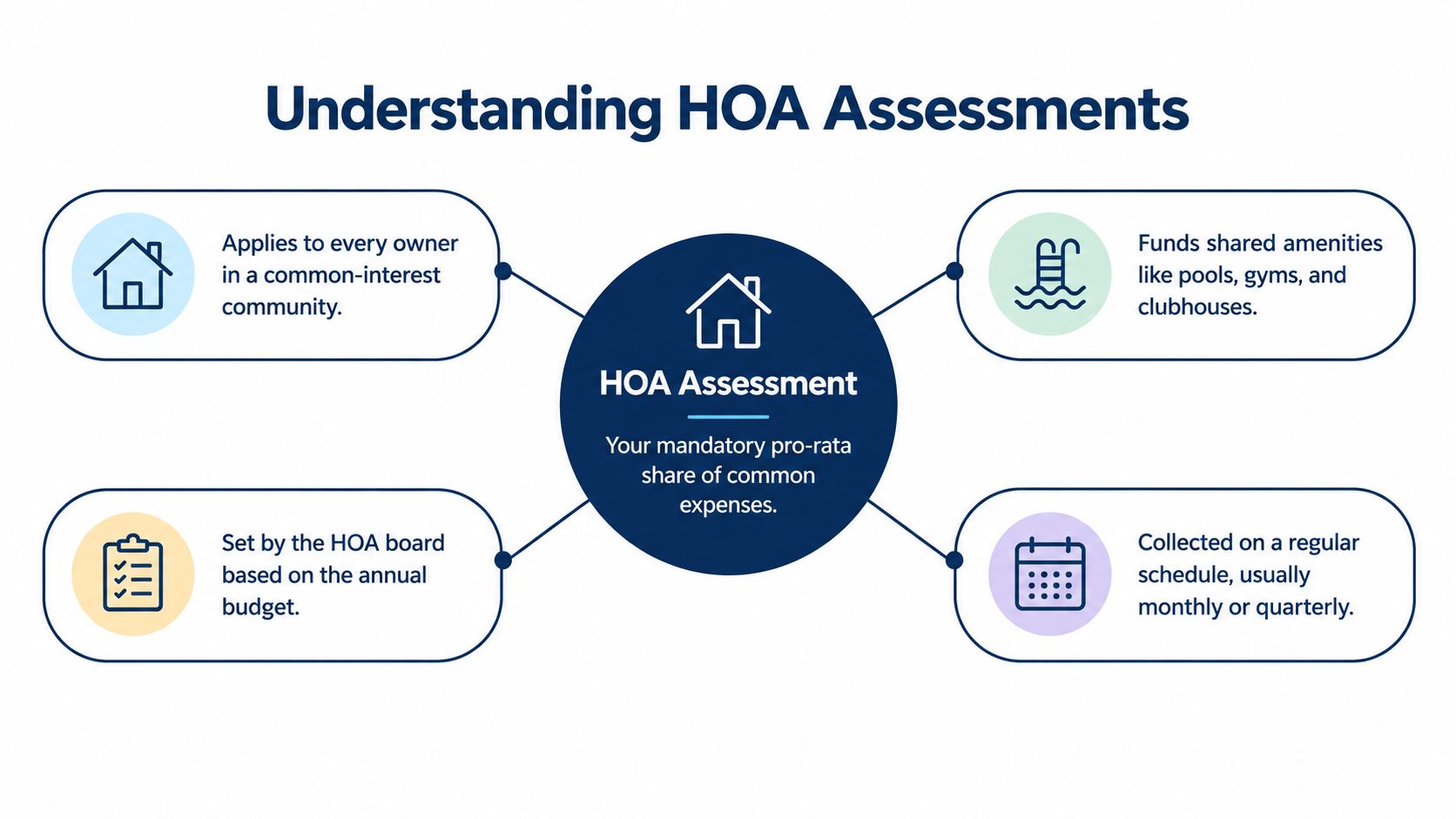
An HOA assessment is the owner's pro-rata share of the association's common expenses. “Pro-rata” means the amount is allocated according to the formula in the declaration and other governing documents. Some communities divide expenses evenly, while others assign costs according to unit ownership interests, square footage, service usage, or the parts of the property that benefit particular units.
What the assessment pays for
The board creates an operating budget, usually through an annual budget cycle, and then sets assessments to fund the expenses the association expects to incur. Typical categories include:
- Property care: Landscaping, cleaning, pest control, repairs, and maintenance for shared areas.
- Utilities: Water, electricity, lighting, heating, or other services serving common property.
- Insurance: Coverage for association-owned structures and shared risks.
- Professional support: Management, accounting, legal, engineering, and other specialized services.
- Reserves: Contributions for major replacements and repairs, such as roofs, paving, exterior systems, or mechanical equipment.
The governing documents matter because they determine both the association's authority to collect assessments and the way costs are allocated. A limited common element, separately metered utility, or amenity used by only some owners may be treated differently if the declaration allows that approach. The amount shouldn't be an arbitrary flat charge chosen for convenience. It should connect to the association's actual obligations and the cost responsibility assigned to each unit.
Practical rule: A low assessment isn't automatically a good assessment. The right question is whether the amount can support today's services and tomorrow's repairs.
The funding model is widespread. About one in four owned households paid an HOA or condominium fee in 2024, and the national median monthly fee was $135, according to the Community Associations Institute assessment trends dashboard. That figure is a national median, not a promise about what a particular community should charge. A condominium with elevators and extensive building systems has different needs from a small association with only entrance landscaping.
Why owners pay on a schedule
Associations commonly collect assessments monthly or quarterly because expenses arrive throughout the year. Regular collection gives the board predictable cash flow for contracts, utilities, insurance, payroll, and reserve deposits. It also spreads the homeowner's share of community costs across the year rather than waiting for a large annual payment.
An assessment is therefore more than a charge attached to a property. It's the financial mechanism that allows owners to share responsibility for an asset they own collectively. When owners pay on time and the board budgets carefully, the association can maintain property proactively, respond to problems, and avoid shifting every major cost into an emergency request.
Regular Operating Fees Versus Special Assessments
A useful way to understand the difference is to compare an association with a household budget. Regular assessments resemble recurring groceries, utilities, insurance, and routine upkeep. A special assessment resembles an unexpected roof replacement or urgent structural repair that the regular budget and savings cannot fully cover.
Regular operating assessments are recurring charges established through the association's budget. They support predictable obligations such as landscaping, cleaning, common-area utilities, insurance, professional management, and ordinary maintenance. They may change from year to year when contracts, insurance premiums, staffing, or reserve needs change, but the board generally plans for them as part of normal operations.
Special assessments address a specific need outside the annual budget or beyond available reserves. A storm-related repair, major building component failure, legal expense, or capital project can create that need. A capital assessment may also fund an improvement or replacement that requires more money than the association has set aside.
| Feature | Regular operating assessment | Special assessment |
|---|---|---|
| Timing | Recurring and included in the annual budget | Usually one-time or limited to a defined collection period |
| Purpose | Ongoing services, administration, insurance, maintenance, and reserve contributions | A stated repair, project, emergency, or other extraordinary need |
| Planning | Expected and incorporated into normal cash-flow planning | Triggered by a specific condition or funding shortfall |
| Owner experience | Predictable payment obligation | Additional charge that may be substantial or unexpected |
The distinction doesn't mean a special assessment is automatically evidence of poor management. An association can face an unusual loss or repair even with responsible budgeting. But repeated special assessments, especially when routine dues remain artificially low, deserve careful questions about reserve planning and the board's long-term assumptions.
Florida condominium law defines a special assessment as an assessment imposed on a unit owner other than the annual budgeted assessment. The law also requires written notice and restricts the collected money to the specific purpose stated in that notice, as set out in the Florida condominium statute. That principle offers a useful governance standard even when a community operates under another state's law: explain the reason, identify the use, follow the required approval process, and keep the funds tied to the approved purpose.
How to read the amount
Before assuming a special assessment is unreasonable, ask four practical questions:
- What work or obligation created the charge? The notice should identify the purpose clearly.
- What will the money pay for? Look for a scope of work, estimate, reserve transfer, insurance gap, or other documented need.
- What alternatives did the board evaluate? Those may include using reserves, financing, adjusting regular assessments, or phasing the work.
- What do the declaration and bylaws require? The authority may depend on a board vote, owner vote, notice period, spending limit, or other condition.
Boards can also use a dues calculator from Alignmint as one practical budgeting aid when evaluating recurring contributions and communicating how a shared cost may be allocated. It won't replace the governing documents, reserve analysis, or professional advice, but a clear calculation can help owners understand how the proposed amount was reached.
For a deeper explanation of the decision and administration process, see this guide to what special assessments cover and how they work. Clear notices and disciplined recordkeeping protect homeowners and the board alike.
Why Assessment Costs Are Rising Across the Country
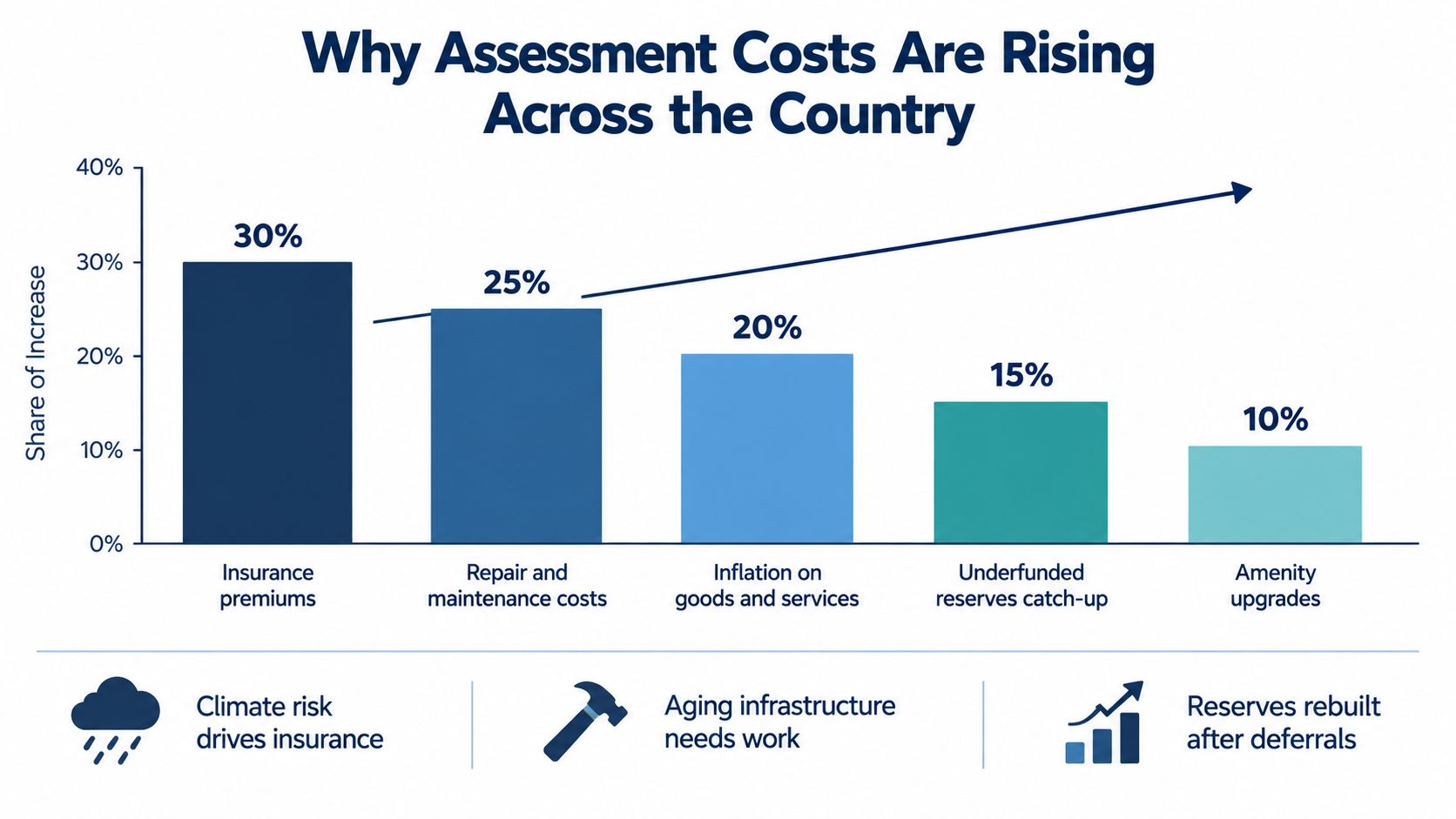
Homeowners often see an assessment increase and assume the board is spending more freely. In many communities, the opposite is closer to the truth. Boards are raising assessments because the association's existing income no longer covers the cost of insurance, labor, materials, contracted services, or responsible reserve contributions.
Insurance has become a particularly important pressure point. A community must maintain coverage appropriate to its buildings and risks, and the premium is not optional merely because owners prefer a lower budget. Labor, repair materials, utilities, compliance work, and vendor contracts can also cost more than they did when the current assessment formula was adopted.
Reserve funding creates a second pressure point. If prior boards postponed contributions or kept dues below the amount needed for future replacements, a later board may need to increase regular assessments sharply. That increase can feel sudden to current owners even though the underlying need has been building for years.
What the recent figures reveal
Regular HOA fees rose 50.5% since 2020, a rate described as more than double inflation, while the median special assessment reached a record $1,100 per door in 2025, according to recent reporting on escalating HOA ownership costs. These figures don't tell a board what its own community should charge, but they show why owners shouldn't assume that a historic dues amount still reflects current operating reality.
The increase can result from several pressures acting together:
- Insurance renewal costs: A higher premium or changed coverage requirement can consume funds that once supported other services.
- Deferred maintenance: A roof, façade, pavement system, elevator, or drainage component becomes more expensive to address after years of postponement.
- Vendor and labor costs: Associations depend on outside professionals and service providers whose prices affect the operating budget directly.
- Reserve adequacy: A board may need to restore contributions after a reserve study identifies a gap.
- Community complexity: More shared systems, amenities, or building responsibilities create more obligations to fund.
The board's job isn't to keep assessments frozen. It's to set a defensible amount, explain the cost drivers, and show how the budget supports both current services and future obligations. Homeowners should ask for that explanation without treating every increase as misuse. A transparent increase can be healthier than a low assessment that postpones costs until they become emergencies.
A strong budget presentation connects each major line item to a decision. For example, the board can explain which services are contractually required, which reserve projects are approaching, and which costs would increase if the association delayed action. That approach turns a contentious number into a shared discussion about risk, service levels, and property preservation.
The Legal Framework and Enforcement Mechanics
An assessment becomes enforceable through a combination of the association's declaration, bylaws, rules, budget procedures, and state law. The board can't assume that a general power to collect dues permits every late fee, lien, or foreclosure action. The association must follow the documents and statutory procedures that apply to its jurisdiction.
California provides a concrete example. Once levied, an HOA assessment becomes a debt of the owner. A late charge may reach 10% of the delinquent amount or $10, whichever is greater, with interest of up to 12% annually beginning 30 days after the assessment is due. The association generally can't foreclose until delinquent assessments, excluding certain other charges, reach at least $1,800 or have been delinquent for more than 12 months, as explained in this overview of California HOA assessment disputes.
The details differ across states, but the governing principle is consistent. Collection authority must be exercised consistently, with accurate account records, proper notices, and a process that gives the owner a fair opportunity to understand and address the balance.
State Assessment Enforcement Thresholds
| State | Late fee or interest rules | Lien and foreclosure thresholds |
|---|---|---|
| California | A late charge may be up to 10% of the delinquent assessment or $10, whichever is greater. Interest may be up to 12% annually beginning 30 days after the assessment is due. | Foreclosure generally requires at least $1,800 in delinquent assessments or more than 12 months of delinquency. |
| Florida | An administrative late fee requires authorization in the declaration or bylaws and can't exceed the greater of $25 or 5% of each late installment, under Florida HOA law. | The association must follow the applicable declaration and statutory notice and enforcement requirements. |
| North Carolina | The association's collection authority and charges depend on the governing documents and applicable law. | An unpaid assessment that remains unpaid for 30 days or longer becomes a lien when a claim of lien is filed of record. Foreclosure generally requires the assessment to remain unpaid for 90 days or more, under North Carolina law. |
These examples aren't a substitute for advice from a lawyer licensed where the property is located. They show why a board should use a written collection policy that states due dates, notices, authorized charges, payment arrangements, referral steps, and escalation procedures.
For homeowners, a delinquency notice shouldn't be ignored. Contact the association promptly, verify the ledger, ask how the balance was calculated, and seek legal advice if you believe the charge or process is defective. For boards, enforcement should protect the community's cash flow without becoming arbitrary or punitive. A consistent process helps avoid claims that the board treated owners differently.
Associations should also understand the difference between a personal debt and a lien against the property. A lien can affect refinancing, sale, and title status, which is why timely documentation matters. Boards looking for a practical overview can review this guide to homeowners association liens, then confirm the required steps with association counsel.
Spotting Warning Signs of Underfunded Reserves
A low monthly assessment can make a community attractive during a purchase search. It can also conceal a future financial problem. The real test is whether the association is collecting enough to maintain its assets over their useful lives, not whether the current invoice looks inexpensive.
Start with the reserve study. It should identify major components, their observed condition, estimated replacement timing, projected costs, and the association's funding position. A study is useful only when the board treats it as a planning document and updates its assumptions as buildings age, prices change, and inspections reveal new conditions.
Signals that deserve closer review
Look for a pattern rather than a single clue:
- The board postpones major work repeatedly: Delayed roofs, exteriors, paving, elevators, or water systems can indicate that the operating budget is absorbing problems that belong in a capital plan.
- Regular assessments stay unusually low while the property ages: Owners may enjoy short-term savings while reserves fall behind the cost of future replacements.
- The association discusses borrowing or emergency charges frequently: Financing can be appropriate, but repeated dependence on it may signal that recurring assessments aren't supporting the long-term plan.
- The budget lacks a clear reserve contribution: A line item for reserves should be visible and connected to the reserve study, not treated as whatever remains after operating bills.
- Financial records are difficult to obtain: Homeowners should be able to review governing documents, budgets, meeting materials, and other records allowed by applicable law.
The risk is especially visible in older buildings. Buildings built before 2000 were particularly exposed to financial stress, with 8.5% receiving special assessments in 2025 and a typical bill near $2,500, according to reporting on condo owner assessment pressures. The same reporting stated that HOA lien filings rose to 284,933 nationwide, a sign that payment strain can grow alongside assessment pressure.
Those figures don't mean every older community is distressed. A well-maintained older property may be financially sound, while a newer one can still have planning problems. They do mean buyers and current owners should ask for evidence instead of relying on the age or advertised dues alone.
Questions for buyers and current owners
Ask when the last reserve study was completed, whether the board follows its recommendations, which major projects are scheduled, and whether the association has pending claims, loans, or known capital needs. Review meeting minutes for recurring discussions about leaks, structural concerns, insurance gaps, or postponed repairs.
A detailed resource on reserve studies for condominiums can help homeowners understand the document's role. The most useful conclusion isn't merely “reserves are funded” or “reserves are underfunded.” It's whether the funding plan matches the condition and replacement schedule of the property.
Building a Sustainable Financial Partnership
A healthy assessment system requires cooperation between owners, the board, and the association's management team. Homeowners deserve clear explanations and accurate records. Boards need the authority and resources to maintain shared assets before small defects become expensive failures.
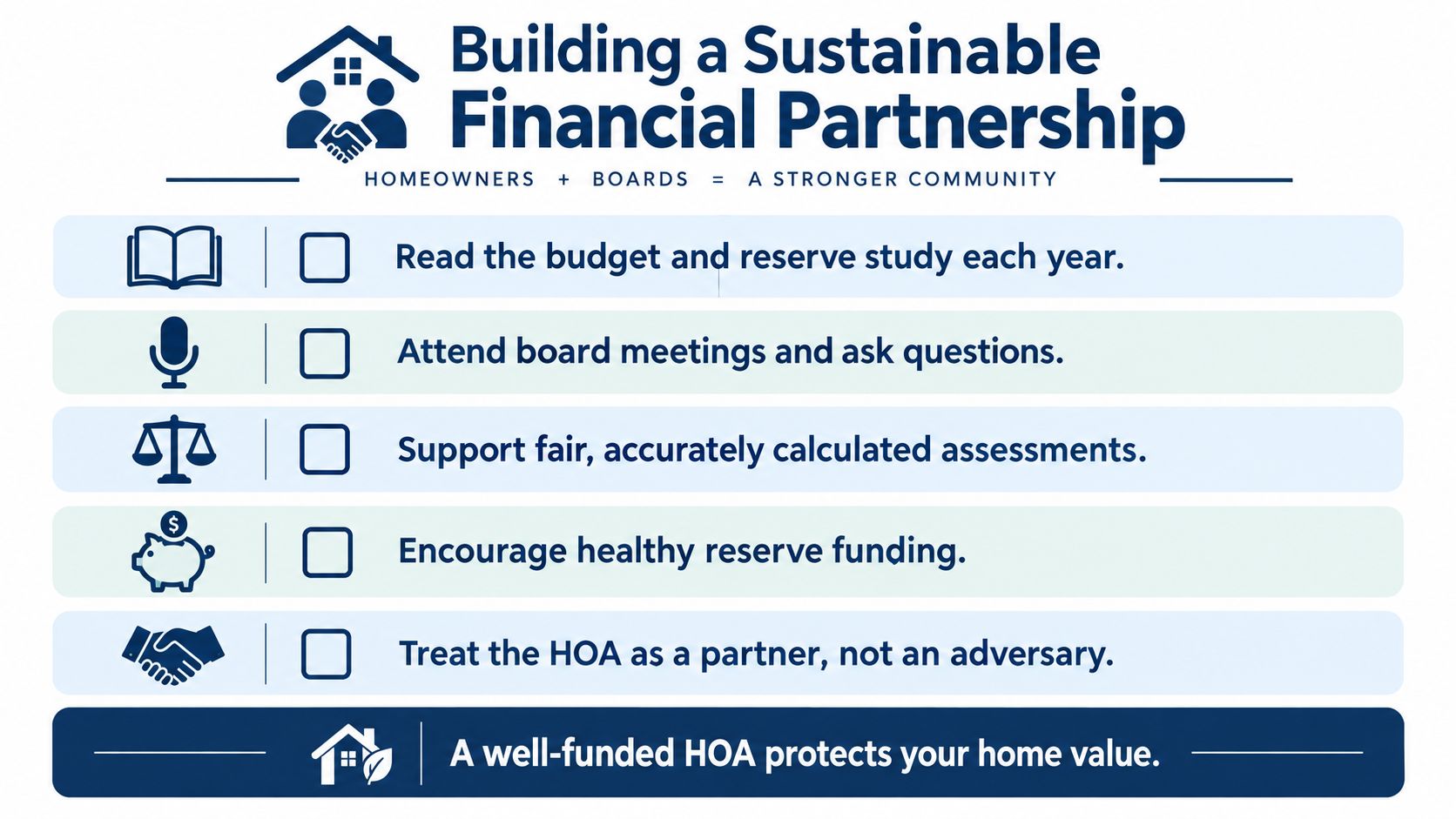
Start with five habits:
- Read the budget and reserve study: Review them each year, especially the assumptions behind major repair schedules and reserve contributions.
- Attend meetings and ask focused questions: Ask which cost changed, why it changed, and what the association risks by delaying action.
- Support accurately calculated assessments: Fair dues distribute the community's obligations according to the governing documents instead of shifting costs into surprise charges.
- Encourage healthy reserves: Reserve funding is not wasted money. It's a planned contribution toward assets every owner relies on.
- Treat collection as administration, not punishment: Owners need consistent notices, accurate ledgers, and a clear way to resolve account questions.
Technology can support that relationship when it makes payments and records easier to manage. Associations evaluating resident payment workflows may also find a guide to rent collection portals useful for understanding how organized online payment processes can improve visibility and reduce manual follow-up. The specific platform should fit the association's controls, accounting process, security requirements, and governing documents.
A community management partner can help translate the budget into homeowner communications, issue assessment invoices, process payments, monitor delinquencies, and coordinate the administrative work behind regular and special assessments. Access Management Group provides condominium and homeowner association management services, including assessment invoicing, payment collection, accounting support, delinquency follow-up, and guidance for planning and communicating special assessments.
The best assessment is neither the lowest nor the highest. It's the amount supported by the property's obligations, documented by the budget and reserve plan, allocated under the governing documents, and explained in language homeowners can understand. That standard protects owners today while preserving the community's value for the future.
Access Management Group can help your HOA or COA build a clearer assessment process, from budgeting and reserve planning through invoicing, payment administration, and delinquency follow-up. Visit Access Management Group to discuss management support that helps your board protect, preserve, and enhance its shared real estate investment.