If you're reading this before tonight's board meeting, you probably already know the feeling. The agenda is too long, one item is emotionally charged, someone still hasn't confirmed attendance, and homeowners expect answers that are both fair and clear.
That pressure is normal. In an HOA or COA, a board meeting isn't just a formality. It's where volunteer leaders make decisions that affect maintenance, budgets, rules, vendor relationships, owner trust, and, over time, the community's reputation and property values. When meetings are run well, homeowners see a board that listens, decides, and follows through. When meetings drift, communities feel it quickly.
At Access Management Group, we think about board meetings through a practical lens. The point isn't to create a perfect script. The point is to help the board make sound decisions, respect homeowners' time, and protect the long-term health of the association. This is how to run a board of directors meeting in a community association setting.
The Foundation for Flawless Pre-Meeting Planning
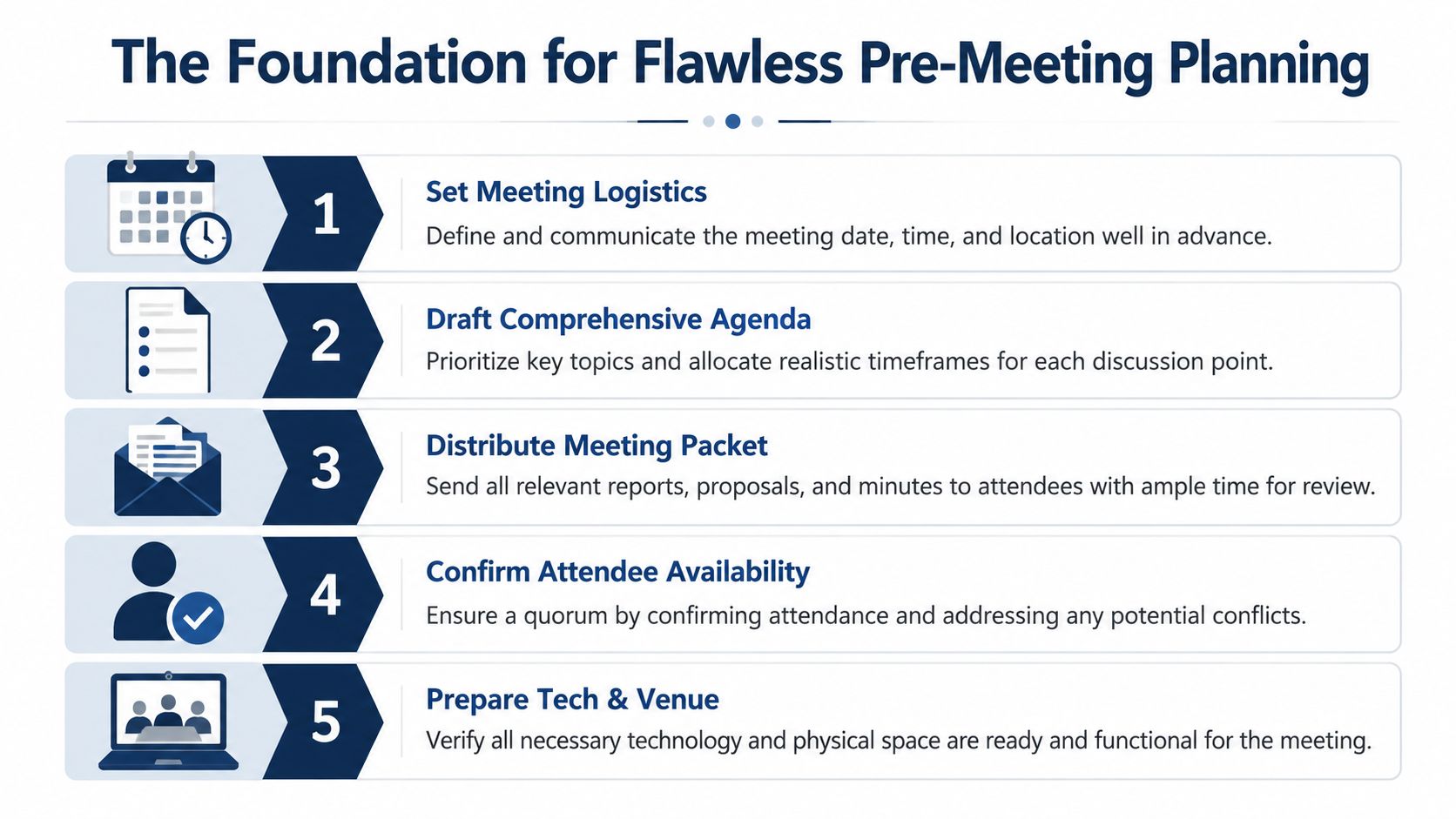
Most bad meetings don't fail in the room. They fail in the days before the meeting, when the agenda is vague, the backup materials are late, and no one has confirmed whether a quorum will exist.
In community management, preparation is more than courtesy. It's risk control. A well-prepared meeting reduces confusion, prevents rehashing, and gives directors enough context to focus on choices instead of summaries. Guidance on board meetings recommends sending a board book at least a couple of days in advance so directors can review prior minutes, financials, reports, and decision materials before the meeting, which supports stronger discussion and less time spent on basic reporting, as noted in Cooley GO's board meeting tips.
Build an agenda that leads to decisions
A weak agenda lists topics. A strong agenda tells the board what action is needed.
For each item, decide which category it fits into before you send the packet:
- Information only: A manager update, project status note, or routine committee summary that doesn't require a vote.
- Discussion needed: A topic that needs board direction before anyone can bring back a final recommendation.
- Action required: A contract approval, policy adoption, rule decision, or spending authorization.
That distinction matters because it changes how people prepare. If directors know a landscaping proposal is up for action, they'll review the bids ahead of time. If they think it's just a verbal update, they'll show up unprepared and the meeting will bog down.
A practical starting point is to use a structured HOA meeting agenda template and customize it for your governing documents, owner comment procedures, and recurring business items.
Practical rule: If an item needs a vote, the packet should answer the obvious questions before the meeting starts.
Give notice and confirm quorum early
Every association operates under its own governing documents and applicable state requirements. That means the board shouldn't rely on habit or memory when sending notice. Check your bylaws, declaration, rules, and legal counsel's guidance for timing, delivery method, and whether homeowners must receive an agenda or only notice of the meeting.
Then confirm attendance directly. Don't assume silence means yes.
A simple process works:
- Send the notice and draft agenda.
- Ask directors to RSVP.
- Follow up with anyone who hasn't responded.
- Confirm whether the board will have a quorum.
- If quorum is at risk, address it before meeting day instead of discovering the problem at call to order.
Assemble a board packet people will actually use
The best packets are complete, short enough to review, and organized in the order of the agenda. Directors shouldn't have to hunt through email chains to find the proposal they're being asked to approve.
Include only what helps the board govern:
- Core records: Draft agenda, prior minutes, meeting notice, and any pending motions.
- Financial decision materials: Summary financials, reserve or project updates, invoices or bids tied to agenda items.
- Operational backup: Vendor proposals, rule drafts, owner correspondence summaries, and committee recommendations.
What doesn't work is dumping every available document into one large file. That creates the appearance of preparation without the benefit of it.
Check the room before the meeting starts
This sounds basic, but it prevents needless disruption. Confirm the room setup, sign-in process, screen-sharing tools, speakerphone, voting materials, and homeowner seating. If any director is joining remotely, test that connection in advance and make sure everyone understands how recognition, discussion, and voting will work.
When a board gets these details right, the meeting starts calmly. That tone carries into the hard decisions.
Chairing the Meeting From Call to Order to Adjournment
The chair's job isn't to dominate the meeting. It's to create order, keep directors focused on the agenda, and make sure the board reaches clear decisions the secretary can record.
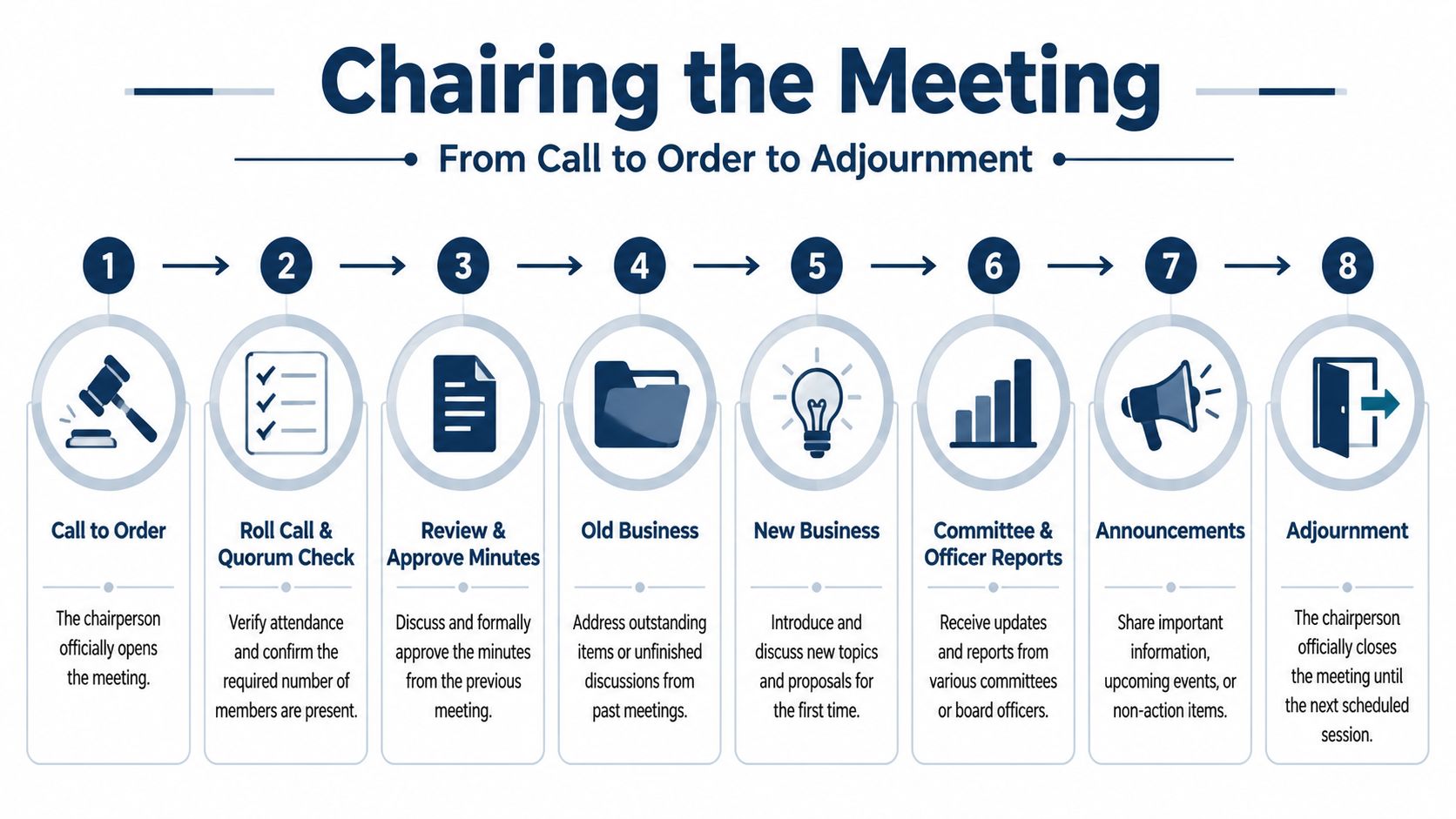
A practical historical benchmark for running a board meeting follows a familiar order: call to order, quorum check, approval of minutes, reports, old business, new business, and adjournment. Modern guidance also recommends allocating about 25% of the meeting to reporting and the "have to's," leaving most of the session for strategic discussion and decisions, as described in Boardable's guidance on running a board meeting.
Follow a meeting order that creates clarity
A steady meeting flow helps volunteers and homeowners alike. People know when comments are appropriate, when decisions are being made, and what's still pending.
A standard order usually looks like this:
| Stage | What the chair does | Why it matters |
|---|---|---|
| Call to order | Opens the meeting formally | Establishes the official start |
| Quorum check | Confirms enough directors are present | Validates that business can proceed |
| Approval of minutes | Asks for corrections and approval | Preserves an accurate record |
| Reports | Receives necessary updates | Gives context without retaking old decisions |
| Old business | Returns to unfinished items | Prevents important work from disappearing |
| New business | Introduces new decisions | Moves current priorities forward |
| Adjournment | Closes the meeting formally | Signals the end of board action |
Some boards place homeowner comment at the beginning, some near the middle, and some before votes on specific items. The right placement depends on your governing documents and meeting rules. The important thing is consistency.
Use motions and votes cleanly
When a board reaches an action item, the chair should slow down and make the process crisp.
A simple pattern works well:
- A director makes a motion: "I move that the board approve the contract with Vendor A."
- Another director seconds it: This shows at least two directors want the matter considered.
- The chair opens discussion: Directors debate the motion itself, not side issues.
- The chair calls the vote: Voice vote, roll call, or whatever method your rules allow.
- The result is stated clearly: Approved, denied, tabled, or referred for more information.
Boards get into trouble when discussion wanders before there's a motion or when nobody states the exact proposal on the table. That creates confusion for everyone, including homeowners in attendance and the secretary trying to draft minutes later.
State the motion in plain English before debate begins. If the room can't repeat what it's voting on, the board isn't ready to vote.
Keep the meeting moving without rushing it
Time control isn't about being rigid. It's about protecting the board's attention for the decisions that matter most.
Three habits help:
- Time-box agenda items: Put a target time next to each item and enforce it. If discussion needs more work, continue it later or assign follow-up.
- Start with the highest-priority topics: Directors think more clearly at the beginning of a meeting than at the end.
- Separate reporting from decision-making: A treasurer or manager should summarize only what the board needs to know to act.
What doesn't work is letting routine reports consume the entire meeting. In community associations, the board's role is governance and oversight. If every meeting becomes an extended recital of updates, the actual choices about contracts, policy, maintenance priorities, and homeowner concerns get squeezed out.
Help debate stay constructive
The chair should invite differing views without letting the conversation become personal. If one director raises maintenance cost concerns and another argues for resident satisfaction, both may be right about different parts of the same problem.
A useful script is simple: "Let's stay with the motion on the floor. What information do we still need to decide?" That keeps the board in decision mode instead of argument mode.
Upholding Trust Through Legal and Governance Duties
Homeowners rarely judge a board only by its final vote. They also judge whether the process felt fair, open, and disciplined. That's why governance matters so much in board meetings.
Legal compliance is part of that. So is trust. A board that understands when to meet openly, when privacy is justified, and how conflicts should be handled gives owners far more confidence in its decisions.

Open meetings, executive sessions, and owner confidence
As a working rule, boards should treat open deliberation as the default and closed discussion as the exception. Owners don't need access to every sensitive detail, but they do deserve confidence that the board isn't making routine decisions behind closed doors.
Executive session usually exists for limited topics such as legal matters, personnel issues, delinquency matters, or other confidential business allowed by law and governing documents. The mistake boards make is using executive session for convenience, awkward topics, or general disagreement. That erodes trust quickly.
Before moving into a closed session, the chair should identify the lawful basis, keep the discussion confined to that subject, and return to open session when the private topic is done.
Conflicts of interest need a process, not a shrug
Conflicts don't always mean wrongdoing. Sometimes they mean a director has a personal, financial, family, or business relationship that could affect impartial judgment. What matters is that the board has a clear process for disclosure and recusal when needed.
A practical board policy should address:
- Disclosure: Directors state relevant interests before discussion starts.
- Recusal when appropriate: The interested director steps back from debate or voting if required.
- Documentation: Minutes reflect that the conflict was disclosed and handled.
If your board is reviewing governing document language or formal internal rules, examples such as these Georgia corporate bylaws examples can help directors understand how meeting authority, officer roles, and procedural standards are often structured in writing.
Procedure should support judgment, not replace it
Many volunteer boards worry they must master every line of Robert's Rules to run a valid meeting. In practice, most associations need something simpler. They need a consistent framework that lets the board recognize motions, manage discussion, vote clearly, and record decisions accurately.
That framework should come from the association's governing documents first, then applicable law, then any adopted procedural rules. A practical overview of board duties also helps directors connect meeting procedure to fiduciary responsibility, which is why many boards benefit from reviewing guidance on HOA board member responsibilities.
Fair process protects the board as much as it protects homeowners. When directors can show how a decision was made, they can defend that decision far more confidently.
After the Gavel Falls with Effective Minutes and Action Items
A meeting only creates value if the board's decisions turn into real work. That's where minutes and action tracking matter.
Minutes are not a transcript. They are the official record of what the board did. When minutes become a play-by-play of every comment, they create unnecessary risk and make it harder to find the actual decisions later.
What minutes should include
A strong set of minutes is short, factual, and easy to follow. The secretary should capture the essentials:
- Meeting basics: Date, time, location, whether quorum was present, and who attended.
- Formal actions: Motions made, whether they passed or failed, and the final wording of approved actions.
- Key procedural notes: Approval of prior minutes, entry into executive session if applicable, and adjournment.
What should stay out:
- Personal opinions: Minutes shouldn't describe who seemed upset, persuasive, or difficult.
- Verbatim debate: Summaries are usually enough unless your attorney advises otherwise.
- Side commentary: Editorial notes and speculation don't belong in the official record.
Boards that want a practical role definition for this work can review the responsibilities commonly handled by the board member secretary.
Turn decisions into assigned work
During the meeting, someone should track action items separately from the minutes. That list is where accountability lives.
A useful action log includes:
| Task | Owner | Due point | Notes |
|---|---|---|---|
| Request contract revision | President or manager | Before next meeting | Confirm insurance terms |
| Send owner update | Secretary or manager | After approval | Use final board language |
| Obtain additional proposal | Committee chair | Next agenda cycle | Bring comparison for vote |
This can live in a spreadsheet, a board portal, or a shared task tracker. What's important is that every decision with follow-up has an owner.
Close the loop with homeowners
Many associations lose goodwill not because the board made the wrong decision, but because homeowners never heard what happened. A short post-meeting summary can prevent that gap.
It doesn't need to include confidential matters. It should explain approved actions, next steps, and what residents can expect. Clear communication reduces rumor, reinforces professionalism, and reminds homeowners that the board is working on the community's behalf.
Mastering Modern Challenges with Remote Meetings and Difficult Dynamics
Some of the hardest board meetings aren't disorganized. They're organized and still tense. A remote participant can't get a word in. One director dominates every issue. Another raises important concerns, but only after the group has moved on. The agenda exists, yet the meeting still slips sideways.
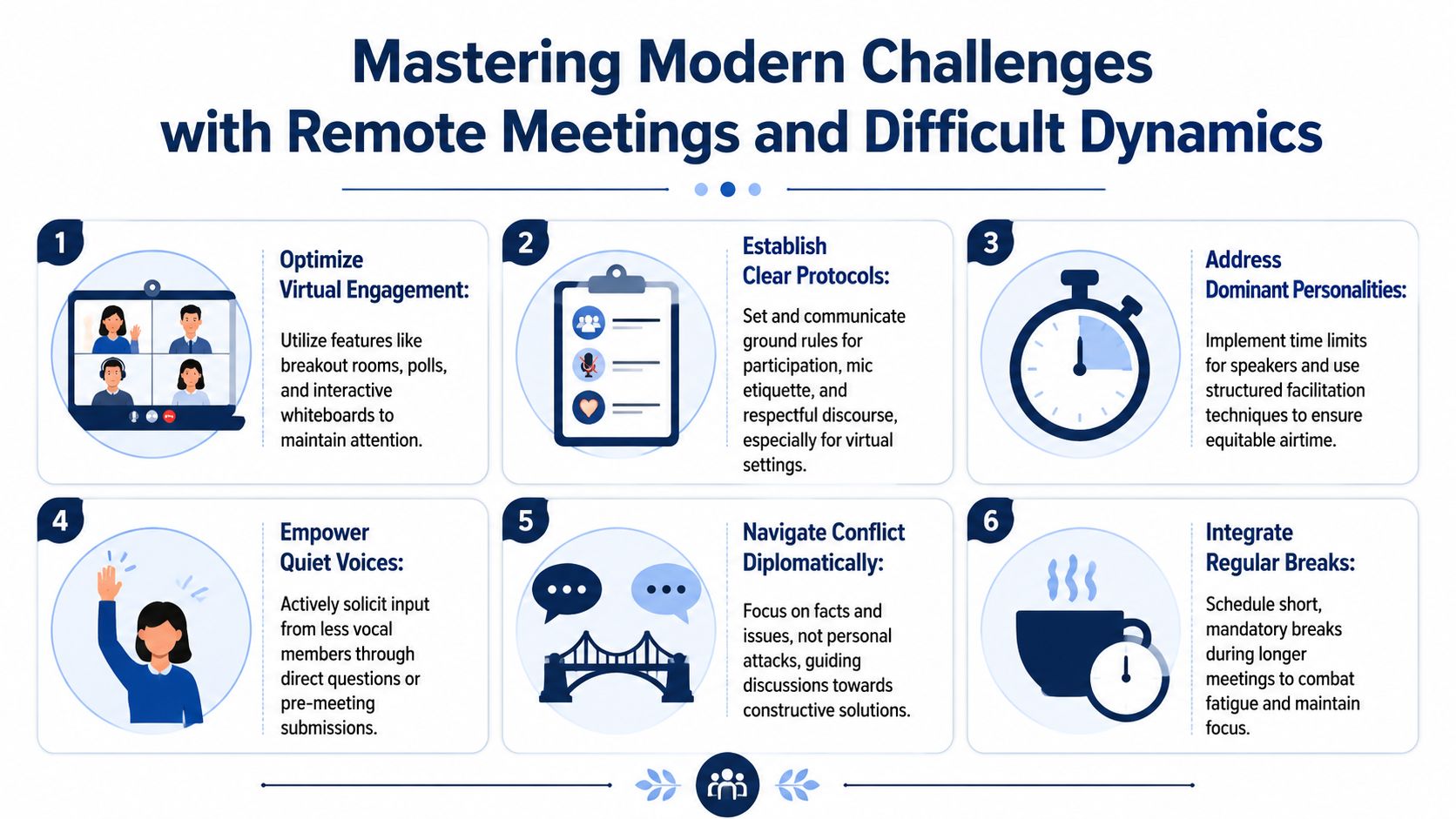
That's where facilitation becomes a leadership skill instead of a procedural one. Guidance on difficult board meetings notes that the chair should actively manage airtime, use set timeframes, and move off-agenda topics into a later parking lot, as discussed in Aprio's advice on running a board meeting.
Make remote participation feel real
Hybrid and virtual meetings fail when remote attendees become observers instead of participants. The chair has to compensate for that on purpose.
A few operating habits help immediately:
- Call on remote directors by name: Don't wait for them to interrupt.
- Use one speaking queue: In-room and online participants should enter the same line for discussion.
- State every motion aloud before voting: Audio lag and screen fatigue make assumptions dangerous.
If your association uses management support tools, a community management partner or board portal can help organize packets, notices, minutes, and meeting logistics. In practice, services such as those offered by Access Management Group can support agenda preparation, board packet distribution, and official minute-taking so volunteer directors can stay focused on governance.
Scripts for hard meeting moments
Difficult personalities don't always require confrontation. They usually require structure.
Try language like this:
"I'm going to pause there so we can hear from directors who haven't spoken yet."
That redirects without accusing anyone of bad behavior.
For off-topic discussion, use: "That's worth capturing, but it isn't on tonight's agenda. Let's place it in the parking lot and return to the item before us." For repetitive debate: "I think the board understands the two positions. Is there new information that would change the decision?"
Encourage disagreement without chaos
Healthy boards don't avoid disagreement. They separate disagreement about ideas from conflict between people.
One way to do that is to ask directors to frame comments in one of three lanes:
- Clarifying question: "What exactly are we approving?"
- Risk concern: "What problem could this create for the association?"
- Preferred option: "I support the alternate vendor because the scope is clearer."
That structure keeps comments useful. It also helps quieter directors contribute because they don't have to fight for the floor with a speech.
Use meeting norms that people can remember
Long policy documents rarely change behavior in real time. Short, visible norms do.
A board can adopt a few simple expectations:
- One speaker at a time
- Stay with the motion
- Keep first comments concise
- Disagree with ideas, not motives
- Flag new topics for later scheduling
Those norms work in person and online. They also make it easier for the chair to intervene because the chair is enforcing a shared rule, not inventing one on the spot.
Frequently Asked Questions About Board Meetings
Boards usually don't struggle with the obvious parts of a meeting. They struggle with the procedural moments that seem small until they stop the meeting cold.
Do we have to follow Robert's Rules exactly
Usually, no. Most HOA and COA boards need a workable procedure, not a formal parliamentary performance. Your governing documents and applicable law come first. If the board has adopted Robert's Rules or another authority, use it as a guide for motions, debate, and votes, but keep the process readable for volunteers and homeowners.
What happens if we don't have a quorum
If quorum isn't present, the board generally can't conduct official business. The chair should document the lack of quorum, avoid taking binding action, and follow the association's rules for adjournment, rescheduling, or limited informal discussion.
Where should homeowner comments go on the agenda
Put owner comment where your governing documents, legal requirements, and adopted meeting rules support it. Many boards choose a set comment period so homeowners know when they may speak and the board can still complete business. The key is to apply the same rule consistently.
What's the difference between old business and new business
Old business is unfinished or previously introduced business that still needs action. New business is being brought before the board for the first time in that meeting cycle. Keeping the two separate helps directors and homeowners track whether an issue is continuing or newly introduced.
Should we record meetings
That depends on your governing documents, board policy, and legal guidance. If recordings are allowed, decide in advance who controls the recording, how long it will be retained, and whether the official record remains the approved minutes rather than the video itself.
Who should speak most during the meeting
Not the chair, and not the manager. The board should. The chair guides the process, the manager supplies operational facts, and directors deliberate and decide. If one person does nearly all the talking, the board usually isn't governing at its best.
How do we stop a meeting from running too long
Cut repeated reporting, identify action items clearly, and table issues that need more work. If an item can't be decided responsibly at that meeting, assign next steps and move on. Long meetings often signal unclear preparation, not just too many topics.
If your board wants practical support with agendas, packets, minutes, and meeting coordination, Access Management Group works with associations to help volunteer leaders stay organized and focused on the decisions that matter to homeowners. Good meetings don't just make board service easier. They help protect trust, preserve community standards, and support the long-term value of the neighborhood.