You agreed to serve on the board because you care about your neighborhood. Then the emails started. A landscaping complaint. A question about dues. A leak near the clubhouse. A neighbor who wants an exception to a rule they never noticed until now.
That moment catches a lot of new hoa board members off guard. The role looks simple from the audience and far more complex from the table. In Georgia communities, especially those balancing rising service costs, aging assets, and homeowner expectations, board service quickly becomes a real form of stewardship.
Your Guide to Serving Your Community
A homeowner gets elected at the annual meeting, accepts a binder of documents, and heads home thinking the role will mostly involve attending a few meetings. Within weeks, that same volunteer is reviewing invoices, answering owner questions, and trying to understand why the reserve account matters so much.
That arc is common. It’s also why board service deserves more respect than it often gets.

Across the country, HOA board members in the United States deliver nearly 97.6 million hours of service annually, a volunteer contribution valued at approximately $2.9 billion. These volunteers oversee associations that house 78.1 million residents and manage $120.9 billion in annual assessments to preserve property values totaling $12.9 trillion, according to DoorLoop’s HOA statistics roundup.
Those numbers matter because they put your local decisions in context. A vote on pool resurfacing, tree maintenance, insurance renewals, or rule enforcement is not small to the homeowners living with the outcome. It affects their budget, their use of the property, and in many cases their largest investment.
What service really looks like
The strongest boards I’ve seen in Georgia don’t treat the role like a neighborhood debate club. They treat it like a responsibility to owners who need clear records, fair decisions, and practical follow-through.
That means:
- Protecting value: keeping common areas maintained and reserve planning grounded in reality
- Protecting fairness: applying rules consistently, even when the conversation gets uncomfortable
- Protecting trust: explaining decisions before frustration fills the gap
Good board service is local, but the standard is bigger than one meeting or one vote. Homeowners feel the difference when their board is prepared.
If you’re newly elected, don’t assume you need to know everything on day one. You do need to understand that the job is consequential. That mindset alone separates passive boards from effective ones.
The Structure of Your HOA Board and Officer Roles
An HOA board works best when every member understands two things. First, the board acts collectively. Second, officer titles matter, but no title excuses a member from paying attention.
The board’s core purpose is governance. It follows the association’s declaration, bylaws, rules, and applicable law. If you’re unclear on which document controls a decision, start by reviewing your HOA governing documents.
The board as a whole
Boards make policy decisions, approve budgets, authorize contracts, oversee maintenance direction, and enforce the governing documents. Day-to-day tasks may be delegated, but authority still sits with the board.
That distinction matters. A manager, accountant, or vendor can prepare information. The board still has to ask the right questions and make the final call.
Officer roles at a glance
| Officer Role | Primary Responsibility | Key Tasks |
|---|---|---|
| President | Leads the board’s work | Chairs meetings, helps keep discussions on track, signs approved contracts, coordinates with management and counsel when needed |
| Vice President | Supports continuity | Steps in when the president is unavailable, follows up on assigned projects, often helps oversee committees or special initiatives |
| Secretary | Protects the association’s records | Maintains minutes, tracks notices, preserves official records, supports election and meeting documentation |
| Treasurer | Oversees financial stewardship | Reviews budgets, monitors reports, watches cash flow and reserves, helps ensure invoices and financial processes are handled properly |
What each role looks like in practice
President
The president should lead, not dominate. A productive president keeps meetings moving, frames the issue, invites discussion, and closes with a clear motion or next step.
What doesn’t work is running the association by side conversation between meetings. Homeowners lose trust when decisions appear personal instead of procedural.
Vice President
In healthy communities, the vice president is not just a backup chair. This role often carries project responsibility. That may include contract review support, architectural process oversight, or committee coordination.
A disengaged vice president creates a gap when the president is absent. A prepared one keeps the board stable.
Secretary
The secretary’s work often gets underestimated until records are needed. Minutes, notices, resolutions, and document retention all become important the moment a dispute arises, an owner requests records, or a board changes hands.
Practical rule: If an action wasn’t properly noticed, documented, and preserved, the board may struggle to defend it later.
Treasurer
The treasurer doesn’t need to be a CPA, but this officer must be financially attentive. That means asking whether the budget is realistic, whether reserve contributions are being made as planned, and whether unusual variances are explained.
The most effective treasurers don’t just read balances. They connect the numbers to actual operations. If paving is delayed, insurance shifts, or a major repair appears sooner than expected, the treasurer should help the board understand the impact before it becomes a homeowner surprise.
Understanding Your Fiduciary Duty and Legal Obligations
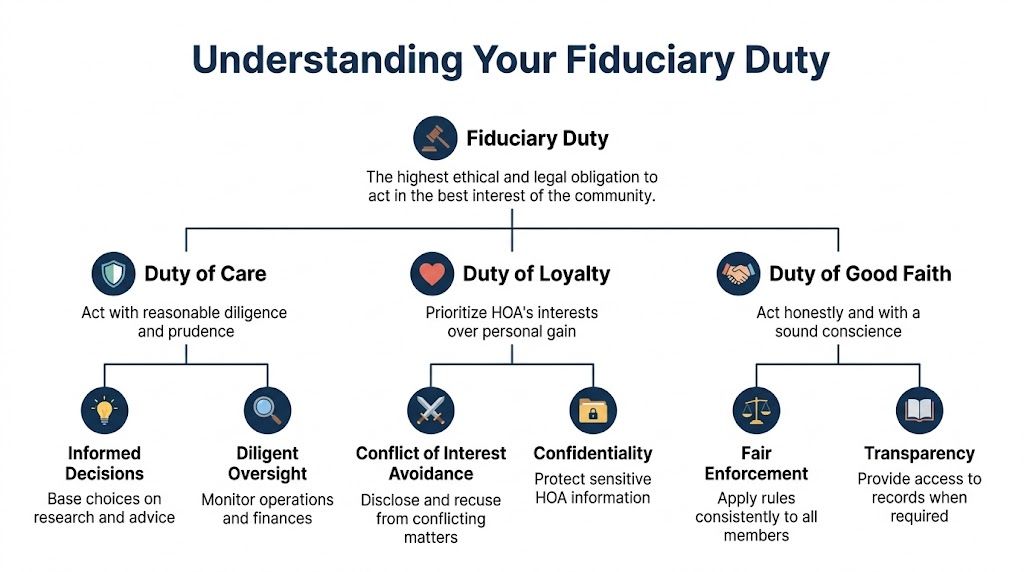
Serving on the board means taking on a fiduciary duty. In plain terms, you’re acting as a steward for shared property, shared money, and shared legal obligations. You are not there to advance your own preferences first, settle scores, or make casual decisions with community funds.
For hoa board members, fiduciary duty is the lens that should shape every vote, every contract, and every enforcement decision.
The three duties that matter most
Duty of care
This means making informed decisions with reasonable diligence. Read the packet. Review bids. Ask what the contract excludes. Confirm whether a repair is temporary or permanent.
Boards get into trouble when they guess. A rushed vote on a roof repair, drainage issue, or tree removal can create a much more expensive problem if the scope was poorly understood.
Duty of loyalty
This means the community’s interest comes before personal relationships or personal convenience. If a board member’s relative owns a service company, that relationship needs to be disclosed and handled carefully.
In Georgia communities, vendor decisions can become emotional quickly. Owners notice when the board appears too close to a contractor, especially when work quality slips.
Acting within authority
Boards must stay within the powers granted by the governing documents and applicable law. Good intentions don’t fix unauthorized action. If the documents require owner approval, a board vote alone isn’t enough.
How fiduciary duty shows up in financial decisions
Reserve funding is where fiduciary duty becomes concrete. According to this overview of HOA board responsibilities and reserve planning, boards must conduct reserve studies every 3-5 years, and fully funded reserves correlate with 20-30% lower long-term assessment hikes. The same source notes that property values can decline by 5-15% when deferred maintenance is allowed to take hold.
That pattern is familiar in practice. Communities that postpone hard decisions usually don’t avoid cost. They delay it, then pay under pressure.
A proper reserve plan helps the board answer basic but critical questions:
- Which components are the association responsible for replacing
- When are those components likely to need major repair
- How much should be set aside now rather than demanded later
- What maintenance schedule supports the longest useful life
Boards that need a clearer starting point should review what an HOA reserve study is and how it supports budgeting.
Vendor diligence is part of legal diligence
Fiduciary duty also affects contractor selection. Price matters, but so do qualifications, scope, insurance, and responsibility for employee conduct. When evaluating vendors for tree work or storm cleanup, it helps to understand the difference between bonded vs insured, because those terms are not interchangeable and they affect community risk.
A cheap contract can become an expensive board decision if the scope is vague and the vendor protections are weak.
A careful board documents why it chose a vendor, what work was approved, and who verifies completion. That isn’t bureaucracy. It’s how you protect owners from avoidable financial shocks.
Running Productive and Compliant Board Meetings
Many homeowners judge the board by one thing first. The meeting. If meetings feel disorganized, rushed, or opaque, confidence drops even when the board is trying to do the right work.
Strong meetings don’t happen because everyone is naturally good at procedure. They happen because the board follows a repeatable process that keeps discussion fair and decisions clear.
Start before the meeting starts
A productive meeting is built in advance. The president or manager prepares an agenda. The treasurer reviews financial items beforehand. The secretary confirms prior minutes and notice requirements. Directors read the materials before they sit down.
Use a sequence homeowners can follow:
- Call to order and confirm quorum
- Approve prior minutes
- Owner forum if your process allows it
- Financial review
- Old business
- New business
- Executive session when legally appropriate
- Adjournment
When that order stays consistent, owners know when issues will be heard and directors stop drifting into side topics.
Use procedure as a fairness tool
Robert’s Rules of Order can sound formal, but the value is practical. It gives the board a way to handle motions, amendments, discussion, and votes without talking over each other.
You don’t need a parliamentary expert for every meeting. You do need a chair who can do the following:
- Recognize motions clearly: know what’s on the floor before discussion starts
- Limit drift: bring comments back to the actual motion
- Call the vote cleanly: confirm whether the motion passed and record it accurately
Meetings run better when members debate the motion in front of them, not the frustration behind it.
Know when the room should be open
Most association business should be handled openly. Owners should be able to see the board discuss routine governance, budgeting, projects, and policy decisions.
Executive session has a narrower purpose. Use it for matters that require confidentiality, such as legal issues, certain personnel matters, or owner account and violation issues where privacy matters. Boards create mistrust when they overuse closed sessions for ordinary business.
Minutes should record decisions, not transcripts
Good minutes are not a word-for-word replay. They are a clear business record. They should show the date, time, attendees, motions, vote outcomes, and actions authorized.
Poor minutes usually fail in one of two ways. They either say too little to prove what happened, or they say too much and preserve unnecessary argument.
A simple test helps. If a future board, auditor, lawyer, or homeowner reviews the minutes, can they tell what decision was made and what authority was given? If the answer is yes, the record is doing its job.
Best Practices for an Effective and Harmonious Board
A board can be technically compliant and still ineffective. The boards that create stable communities do more than vote and adjourn. They build habits that reduce friction before conflict hardens.
In Georgia associations, especially those with mixed owner expectations and active amenities, harmony usually comes from predictability. Homeowners don’t need to agree with every decision. They do need to understand how decisions are made.
Communicate before rumors take over
Silence creates its own narrative. If the board is considering a major repair, rule clarification, vendor change, or budget pressure, tell owners early and in plain language.
Useful channels include:
- Board updates: brief post-meeting summaries focused on decisions and next steps
- Community email or portal notices: timely updates on projects, closures, and deadlines
- Annual planning messages: a straightforward explanation of priorities for the coming year
What doesn’t work is dropping information only when owners are already upset. By then, the board is reacting instead of leading.
Use committees with a clear lane
Committees can be a real asset when the board defines the assignment. Architectural review, landscaping input, social planning, and communications support are common examples.
Committees fail when they become shadow boards. Give them a charter, a chair, and a reporting process. Let them gather information and recommendations. Keep final decisions with the board unless your documents say otherwise.
Enforce consistently
Selective enforcement creates two problems at once. It frustrates the owner being cited, and it signals to everyone else that rules may depend on who you know.
Fair enforcement usually looks boring, and that’s a good sign. The process should be documented, consistent, and free of personal commentary.
Homeowners can accept a firm answer more easily than an unpredictable one.
Plan beyond the current complaint
Some boards spend every meeting in reaction mode. That approach wears members out and makes the community feel unmanaged.
Set aside time for longer-range issues such as maintenance sequencing, contract timing, rule review, owner education, and reserve priorities. Strategic planning sounds formal, but in practice it often starts with a simple question: what decisions do we keep postponing that will cost more later?
An effective board protects harmony by reducing surprises. Owners notice when their community feels orderly, informed, and fairly run.
Navigating Common HOA Board Challenges and Burnout
Burnout is one of the most underplayed problems in association governance. People still talk about board service as if stress is just part of being a good volunteer. That mindset drives capable members away.
The experience is often more difficult. According to Neighborhood Management’s discussion of HOA board challenges, board turnover rates have increased by 20-30% in the past year, 40% of members resign mid-term due to burnout from increased time demands, and 55% of board members experience clinical anxiety levels from conflicts. The same source reports that boards partnering with professional managers can reduce burnout by 35% through shared workloads.

What burns boards out first
In practice, burnout rarely comes from one dramatic issue. It usually builds through repetition.
Conflict that follows you home
Board members live where they serve. That changes the emotional weight of the job. A budget vote can turn into a parking-lot conversation. A covenant issue can become an awkward encounter at the mailbox.
That constant proximity is draining, especially when owners treat board members as personal opponents instead of community volunteers.
Rising costs and no easy answer
Boards have to make decisions owners may dislike. Insurance pressure, maintenance needs, and reserve reality don’t disappear because the board wants to avoid backlash. Saying no to a cosmetic project or yes to a necessary increase can feel equally unpopular.
The hidden second job
Most board members already have careers, family obligations, and personal responsibilities. Add review of contracts, homeowner messages, meeting prep, and enforcement hearings, and the role starts to consume evenings and weekends.
What actually helps
Generic advice about self-care doesn’t solve governance overload. Systems do.
- Set response boundaries: board members should not feel required to answer every owner message instantly or individually
- Use role discipline: if the secretary is handling records and the treasurer is tracking financial review, the work doesn’t pile onto one person
- Delegate operational follow-up: maintenance coordination and routine owner communication should have a clear handler
- Keep meetings focused: scattered meetings create extra labor after the meeting ends
Burnout often looks like irritability, avoidance, late replies, missed reviews, and a desire to quit before the term ends.
A better way to think about service
The old narrative says good board members absorb the stress. That doesn’t protect the community. Exhausted volunteers make slower decisions, avoid hard conversations, and eventually leave unfinished work behind.
Healthy boards normalize asking for help. They divide responsibilities, document processes, and avoid making one person the emotional shock absorber for the whole neighborhood. That protects the volunteer and the association at the same time.
The Strategic Value of a Professional Management Partner
A professional management partner should remove administrative weight from the board without replacing board authority. That distinction matters. The board still governs. The manager helps execute, organize, and report.
For many communities, this is the point where service becomes sustainable again. The board stops spending most of its energy chasing invoices, tracking vendor follow-up, handling owner communication volume, and trying to decipher compliance details on the fly.
What the board keeps
The board should retain control over decisions such as:
- Budget approval
- Contract approval
- Policy and rule decisions
- Enforcement direction
- Strategic priorities for the community
If a management relationship blurs those lines, confusion follows. Owners need to know who decides and who implements.
What a manager can carry
A strong management setup can handle the work that drains volunteer bandwidth but still requires consistency:
- Assessment collection and delinquency follow-up
- Work order intake and vendor coordination
- Agenda and board packet preparation
- Financial reporting support
- Record organization
- Owner communication routing
- Meeting logistics and follow-through
That structure gives hoa board members room to focus on judgment instead of constant administration.
Why this matters in real communities
When boards are self-managing every detail, small tasks stack up fast. A missed maintenance follow-up becomes resident frustration. A delayed financial question becomes suspicion. An undocumented decision becomes a future dispute.
A community association manager creates operational continuity. If you want a clear sense of that role, this overview explains what a community association manager does.
One practical example is Vantaca, a management software platform used in the industry to support board operations, records, communication, and accounting workflows. In a management relationship, tools like that can centralize tasks so the board isn’t relying on scattered emails, personal spreadsheets, or one volunteer’s memory.
This is also where a firm such as Access Management Group fits factually into the picture. A management company can serve as the liaison between board and homeowners, handle payment processing and delinquent follow-up, and support the board’s operational workflow while leaving governance decisions with the elected directors.
Georgia HOA FAQs and Your Path Forward
Georgia board members often ask practical legal questions that don’t come up until there’s a dispute, a records request, or a contested meeting. The right answer usually starts with your governing documents, then moves to applicable state law, and often includes advice from association counsel when the issue is sensitive.
Common questions from Georgia boards
Does every Georgia HOA fall under the same law
No. Some communities are subject to the Georgia Property Owners’ Association Act, while others operate primarily under their recorded declaration, bylaws, corporate requirements, and other applicable law. That’s why two nearby communities can handle similar issues differently.
Are all board meetings required to be open
Georgia communities should be careful here because the answer depends on the association’s documents and legal framework. In practice, boards should treat transparency as the default for ordinary business and limit closed discussion to matters that require confidentiality.
How should a board handle owner records requests
Start with the documents your association is required to maintain and the process your governing documents establish. Respond in an organized, professional way. Boards get into trouble when records are scattered across personal devices, private email accounts, or former directors’ files.
Can the board make exceptions just to be neighborly
Sometimes boards want to solve a short-term problem informally. That can create a bigger enforcement issue later. Before granting any exception, confirm the board has authority to do so and document the basis for the decision.
What should a new board member read first
Begin with the declaration, bylaws, rules, current budget, recent financial statements, reserve information, and the last set of approved minutes. A board member who understands those items can participate much more effectively.
Your next move
Most hoa board members don’t need perfection. They need structure, discipline, and a willingness to ask better questions before acting.
If you serve with homeowners in mind, keep your process fair, and treat finances and records seriously, you’ll already be ahead of many struggling boards. That kind of governance protects property values and makes daily community life calmer for everyone who lives there.
If your board wants practical support with financial oversight, homeowner communication, meeting administration, and day-to-day community operations, Access Management Group is one option to explore. The right management partnership can help your board stay focused on governance while giving homeowners the responsive, organized service they expect.