One of the hardest board conversations usually starts with a simple sentence: “We need to replace it sooner than expected.”
Maybe it is the clubhouse roof. Maybe it is the pool surface, the entry monument, private roads, or a failing HVAC system in a common building. The problem is rarely just the repair itself. Strain arises when the association does not already have a clear plan to pay for it.
That is when homeowners hear words they never want to hear: special assessment.
A reserve study helps prevent that moment. If you are asking what is an hoa reserve study, the short answer is this: it is the community’s long-range plan for major repair and replacement costs. It gives the board a practical way to match future expenses with steady, fair funding today.
For a new Georgia board member, this document can look technical at first. It is not. It is a disciplined way to answer a few common-sense questions. What does the association own? What condition is it in? How long will it last? What will it cost to replace? And how much should the community be setting aside now?
Your Community’s Financial Roadmap
A healthy HOA budget covers two very different jobs.
The first job is daily operations. That includes landscaping, management, utilities, and routine maintenance. The second job is preparing for major future costs that do not happen every month, but absolutely do happen.
That second job is where boards often get tripped up.
Think about a community with aging roofs, sidewalks, and a pool area that has seen better days. If the board only focuses on this year’s bills, the association can look stable right up until a major component fails. Then owners may face a sudden bill that feels unfair, even if the repair itself is necessary.
A reserve study works like a financial roadmap. It helps the board look past the next budget cycle and plan for the shared assets that wear out over time. It is not a guess. It is a structured review of physical components and the money needed to repair or replace them in the future.
Why boards and homeowners both need it
Homeowners want predictability. Boards need defensible numbers. A reserve study serves both.
When a board adopts a budget informed by reserve planning, it can explain why reserve contributions matter and how those funds protect the community. That clarity also improves communication during annual budget season, especially when paired with organized financial reporting tools such as best HOA accounting software.
A simple way to think about it
A reserve study is a lot like preventive care.
You do not wait for a crisis before paying attention to the warning signs. You inspect, plan, and save before the emergency arrives. Communities that take that approach usually make calmer decisions, maintain common areas more consistently, and avoid the kind of last-minute scrambling that creates conflict between the board and owners.
Key takeaway: A reserve study is not just an accounting exercise. It is a planning tool that helps protect homeowners from avoidable financial shocks.
Deconstructing the HOA Reserve Study
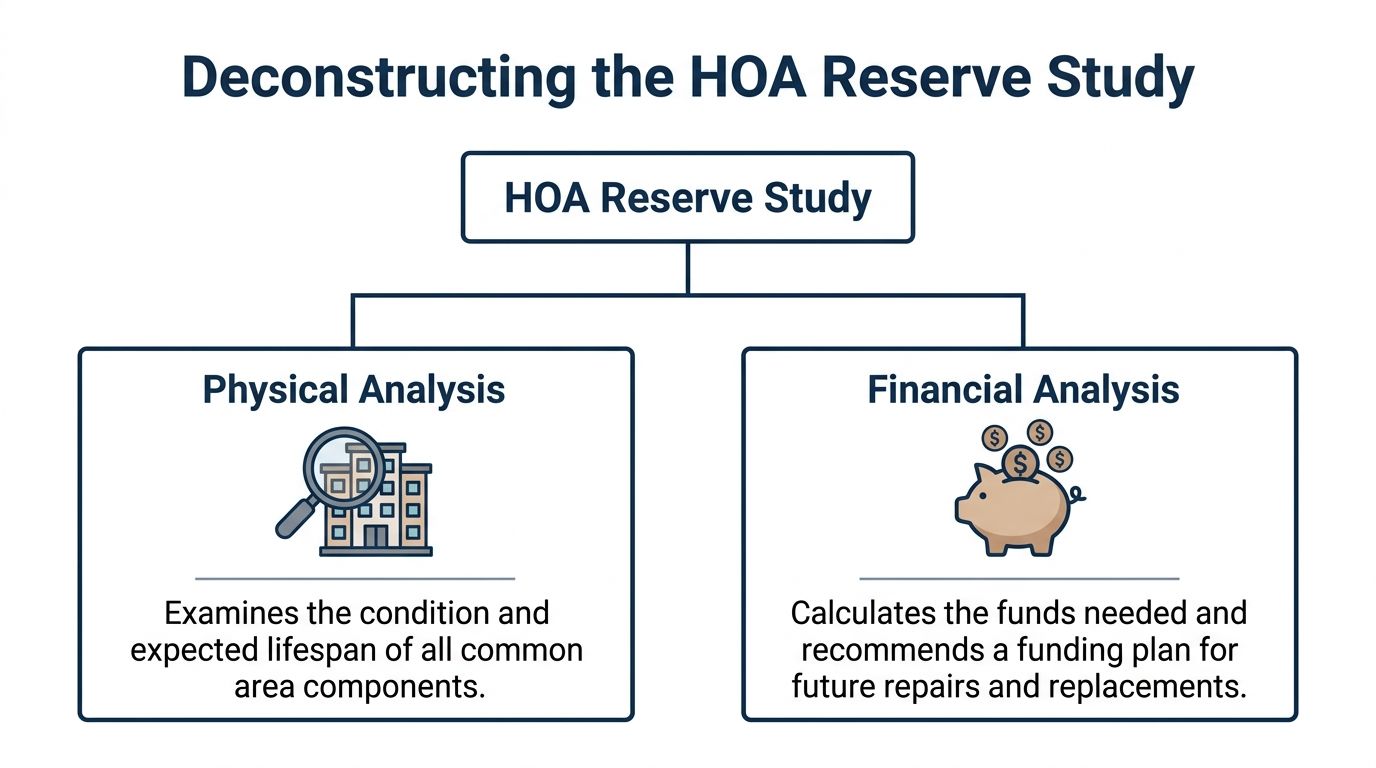
An HOA reserve study has two working parts: a physical analysis and a financial analysis. One tells the board what the community owns and how those assets are aging. The other shows how to save for repairs and replacements on a schedule the association can manage.
For a new board member, it helps to compare the study to a property maintenance manual paired with a savings plan. The maintenance side identifies the parts likely to wear out. The savings side answers a harder question: how much should the association collect now so owners are less likely to face a large, sudden bill later, such as a condominium special assessment for major repairs.
The physical analysis
The physical analysis starts with responsibility.
In Georgia communities, that means confirming which common elements the association must repair or replace under the declaration, plats, and governing documents. That step matters because boards sometimes assume an item belongs in reserves when the documents place responsibility elsewhere. A good study clears that up before the numbers are built.
From there, the reserve professional creates a component inventory. This is the list of major shared assets the association is expected to maintain over time, such as roofs, private roads, retaining walls, pool equipment, elevators, fencing, sidewalks, lighting, or clubhouse systems. Each item is reviewed for current condition, expected lifespan, remaining lifespan, and replacement cost at current prices.
A few terms can blur together if you are seeing them for the first time:
- Component inventory is the master list of reserve items the HOA is responsible for.
- Useful life is the total expected service life of a component under normal use.
- Remaining useful life is the estimated time left before major repair or replacement.
- Current replacement cost is the estimated cost to replace the item based on today’s pricing.
Those definitions matter because they shape the budget. If a pool pump has three years left, that affects funding differently than a roof with twelve years left. Small differences in lifespan assumptions can change annual reserve contributions in a noticeable way.
The financial analysis
Once the asset list is established, the study turns into a funding exercise.
The financial analysis compares projected future expenses with the money already in reserves and the money expected to be added each year. Industry guidance from Reserve Study Basics explains that studies often model expenses across a 20 to 30 year period and adjust projected costs for inflation. That long view helps boards avoid setting dues based only on what feels affordable this year.
For Georgia boards, this is the point where judgment and fiduciary duty meet. A contribution schedule that looks comfortable in the short term can still be risky if it leaves major components underfunded. The study gives directors a documented basis for those decisions, which is especially important when owners question reserve increases or the timing of capital projects.
Two analyses, one plan
| Analysis Type | What It Answers |
|---|---|
| Physical Analysis | What does the HOA maintain, what condition is it in, and how long is it likely to last? |
| Financial Analysis | How much should the HOA set aside, and what funding plan supports future repair and replacement? |
How often should a study be updated?
Reserve planning works best as an ongoing discipline, not a report that sits on a shelf.
Many associations obtain a full study with a site inspection, then update it periodically as conditions, prices, and completed projects change. In practice, a Georgia board should also review the study during budget season and after major events such as storm damage, a large repair project, or a sharp jump in construction costs. A report written several years ago may still be useful, but only if the board checks whether the assumptions still match reality.
Board tip: If your reserve study does not reflect your governing documents, recent projects, or current construction pricing in Georgia, treat it as outdated until it is reviewed.
Why a Reserve Study Is Your Best Defense Against Special Assessments
A Georgia board often learns the value of reserves at the worst possible moment. The roof starts leaking after a storm, the pavement fails sooner than expected, or the pool equipment quits in the middle of summer. Owners are not upset because the repair is needed. They are upset because the bill arrives all at once.
A reserve study helps prevent that kind of surprise. It gives the board a plan to collect money gradually, while common elements are wearing out, instead of scrambling after a failure. For boards trying to meet their fiduciary duties in Georgia, that plan is more than good budgeting. It is evidence that the board acted with foresight.

Reserve funding works like setting aside money for a car you know will eventually need tires and brakes. If you save a little each month, the replacement is inconvenient but manageable. If you ignore the wear, the same expense turns into a financial shock. An HOA faces that same choice, just on a larger scale with roofs, asphalt, fencing, clubhouses, mechanical systems, and other shared components.
That changes the owner experience in concrete ways. These numbers translate directly into the lived experience of homeowners. Regular reserve contributions are easier to absorb than a sudden demand for thousands of dollars per household. Board meetings are calmer. Project timing improves. Contractors can be scheduled before a minor issue becomes a community-wide problem.
Why special assessments hit so hard
A special assessment usually appears when the association has too little cash, too little time, or both.
That pressure creates bad options. The board may have to delay work, borrow at unfavorable terms, or ask owners for an unplanned payment on short notice. In a condominium or townhome community, where shared infrastructure is extensive, the impact can be severe. If your association has already faced one, a condominium special assessment often leaves owners wary of future budgets and skeptical of board planning.
For Georgia communities, that history matters. A board that cannot explain how it is preparing for known replacement costs will face harder questions from owners, and sometimes from lenders or buyers reviewing the association’s financial health.
What a reserve study changes
A current reserve study gives the board a working map for future capital expenses. It does not promise that every surprise disappears. It does make expensive surprises less likely and easier to handle.
Here is how that protection shows up in practice:
- Budgets become more predictable. The board can build reserve contributions into annual dues instead of reacting after a component fails.
- Projects can be timed more intelligently. Planned replacements usually cost less and create less disruption than emergency work.
- Owners get a clearer explanation. A documented funding plan is easier to defend than a last-minute request for money.
- The board can show its reasoning. That matters in Georgia, where directors should be able to show they used a reasonable process when making financial decisions.
Cost forecasting is part of that discipline. Tools such as Exayard construction estimating software illustrate the kind of estimating method professionals use to build and update capital cost assumptions, which is especially helpful when boards are reviewing reserve recommendations against current construction pricing.
Property values follow planning
Buyers notice deferred maintenance. Lenders and appraisers do too.
A reserve study supports property values because it ties physical upkeep to a funding plan the board can follow. That credibility matters in any association, but it carries extra weight in Georgia communities competing for buyers who compare dues, visible maintenance, and the likelihood of future assessments.
Practical point: A reserve study does not remove hard decisions. It gives the board time, structure, and financial context to make those decisions before they become emergencies.
The Reserve Study Process from Start to Finish
Boards often assume the process will be technical, disruptive, or difficult to manage. In practice, it is much more straightforward when the association is organized.
The work usually unfolds in a sequence that makes sense.
Step one, define the property scope
Before a specialist can evaluate anything, the board and manager need a clean picture of what the association is responsible for maintaining.
That means confirming maintenance duties in the declaration, plats, prior studies, maintenance records, and repair history. In many communities, confusion starts right here. Boards may assume a component belongs in reserves even though the governing documents assign responsibility elsewhere.
Step two, choose a qualified reserve specialist
The specialist reviews the property, documents, and funding position. On a full study, that generally includes a site visit.
During the inspection, the reviewer examines major common elements, notes condition and estimated life, and gathers cost assumptions for future repair or replacement. Good specialists are methodical. They also know how to write reports that board members can use.
For boards comparing vendors, it can help to understand how construction costs are typically built and updated. A practical reference point is Exayard construction estimating software, which shows the kind of estimating discipline behind many capital cost projections.
Step three, receive the report and funding plan
The final report usually includes a component list, condition observations, projected replacement timing, and recommended reserve funding levels.
This is the point where the board should slow down and ask questions. Which projects are near-term? Which assumptions are conservative? Which items may need separate engineering review? A reserve study is a planning tool, but the board still has to interpret and apply it carefully.
Different study types
Boards should also understand that reserve planning happens in cycles, not isolated events.
- Full study: Used for the initial baseline or after a long lapse. It typically includes a site visit and a complete review.
- Update with site visit: Useful when the association already has a study but needs refreshed field observations.
- Update without site visit: Often used for annual financial adjustments when the physical data remains largely reliable.
Helpful mindset: Treat the reserve study as a living document. The best report in the world loses value if the board never revisits it after projects, price changes, or major storms.
Legal Duties and Financial Risks for Georgia HOA Boards
In Georgia, reserve planning is not just a budgeting preference. It is closely tied to the board’s fiduciary duty.
A board is responsible for protecting common assets, using association funds prudently, and making decisions that serve the community as a whole. When directors ignore foreseeable capital needs, the consequences often land on homeowners through deferred maintenance, large assessments, and disputes over whether the board acted responsibly.

A professional reserve study helps a board show that it is acting with care. It creates a documented basis for funding decisions, repair timing, and communication with owners. That matters when owners question the budget or when a major project becomes controversial.
Georgia’s direction and why it matters
Verified data states that Georgia legislation such as House Bill 222 from 2024 is moving toward mandating reserve studies for larger HOAs by 2026, following a broader national trend, according to Vanguard Management Group’s discussion of HOA reserve study legal trends.
That same verified source states that a 2023 CAI survey found 62% of associations were underfunded by over 50%, and that litigation saw a 25% rise in some states after similar reforms.
For Georgia boards, the practical lesson is clear even before any specific mandate applies to a given community. Regulators, homeowners, and courts are paying closer attention to reserve adequacy and board oversight.
Fiduciary duty in plain language
Board members often hear “fiduciary duty” and think it refers only to preventing fraud or approving invoices correctly. It is broader than that.
It also means the board should:
- Plan ahead: A community’s major assets do not fail without warning. Roofs, pavement, and mechanical systems age over time.
- Use objective information: Decisions should rely on professional analysis, not optimistic assumptions.
- Treat owners fairly: Delaying reserve contributions can shift today’s costs onto tomorrow’s owners.
- Protect the association’s position: Lenders, buyers, and insurers often look closely at how a community handles long-term obligations.
A strong board education resource on this point is hoa board responsibilities, especially for directors who are still learning where governance ends and operations begin.
Why inaction gets expensive
When boards delay long-term planning, the costs do not stay still.
Repairs can expand in scope. Small failures can affect nearby components. Owners may become less willing to approve necessary funding once trust has already eroded. Even when everyone agrees the work is needed, the financial path gets harder because the association is starting late.
The legal risk rises too. Owners are more likely to challenge board decisions when there is no record showing the board evaluated capital needs in a disciplined way.
Takeaway for Georgia boards: A reserve study does not replace legal advice or engineering advice, but it does show that the board is taking foreseeable obligations seriously.
Taking Action and Hiring a Reserve Specialist
Some communities know they need a reserve study because they have never had one. Others need one because the old report no longer reflects reality.
A few warning signs usually stand out.
Red flags that should move this up the agenda
- Visible deterioration: Cracking pavement, recurring roof leaks, failing fences, worn pool surfaces, or aging mechanical systems are signs that future costs are getting closer.
- Budget stress during capital projects: If every major repair triggers debate about where the money will come from, the reserve plan is probably weak or outdated.
- Outdated or missing documentation: If the board cannot quickly identify reserve components and projected replacement timing, decision-making is already harder than it should be.
- Frequent owner frustration: Surprise projects and unclear funding explanations often point to poor long-range planning.
What to ask before hiring
Not every provider communicates well, and not every report fits every community. Boards should interview candidates carefully.
Ask questions such as:
- What credentials do you hold? Boards often look for reserve specialists, professional reserve analysts, or engineers with reserve study experience.
- Have you worked with communities like ours? A townhome association, mid-rise condominium, and master-planned community do not have identical reserve profiles.
- Will you review our governing documents? The provider needs to know what the association is obligated to maintain.
- How do you present funding recommendations? A strong report should be clear enough for directors and homeowners to understand.
- What update cycle do you recommend for our property? The answer should reflect your asset mix, age, and complexity.
What a good fit looks like
The right specialist is not just technically capable. They are also understandable.
Boards need reports they can use at meetings, explain to owners, and build into annual budgets. If a provider cannot explain reserve concepts in plain language during the proposal stage, that usually will not improve after the contract is signed.
Secure Your Community’s Future
A reserve study is one of the clearest ways a board can protect homeowners, stabilize budgets, and preserve shared property over time. It turns future repair obligations into a manageable plan instead of a recurring emergency.
For Georgia boards, that matters even more as legal expectations evolve and owners look for stronger financial stewardship. The communities that plan early usually have better options later.
Take the next step now. Review your current reserve position, confirm your maintenance responsibilities, and decide whether your association needs a new study or an update.
If your board wants experienced guidance on community finances, governance, and long-term planning, Access Management Group can help your association protect, preserve, and enhance its real estate investment with informed, homeowner-focused management.