Late agendas. Resident complaints that can’t wait. A vendor who wants direction now, not after next month’s meeting. A treasurer staring at reports that answer some questions and create three more.
That’s where many boards find themselves. Good volunteers care about their communities, but care alone doesn’t create clean financial controls, consistent covenant enforcement, or reliable project follow-through. The issue usually isn’t commitment. It’s capacity.
When boards search for information about homeowner association jobs, they often get content aimed at job seekers. What boards need is something more useful. They need a practical guide to the roles that keep an association stable, compliant, responsive, and financially disciplined.
Why Your HOA Board Needs Professional Support
A volunteer board can govern well. It usually can’t operate everything well for long.
That distinction matters. Boards are designed to set direction, approve budgets, enforce standards fairly, and protect the association’s long-term interests. They are not built to personally chase delinquent accounts, coordinate every vendor, inspect common areas, draft owner notices, prepare management reports, and mediate every resident conflict.

A common pattern looks like this. The board starts by handling everything internally to save money. One director becomes the informal maintenance contact. Another ends up answering owner emails at night. The treasurer carries too much of the accounting burden. Over time, response times slip, documentation gets uneven, and board meetings turn into operating sessions instead of governance sessions.
That’s usually the moment when a board stops asking, “Can we manage this ourselves?” and starts asking the better question: “What professional support does this community need?”
This is a real industry, not an occasional volunteer function
The scale of the field tells you something important. The homeowners association industry employs approximately 138,667 people in the United States as of 2025 and supports 369,000 associations representing properties valued at about $12.9 trillion, according to IBISWorld’s homeowners association employment data.
Those figures matter because they reframe HOA operations. This isn’t a side activity. It’s a specialized professional environment with defined roles, technical responsibilities, and real consequences when positions are poorly filled.
Board reality: When volunteers carry operational work for too long, the association usually pays for it later in delayed decisions, inconsistent records, and avoidable disputes.
Professional support also protects the board itself. It creates distance between resident frustration and board governance. It puts trained people in charge of process. It improves continuity when directors rotate off.
Boards exploring community association management company support usually discover that the right staffing model doesn’t replace board authority. It makes board authority more effective.
What changes when the team is built correctly
A supported board spends less time reacting and more time deciding. That changes meeting quality, owner communication, and vendor accountability.
The best result isn’t that the board does nothing. It’s that the board does the right work:
- Governance work: adopting policy, approving contracts, setting expectations
- Financial oversight: reviewing reports, not creating them from scratch
- Strategic planning: reserves, maintenance priorities, rules, and community standards
- Executive judgment: evaluating manager performance instead of doing the manager’s job
That’s the mindset shift behind every smart hiring decision in an HOA or COA.
The Structure of a Professional HOA Team
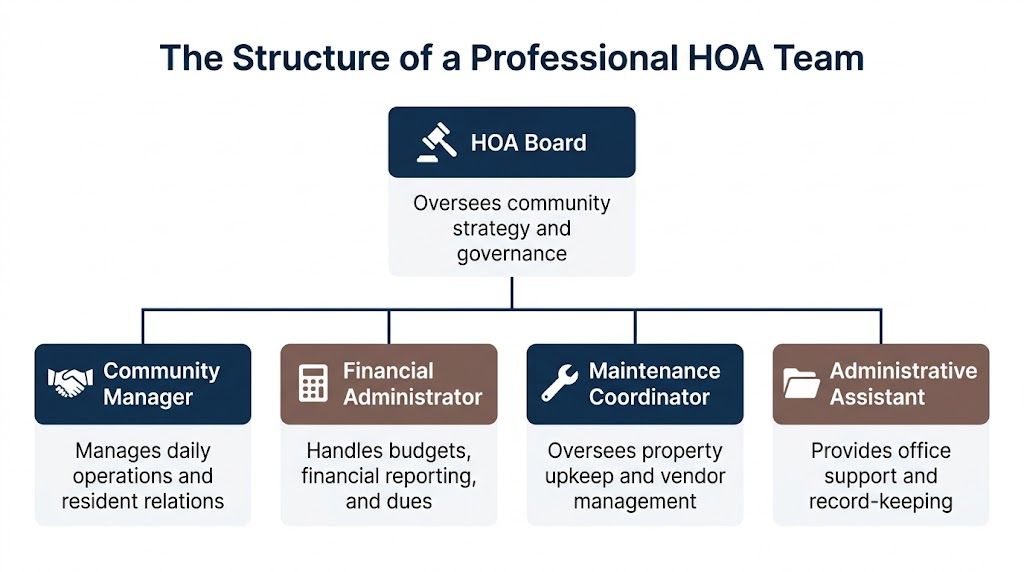
A professional HOA team works best when the board remains at the top of the governance chain and the staff or management partners run the daily operation. Problems start when those lines blur.
The board should decide policy. The management team should execute policy, document activity, coordinate vendors, and keep information flowing back to the board in a usable form.
The core team most boards need to understand
For most communities, the staffing picture centers on four operational functions.
Community manager
The community manager is usually the board’s primary operating partner. This person handles day-to-day administration, owner communication, meeting preparation, violation workflows, vendor coordination, and follow-up on board decisions.
A strong manager also knows when not to act alone. They escalate legal issues, policy decisions, and major spending questions back to the board instead of freelancing.
Boards that want a deeper role definition should understand what a community association manager does, because many hiring mistakes happen when boards ask one person to be manager, bookkeeper, project supervisor, and conflict negotiator all at once.
Financial administrator
The financial administrator handles the money mechanics that boards must oversee closely but shouldn’t process casually. That includes assessment posting, payables, receivables, reconciliations, budgeting support, monthly financial package preparation, and records needed for audits or tax work.
In smaller associations, this function may sit inside the manager’s role. In larger or more complex communities, it needs dedicated attention.
Maintenance coordinator
The maintenance coordinator keeps the physical asset from drifting. This role tracks work orders, schedules site inspections, gathers vendor proposals, monitors contract performance, and helps the board prioritize repairs versus replacements.
For communities with amenities, aging infrastructure, or active capital work, this role becomes operationally important very quickly.
Administrative assistant
The administrative assistant is often underrated until the association lacks one. Records organization, resale package support, meeting logistics, owner correspondence routing, file retention, and document distribution all land here.
When this role is missing, higher-value staff end up doing clerical work badly and expensively.
Comparing key HOA management roles
| Role | Primary Focus | Typical Environment | Best For Associations That… |
|---|---|---|---|
| Community Manager | Operations, communication, governance support | Portfolio or on-site | Need a central point of accountability |
| Financial Administrator | Assessments, reporting, payables, records | Back-office or hybrid | Have budget complexity or collections pressure |
| Maintenance Coordinator | Property upkeep and vendor follow-through | On-site or field-based | Have substantial common areas or many active vendors |
| Administrative Assistant | Documentation and office support | Office-based or hybrid | Need faster response times and cleaner records |
A board should never assume one capable person can cover every function indefinitely. Even when one person can do it for a while, that structure often fails during vacations, turnover, or heavy project periods.
What a healthy reporting line looks like
Residents interact with management. Management reports to the board. The board governs on behalf of the membership.
That sounds obvious, but many associations break it by letting residents direct vendors, letting directors supervise staff individually, or letting the manager become the policy maker. A clean structure prevents confusion and reduces conflict.
Detailed Look at Common Homeowner Association Jobs
Boards hire better when they understand daily responsibilities, not just job titles. Two candidates can both call themselves community managers and operate at very different levels.
Most lists of homeowner association jobs fall short; they name roles, but they don’t explain how those roles protect the association from drift, rework, and preventable risk.
Community association manager
The community association manager, often called a CAM, sits closest to the board’s operating pressure points. This person prepares meeting packets, tracks decisions, follows up with vendors, coordinates owner communications, assists with violation procedures, and keeps the board from losing momentum between meetings.
The role has become more demanding. A 2022 industry report on HOA and CAM staffing challenges noted that 38% of management company executives are still directly overseeing associations themselves, and overload is the top staffing concern for 20% of leaders. Boards should read that as a warning. If responsibilities aren’t clearly defined, even strong managers get pulled into constant triage.
A good CAM protects the board in practical ways:
- Decision follow-through: makes sure approved actions take place
- Documentation discipline: keeps notices, minutes, correspondence, and work records organized
- Resident communication: reduces confusion before it becomes conflict
- Vendor accountability: confirms proposals, scope, timing, and completion
A weak CAM often looks busy but leaves loose ends everywhere. The board feels active, but unresolved items keep returning to the agenda.
On-site manager or general manager
Larger communities, high-rise buildings, amenity-rich properties, and active lifestyle associations often need an on-site manager or general manager. This is different from a portfolio manager who divides attention across multiple accounts.
On-site leadership matters when the property has daily operational complexity. Think staff supervision, amenity scheduling, visible rule enforcement, maintenance walk-throughs, contractor access, package or key control systems, and resident-facing service issues that need same-day judgment.
Boards should expect this role to be highly visible. Residents often judge the association’s competence by how this person communicates and follows through.
The board’s mistake is usually not hiring an on-site manager too early. It’s waiting until service failures become public and expensive.
Financial manager or accounting specialist
HOA finances need more than bookkeeping. A capable financial manager or accounting specialist understands the rhythm of association cash flow, recurring obligations, reserve activity, owner assessments, and reporting deadlines.
The board should expect this role to handle or support:
Monthly financial reporting
Accurate board packets matter. Directors need reports that are timely, understandable, and reconciled well enough to support real oversight.
Assessment collections and owner account records
This work needs consistency. Inconsistent collections procedures create fairness problems and can escalate owner disputes.
Payables and approval controls
The board needs a process that prevents rushed payments, duplicate payments, and weak documentation.
Budget support
A finance professional should help translate contracts, recurring costs, and expected projects into a workable budget draft, not merely input numbers after the fact.
This role often delivers its value without fanfare. Boards usually notice its importance only after they inherit messy ledgers, missing invoices, or owner account disputes.
Maintenance coordinator or facilities lead
A maintenance coordinator keeps physical operations from becoming reactive. The role isn’t just about broken items. It’s about systems.
The strongest candidates know how to inspect common areas with discipline, track recurring failures, document vendor performance, and separate urgent repairs from work that should go through bidding and planning. They also understand that a board needs clear options, not vague updates.
Look for someone who can answer practical questions:
- What failed?
- What’s the short-term fix?
- What’s the long-term fix?
- Does this affect safety, appearance, or cost exposure?
- Which contractor owns the next step?
Administrative and resident service support
An administrative assistant or resident services coordinator often becomes the association’s traffic controller. Calls, emails, records requests, meeting notices, package requests, access credentials, forms, certificates, and document routing can all pass through this role.
Boards that dismiss this as “just office support” usually end up overloading the manager with work that doesn’t require managerial judgment. That’s an expensive misuse of talent.
Administrative support also improves resident experience. Owners don’t need every issue solved instantly, but they do need a clear response path and confidence that requests aren’t disappearing into a void.
Essential Skills Certifications and Compensation
Once the board knows which role it needs, the next question is quality. Titles aren’t enough. A candidate can interview well and still fail under the pressure of resident conflict, board politics, and messy operational details.
The strongest hires combine judgment, process discipline, communication skill, and enough technical knowledge to know when to escalate.

Skills boards should screen for first
Some qualifications are easy to verify. The most important ones often show up in how a candidate thinks.
Use interviews and reference checks to test for these:
- Communication control: Can the person write a clear owner notice, run a difficult meeting, and deliver bad news without making things worse?
- Document fluency: Do they understand governing documents, board authority, and where procedure matters?
- Financial comfort: Can they read reports, spot anomalies, and explain budget implications in plain language?
- Vendor management: Do they know how to define scope, compare proposals, and document performance?
- Conflict handling: Can they de-escalate without promising things the board hasn’t approved?
- Prioritization: Do they know the difference between urgent, important, and merely noisy?
A practical interview prompt works better than a generic one. Ask, “A homeowner says the association is selectively enforcing a rule, and the board president wants an answer tonight. What do you do first?” The answer tells you far more than “Tell us about yourself.”
Certifications and licensing matter, but context matters too
Professional designations can help boards separate candidates who take the field seriously from those who drifted into it. In community association management, boards often look for CAI-related credentials such as CMCA, AMS, and PCAM. Those designations don’t replace judgment, but they can signal structured training and commitment to the profession.
In Georgia, boards should also verify whether a candidate needs state-specific licensing for the role they’ll perform. Don’t assume a strong resume means compliant eligibility.
If your hiring committee reviews resumes in detail, this guide on how to list certifications on a resume is useful because it shows what organized, verifiable credential presentation should look like. That makes screening easier and helps boards distinguish between meaningful qualifications and decorative initials.
Hiring standard: Ask candidates to explain how they used a certification in actual board work. If they can’t connect the credential to decisions, communication, or compliance, the letters alone don’t tell you much.
Compensation has to match market reality
Boards often underbudget for management talent and then wonder why the applicant pool is thin. This is a labor market issue, not a branding issue.
The broader occupational category for property, real estate, and community association managers is projected to grow 4% from 2024 to 2034, with a median annual salary of $66,700 as of May 2023 and about 39,000 job openings projected each year, according to the U.S. Bureau of Labor Statistics occupational outlook.
That doesn’t mean every HOA role should pay the same. It does mean boards should expect steady demand for qualified people and should budget accordingly if they want someone experienced, organized, and likely to stay.
What boards often miss when setting pay
Compensation isn’t just base salary. Candidates also evaluate workload, authority, software support, board culture, after-hours expectations, and whether the job is set up to succeed.
A lower salary can still attract a strong candidate if the role has:
| Hiring factor | Why it matters |
|---|---|
| Clear scope | Good candidates avoid jobs with undefined expectations |
| Professional tools | Strong software and accounting support reduce burnout |
| Reasonable board access | Candidates want structure, not constant informal demands |
| Decision clarity | Managers stay longer when approval paths are predictable |
Boards that want top talent need to present a credible job, not just a paycheck.
Your Board's Guide to Hiring and Retaining Top Talent
Boards usually don’t lose good candidates because they posted in the wrong place. They lose them because the role sounds chaotic, the interview process feels disorganized, or the community seems unclear about what it wants.
That’s especially risky in the current market. ManageCasa’s discussion of HOA management staffing trends describes a nationwide “squeeze” on qualified community association managers, with operational consequences that include delayed maintenance and increased liability. A board that hires casually in that environment usually ends up rehiring.
Start with a job description that tells the truth
A good posting doesn’t try to impress candidates. It helps the right candidates opt in and the wrong ones opt out.
The most effective HOA job descriptions do five things well:
Define the community clearly
Explain whether the property is on-site or portfolio-managed, whether it includes amenities, whether there are active capital projects, and how resident communication is handled.Separate must-haves from nice-to-haves
If everything is required, nothing is. Boards that demand every possible skill in one role often signal poor internal organization.Describe authority lines
State who the role reports to, how board communication works, and what spending or operational discretion exists.List recurring responsibilities clearly
Evening meetings, violation administration, vendor bidding support, budget preparation, and emergency coordination should all be stated plainly.Acknowledge support systems
Candidates want to know whether they’ll have accounting support, software, admin help, and established processes.
Ask interview questions that expose judgment
Many boards conduct interviews that are too polite to be useful. You don’t need trick questions. You need scenario questions that reveal how the candidate works under pressure.
Try questions like these:
- Resident conflict: “A homeowner demands immediate action on a neighbor complaint, but the documents require notice and process. How do you respond?”
- Board dynamics: “Two directors give you conflicting instructions between meetings. What do you do?”
- Vendor control: “A contractor missed deadlines twice and now wants a change order. How would you present this to the board?”
- Financial discipline: “The board wants to defer a needed repair because owners are fee-sensitive. How would you frame the risk?”
The strongest candidates don’t answer with slogans. They answer with sequence, documentation, and escalation logic.
A reliable manager doesn’t promise to solve every problem personally. They explain the process they would use, what they would document, and when they would bring the matter back to the board.
Where boards should look for candidates
Generic job boards can help, but they rarely produce the highest-fit HOA candidates by themselves. Better sourcing often comes from industry networks, management referrals, local association circles, and professional education channels where people already understand this work.
Boards should also ask whether they want someone already trained in association operations or whether they are willing to train a strong property, hospitality, accounting, or facilities candidate into the role. That’s a valid trade-off, but only if the board has support systems in place.
Retention starts before day one
A board can hire a capable manager and still lose them quickly through avoidable friction. Retention depends on how the board behaves once the person is in the seat.
What works:
- One board contact path: funnel direction through the president or a designated liaison
- Clear meeting cadence: regular schedules and deadlines for board packets
- Written priorities: top projects, unresolved issues, and policy boundaries
- Respect for process: no last-minute pressure to skip procedure because someone is loud
- Performance feedback: direct, documented, and tied to actual expectations
What doesn’t work:
- Individual directors assigning work privately
- Changing priorities without documentation
- Blaming staff for board indecision
- Treating availability as a substitute for systems
- Expecting executive judgment without granting authority
Turnover is expensive even when a board doesn’t see a line item labeled “turnover cost.” Service drops. Owner trust drops. Records continuity weakens. Vendors reset the relationship. The board ends up spending more time managing the vacancy than it ever would have spent supporting the employee properly.
Direct Hire vs Partnering with a Management Company
Some boards assume the choice is simple. Hire a manager directly, save money, keep control. Sometimes that works. Often it creates obligations the board didn’t fully price in.
The better question is which model gives the community the right level of continuity, expertise, and operational resilience.
When direct hire makes sense
Direct hiring can work well for a community with enough scale to support a dedicated employee and enough internal structure to supervise that employee properly. This model can offer visibility, consistency, and a stronger day-to-day property presence.
It may fit best when the association has:
- Substantial on-site needs
- A stable board with strong governance discipline
- Reliable back-office accounting already in place
- Clear HR, payroll, and supervision processes
The risk is concentration. If the employee resigns, takes leave, or underperforms, the board inherits the gap immediately.
When a management company is the stronger option
A management company usually gives the board more than one person. It gives the board a system.
That often includes accounting infrastructure, process templates, supervisory depth, software platforms, administrative backup, and continuity when one manager is unavailable. For many communities, that package reduces operational fragility more than a single direct hire ever could.
Boards comparing options should look closely at what distinguishes the best HOA management companies and evaluate whether they are buying a person or a platform.
Side-by-side board comparison
| Decision area | Direct hire | Management company |
|---|---|---|
| Supervision | Board manages employee directly | Firm supervises and supports staff |
| Continuity | Vulnerable to one-person absence or turnover | Broader bench and backup capacity |
| Tools and systems | Board may need to source software and processes | Systems are often already in place |
| Liability exposure | Board carries more employer-side burden | Some operating burden shifts to the firm |
| Expertise depth | Depends heavily on one person’s range | Access to multiple specialties |
If your community needs accounting depth, process redundancy, and continuity during turnover, a company model often solves problems a single direct hire can’t solve alone.
The trade-off boards should evaluate honestly
A direct employee may feel closer to the community. A company relationship may feel less personal at first. But boards should evaluate service design, not sentiment.
If the community has complex finances, aging assets, frequent resident issues, or volunteer capacity constraints, partnership often produces a steadier result. If the property is operationally intense and large enough to justify dedicated on-site leadership, a direct hire or a hybrid structure may be appropriate.
The right answer is the one that protects service quality when things go wrong, not just when everything is calm.
Conclusion Building a Strong Foundation for Your Community
Boards rarely struggle because they don’t care. They struggle because homeowner association jobs involve more specialization than many volunteer leaders expect at the outset.
Once a board sees the work clearly, better decisions follow. The conversation shifts from “Who can help us with this issue?” to “What staffing structure will protect this community over time?” That’s a much stronger place to lead from.
Professional support isn’t only about convenience. It affects financial visibility, maintenance execution, owner communication, rule consistency, and board continuity. In other words, it affects the daily reputation and long-term value of the community.
The smartest boards stay focused on their proper role. They govern, set standards, approve priorities, and demand accountability. Then they make sure the right professionals are in place to carry the operating load.
That approach gives residents a better experience. It gives directors a more sustainable role. Most importantly, it gives the association a stronger foundation for preserving and enhancing the community everyone depends on.
Frequently Asked Questions About HOA Staffing
Some staffing questions don’t fit neatly into a job description or organizational chart. They come up when a board is between bad options, under time pressure, or unsure how much support it really needs.
The answers below are the ones boards usually need in practical terms.
Frequently asked questions
| Question | Answer |
|---|---|
| Should our HOA hire a manager before we think we need one? | Usually yes, if board members are already spending significant time on resident issues, vendors, or financial follow-up. Hiring after service breakdown is harder than hiring while the board still has room to train and transition. |
| Can one person handle management, accounting, and maintenance oversight? | Sometimes for a small, simple community. Usually not for long. Once collections, projects, owner disputes, and vendor supervision all increase at the same time, quality slips somewhere. |
| What’s the biggest hiring mistake boards make? | Writing a vague role, interviewing for personality instead of judgment, and failing to define authority. Good candidates avoid confusion. Weak candidates often accept it. |
| How do we know if a candidate understands board governance? | Ask scenario questions about conflicting director instructions, document enforcement, owner complaints, and approval limits. You’re listening for process, restraint, and escalation discipline. |
| Is experience outside HOA management ever enough? | Yes, if the candidate has strong transferable skills in property operations, accounting, hospitality, administration, or facilities supervision, and the board can provide structure and training. |
| What if our board doesn’t have time to supervise an employee well? | That’s a sign to consider a management company model. Poor supervision leads to turnover, inconsistent performance, and avoidable conflict. |
| How should we evaluate the first six months of a new hire? | Focus on reporting quality, response consistency, follow-through on board decisions, vendor control, and whether problems are becoming more organized rather than more emotional. |
A practical rule helps here. If your board is debating staffing only when something has already failed, you’re making the decision late. Staffing works best when it’s tied to risk, workload, and continuity before the strain becomes visible to residents.
The right hire won’t remove every challenge. It will give the board a professional structure for dealing with challenges before they spread into finances, maintenance, and owner trust.
If your board wants experienced guidance on the right staffing model for your association, Access Management Group can help you evaluate whether your community needs direct support, broader management infrastructure, or a more durable operating structure. The goal isn’t just to fill a role. It’s to protect, preserve, and enhance your community with the right professional support in place.