The board meeting is scheduled for tonight. The treasurer is still looking for the latest financials. A homeowner plans to raise a landscaping complaint that isn’t on the agenda. Someone else wants to revisit a vendor decision that was already settled last month. By the time the meeting starts, the room already feels behind.
That’s usually not a people problem. It’s an agenda problem.
A strong hoa meeting agenda template does more than list topics in order. It tells the board what decisions must be made, tells homeowners when they can participate, and tells everyone where the meeting begins and ends. When that structure is missing, meetings drift. When it’s done well, the board protects time, keeps discussions fair, and creates a cleaner record of every action taken.
Why Your HOA Agenda Is More Than Just a Checklist

Most boards start with good intentions. They want to cover financials, hear from owners, approve necessary work, and get home at a reasonable hour. But if the agenda is thin, vague, or distributed too late, the meeting turns reactive. The board spends its energy sorting out what should be discussed instead of governing.
That matters because association governance now affects an enormous share of residential life. In the United States, over 370,000 homeowners associations serve more than 74 million residents, and 49 states require HOAs to hold regular board meetings with agendas distributed in advance, according to DoorLoop’s HOA meeting agenda overview. For boards, that means the agenda isn’t administrative paperwork. It’s part of the governance process itself.
What the agenda actually protects
A good agenda protects three things at once.
First, it protects board time. Directors are volunteers in most communities, and volunteer time gets wasted fast when the meeting lacks a sequence, time limits, and decision-ready materials.
Second, it protects community assets. Maintenance approvals, reserve spending, vendor oversight, architectural decisions, and collections all require orderly handling. If the board rushes major decisions because the meeting ran long on unrelated complaints, the community pays for that later.
Third, it protects trust. Homeowners may disagree with a decision, but they’re more likely to accept it when the process is visible, organized, and tied to the governing framework. That’s one reason boards benefit from understanding both agenda design and broader HOA board responsibilities.
Practical rule: If an item may require discussion, a motion, or a vote, it should be framed clearly on the agenda before the meeting begins.
Checklist thinking versus governance thinking
Checklist thinking says, “Put old business and new business on the page and move on.”
Governance thinking says, “What must this board accomplish tonight, what support documents are needed, who needs to speak, and where can homeowner input happen without disrupting decisions?” That’s a different standard.
A strategic hoa meeting agenda template does a few things that a generic one doesn’t:
- It defines purpose: Each item exists for a reason, not because it appeared on last month’s form.
- It creates boundaries: Homeowner comments, committee reports, and board votes happen in the right place.
- It prepares the record: The secretary or manager can map motions, votes, and follow-up directly from the agenda.
- It reduces avoidable conflict: When everyone knows the order of business, fewer people feel blindsided.
Boards that treat the agenda as a governance tool usually run calmer meetings. Not necessarily shorter every time, but cleaner, more focused, and easier to defend.
The Anatomy of a Legally Sound HOA Agenda
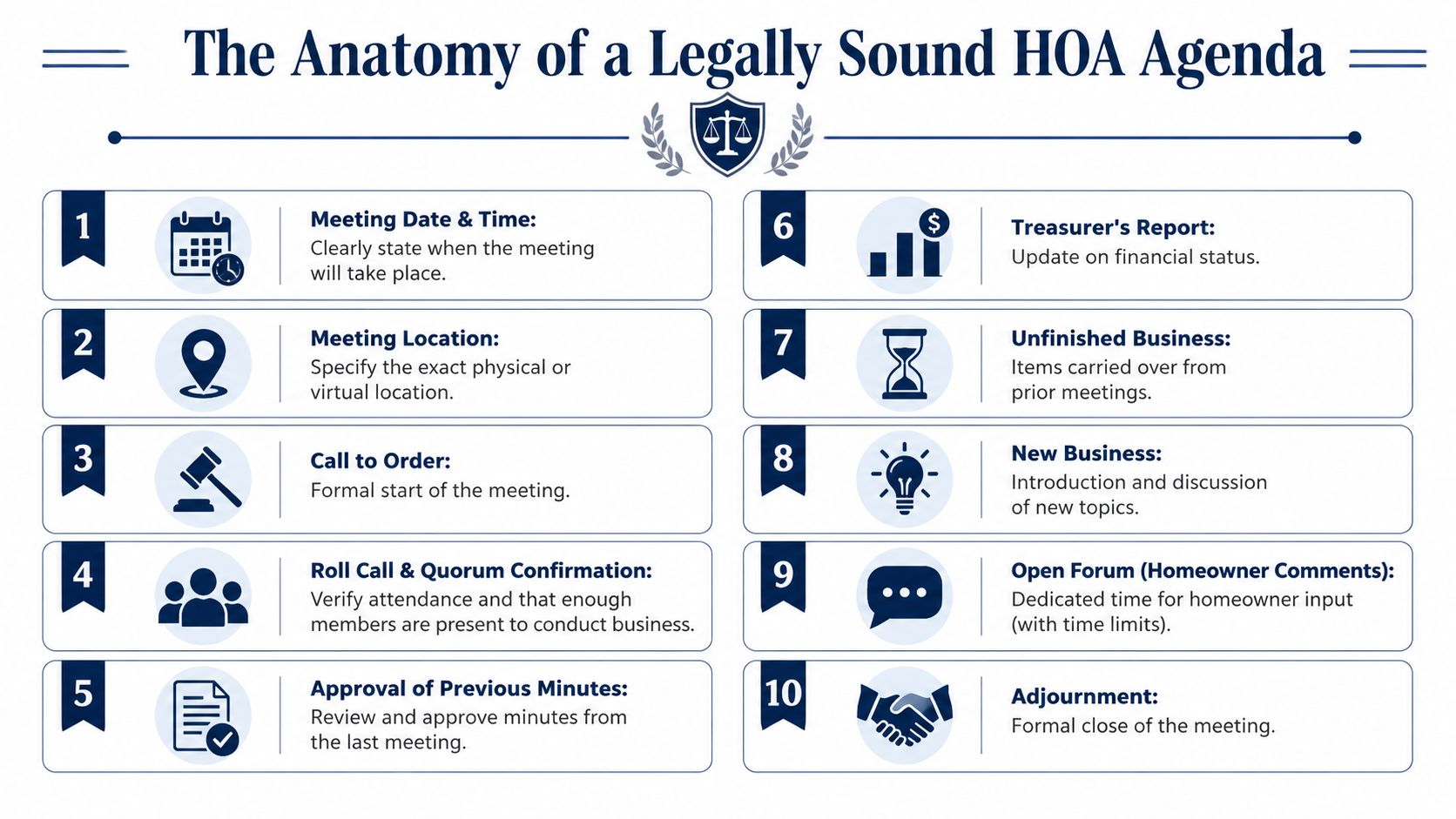
A legally sound agenda starts with basics that seem simple until a board skips one. Missing the meeting location, failing to confirm quorum, or lumping major decisions into a vague “new business” heading can create confusion fast. The safest hoa meeting agenda template is one that is predictable, readable, and aligned with the association’s own governing documents.
The opening items that establish control
The first part of the agenda is procedural, but it sets the tone for the entire meeting.
- Meeting date, time, and location: This tells members exactly where and when the board is meeting, whether in person, virtual, or hybrid.
- Call to order: The chair formally starts the meeting. That matters because official business should begin only after the meeting is opened.
- Roll call and quorum confirmation: The board must know who is present and whether enough directors are there to transact business.
- Approval of previous minutes: This confirms the board’s prior record before new action is taken.
These items are not filler. They establish that the meeting exists in a valid format and that the board is acting through process, not improvisation.
The reporting section that gives context
Reports should inform decisions, not become endless monologues. The best agendas list reports in a practical order so directors hear what they need before voting on business items.
A common sequence works well:
| Agenda component | Why it matters |
|---|---|
| Officer reports | Gives the board a brief leadership snapshot |
| Treasurer’s report | Frames the financial position before spending decisions |
| Manager’s report | Updates operations, vendors, compliance, and maintenance |
| Committee reports | Brings focused recommendations from architecture, landscaping, finance, or other committees |
When these reports are tight, the board has context. When they ramble, the meeting loses momentum before it reaches any decision point.
Keep reports decision-oriented. If a report doesn’t help the board understand status, risk, or next action, it belongs in the packet, not in a long spoken summary.
The business items that move the association forward
The agenda’s importance becomes clear. Every board meeting should separate unresolved matters from new ones.
Unfinished business
Unfinished business covers items already introduced but not resolved. Examples include a pending roofing bid, revised pool rules, or follow-up on a collections policy. This category keeps the board from reopening old discussions without context.
New business
New business is for matters that are properly ready for board attention. That could include contract approvals, architectural recommendations, policy changes, or project authorizations. The key is clarity. “Landscaping” is too vague. “Review and vote on revised landscaping proposal” is far better.
Open forum
Many templates include homeowner comments, but the placement matters. Some boards put open forum near the beginning for agenda items only, then allow broader comments later. Others keep it to one defined slot. Either way, the agenda should show when comments happen and under what ground rules.
Adjournment
Adjournment is the formal close. Once the meeting ends, business ends with it unless the board moves into a properly noticed executive session where permitted.
A practical model for the core agenda
Most boards don’t need a fancy document. They need a disciplined one.
A dependable hoa meeting agenda template usually includes these core elements:
- Association name and meeting details
- Call to order
- Roll call and quorum verification
- Approval of prior minutes
- Officer, manager, and committee reports
- Unfinished business
- New business
- Open forum
- Executive session notation, if applicable
- Adjournment
That structure works because each item has a procedural job and a strategic job. Procedurally, it keeps the board inside a defensible meeting format. Strategically, it helps the board think in sequence instead of in circles.
Tailoring Your Agenda for Every Meeting Type
A monthly board meeting, an annual members’ meeting, and a special meeting should not use the same agenda with minor edits. That’s one of the most common mistakes boards make. The document may look familiar, but the purpose, notice posture, and participation rules are different.
The board gets better results when it matches the agenda to the meeting’s actual job. In practice, that usually means the community manager drafts the framework, the secretary checks the formal requirements, and the chair shapes the final flow. If your board works with a professional, understanding the role of a community association manager helps clarify who should prepare what.
Regular board meeting agenda
This is the operational meeting. The board reviews reports, addresses ongoing projects, considers owner requests, and votes on current association business.
The agenda should be compact and decision-focused. If every recurring meeting becomes a catch-all, directors start revisiting old frustrations instead of handling current obligations.
A practical regular meeting agenda often includes:
- Opening procedure: Call to order, roll call, quorum, approval of prior minutes
- Reports: Treasurer, manager, committees
- Operational decisions: maintenance approvals, vendor updates, rule enforcement, architectural requests
- Homeowner comments: within a defined segment
- Closing action: confirm next steps, adjourn
This meeting works best when the packet answers most factual questions before the meeting starts.
Annual meeting agenda
The annual meeting has a different rhythm. It is less about routine operations and more about community-wide governance. Elections, budget presentation, major project communication, and formal member business take priority.
For that reason, the agenda should place the most consequential membership items early enough that they don’t get squeezed by lengthy side discussions.
A typical annual meeting agenda may include:
- Registration and verification matters
- Call to order and quorum confirmation
- Proof of notice
- Approval of prior annual meeting minutes
- State of the association or president’s remarks
- Budget presentation or ratification process, if applicable
- Board election or announcement of results
- Major project updates
- Member comments
- Adjournment
Annual meetings also require stronger coordination with ballots, proxies where permitted, sign-in procedures, and election materials.
The annual meeting agenda should assume a broader audience. Homeowners need a clearer line of sight into what the board is presenting and what members are being asked to approve or elect.
Special meeting agenda
A special meeting should be narrow. If it starts broad, it usually ends messy.
Special meetings exist for a specific issue that can’t reasonably wait for the regular schedule. That may be a time-sensitive contract, an urgent property matter, or a member vote on a defined question. Because the purpose is narrow, the agenda should stay narrow too.
Good special meeting agendas usually have three characteristics:
- A single stated purpose
- Only the items necessary to address that purpose
- No drift into unrelated board business
If the board notices a special meeting to discuss one urgent contract, that meeting is not the right place to reopen landscaping complaints, budget philosophy, and parking enforcement.
Comparison of HOA Meeting Types
| Meeting Type | Primary Purpose | Notice Requirement | Key Agenda Items | Homeowner Role |
|---|---|---|---|---|
| Regular board meeting | Conduct routine association business | Follow state law, bylaws, and regular notice procedures | Reports, unfinished business, new business, homeowner forum, adjournment | Attend, observe, and comment during designated periods |
| Annual meeting | Handle membership-level governance matters | Follow annual meeting notice and election procedures in governing documents and applicable law | Quorum, proof of notice, annual minutes, elections, budget communication, major updates | Members often vote and participate more directly |
| Special meeting | Address a specific urgent or limited issue | Follow special meeting notice rules and keep the purpose specific | Call to order, quorum, stated subject, discussion, vote, adjournment | Usually limited to the noticed topic |
How the templates differ in practice
The regular board meeting agenda should feel like a management tool. It keeps the board current and accountable.
The annual meeting agenda should feel like a membership governance tool. It emphasizes legitimacy, transparency, and formal community-wide action.
The special meeting agenda should feel tightly controlled. If the board uses a broad template there, it invites off-topic discussion and procedural trouble.
One more practical point matters here. Boards often overestimate how much can fit on an annual or special meeting agenda. The better move is usually to trim. A shorter, purposeful agenda creates cleaner votes and a more defensible process than an ambitious one that encourages drift.
Executing the Plan Roles Responsibilities and Timing

An agenda doesn’t fail in the meeting room. It usually fails earlier, when no one owns the drafting process, supporting documents arrive late, or the final packet goes out with too little time for review.
The strongest boards use a repeatable workflow. Everyone knows who collects topics, who assembles backup, who checks notice requirements, and who gives final approval.
Who should do what
The exact division of labor varies by community, but the responsibilities are usually clear.
- Community manager: gathers reports, tracks open projects, collects vendor materials, drafts the working agenda, and assembles the board packet.
- Board secretary: reviews for completeness, confirms prior motions and pending matters, and supports notice and record accuracy.
- Board president or chair: decides sequencing, confirms priorities, and runs the meeting according to the final agenda.
- Treasurer and committee chairs: submit concise reports and any items that require board action.
Problems start when everyone assumes someone else is handling the details.
A clean timeline works better than last-minute edits
Top-performing boards benchmark their agendas against state requirements, and FS Residential’s open meetings guidance for Texas associations notes that agendas with time blocks achieve 85% on-time completion versus 45% for ad-hoc agendas. The same guidance warns that failing to provide the agenda and board packet with adequate notice can delay decisions in up to 40% of cases.
That’s why timing matters as much as content.
A practical workflow looks like this:
- Topic submission: Directors, officers, and the manager submit agenda items before the drafting deadline.
- Draft assembly: The manager or secretary organizes the agenda and compiles backup materials into one packet.
- Chair review: The president reviews sequence, confirms priorities, and removes items that are not ready.
- Notice and distribution: The final agenda and packet go out within the required notice window.
What should be in the board packet
The agenda should never travel alone if the board is expected to vote intelligently.
A solid packet often includes:
- Previous minutes: so the board can approve or correct the record
- Current financials: treasurer’s report, balance information, and relevant account summaries
- Manager report: project updates, vendor status, compliance issues, and operational notes
- Proposal backup: bids, contracts, architectural applications, draft rules, or policy language
- Action item log: open tasks carried forward from prior meetings
Board packet standard: If a director needs to read it before voting, it belongs in the packet, not in a live verbal explanation during the meeting.
Time blocks are not cosmetic
Adding estimated minutes beside each item changes the chair’s behavior. It signals what deserves full discussion and what should move quickly.
A meeting without time blocks tends to give equal airtime to minor issues and major decisions. A meeting with time blocks forces triage. That doesn’t mean cutting off useful debate. It means recognizing that a vendor contract, reserve-related repair, and owner hearing don’t all deserve the same treatment.
For most boards, the better routine is simple. Draft early, finalize deliberately, distribute on time, and treat the packet as part of the agenda process rather than an optional attachment.
Beyond the Template Running Efficient and Productive Meetings
A clean agenda on paper won’t rescue a meeting that lacks discipline in the room. The chair has to use the agenda actively. That means controlling sequence, limiting drift, and protecting the board’s ability to finish the business that affects the community.
Two practices make the biggest difference in real meetings. One is using a consent agenda for routine approvals. The other is managing homeowner comments without letting the meeting become an open-ended grievance session.
Use a consent agenda for routine items
Boards waste a surprising amount of meeting time on items that aren’t controversial. Approval of prior minutes, standard invoices, or straightforward committee recommendations often don’t require separate discussion unless a director asks for it.
That’s where a consent agenda helps. The board groups routine items together and approves them in one motion. Any director can pull an item out for separate discussion if needed.
This works well for:
- Previous minutes approval
- Routine vendor invoices
- Non-controversial committee recommendations
- Administrative approvals that were fully documented in advance
It does not work well for disputed contracts, rule changes, major projects, or emotionally charged owner matters.
Run the open forum with structure
Unmanaged owner comment periods are one of the biggest reasons meetings lose focus. A 2025 CAI report cited by BoardRoom’s HOA board meeting article found that 35% of HOA meetings are derailed by unmanaged open forums, tied to a 25% lower board satisfaction score. The same source notes that virtual and hybrid meetings surged by 55% in 2025, which means many boards now need comment rules for both in-person and digital participation.
That changes how a modern hoa meeting agenda template should be written. It should tell owners when they may comment, how long they have, whether comments must relate to agenda items, and how digital submissions will be handled.
A practical open forum script sounds like this:
We welcome owner comments. Please keep remarks to the posted time limit, address the board rather than individual attendees, and focus first on items listed on tonight’s agenda. If your concern requires research or isn’t posted for action tonight, we’ll log it for follow-up.
That script does three useful things. It invites participation, it sets boundaries, and it avoids promising immediate board action on matters that aren’t ready.
What works and what doesn’t
Here is the trade-off most boards learn the hard way.
| Approach | What happens in practice |
|---|---|
| Open comments anytime | Discussion jumps tracks and directors start debating without context |
| Comments in a defined slot | Owners are heard without interrupting every business item |
| No time limit | A few speakers can consume the meeting |
| Stated time limit and relevance rule | More owners get heard and the board still reaches decisions |
| Verbal complaints only | Issues vanish after the meeting with no accountability |
| Comment log plus follow-up path | The board can separate listening from action |
For hybrid meetings, it also helps to standardize how comments are submitted. Some boards accept chat comments only during the designated forum. Others require digital attendees to raise a hand and be recognized in order. What doesn’t work is inventing the process mid-meeting.
If your board sends reminders before meetings, it’s smart to pair the agenda notice with practical communication tools such as these essential meeting reminder email samples. Clear reminders reduce confusion about time, format, and participation rules before owners ever enter the room.
Table issues without dismissing people
Boards often struggle with the moment when an owner raises a valid concern that is not ripe for action. The answer is not to argue. The answer is to acknowledge and defer properly.
Try language like:
- For off-agenda issues: “We’ve noted the concern, and because it isn’t listed for action tonight, the board will route it for review and place it on a future agenda if needed.”
- For items needing research: “The board needs supporting information before discussing action. Management will gather the details and report back.”
- For repeated personal disputes: “The board will not debate neighbor-to-neighbor conflicts in open session. Please submit the issue through the established process.”
That’s how the agenda becomes a live governance tool, not just a document handed out at the door.
From Agenda to Action Mastering Minutes and Follow-Up
A well-built agenda makes the next two jobs easier. First, it gives the secretary or manager a clean structure for minutes. Second, it turns discussion into accountable follow-up.
Boards that struggle with minutes often have the same underlying problem they had with the agenda. The meeting lacked clear order, so the record becomes a messy recap of who said what. That isn’t what minutes are for.
Minutes should track action, not conversation
The official record should be concise, neutral, and focused on what the board did.
Good minutes usually capture:
- Meeting details: date, time, place, and attendance
- Procedural milestones: call to order, quorum confirmation, approval of prior minutes
- Motions: who made the motion and what was decided
- Votes: whether the motion passed or failed
- Adjournment: when the meeting ended
They do not need a transcript of every comment, frustration, or back-and-forth exchange.
Record decisions, not drama. If a future owner, auditor, or attorney reads the minutes, they should see what the board approved and why the record is complete, not how heated the conversation became.
Use the agenda as the skeleton for the minutes
This is where a strong hoa meeting agenda template pays off. If the agenda is clearly segmented, the minute-taker can follow the same order.
A practical workflow looks like this:
- Start with the agenda headings as the draft minute format.
- Add motions and vote results under the specific item where action occurred.
- Note referrals and deferrals so unfinished matters don’t disappear.
- Convert assigned work into an action list after the meeting.
That last step is where many boards fall short.
Follow-up should be specific
“Manager to look into it” is not a usable action item. It doesn’t identify what must happen, by when, or what will come back to the board.
Better follow-up language is concrete:
| Weak follow-up | Strong follow-up |
|---|---|
| Manager to review pool issue | Manager to obtain two pool gate repair proposals for next board meeting |
| Treasurer to check budget | Treasurer to confirm whether the line item can absorb revised contract pricing |
| Committee to discuss landscaping | Landscape committee to submit recommendation with vendor comparison for board review |
The point is accountability. If the board approved a motion, requested bids, deferred an owner concern, or asked counsel for input, the next agenda should reflect that status under unfinished business or a related report.
Close the loop before the next meeting
The best boards don’t wait until the next meeting to remember what happened at the last one. They circulate draft minutes promptly, maintain an action list, and start the next agenda with unresolved items already identified.
That creates a working cycle:
- agenda,
- meeting,
- minutes,
- action log,
- next agenda.
When that cycle is consistent, the board spends less time reconstructing history and more time governing. Homeowners also see the difference. Promises are easier to track, vendor items are less likely to vanish, and the board’s decisions turn into visible progress instead of repeated discussion.
HOA Meeting Agenda FAQs
Can the board discuss matters in executive session instead of putting them on the open meeting agenda
Executive session should be reserved for matters that are confidential under applicable law or the association’s governing framework, such as legal issues, certain enforcement matters, collections, contract sensitivity, or personnel-related topics where permitted. The board should still handle the open meeting portion properly and avoid using executive session as a shortcut for difficult public discussion. If an issue belongs in open session, the agenda should reflect that.
What should the chair do when a homeowner brings up something that is not on the agenda
Acknowledge it, don’t debate it on the spot, and route it correctly. The clean response is to note the concern, explain that the board won’t take up off-agenda business for action at that meeting, and assign the matter for review or possible placement on a future agenda. That protects fairness for all owners and keeps the board from making rushed decisions without notice or backup.
How should the board handle emergency items
True emergencies require judgment and discipline. If the issue can’t wait because delay risks people, property, or the association’s legal position, the board should follow the emergency procedures allowed by its governing documents and applicable law. The record should clearly show why the item was handled outside the normal sequence, what action was taken, and what follow-up will occur at the next properly noticed meeting. Boards get into trouble when they label something an emergency because preparation happened late.
If your board wants a more disciplined meeting process, stronger agenda support, and experienced guidance on community governance, Access Management Group can help. Their team has served associations since the 1970s and focuses on protecting homeowner interests, supporting board leadership, and helping communities run meetings that are efficient, organized, and legally sound.