So, what exactly is a community association management company?
For homeowners, it’s the professional team that ensures your community is a wonderful place to live. For a volunteer board of directors, it’s the expert partner that handles the complex daily operations, allowing you to lead effectively.
Think of it this way: your board of directors sets the vision for the community, making crucial decisions to protect property values and enhance the quality of life for all residents. But executing that vision—handling the hundreds of daily tasks required to keep a community running smoothly—is a full-time job.
That’s where a management company comes in. We are the professional firm hired by your board to handle those day-to-day operations. We serve as the operational arm of the board, freeing you from the administrative grind so you can focus on governance and making the best decisions for your neighbors.
Your Community’s Strategic Partner
For an HOA or COA president and board, you are responsible for steering the ship and charting the course for your community’s future. But you shouldn’t have to be the one swabbing the decks, patching the sails, and managing the entire crew by yourself.
A community association management company lifts that heavy burden of daily operations off your shoulders. We aren’t just a vendor; we are your strategic partner. Our role is to implement your board’s decisions, manage the finances, oversee maintenance, and ensure every homeowner has a responsive point of contact. This partnership allows you, the volunteer leaders, to concentrate on what truly matters: serving your community effectively.
The Value of Professional Expertise
For homeowners, a well-managed community simply feels better. The amenities are clean and functional, the rules are applied fairly, and their investment is secure. For the board, having a professional partner means you have an expert guide to navigate the complexities of running what is, essentially, a non-profit corporation on behalf of your neighbors.
The relationship is designed for clarity and accountability. The board retains all decision-making authority, while the management company executes those decisions and serves the homeowners.
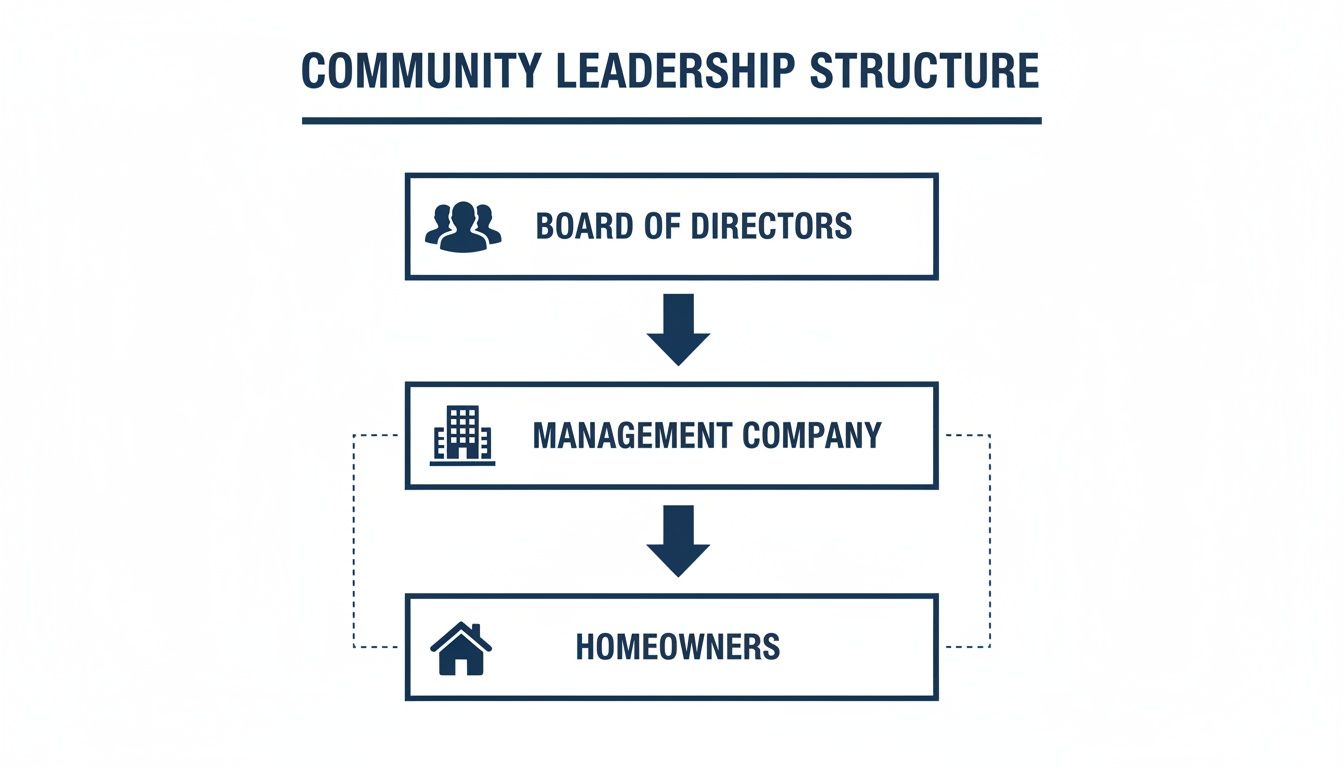
This structure ensures clear lines of responsibility, allowing your board to govern effectively without getting bogged down in daily tasks, and giving homeowners a reliable resource for their needs.
Self-Management vs. Professional Management
Many new or smaller associations start by trying to do it all themselves. While admirable, this “DIY” approach often leads to volunteer burnout for board members, inconsistent enforcement that frustrates homeowners, and costly mistakes that impact everyone. As communities grow, professional management becomes less of a luxury and more of a necessity for a thriving community.
Here’s a look at how professional support benefits both the board and homeowners.
| Responsibility Area | Self-Managed Board (DIY Approach) | Professionally Managed by a Company |
|---|---|---|
| Financials | Board members must personally collect dues, pay bills, chase delinquencies, and prepare financial reports. | The management company provides homeowners with easy payment options, handles all billing and collections professionally, and delivers transparent financial statements to the board. |
| Maintenance | The board has to find, vet, and coordinate all vendors for landscaping, pool care, repairs, etc. | The company leverages its network of vetted, insured vendors to ensure quality work, manages bids, and oversees all projects, keeping amenities in top shape for residents. |
| Compliance | Board members are solely responsible for enforcing covenants and sending violation letters, which can create friction with neighbors. | A dedicated manager handles inspections and violations consistently and professionally, ensuring fair application of the rules for all homeowners. |
| Homeowner Communication | The board fields all homeowner calls, emails, and complaints directly, often at all hours. | The company acts as the primary point of contact for homeowners, handling inquiries, logging issues, and providing timely responses and solutions. |
| Administrative Tasks | Volunteers are responsible for all meeting minutes, record-keeping, mailings, and organizing annual meetings. | All administrative duties are managed professionally, ensuring records are accurate and accessible and that meetings are properly noticed and run for the benefit of all members. |
Ultimately, a management company doesn’t replace your board—it empowers it. By offloading the administrative workload, a professional partner allows board members to serve as true leaders for their community.
The Growing Need for Experienced Partners
Community associations are no longer a small niche; they are a dominant force in American housing. The numbers tell a compelling story.
According to the Foundation for Community Association Research, the number of associations is projected to hit 377,000 by the end of 2026. This growth is driven by 3,000 to 4,000 new communities forming every single year.
This explosive growth means that nearly 80 million Americans now live in an HOA or condo association. For these residents and their elected boards, the need for experienced, professional management has never been greater.
A professional community association management company provides specialized knowledge that benefits everyone:
- Financial Stewardship: We handle budgeting and dues collection and deliver transparent financial reports so the board can make informed decisions and homeowners can see how their funds are working for them.
- Operational Execution: From managing landscapers and pool vendors to overseeing major repairs, we keep common areas safe and beautiful for all residents to enjoy.
- Legal & Regulatory Compliance: We help ensure the association operates in full compliance with its governing documents and state laws, reducing liability for the board and protecting the community as a whole.
By entrusting these duties to a dedicated team, your board can operate more efficiently, minimize risks, and create a better quality of life for every resident. The individual manager assigned to your community is a huge part of this, and you can learn more about the specific responsibilities of a community association manager in our detailed guide.
The Core Services That Make a Community Thrive

A truly great community association management company provides the operational backbone that protects a community’s value and makes it a place people are genuinely happy to call home.
Think of these services as the core functions that support everything your association does. For the board, this means you can finally stop putting out fires and start focusing on big-picture governance. For homeowners, it means responsive service and well-maintained amenities. Let’s break down what that support really looks like.
Community and Site Operations
This is the most visible part of management—the physical condition of your property. It’s all about making sure your community looks fantastic and that every amenity is safe, clean, and ready for homeowners to use. This isn’t just about appearances; it’s about creating an environment that residents are proud of, which is directly tied to protecting everyone’s property values.
A good manager coordinates everything from routine property walks to emergency repairs, proactively spotting a wobbly fence post before it becomes a hazard. This means keeping all common areas—the pool, clubhouse, playgrounds, and green spaces—looking their absolute best for the enjoyment of all residents.
One of the most important jobs is managing the vendors who handle the heavy lifting, like contracting for expert commercial lawn care services to keep the grounds pristine. That first impression matters for both current and future homeowners.
Financial Management
Ask any board president or treasurer, and they’ll tell you that sound financial stewardship is what keeps them up at night. This service is the financial engine of your community, and it’s what guarantees your association’s long-term health. A first-rate management company brings clarity and accountability to the numbers, giving your board total confidence and homeowners transparency.
This goes way beyond just collecting dues. Professional financial management includes:
- Budgeting and Forecasting: Working with the board to build a realistic annual budget that covers operating costs and plans for future projects, protecting homeowners from unexpected assessments.
- Accounts Receivable: Providing homeowners with convenient ways to pay dues and managing late accounts with professionalism and respect.
- Accounts Payable: Ensuring all community vendors are paid correctly and on time, which is key to maintaining good relationships and reliable service.
- Financial Reporting: Delivering clear, easy-to-read monthly financial statements that give the board and homeowners a real-time snapshot of the association’s health.
A management company’s ability to handle finances professionally protects the board from liability and gives homeowners transparent access to how their money is being used to improve the community.
Vendor and Contract Management
Juggling vendors can quickly become a full-time job for a volunteer board. A professional management company takes this entire burden off your plate, using their experience and deep network to get the best service and value for your community. This ensures every dollar from homeowner dues is spent wisely.
This is a structured process that benefits the association:
- Sourcing and Bidding: They gather multiple competitive bids from vetted, insured, and reliable vendors for any project, from routine landscaping to a major roof replacement.
- Contract Negotiation: They ensure the scope of work is crystal clear and that the contract is written to protect the association’s interests.
- Performance Oversight: They are on-site supervising the work to make sure it meets agreed-upon standards and gets done on time, minimizing disruption for residents.
An experienced community association management company brings established relationships with a wide range of contractors. That network almost always translates into better pricing, faster service, and higher-quality work for your community.
Administrative and Board Support
This last piece is the glue that holds everything else together. It covers all the critical administrative work that keeps the association running smoothly and in full compliance. It’s the behind-the-scenes support that makes board meetings productive and allows homeowners to feel heard and supported.
Key administrative support includes:
- Organizing and preparing all materials for board meetings, including agendas and detailed management reports.
- Attending meetings and taking accurate minutes for the association’s official records.
- Handling all official association correspondence and providing timely responses to homeowner communications.
- Maintaining all official records so they are organized, secure, and easily accessible to members.
By taking care of these essential but time-consuming tasks, the management company empowers your board to be more strategic and make informed decisions that benefit everyone in the community.
How Technology Empowers Your Board and Homeowners
Good community management isn’t just about good people—it’s about giving those people the right tools to serve your community effectively. Technology is what elevates a board from reactive to proactive, and it’s what gives homeowners the simple, direct access they expect. For a community association management company, the right tech is the backbone of exceptional service for everyone.
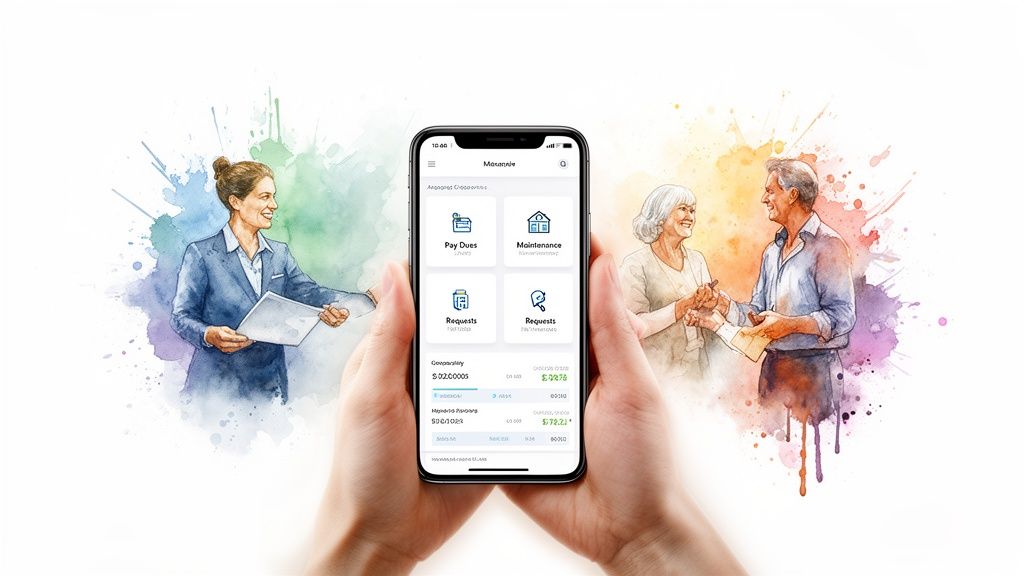
From a homeowner’s perspective, this means convenience and transparency. Instead of digging for paper forms or playing phone tag, a resident can hop on their phone at 10 PM, pay their dues, submit an architectural request for a new deck, and report a maintenance issue. They get an instant confirmation, and the process is started. It’s simple, fast, and transparent.
For the board, that same system becomes your command center. You can log in and see real-time financial dashboards, giving you a crystal-clear picture of your community’s fiscal health. This turns long, confusing budget meetings into productive, data-driven strategy sessions that benefit the entire community.
From Manual Paperwork to Strategic Guidance
This isn’t just about making things faster; it’s about changing the very nature of your manager’s role to better serve the board. When routine tasks like processing payments and logging calls are automated, your manager is freed from administrative work.
Instead, they can focus their expertise where it truly matters: providing your board with high-level strategic guidance. Rather than just paying invoices, they can analyze spending patterns to find cost savings for the association. Instead of just fielding maintenance calls, they can use that data to build a preventative maintenance schedule that saves the community thousands in the long run.
Technology has become essential in our industry, with studies showing 89% of managers and 75% of boards now use specialized software to run their communities more effectively.
The impact of this is huge for your board’s efficiency. Communication alone can be a major time sink, with some managers spending 20% of their day just answering homeowner emails and calls. Automating even a fraction of that opens up a massive amount of time for your manager to focus on supporting your board’s goals. You can see more on these trends in TownSq’s 2026 industry survey.
Key Tools for a Smarter Community
A top-tier community association management company provides a fully integrated platform built specifically for the needs of HOAs and COAs, making life easier for both residents and their board.
- Online Payment Portals: Homeowners can securely pay assessments online, check their payment history, and set up automatic payments. This improves cash flow for the association and simplifies life for residents.
- Maintenance & Work Order Tracking: Residents can submit a work order, complete with photos, right from their phone. The request is automatically sent to the manager and the right vendor, and the homeowner gets real-time status updates until the job is done.
- Architectural Review Management: The whole ACC process goes digital. Homeowners submit their plans online, and board members can review, comment, and vote from anywhere, creating a clear, permanent, and searchable record.
- Communication Hubs: A community portal acts as a central source of information. The manager can post announcements, send community-wide emails, and keep an online library of important documents for all homeowners to access.
These tools are about more than just convenience. They create a more connected, responsive, and well-run community for everyone. You can explore the specific features of our community association management software to see exactly how it gives your board the data it needs to lead with confidence while improving the experience for every single homeowner.
Choosing the Right Management Partner for Your Community
Picking a new community association management company is one of the most important decisions your board will ever make on behalf of your community. This choice ripples through everything, from your community’s long-term financial stability to the daily experience of every single homeowner.
The goal isn’t just to hire a manager; it’s to find a genuine partner—a team that understands your community’s vision and has the expertise to help you achieve it. A great partnership is built on trust and a shared goal: making your community a better place to live. This process demands a bit of homework, but getting it right is worth the effort for everyone.
Evaluating Potential Management Firms
Before you set up interviews, your board needs a clear scorecard for what matters most to your community and its residents. It’s easy to get distracted by glossy brochures, so focus on the fundamentals that ensure excellent service.
A solid evaluation boils down to a few key areas.
- Local Roots in Georgia: A company with a deep presence in Georgia already knows the local laws, has built relationships with quality vendors, and understands the unique needs of our communities. That’s a huge head start for your board.
- Proven Financial Health: You’re handing over the keys to your community’s finances. It’s fair to ask for proof of their own financial stability and to understand the checks and balances they use to protect your association’s funds.
- Real Credentials: Look for affiliations with respected industry groups like the Community Associations Institute (CAI). Certifications like CMCA (Certified Manager of Community Associations) or AMS (Association Management Specialist) show a true commitment to professional standards that benefit your community.
- The Right Fit for Your Board: Does the company listen to your board’s specific needs? A boutique firm might offer a highly personal, collaborative approach. A larger national company might have a more standardized system. One will be a better fit for your board’s personality and goals.
Asking the Right Interview Questions
Once you have a short list, the interview is where you find out which firm can truly deliver for your community. The goal is to get past canned answers and understand how they actually operate. The right questions can tell you everything about their problem-solving style and their philosophy on serving homeowners and the board.
A detailed list of questions is your best friend here. For more specific ideas, you might find our guide on choosing among condo association management companies helpful.
Good questions don’t just test a company’s resume—they reveal their character. They show you how a potential partner handles pressure, communicates with homeowners, and respects the board’s authority.
When you’re sitting across the table, you need questions that get to the heart of what a partnership would actually look like. Here are a few critical questions designed to get the meaningful answers your board deserves.
Key Interview Questions for Your Next Management Company
| Question Category | Sample Question to Ask | What You’re Looking For in the Answer |
|---|---|---|
| Conflict Resolution | “Describe a time you dealt with a tough conflict between a homeowner and the board. Walk us through your process and the outcome.” | Look for a process that values de-escalation, clear communication, and fair enforcement of the rules. The best partners help resolve issues, not just “side with the board.” |
| Financial Oversight | “How do you help the board plan for major capital projects and actively manage our reserve fund to protect homeowners?” | You want a proactive approach: regular reserve study updates, long-term budget planning, and clear options to protect the community’s financial future and avoid special assessments. |
| Board Communication | “What’s your standard process for keeping the board updated on operational issues, homeowner complaints, and finances between meetings?” | A great partner provides regular, detailed management reports, proactive updates on urgent matters, and a responsive single point of contact for the board. |
| Technology and Support | “Show us the technology you provide. How does it make life easier for our homeowners and our board, practically speaking?” | They should give concrete examples of how their software simplifies payments for residents and provides the board with actionable data, demonstrating real value, not just features. |
At the end of the day, choosing the right community association management company is about finding a partner you trust completely—one who will protect and grow the value of your community for years to come.
Understanding Management Fees and Pricing Structures
For any board member, fiscal responsibility to your neighbors is non-negotiable. When evaluating a community association management company, getting a clear picture of the costs is the first step to making a smart decision that serves every homeowner well.
The price tag isn’t just a number. It’s a direct reflection of the expertise, time, and resources your community will receive. Understanding how companies structure their fees helps your board match the right services to your budget and your association’s unique needs.
After all, a sprawling HOA with a pool, clubhouse, and tennis courts has completely different demands—and a different cost structure—than a small townhome community with a few shared green spaces.
The Most Common Pricing Models
As you start getting quotes, you’ll see three main pricing models. Each has its own benefits, and the best fit for your community depends on your budget and how much predictability your board needs.
- All-Inclusive Contract: This is a flat-rate monthly fee covering a comprehensive, pre-defined list of services. This model is fantastic for budget certainty, helping your board plan finances without worrying about surprise charges.
- Per-Door Fee: This is the most common approach. The management fee is calculated based on the number of homes (or “doors”) in your association. It’s a simple, logical way to scale the cost to the size of the community you serve.
- A La Carte Services: This pay-as-you-go model lets a board pick and choose specific services. While it can look tempting upfront, it often leads to unpredictable spending when you need extra help with special mailings or project oversight.
The “a la carte” option can work for a self-managed board that just needs a hand with one or two tasks. But for most communities, the all-inclusive or per-door models deliver far better long-term value and peace of mind for the board and residents.
The goal shouldn’t be finding the cheapest option, but the best value. An experienced management partner who prevents one costly legal mistake or negotiates better vendor contracts provides a return on investment that far exceeds their monthly fee.
What Drives the Cost of Management
Beyond the pricing model, a few key factors will shape the final proposal. Knowing what these are helps your board see exactly what you’re paying for on behalf of the homeowners.
| Cost Driver | Why It Matters for Your Board |
|---|---|
| Community Size & Type | A 500-home single-family HOA has different needs than a 50-unit condo. The number of units drives the volume of homeowner communications, collections, and administrative work required. |
| On-Site Amenities | Pools, gyms, and clubhouses require active management, from coordinating vendors to ensuring safety compliance. More amenities mean more hands-on support is needed to keep them in great shape for residents. |
| Level of Service | Does your community need a full-time, on-site manager? Or will a portfolio manager who supports several communities fit your needs? The amount of direct manager time is a major cost factor. |
| Board Involvement | A highly active board that enjoys handling certain tasks might need a different service level than a board that wants a comprehensive management partner to handle all operational aspects. |
Ultimately, investing in the right community association management company is a strategic move to protect and grow your community’s property values. A professional partner reduces risk for the board, keeps homeowners happy, and frees you up to focus on what you do best: governance. That’s a tangible value that strengthens the entire community.
Why an Experienced Partner Is Your Greatest Asset
In the world of community management, stability is everything. The industry is in the middle of a major shake-up, with smaller management firms being bought up by larger national companies at a rapid pace. For board members, this creates a huge risk: what happens if the management company you just hired gets acquired?
Suddenly, the personalized service your board chose is gone, replaced by a new corporate structure you never signed up for. The manager who knew your community’s history is reassigned or leaves, and all that institutional knowledge vanishes. This disruption throws projects into chaos and can undo the trust you’ve worked so hard to build with your homeowners.
Choosing an established, deeply-rooted community association management company is the best way to protect your community from this volatility.
The Real Risks of Industry Consolidation
The push for rapid growth is changing the management landscape. This isn’t just a small trend; recent industry data shows it’s a tidal wave.
Portfolio expansion is the top priority for nearly every company, with a staggering 92% of firms planning significant growth through 2026. This is driving a frenzy of acquisitions as big players swallow up smaller ones to grab market share. You can read more about this industry-wide shift in the 2026 Community Manager Trends report from AvidXchange.
For an HOA or COA board, signing on with a company that might be an acquisition target comes with very real risks to your community:
- Service Disruption: Your points of contact can change overnight. Systems get migrated with little warning, and your community’s specific needs get lost in the transition.
- Loss of Your Manager: Great managers often leave during an acquisition. They take with them their deep understanding of your covenants, projects, and the relationships they’ve built with your residents.
- A Shift in Culture: A small, service-focused firm can be absorbed by a massive corporation with a one-size-fits-all model, leaving your board and homeowners feeling like just another account number.
These aren’t just minor inconveniences. They actively harm your community by creating inconsistent rule enforcement, delaying critical maintenance, and leaving homeowners confused and frustrated.
The Power of a Long-Term Local Partner
On the other hand, a company with decades of local experience brings something to the table that money can’t buy: unwavering stability. An established partner like Access Management Group isn’t just another vendor; we are a permanent fixture in Georgia’s community management world. Our company history dates back to the 1970s, giving us a long-term perspective that directly benefits every board and homeowner we serve.
Here’s what that deep-seated experience really means for your community:
- Refined Processes: After decades in the business, we’ve fine-tuned our financial, operational, and administrative systems to be incredibly efficient and transparent for both the board and residents.
- Dedicated Team: Our low staff turnover means your board will build a lasting relationship with a manager who is truly invested in your community’s success and understands its unique character.
- Unmatched Stability: We are not for sale, and we aren’t looking to be acquired. Our focus has always been on steady, organic growth by forming genuine partnerships that benefit the communities we serve.
Choosing an experienced community association management company gives your board true peace of mind. It’s the confidence of knowing that the team guiding you today will be the same team guiding you through market shifts, economic changes, and the long-term projects that protect your community’s value for years to come.
Frequently Asked Questions About Community Management
Choosing to partner with a community association management company is a big step for any board. We understand you have questions about how it all works and what it means for your community and its homeowners. Here are straightforward answers to the questions we hear most often from boards just like yours.
Property Manager vs. Community Association Manager
This is a common point of confusion, but the jobs are worlds apart. A property manager typically works for a single investor or landlord, focusing on finding tenants, collecting rent, and handling maintenance for an individual rental unit.
A community association manager, on the other hand, works for the entire community. Hired by and reporting to the board of directors, our job is to manage the common areas, run the association’s business, and carry out the board’s directives for the benefit of every single homeowner. Our client is the community as a whole.
How Management Companies Increase Property Values
A good management company doesn’t just maintain property values; we actively work to increase them. This is achieved through consistent, professional work that makes your community a place where people genuinely want to live.
We achieve this by focusing on key areas that benefit all residents:
- Curb Appeal: Through proactive maintenance and solid vendor management, we ensure the community always looks its best. Pristine landscaping and clean amenities make a great first impression on potential buyers and enhance daily life for current residents.
- Financial Stability: We bring professional oversight to the association’s finances, including diligent dues collection and smart planning for the reserve fund. A fiscally healthy community is more attractive to lenders and protects homeowners from surprise special assessments.
- Consistent Governance: By enforcing the covenants fairly and consistently for everyone, we protect the community’s standards and character. This predictability reassures homeowners that the rules designed to protect their investment are being upheld for all.
A well-run community is the direct product of sound governance by the board and professional operations from a management partner. These are the cornerstones of strong and rising property values.
The Transition Process to a New Company
We know the idea of switching management can feel daunting for a board. A smooth transition is priority number one for an experienced firm. A typical handover takes between 30 to 60 days, depending on your community’s size and the state of your records.
It’s a highly organized process designed to be seamless for residents. As soon as the contract is signed, our team works with the board to collect all essential documents. We then send a welcome package to all homeowners, introducing their new team and explaining how to access everything they need, like the online payment portal, ensuring no interruption to services.
Does the Board Lose Control?
This is perhaps the most important question a board can ask, and the answer is clear: no. The board of directors always retains full decision-making authority.
Your community association management company acts as your agent and expert advisor, not your boss. We are here to execute the policies and decisions your board makes. We provide professional recommendations based on our experience, but the final vote on budgets, vendors, and policy changes always belongs to you, the elected board. Our partnership empowers you by taking the day-to-day administrative weight off your shoulders, so you can focus on leading effectively for your community.
At Access Management Group, we have been forming lasting partnerships with communities since the 1970s, helping boards protect and enhance their investments. Our team is dedicated to providing the stability and expertise your association deserves. Learn more about how our customer-centric approach can benefit your community at https://accessmgt.com.