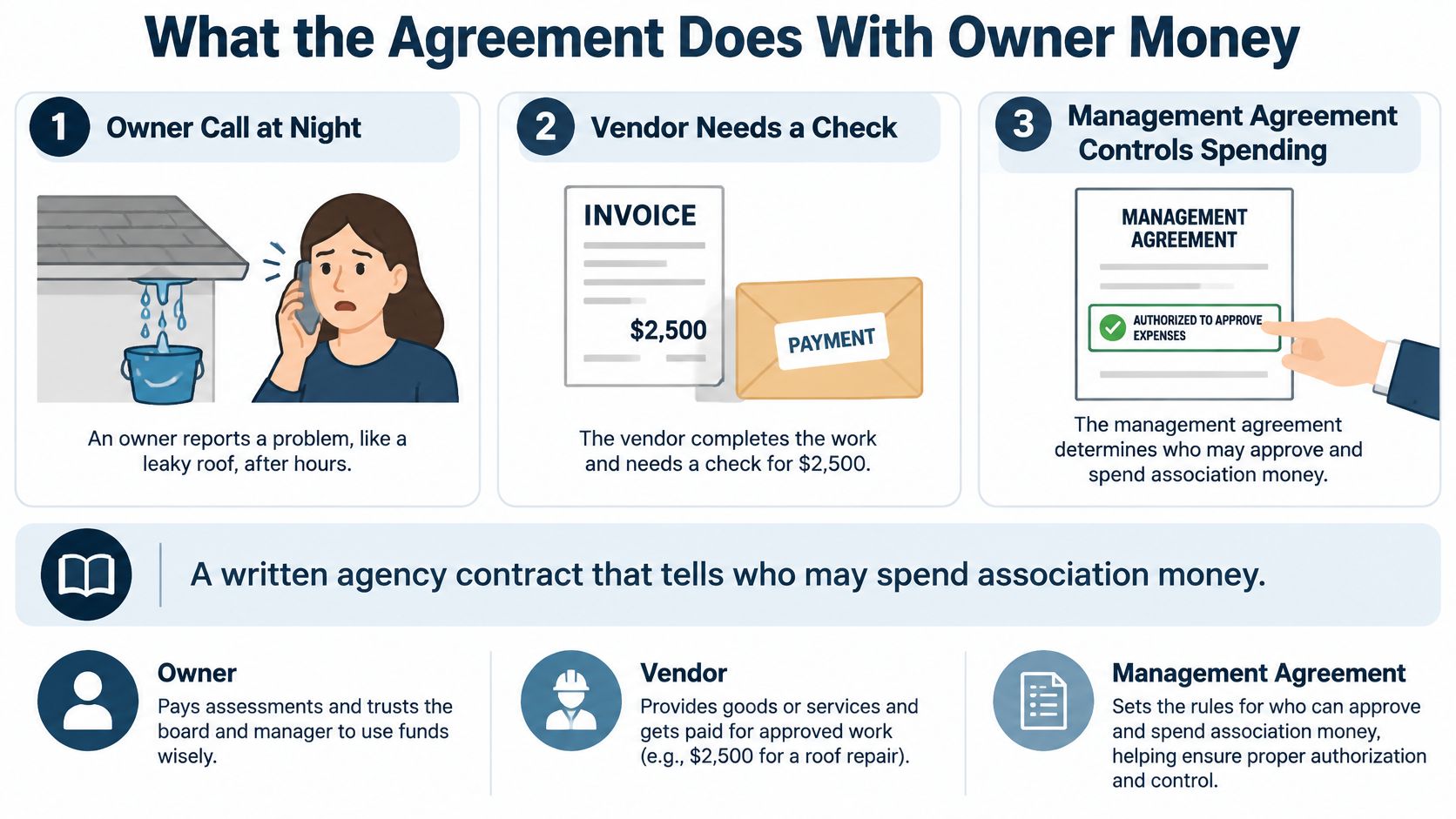
It's 10:40 on a Tuesday night and the roof is leaking over the top floor hallway. An owner calls you, the board president, because water's coming through a light fixture. A roofer will come tonight, but only if someone can authorize the work and promise payment before morning.
You probably don't have the checkbook at home, and you shouldn't. What you need in that moment isn't a vendor list. You need to know, in plain writing, who may spend association money, up to what limit, and how you'll see proof tomorrow. That's what a Condo Association Management Agreement is for.
What the Agreement Does With Owner Money
Start with that phone call. The owner wants the leak stopped. The roofer wants a work order and a check. The manager on call wants to know whether the contract lets them act tonight or whether they must wake a director first.
Definition: A condo association management agreement is a written agency contract in which the association remains the principal and the manager acts only inside authority granted by that contract, the declaration and bylaws, and state law.
Think of it as a building key that opens the office and the bank portal for set tasks. It isn't the deed, and it doesn't transfer ownership or governance to the management company.
Why Owners Should Care About the Paperwork
In 2024, approximately 21.6 million of 86.6 million U.S. owner-occupied households, about 25%, paid a condominium or homeowners association fee, according to the U.S. Census Bureau's American Community Survey figures reported by Realtor.com. The U.S. Census Bureau's American Community Survey story on condo and HOA fees puts the national median monthly condominium or HOA fee at $135 in 2024.
Those monthly payments add up fast across a building. Earlier estimates collected in a CIA Services summary of community association figures placed annual homeowner assessments at approximately $70 billion in 2014, with roughly $22 billion directed to reserve funds. That summary also estimated 30% to 40% of associations remained self-managed, so hiring a manager is a real governance choice, not a default.
For an owner, the agreement decides practical things. Who collects assessments? Who lets vendors into the building? Who carries proof of cover, the way insurance for owners corporations is documented before work starts in strata settings? How quickly does the board hear about a leak, a delinquency, or a failed pump?
Georgia law keeps one limit in place regardless of what a draft says. The Georgia condominium statute material states the association's capacity to administer, repair, and maintain the condominium cannot be waived, abridged, modified, or removed by a contract or instrument made before the declarant control period expires.
Read every clause as a way to carry out that authority. If a clause replaces it, you've found your first problem.
Clause Scorecard Before You Compare Fees
Don't start with the monthly fee. Start by scoring whether each clause can be enforced on a bad month, when reports are late and the president is fielding angry emails.
| Clause | What it must state | Risk if vague |
|---|---|---|
| Services and staffing | Named tasks, frequency, and minimum staffing or hours | Missed inspections and no remedy for underperformance |
| Term and renewal | Start, length, auto-renewal, and how notice is given | A contract that rolls on while the board thinks it ended |
| Fees and reimbursables | Base fee, reimbursable costs, and each ancillary charge | A low base fee with uncapped add-ons |
| Termination | For cause, without cause, cure period, notice, and any fee | Penalties or a long lock-in after poor service |
| Insurance | Manager liability, workers' compensation, and vendor proof before entry | An uninsured injury on common property |
| Indemnification | Association covered for manager negligence; no waiver of owner claims for misconduct | Owners paying for the manager's mistakes |
| Reporting | Monthly financials, delinquency detail, and a delivery deadline | A board that cannot see solvency until it is late |
Services, Term, and the Real Price
Services can't be a slogan like full service. The contract should name the task, say how often it happens, and set minimum staffing. Monthly site inspection means something. Periodic visits doesn't.
Term needs a start date, a length, any auto-renewal, and the exact notice method. If notice must go by certified mail to a named address, an email to your usual contact may not count. Calendar the opt-out date the day you sign.
Fees need three separate buckets. There's the base fee, there are reimbursable costs the manager passes through, and there are ancillary charges for items like postage, portal access, after-hours calls, resale letters, and transfer work. A low base fee with uncapped add-ons isn't cheap. It's just unpriced. Our guide to how HOA management fees are structured helps boards build that all-in, controllable total before comparing proposals side by side.
Use any published owner fee benchmark only as background for what owners already pay. It doesn't tell you what your building should pay a manager. Your test is total cost for named work, plus a remedy when the work doesn't happen.
Exit, Insurance, and Accountability
Termination should give you two clear paths. For cause covers a defined breach with a chance to cure it in a stated number of days. Without cause lets either side end the relationship with stated notice, and it should say whether any fee applies beyond amounts already earned.
Insurance is where boards get casual and owners pay for it. Require current evidence of the manager's liability and workers' compensation coverage, and apply the same discipline to vendors. All service providers must submit proper insurance information before setting foot on association property. A certificate in a drawer after an injury doesn't help.
Indemnification should stop at the manager's own negligence and willful misconduct. Don't sign language that makes owners insure the manager's mistakes or give up claims for misconduct. If the sentence is hard to follow, ask counsel to rewrite it in plain English and read it aloud in the meeting.
Reporting closes the loop. Require monthly financials, a delinquency ledger with aging, and a delivery deadline tied to the board meeting, not a vague promise to provide reports regularly.
Florida gives boards a useful checklist even if you're signing in Georgia. Florida's 2025 condominium statute on management contracts requires agreements to specify services, reimbursable costs, performance frequency, minimum staffing, and certain financial or ownership interests, and it allows an association to obtain substitute services and recover related charges when the manager fails to perform.
If a proposal can't fill every row of the scorecard in writing, it isn't ready for a board vote.
Directors carry fiduciary duties to owners. The contract has to turn that duty into dates, dollar caps, and documents you can audit. Price comes last, after enforceability.
Decisions the Board Must Keep
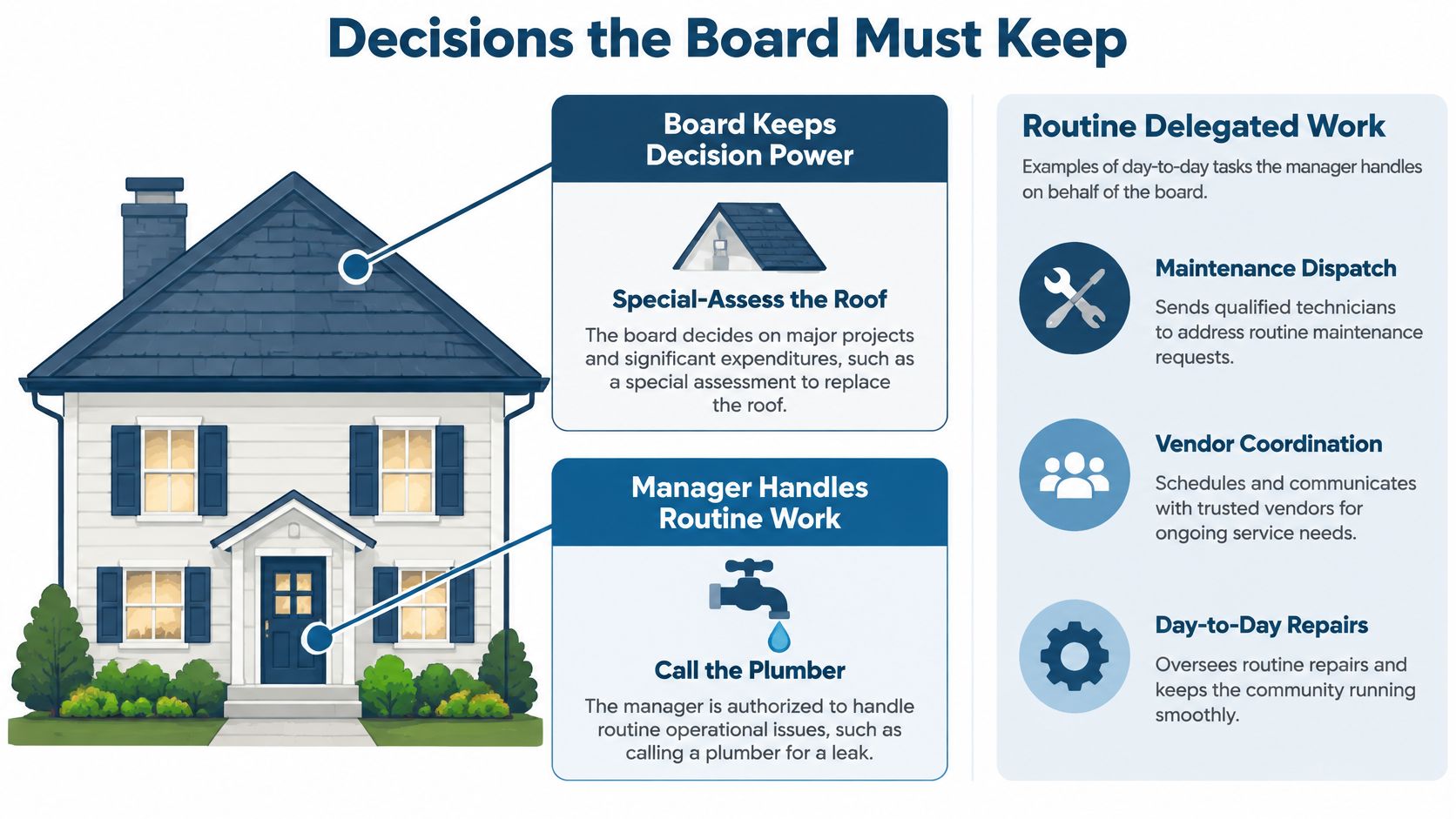
Use a house analogy and the confusion mostly disappears. The manager may call the plumber for a leaking supply line. The board still decides whether to special-assess every owner to replace the roof.
What You Can Delegate and What You Can't
- Routine delegated work: Maintenance dispatch, invoice processing under a cap, records administration, and owner communications the board has already approved in policy.
- Reserved board powers: Adopting assessments, borrowing, litigation strategy, major contracts, capital projects, and rule enforcement decisions such as fines or suspension of privileges.
When an owner or resident submits a service request, the community association manager reviews it to confirm the provider can act on it under the management contract and/or Board policy. That check matters. It stops a friendly yes on the phone from becoming an unauthorized project in the hallway.
Florida's professional standard points in the same direction. The Florida community association manager professional practice statute requires managers to act loyally, skillfully, diligently, with integrity, fairly, and in good faith, account for association funds, provide full disclosure, and avoid unreasonable or excessive fees.
Those words help, but they aren't a matrix. Florida law also doesn't automatically create the same fiduciary relationship for a manager that directors owe owners. That's why your contract needs explicit performance, disclosure, and reporting duties instead of relying on implied good behavior. Our overview of HOA board member responsibilities is a good companion when you're deciding which duties directors can't hand off.
Put Three Numbers in Writing
| Control | Common working range |
|---|---|
| Emergency spend without prior approval | $1,000 to $5,000, higher only for life-safety |
| Competitive bid threshold | Three bids above $5,000 to $10,000 |
| Dual signature on checks | Above a board-stated amount |
These are board-chosen numbers, not law. A small walk-up may set a low emergency cap because the president lives on site. A high-rise with a chiller plant may need a higher one to stop active damage at 2 a.m. Either way, say what counts as an emergency, who gets notified, and how fast the invoice reaches the treasurer.
Require conflict disclosures before the manager or an affiliate gets paid on a side contract, rebate, or referral. If the manager recommends its own landscaping affiliate, owners should see that interest before the vote, not after the invoice. Boards that skip this step often learn about conflicts during a dispute, which is why resources like the Lein Law Offices guide to landlord negligence stress documenting duties and breaches early rather than reconstructing them later.
End this part of the negotiation with one sentence in the minutes.
Working rule: If the contract is silent, the board hasn't delegated it.
That single rule protects owners more than a page of reassuring adjectives.
Assessment and Reserve Controls in the Contract
Follow one assessment dollar from the owner's coupon to the vendor's bank account. Every control in this part of the agreement exists so that dollar doesn't get lost, mixed, or moved without permission.
Separate Accounts, No Exceptions
Illinois sets the cleanest example. The Illinois Common Interest Community Association Act provision on manager accounts requires a manager serving multiple associations to maintain separate, segregated accounts for each association and prohibits commingling association funds with the manager's, the firm's, or another association's funds.
Write that principle into your contract even if your state statute is quieter. Require one operating account and one reserve account in the association's name, monthly bank reconciliations, and no manager-only control of reserves.
Say who may move money between operating and reserves and what approval each transfer needs. A board vote recorded in minutes works. A standing, unlimited transfer permission doesn't. If you want background on the reserve side, our guide to condo reserve fund requirements explains why reserve money needs tighter handling than monthly operating cash.
A Monthly Package the Treasurer Can Actually Check
A practical pattern protects everyone, including a good manager accused unfairly.
- Manager prepares: Payables, bank reconciliations, and the monthly financial package.
- Board or treasurer approves: Disbursements above the invoice cap, with documented vendor-payment approval.
- A second director reviews: Bank statements and variances, and that director isn't the check signer.
The package should show assessment receipts, aging delinquencies, the reserve balance, and variances to budget. If landscaping is over budget, the package should let a director find the invoice, the approval, and the cleared check without a treasure hunt through email.
Owners, buyers, and lenders also need reliable balances during sales and refinances. A Georgia Property Owners' Association Act provision on assessment statements gives a lot owner, mortgagee, purchaser under contract, or prospective lender the right to request a statement showing assessments that are past due, together with applicable late charges and interest.
That provision sits in the property owners' association statute rather than the condominium statute, so don't treat it as a condo-specific deadline. Do borrow the function. Put a board-chosen response target in the agreement for payoff and delinquency statements, and require the ledger behind the statement to be verifiable. A closing delayed by a wrong balance is an owner harm you can prevent with one clause.
Financial language isn't bookkeeping filler. It's risk control. Owners should be able to trace a dollar from receipt to vendor, and directors should be able to prove they watched it move.
Notice Windows and the Exit File
Boards worry about the termination fee. The bigger switching risk is usually a locked ledger, missing passwords, and a new manager who can't collect assessments on day one.
| Place or rule | Timing | What owners can do |
|---|---|---|
| Georgia developer-era contract | 12 months after declarant control ends | Majority of all votes may cancel unless already ratified |
| Virginia auto-renewal | At least 60 days' written notice | End without cause and without penalty |
| Washington specified transition contracts | Generally at least 90 days' notice | End certain pre-board contracts without penalty |
| Florida records return standard | No later than 10 business days after termination and written request | Recover records after the relationship ends |
What Those Windows Teach Every Board
Georgia's rule is the one many of our boards need first. The Georgia condominium legislation on declarant-era contracts allows owners, for 12 months after the declarant's control period ends, to cancel a management contract signed during declarant control by an affirmative vote representing a majority of all votes, unless owners already ratified it by that same majority.
Washington shows a similar transition concern. The Washington condominium statute on certain pre-board contracts allows specified contracts made before the elected owner board takes office to be terminated without penalty generally with at least 90 days' notice, including declarant or affiliate contracts and contracts that weren't bona fide or were unconscionable when made. Virginia uses a different trigger, allowing a condo association with an automatically renewing contract to end it without cause and without penalty on at least 60 days' written notice.
Don't copy another state's number blindly. Do make your contract at least as workable as your own law. Draft a without-cause path, often in the 30 to 60 day range boards choose for themselves, a cure period for cause, and language that doesn't impose a penalty that wipes out a statutory right. Disputes over notice and fees are exactly the kind of contract fight where regulated directories that help parties find a lawyer for contract disputes in Singapore show, by contrast, why Georgia boards should use Georgia association counsel who knows the local statute.
The Exit File Is the Real Continuity Plan
Name the transition package in the agreement, not in a farewell email.
- People and money records: Owner roster, vendor list, ledgers, bank permissions, and a reconciled financial close.
- Open work: Violations, work orders, warranties, bids, contracts, and insurance information.
- Access and legal files: Passwords, keys, portal exports, litigation files, and governing documents.
Florida's records framework underlines why bids and contracts belong on that list. Florida's 2025 condominium records statute requires associations to maintain bids for at least one year and treats executory contracts and recently received bids as disclosable records.
Revoke portal and bank access on the end date, after the export is confirmed. A longer notice period hurts less than missing data. You can survive waiting to leave. You can't run collections, insurance claims, or vendor payments if the records didn't come with you.
Sample Language for Six Pressure Points
Hand these starting points to association counsel. They're drafting examples for discussion, not legal advice, and your lawyer should conform them to your governing documents and state law.

Services, Fees, and Emergency Spend
Services need a frequency and a response time.
Manager will inspect common elements monthly, dispatch routine maintenance within one business day, and answer owner inquiries within two business days, with after-hours coverage for life-safety emergencies.
That sentence lets the board measure performance. Without times, slow service is just an opinion.
Fees need a closed list.
The monthly fee is the only management charge. Ancillary items are only those listed on Schedule B with a dollar cap, and unlisted work needs prior board approval.
This stops a low headline fee from growing through unpriced extras.
Emergency spend needs a cap and a fast report.
Manager may spend up to $2,500 without prior approval only to stop active water, fire, or safety damage, and will report that spend within 24 hours.
The number is a sample. A 40-unit mid-rise and a 400-unit high-rise won't use the same figure, but both need the active-damage limit and the next-day paper trail.
Indemnity, Insurance, and Exit
Indemnity should follow fault.
Manager indemnifies the association for losses arising from manager negligence or willful misconduct. The association does not indemnify manager for those acts.
Owners shouldn't pay for the manager's own mistakes.
Insurance should be proved before work begins.
Manager keeps commercial general liability of at least $1 million per occurrence and workers' compensation, and no vendor enters the property without a current certificate naming the association as additional insured where appropriate.
Ask counsel whether an endorsement, not just a certificate, is needed for a particular risk. The point sample language can't make for you is verification before entry.
Exit should protect continuity.
Within 10 business days after termination and written request, manager returns funds, records, passwords, keys, and a reconciled close, and cooperates for 30 days at no termination penalty beyond fees already earned.
That sentence treats records as association property held by the manager. It's the clause you'll be most grateful for if the relationship ends badly.
Clear This Checklist Before the Board Votes
Run the vote like a meeting sequence, not a signature errand. If a step fails, pause and fix the draft while you still have time.
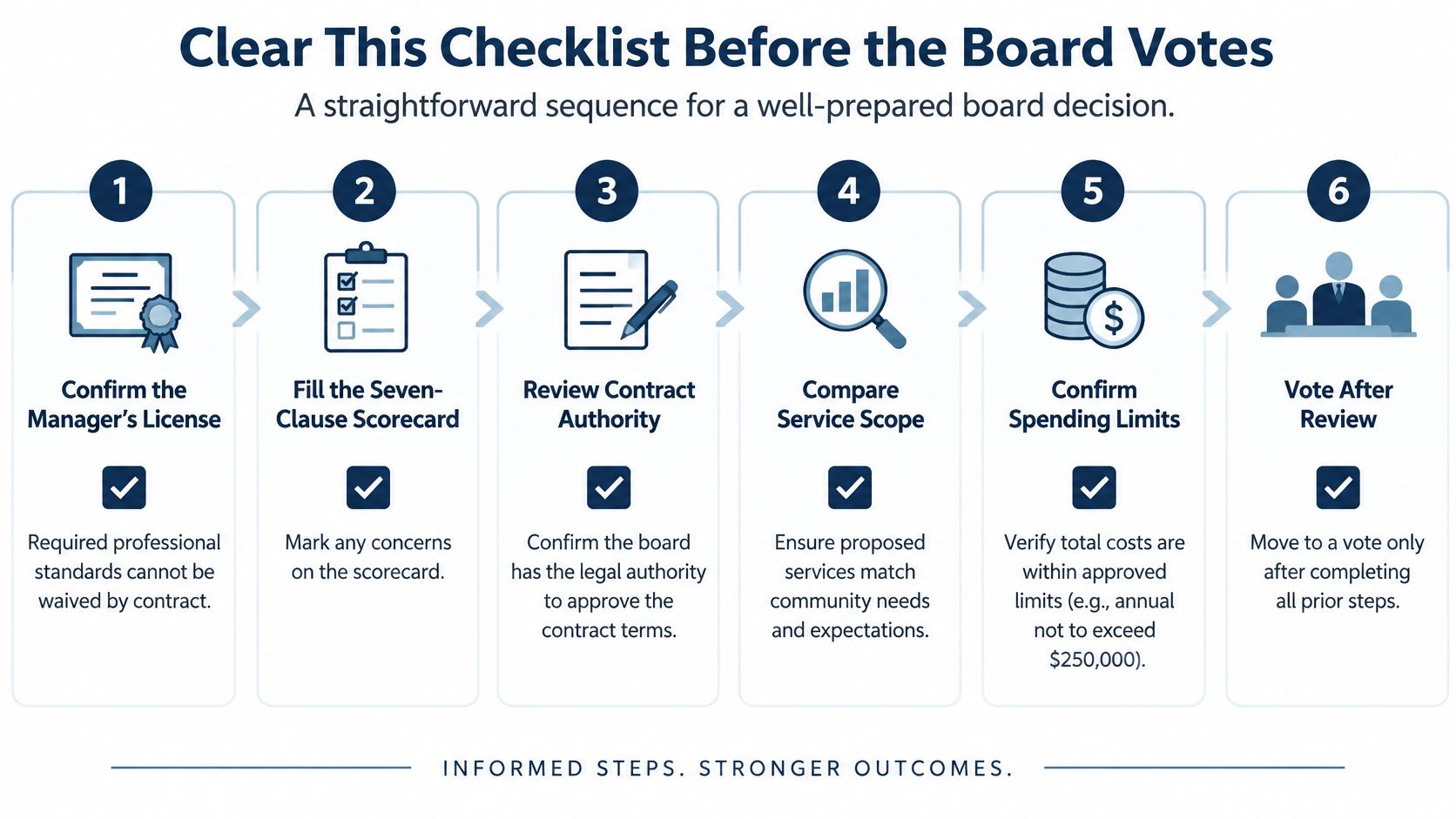
- Confirm licensing and standards: Verify the manager's license and confirm required professional standards can't be waived by contract.
- Complete the scorecard: Mark any blank row as a no until the proposal fills it in writing.
- Match the exit path: Check the developer-era window if the declarant signed, plus your own without-cause notice and cure period.
- Demand Schedule B: A Schedule B showing the cost of each ancillary charge is included with every management agreement, and it can be requested at any time.
- Set the dollar controls: Write the emergency cap, bid threshold, dual-signature rule, and reserve-transfer approval as numbers.
- Require the exit file: Set the records, password, and reconciled close deadline before anyone needs it.
- Use your own counsel: Association counsel, not the manager's counsel, should review the final draft.
- Approve in the open: Vote in an open meeting, file the signed copy with the governing documents, and post the agreement and Schedule B where owners can read them.
Red Flags and a Final Test
Walk away from auto-renewal longer than one year with no without-cause exit. Be just as wary of indemnities covering the manager's negligence and software the association can't export in a usable format.
Test a finalist with concrete questions. Does the assigned manager hold a recognized credential such as the Association Management Specialist, a credential Condo Connection's compilation of Community Associations Institute figures says 4,865 professionals held in November 2024? Will the board get one licensed manager's direct phone and email? Will the firm walk the scorecard row by row in a work session before signing?
Credentials at the firm level matter too. Access Management Group has earned the Accredited Association Management Company (AAMC) designation from Community Associations Institute (CAI), and we provide complete COA property management services for condominium associations. Still, don't let any credential, ours included, substitute for a contract owners can read and directors can enforce.
Bring your current draft or renewal to a board work session and score it clause by clause, from Schedule B fees to the exit file, before the next auto-renewal date locks you in. Visit Access Management Group to talk with a licensed community association manager about building an agreement that keeps spending authority, records, and decision-making with your board.