Full-service HOA management typically runs $10 to $35 per unit per month, and many single-family communities fall around $10 to $20 per unit while condo and townhome associations often land higher because they're more complex (HOA Explore on HOA management fees). That base rate matters, but it doesn't tell you what your board will spend by year-end.
If you're on a board right now, you're probably looking at proposals that all claim to be “full service,” yet the pricing doesn't line up. One company looks cheap. Another looks expensive. A third has a low monthly fee but a long list of extra charges buried in the rate sheet. That's where boards make expensive mistakes.
I'll give you the straight answer. The lowest proposal is often not the best value for homeowners, for the board, or for the president who gets the complaint calls when service slips. A smart board doesn't buy a number. It buys clear scope, dependable execution, financial control, and a manager who will have time to run the community.
Making Sense of HOA Management Proposals
Your board gets three proposals on a Tuesday. By Thursday, one director wants the cheapest contract, another likes the company with the polished presentation, and nobody can tell which fee covers the work your community needs. That is how associations end up overpaying for bad service.
A management proposal is an operations contract. Treat it that way. The company you hire will touch your money, owner communications, violations, records, vendors, meeting support, and day-to-day execution. If the scope is sloppy, the service will be sloppy too.
The first job is to identify the actual operator. Ask who your assigned manager will be, what authority that person has, and how many communities sit on that portfolio. Budget firms often sell a dedicated relationship and deliver a satellite manager instead. You get a name on the proposal, then your calls route through accounting, a shared inbox, or a rotating assistant. If you want a clear picture of what a true manager should handle, review the role of a community association manager before you compare bids.
Use the Last Year Test
Pull last year's calendar, invoices, and board minutes. Then score each proposal against the work your association needed.
Did you hold more than the standard number of board meetings? Did you have delinquency letters, covenant hearings, insurance requests, resale packages, after-hours emergencies, or a contractor dispute? Did you spend time reviewing architectural requests or evaluating projects such as clubhouse repairs, gate access upgrades, or even planning for solar panels for condos? If the answer is yes, price those tasks into the proposal now. Do not wait for add-on invoices to teach the lesson later.
That single exercise gives boards a far better number than the front-page monthly fee.
What to compare before price
Use a side-by-side grid and force every company to answer the same questions in writing:
- Scope detail: Do not accept broad labels like “vendor management” or “full service.” Vague: “Vendor management.” Clear: “Solicit bids, coordinate routine service for landscaping, pool, and security, negotiate contracts under board-approved limits, and document vendor performance issues.”
- Manager access: Require the manager's name, portfolio size, backup coverage, response-time standard, and whether your community gets direct phone and email access.
- Meeting support: Confirm how many board meetings are included, whether annual meetings are separate, and what preparation, attendance, and follow-up minutes cost if billed extra.
- Financial work: Spell out monthly reports, assessment collections support, bank reconciliations, budget drafting, owner statement handling, and who answers auditor and tax preparer questions.
- Compliance and admin work: Ask who handles violation notices, hearing coordination, resale disclosures, insurance certificates, lender questionnaires, and record requests.
- Contract lifecycle costs: Review setup fees, software charges, mailing charges, copy fees, transition labor, and termination terms.
One-page proposals are usually trouble. Good management companies can explain exactly what they do, where the limits are, and what triggers extra charges. Industry guidance from Community Associations Institute on selecting professional management supports that approach.
Use a simple rule. If a company cannot define the service clearly before the contract starts, it will bill you for the ambiguity after the contract starts.
Boards that follow this process make better decisions because they judge proposals by total annual cost and service reliability, not by a teaser rate that falls apart six months in.
What HOA Management Fees Actually Pay For
A board hires a management company because volunteer directors should not spend Tuesday night chasing late assessments, calling groundskeepers back for missed work, and answering the same owner question for the fourth time. Your management fee pays for someone to keep the association operating in an orderly, documented, accountable way.
That is the core product. Consistent execution.
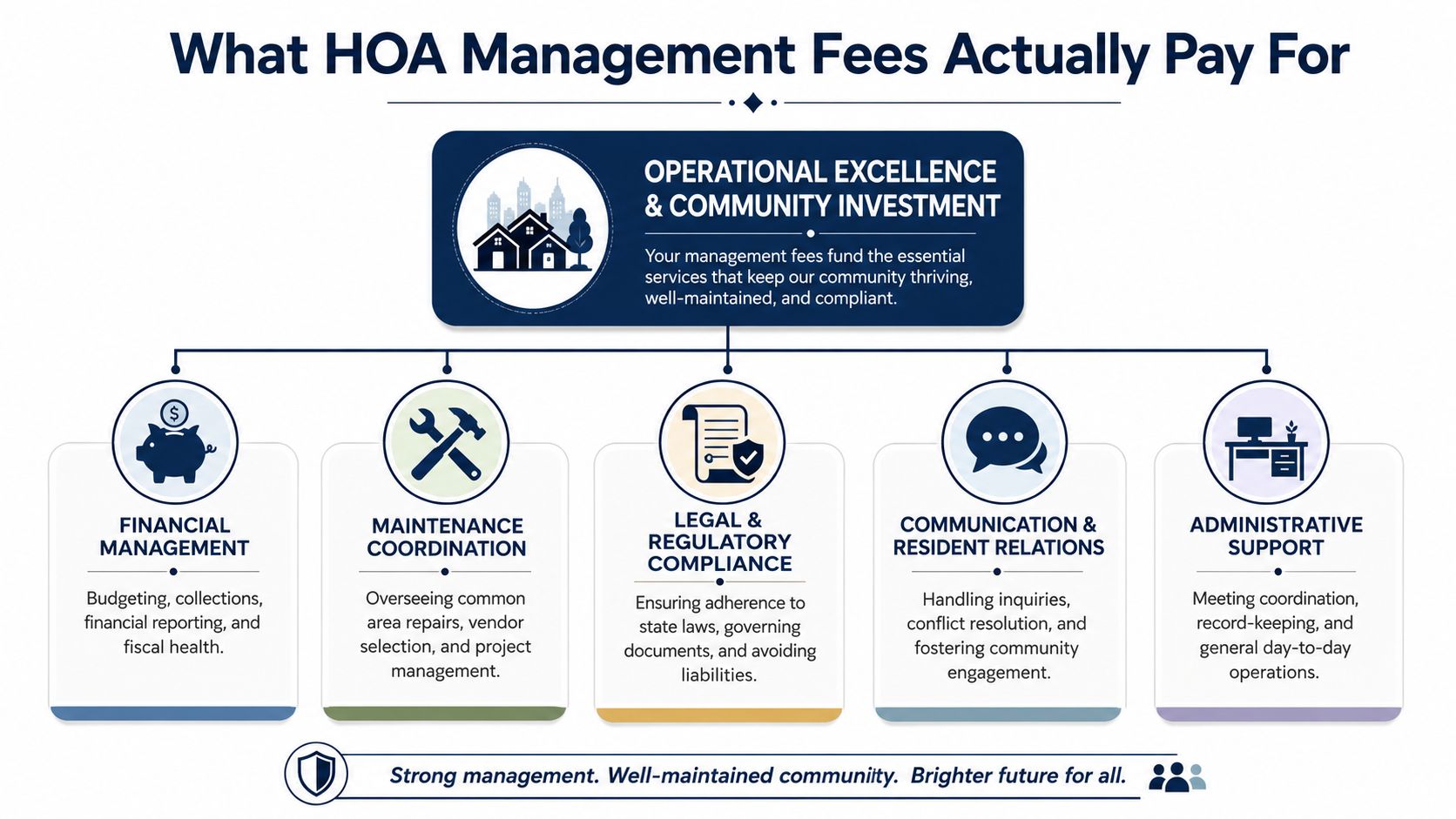
The six functions boards should expect
Use a simple test. Ask what work the manager handled for a similar community over the last twelve months, then compare that list to what this proposal includes. I call this the Last Year Test. It exposes the gap between a cheap base fee and the work your community will need.
A management fee should cover six service categories that boards rely on year-round, not just when something goes wrong. Industry guidance from Associa on what HOA management companies typically handle aligns with that expectation.
- Financial oversight: Assessment tracking, monthly financial reporting, budget support, bank coordination, and owner account questions. Weak financial management creates late reports, collection problems, and board confusion fast.
- Maintenance coordination: Work order handling, vendor communication, proposal collection, repair follow-up, and documentation. Budget firms often assign a distant or overloaded "satellite manager" who forwards emails but does not drive the work to completion.
- Rule enforcement: Violation tracking, notice processing, hearing support, and consistent recordkeeping. If enforcement is sloppy, owners notice immediately and the board takes the blame.
- Administrative support: Meeting preparation, board packets, owner notices, records handling, resale paperwork, and day-to-day correspondence.
- Board guidance: Practical direction on process, authority, meeting discipline, and how to keep decisions within the board's role.
- Legal and policy support: Help applying the governing documents, coordinating with association counsel when needed, and keeping routine decisions from becoming expensive mistakes.
Here is what many boards miss. The fee is not just paying for tasks. It is paying for follow-through, judgment, and access. A proposal can list all six categories and still give your community poor service if your assigned manager is stretched across too many properties or hidden behind a general inbox.
That is why price alone is a bad filter.
A condominium, a large master-planned HOA, and a small single-family association do not create the same workload. Communities with shared mechanical systems, active amenities, insurance complexity, or frequent owner turnover need tighter management. If your association is evaluating projects like solar panels for condos, your manager also needs to coordinate vendor communication, approvals, owner messaging, and board follow-up without letting details fall apart.
A qualified community association manager's role is to keep routine operations off the board's plate and keep board decisions moving after the meeting ends. If your directors are still acting as project manager, collections clerk, and customer service desk, the management fee is not buying enough real management.
The Four Common HOA Management Fee Structures
Fee structures confuse boards because the same service can be priced in very different ways. You need to understand the model before you judge the price.
Per-unit pricing
This is the most common structure. The company charges a set amount per home or per door each month. It's straightforward, and it scales with the size of the association.
Boards like this model because it's easy to budget. The downside is that proposals can look similar while hiding very different service assumptions.
Flat monthly fee
A flat fee gives you one monthly number regardless of unit count. Some boards prefer it because it feels simple and predictable.
The problem is that simplicity can mask exclusions. A flat monthly number only helps if the included scope is detailed and realistic.
Percentage of dues
Some companies charge a percentage of assessments instead of a per-unit rate. When charged on a percentage basis, HOAs typically pay their property manager 5% to 12% of total monthly dues (Cedar Management Group on percentage-based HOA management fees).
This model can work, but boards need to be careful. If your assessments rise, the management fee rises with them. That doesn't always mean the manager is doing more work.
Hybrid or menu-based pricing
This is the structure that trips up many boards. The company offers a base package, then bills separately for added services, extra meetings, document handling, project oversight, or other administrative tasks.
Hybrid pricing isn't automatically bad. It becomes bad when the board doesn't know what the community's normal activity level will trigger.
HOA Management Fee Structures Compared
| Fee Structure | How It Works | Pros for the HOA | Cons for the HOA |
|---|---|---|---|
| Per-unit | Monthly fee multiplied by the number of homes or units | Easy to benchmark and compare across proposals | Can hide major differences in what's included |
| Flat fee | One monthly charge for the whole community | Predictable budgeting, simple invoicing | Can look clean while excluding commonly needed services |
| Percentage of dues | Fee is tied to assessments collected or billed | May align with some communities' budgeting style | Fee can increase as dues increase, even if workload doesn't |
| Hybrid or menu-based | Lower base fee plus separate charges for selected tasks | Can fit communities with very narrow service needs | Often creates surprise invoices and a distorted “cheap” proposal |
If your board wants fewer billing surprises, favor contracts with a tight scope and fewer open-ended extras. Predictability helps homeowners. It also helps the treasurer sleep at night.
How Much Should Your HOA Expect to Pay
A board signs a “low-cost” management contract in December, feels good about the budget, and by July has paid for extra meetings, resale paperwork, violation processing, and project coordination that were never built into the base fee. That is how boards end up overpaying for cheap management.
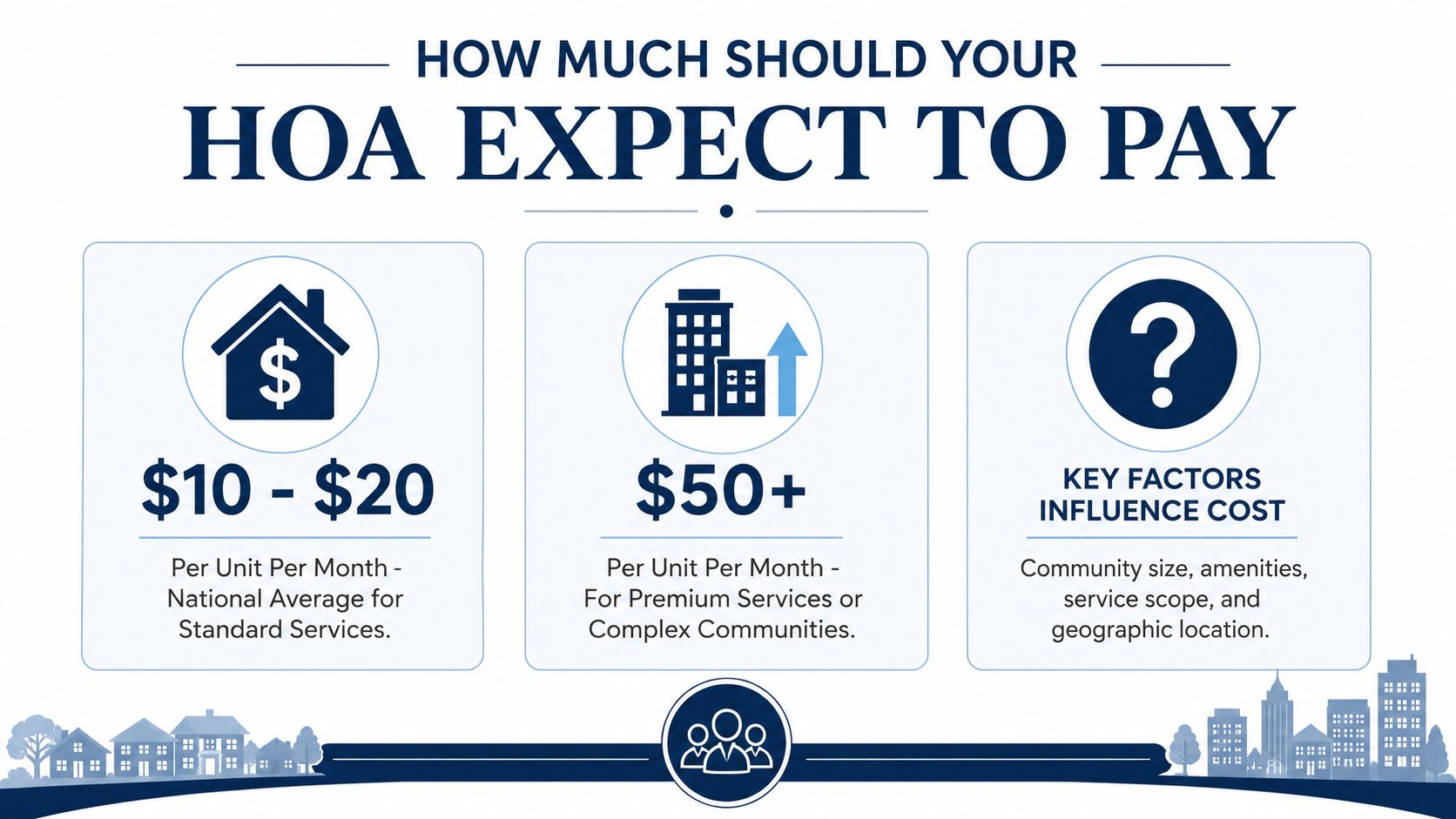
National benchmarks help, but they do not answer the only question that matters. What will your association spend over a full year for the level of service your board expects? According to HOA Start's review of average HOA management company costs, standard HOA management often falls in the $10 to $20 per unit per month range, with higher-service communities and amenity-heavy properties reaching $20 to $50 per unit per month.
That range is only a starting point.
What your community will actually pay
Price moves fast when the community is harder to run than it looks on paper. Condos usually cost more than single-family HOAs. Communities with pools, gates, clubhouses, elevators, or heavy vendor traffic cost more. Boards that expect prompt responses, polished financials, strong covenant enforcement, and active meeting support should expect to pay more.
Size matters too, but not the way boards assume. Large associations may spread costs better. Small associations often get squeezed because the manager still has to answer calls, prepare financials, attend meetings, and handle owner issues, even if there are fewer doors to bill.
The biggest pricing mistake is focusing on the monthly line item instead of the annual operating reality.
Use the Last Year Test
Take your association's actual activity from the last 12 months and run every proposal against it. Count board meetings, annual meetings, violation letters, architectural requests, resale packages, after-hours calls, major projects, and vendor bid work. Then price those items using each company's fee schedule.
That is the Last Year Test. It gives you the true annual cost.
If one company quotes $14 per door and another quotes $18, the cheaper proposal may still lose once you price in the work your community already generates. Boards that skip this step are the ones that end up with the satellite manager problem. Your community gets a manager who is stretched across too many accounts, shows up late to issues, and starts billing extra every time the board needs real help.
A fair budget range depends on service level
Some associations only need financial management and limited administrative support. Others need full-service management with meeting attendance, site inspections, vendor coordination, collections support, homeowner communication, and day-to-day board guidance. Association management fee categories and service tiers outlined by Henderson Investment Group show the same basic truth boards see in practice. Broader service and more touchpoints drive higher monthly cost.
Do not compare fees without comparing staffing and scope. A proposal is only as good as the service model behind it. If your board is still sorting through options, review a broader list of best HOA management companies and compare how each firm handles account load, meeting support, and operational coverage.
For budget context, management fees are only one part of the owner's total housing cost. DoorLoop's HOA statistics roundup notes that monthly HOA dues in many states are far higher than the management line itself. That is exactly why boards should stop chasing the lowest management fee and start buying the right fit. A weak management contract creates extra work, slower response times, more board frustration, and higher total cost by year-end.
Uncovering Hidden Costs and Add-On Fees
Boards often find themselves in hot water.
A proposal with a low base fee can become the most expensive contract on your desk once normal activity starts generating add-on charges. That problem is especially common in smaller associations that think they've found a bargain.
The total annual cost trap
Low base fees are often misleading for small HOAs because on-demand add-ons can increase the all-in annual cost by 30 to 50 percent (Nexova on hidden total annual cost in HOA management contracts). That's not a minor variance. That's the difference between a good contract and a budget problem.
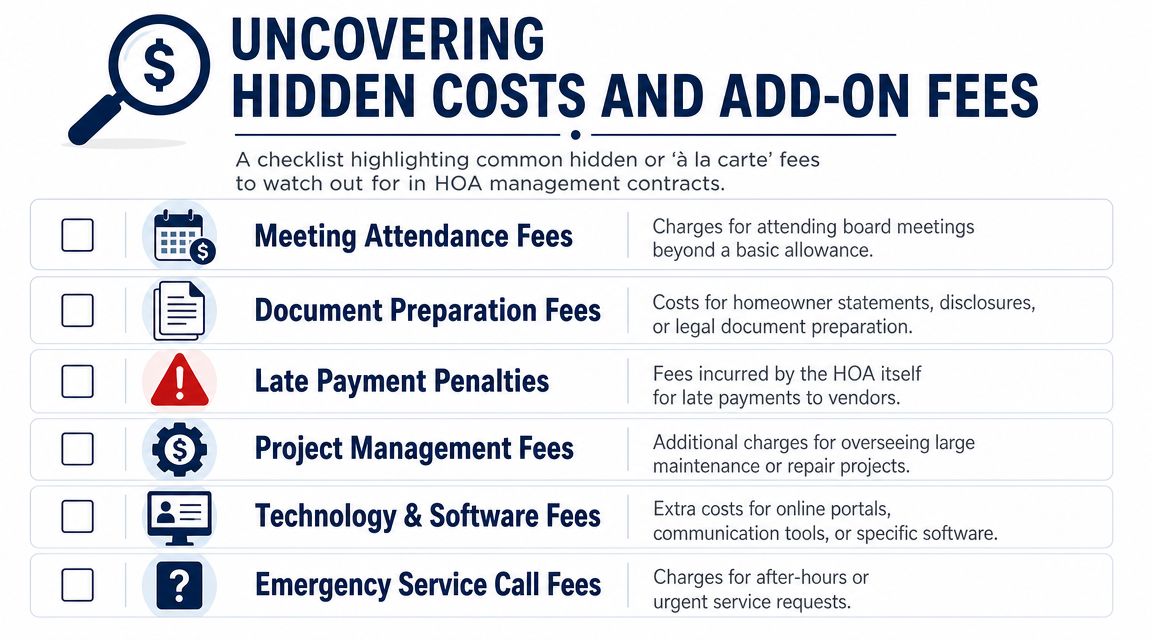
Common triggers include:
- Extra meetings: Beyond the number included in the contract
- Document prep: Resale paperwork, lender requests, owner statements
- Compliance work: Violation letters, hearing support, follow-up administration
- After-hours response: Urgent calls, dispatch coordination, emergency handling
- Project oversight: Special repairs, bid coordination, and vendor supervision
- Technology charges: Portal access, software fees, and administrative platforms
If your community uses those services regularly, a low monthly fee means almost nothing.
Use the Last Year Test
The best tool I know is simple. Pull your association's activity from the prior year and apply each company's full rate card to it. Use actual board meetings, actual violation volume, actual document requests, actual special projects, and actual after-hours issues.
Board advice: Ask every bidder for the complete rate card before interviews. If they won't hand it over, stop the process.
This method matters because the “cheap” company is often cheap only on paper. Boards should compare what the community would have paid last year under each proposal, not what the cover page says today.
The software side matters too. If your board is trying to tighten operations, review what modern community association management software should support, including owner communication, accounting workflows, and record access. Good systems don't fix a bad contract, but bad systems make a marginal contract worse.
Special Considerations for Georgia HOAs and COAs
Georgia boards shouldn't hire management on price alone. Local legal knowledge matters. A company can be polished, responsive in the sales process, and still be the wrong fit if it doesn't understand how community associations operate in this state.

Georgia law changes what good management looks like
For HOAs, the Georgia Property Owners' Association Act can shape collections, liens, and enforcement authority. For condominiums, the Georgia Condominium Act affects governance and operational obligations in different ways. A board doesn't need a manager to practice law. It does need a manager who understands the legal framework well enough to keep routine operations from drifting into preventable risk.
That includes practical things like meeting support, records discipline, notice workflow, vendor coordination, and knowing when an issue needs to go to association counsel instead of being handled casually through email.
Local expertise protects the board
Georgia also expects professionalism from the people managing associations. Boards should ask direct questions about licensing, local experience, support depth, and who will touch the account after contract signing.
A Georgia-based community benefits when its manager knows the vendors, understands local expectations, and can spot a governance issue before it becomes a board crisis. That's especially important for presidents and treasurers, because they usually absorb the fallout when management misses something basic.
A weak manager creates more work for the board. A strong Georgia manager removes noise, organizes the process, and keeps the association steady.
Frequently Asked Questions from Board Members
Are HOA management fees the same as HOA dues
No. HOA dues fund the association's broader operating obligations. Management fees are what the association pays the management company for professional services. Homeowners feel both through the budget, but they're not the same line item and shouldn't be treated like they are.
How should we negotiate a management contract
Don't start by demanding a lower monthly fee. Start by tightening the scope.
Ask for written detail on meeting attendance, financial deliverables, violation handling, owner communication, and project support. Then negotiate fee caps, included quantities, and clearer definitions of what triggers additional billing. A smaller discount with a better contract is usually the better deal.
What are the biggest red flags in a proposal
Watch for these immediately:
- Vague language: Terms like “as needed” or “reasonable support” invite billing disputes.
- Missing rate card: If you can't see the add-on pricing, you can't judge the proposal.
- No named manager: If they won't identify who's handling your account, assume the staffing model is unstable.
- Thin local support: If everything routes through a remote call chain, service will feel reactive.
What is the satellite manager problem
It's one of the biggest issues boards ignore. Small HOAs are increasingly assigned to junior “Satellite Managers” handling 15+ portfolios, which can lead to degraded service and a 30 to 50 percent service gap compared to larger clients (Associa on satellite manager concerns for small HOAs).
That's why a low fee can backfire. Your board signs for “full service,” but your community gets a fraction of a manager's attention. Emails slow down. Follow-up weakens. Projects drag. Homeowners blame the board, not the portfolio design behind the scenes.
If your manager is spread too thin, your contract price isn't your real cost. The board pays the rest in delays, frustration, and cleanup.
When is it time to switch management companies
Start considering a change when the same failures repeat. Financial reports arrive late. Action items disappear. Vendors aren't managed. Board members have to chase basic tasks. Owners don't know where to turn. Those aren't personality issues. They're operating failures.
Boards should also act when the company is billing heavily for work the contract implied was routine, or when the assigned manager turns over so often that continuity disappears. Residents need consistency. So does the board.
If your board wants a Georgia partner that puts homeowners first, supports the board with clarity, and helps protect the community's long-term value, Access Management Group is worth a serious look. Their reputation in Georgia community association management goes back to the 1970s, and their focus has stayed the same: protect, preserve, and enhance the association's real estate investment with educated, elite Community Association Managers and strong operational systems.