A gated community is a residential area with restricted access controlled by walls, fences, or gates, typically with an authorization process for residents and guests. For an HOA or COA board, that definition isn't just descriptive. It creates ongoing responsibilities for access control, rule enforcement, vendor oversight, budgeting, and resident expectations.
If you're a board member reading this, you're probably not asking the question in the abstract. You're asking it because a gate arm keeps failing, residents want easier guest entry, a delivery issue turned into a complaint, or your reserve study doesn't clearly address the front entrance system. That's when the definition of a gated community starts to matter in a very practical way.
Boards often inherit a gate and treat it like an amenity. In practice, it functions more like infrastructure. Once a community controls entry, the board is no longer just maintaining landscaping and reviewing violations. It's managing a private-access environment with real operational consequences for homeowners, vendors, guests, and emergency response.
What "Gated Community" Really Means for Your Board
A board usually feels the meaning of "gated" on the worst day first. The gate won't open. A resident is locked out. A vendor entered without authorization. Someone asks whether the association is liable because the entrance wasn't working as intended. In those moments, the definition of a gated community stops being a brochure phrase and becomes a governance issue.
The technical definition is straightforward. A gated community is defined by its access-control architecture: a physical perimeter, controlled entry and exit points, and an authorization layer for residents and guests. That setup creates a managed-access environment instead of an open public street network, as explained in this overview of what makes a neighborhood a gated community.
The board's job starts where the hardware ends
A gate system is only one piece of the board's responsibility. The essential work sits behind it.
- Authority: The board needs clear rules about who may enter, how access is granted, and who can revoke credentials.
- Operations: Someone must manage call boxes, remotes, credentials, resident lists, and visitor procedures.
- Maintenance: Gates, motors, loops, cameras, barriers, and software all need service plans and replacement planning.
- Enforcement: Rules must be enforceable, applied consistently, and tied back to the association's governing authority.
Practical rule: If your governing documents don't clearly support how the community controls access, your gate policy is weaker than most boards realize.
This is why boards should review their HOA governing documents before changing access rules, issuing credentials, or tightening visitor procedures. The physical system can only do what the legal framework allows.
Why the definition matters in daily governance
For homeowners, the gate often represents privacy, order, and a sense of control. For the board, it creates service standards. Residents expect the gate to work consistently, guests to be processed fairly, and safety procedures to make sense.
That means the definition of a gated community is not limited to "a neighborhood with a fence." It is a private community operating under controlled entry conditions. Once a board understands that, better decisions follow. Policies become clearer, reserve planning becomes more realistic, and discussions about convenience versus security become less emotional and more operational.
Beyond the Gate Understanding the Core Concept
Many boards make a costly mistake early. They think the gate defines the community. It doesn't. The gate is the visible edge of a broader private governance system.
A gated neighborhood is usually better understood as a common-interest community with shared property, shared obligations, and private rules. Residents don't just own homes. They also participate in a structure where the association maintains assets, collects assessments, and regulates use of common elements. The gate is one feature within that structure, not the whole structure.
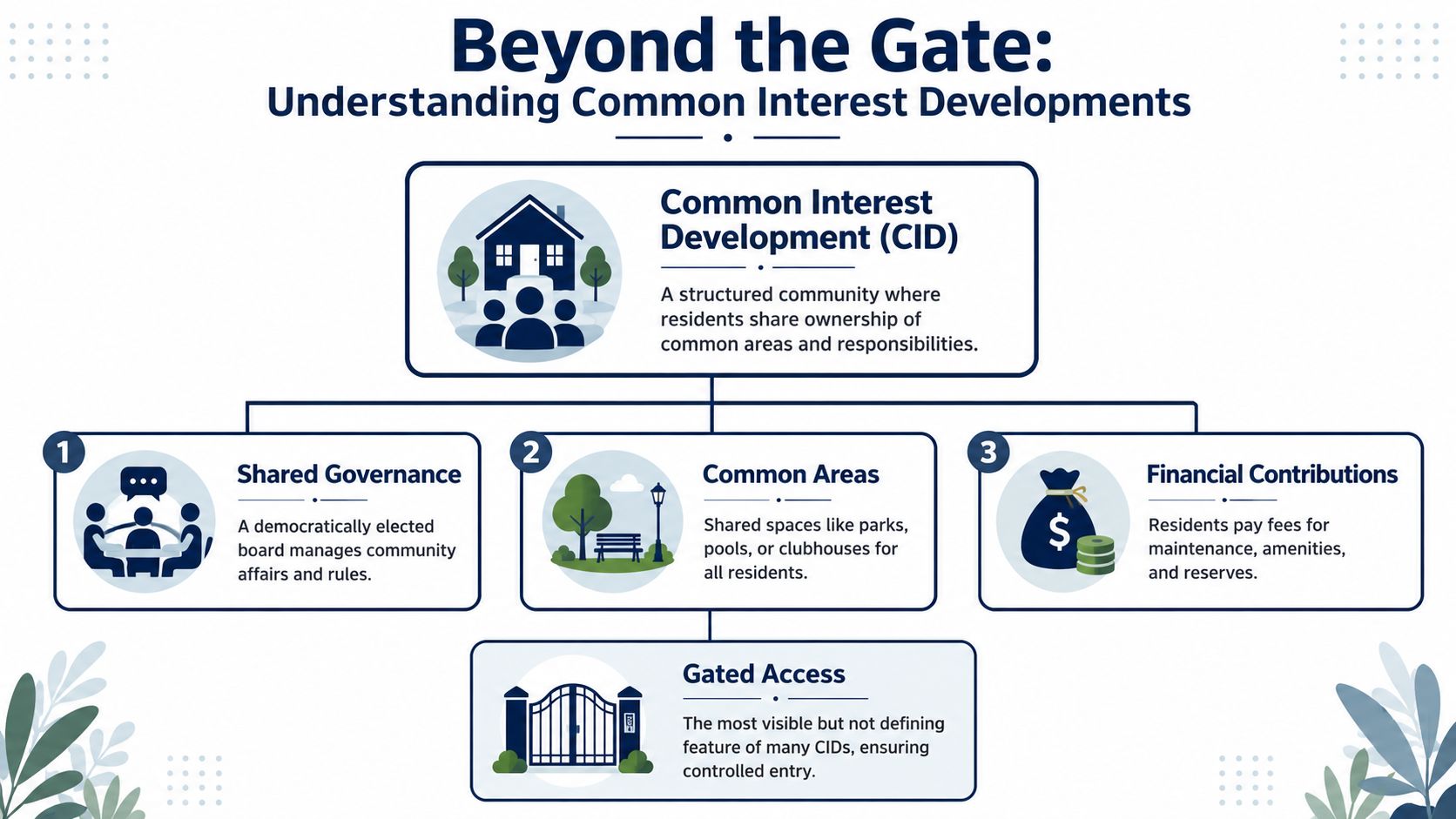
The gate is visible. The private system behind it is what matters.
A useful way to explain this to new board members is to compare the association to a private membership organization. Owners have rights, but they also accept obligations through the declaration, bylaws, and rules. The board acts on behalf of the membership to preserve common assets and administer standards.
That changes the meaning of everyday decisions. When the board approves a gate vendor, adopts a guest policy, or budgets for an entry system upgrade, it isn't just making a convenience decision. It is managing a private asset that supports the association's broader duty to protect community operations and maintain order.
This housing model became significant, not niche
The modern gated model didn't remain a rare development type. Researchers estimated there were about 20,000 gated communities in the United States in the 1990s, and the 2001 American Housing Survey found more than 7 million people living in “walled and fenced” communities, representing 5.9% of the sample, according to the historical summary in this gated community reference.
Those figures matter because they frame gated communities as a distinct housing form with meaningful scale. Boards aren't overseeing a novelty. They're governing a mature residential model with known patterns: controlled access, private obligations, and heightened owner expectations.
The strongest boards stop treating the entrance gate as a symbol and start treating the entire community as a managed private environment.
What that means for board thinking
When a board understands the core concept, three practical shifts happen:
- The board governs a system, not just an entrance. Roads, common areas, access credentials, visitor procedures, and enforcement all connect.
- Rules become contractual, not informal. If standards aren't written clearly and applied evenly, disputes multiply.
- Property value protection becomes operational. Maintenance quality, appearance, access reliability, and owner experience all shape how the community functions.
That broader lens usually improves decision-making. It also helps board members explain to homeowners why gate policies, access logs, repair contracts, and reserve funding are not over-management. They are part of operating a private community the way it was designed to function.
Types of Gated Communities and Access Control Systems
Not all gated communities operate for the same reason. Some are built around exclusivity. Others are designed around amenities, traffic control, or resident peace of mind. A board makes better policy decisions when it understands which type of community it governs.
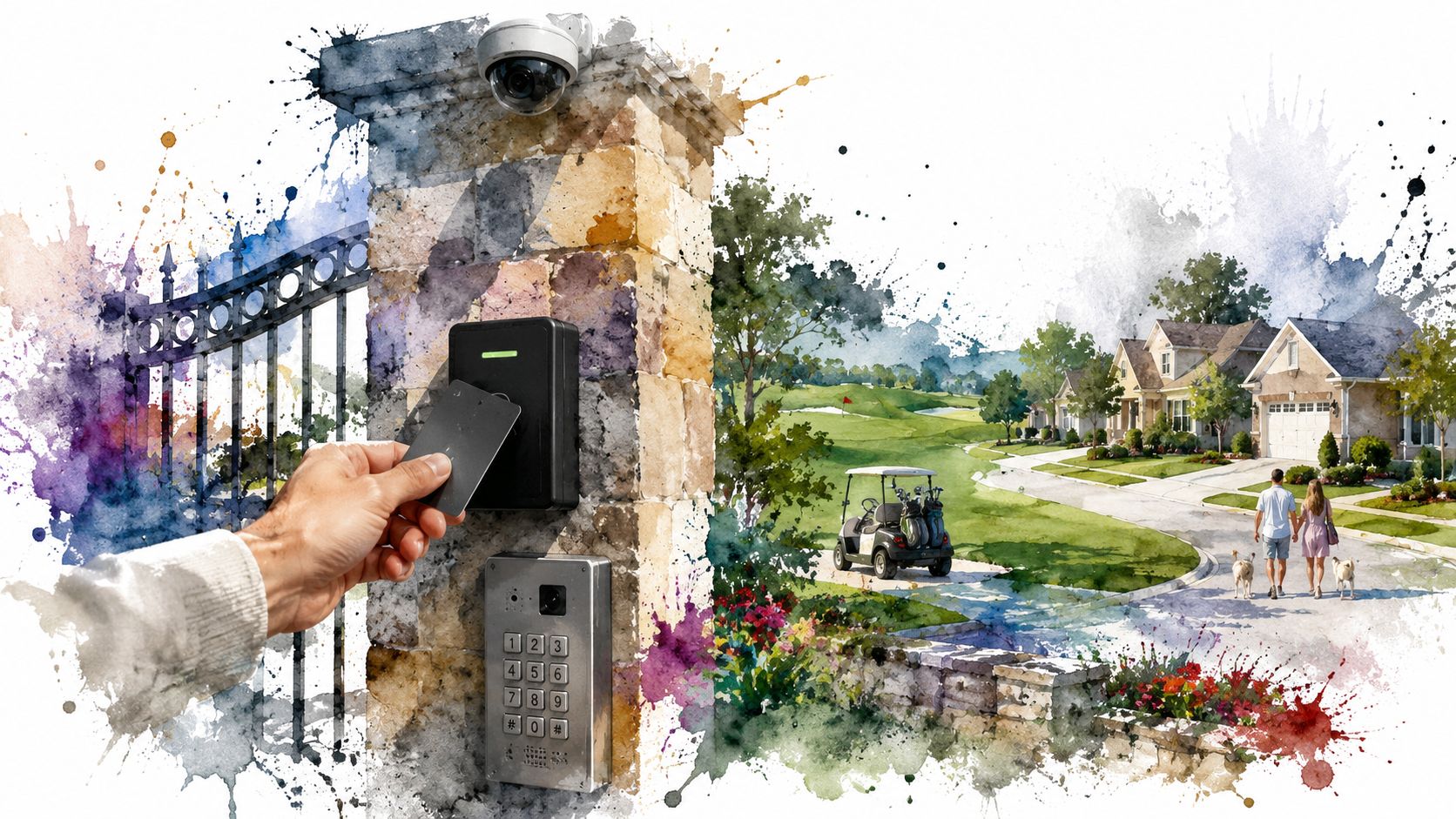
Three common community profiles
| Community profile | What residents usually expect | What boards must prioritize |
|---|---|---|
| Prestige-oriented | Privacy, appearance, controlled visitor presentation | Strong entry protocols, polished front entrance, consistent vendor standards |
| Lifestyle-focused | Smooth resident access, amenity integration, easy guest handling | Convenience, credential management, predictable service workflows |
| Security-driven | Tight control over entry, visitor verification, limited unmanaged traffic | Clear policies, audit trails, reliable equipment, disciplined enforcement |
Most communities are a mix. The problem starts when the board governs one way while the residents expect another. A lifestyle community with a fortress-style visitor process will frustrate owners. A security-driven community with loose guest controls will create complaints for the opposite reason.
Comparing access control options
Boards usually evaluate systems on four criteria: security, convenience, maintenance burden, and ongoing cost. The right answer depends on traffic patterns, staffing capacity, and resident expectations.
- Manned guard stations: Best for communities that want active screening and a visible presence at the entrance. They can handle exceptions well, but they require staffing discipline and ongoing supervision.
- Keypads and call boxes: Common and familiar. They work well when resident data is kept current, but they create problems when directories are outdated or visitor codes are shared too freely.
- Cards, fobs, remotes, and windshield credentials: Efficient for resident access. They reduce entry friction, though boards need procedures for lost devices, transfers, and deactivation.
- App-based and cloud-managed systems: Useful when a board wants centralized control and easier updates. These systems still need written policies and someone responsible for administration.
- Virtual guarding and remote verification: A practical middle ground for some communities. Success depends on clear procedures, reliable connectivity, and resident acceptance.
A weak policy can make a strong system ineffective. A clear policy can make a modest system work far better.
Boards comparing products can also learn from adjacent sectors. The operational issues in multi-family access control often overlap with HOA gate management, especially around credentialing, visitor entry, and system integration.
What doesn't work
Three patterns show up repeatedly in troubled communities:
- Buying for features instead of fit: A board chooses technology that looks modern but doesn't match the community's traffic flow.
- Letting convenience override governance: Too many permanent guest codes or undocumented workarounds eventually undermine the system.
- Ignoring administration: Every access system needs ownership. If no one maintains resident records and permissions, failure is only a matter of time.
The Legal Framework of a Gated Community
A gate changes legal and operational assumptions. Once the association controls entry into a private residential area, the board has to pay closer attention to the documents that authorize that control and to the obligations tied to private property.
For most boards, the critical documents are the declaration or CC&Rs, the bylaws, the rules and regulations, and any architectural or access-control resolutions the association has adopted. If those documents are vague, inconsistent, or outdated, the board may still have practical control of the entrance but weak footing when disputes arise.
Where gated status shows up in the documents
The most important provisions usually address these issues:
- Private roads and common areas: If the association owns or maintains private streets and entrance infrastructure, maintenance and liability questions often sit with the association rather than a local government.
- Access authority: The documents should support the board's ability to regulate resident credentials, guest access, service access, and enforcement procedures.
- Use restrictions: Rules about deliveries, move-ins, contractor access, or event traffic should connect back to actual authority in the governing documents.
- Enforcement process: Fines, suspensions, hearing rights, and notice requirements need to be followed carefully when access-related violations occur.
Boards that need a plain-language primer on community restrictions often benefit from understanding the broader meaning of a deed-restricted community, because many gated neighborhoods operate within that larger framework of recorded obligations.
Public versus private is a board issue, not a technicality
One of the most misunderstood questions is whether roads are public or private. If roads are public, the association's authority may be narrower than many residents assume. If roads are private, the board's maintenance obligations are typically more direct, and control measures may carry different liability considerations.
That distinction affects more than resurfacing budgets. It influences signage, towing rules, traffic enforcement expectations, gate placement, and vendor access procedures. Boards shouldn't guess on this point. They should confirm it in the plat, declaration, and legal records.
When a board controls entry but hasn't confirmed the scope of its authority, it risks inconsistent enforcement and avoidable disputes.
Policy must follow authority
A practical way to check legal alignment is to compare three things side by side:
| Governance question | What the board should verify |
|---|---|
| Who may enter? | Whether the documents authorize guest, vendor, and contractor controls |
| Who maintains the system? | Whether gates, roads, operators, cameras, and barrier arms are association assets |
| How are rules enforced? | Whether notice, hearing, and sanction procedures are already defined |
Boards run into trouble when they create operational policies that sound sensible but lack documentary support. Examples include denying certain vendor access without written authority, adopting inconsistent event-entry rules, or changing resident credential policies without a formal resolution.
A legally sound gated community isn't the one with the most restrictive gate. It's the one where the board's access procedures match the governing documents, are applied consistently, and are documented well enough to defend.
Weighing the Pros and Cons for Your Community
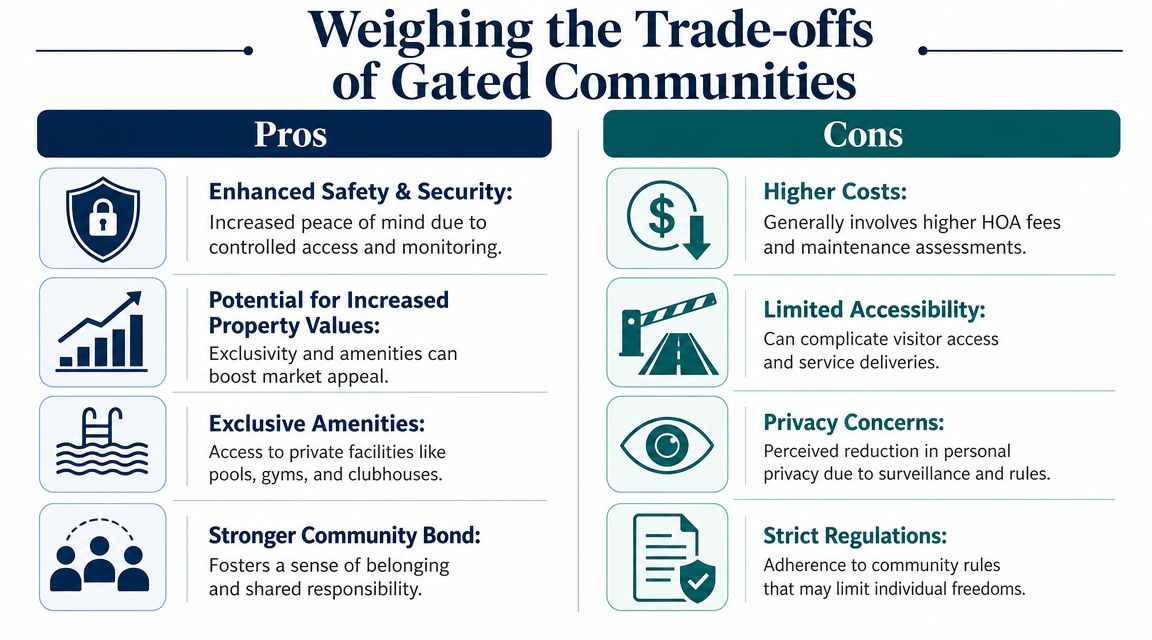
Boards need a balanced view of gated living because residents usually see only one side of the equation. Some focus on safety and privacy. Others focus on cost and inconvenience. Good governance requires both views at the same time.
Research often cited in the industry found that homes behind gates had 33% lower burglary risk, while a 2016 real-estate study found the average home in a gated community sold for $30,000 more than a comparable non-gated home, as summarized in this gated communities research overview. Those figures help explain why owners place real value on controlled access, even when the system creates extra expense and oversight.
Where gated communities deliver value
For many associations, the benefits are real and visible in day-to-day operations.
- Controlled entry: Fewer unmanaged access points make visitor management simpler and reduce casual pass-through traffic.
- Resident confidence: Owners often feel more comfortable in a managed-access setting, even when they understand it isn't a guarantee against all incidents.
- Market positioning: Buyers frequently associate gates with privacy, order, and a more curated community environment.
- Rule enforceability: When the association controls access points, it can manage contractor entry, event traffic, and other operational issues more effectively.
Where boards feel the pressure
The trade-offs are just as real.
- Cost exposure: Gates require maintenance, repair coordination, software administration, and eventual replacement.
- Convenience friction: Residents get frustrated when guest entry is cumbersome or when service providers face repeated delays.
- Operational dependence: If the system fails, the community notices immediately. Very few common assets generate complaints as quickly as a malfunctioning entry point.
- Social concerns: Some owners appreciate the separation from surrounding streets. Others feel it creates an unnecessary barrier or a less open neighborhood culture.
Controlled access works best when the board defines what problem the gate is meant to solve. Problems that aren't clearly defined are rarely managed well.
A board-level way to evaluate the trade-off
Ask these questions before approving upgrades, staffing changes, or policy revisions:
- Is the current system aligned with homeowner expectations?
- Are we paying for appearance, security, convenience, or some combination of all three?
- Do our policies create unnecessary friction for residents, guests, and vendors?
- Have we budgeted for the full lifecycle of the equipment, not just repairs?
The strongest boards don't sell the gate as a cure-all. They present it realistically. A gated community can support owner confidence, property values, and order, but only when the board accepts the recurring cost and management discipline that come with it.
Your Board's Role in Operating a Gated Community
Once a community is gated, the board has to run the entrance like a core asset. That means budgeting for it, assigning responsibility for it, and planning for failure before failure happens. Too many boards do the opposite. They wait for a breakdown, approve an emergency invoice, and then repeat the cycle.

Build an operating plan, not just a repair file
A practical board approach usually includes four operating tracks.
Budgeting and reserves
Your annual budget should separate routine operating costs from long-term replacement planning. Ongoing expenses may include service calls, preventive maintenance, software subscriptions, communication charges, credential inventory, and staffing or monitoring contracts. Replacement planning should address gate operators, arms, control panels, loops, readers, cameras, and entry devices.
If the reserve study doesn't identify these assets clearly, correct that. A gate system ages like any other mechanical and electronic system. Boards that hide replacement risk inside the general operating budget usually end up with surprise special assessment pressure.
Vendor oversight
The right vendor relationship is more than a phone number for breakdowns.
- Scope clarity: Define who handles hardware, software, communication lines, camera integration, and after-hours response.
- Service standards: Require clear response expectations, documentation after service, and explanation of recurring failures.
- Data control: The association should know who owns system credentials, resident data, and administrative permissions.
Rules and procedures
Access policies must be written down, distributed, and enforced consistently. That includes resident credentials, guest entry, contractor access, delivery protocols, move-in procedures, and temporary access for projects or events.
One useful discipline is to test every rule against a real scenario. If a groundskeeper arrives early, a delivery driver goes to the wrong lane, or a resident changes tenants, staff and volunteers should know exactly what happens next.
Assign human ownership
Technology doesn't manage itself. Someone has to administer rosters, deactivate old credentials, update resident information, and coordinate with vendors. In many communities that work falls to management, with oversight from the board.
A professional Community Association Manager typically supports those functions by coordinating vendors, maintaining records, implementing board policy, and helping the association stay consistent. Access Management Group provides that kind of HOA and condominium management support for communities that need structured administration rather than ad hoc volunteer handling.
The board should approve the rules. Management should run the process. Vendors should maintain the equipment. When those roles blur, gate operations usually suffer.
Plan for obsolescence before residents force the issue
Every access system eventually feels outdated. Boards should watch for warning signs:
- Frequent part failures
- Poor integration with current resident needs
- Administrative workarounds that staff or volunteers rely on
- Resident complaints that point to system design, not one-off errors
When those signs appear, start planning before the hardware forces your hand. A smoother transition happens when the board evaluates options early, updates policies first, and communicates changes clearly to homeowners.
Key Questions for Gated Community Boards
What is our liability if the gate fails and an incident occurs?
Boards shouldn't assume that a gate creates blanket responsibility for every event, but they also shouldn't assume the opposite. Liability usually turns on facts such as ownership, maintenance history, notice of defects, consistency of operations, and whether the association followed its own procedures. The practical response is simple: maintain the system, document service history, and avoid making promises the community can't operationally support.
How should we budget for long-term gate replacement?
Treat the gate system as a capital asset group, not a one-line repair item. Identify all related components, confirm useful life assumptions with qualified vendors or reserve professionals, and fund replacement steadily rather than waiting for emergency failure. If your reserve schedule lists only "front gate" as one asset, it may be too vague to support reliable planning.
What's the best way to manage access during large events or construction projects?
Use temporary procedures, not exceptions that become habits. Require advance notice, designate access windows, identify responsible contacts, and communicate the process to residents before traffic increases. Construction projects especially need a written access protocol so the community isn't improvising daily.
How strict should visitor policies be?
Strict enough to support the community's purpose, but not so rigid that residents stop following the process. If the policy is cumbersome, people create workarounds. The best visitor policy is one residents will use, staff or management can administer, and the board can enforce fairly.
When should a board revisit access rules?
Review them when resident complaints cluster around the same issue, when technology changes, after a major incident, or when vendor transitions expose gaps. Most boards wait too long. Access policies age faster than many document provisions because resident expectations and delivery patterns change.
If your board needs help turning gate operations into a clear governance system, Access Management Group can support that work through community association management, vendor coordination, document-based policy administration, and day-to-day operational oversight. For boards responsible for private access, that kind of structure helps protect homeowners, reduce avoidable friction, and keep the community running the way residents expect.