If you're a new board member and someone just said, “This is a PUD, not a condo community,” you're probably sorting through more than vocabulary. You're trying to understand who owns what, who pays for what, and why your association has obligations that feel bigger than a typical neighborhood's. For homeowners, the same confusion often starts at closing, when the deed, lender paperwork, or governing documents use terms that sound technical but carry real financial consequences.
That's why the definition of a PUD in real estate matters. In practice, a Planned Unit Development affects governance, budgeting, maintenance, architectural control, resident expectations, and how the community explains itself to buyers. For a board in Georgia, it also shapes how you handle the daily work of protecting common property while respecting individual ownership rights.
We are a customer-centric boutique property management and community management company. Articles like this should first benefit homeowners, board members, and the HOA or COA president who has to make clear decisions under real-world pressure.
What Is a Planned Unit Development
A Planned Unit Development, usually shortened to PUD, is a form of community development where owners typically hold title to both their home and the lot beneath it, while also sharing responsibility for common property through a mandatory homeowners association. It blends private ownership with collective obligations.
That sounds simple on paper. It rarely feels simple in board meetings.
A homeowner in a PUD may own the house, yard, and lot, but the community still depends on shared management of private roads, entry features, lighting, recreational areas, and other common assets. The result is a neighborhood that often looks like a conventional subdivision but operates with more structure and more ongoing coordination.
Why the term matters to a board
For a board, a PUD isn't just a label on a plat or loan file. It tells you the association exists because the community has shared obligations that individual owners can't handle alone. If the neighborhood includes common infrastructure, someone has to budget for it, contract for it, insure it, and enforce rules that keep it functional.
For homeowners, the term matters because it usually means the community isn't purely private and isn't purely public. You're living in a setting with deed restrictions, mandatory membership, and shared maintenance expectations. If you need a refresher on how that broader framework works, this overview of a deed-restricted community helps connect the legal language to everyday ownership.
A PUD works best when owners understand that “my home” and “our community” are both true at the same time.
In other words, the definition of a PUD in real estate isn't just a dictionary entry. It's the operating model for how the community lives, pays, and governs itself.
Key Features That Define a PUD
A board should think of a PUD as a private mini-town. Owners hold private property rights, but the neighborhood also contains shared infrastructure and shared decision-making that require formal governance.
Planned Unit Developments were originally conceived in 1925, giving developers flexibility from rigid zoning categories so they could create more cohesive communities that blend uses and layouts in ways traditional zoning often doesn't allow, according to the National Association of Realtors' overview of Planned Unit Developments. That history still matters because the structure of the community drives the structure of the association.
The ownership piece
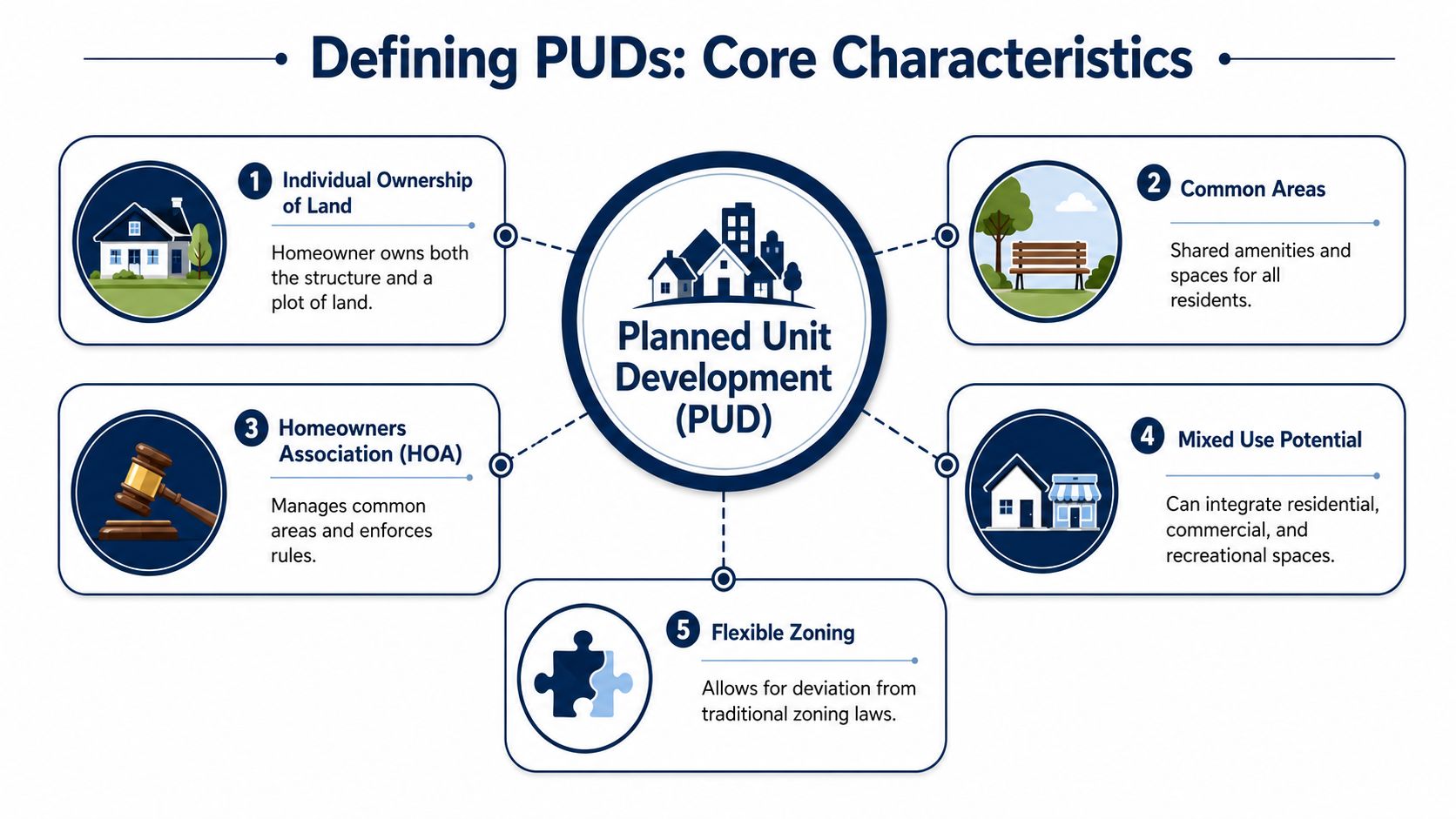
The first defining feature is individual ownership. In a PUD, owners generally have title to the dwelling and the land under it. That gives residents a stronger sense of conventional homeownership than they would have in a condominium arrangement.
From a governance standpoint, that ownership creates an important boundary. The board doesn't own the members' homes, but it may regulate exterior standards, improvements, and use restrictions through the governing documents.
The mandatory association piece
The second defining feature is mandatory association membership. This isn't optional participation in a neighborhood club. If the property is in the PUD, the owner belongs to the association and must comply with the covenants and pay the assessments that support the community.
That point needs to be clear in every welcome packet and resale disclosure. Boards run into conflict when owners assume dues only cover amenities they personally use. In a PUD, dues are tied to shared obligations, not just personal preferences.
The shared responsibility piece
The third defining feature is shared property and shared responsibility. The NAR description highlights common infrastructure such as private roads, sidewalks, entry gates, and streetlights within the PUD model. Those items don't maintain themselves, and they don't belong on the board's agenda only when they fail.
A practical board should identify which assets are:
- Operational assets such as lighting, irrigation, and entry systems that need routine service
- Capital assets such as roads, retaining walls, or amenity buildings that need long-term funding plans
- Risk assets such as ponds, playgrounds, and gates that carry safety and liability exposure
The planning piece
PUDs also stand apart because of flexible zoning and integrated design. Developers can combine residential, natural, and sometimes commercial or recreational components in one coordinated area. That flexibility can produce more usable neighborhoods, but it also means boards often inherit more complex maintenance maps and covenant enforcement issues than a standard subdivision would.
Practical rule: If your board can't clearly explain what the association owns, maintains, regulates, and insures, it doesn't yet understand its PUD.
How PUDs Differ from Condos and Subdivisions
Most homeowner confusion comes from comparison. A PUD may look like a subdivision. It may share some administrative traits with a condo. But it isn't the same thing as either.
The cleanest way to explain it is to focus on ownership, maintenance, and governance.
The biggest difference from a condo
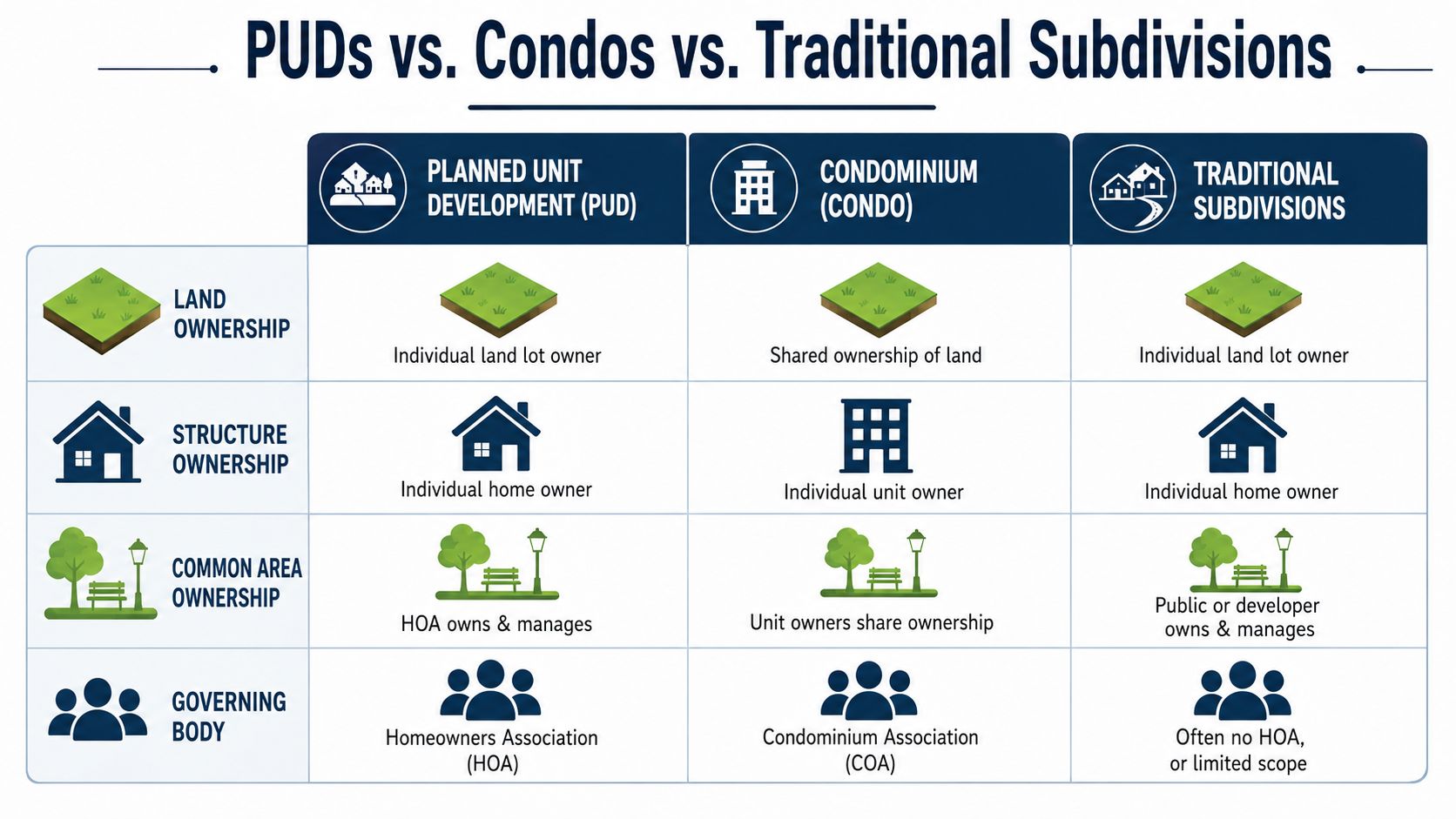
A PUD is legally distinct because the owner holds title to both the dwelling and the lot, while condominium ownership is generally limited to the interior space of the unit, as explained in this overview of what a Planned Unit Development is. The same source notes that because PUD owners hold land title, they are exempt from Federal Housing Authority rules that typically govern condominiums, which can provide greater flexibility in financing and resale.
That one distinction changes a lot of daily assumptions.
In a condo, people usually understand that the association has a much larger maintenance role because the owners don't hold separate lot ownership in the same way. In a PUD, owners may assume they have complete autonomy because they own the lot. They don't. Lot ownership exists alongside restrictive covenants and shared community obligations.
The practical comparison
| Property type | What the owner typically owns | Who handles shared areas | What boards usually deal with most |
|---|---|---|---|
| PUD | Home and lot | HOA manages common property and infrastructure | CC&R enforcement, shared asset funding, architectural control |
| Condo | Interior unit space | COA or condo association manages building/common elements | Building systems, insurance, structural maintenance |
| Traditional subdivision | Home and lot | Often public infrastructure, sometimes limited HOA role | If an HOA exists, it may focus more narrowly on restrictions and appearance |
Where boards get tripped up
The hardest conversations usually involve maintenance lines.
A resident says, “I own my lot, so why can't I remove that tree?” Another says, “If I pay dues, why doesn't the HOA fix my driveway?” A third assumes the county will handle a private street because it looks like every other street in town.
Those are classic PUD questions. The answers live in the declaration, plats, easement maps, and maintenance responsibility charts, not in assumptions based on appearances.
What doesn't work
Boards create problems when they explain the community loosely. Saying “we're basically like a condo” or “we're just a neighborhood with amenities” causes confusion later. Those shortcuts break down when owners ask about roofs, fences, stormwater systems, private roads, or lender questionnaires.
A better explanation is direct:
- You own your house and lot
- The association is mandatory
- The community has common obligations that all owners fund together
- The governing documents decide the maintenance split
The down-the-street condo community and your PUD may both have a pool and rules. That doesn't mean the legal structure is the same.
Managing the Governance and Finances of a PUD
A PUD board's job is stewardship. You're not there to act like a neighborhood complaint desk. You're there to protect common assets, enforce the governing documents fairly, and keep the association financially capable of meeting its obligations.
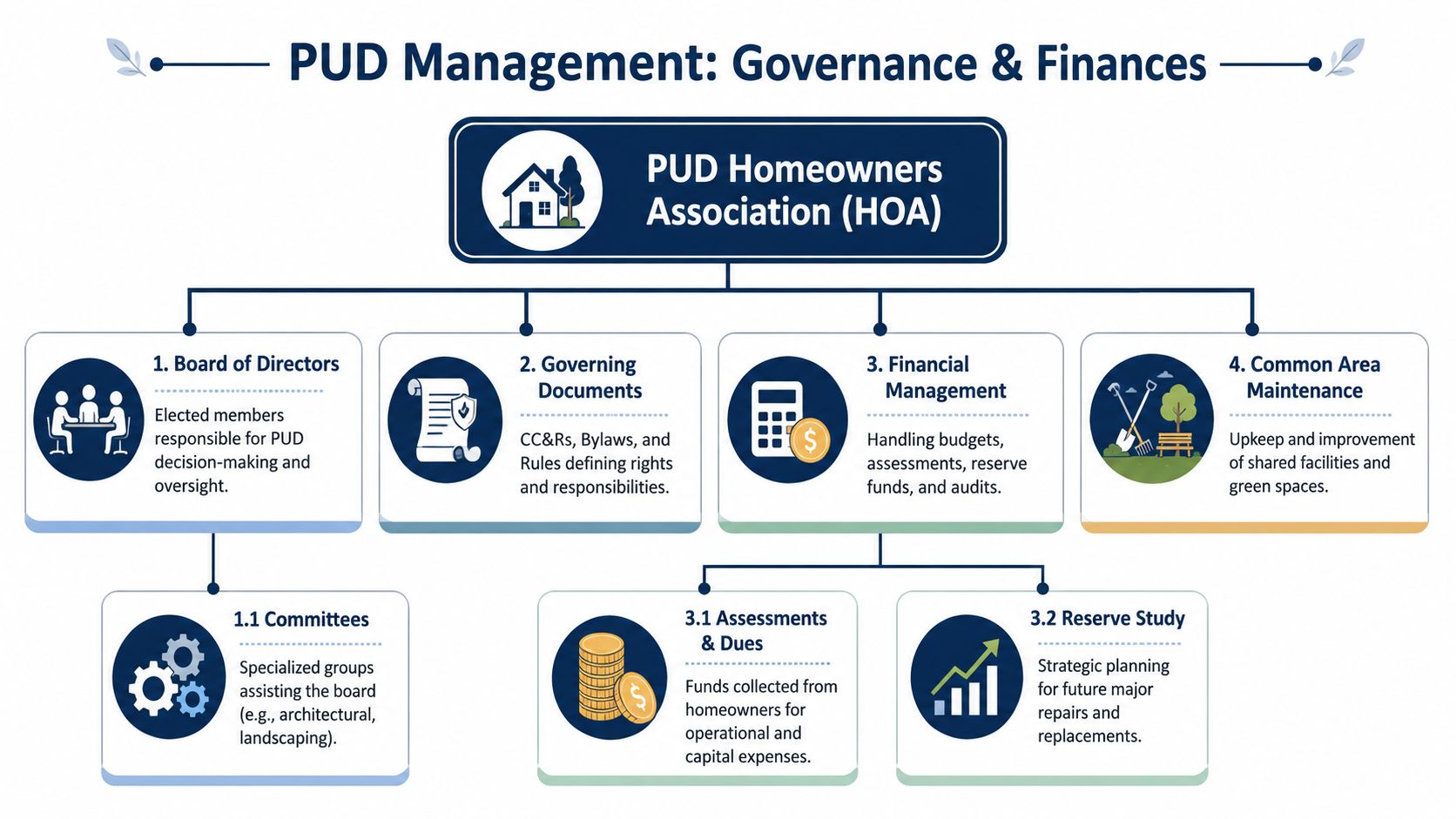
The operational core of a PUD is a mandatory HOA structure that enforces CC&Rs and funds common infrastructure through required dues, as outlined in Rocket Mortgage's explanation of what a PUD is. That collective maintenance model is where boards either build trust or lose it.
Start with the documents
In Georgia, a board needs to know exactly which document controls which decision. Usually that means working from the declaration or CC&Rs, bylaws, rules, plats, easements, and any board policies adopted over time.
If you're new to the role, this guide to HOA board responsibilities is useful because it frames the board's authority as a set of duties, not just powers.
Your first governance checklist should include:
- Maintenance authority. Identify every common element, limited common area, easement, and owner-maintained item.
- Assessment authority. Confirm how regular assessments, special assessments, and collection procedures are authorized.
- Architectural authority. Know where approval power begins and where it ends.
- Enforcement procedure. Follow the due process steps in the governing documents every time.
Build a budget that reflects reality
Many boards treat budgeting as a yearly accounting exercise. In a PUD, that approach is too narrow. Your budget is the operating expression of your maintenance obligations.
If the community has private roads, controlled access, ponds, lighting, perimeter fencing, recreation space, or irrigation, the budget needs to account for routine service and eventual replacement. The board doesn't have the luxury of thinking only one year at a time.
A working budget should separate at least three categories:
| Budget area | What it covers | Why it matters |
|---|---|---|
| Operations | Recurring services such as landscape, utilities, management, and routine repairs | Keeps the community functioning month to month |
| Reserves | Future major repair and replacement needs | Reduces the shock of large capital costs |
| Contingency | Unexpected but legitimate expenses | Gives the board room to respond without panic |
Explain dues like a fiduciary, not a salesperson
Boards lose credibility when they justify assessments by listing amenities only. Owners need to hear the full picture. Dues don't just buy access to a pool or clubhouse. They fund the legal and physical obligations that come with shared infrastructure.
Use plain language in owner communications:
- Private roads need resurfacing
- Entry systems need service contracts and replacement planning
- Streetlights, landscaping, and drainage systems require ongoing spending
- Insurance, legal compliance, and administration are part of keeping the association solvent
A low assessment that doesn't match the community's obligations isn't frugal. It's deferred trouble.
Enforce CC&Rs consistently
Selective enforcement causes more damage than strict enforcement. In Georgia communities, especially those with visible exterior standards, owners pay attention to consistency. If one owner gets cited for an unapproved fence but another doesn't, the issue quickly becomes governance, not aesthetics.
What works is boring, and that's a compliment. Written standards. Documented review. Timely notice. Consistent fines or corrective procedures when authorized. Board minutes that show decisions were made on record, not in the parking lot after the meeting.
PUD Financing and Resale Considerations
Financing questions usually surface when a sale is pending and everyone wants an answer fast. By then, it's late. Boards should understand the PUD's financing profile before lenders, appraisers, and closing attorneys start asking for documents.
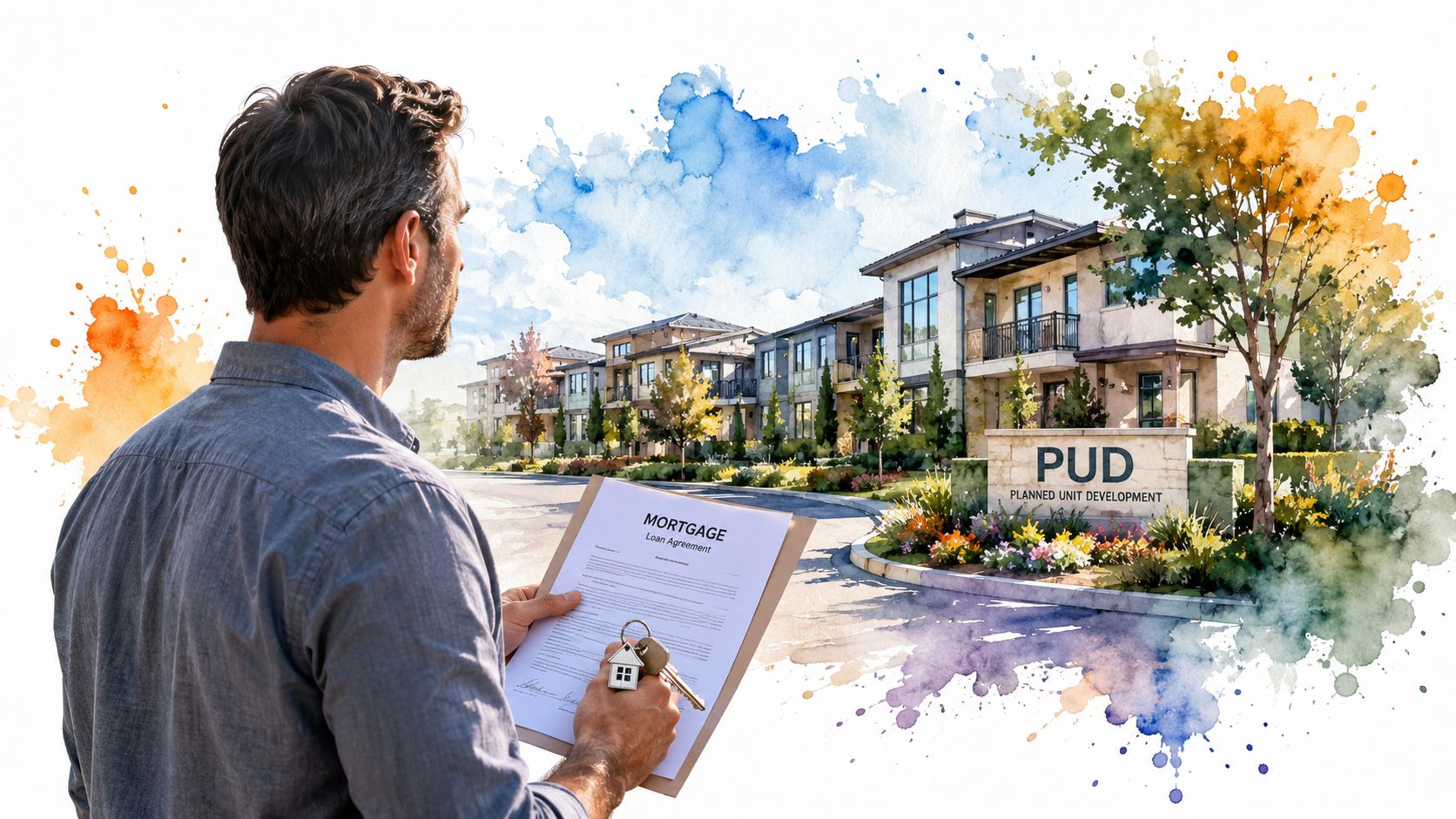
According to CA Builder Services' explanation of planned unit development financing considerations, lenders consider a property a PUD when the owner holds title to both the home and lot under mandatory HOA membership. That same distinction matters because all PUDs have HOAs, but not all HOA-managed communities are PUDs.
Why boards should care about lending questions
A disorganized association can slow sales even when the homes themselves are desirable. Buyers, lenders, and closing professionals want clear records. They may ask about dues, litigation, insurance, governance, common area responsibility, and whether the project is treated as a PUD for underwriting purposes.
This is also where owners often benefit from basic real estate title protection advice so they understand what title insurance does and does not cover in a community with easements, shared obligations, and recorded restrictions.
Resale value isn't just curb appeal
Well-managed PUDs tend to present better in the market because buyers can see the value of maintained amenities, functioning infrastructure, and consistent standards. Poorly managed PUDs show their problems just as clearly. Deferred roadwork, weak collections, neglected entries, and confusing records all raise questions.
For boards, that means resale strength depends on operations:
- Accurate records help closings move with fewer surprises.
- Visible maintenance supports buyer confidence.
- Clear governing practices reduce fear about future conflict.
- Financial discipline signals that the community is not drifting toward emergency decisions.
If your board also fields owner questions about financing distinctions in attached housing, this overview of FHA-approved condo requirements can help clarify why a condo analysis isn't always the right comparison for a PUD.
Navigating PUD Life as a Board Member or Resident
PUD communities run best when people stop treating the association as someone else's problem. That's true for residents and even more true for directors. A board that communicates late, explains poorly, or avoids hard financial conversations almost guarantees owner frustration.
That risk is becoming more visible. A 2025 trend identified by FirstService Residential notes rising HOA fees in PUDs due to costly amenity maintenance, with average increases of 8 to 12 percent annually, and also observes that buyers often miss the shared-responsibility issue until closing, which can trigger disputes later in the process, as described in this article on HOA vs. PUD responsibilities. For boards, that isn't a reason to panic. It's a reason to plan and explain.
What board members should do differently
In Georgia, many associations operate within a legal framework that may include the Georgia Property Owners' Association Act, along with their recorded declaration, bylaws, and adopted rules. Board members should work from counsel-approved documents and avoid making policy by habit or memory.
Strong boards tend to do four things well:
- Communicate before the increase. Don't wait until the annual notice goes out to explain why costs are changing.
- Show the maintenance logic. Owners are more receptive when they can connect assessments to specific obligations.
- Document reserve thinking. Even if the community isn't using advanced reserve planning, the board should still show how it is preparing for future repairs.
- Stay consistent with enforcement. Residents may disagree with a rule, but they react even worse to unpredictable enforcement.
Good governance in a PUD means fewer surprises, not just fewer violations.
What residents need to understand
Residents also have a role. The best homeowner experience in a PUD comes from reading the governing documents early, asking questions before making exterior changes, and treating dues as part of ownership rather than an optional add-on.
A practical resident checklist looks like this:
- Read before you alter. Check architectural rules before painting, fencing, landscaping, or changing exterior fixtures.
- Use the amenities you fund. Engagement increases when owners understand what their assessments support.
- Review budgets and meeting notices. That's where the health of the community is revealed.
- Ask specific questions. “Why did dues go up?” is less helpful than “Which shared assets are driving the increase?”
What doesn't help
Boards and residents both make things worse when they reduce every dispute to personality. Most recurring conflicts in a PUD are structural. People are reacting to unclear boundaries, unclear costs, or unclear expectations.
The fix is rarely dramatic. It's usually better records, better owner education, cleaner enforcement, and more transparent budgeting.
Partnering for a Thriving PUD Community
A PUD brings together two ideas that can pull against each other if the board isn't careful. Owners want the independence that comes with holding title to their homes and lots. The community needs the discipline that comes with shared funding, common maintenance, and enforceable standards.
When those pieces are managed well, a PUD can deliver a strong resident experience and protect long-term real estate value. When they're managed poorly, the same structure creates avoidable friction, funding gaps, and confusion about responsibility.
For Georgia boards, the best results usually come from steady governance, realistic budgets, clean records, and communication that treats homeowners like stakeholders. That's how a Planned Unit Development stops being a confusing real estate term and starts functioning like a healthy community.
If your association needs experienced guidance on governance, budgeting, compliance, and day-to-day operations, Access Management Group helps Georgia HOA and condominium boards protect, preserve, and enhance their communities with professional association management built around the needs of homeowners, board members, and community leaders.