A lot of board presidents meet condo maintenance the hard way. It starts with a resident call before sunrise, then another, then a photo of water coming through a ceiling, an elevator sitting out of service, or a drain backup that has now become a hallway problem instead of a unit problem. By the time the board gets involved, emotions are high, vendors are scrambling, and every decision feels expensive.
That's why good condo maintenance services aren't just operational support. They're part of the board's fiduciary responsibility. A board protects people, preserves the association's assets, and makes sure today's shortcuts don't become next year's special assessment. For homeowners, that means safer living conditions and steadier property values. For the board and the COA president, it means fewer surprises, cleaner decision-making, and a stronger record of stewardship.
The True Cost of Neglecting Condo Maintenance
A neglected building rarely fails in one dramatic moment. More often, it slips. A small roof issue becomes staining in upper-floor units. A recurring elevator shutdown turns into resident complaints, access problems, and pressure on the board. An ignored plumbing warning becomes collateral damage across several homes.
When that happens, the board isn't just dealing with a repair. It's dealing with risk, resident trust, insurance complications, and the question every owner asks after the fact: why wasn't this handled sooner?
What a crisis really costs
Reactive maintenance creates three problems at once:
- Operational disruption: Residents lose normal use of their homes and common areas.
- Financial strain: Emergency calls and rushed decisions usually leave less room for competitive bidding or orderly scheduling.
- Governance pressure: The board has to answer for both the problem and the process.
That's why experienced boards stop treating maintenance as a line item to minimize and start treating it as a control system for the entire property. Professional condo maintenance services help the association document inspections, schedule recurring work, and keep the right vendors accountable before a minor issue becomes board-level damage control.
Practical rule: If the board only talks about maintenance when something breaks, the community is already behind.
That broader shift is happening across the industry. The global building maintenance services market was valued at USD 412.6 billion in 2023 and is projected to reach USD 842.3 billion by 2032, reflecting a move toward specialized firms that can deliver greater efficiency and cost savings than in-house management, according to DataIntelo's building maintenance services market report.
Why boards need a risk mindset
A new board president often inherits unfinished work, deferred decisions, and resident expectations that weren't set clearly. The worst response is to chase the loudest complaint while ignoring the systems that hold the building together.
The better response is to ask a different question: what failures would most seriously affect safety, livability, and property value if they happened tomorrow? That question leads to a maintenance program instead of a repair list.
Understanding the Scope of Maintenance Services
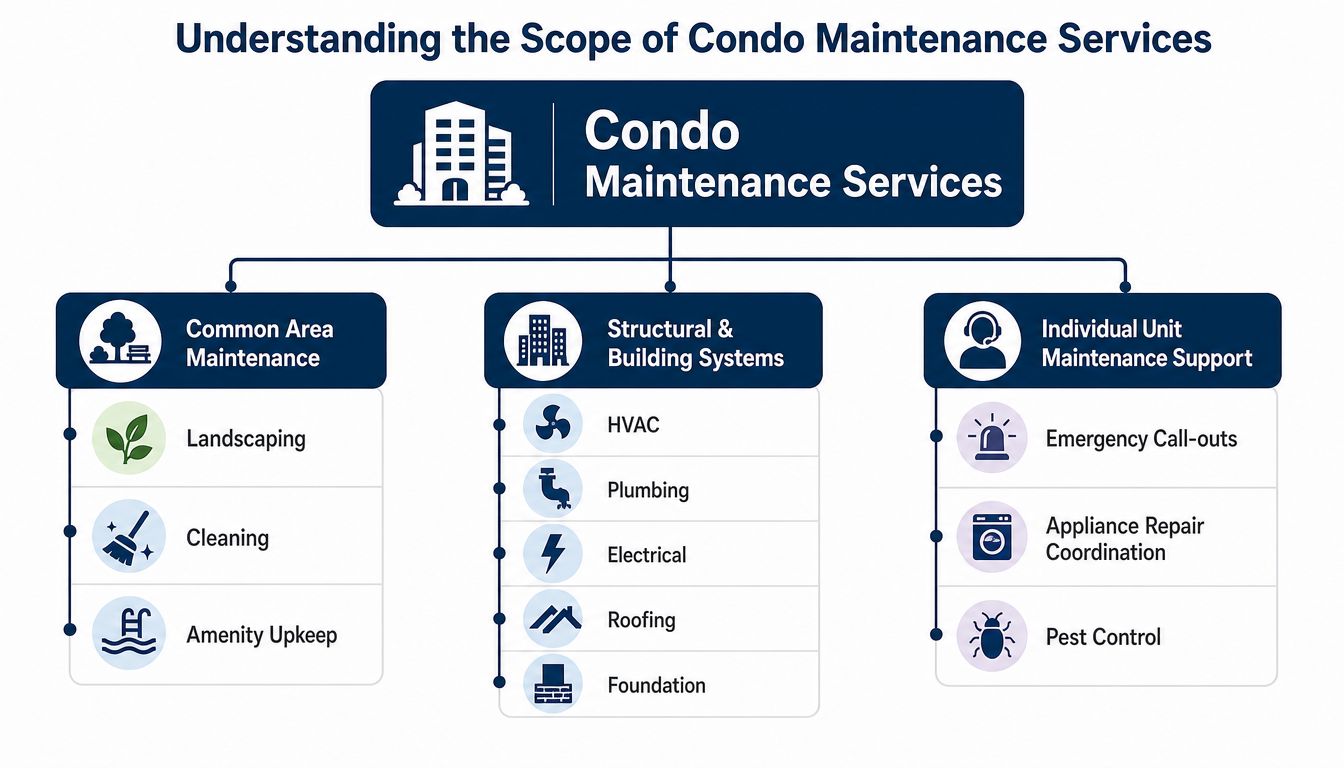
Most new board members hear “maintenance” and think janitorial work, landscaping, and fixing things that residents can see. That's only part of it. A condominium operates more like a body than a single appliance. If the skin fails, water gets in. If the circulation systems fail, comfort and function suffer. If the structural frame is neglected, every other problem gets more expensive.
Condo associations are responsible for maintaining common areas and shared systems, including exterior walls, roofs, building foundations, stairwells, plumbing, HVAC, and electrical systems serving multiple units, plus amenities such as pools and gyms and private roads or parking lots, as outlined by All Property Management's explanation of HOA repair responsibilities.
Common area work
This is the maintenance residents notice first because they walk through it every day. Clean lobbies, safe lighting, elevator cab upkeep, trash room sanitation, clubhouse care, gate function, and pool-area cleanliness all shape how owners judge the association.
Common area service usually includes:
- Cleaning and appearance: Hallways, entry glass, floors, restrooms, and shared amenity spaces.
- Grounds care: Landscaping, irrigation checks, tree trimming, and seasonal cleanup.
- Amenity upkeep: Fitness rooms, pools, mail areas, and access control points.
Poor performance here doesn't always create catastrophic damage, but it sends a message that the board is behind. That perception matters.
Structural and building systems
Experienced board leadership stands apart from reactive governance. The building envelope, roof, drainage, windows, waterproofing, and foundation protect every unit, not just the common areas. Plumbing risers, shared electrical infrastructure, central HVAC components, fire systems, and elevators are the working systems that keep the property habitable.
Boards should expect condo maintenance services to include regular inspection, documentation, contractor coordination, and follow-up for these categories, not just repair dispatch.
A practical example is plumbing. A board may not need a full building-wide plumbing overhaul today, but it does need a plan for recurring trouble spots, isolation procedures, and preventive checks in vulnerable areas. This kind of thinking is why resources on preventative plumbing for Las Vegas rentals can be useful beyond rentals. The principle is the same in a condominium. Small plumbing issues don't stay small when units are stacked vertically.
Individual unit support that still affects the association
The association doesn't own what's inside every wall, but unit-level issues often spill into common-element responsibility. Emergency call-outs, leak tracing, pest-control coordination, and access management for repairs often sit in the gray zone between private ownership and association impact.
Good condo maintenance services don't just fix systems. They help the board understand which systems are shared, which are private, and where one owner's delay becomes everyone's problem.
Defining Association vs Owner Responsibilities
Nothing creates more friction in a condominium than a blurry responsibility line. Residents often assume the association should handle whatever's causing inconvenience. Boards sometimes assume anything inside a unit belongs entirely to the owner. Both assumptions can create avoidable disputes.
In practice, the division is usually more straightforward. The association is responsible for common elements and shared systems. Owners handle what's inside their unit walls, including appliances, finishes, fixtures, and unit-specific components. The challenge isn't the concept. The challenge is applying it consistently when water, air, or wiring crosses boundaries.
Condo maintenance fees average $100 to $600+ monthly, covering the association's legal responsibility for common elements like exterior walls, roofs, and hallways, while unit owners handle interior maintenance. That division matters because delayed owner maintenance can lead to collateral damage that becomes a COA issue, as noted in this overview of condo owner maintenance responsibilities.
The line that boards should enforce
A useful starting point is the practical “within the walls” rule, but boards shouldn't stop there. They need to compare resident assumptions against the declaration, bylaws, insurance language, and maintenance matrix the association uses.
For many communities, the clearest way to reduce conflict is to publish a simple reference guide and direct owners to resources that explain what an HOA may cover in real-world terms.
Maintenance Responsibility Checklist Association vs Unit Owner
| Component / Area | Association Responsibility (Common Element) | Unit Owner Responsibility (Inside the Unit) |
|---|---|---|
| Roof | Yes | No |
| Exterior walls | Yes | No |
| Hallways and stairwells | Yes | No |
| Foundations | Yes | No |
| Shared plumbing lines serving multiple units | Yes | No |
| Shared HVAC or electrical systems serving multiple units | Yes | No |
| Parking lots or private roads | Yes | No |
| Unit appliances | No | Yes |
| Interior flooring | No | Yes |
| Interior fixtures | No | Yes |
| Plumbing serving only the unit | No | Yes |
| Electrical components serving only the unit | No | Yes |
Where boards get into trouble
The biggest mistakes usually look like this:
- Informal exceptions: A board covers an owner expense once “to be helpful,” then struggles to explain why it won't do so again.
- No written maintenance matrix: Managers and directors answer based on memory instead of governing documents.
- Slow response to owner neglect: A unit leak or fixture failure is left alone until neighboring units are affected.
If responsibility is unclear during a crisis, the board should stabilize the situation first and document responsibility second. Delay the paperwork if necessary. Don't delay damage mitigation.
Consistency protects everyone. It protects homeowners from arbitrary treatment, the board from claims of uneven enforcement, and the association from paying for work it never owed in the first place.
The Power of a Preventive Maintenance Mindset
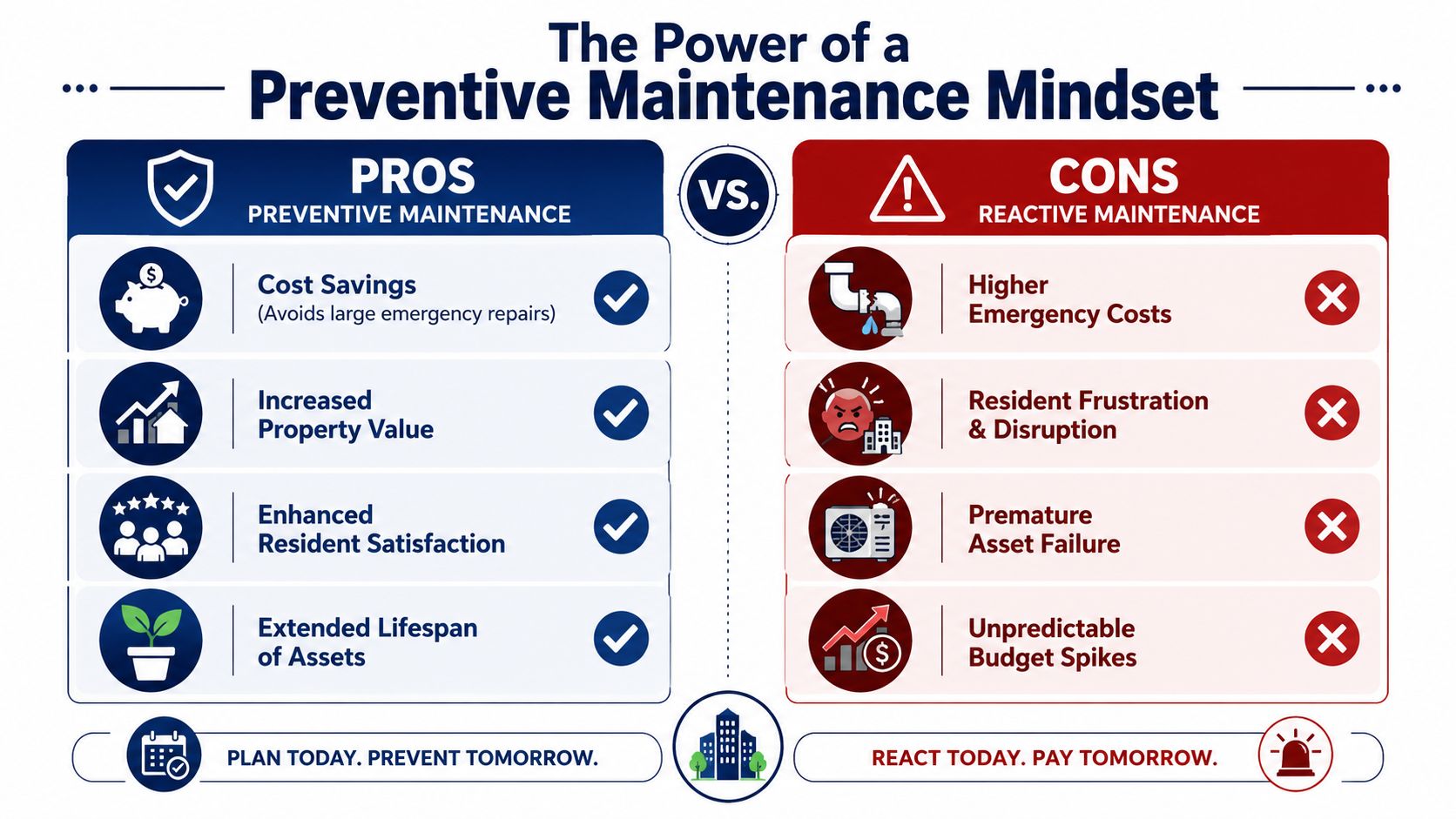
Boards that rely on reactive repairs usually think they're saving money right up until the emergency invoice arrives. A preventive mindset changes the board's timing. Instead of waiting for failure, the association schedules inspections, service intervals, and replacements around known risks.
That approach is less dramatic, which is exactly why it works.
A predictive annual maintenance plan that prioritizes high-risk components such as roof systems and elevators based on past inspection reports can prevent structural failures that are 3 to 5 times more costly later, according to FirstService Residential's guidance on annual maintenance planning.
What preventive maintenance actually looks like
Preventive maintenance isn't just “doing more.” It means the board places recurring attention on systems that can create disproportionate damage if they fail.
That usually includes:
- Water management: Roof drains, plumbing risers, sump systems, sealants, and leak-prone transitions.
- Vertical transportation: Elevator inspections, service logs, shutdown response, and code-related follow-up.
- Life safety systems: Fire and smoke components, access routes, and contractor testing schedules.
- Mechanical assets: Shared HVAC equipment, pumps, motors, and ventilation components.
This mindset also changes board conversations. Instead of asking, “Can this wait?” the better question is, “What's the risk of waiting?”
What doesn't work
Some boards approve preventive work in theory but undermine it in practice. They postpone inspections, decline routine service because nothing looks broken, or approve patchwork repairs without asking what caused the issue in the first place.
Those choices create a false economy.
A roof leak isn't just a roof problem. It can become drywall work, flooring damage, mold remediation, insurance coordination, owner complaints, and a records issue when the board is asked why repeat warnings were ignored. Preventive thinking reduces those chains of failure.
A healthy maintenance program should feel boring most of the time. That's a sign the board is controlling the property instead of being controlled by it.
Budgeting for Maintenance and Your Reserve Fund
A board president usually feels the pressure when two bills hit at once. The chiller needs a major repair in July, and the roof consultant says the association cannot postpone replacement planning any longer. If the budget treats all maintenance dollars the same, the board ends up choosing between cash flow stress, a special assessment, or another deferral that raises risk.
That is why maintenance budgeting is a governance issue, not just an accounting exercise. The operating budget keeps the property functioning month to month. Reserve funding protects the association from predictable capital costs that can destabilize owner finances and depress confidence in the community.
Build the operating budget from actual service demands
Start with the building you have, not last year's totals with a percentage added. Review recurring contracts, inspection schedules, common trouble spots, seasonal work, and service patterns from the past 12 to 24 months. A property with older domestic water lines, frequent elevator callbacks, or drainage issues needs a different operating budget than a newer community with fewer shared systems.
The budget should also reflect how maintenance is administered. Many management agreements charge separate fees for supervising larger repair work or coordinating vendors beyond ordinary service calls. The exact structure varies, so boards should read the management contract line by line and ask how after-hours calls, project oversight, and emergency coordination are billed before adopting the budget.
Response standards belong in this discussion too. Fast emergency response has a cost, whether that comes through on-site staffing, management coverage, or vendor standby rates. If the board expects immediate action on leaks, access failures, or life-safety issues, the budget needs to support that expectation.
Reserve funding shows whether the board is planning or reacting
Reserve contributions should be based on the remaining life and replacement cost of common elements, not on what feels affordable this year. Roof systems, boilers, paving, waterproofing, fire panels, and elevator modernization are all foreseeable obligations. The timing may shift. The expense itself rarely disappears.
A useful starting point is a reserve study and a clear understanding of your governing standards for condo reserve fund requirements. That gives the board a defensible basis for contribution levels and helps explain to owners why steady funding is usually cheaper than deferred funding followed by special assessments or emergency borrowing.
The old 1% rule shows up often in property maintenance discussions, but condo boards should treat it as a rough screening tool, not a reserve policy. Associations are responsible for shared assets with different life cycles, construction types, and exposure conditions. A reserve study tied to the actual components on site is the better fiduciary approach.
A budgeting framework boards can use
Use a clear split when reviewing maintenance dollars:
- Operating budget: Janitorial service, landscaping, recurring inspections, routine vendor visits, minor repairs, and seasonal upkeep.
- Reserve fund: Major replacements and infrequent capital work such as roofing, paving, waterproofing, elevator upgrades, and central mechanical equipment.
- Contingency planning: A modest buffer for unplanned but likely events, especially in older communities where one failure can expose a second problem.
- Review cadence: Update assumptions when system condition changes, major bids come in high, or repeated repairs suggest a component is nearing the end of its useful life.
Boards can also borrow practical budgeting discipline from adjacent property types. Advice on maintenance strategies for Flagstaff homes is geared to single-family properties, but the lesson carries over. Climate, exposure, and recurring upkeep shape long-term costs, and deferred work usually returns later at a higher price.
Board test: If a common-element expense is predictable, the association should have already decided where it belongs, operating budget, reserves, or contingency. If that answer is unclear, the board still has budget work to do.
How to Select and Manage Maintenance Vendors
A maintenance plan only works if the association has vendors who can perform reliably, document clearly, and respond within the expectations the board has approved. Too many communities focus on getting bids and skip the harder part, which is managing vendor performance after the contract is signed.
The board is responsible for managing the condo building and setting rules, while property managers are hired to coordinate maintenance, hire contractors, and manage budgets. Those roles need clear communication to define who does what on specific projects, as described by Hales Property Management's overview of board and management responsibilities.
What to verify before award
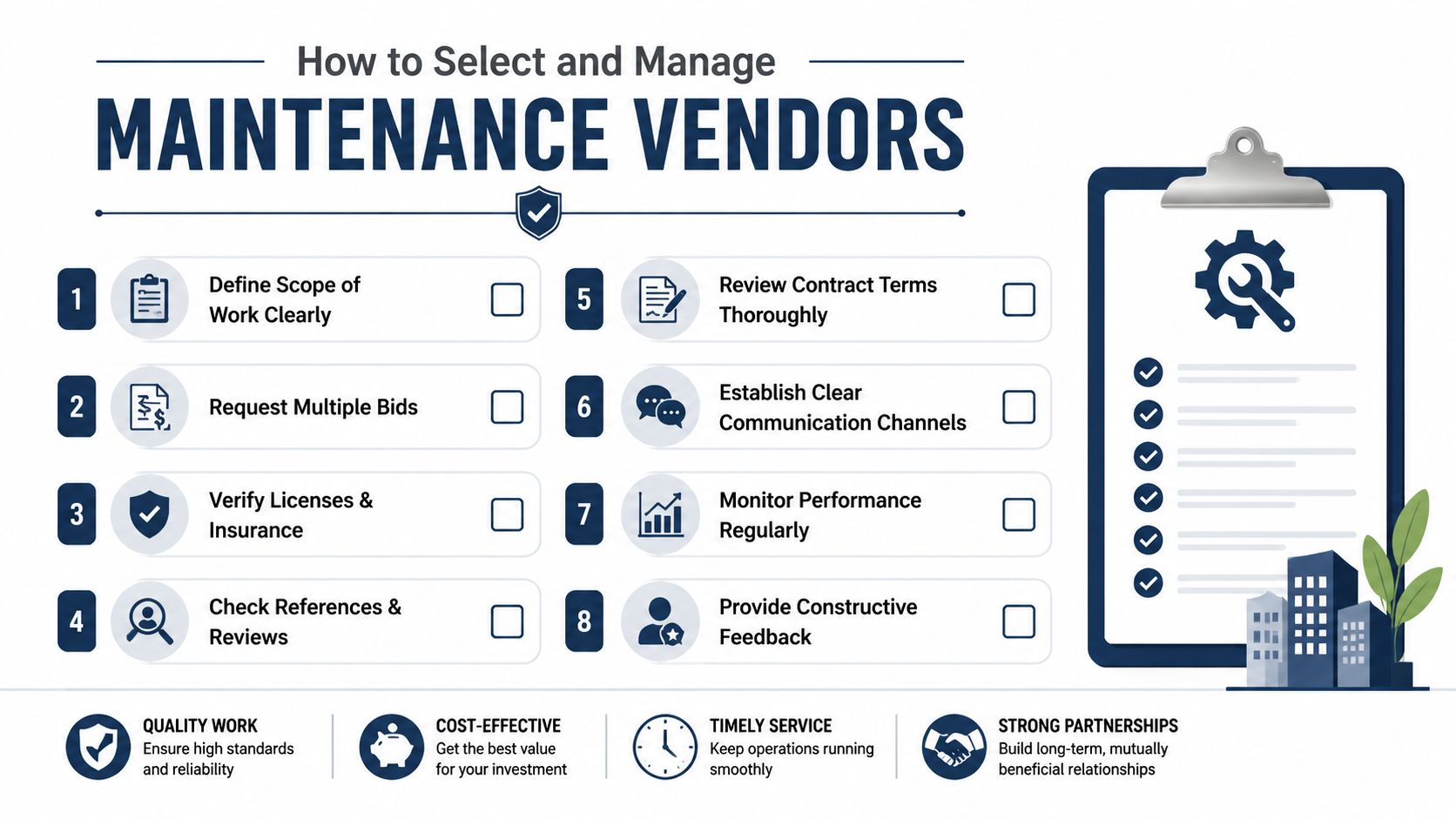
A low bid isn't a maintenance strategy. It's just a number. The board or manager should confirm that the vendor can perform the work under condominium conditions, which often means resident access, noise limitations, insurance requirements, and documentation standards.
Review these items before approval:
- Licensing and insurance: Confirm the trade license, general liability coverage, and worker-related coverage required by the association's standards.
- Scope clarity: The proposal should say exactly what is included, excluded, and assumed.
- Relevant references: Ask about similar communities, not just any property.
- Site logistics: Confirm how the vendor will access units or controlled areas, protect common surfaces, and communicate disruptions.
For boards that want a structured approach to larger projects, maintenance and construction coordination should include bid comparison, scope review, contractor oversight, and closeout documentation.
How the board and manager should divide the work
Often, communities either micromanage or disengage. Neither works well.
The board should set expectations, approve material decisions, and hold the management side accountable for reporting. The manager should coordinate the actual workflow, including scheduling, resident notices, site meetings, invoice review, and follow-up with contractors. If one side assumes the other is handling details, details get missed.
One property management option in this space is Access Management Group, which provides general property maintenance services for condominium associations, from routine upkeep to renovation and construction-related coordination. That kind of support can be useful when the board needs an operational layer between vendor activity and board oversight.
Manage vendors after the contract starts
The contract award is the beginning of accountability, not the end of it. Strong vendor management usually includes:
- Written service standards: Response expectations, reporting format, and escalation contacts.
- Field verification: Someone should confirm the work matches the invoice and the approved scope.
- Resident communication: Owners should know when access is needed, what areas are affected, and who to contact with issues.
- Performance review: Repeat delays, incomplete punch items, and recurring callbacks should affect future assignments.
A vendor who communicates well and documents thoroughly is often less expensive in the long run than a cheaper contractor who creates confusion for residents and rework for management.
Building Your Master Maintenance Schedule and Emergency Plan
A good maintenance program becomes real when it's on a calendar. Without that, even conscientious boards end up relying on memory, vendor reminders, and resident complaints to decide what happens next. That's not a system. It's drift.
The board should maintain one master schedule for recurring work and one emergency plan for disruptions. Those documents should be practical enough for a manager to use on a busy day and clear enough for a new director to understand without verbal history.
What belongs on the master schedule
The schedule should group tasks by frequency and by system. It doesn't need to be elaborate. It needs to be current.
A simple structure often works best:
- Daily tasks: Lobby checks, entry cleanliness, trash area review, lighting outages reported by staff or residents.
- Weekly tasks: Amenity inspections, sanitation checks in shared spaces, grounds review, irrigation observations.
- Monthly tasks: Fire extinguisher checks, elevator log review, plumbing trouble-spot review, access control testing.
- Quarterly tasks: HVAC filter changes for shared equipment, drain line review, exterior walk-throughs, vendor performance check-ins.
- Annual tasks: Roof inspection, gutter or drainage review, reserve project planning, contract renewals, policy and procedure review.
How to turn the schedule into a working tool
The schedule has to answer five questions clearly:
| Question | What the board should define |
|---|---|
| What is being maintained? | The specific system, area, or asset |
| How often? | The service interval |
| Who is responsible? | Vendor, manager, staff, or board follow-up |
| What documentation is required? | Photos, service logs, inspection forms, invoices |
| What triggers escalation? | Safety issue, repeated failure, resident impact, budget concern |
This is also where contract language matters. Landscaping is a good example. If the contract says “maintain grounds,” everyone will interpret that differently. If it defines mowing, trimming, debris removal, seasonal expectations, and response for storm cleanup, the board has something enforceable. For directors reviewing or tightening those expectations, the R.E. and Sons guide to contracts is a useful example of how clearer maintenance language leads to fewer disputes.
Build an emergency plan before you need one
Emergency planning should sit next to the maintenance calendar, not somewhere else in a forgotten binder. Water intrusion, elevator failure, fire system issues, storm damage, and security failures all require fast coordination.
At minimum, the plan should include:
- Priority vendor contacts: Plumbing, electrical, elevator, restoration, roofing, security, and after-hours management contacts.
- Authority levels: Who can approve emergency work, up to what threshold, and when the board president must be notified.
- Resident communication templates: Short notices for email, text, or posting so updates go out quickly and consistently.
- Access procedures: How to enter common spaces, mechanical rooms, or units when urgent mitigation is needed.
- Documentation protocol: Photos, timeline notes, vendor arrival times, owner notices, and incident logs.
In an emergency, residents don't expect perfection. They expect visible control, fast communication, and a board that knows who is doing what next.
The board president's practical checklist
If you're a new board president, start here:
- Confirm the association's responsibility matrix is written and current.
- Ask for the active vendor list with licenses, insurance, and emergency contacts.
- Review the maintenance calendar by system, not just by vendor.
- Check whether recurring problem areas are being tracked, not just repaired.
- Make sure resident communication templates exist before the next incident.
That's how condo maintenance services move from scattered tasks to a real governance function. Homeowners benefit first because the property is safer, better maintained, and less vulnerable to costly surprises. The board benefits because decisions become more consistent and defensible. The association benefits because long-term value is protected by discipline, not luck.
If your board wants a more organized approach to maintenance planning, vendor coordination, reserve awareness, and day-to-day community operations, Access Management Group works with condominium and homeowner associations to help protect, preserve, and enhance their real estate investments through professional community association management.