A lot of boards reach the rental issue at the same point. The meeting starts with routine business, then the conversation turns. Owners are upset about short-stay guests dragging luggage through the lobby at odd hours. A few directors have noticed more leasing signs. Someone asks whether investors are buying up homes. Someone else asks whether the board can just ban rentals.
That's usually when the room splits. Some owners want strict controls immediately. Others see any restriction as an attack on property rights. Both sides are reacting to real concerns.
Rental policy works best when the board treats it as community governance, not punishment. Good hoa rental restrictions protect owner expectations, preserve marketability, and reduce avoidable conflict. Poorly designed restrictions do the opposite. They trigger disputes, create uneven enforcement, and leave management trying to fix a rule that was never operationally sound.
Navigating the Rental Restriction Conversation
New board members often inherit this issue after tension has already built. By then, the community isn't debating theory. It's dealing with day-to-day friction. Residents complain that new tenants don't know the parking rules. Owners ask why the board allowed another lease when the neighborhood already feels less stable. A president wants to know whether the association can stop short-term rentals before the next holiday weekend.
Those questions deserve direct answers, but they also need context. Hoa rental restrictions sit at the intersection of owner rights, document authority, lender expectations, and practical enforcement. If a board focuses only on stopping a nuisance, it may adopt a rule that sounds strong and fails in practice. If it focuses only on fairness, it may avoid action until the community has no clear standard at all.
What boards are really managing
The primary task isn't just deciding whether rentals are good or bad. The job is deciding how the association wants the community to function.
A board usually needs to sort through issues like these:
- Resident stability: Frequent turnover can make rule compliance harder and reduce owner engagement.
- Operational strain: Management has to track leases, collect paperwork, and respond to violations.
- Buyer perception: Prospective purchasers pay attention to whether the community feels owner-occupied or investor-driven.
- Legal exposure: A restriction that isn't properly adopted or consistently enforced can create more risk than it solves.
Practical rule: If the board can't explain who tracks leases, who approves paperwork, and what happens when the cap is full, the policy isn't ready.
Boards make better decisions when they stop asking, “Should we restrict rentals?” and start asking, “What problem are we solving, and what system can we administer?”
Why HOAs Must Strategically Manage Rentals
A board usually feels the pressure around rentals after a problem surfaces. An investor buys two units. Owners start asking whether values will drop. A lender questionnaire raises concerns about occupancy levels. Management is left answering urgent questions with no clear policy, no lease records, and no agreed threshold for action.
That is why rental policy has to be treated as an operating issue, not just a reaction to complaints. Boards are managing buyer financing, resale appeal, administrative workload, and the long-term character of the community at the same time.
The financial reasons usually come first
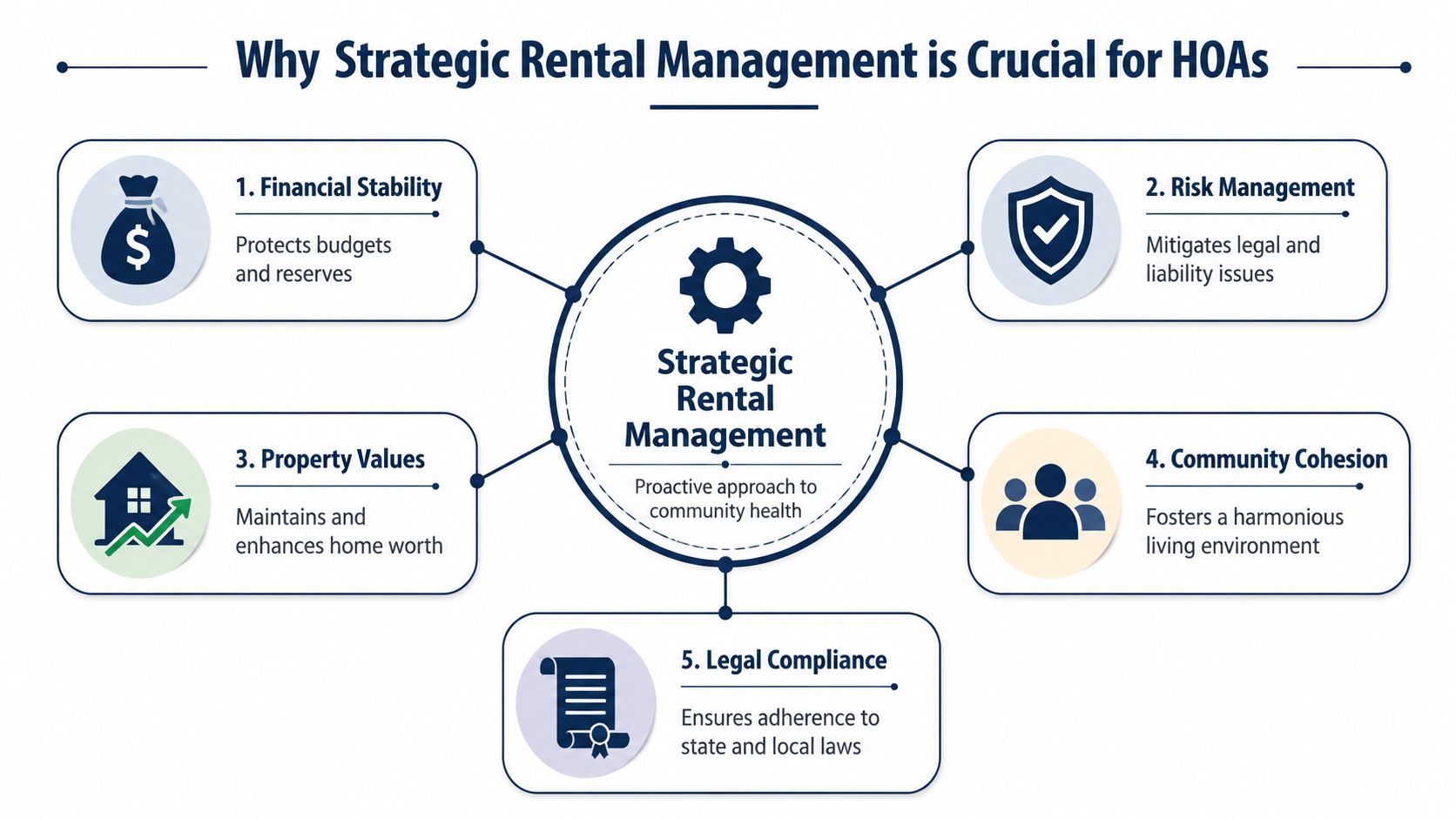
In practice, rental concentration affects the marketability of the whole association. Many boards focus on conduct issues first, but the more durable concern is whether the community remains attractive to buyers and acceptable to lenders. Once a community gains a reputation as heavily investor-owned, that perception can be hard to reverse.
Boards should evaluate at least four financial pressure points:
- Financing access: Some loan programs and lender reviews become more difficult when rental levels rise beyond the range the market considers owner-occupied enough.
- Resale demand: A smaller financing pool can shrink the number of qualified buyers and slow sales.
- Budget behavior: Owners who live on site often participate differently in reserve planning, maintenance priorities, and annual meetings than absentee owners.
- Assessment resilience: Communities already facing major capital projects have less room for avoidable market pressure. Boards dealing with reserve shortfalls or a special assessment real estate issue should be careful about policy choices that may further limit financing or buyer demand.
That does not mean tenants are the problem. It means concentration is the problem boards must monitor.
A well-run association watches rental levels the same way it watches delinquencies, reserve funding, and insurance renewals. All four affect stability.
Rentals also test the board's governance discipline
A restriction that looks strong on paper can fail fast in administration. I have seen boards adopt lease limits without deciding who maintains the roster, how owners claim hardship exceptions, what documents tenants must receive, or how the board verifies move-in dates. The result is predictable. Owners challenge the process, managers improvise, and enforcement becomes uneven.
Good rental policy is specific enough to administer. It assigns tasks, deadlines, records, and consequences. It also accounts for turnover on the board, because a rule that only works when one knowledgeable director is in office is not a good rule.
That is where a trained manager adds value. A community association manager who handles compliance and owner communication can turn broad policy into repeatable procedures such as lease registration, deadline tracking, tenant notices, and violation follow-up.
Boards that manage rentals strategically are protecting three groups at once. Current resident owners. Owners who may need to lease because of a job move, military service, or family change. Future buyers who will judge the community by its records, its rules, and how consistently those rules are enforced.
The primary goal is control, fairness, and predictability. That is how boards protect property values and reduce conflict at the same time.
Understanding the Types of Rental Restrictions
A board meeting usually reaches this point after a specific trigger. An investor buys two units. A resident complains about weekend turnover. A lender questionnaire shows rising tenant occupancy. The mistake is treating all of those problems with the same rule.
“Rental restrictions” is a broad label for several different policy tools. Each one controls a different part of the leasing process. Boards get better results when they choose the restriction that fits the operational problem, then build procedures around it. The association's governing documents and amendment authority determine which tools are available, but the board still has to decide how those tools will work in practice.
Rental caps
A rental cap limits the number or percentage of homes that may be leased at one time. This tool is used to control rental concentration, protect financing options, and avoid a fast shift from owner-occupied community to investor-heavy community.
Caps only work if the board answers the administrative questions before enforcement starts. Who gets the next available slot. Whether priority goes by application date, purchase date, or hardship status. Whether a leased unit keeps its place after a tenant moves out. How long a unit can sit vacant before it loses the slot. If those answers are unclear, owners will challenge the process, and they usually have a fair point.
Boards should also be realistic about what a cap will not do. It will not fix a nuisance issue by itself. It will not screen out every bad tenant. It will not stop conflict if the association cannot maintain a current lease roster and a documented waitlist.
Lease term restrictions
Lease term restrictions address turnover and occupancy pattern. They do not control total rental volume. A minimum lease term can reduce frequent move-ins, amenity abuse, and the feel of a revolving door, while still allowing owners to lease their homes.
This category matters most in communities trying to separate ordinary leasing from short-term or vacation-style use. For example, California Civil Code section 4741 limits how associations regulate rentals while still allowing restrictions on shorter stays, as explained in LS Carlson Law's review of HOA rental rules and owner rights. For boards in tourism-driven markets, that distinction can affect both enforcement strategy and owner expectations. Anyone comparing community rules with buyer demand in historic destinations may also want this essential guide for STR investors.
Drafting matters here. “Residential use only” is often too vague to manage day to day. A stated minimum term, clear renewal rules, and a definition of prohibited transient occupancy give management something concrete to verify.
Specific lease terms are easier to explain, document, and enforce.
Approval and registration requirements
Some communities need visibility more than limits. Lease registration and tenant acknowledgment requirements give the board that visibility.
These policies usually require the owner to submit the lease, tenant contact information, vehicle details if parking is assigned, and proof that the tenant received the rules. That gives management a record for move-ins, access devices, emergency contact, amenity privileges, and violation notices. It also reduces the common excuse that a tenant never received the association's rules.
Board approval requirements fall in this same category, but they need careful drafting. If the documents allow approval, the standard should be objective and tied to document compliance. Open-ended approval language creates avoidable disputes.
Comparison of common HOA rental restrictions
| Restriction Type | Primary Goal | Common Example |
|---|---|---|
| Rental cap | Control total rental concentration | Limit rentals to a recorded percentage of total units |
| Minimum lease term | Reduce turnover and transient occupancy | Require leases of 30 days or longer |
| Short-term rental ban | Prevent hotel-style use | Prohibit rentals of 30 days or less where allowed |
| Lease registration | Improve oversight and enforcement | Require lease copies and tenant contact details |
| Tenant rule acknowledgment | Improve rule compliance | Require tenants to sign receipt of community rules |
| Board approval process | Review compliance before occupancy | Require application submission before lease start |
Strong communities rarely rely on a single restriction. They combine the right tools for their goals, write them clearly, and set up a process the manager and future boards can maintain.
The Legal Framework for Your Rental Policies
A board can't enforce what it doesn't have authority to adopt. That's the first legal principle to remember. If rental restrictions aren't grounded in the declaration, recorded amendments, and applicable state law, the board is operating on hope.

Most communities start with their declaration or CC&Rs. If the documents don't already authorize the restriction, the board usually has to pursue a formal amendment using the approval process required by those documents and state law. That means owner votes, recorded amendments, and careful drafting.
For boards that need a refresher on where authority sits, a practical starting point is understanding the association's governing documents. Rental policy disputes often happen because someone relied on board-made rules when the declaration required something stronger.
State law can change the answer
Florida is a useful example because it shows how state law can limit an association's reach even after an amendment is passed. Under Florida Statute 720.306(1)(h), amendments adopted after July 1, 2021 that prohibit or regulate rentals generally bind only owners who bought after the amendment took effect or who consented. Existing non-consenting owners are generally grandfathered. The same framework also provides that restrictions on rental terms of 6 months or less and limits of 3 or fewer rentals per calendar year can apply to all owners, as summarized in TrueNorth's analysis of Florida HOA rental restrictions.
That matters because one community can end up with different rental rights attached to different owners. The board may have to track who is grandfathered, who consented, and who bought after the amendment date. That's not a side issue. It's central to enforcement.
Precision matters more than broad intent
Boards sometimes assume a general residential-use clause will support a rental restriction. Courts don't always agree. A defensible policy usually has three features:
- Clear recorded authority
- Specific rule language
- Procedural compliance from adoption through enforcement
This is also where short-term rental debates become especially sensitive. Owners who are considering that market often read investor-focused material long before they review association documents. A board that wants to avoid conflict should communicate early and plainly. Material aimed at hosts and buyers, like this essential guide for STR investors, shows how active that market remains. That makes recorded restrictions and direct disclosure even more important.
If the board wants the rule to hold up, it needs more than good intentions. It needs document authority, exact language, and a clean record of adoption.
Balancing the Pros and Cons for Your Community
Rental restrictions can help a community. They can also frustrate owners and create real administrative work. Good boards acknowledge both sides openly.
The best discussions don't start with “rentals are the problem.” They start with “what outcome are we trying to protect?” In one community, that may be financing stability. In another, it may be reducing short-stay turnover. In a third, the right answer may be a registration system instead of a cap.
Where restrictions help
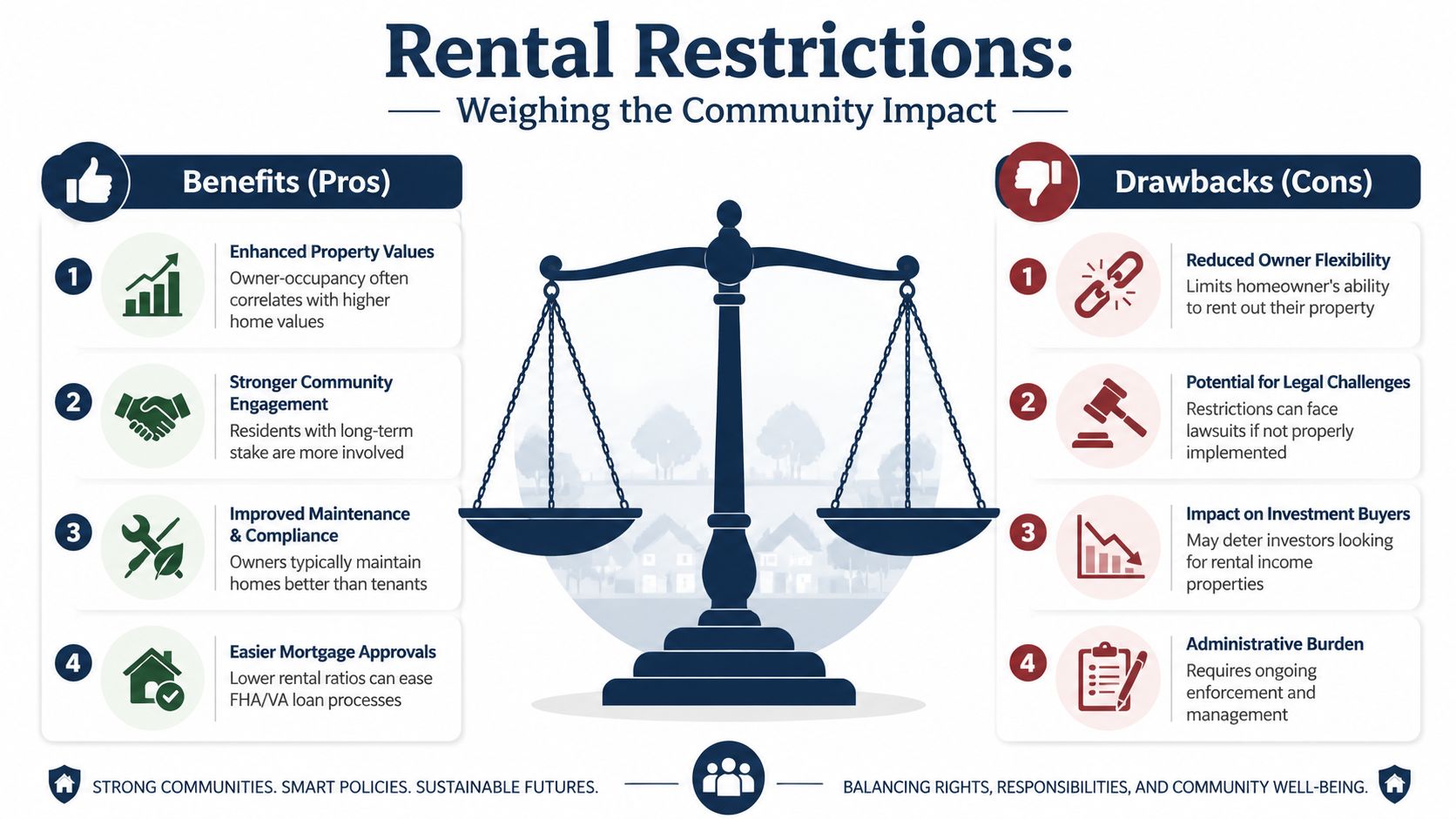
Boards usually see several advantages when policies are drafted and enforced properly.
- Stronger owner-occupancy profile: Many buyers prefer communities that feel stable and residential.
- Less turnover pressure: Fewer move-ins and move-outs can reduce strain on parking, elevators, amenities, and common areas.
- Better rule communication: Registered leases make it easier to identify who is living in the property and who needs compliance notices.
- Clearer expectations: Owners know in advance whether leasing is unrestricted, capped, delayed, or term-limited.
There's also a practical culture benefit. Communities with fewer surprises tend to have fewer arguments. That alone can improve board meetings.
Where restrictions create problems
The downsides are real and should be discussed without sugarcoating them.
- Reduced owner flexibility: An owner who needs to relocate or hold a property temporarily may feel boxed in.
- More administration: Someone has to maintain records, track lease dates, monitor turnover, and answer challenges.
- Potential enforcement disputes: If exceptions are granted casually, owners will claim unequal treatment.
- Narrower investor appeal: Some buyers won't purchase in a heavily restricted association.
A rule that protects the community but is impossible to administer will eventually hurt the community anyway.
A practical way to weigh the decision
Boards usually make better choices when they compare the policy to the community's actual needs, not to someone else's documents.
Ask questions such as:
| Consideration | If the answer is yes | Likely policy response |
|---|---|---|
| Is short-stay turnover the main problem | Focus on lease term limits | Minimum lease term or short-term rental prohibition |
| Is investor concentration the concern | Focus on quantity | Recorded rental cap with tracking |
| Are rules being violated because tenants aren't informed | Focus on process | Lease registration and tenant acknowledgment |
| Does the board lack capacity for complex enforcement | Keep the system simple | Fewer exceptions and straightforward procedures |
A board that walks through this analysis can defend its decision whether it adopts tighter restrictions or decides not to.
How to Implement and Enforce Rental Policies
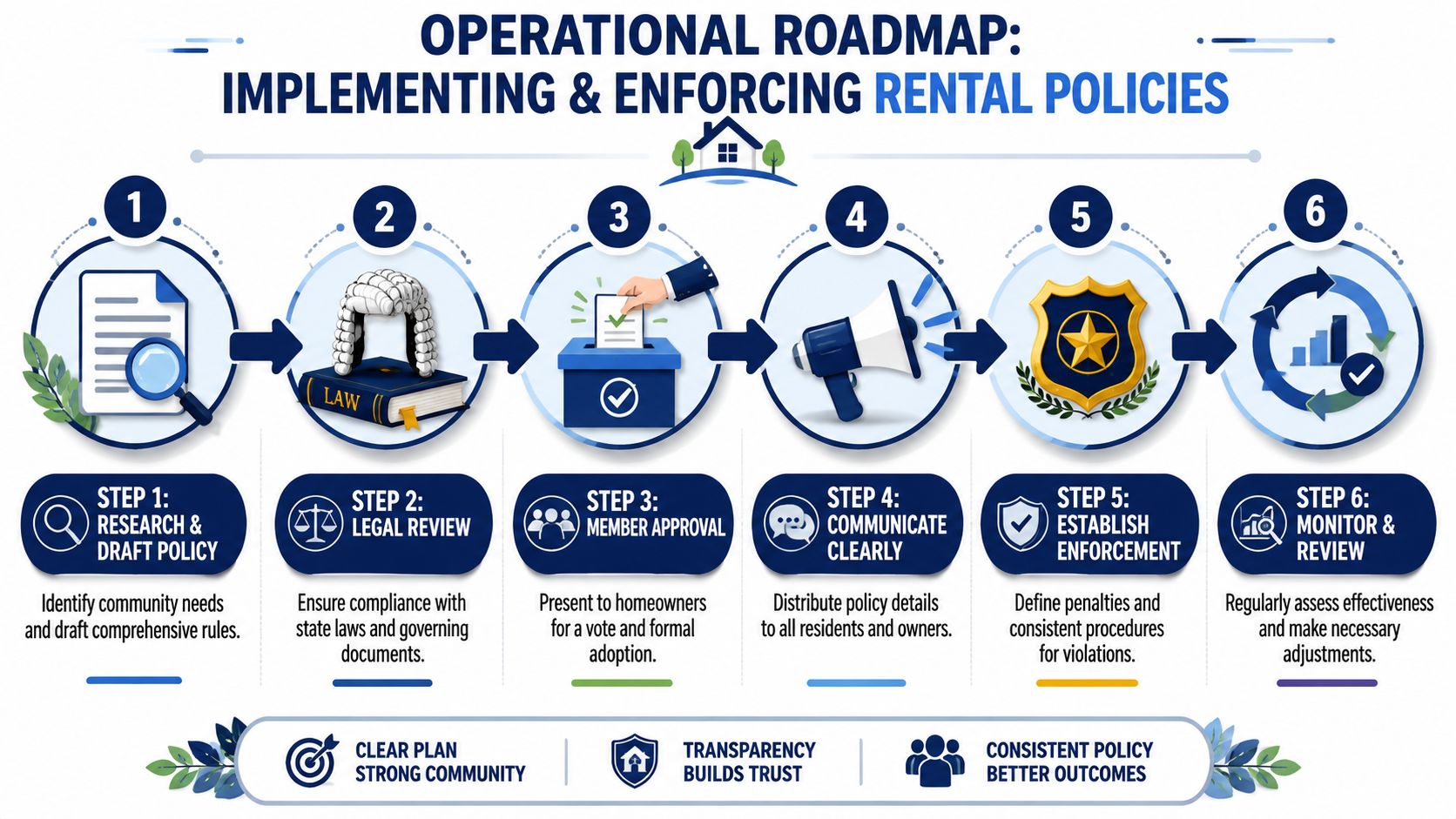
Most rental policies fail at the implementation stage. The board adopts a restriction, sends a notice, and assumes the job is finished. It isn't. The hard part starts after approval.
Operationally, enforcement gets complicated as a community approaches its cap. Boards must decide on systems such as waitlists or vacancy-triggered reallocation. California law gives some structure by allowing HOAs to cap rentals at 25% or more under Civil Code section 4741, but implementation mistakes can still lead to claims of unequal treatment, as noted in FindHOALaw's discussion of rental-cap limitations and enforcement challenges.
Build the system before the first dispute
A board should settle the mechanics before the first owner applies to rent.
- Adopt exact written procedures. Define the documents required, submission deadlines, approval checkpoints, and consequences for incomplete files.
- Create a lease registry. Track unit address, owner name, tenant name, lease start, lease end, and status under any cap or grandfathering rule.
- Set the waitlist rules. Use a consistent method such as chronological order and document every position change.
- Standardize owner communication. Every owner should receive the same forms, deadlines, and policy summary.
- Coordinate violations through one process. If the association has a published approach to homeowners association violations, rental violations should fit within that broader framework.
Consistency is what boards get judged on
Owners can live with a tough rule more easily than they can live with an uneven one. Selective enforcement invites conflict quickly. So does making exceptions off the record.
A workable enforcement sequence usually includes:
- Notice of noncompliance: Identify the rule and the missing action or prohibited conduct.
- Opportunity to cure: Give the owner a defined path to correct the issue if the documents and law allow it.
- Formal hearing process: Follow required procedures before fines or penalties.
- Escalation when needed: Move to legal counsel or injunctive relief when the violation continues.
Keep the paper trail clean. Dates, notices, registry updates, waitlist movement, and hearing records matter more than board recollections.
The board doesn't need to be aggressive. It needs to be organized. Organized boards usually resolve more disputes before they become legal disputes.
Frequently Asked Questions About Rental Restrictions
Can the board cap rentals by board vote alone
A new board often learns this the hard way. An owner asks to lease, the board wants to slow investor activity, and someone suggests passing a rule at the next meeting. In many communities, that is not enough. If the declaration treats leasing rights as a property right, the board usually needs a formal amendment approved by the membership and recorded properly.
Boards should also avoid copying a rental cap from another association without examining how it will work in daily administration. The real question is not just whether a cap sounds reasonable. The question is whether the association can track eligibility, handle turnover, and apply the rule the same way every time.
Should the board allow hardship exceptions
Sometimes yes. Sometimes no.
Hardship exceptions can solve real problems for owners dealing with military deployment, medical care, job relocation, or an inherited unit they cannot occupy right away. They can also become the fastest way to weaken a restriction if the documents are vague or the board applies sympathy unevenly. Any hardship process should be grounded in the governing documents or confirmed by association counsel, with written standards, time limits, and a record of each decision.
What if the cap is full when an owner wants to lease
Use the waitlist the policy already established. Boards get into trouble when they start making side decisions for neighbors they know, urgent personal stories, or last-minute sales that were never planned properly.
A first-come, first-served waitlist is common because it is easy to explain and defend. Whatever system the association adopts, the board should be able to show an owner exactly where they stand, why they are there, and what event moves them up.
Can the association require lease paperwork even if it doesn't prohibit rentals
Often yes, if the governing documents give the association authority to regulate occupancy, enforce rules, or collect information needed for operations. In practice, lease paperwork helps with more than rule enforcement. It gives management current tenant contacts, confirms who is living in the unit, and helps the association deliver parking rules, amenity procedures, move-in requirements, and emergency notices to the right people.
That is an operations issue, not just a legal one.
What causes the most trouble in practice
Three things show up again and again. Loose drafting. Poor records. Uneven enforcement.
A restriction can look fine on paper and still fail in practice if nobody knows which units are grandfathered, whether a lease renewal counts against the cap, or who approved an exception three years ago. Boards protect themselves by answering those questions before the conflict starts, not during the hearing.
Boards do better with a clear policy they can administer consistently than with a stricter policy that breaks down under exceptions.
If your board is weighing hoa rental restrictions, reviewing old amendment language, or struggling with enforcement workflow, Access Management Group can help your association organize the operational side of the issue. That includes aligning board decisions with governing documents, improving owner communication, and setting up practical processes for lease tracking, compliance, and day-to-day administration.