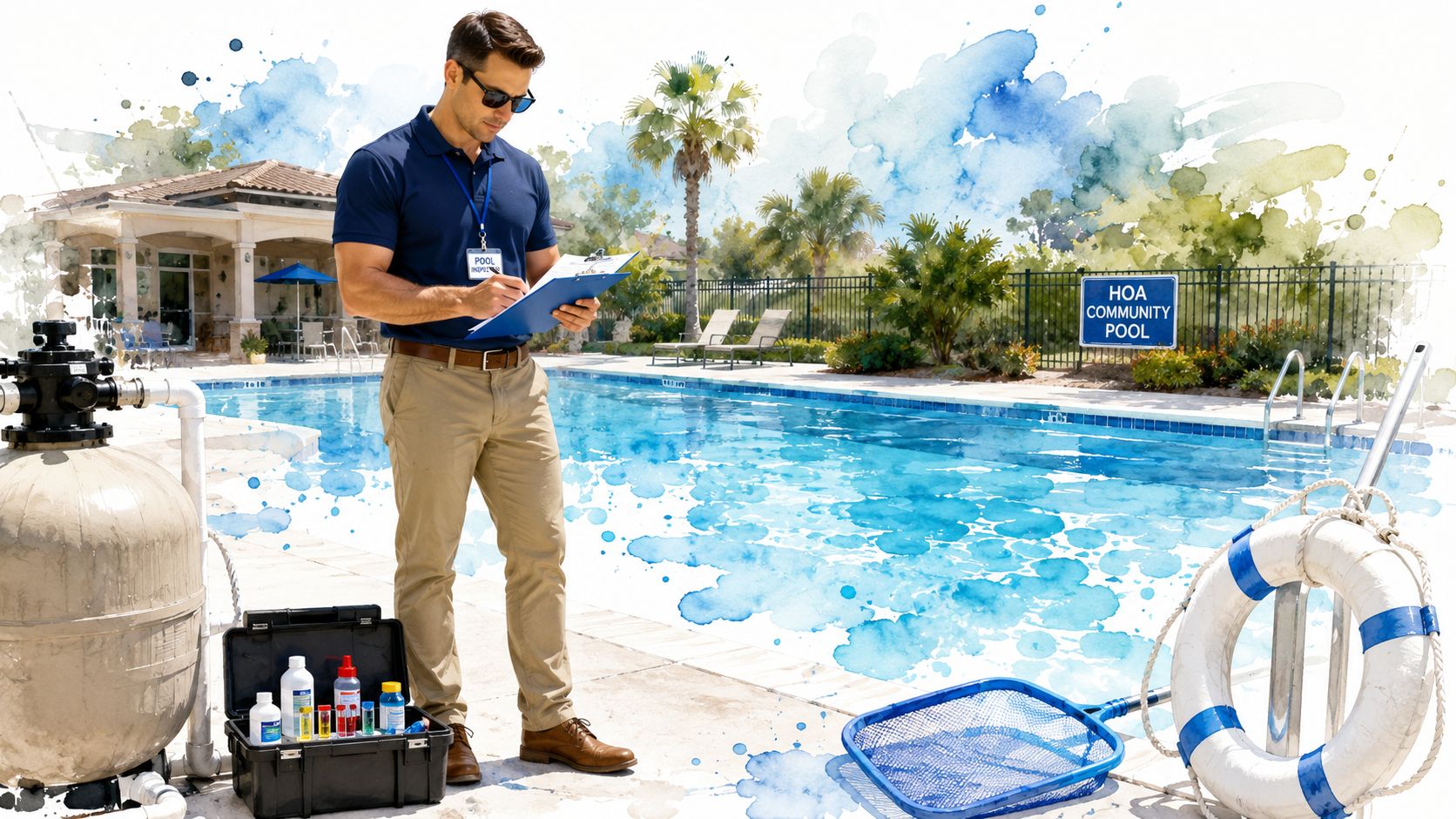
It is 48 hours before the pool is supposed to open. A board member notices the gate dragging, a resident asks why the water is still cloudy, and the management office is waiting on a vendor report that says everything looks fine. If the board approves opening without clear documentation, it owns the risk if a child gets hurt, a health inspector cites the property, or a preventable equipment failure forces a mid-season closure.
That is why a swimming pool inspection checklist matters for an HOA or COA board. It gives the board a way to verify conditions that affect safety, operating cost, insurance exposure, and resident confidence. A checklist also helps separate cosmetic issues from the items that can trigger claims, code problems, emergency repairs, or avoidable reserve spending.
Boards do not need to perform every technical test themselves. They do need to know what was checked, who checked it, what failed, and what the failure could cost if it is ignored. That standard protects the community far better than a short vendor note that says the pool is ready.
For association communities, the value of an inspection process is not just compliance. It is decision support. A missing record, a weak gate latch, or a pump problem can affect more than pool operations. It can shape how the board handles contracts, reserves, and even questions tied to the community's master insurance policy for homeowners association.
This checklist is written for board members and community managers who need to ask better questions and make defensible decisions. Use it to review your current process, test whether vendor reporting is detailed enough, and make sure your swimming pool inspection checklist protects residents, budgets, and property value.
1. Safety Equipment and Compliance
A child slips through a gate that does not latch, a guest hits an unmarked shallow area, or staff cannot reach rescue equipment without moving stacked chairs. Those are not routine maintenance misses. They are liability events that put the board's judgment under a microscope.
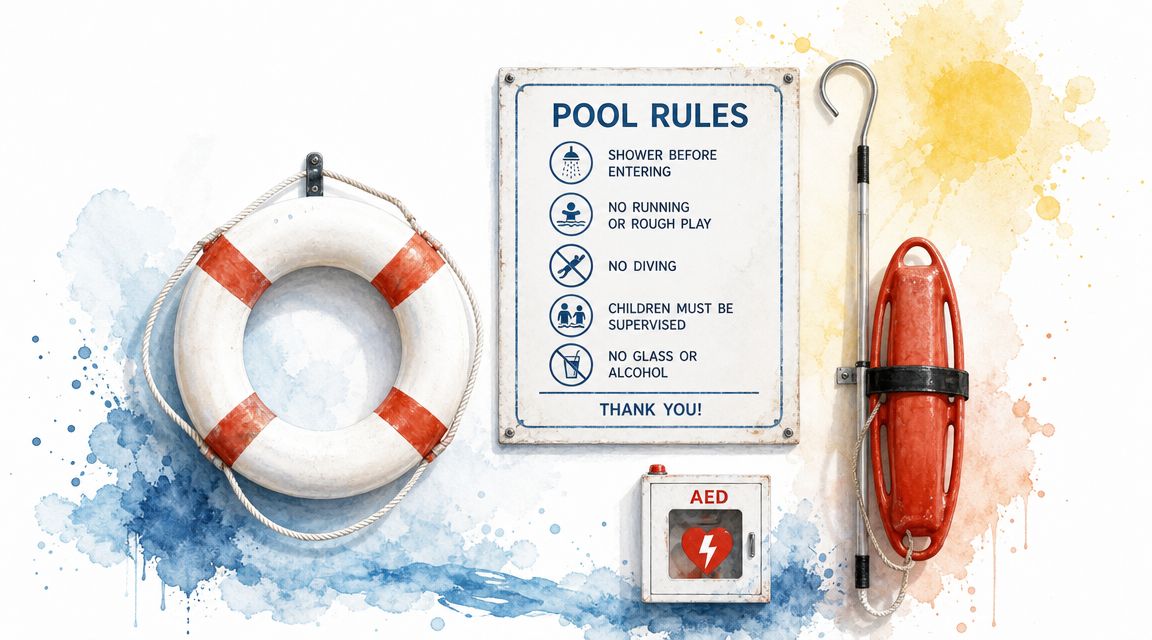
For HOA and COA boards, safety equipment and compliance deserve close attention because failures here create the shortest path to injuries, claims, and forced closures. Water quality ranges, gate function, drain cover compliance, posted rules, and rescue readiness all need documented verification. Boards do not need to run every test personally. They do need evidence that qualified staff or vendors checked the right items, recorded the results, and corrected problems on time.
Start with what residents and inspectors see first. Gates should self-close and self-latch on every cycle. Rule signs, depth markers, and hazard warnings should be readable from normal approach points. Rescue poles, ring buoys, first aid supplies, and any AED on site should be visible and immediately accessible. If furniture, storage bins, or locked doors slow access, the control is weaker than it looks on paper.
What boards should verify in person
- Rescue equipment is reachable: Ring buoys, rescue poles, and first aid supplies should be visible and not locked away behind staff-only barriers.
- Signage matches actual conditions: Depth markers, rules, and hazard notices need to be legible from normal approach points, not faded into the background.
- Entry control works every time: Gates should self-close and self-latch without a resident having to push or lift them into place.
- Drain protection is documented: Ask for records showing compliant drain cover specifications and replacement history, not verbal assurances.
- Slip hazards are corrected quickly: Deck algae, standing water, loose mats, and broken transitions cause preventable incidents.
Practical rule: If a protection only works when staff remembers to help it, it isn't a reliable safety control.
Boards should also ask a harder question. What is the financial consequence if this item fails? A missing drain cover record can complicate claim defense. A bad gate closer can lead to an incident that affects insurance renewal terms. Poorly maintained deck edges and transitions can turn into trip claims, surface repairs, and resident frustration at the same time. If resurfacing work is already on the horizon, connect safety review with long-term finish planning by reviewing plaster swimming pool resurfacing options and timing.
The deck perimeter deserves attention too, especially where coping, drainage, and walking surfaces meet. Those edge conditions affect footing, water movement, and deterioration at the pool border. Boards comparing materials or replacement standards can use this comprehensive pool coping guide for Australians as a reference point when discussing repairs with contractors.
Pool oversight also belongs inside the association's broader risk controls. Incident logs, inspection reports, vendor service notes, and corrective-action records all help the board show that it acted reasonably and consistently. That is one reason pool inspections should be coordinated with your broader HOA master insurance policy review, not treated as a stand-alone maintenance item.
The trade-off is straightforward. Better compliance takes staff time, follow-up, replacement spending, and record keeping. Those costs are usually modest compared with a claim, a citation, or an emergency closure in peak season.
2. Structural Integrity Assessment
A board usually learns the true condition of a pool at the worst possible time. A hairline crack opens into a leak in July. Loose coping becomes a trip hazard over a holiday weekend. What looked like a cosmetic issue in spring turns into an emergency vote, resident complaints, and a repair bill with no time for competitive bids.

Structural inspection protects more than the pool shell. It protects the reserve plan, the operating budget, and the board's ability to show that it addressed known risks before someone got hurt or the facility had to close.
Review the shell, plaster or other interior finish, coping, deck joints, tile line, skimmers, main drain covers and sumps, and the equipment pad area. Look for cracking, hollow spots, spalling, shifted sections, missing sealant, rust staining, movement between materials, and repair patches that suggest a recurring problem rather than a one-time fix. Staining matters. It can point to metal issues, waterline neglect, or leak paths that deserve follow-up.
Where boards save money, or lose it
Small defects stay small only if someone verifies the cause. A cracked deck panel may reflect simple age, but it can also signal settlement, poor drainage, or soil movement at the pool edge. Coping that pulls away from the bond beam is not just an appearance problem. It can create trip exposure, allow water intrusion, and accelerate damage in the surrounding deck.
Surface condition deserves its own line item in the inspection report. Rough plaster increases abrasion complaints, traps dirt, and makes the pool look poorly maintained even when chemistry is in range. For older pools, boards should compare patching against full renewal with a clear understanding of service life, downtime, and finish quality. This plaster swimming pool resurfacing guide is a useful reference when the board needs to discuss those trade-offs with a contractor.
Coping deserves the same attention. It handles edge protection, transitions, splash-out, and movement between the pool and deck. Material choice affects durability, slip resistance, heat retention, and replacement cost. Boards that want a practical outside reference can review this comprehensive pool coping guide for Australians before approving repair specifications or replacement standards.
Small structural defects are cheaper to investigate than to ignore.
Good structural review sometimes requires a leak specialist, a concrete contractor, or an off-season site visit when surfaces are easier to assess. That added cost is usually the cheaper option. Planned repairs give the board time to scope the work, compare bids, and schedule around resident use. Emergency repairs remove that control and usually increase both price and dissatisfaction.
3. Mechanical Equipment Evaluation
Residents rarely think about the pump room until the pool closes. Boards should think about it before then.
Mechanical equipment decides whether the pool can circulate, sanitize, and reopen after routine maintenance. Pumps, motors, heaters, feeders, valves, and automation controls all belong on the swimming pool inspection checklist because a pool can look fine one day and be unusable the next if one critical component fails.
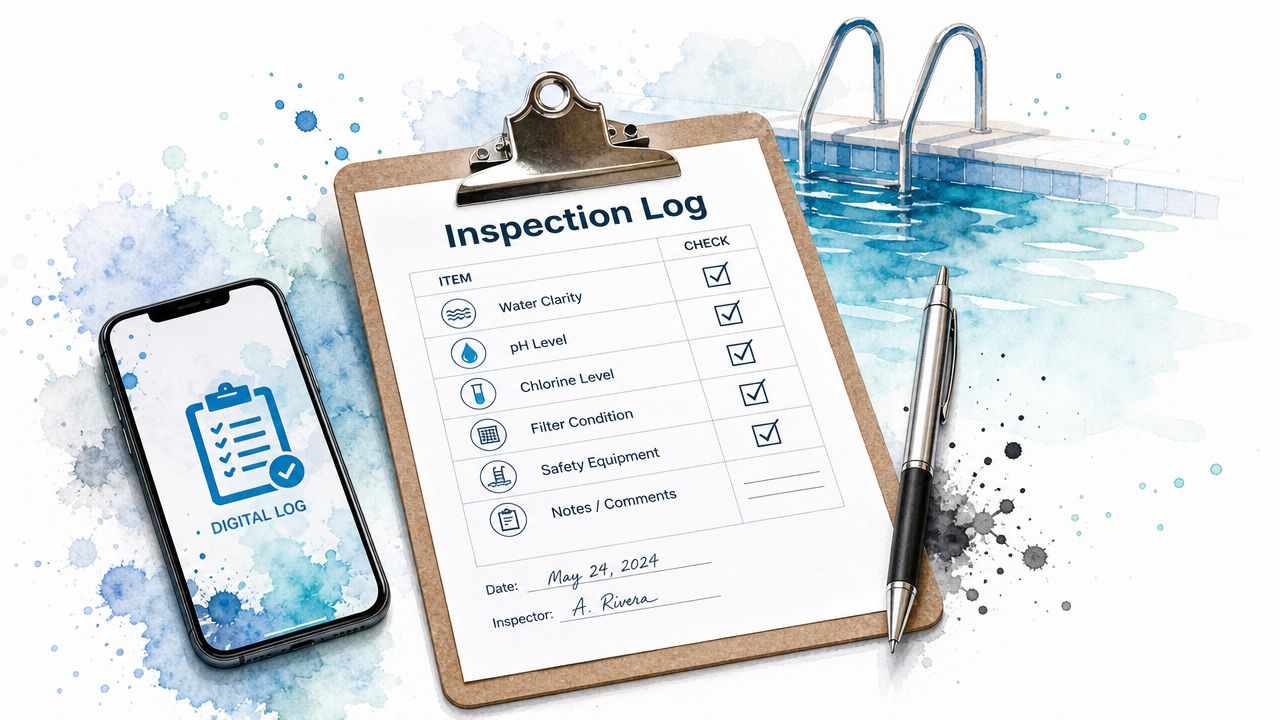
The practical review starts with operation, not age alone. Does the pump prime properly? Are there leaks around seals and unions? Do pressure readings make sense for the filter condition? Does the chlorinator feed consistently? Can staff explain what “normal” sounds and looks like for this system?
What works better than a generic vendor note
Boards get better results when they require technicians to document condition in plain language, with photos and operating observations. “Checked equipment, all good” is not useful. A stronger report identifies what was tested, what was observed, what needs monitoring, and what should be replaced on a planned basis.
The market is moving toward more connected oversight. The automatic swimming pool monitoring system market was estimated at USD 4.298 billion in 2024 and is projected to reach USD 17.51 billion by 2035, with a 13.62% CAGR from 2025 to 2035, according to this automatic swimming pool monitoring system market report. For HOA and COA boards, the takeaway isn't that automation replaces inspections. It means modern inspection programs should verify calibration status, alarm settings, feeder performance, and remote monitoring outputs alongside physical equipment checks.
- Pump condition: Listen for bearing noise, vibration, and signs of overheating.
- Filter support equipment: Confirm gauges read accurately and valves move through full travel.
- Heater readiness: Check ignition, thermostat response, and evidence of corrosion or bypass issues.
- Chemical feed controls: Verify feed systems are functioning, not merely powered on.
- Maintenance history: Ask for service logs that show repeat issues, not just the most recent repair.
What doesn't work is treating mechanical review as a one-time opening task. Community pools need recurring checks during the season because many failures come from drift, wear, and neglected warning signs.
4. Water Chemistry Balance
Boards often overestimate how much they can tell from water appearance. Clear water can still be out of balance. That's why chemistry belongs near the top of every swimming pool inspection checklist, not at the bottom as a routine maintenance afterthought.
The board-level issue isn't learning every chemical nuance. It's making sure the association has a defensible process for testing, recording, correcting, and rechecking water conditions. If your vendor can't show logs, calibration practices, and response steps, you don't have a strong chemistry program.
The ranges that matter most
Public-health guidance commonly checks free chlorine at 1 to 10 ppm for pools and 3 to 10 ppm for spas, with pH kept between 7.2 and 7.8, because those ranges are associated with safer swimmer conditions and effective disinfection, as noted earlier in the public-health checklist framework. Those ranges give boards a useful governance benchmark. The question is whether your operator consistently measures and documents them.
A reliable process also checks whether testing supplies are current, kits are usable, and staff know what corrective action requires immediate closure versus same-day adjustment. That's where many communities stumble. They rely on one experienced technician, then lose continuity when schedules change or a vendor rotates personnel.
What a board should ask for monthly
- Current chemical logs: Review entries for completeness, not just whether a clipboard exists.
- Testing readiness: Confirm test kits and probes are calibrated and stored properly.
- Corrective action records: Ask what happened after out-of-range readings were found.
- Chemical storage practices: Verify organized storage and clear separation of incompatible products.
- Escalation rules: Make sure someone knows when the pool must be closed to swimmers.
Water chemistry should be treated as documented operations, not pool intuition.
The trade-off is labor and consistency. Daily attention costs money. But poor chemistry costs money too, through surface damage, equipment stress, resident complaints, and temporary closure. For boards, the practical win is simple. Demand records that show the system works even when the usual technician isn't on site.
5. Filtration System Performance
A board usually hears about filtration after residents start complaining that the water looks dull or cloudy. By that point, the pool may still be open, but risk is already rising. Poor filtration drives more service calls, more chemical adjustment, more wear on pumps, and more resident frustration than many boards expect.
For HOA and COA communities, the inspection question is straightforward. Does the system turn over water reliably, and can management prove it with records? If the answer is vague, the board should expect higher operating costs and a greater chance of avoidable closure.
Filter type matters, but maintenance discipline matters more. Sand, cartridge, and DE systems all work well when they are sized correctly and serviced on schedule. Each also creates a different budget profile. Cartridge systems can reduce backwashing but increase labor and replacement costs. Sand systems are familiar and durable but still need media review and pressure tracking. DE can filter finely, but it demands closer handling and more consistent service.
What the board should verify
Inspection notes should show a clean baseline pressure, current operating pressure, flow conditions, and service history. If every reading looks identical month after month, the report is probably being copied rather than observed. That is a management problem as much as a maintenance problem.
A good review also confirms that valves operate properly, backwash lines discharge as intended, and the system is not bypassing obvious signs of trouble such as short cycling, weak circulation, or recurring debris in the water. Functional verification matters more than brand names on the tank.
- Pressure trends: Compare current readings against the documented clean starting point.
- Valve operation: Check that backwash and isolation valves move fully and seal correctly.
- Media or cartridge service history: Confirm when sand, cartridges, grids, or related components were last cleaned or replaced.
- Discharge condition: Look for leaks, washout, erosion, or drainage problems around backwash lines.
- Water clarity correlation: Match what residents see in the pool to the actual service record and operating data.
I tell boards to treat filtration records the same way they treat reserve studies or violation logs. If the documentation is weak, decision-making gets expensive fast.
Outside guidance can help board members understand how inspectors evaluate ongoing operating conditions, documentation, and safety practices in real facilities, as outlined in this pool safety inspection guidance for ongoing verification. Boards should apply that same discipline to filter performance. A working filter is not just installed equipment. It is a documented process that protects swimmer confidence, supports water quality, and reduces the chance that a small maintenance issue turns into a larger electrical or equipment failure requiring commercial electrical repair.
6. Electrical Systems and Safety
Electrical review is where boards should be humble and strict at the same time. Humble, because this isn't a DIY category. Strict, because vague assurances around electricity near water are unacceptable.
A swimming pool inspection checklist should require a qualified electrician or appropriately licensed contractor to verify GFCI protection, bonding, grounding, panel condition, weatherproof enclosures, and lighting safety. If the board can't see the last inspection record or service note, it should assume follow-up is needed.
Non-negotiable questions for the board
Ask whether underwater lights are secure and functioning as intended. Ask whether electrical panels are labeled clearly enough that an emergency responder or replacement technician can isolate circuits quickly. Ask whether exposed conduits, damaged covers, or makeshift wiring have appeared near the equipment pad since the last review.
Boards should also watch for the kind of shortcuts that creep in during season. Extension cords. Temporary power arrangements. Outdoor devices that were never meant for pool environments. Those are management problems, not just maintenance problems.
If a vendor says an electrical condition is “probably okay,” the board should treat that as unresolved.
An outside technical reference can help board members understand the maintenance mindset involved in this category. This commercial electrical repair overview is useful for framing why electrical issues need documented diagnosis and proper repair, not improvised fixes.
The downside here is obvious. Electrical corrections can be expensive, especially in older communities with legacy systems. But the cheaper mistake is usually the one that gets corrected before a shock hazard, equipment failure, or emergency closure forces the board's hand. Good boards budget for electrical modernization in phases rather than pretending age alone makes a condition acceptable.
7. Accessories and Amenity Functionality
Residents often judge the pool area by what they touch first. Wobbly handrails, broken furniture, loose ladders, rough deck edges, or an out-of-service shower can make a community feel neglected even if the water is balanced and the pump room is immaculate.
That's why amenity function belongs on the swimming pool inspection checklist. This category protects more than appearance. It addresses trip hazards, accessibility concerns, injury exposure, and the day-to-day resident experience that shapes confidence in the board.
Inspect what residents actually use
Start with railings, ladders, steps, and deck transitions. Those components carry constant contact, and loosening hardware tends to show up gradually. Diving boards, slides, outdoor showers, gates to ancillary areas, restroom fixtures, and pool furniture also deserve direct observation, not a quick walk-by.
Boards should pay particular attention to anything that invites active use. If a feature exists, residents assume it's safe. That includes shaded seating areas, grab bars, rinse stations, and changing facilities. If the association can't maintain a feature properly, removal is often safer than leaving it in marginal condition.
A practical review usually includes:
- Hand contact points: Check ladders, rails, and grab bars for movement and corrosion.
- Deck usability: Look for uneven surfaces, drainage issues, and worn slip-resistant finishes.
- Furniture condition: Remove broken loungers and unstable tables immediately.
- Accessory safety: Confirm slides, boards, and specialty features meet current use expectations.
- Support spaces: Restrooms and changing areas should be functional, clean, and secure.
This is also a property value issue. Buyers and residents read the amenity area as a sign of how the association handles the whole property. A polished pool environment signals attentive governance. A tired one signals deferred maintenance.
What doesn't work is budgeting only for headline projects while leaving small-use items to fail one by one. Residents notice the small things first.
8. Documentation and Record Keeping
A board usually discovers the value of pool records after a complaint, an injury report, or a dispute with a vendor. At that point, the question is no longer whether the pool was inspected. The question is whether the association can prove what was found, what was approved, and how quickly it responded.
That is why documentation deserves board attention. A swimming pool inspection checklist protects the association only if the records are complete, dated, and easy to retrieve.
Keep a file containing the full operating picture: inspection reports, chemistry logs, maintenance tickets, repair invoices, photos, incident reports, staff or vendor certifications, and compliance documents. Include board decisions as well. If a gate latch was flagged in May but replacement was deferred until the next meeting cycle, that decision should be documented along with the reason and target date.
Good records also reduce turnover risk. Managers change. Pool vendors change. Board members rotate off. The file should still tell a clear story without forcing the next person to reconstruct events from emails and memory.
A workable system is usually simple:
- Date every entry and identify who performed the inspection or service.
- Match photos to the related deficiency, work order, or invoice.
- Track recommendations through completion, deferral, or rejection.
- Separate routine operating records from capital repair history.
- Store documents in one shared location with clear naming conventions.
Documentation supports budgeting in a very practical way. Repeated patch repairs, recurring leak complaints, resurfacing notes, and pump service history help the board decide whether it is still funding maintenance or drifting into deferred replacement. A formal HOA reserve study for long-term capital planning helps place pool finishes, deck work, fencing, and equipment replacement into a funding schedule the board can defend.
The best maintenance record is the one a new board member can read in five minutes and trust.
There is a trade-off. Good record keeping takes staff time, manager discipline, and follow-up with vendors who submit thin or inconsistent reports. But the payoff is broad. Clear documentation strengthens legal defense, supports insurance discussions, improves vendor accountability, helps explain costs to residents, and protects property value by showing that the amenity is being managed with care rather than reaction.
8-Point Swimming Pool Inspection Comparison
| Item | Implementation complexity | Resource requirements | Expected outcomes | Ideal use cases | Key advantages |
|---|---|---|---|---|---|
| Safety Equipment and Compliance | Moderate, ongoing training and regulatory updates | Moderate–High, safety gear, certifications, inspections | Reduced injuries and liability; regulatory compliance | HOAs/COAs prioritizing resident safety and legal compliance | Lowers liability, may reduce insurance costs, documented protocols |
| Structural Integrity Assessment | High, specialized inspections, possible draining | High, structural engineers, repairs, diagnostic tools | Early defect detection, preserved asset value, avoided emergencies | Aging pools, reserve studies, capital planning | Prevents costly failures, protects property value |
| Mechanical Equipment Evaluation | High, technical diagnostics and calibration | Moderate–High, technicians, spare parts, maintenance tools | Reliable operation, improved energy efficiency, fewer shutdowns | Preventing mid-season failures, efficiency upgrades | Energy savings, extended equipment life, planned replacements |
| Water Chemistry Balance | Moderate, frequent testing and adjustments | Low–Moderate, test kits/automation, chemicals, trained staff | Safe water, reduced illness/algae, compliant with health codes | Daily pool operations, high-use seasons | Protects health, reduces chemical waste, maintains comfort |
| Filtration System Performance | Moderate, monitoring pressure and media condition | Moderate, replacement media, backwash systems, maintenance | Clear water, lower chemical demand, quantified performance | Pools with clarity issues or high bather load | Improves clarity, reduces chemicals and particulate damage |
| Electrical Systems and Safety | High, licensed electrician, code compliance work | High, electrical contractors, upgrades, testing equipment | Prevents electrocution/fire, NEC compliance, equipment protection | Older facilities, electrical faults, lighting/equipment upgrades | Critical life-safety improvements, liability reduction |
| Accessories and Amenity Functionality | Low–Moderate, visual checks, routine repairs | Moderate, furniture/structure replacement, seasonal upkeep | Higher resident satisfaction, better aesthetics, fewer hazards | Amenity-focused communities seeking member retention | Enhances appeal and usability, addresses trip/hazard risks |
| Documentation and Record Keeping | Low–Moderate, system setup and discipline | Low–Moderate, software, staff time, secure storage | Legal protection, traceable maintenance history, transparency | Boards needing audits, liability defense, trend analysis | Demonstrates due diligence, aids budgeting and claims defense |
From Checklist to Action Plan
A board usually learns the true state of its pool at the worst possible time. Opening weekend arrives, residents are ready to swim, and a gate closer fails, a pump trips offline, or the inspection file is missing key records. At that point, the issue is no longer just maintenance. It is a liability decision, a budget decision, and a resident-relations problem all at once.
The boards that handle pool oversight well assign an owner to every finding. A checklist item should end with a decision, a deadline, and a record of who is responsible. If a self-latching gate fails, approve the repair and confirm completion. If plaster wear signals a larger surface problem, move it into reserve planning before it turns into an emergency expense. If the vendor logs are incomplete, require a reporting format the association can defend in a claim or audit.
That discipline protects money as much as safety. Deferred pool work rarely stays small. A minor leak can raise water and chemical costs for months before anyone traces the cause. Inconsistent service records make it harder to challenge vendor performance, justify replacements, or explain special spending to owners. Boards that connect inspection results to reserve planning, contract oversight, and seasonal scheduling usually avoid the premium pricing that comes with rushed repairs and forced closures.
It also protects confidence in the board.
Residents judge pool management by outcomes. They notice whether the pool opens on schedule, whether closures are explained clearly, and whether the area feels safe and well run. Clean water, secure railings, working lights, and posted rules signal that the association is paying attention. That affects resident satisfaction, complaint volume, and how buyers view the community.
Use the checklist as a board management tool, not a seasonal form. Set an inspection calendar, define which items require licensed specialists, and require written closeout for every repair. The strongest final step is simple. At the end of each inspection cycle, review the open items in a board or management meeting and decide what gets funded now, what moves into reserves, and what needs follow-up before the next high-use period.
If your board wants stronger pool oversight, cleaner documentation, and a management partner that understands how amenity operations affect safety, budgets, and homeowner confidence, Access Management Group can help your association build a more disciplined approach to community management.