Your board just sent three separate emails about the pool schedule, a landscaping project, and a budget meeting. Residents still have questions. Someone posts outdated information in the community Facebook group. A homeowner says they never saw the notice. Another assumes the board is hiding something because they heard about a vendor change from a neighbor instead of the association.
That’s the moment when a homeowners association newsletter stops being a nice extra and becomes an operating tool.
A strong newsletter gives the board one dependable channel for context, timing, and tone. It reduces reactive communication. It gives residents a place to look before they call management, email directors, or speculate online. Above all, it helps the association communicate in a way that feels organized, fair, and transparent. That matters to homeowners, to the board, and to the long-term health of the community.
Why Your HOA Newsletter Is a Strategic Asset
When communication gets fragmented, boards spend more time correcting misunderstandings than solving problems. One notice goes out by email, another by posted sign, another by word of mouth. Residents miss deadlines, question decisions, and fill in the blanks themselves.
A newsletter fixes that by becoming the association’s single source of truth.
According to Newsletter Pro’s HOA communication data, 74% of homeowners associations rank communication with residents as their top priority, and 89% of residents in well-managed communities rate their HOA experience positively or neutrally. That connection matters. Residents don’t need constant messages. They need consistent, useful communication they can trust.
What a newsletter does that one-off emails do not
A one-off email handles urgency. A newsletter handles governance.
It creates a predictable rhythm for communication. Residents learn where to find board updates, event dates, maintenance schedules, policy reminders, and contact information. That predictability lowers friction for everyone involved.
It also supports the work typically coordinated by a community association manager. Managers and boards spend less time repeating answers when the newsletter already explained the project timeline, the reason behind a rule reminder, or the next step in a board decision.
Practical rule: If residents regularly say “Nobody told us,” you likely have a communication system problem, not just a delivery problem.
Why this affects trust and property values
Boards often think of newsletters as resident relations. They’re also about stewardship.
When owners understand what the board is doing, why money is being spent, and what’s changing in the community, they’re less likely to assume mismanagement. That doesn’t mean every decision becomes popular. It does mean fewer surprises, fewer rumor cycles, and a more credible board.
A newsletter is not fluff. It is part of how the association protects confidence in the community.
Strategic Planning for Your HOA Newsletter
Most weak newsletters fail before anyone starts writing. They don’t have a purpose, a schedule, or an owner. They show up late, repeat stale information, and read like a compliance memo. Residents stop opening them, and the board concludes that newsletters don’t work.
Usually, the issue isn’t the format. It’s the lack of planning.
HOA communities are also serving a wide mix of residents. According to This Old House HOA statistics, HOA communities grew to 373,000 in 2025, with 47% Gen Z homeowners and 45% of households earning over six figures. That kind of audience spread means one generic message won’t land equally well with everyone.
Start with outcomes, not articles
Before choosing sections or assigning writers, the board should answer one question: What should this newsletter help the community do better?
For most associations, the answers are practical:
- Improve meeting participation so owners show up informed
- Reduce confusion around projects, policies, and deadlines
- Support assessment communication with clear budget context
- Build community involvement through events and volunteer opportunities
- Lower unnecessary conflict by explaining decisions before frustration builds
Those outcomes shape content. If your problem is low annual meeting turnout, your newsletter should repeatedly clarify why attendance matters, what decisions are coming up, and how owners can participate. If your problem is resident distrust during a large project, the newsletter should focus on timelines, milestones, contractor presence, and what homeowners can expect week by week.
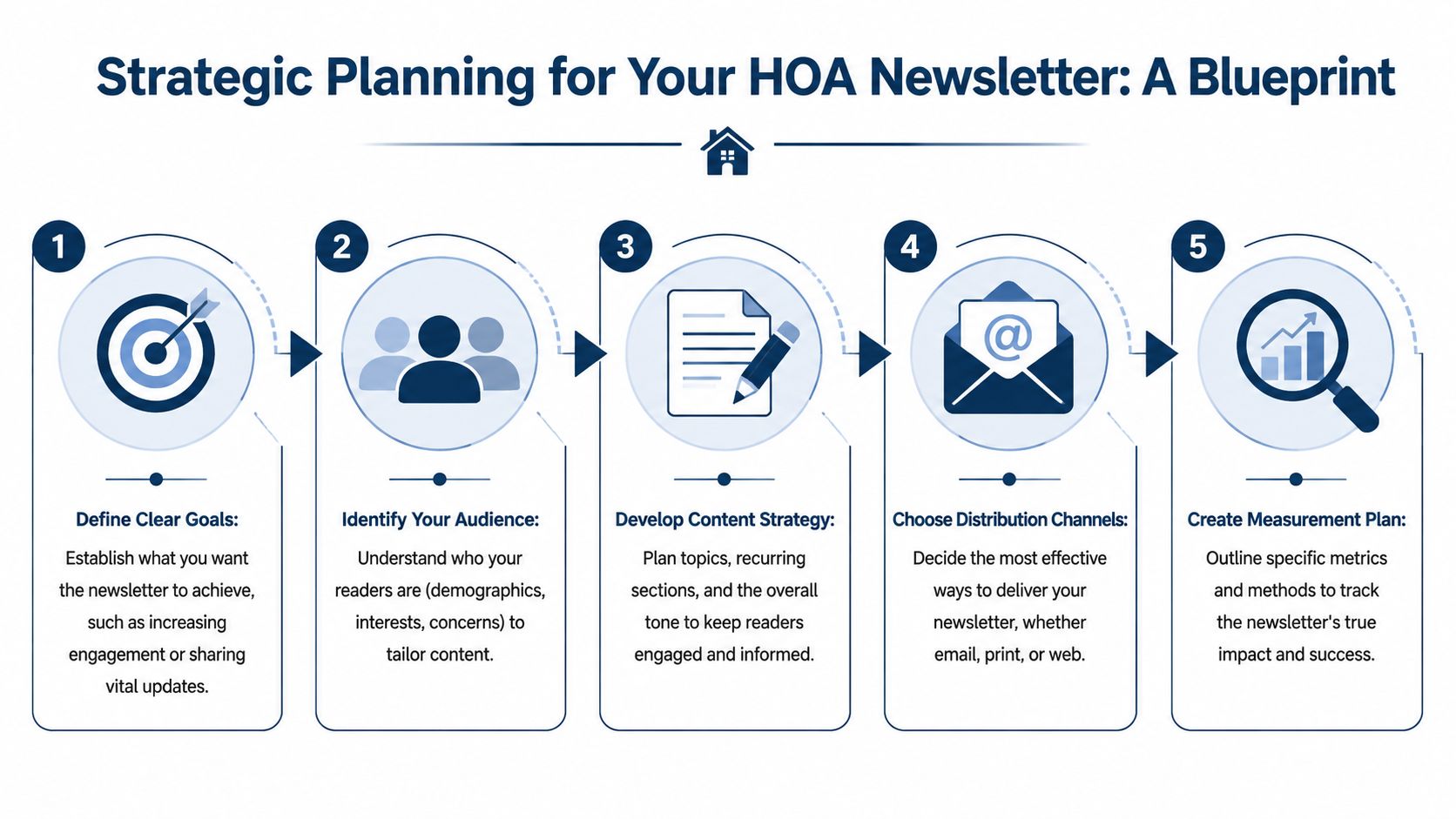
Build a simple operating plan
The best planning system is one your board can maintain. Keep it lean.
Use this framework:
-
Choose frequency
Quarterly works well for many associations. Monthly works better if your community has active amenities, frequent events, or ongoing projects. What matters most is consistency.
-
Assign ownership
One person should own the process. That might be the manager, an editor on the communications committee, or a board member. Ownership prevents last-minute scrambling.
-
Set deadlines
Pick a recurring production schedule. For example: content due on the first Monday, review by Friday, distribution the following week.
-
Create recurring sections
Repetition helps residents scan quickly. Keep core sections in every issue, such as president’s note, project updates, calendar, reminders, and contact information.
-
Decide how success will be measured
Don’t wait until after sending. Decide in advance what you’ll track, such as open rate, click activity, meeting attendance after promotion, or homeowner response to a specific initiative.
Use a content calendar that reflects the community year
A useful homeowners association newsletter follows the association’s operating cycle, not the board’s mood that month.
A strong calendar often includes:
| Quarter or season | Typical newsletter focus |
|---|---|
| Budget season | Dues context, budget process, owner questions, meeting dates |
| Project season | Vendor schedules, access expectations, progress photos |
| Annual meeting period | Candidate information, quorum reminders, voting steps |
| Community event months | Social calendar, volunteer requests, recap photos |
| Rule update periods | Plain-language explanations, compliance deadlines, FAQs |
A newsletter should arrive before residents need the information, not after they’ve already called to ask for it.
Form a small committee, but keep approvals tight
Committees can help gather photos, resident stories, and event details. They can also slow production if too many people need to sign off.
A good balance is a small contributor group with one editor and one final approver. The board should review for accuracy and tone, not rewrite every paragraph. If every issue becomes a line-by-line debate, publication slips and consistency disappears.
Planning sounds administrative because it is. That’s exactly why it works.
Gathering and Creating Compelling Content
Residents don’t ignore newsletters because they hate information. They ignore newsletters because too many newsletters read like a list of warnings.
The associations that get traction usually sound more like a well-run community and less like a citation department. They explain what’s happening, why it matters, and what the resident should do next.

According to EJF Real Estate’s HOA newsletter guidance, a strong mix is 40% updates and announcements, 30% events and calendar items, 20% resident spotlights, and 10% tips. The same guidance notes that framing rules as community benefits can lift positive perception by 55%.
That ratio is useful because it forces balance. Governance still leads, but the publication doesn’t become a wall of enforcement language.
What belongs in each issue
A practical issue often includes a blend of operational and community content:
- Board message that gives context on one current issue
- Maintenance or project update with expected timing and resident impact
- Financial snapshot in plain language, not accounting jargon
- Upcoming events and meeting dates
- Resident spotlight or volunteer recognition
- Quick reminders tied to seasonal needs
- How to find rules or forms in the association’s governing documents
That last point matters. Don’t paste long rule excerpts into the newsletter if a summary and link will do the job. The newsletter should guide residents to the source document without overwhelming them.
Turn dry notices into readable copy
Here’s the difference between content that gets skimmed and content that gets understood.
Instead of writing:
“Residents are reminded that landscaping modifications require prior approval pursuant to the architectural standards.”
Write this:
“Planning a new planting bed, tree removal, or exterior landscape change? Please submit the request before work begins so the board can confirm it fits the community standards and avoids costly rework.”
The second version still communicates the rule. It provides the homeowner with a reason to comply.
Here’s another example for a sensitive topic.
Weak special assessment notice
- The board approved a special assessment.
- Payment is due by a certain date.
- Failure to pay may result in collection action.
Stronger version
- The board approved a special assessment to address a defined community need.
- The newsletter explains what work is being funded, when it is expected to begin, and where owners can review the full notice and payment details.
- It also gives owners a clear contact path for billing questions.
That approach doesn’t soften the obligation. It removes ambiguity.
Use stories where they actually help
One of the most underused newsletter tools is the short resident or volunteer story. Not a long profile. Just enough to humanize the community.
A brief spotlight on the owner who leads the garden committee, coordinates a holiday drive, or helps with welcome baskets does two things. It makes the newsletter more readable, and it signals that the association notices constructive participation.
That tone matters because people are more likely to read future issues when the publication reflects community life, not just board action.
Sensitive topics need clarity and restraint
Some subjects trigger defensiveness fast. Rule reminders, parking enforcement, pet waste, noise complaints, architectural denials, and assessments all fall into that category.
Use these practices:
- State the reason first so residents understand the community purpose
- Be specific about action rather than vague about expectations
- Avoid scolding language that sounds personal or accusatory
- Point to process so homeowners know what happens next
- Offer one clear contact path for questions
Residents usually accept difficult news more readily when the board explains the purpose, the process, and the timeline in plain English.
A newsletter is not the place to litigate every controversy. It is the place to communicate with enough clarity that fewer controversies grow in the first place.
Designing for Readability and Engagement
A newsletter can contain solid information and still fail if it looks dense, cluttered, or inconsistent. Residents are busy. They scan before they read. If the page feels hard to understand, many won’t make it past the first block of text.
Good design is not about making the newsletter fancy. It’s about making it usable.
Build a template residents can learn
Keep the layout familiar from issue to issue. Put the logo, issue date, contact information, and main sections in the same places each time. Residents should know where to look for the calendar, project updates, and board note without hunting.
A dependable template also saves production time. Once the structure is set, the team can focus on content quality instead of redesigning every month.
For print editions, boards that want a cleaner layout can borrow ideas from guides on designing professional print booklets. The key lesson is simple. Strong hierarchy helps people find what matters fast.
Make the page easy to scan
Use short paragraphs, descriptive headings, and bullet points where they improve clarity. Dense legal-style copy belongs in a policy document, not in a homeowners association newsletter.
A few practical design habits go a long way:
- Use one or two fonts only so the issue looks organized
- Keep headings descriptive such as “Pool resurfacing schedule” instead of “Community update”
- Add white space so sections don’t run together
- Choose real community photos instead of generic stock art when possible
- Highlight deadlines carefully so dates and required actions stand out
Match tone and design
If the board wants the newsletter to feel transparent and calm, the design should support that. Overusing all caps, red warning boxes, and heavy bolding makes every item look like a problem.
The best newsletters have visual discipline. They don’t shout. They guide.
Choosing Your Distribution Channels
A newsletter that never reaches the resident has no value. Distribution deserves the same level of board attention as writing and design because every channel has trade-offs in cost, accessibility, speed, and trackability.
Most boards do best with a layered approach rather than a single method.
How each channel performs in practice
Email is usually the fastest way to distribute a newsletter. It’s easy to send, simple to archive, and useful for tracking engagement. The downside is that residents may ignore it, unsubscribe, or miss it because of inbox filtering. Boards that struggle with deliverability can benefit from technical guidance like how to stop email from going to spam in Gmail, especially if newsletter complaints sound like “I never got it.”
Print has a different advantage. People see it. A printed copy on the kitchen counter often gets more attention than an email buried under retail promotions. But print takes more coordination. You have to finalize content earlier, handle production, and manage mailing or physical delivery.
A resident portal or website archive gives the association a stable home for current and past issues. That’s useful when owners want to look back at policy explanations, project updates, or meeting notices. The weakness is that portal content usually requires residents to take the initiative to log in.
HOA Newsletter Distribution Method Comparison
| Method | Pros | Cons | Best For |
|---|---|---|---|
| Fast delivery, easy to forward, can track opens and clicks, simple to archive | Can land in spam, depends on current email list, easy to ignore | Communities with strong digital adoption and frequent updates | |
| Tangible, visible in the home, accessible for residents who prefer paper | Higher production effort, slower turnaround, harder to update once sent | Communities with mixed digital use or residents who prefer mailed notices | |
| Portal or website | Central archive, useful for reference, supports links to forms and documents | Residents must actively visit, less effective for urgent awareness on its own | Associations that want a permanent communication library |
| Multi-channel mix | Reaches more residents, reinforces key messages across formats | Requires coordination and version control | Most communities, especially those with varied resident preferences |
Match the method to the message
Not every update needs every channel.
Use email for timely delivery, use the portal for recordkeeping, and use print when the board needs broader household visibility or when some owners reliably engage better on paper. If your management process already relies on digital tools, software can help coordinate communications, notices, and records through platforms built for community association management software.
The mistake boards make is assuming one channel equals full reach. It rarely does.
If a notice is important enough to affect attendance, payments, access, or compliance, send it in more than one way.
Keep version control tight
Multi-channel communication only works if the message stays consistent. One edited email and one outdated PDF can create avoidable conflict.
Use one final approved version, then adapt the formatting for each channel without changing the substance. Residents should not get different dates, different instructions, or different tones depending on where they read the update.
Distribution isn’t just logistics. It’s part of trust.
Measuring Success and Proving ROI
Most boards stop measurement too early. They check the open rate, maybe glance at clicks, and decide the newsletter performed well or poorly. That tells you something, but not enough.
A newsletter is worth the effort when it improves community outcomes. That’s the true return.

According to ECHO’s HOA newsletter benchmarks, digital newsletters can achieve 65-85% open rates, but focusing on negative rules and sanctions can cause a 45% readership drop. The same guidance notes that a positive tone correlates with a 30% higher perception of property value among residents.
Those numbers are useful, but they are still only the starting line.
Measure leading indicators and operating results
Think in two layers.
Layer one is engagement.
This includes open rates, click activity, and which sections get the most interaction. These metrics tell you whether residents are paying attention.
Layer two is community performance.
This includes outcomes the board already cares about, such as:
- Meeting attendance after agenda previews or annual meeting reminders
- Assessment compliance patterns after billing explanations or budget education
- Resident questions before and after major project communications
- Dispute volume tied to misunderstandings about rules, schedules, or access
- Volunteer response after committee spotlights or event promotion
If open rates are healthy but meeting turnout remains weak, the issue may be the content or call to action, not delivery. If project-related complaints drop after a newsletter series that explains timing and disruption, that’s operational value.
Build a simple ROI scorecard
Boards don’t need a complicated dashboard. They need a repeatable scorecard.
| Newsletter objective | What to track | Why it matters |
|---|---|---|
| Better attendance | Attendance at meetings promoted in the newsletter | Shows whether the newsletter drives participation |
| Better payment understanding | Questions related to assessments before and after explanations | Indicates whether owners understood the billing message |
| Fewer misunderstandings | Number and type of recurring resident complaints | Helps identify where communication reduced confusion |
| More resident involvement | Responses to volunteer requests or event registrations | Shows whether community-building content is working |
| Stronger trust | Short resident feedback surveys and tone of responses | Reveals whether communication feels clear and credible |
If your board wants a broader framework for evaluating communications, Call Loop’s marketing measurement guide offers a useful way to think about goals, metrics, and conversion actions. The idea applies well here. Don’t just ask whether people saw the message. Ask what happened next.
What successful boards pay attention to
Boards that use newsletters well tend to notice patterns over time.
They learn which subject lines get opened. They see whether explaining a project in stages reduces angry calls. They notice whether a president’s note builds trust or gets skipped. They compare attendance before and after adding clear calendar reminders. They look at whether owners respond better to “here’s why this matters” than to “you must comply.”
A newsletter earns its budget when it reduces confusion, improves participation, and gives the board fewer preventable problems to manage.
The strongest newsletter program is not the prettiest one. It’s the one that helps the board govern better.
If your board wants help creating a more effective communication system, Access Management Group works with associations on the practical side of community operations, including the kind of structured communication that supports informed homeowners, more confident board decisions, and stronger day-to-day management.