You know the situation. It's 11:47 p.m., the music next door starts again, the footsteps overhead get heavier, and the homeowner who planned to be up at 6 a.m. is now staring at the ceiling. By the third night, this stops feeling like an annoyance and starts feeling like a governance failure.
That's the right way for an HOA or COA board to think about it. A noisy neighbour problem isn't just about two residents who don't get along. It's about whether the association can protect quiet enjoyment, apply rules fairly, and keep owners from deciding that living in the community isn't worth the hassle. If you want to know how to deal with noisy neighbour complaints properly, you need a process that works for both the resident and the board.
Why Quiet Enjoyment is a Community-Wide Issue

A resident loses sleep. Another starts avoiding evenings at home. A third decides not to renew a lease or puts the unit on the market. That's how a “small” noise issue spreads. It moves from one wall or ceiling into the reputation of the entire community.
Boards should stop treating repeated noise complaints as personality clashes. In shared living, quiet enjoyment is basic. People buy or rent into associations because they expect order, predictability, and a reasonable chance to live in peace. When that breaks down, confidence in the board breaks down with it.
The data backs that up. In a FindLaw.com survey, noise was the leading cause of neighbor disputes, accounting for 48% of all conflicts, and 82% of disputes were eventually resolved, which supports having a structured complaint and enforcement process instead of improvising each case (FindLaw survey results reported by Thomson Reuters).
Why boards should care early
If noise is the most common trigger, then noise complaints are not edge cases. They are routine operational issues. A board that has no clean process for handling them is inviting inconsistency, resident frustration, and claims of unfair treatment.
Practical rule: If the same type of complaint keeps appearing, the problem is no longer interpersonal. It's administrative.
A board's job is not to guarantee silence. It is to define what the community considers unreasonable, communicate that standard clearly, and enforce it without favoritism.
What quiet enjoyment means in practice
For homeowners, it means they shouldn't have to tolerate chronic blasting music, recurring late-night parties, repeated shouting, or continuous impact noise that goes beyond normal daily living. For the board, it means the governing documents should give management and leadership a usable path to act.
That path needs four things:
- Clear rules that define nuisance noise and quiet hours.
- A complaint method residents can easily follow.
- Consistent records so one board member's memory doesn't drive the outcome.
- Measured enforcement that gives due process to everyone involved.
When boards get this right, they reduce conflict before it hardens into resentment. When they get it wrong, the community pays for it in trust, turnover, and avoidable disputes.
Your First Moves Document and Communicate
Most residents make the same mistake first. They either say nothing for weeks and get angrier, or they confront the neighbor in the heat of the moment. Both approaches usually fail.
Start with discipline, not emotion. The first job is to create a factual record. The second is to make one calm attempt to resolve the issue directly.
Build a noise log that a board can use
A useful noise log is objective. “They were obnoxious again” won't help much. “Bass-heavy music from 10:35 p.m. to 12:10 a.m., strong enough to vibrate the bedroom wall” will.
Use a simple log like this:
| Date | Time Started | Time Ended | Type of Noise | Impact on You |
|---|---|---|---|---|
Call it your Sample Noise Incident Log and keep it current.
Include:
- Date and exact time so there's a reliable pattern.
- Duration because a brief drop of furniture is different from three hours of music.
- Type of noise such as barking, amplified music, yelling, stomping, or power tools.
- Location impact such as bedroom wall, ceiling over living room, or balcony area.
- Effect on daily life such as interrupted sleep, inability to work, or inability to use a room normally.
If possible, keep short audio or video samples with timestamps. Don't make secret recordings that violate local law. Just capture enough to show the issue exists and is recurring.
Residents should also review the community's governing rules before escalating. If your association documents define nuisances or quiet hours, use that language in your complaint. This overview of HOA governing documents is a useful starting point for understanding where those standards usually live.
Have one calm conversation
The best first step is still a direct conversation. Guidance on noisy-neighbor disputes supports a practical escalation path that starts with a calm request, then documentation, then a formal complaint to management or the board, with law enforcement as a last resort (practical escalation guidance for noisy neighbors).
Don't knock on the door while furious. Don't start with accusations. Catch the neighbor at a neutral time and keep it short.
Try language like:
“Hi, I wanted to mention something. I've been hearing loud music late at night from your unit, usually after I've gone to bed. I'm up early for work, so it's been tough to sleep. Could you help keep it down after quiet hours?”
Or this:
“I'm not looking for a fight. I just want to solve the noise issue before it turns into a formal complaint.”
What to avoid
A bad opening poisons the rest of the process. Skip these:
- Threats first such as “I'm reporting you.”
- Absolute claims such as “You're always loud.”
- Moral lectures about respect or decency.
- Group pressure unless you already know other residents want to join the conversation constructively.
One respectful conversation often fixes the problem. If it doesn't, your log becomes the foundation for the next step.
Engaging Your HOA or COA Board
Don't involve the board because you're irritated. Involve the board because you've crossed the line from isolated annoyance into a rule-enforcement issue. That usually means two things are already true: you tried direct communication, and the noise continued.
Boards need residents to understand this distinction. The association is not there to referee hurt feelings. It is there to enforce the governing documents, apply nuisance standards, and protect the community from recurring disruption.
What a homeowner should submit
A strong complaint packet is boring in the best way. It's organized, specific, and easy to review.
Include:
- Your written summary of the problem.
- The incident log with dates, times, and impact.
- Any recordings or photos that support the pattern.
- A note confirming direct contact with the neighbor, if you made it.
- Reference to the rule violated if the documents address nuisance behavior, quiet hours, or tenant conduct.
If you want the board to act professionally, give them something they can process professionally.
What the board should focus on
A board should ask three simple questions first:
- Is this a documented pattern or a one-off event?
- Does the complaint point to a rule, covenant, or nuisance standard the association can enforce?
- Has the resident provided enough detail for management to investigate?
If the answer to all three is yes, the board should treat the complaint seriously. It isn't just about one unhappy owner. Survey data reported by LendingTree found that 11% of Americans have moved specifically because of a neighbor, another 27% have considered it, and noise was the top complaint among those who had neighbor problems at 33% (LendingTree neighbor survey). Boards should read that as a retention warning.
Boards that ignore recurring nuisance complaints teach residents that the rules are optional.
A qualified community association manager can help the board separate valid nuisance cases from weak or unsupported complaints, maintain records, and keep enforcement consistent. That matters because inconsistency is where many associations create their own legal problems.
The Official HOA Enforcement Process
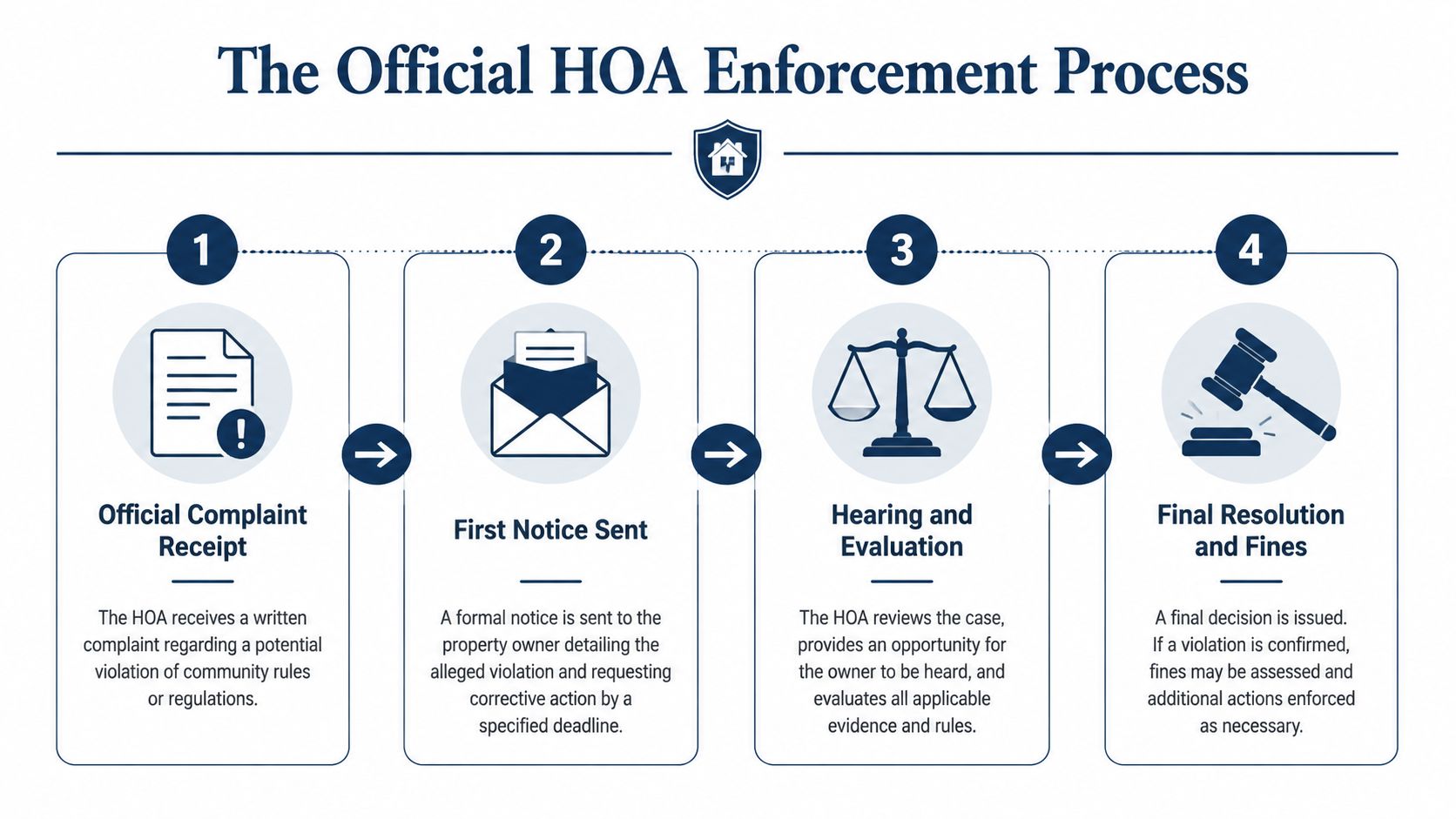
Once the complaint reaches the association, the board needs procedure, not improvisation. Residents notice very quickly when one owner gets a warning, another gets silence, and a third gets fines with no hearing. That's how selective enforcement claims start.
The operational sequence should be steady every time. Receive the complaint. Review the evidence. Send a courtesy notice if the facts support it. Escalate only if the behavior continues. Keep records at every stage.
Step one and step two
The basic workflow is straightforward. Start with the formal written complaint already described above. Then confirm whether the complaint appears to involve a rule violation or nuisance condition the association can address.
After that, issue a courtesy warning letter. This isn't a punishment. It's notice. It tells the resident or owner that a complaint has been made, states the conduct at issue, references the relevant rule, and requests immediate compliance.
A simple warning should include:
- The conduct described in plain language.
- The dates or pattern alleged from the complaint record.
- The governing provision the board believes may apply.
- A request to cure the issue by stopping or reducing the conduct.
- A notice that further violations may lead to formal enforcement.
Keep the tone neutral. Don't accuse. Don't editorialize. Don't write a letter that sounds angry.
Step three and step four
If the noise continues after the warning, move to a formal violation notice. That notice should comply with the association's documents and applicable law. It should explain the alleged violation, the evidence on file, the resident's right to a hearing if required, and the potential consequences.
Then hold the hearing if your process or state law requires one. During the hearing:
- Review the evidence and let the owner respond.
- Stick to the documented facts rather than side arguments.
- Decide based on the rule and the record, not on who is more likable.
After the hearing, the board can impose the remedy authorized by the governing documents. That may include fines, suspension of privileges, or additional directives to cure the nuisance. Any action should align with your published homeowners association violations process.
A board that can't show its paperwork usually can't defend its decision.
Sample notice language
Use language like this in a formal notice:
“The Association has received documented complaints alleging repeated noise disturbances originating from your unit. The reported conduct may violate the community's nuisance and quiet-hours provisions. Please consider this formal notice and review the enclosed information regarding your opportunity to respond.”
That tone works because it is factual and restrained.
The standard that protects the board
The process only works if the board applies it the same way to everyone. If one owner gets endless informal chances while another gets immediate fines, the problem is no longer the noise. It's the board's inconsistency.
The association can also use outside management support where needed. For example, Access Management Group can assist boards with complaint handling, documentation flow, and rule-enforcement coordination as part of association management operations. That kind of support helps boards stay organized, especially when complaints become repetitive or emotionally charged.
Handling Complex Cases and Legal Options

Some complaints look simple at first and aren't. The board thinks it's handling a nuisance case, but the facts start pointing toward disability, medical sensitivity, caretaker needs, or another protected issue. That's where many volunteer boards get into trouble.
A key point often missed in basic advice is that noise complaints can overlap with health or disability concerns, which may trigger fair-housing obligations for the association. Boards need a framework for accommodation requests, supporting documentation, and enforcement decisions because mishandling the issue can create discrimination risk (guidance on noise, disability, and fair-housing concerns).
Cases that need a different lens
The source of the noise may be connected to a protected condition. The impact of the noise on the complaining resident may also be connected to a protected condition. Either way, the board should stop treating it as a routine violation file and slow down.
Examples include:
- A resident requests accommodation because a medical device, caregiver visits, or support-related activity creates recurring sound.
- A complaining owner reports disability-related sensitivity to noise and asks for a different enforcement response or mitigation.
- The facts are unclear and the board is being asked for medical exceptions, modified rules, or special handling.
These situations require judgment, privacy awareness, and legal caution.
When mediation makes sense
Not every hard case belongs on a punishment track. Mediation can be more effective when both residents are dug in, the facts are emotionally charged, or the noise comes from lifestyle clashes rather than outright misconduct.
Mediation works best when:
- Both sides can still communicate without hostility.
- The board wants compliance, not a showdown.
- The issue involves recurring friction like music, pets, guest activity, or shared-wall habits.
A neutral professional can often produce an agreement that the board could never force on its own.
When to call legal counsel
Call association counsel early if any of these appear:
- A fair-housing or disability angle
- Threats of litigation
- Claims of selective enforcement
- Repeated violations after formal hearings
- Requests for accommodation documents or policy exceptions
If the legal review will involve document organization, hearing prep, or compiling complaint records, administrative support can help. Boards or counsel handling heavy case files sometimes use specialized Legal assistants to organize timelines, correspondence, and supporting materials before counsel advises on the next step.
The board doesn't need to become a medical evaluator or a courtroom. It does need to know when a noise complaint has stopped being routine.
Proactive Strategies for a Quieter Community
Reactive enforcement is necessary. It's not enough. The better approach is to lower the number of disputes that ever reach the enforcement stage.
A quieter community usually comes from plain expectations, repeated communication, and early correction. If the rules are vague, residents will fill in the gaps with their own assumptions. That creates conflict the board could have prevented.
Tighten the rules before you need them
Review your nuisance and quiet-hours language. If the documents say only “no annoying behavior,” that's weak. The board should adopt or clarify operating rules that define common problem areas such as amplified music, balcony gatherings, barking dogs, hallway noise, and late-night move-ins.
Use examples. Residents understand examples better than legal abstractions.
Repeat the standards often
Don't bury noise expectations in a stack of closing documents and hope for the best. Put them in routine communication.
Useful channels include:
- Welcome packets for new owners and tenants
- Seasonal reminders before holidays and outdoor entertaining periods
- Community newsletters with short good-neighbor guidance
- Move-in and leasing rules that remind owners they are responsible for their occupants
The easiest violation to enforce is the one the resident was clearly warned about before it happened.
Train the board and manager to respond the same way
Prevention also depends on internal discipline. If one director tells residents to call the police first, another says to “work it out,” and management wants a written complaint, the community gets mixed signals.
Create one standard intake and response method. Then use it every time.
A practical prevention checklist looks like this:
- Standardize forms so complaints arrive with the facts the board requires.
- Publish quiet hours where residents can easily find them.
- Set expectations for owners with renters so lease enforcement supports association enforcement.
- Review repeat locations such as pool areas, courtyards, and units with prior complaint history.
That's how you reduce conflict without becoming heavy-handed.
Frequently Asked Questions on Noise Disputes
What if the noisy neighbor is a renter, not an owner
The board should still enforce the governing documents. In most associations, the owner is responsible for the conduct of tenants, guests, and occupants. Send notices to the owner of record and, where your documents allow, copy the tenant or onsite occupant.
The board shouldn't get distracted by “it's my tenant, not me.” From the association's standpoint, the ownership account is the enforcement point. The owner then handles lease enforcement on their side.
Can the HOA act against noise from short-term rentals
Yes, if the governing documents or adopted rules give the board authority over nuisance activity, occupancy conduct, leasing restrictions, or use limitations. Short-term rental noise is still noise. The fact that the occupants rotate doesn't remove the association's enforcement power.
The board should focus on conduct and document the pattern. If short-term rentals are creating repeat disturbance, the board may also need to review whether its leasing and occupancy policies are too loose or poorly enforced.
How should a board handle a complaint against one of its own members
Treat it like any other complaint, but remove the conflict. The director involved should not investigate, discuss privileged strategy, vote, or influence the outcome behind the scenes.
Good practice includes:
- Recusal by the involved director
- Management-led documentation
- Advice from counsel if the matter is sensitive
- Clear minutes showing the conflicted member did not participate
That protects the board and the complaining resident. It also protects the accused director from claims that the process was either biased in their favor or unfairly political.
Should homeowners call the police for routine noise
Usually no, not as a first move. Use direct communication, documentation, and the association process first. Police involvement makes sense when there is suspected violence, immediate danger, or a likely local ordinance violation that requires public enforcement.
Routine disputes usually improve when the board and management handle them through a documented process instead of turning every complaint into a law-enforcement event.
What if the complaint is real but the proof is weak
The board should ask for better documentation before taking formal action. That's not indifference. It's good governance. Enforcement without evidence creates risk for the association and usually fails if challenged.
A resident with a weak complaint should be told exactly what to provide next time: dates, times, duration, type of noise, and impact. Boards don't need drama. They need records.
If your board needs a cleaner process for handling nuisance complaints, rule enforcement, owner communication, and day-to-day community operations, Access Management Group is a practical resource for HOA and COA leadership that wants a more consistent, homeowner-focused approach.