You open a violation letter about decorations, a driveway condition, or a satellite dish. There's a deadline, a threatened fine, and a reference to community rules. It looks final, but the letter proves only that the association has taken a position, not that its position is legally enforceable.
Before you pay or ignore it, separate a defective rule from a defective enforcement process. Homeowners need that distinction to challenge the right issue. Board members and the HOA or COA president need it to avoid collecting a charge the association can't defend.
Five Tests for Unenforceable HOA Rules
A fine notice can cite a real rule and still fail to establish that the rule is valid or that the association followed the required process. Separate those questions. An unenforceable HOA rule has a specific defect, such as missing authority, conflict with higher law, improper adoption, unclear wording, or unfair application.
Courts generally analyze covenants as private contractual restrictions, examining governing-document authority, consistency with law and public policy, and fair adoption and enforcement. That framework helps owners and boards identify what the documents and enforcement record show.
Five defects that make an HOA rule unenforceable
| Defect | What it looks like | Who is exposed | Usual result |
|---|---|---|---|
| Conflicts with higher law | A total flag ban, an antenna ban on a balcony, or a rule that treats religion differently | Owner protected by statute; board facing a discrimination or preemption claim | Rule void as applied to the protected conduct |
| Exceeds the governing documents | Holiday-decoration guidelines or a rental ban with no supporting covenant language | Owner's use of the home; association fee award | Enforcement judgment and related fees can be lost |
| Improper adoption | Missing owner notice, vote, comment period, or required recording | Every owner subject to the new rule | The penalty, and sometimes the rule, cannot be enforced |
| Vague standard | Bans on unattractive, excessive, or not harmonious conditions without written criteria | Owners judged differently by each reviewer | The fine is hard to defend and may fail for lack of notice |
| Selective or discriminatory enforcement | Similar homes and similar conduct, but only some owners are fined | Targeted owner; fair-housing exposure for the board | That notice or fine may fail; future even enforcement may still be allowed |
Use the strongest matching defect to guide a document-and-timeline audit. Compare the declaration clause with the rule text, then check adoption minutes, required notices, deadlines, and available records of comparable enforcement. A homeowner can use those materials to frame a challenge. A director can use them to assess the association's position, while the president can decide whether collection should pause. A long-standing resolution isn't a substitute for recorded authority.
Use the law that governs your community
The governing state's law shapes which restrictions and procedures apply. Texas owners assessing homeowner rights when facing HOA enforcement can use that resource to orient their questions before reviewing their documents or seeking advice.
Georgia communities should consult guidance on HOA laws in Georgia rather than assume another state's deadlines or remedies apply.
Practical rule: Identify the specific legal or procedural defect, then support it with the relevant document and timeline.
An unpleasant rule may still be enforceable. A clear handbook or unanimous board vote does not, by itself, cure a conflict with higher law, missing authority, or a failure to follow required adoption procedures. Conversely, a valid rule can be undermined by vague notice or inconsistent enforcement. The fine letter alone answers none of those questions.
When the Declaration Never Granted the Power
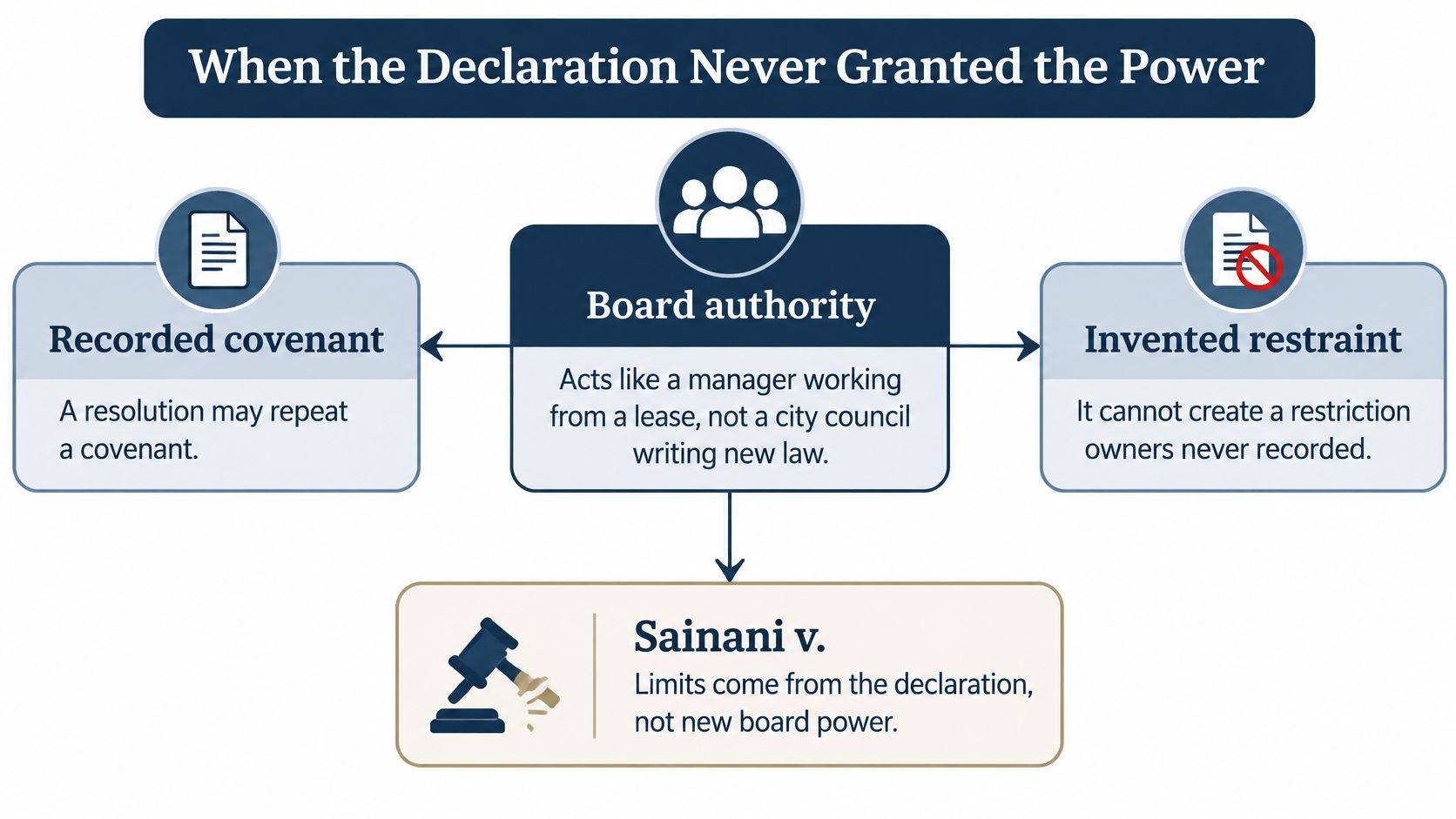
Think of the board as a manager working from a lease, not a city council writing new law. The manager can administer the agreement and exercise powers it grants. The manager can't assume that responsibility for the property includes unlimited authority over its occupants.
Say your association circulates seasonal decorating guidelines. The board may reasonably want predictable removal dates and orderly exterior displays. But the legal question isn't whether directors prefer that policy. It's whether the governing documents authorize that particular restriction.
What the courts rejected
In Sainani v. Belmont Glen Homeowners Association, decided by the Supreme Court of Virginia in 2019, the court overturned a judgment awarding the association monetary relief, an injunction, attorney fees, and costs over holiday decorations. Its seasonal guidelines exceeded the recorded restrictive covenants and weren't reasonably related to a covenant the association could enforce.
That distinction matters when a board points to its general rulemaking power. Permission to adopt rules doesn't establish permission to impose every kind of restriction. A board resolution may implement an existing covenant, but it can't substitute for missing authority.
Leasing restrictions illustrate the same problem. In Estates at Desert Ridge Trails v. Vazquez, a New Mexico Court of Appeals decision from 2013, the court held a rental rule invalid and unenforceable and treated the supplemental declaration as void. The general grant of management power didn't adequately notify owners that the association could later restrict rental activity.
Those decisions aren't a nationwide answer to every decorating or leasing dispute. They demonstrate why the actual language matters more than the label on the board's policy.
Test the authority before debating the policy
Use the complete set of HOA governing documents, including applicable amendments, rather than relying on a welcome packet or a summary sheet.
- Find textual support. Identify the declaration, covenant, or bylaw provision that authorizes the restriction. A general duty to manage the community deserves closer examination when the rule controls private property use.
- Connect the rule to an authorized purpose. Explain how it implements an existing maintenance, architectural-control, or other documented power.
- Verify the adoption route. Determine whether the board could implement that standard itself or needed an amendment, owner approval, or another required step.
Leasing, occupancy, and exterior-change restrictions deserve particularly careful review because they affect how owners use their homes. A board should distinguish a practical implementation detail from a new restraint on ownership.
For presidents, the financial consequence is direct: overreach can cost the association the enforcement case and its related fee award. Continuing to mail the same unsupported guideline doesn't make the next case safer. Obtain a written authority analysis before committing association funds to defend it.
Procedure Mistakes That Void the Penalty
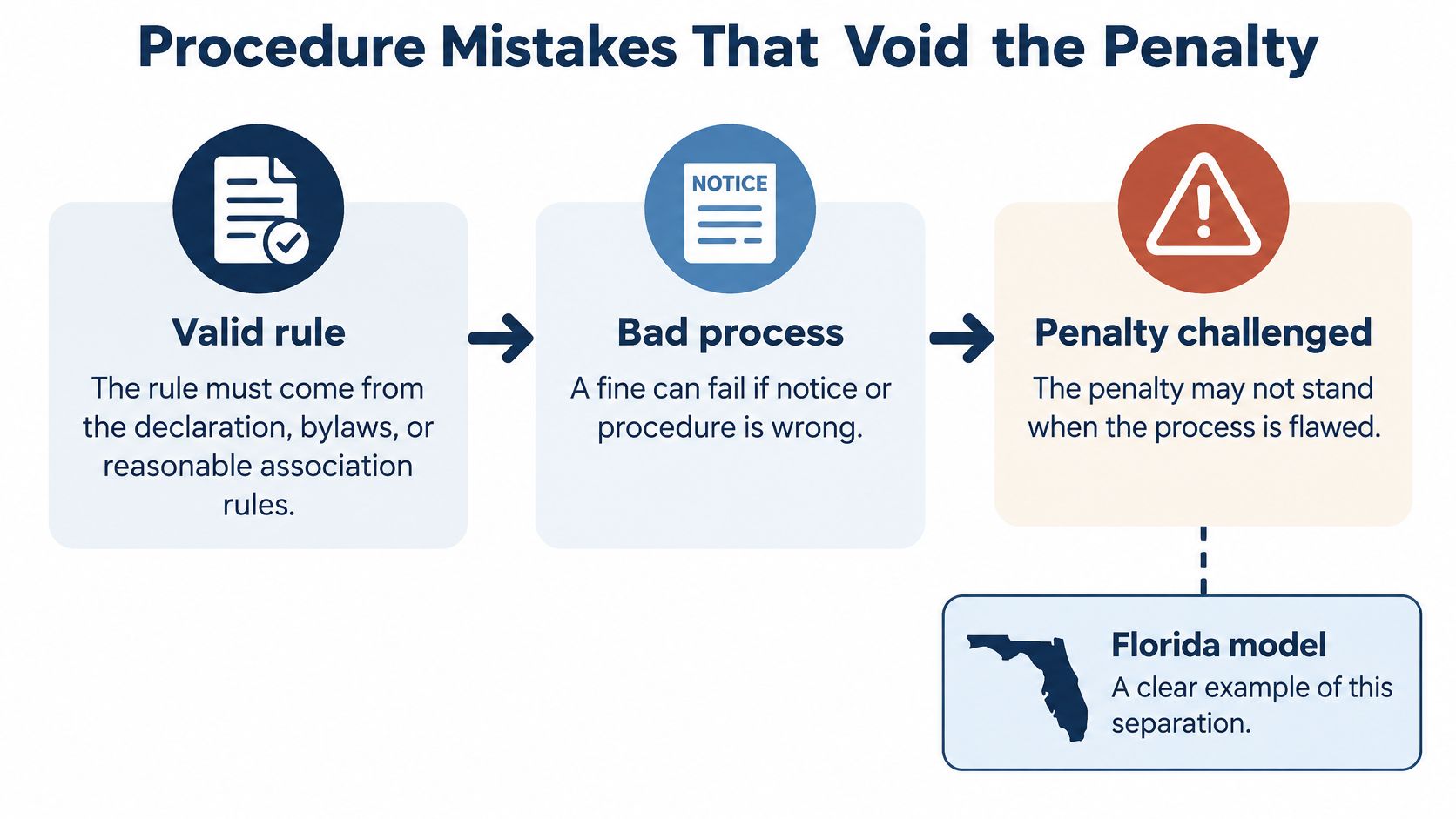
A valid covenant and a collectible fine aren't the same thing. An owner may have violated a properly authorized restriction while still having a sound objection to the association's notice, hearing, or assessment process.
Florida provides a concrete model. Under Florida's HOA enforcement statute, fines must concern violations of the declaration, bylaws, or reasonable association rules; the fine and hearing limits below include the $100 default per-violation limit, $1,000 continuing-violation cap, and specified notice and committee requirements.
Florida fine and hearing limits that can make a penalty fail
| Topic | What is limited | Figure | If the board misses it |
|---|---|---|---|
| Per violation | Fine unless documents provide otherwise | $100 | The fine can be unenforceable |
| Continuing violation | Aggregate of daily fines | $1,000 cap | Amounts above the applicable cap shouldn't be charged |
| Lien | Fines potentially eligible to become a lien | Fine of $1,000 or more | A fine below $1,000 cannot be liened |
| Hearing notice | Written notice of the right to a hearing | At least 14 days before the fine or suspension | The fine process is vulnerable to challenge |
| Hearing timing and panel | Hearing date and committee | Hearing within 90 days; at least 3 members who aren't officers, directors, employees, or their immediate family members | An improperly constituted committee undermines the fine process |
Lien eligibility isn't automatic lien authority. Meeting the monetary threshold doesn't excuse other statutory or document requirements.
Procedure also matters outside Florida. The Minnesota House's account of its 2026 HOA reforms describes at least 21 days' notice for owner review and comment before adopting, amending, or revoking a rule, and a $100 single-violation fine cap unless owners approve more; communities must confirm the applicable effective date before using those requirements.
South Carolina legislative proposals likewise emphasize authority under covenants and bylaws, including authorization for fines. A proposal isn't an operative collection rule, so don't treat it as enacted law or import another state's figures.
Run a document-and-timeline audit
- Locate both grants of authority. Find the provision governing the conduct and the provision authorizing monetary enforcement. They may appear in different documents.
- Reconstruct adoption. Pull the meeting notice, agenda, minutes, and evidence of any required owner comment window. Compare actual dates with required dates.
- Check amendment formalities. If the change required an owner vote or recording, obtain the voting record and recorded amendment. Minutes announcing approval aren't necessarily enough.
- Reconcile the amount. Match the assessment against the fine schedule and applicable statutory limits. Separate individual violations from claimed continuing violations.
- Preserve hearing records. Save the hearing notice, delivery information, committee roster, and written decision. Confirm that the decision-makers were eligible.
A failed fine doesn't necessarily erase the covenant. It may mean the association must stop that collection attempt and use a lawful process going forward.
Outside Florida, obtain the current statute governing your association type before applying any table entry. HOA and condominium procedures aren't interchangeable merely because the communities share a manager.
Vague Wording and Uneven Enforcement
An owner can't reliably comply with a standard that changes whenever a different director reviews the driveway. Terms such as unattractive, excessive, or not harmonious leave too much unanswered when the association supplies no measurable criteria.
The problem isn't that appearance involves judgment. It's that an owner needs to understand what action will resolve the violation, and another reviewer should reach a defensible, comparable result. ManageCasa's discussion of disputed HOA rules identifies vagueness and selective enforcement as sources of enforceability concerns.

Build a comparison, not a rumor
A photograph of another property is a starting point, not a complete selective-enforcement defense. Build the comparison around these questions:
- Similar property. Does the other home fall under the same restriction, with comparable location and physical conditions?
- Similar conduct. Is the actual condition equivalent, rather than merely related?
- Comparable timing. Did both conditions exist during the same enforcement period?
- Board knowledge. Can you show that the association knew about the comparison property?
- No documented distinction. Was there a safety concern, prior written variance, accommodation, or other legitimate reason for different treatment?
Say your driveway letter concerns stored equipment. A neighbor's equipment present briefly during active repairs may not establish unequal treatment. Dated photographs showing comparable long-term storage, together with evidence of board awareness, offer a more useful comparison.
Request records through the community's applicable inspection process. Don't enter neighbors' property, assume private accommodation details are available to you, or treat a missing public letter as proof that no enforcement occurred.
Consistency isn't an all-or-nothing defense
Uneven past enforcement doesn't automatically authorize every future violation. An association may be able to correct its practices prospectively, while the owner's strongest challenge concerns the particular notice or penalty already imposed.
For the board, the repair is operational. Define relevant size, material, placement, or condition standards; use a common inspection checklist; and maintain a violation log with inspection dates, photographs, correspondence, and outcomes.
Write a standard another director could apply next year, not one that depends on the current president's taste.
Use uniform cure periods for comparable violations and record the reason for exceptions. An accommodation shouldn't be mistaken for favoritism because a later manager can't find the explanation.
Proposed South Carolina oversight measures also illustrate attention to knowing violations by board members and managers. Regardless of whether a particular proposal becomes law, presidents should be able to explain the enforcement system, not just defend an individual letter.
Flags Antennas and Fair Housing Limits
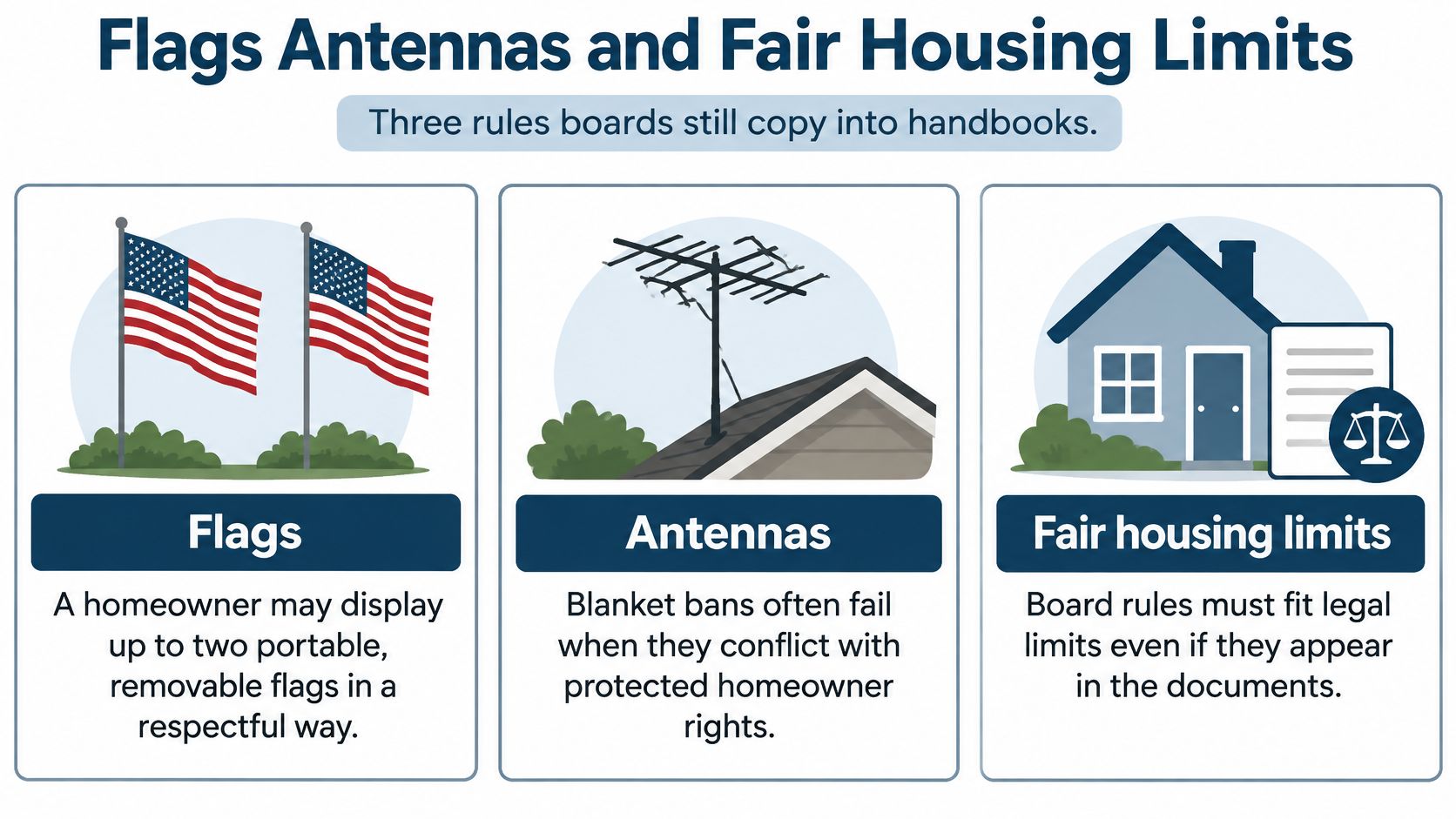
A board updates its handbook and keeps familiar prohibitions against flags, satellite dishes, and exterior displays. Copying those provisions is easy. Applying them without checking legal protections is where the association creates risk.
Each category calls for a different review. The board must identify what the law protects, where that protection applies, and which neutral restrictions remain available.
Flags and reception devices
Under Florida's HOA flag provisions, homeowners may respectfully display up to two portable, removable permitted flags, expressly including the United States flag, with each no larger than 4.5 feet by 6 feet, notwithstanding conflicting association restrictions. That protection concerns the flags and display conditions covered by the statute, not every possible banner.
A board should review permissible time, place, manner, and safety conditions instead of sending a letter based solely on a categorical ban. The fact that the prohibition appears in recorded documents doesn't resolve the statutory conflict.
For reception devices, the Federal Communications Commission's OTARD guide explains protections for qualifying antennas and satellite dishes on property an owner or tenant owns or exclusively controls, including qualifying balconies, terraces, and patios. Restrictions cannot unreasonably prevent installation or use, unreasonably increase cost, or prevent an acceptable-quality signal.
The location is decisive. Association-owned or jointly owned common areas generally aren't covered in the same way, so a request involving a shared roof requires a different analysis from one involving an exclusively controlled balcony.
A central antenna isn't automatically grounds for prohibiting individual equipment. The central system must provide signal quality at least as good and cost no more to use.
Religious displays need a different legal frame
A private HOA generally isn't a government actor subject to the First Amendment in the same way as a city. The fair-housing analysis of religious-display restrictions instead emphasizes the Fair Housing Act's prohibition against religious discrimination in housing terms, conditions, and privileges, alongside potentially broader state protections.
That distinction prevents a common mistake: treating the absence of a constitutional claim as permission to discriminate. A religious item and a comparable secular decoration shouldn't receive different treatment without a legally defensible basis.
Use content-neutral criteria addressing dimensions, attachment methods, location, and genuine safety concerns. Document the actual maintenance or safety issue rather than relying on generalized discomfort with the display.
Where religious practice is involved, obtain appropriate accommodation analysis rather than assuming an automatic entitlement or automatic denial. Presidents should mark potentially protected displays in the inspection checklist before the first violation letter goes out, allowing legal review before the association takes a position it may need to withdraw.
Owner and Board Steps Before Any Fine Is Collected
Homeowners should respond to the notice without conceding that the charge is valid. Silence leaves the association's account unanswered; an organized written objection identifies what must be resolved.
Keep the response factual. A director can investigate a missing clause or delivery record more effectively than an accusation about motives.
The homeowner's response
- Request the enforcement packet in writing. Ask for the covenant or bylaw section, complete rule text, adoption minutes and notice, and applicable fine schedule. Request the version in effect when the alleged violation occurred.
- Calendar every response and hearing deadline. Send a short objection identifying the missing authority, procedural defect, or meaningful comparison. Ask for written confirmation of the hearing arrangements.
- Bring evidence, not just disagreement. Organize dated photographs, correspondence, and lawfully obtained comparable notices. Request an independent committee where governing law requires one.
- Resolve payment deliberately. Don't assume that disputing the charge automatically pauses collection. Ask counsel whether to seek a collection hold, pay an undisputed amount, or use a payment-under-protest practice if available and appropriate.
The practical handling of homeowners association violations should keep the alleged condition, response deadline, hearing request, and monetary dispute clearly separated. Continue paying unrelated, undisputed assessments unless your attorney advises otherwise.
The board and president's repair plan
- Pause new fines under a questionable rule. Send counsel the actual documents and timeline, not a summary that assumes authority exists.
- Replace subjective wording where authority is sound. Adopt measurable standards through the required process, with consistent cure periods for comparable cases.
- Use an amendment when power is missing. Stop unsupported enforcement and follow the required notice, voting, and recording route. Another resolution isn't a substitute.
- Record exceptions and accommodations. Preserve an appropriate explanation so a successor manager can distinguish an authorized exception from an overlooked violation.
- Tell owners what changed. Identify withdrawn charges, revised procedures, and restrictions that remain effective. Avoid implying that every community obligation has been suspended.
At AMG, we assign a specific Community Association Manager (CAM) to each community, and the Board receives that manager's contact phone and email. Each CAM must hold at least a Community Association Management license, giving the Board a named, credentialed contact for organizing the record.
We keep up with current developments and anticipated changes through communication with association attorneys, service providers, CAI, and pro-association lobbyists. That supports informed administration, while community-specific legal conclusions belong with association counsel.
A missing authority clause, adoption record, or hearing step is a reason to pause and investigate, not automatically declare a debt collectible or erased. Before a disputed lien proceeds, the president should send the packet to counsel; the owner should preserve the hearing request and dispute the charge in writing. A rule that fails should be repaired lawfully or dropped, not reissued under a different title.
Access Management Group offers HOA and condominium association management that supports homeowners and boards in handling community concerns and maintaining organized communication. If your community needs a clearer approach to violation records, owner responses, and board follow-through, visit Access Management Group to discuss your association's management needs.