You've probably seen it happen already. A new board gets seated, someone opens the declaration, and a term shows up that nobody wants to admit they only half understand: PUD. Then the questions start. Does it just mean the neighborhood has amenities? Does it change what the board has to maintain? Does it affect budgets, rules, or legal authority?
Yes, it does.
For a Georgia HOA board, a Planned Unit Development isn't just a real estate label. It's the operating model for the community. It shapes what owners bought, what the association must maintain, and where hidden costs can sit for years before they hit the budget. If your board treats a PUD like a basic subdivision, you'll make avoidable mistakes in maintenance planning, covenant enforcement, and reserve funding.
We're a customer-centric boutique property management and community management company, and articles like this should first help homeowners, board members, and the HOA or COA president make better decisions. So let's keep this practical. If you're asking what does planned unit development mean, the right answer is this: it means your community was designed as a single coordinated project, and your board now carries the long-term responsibility for making that plan work.
An Introduction to Planned Unit Developments
A new Georgia HOA board gets control from the developer, opens the files, and finds private streets, a detention pond, monument lighting, planted buffers, and design standards tied to the original approval. Then the budget discussion gets real. Those items cost money every year, and many of them exist because the community was approved as a Planned Unit Development.
A Planned Unit Development, or PUD, is a community approved under a single development plan that allows a mix of uses, housing types, open space, and shared improvements that would not fit neatly into conventional zoning. The concept started as a flexible zoning tool in the early twentieth century and expanded into larger master-planned communities with varied densities and building forms by the 1960s, as summarized by the National Association of Realtors overview of planned unit developments.
For a board, the history matters less than the structure it created. A PUD usually leaves the association with broader duties, more layered restrictions, and more exposure to long-term costs than a simple plat subdivision. That is why boards need to read the community as a legal and financial system, not just a neighborhood with amenities.
The part many boards miss is this: municipalities often require the developer to provide features or infrastructure as a condition of approval. Those exactions can include open-space maintenance, stormwater facilities, buffering, private roads, entrance features, sidewalks, trail systems, or lighting. Once turnover happens, the developer is gone and the association inherits the operating bill.
That is also why PUDs often function as a stricter form of deed-restricted community governance. The restrictions are not only about appearance or owner conduct. They often tie directly to land-use approvals, maintenance assignments, and shared cost obligations that the board cannot ignore without creating legal and financial problems.
Why boards need to care early
If your community is a PUD, start with three assumptions:
- Your documents assign real operating duties. The declaration, plats, easements, and approval exhibits often decide who maintains roads, drainage, walls, signage, landscaping, and recreational property.
- The association may own less than it maintains. Some PUD obligations arise from easements, license areas, or municipal approval conditions, not just fee-simple common area.
- Your budget needs to account for inherited approval costs. Reserve planning, insurance, vendor contracts, and special project forecasting should reflect what the original development plan requires the association to keep up.
Board advice: If your documents say “Planned Unit Development,” treat that as a governance and reserve-planning issue on day one.
Get the declaration, final plat, recorded easements, design standards, turnover materials, and local approval documents. Review them before you set priorities. If you do not know what the municipality required and what the developer promised, you will underbudget, misassign maintenance, and frustrate owners fast.
What a PUD Really Means for Your Community
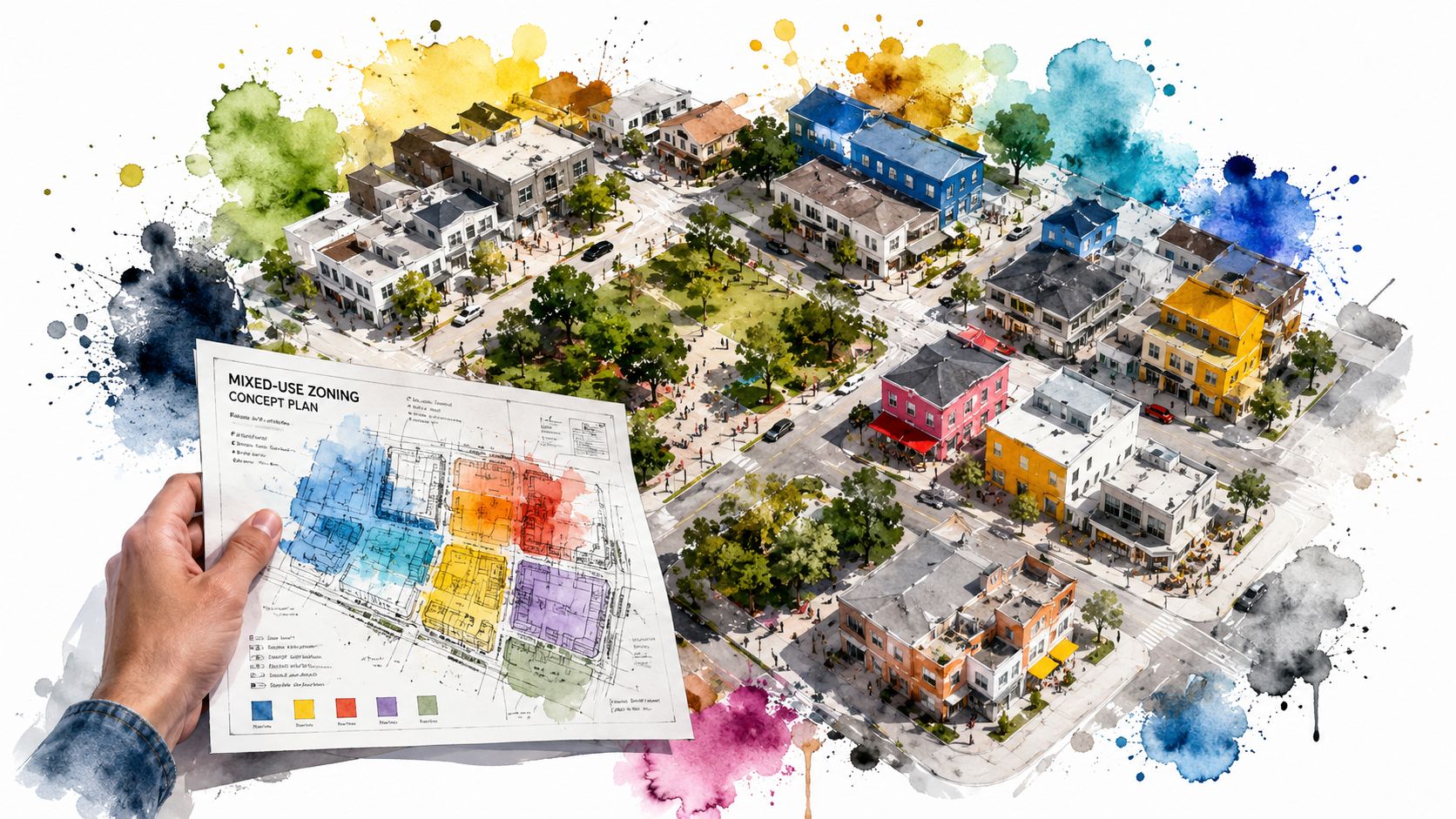
A PUD works best when you think of it as a master-planned operating system for the neighborhood. It's not just homes on lots. It's a coordinated land-use and governance framework that ties design, use, and maintenance together.
A strong technical definition comes from planning practice. A PUD functions as a “floating overlay district” or similar flexible zoning mechanism that lets a developer meet community density and land-use goals without being locked into conventional zoning rules, while adjusting setbacks, density, and building heights to create clustered design and common open space, as explained in the University of Wisconsin-Stevens Point planning guide on planned unit development.
That sounds like planner language. For a board, it means the community was approved as a whole, not as a pile of unrelated parcels.
The three parts that affect daily governance
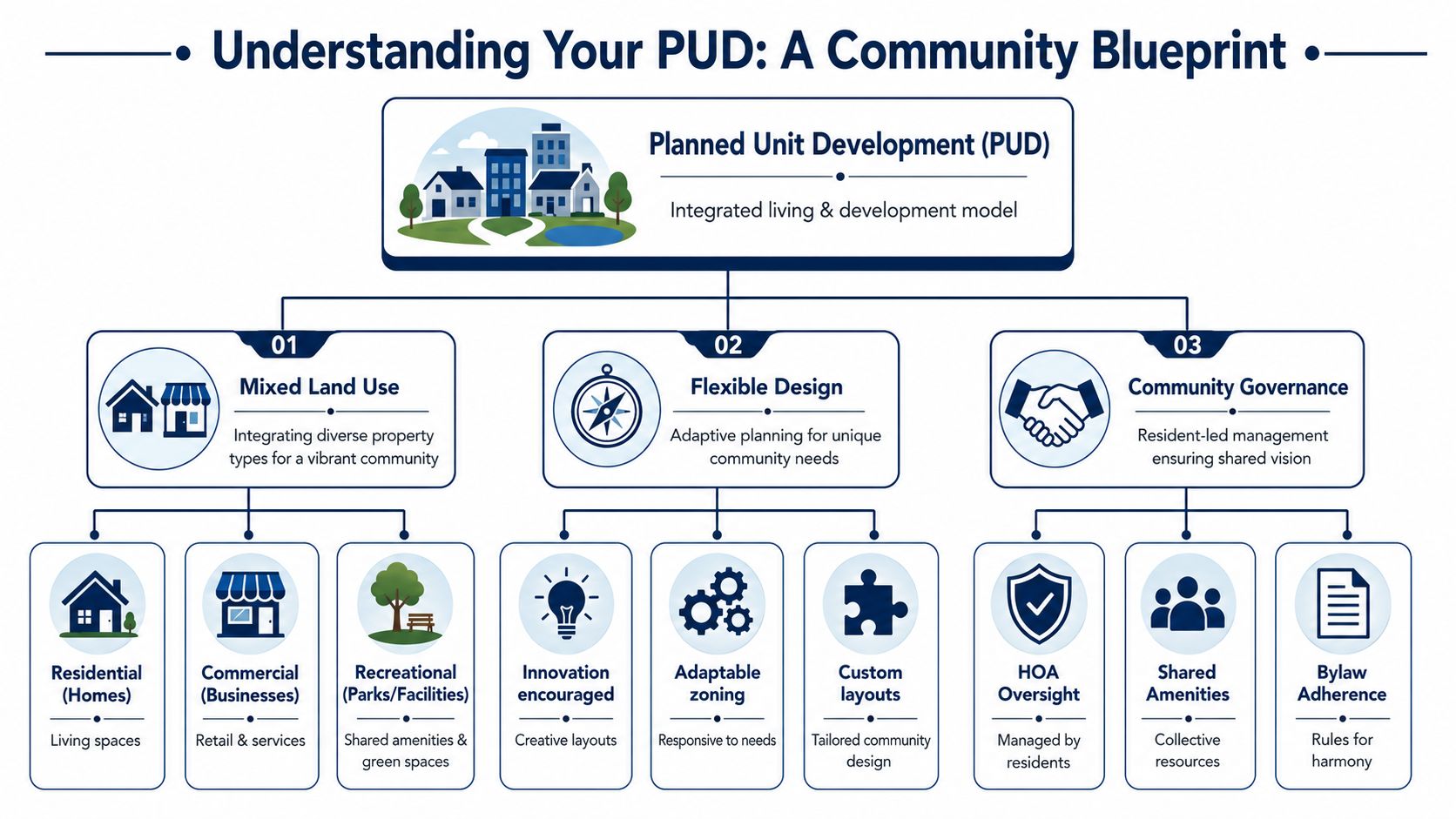
Most PUDs create a long-term board workload in three areas.
Mixed uses
Some PUDs combine detached homes, townhomes, green space, retail pads, offices, or recreational facilities. Even where the community looks purely residential, the planning logic is the same: the site was designed as one integrated place.
That creates board questions a standard neighborhood may not face. Parking near nonresidential areas, delivery access, signage, lighting, and use restrictions all become more sensitive when one part of the community affects another. Boards that ignore those friction points usually end up managing complaints instead of preventing them.
Shared property and shared systems
PUDs often rely on common areas to make the whole design work. Open space isn't decorative. It's part of the approval concept. The same may be true for private roads, sidewalks, landscaping buffers, detention areas, playgrounds, monuments, and club facilities.
If your board wants a plain-English way to think about it, compare the PUD framework with the broader idea of a deed-restricted community and what those rules mean in practice. In a PUD, the restrictions and shared responsibilities usually go further because the development itself was approved as a unified plan.
Covenants with operational consequences
Boards often focus on covenant enforcement as an aesthetic issue. In a PUD, covenants are often doing heavier work. They preserve the layout, land-use balance, maintenance standards, and design consistency that justified the original approval.
A PUD board isn't just enforcing neighborhood preferences. It's protecting the structure of the community the municipality approved.
What this changes for the board
Here's the blunt version. If you govern a PUD, your board isn't just collecting dues and sending violation letters. You're managing a coordinated physical plant and a tightly connected set of use rights.
A practical board checklist looks like this:
| Board focus | What to verify |
|---|---|
| Use controls | Whether any parcels or amenities have special restrictions or shared-use rights |
| Maintenance map | Which assets belong to the HOA, to owners, or to another entity |
| Approval conditions | Whether municipal approvals imposed ongoing obligations |
| Insurance scope | Whether the policy matches the actual property and risk profile |
| Reserve planning | Whether long-life common assets are being funded realistically |
If you want the clean answer to what does planned unit development mean, this is it: your community was built to operate as one planned whole, and that makes your board responsible for more than most owners assume.
PUD vs Subdivision vs Condominium
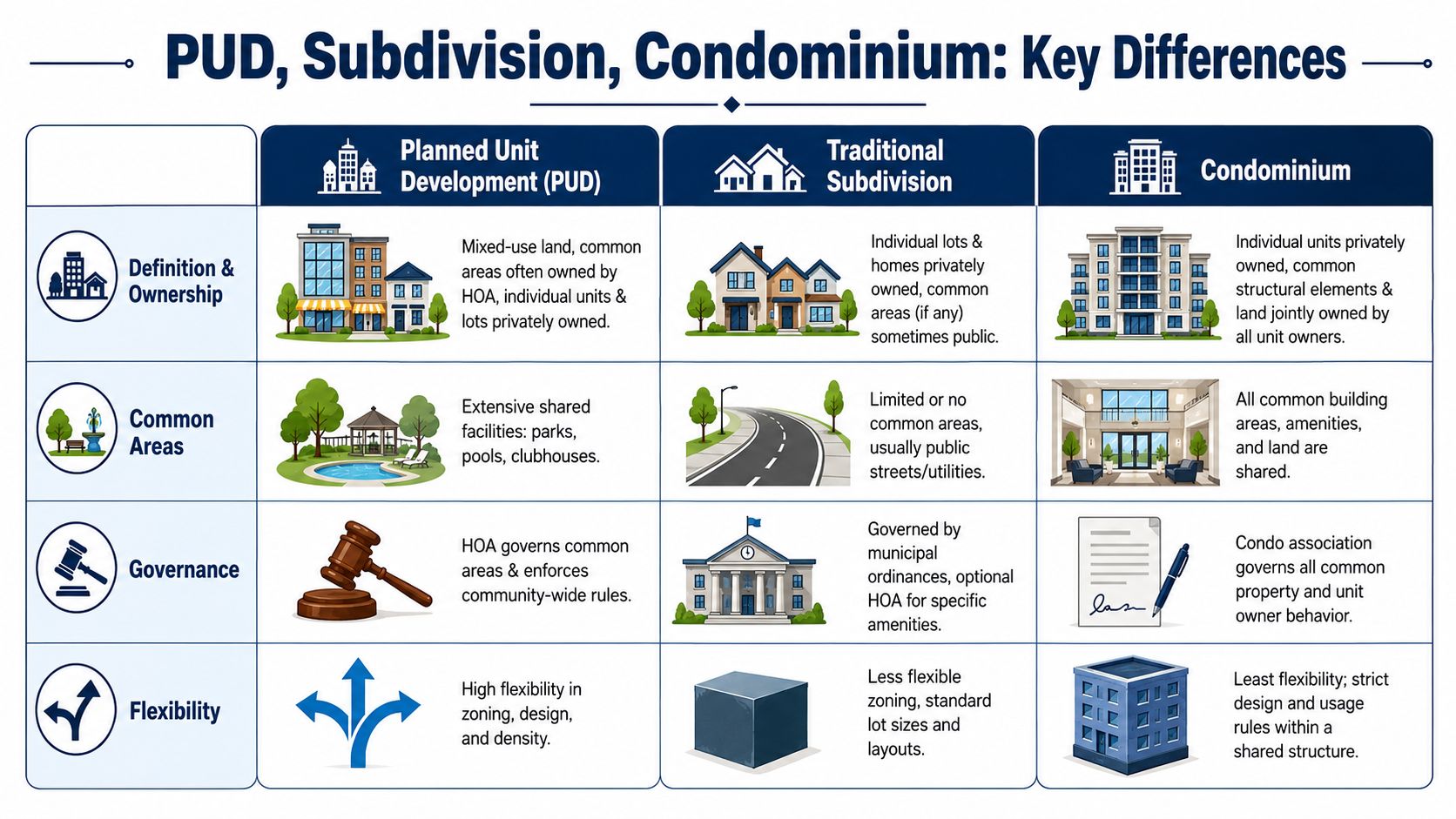
Boards get into trouble when they use these terms loosely. Owners do it. Realtors do it. Sometimes even vendors do it. But for governance, PUD, subdivision, and condominium are not interchangeable.
The biggest practical difference is the ownership and maintenance structure. That difference controls what the board can enforce, what the association must insure, and who pays when something breaks.
Where a PUD stands apart
A PUD is a housing community with a mandatory homeowners association that administers common property. Unlike a standard subdivision where an HOA may be optional, ownership in a PUD requires membership in the HOA, and that membership supports shared amenities and common property management, as described in Clear Capital's definition of a planned unit development.
That mandatory structure is the dividing line many homeowners miss.
A practical side-by-side view
| Issue | PUD | Traditional subdivision | Condominium |
|---|---|---|---|
| What owners usually own | A home and often the lot, subject to community-wide controls | A home and lot, often with fewer shared systems | An individual unit, with common ownership interests in shared elements |
| HOA membership | Mandatory | Sometimes optional or limited | Mandatory |
| Common property | Often extensive, including amenities or infrastructure | Sometimes limited, sometimes public | Broad common elements throughout the property |
| Board authority | Broad, because the community operates as an integrated plan | Often narrower unless documents expand authority | Broad, especially over shared building systems |
Why this matters in board decisions
If you govern a subdivision with minimal common property, your board may mostly manage landscaping contracts and basic covenant enforcement. If you govern a condominium, the association may be significantly involved in roofs, exteriors, and structural elements.
A PUD sits in the middle and can be harder to run. Owners may think they “just own a house,” but the association may still be responsible for significant common assets and design controls. That's why board members need to understand both ownership boundaries and operational boundaries.
For a useful ownership comparison, review the practical differences between single-family and multi-family home community structures. It helps boards explain why a detached-home PUD can still carry association responsibilities that feel much closer to a shared-interest community than a simple neighborhood.
Three questions to settle immediately
When a new board takes over, I'd insist on clear answers to these three questions:
What does the owner own outright?
Don't rely on sales language. Use the plat, declaration, and recorded easements.What exactly does the association maintain?
Private roads, detention systems, walls, irrigation, entry monuments, and green buffers are common flashpoints.Who has rule-making authority over mixed-use impacts?
If residential owners live near commercial or recreational activity, vague authority creates conflict fast.
If your board can't explain the difference between your PUD and a condo in one minute, owners won't understand their obligations either.
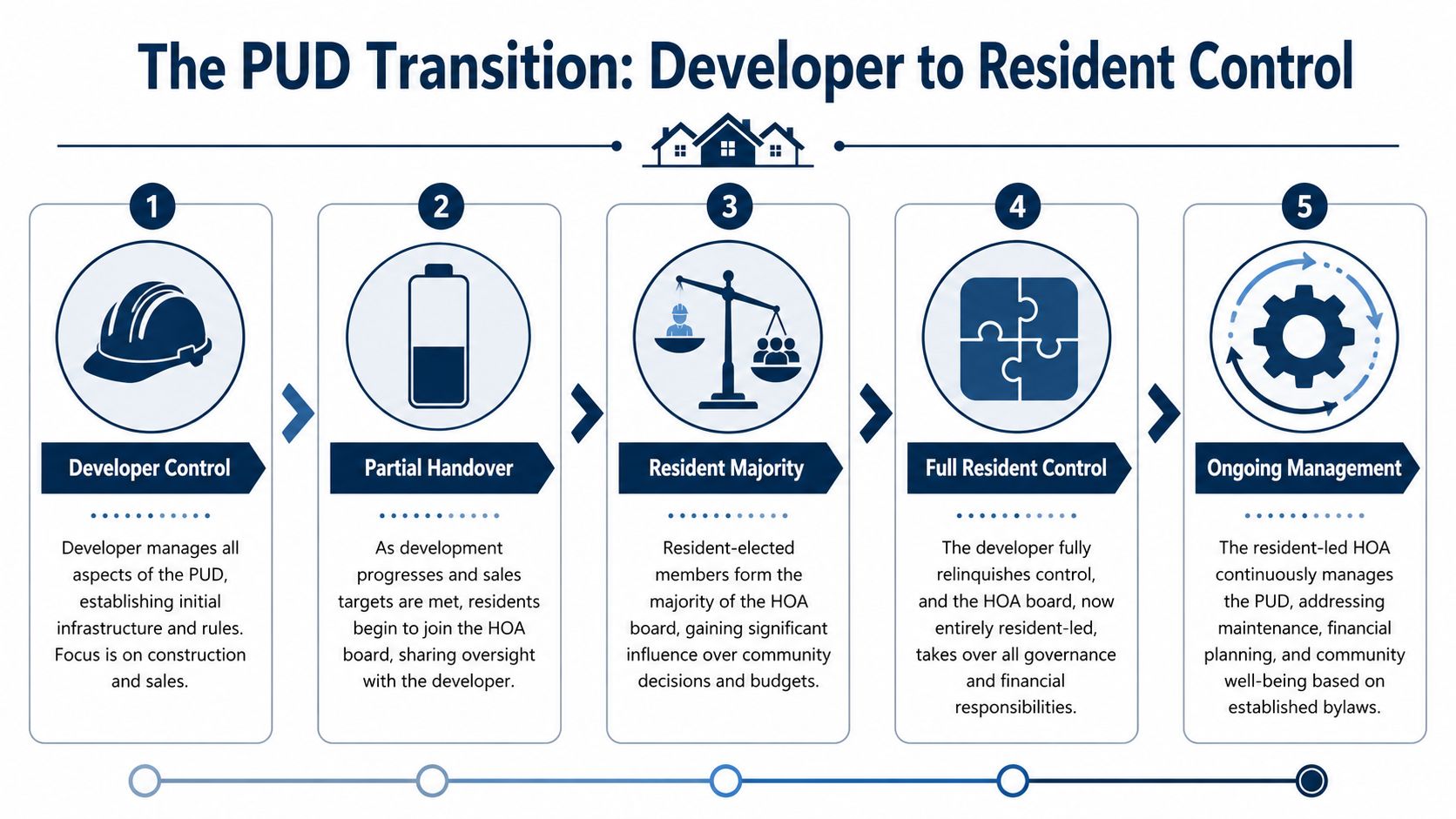
The Critical Developer-to-Association Transition
The most important season in a PUD's life is the handoff from developer control to resident control. A weak transition leaves the board holding unfinished projects, thin reserves, undocumented infrastructure, and years of avoidable disputes.
Too many boards treat turnover like a ceremony. It's an audit.
What the board should demand
The resident board needs the full paper trail and the physical reality behind it. That means more than a binder of declarations and meeting minutes.
Use the community's HOA governing documents as the control checklist for transition review, but don't stop there. The board should also push for municipal approvals, engineering materials, vendor contracts, warranties, and any records showing what was promised versus what was built.
A serious turnover file should include:
- Financial records showing assessments collected, expenses paid, open receivables, contracts, and reserve balances
- Physical asset records such as as-built plans, maps, equipment lists, warranty documents, and maintenance histories
- Legal and approval records including permits, zoning conditions, easements, plats, and association filings
- Operational records like access credentials, vendor contacts, architectural files, and owner rosters
Inspect before you accept
Don't assume the common areas are complete because they look finished from the street. PUDs often include buried systems, drainage components, site lighting, irrigation, retaining features, and hardscape that won't show problems until after turnover.
I tell boards to separate the turnover review into two tracks:
Paper review
Confirm what the association is legally obligated to own, maintain, insure, and enforce.
Field review
Inspect what the association will inherit.
Board advice: If a component will become the association's responsibility, inspect it before full turnover, not after the first failure.
Watch for the quiet risks
Some of the worst transition problems aren't dramatic. They're hidden in assumptions.
- Amenities may be “substantially complete” but not fully documented.
- Reserve funding may exist on paper but not match actual replacement needs.
- Rules may have been enforced unevenly during sales activity.
- Commercial or undeveloped parcels may still carry rights that affect residents later.
A careful transition gives the resident board an advantage. A sloppy one gives the board bills.
Governing a PUD Key Financial and Maintenance Duties
Boards either protect the community or slowly weaken it. A PUD board has to run the association like an operator, not a volunteer club. That means disciplined budgeting, clear maintenance allocation, and zero confusion about long-term obligations.
The biggest mistake I see is treating the annual budget as a list of recurring invoices. In a PUD, that isn't enough. You also need to account for inherited obligations tied to the original development approval.
Build the budget around obligations, not habits
Start with a maintenance matrix. Every common asset should be listed with four answers: who owns it, who maintains it, how often it must be serviced, and how replacement is funded.
That sounds basic, but many PUD boards still don't have one. Without it, the association ends up arguing over irrigation lines, fencing segments, vegetation buffers, private streets, stormwater structures, or limited-use amenities after a failure. By then, the budget problem is already real.
A useful operating list should cover:
- Infrastructure assets such as private roads, sidewalks, drainage features, lighting, and signage
- Amenity assets such as pools, clubhouses, courts, parks, and playgrounds
- Grounds systems including irrigation, monument beds, buffers, and tree management
- Boundary items where owner responsibility and association responsibility meet
Reserve planning in a PUD has to be tougher
A board can't fund reserves by guesswork. PUDs usually carry more varied assets than a simple neighborhood, and those assets don't fail on the same timeline. Surface repairs, amenity upgrades, vegetation replacement, and infrastructure rehabilitation all compete for money.
That's why reserve planning has to reflect the actual property, not a generic template. If your reserve schedule ignores roads, stormwater components, walls, or site systems because they're inconvenient to price, your board isn't conserving cash. It's delaying a future assessment fight.
Budgeting for a PUD means planning for the assets owners use every day and the systems they never see.
Exactions are the hidden board problem
Here's the issue too many boards discover late. Municipalities often require PUD developers to give something in exchange for zoning flexibility. That may include land dedications, park or trail contributions, off-site improvements, or related conditions attached to the approval.
In some regions, 78% of suburban PUDs include these exactions, and HOA fees run 12% higher on average than comparable non-PUD communities because the association ends up carrying those long-term costs, according to the Housing Affordability Institute analysis of planned unit development exactions.
That should change how every board reads its financials.
What boards should do about exactions
Don't treat municipal conditions as old developer business. If the obligation affects land, amenities, maintenance standards, or replacement costs inside the community, it's your business now.
I recommend a direct review in four parts:
Pull the approval history
Get the zoning file, development agreement, site plan approvals, and recorded conditions from the local jurisdiction.Match every condition to a present-day cost
If there's trail maintenance, open-space upkeep, off-site responsibility, or dedicated improvements, put a budget line or reserve line against it.Check whether assessments allocate costs fairly
Mixed-use PUDs especially need to verify that residential owners aren't subsidizing obligations tied to another parcel or use.Explain the burden to owners clearly
Residents are more likely to support disciplined budgeting when the board can show which costs come from mandatory community obligations, not board preference.
Maintenance discipline protects resident satisfaction
Homeowners don't care what zoning framework created the problem. They care whether the lights work, the outdoor spaces are maintained, the amenity is open, and the fees make sense.
That's why good PUD governance is practical. Clear responsibility charts reduce conflict. Honest reserve planning reduces special assessment pressure. Early identification of exactions prevents ugly budget surprises. Boards that do this well usually create calmer communities, because owners can see the system is being run on purpose.
Navigating Common PUD Pitfalls and Challenges
The flexibility that makes a PUD appealing also creates management traps. Most of them start small. Then they turn into recurring arguments because the documents weren't interpreted early enough.

The parking fight that isn't really about parking
A resident complains that customers from a nearby commercial parcel are using residential guest spaces. The commercial owner says the area has always functioned that way. The board reviews the complaint and realizes the documents aren't clear enough on shared parking rights.
This is common in mixed-use or adjacent-use PUDs. The fix is to stop improvising. The board needs legal interpretation of the recorded rights, then written parking rules that match the governing documents and can be enforced.
The landscaping dispute that exposes a bad maintenance map
Owners on one side of the community assume the HOA maintains a buffer. The board assumes the adjoining lots do. Months go by, the area declines, and now everyone is angry over appearance and cost.
That problem isn't really about landscaping. It's about unclear allocation. The solution is a written maintenance responsibility chart adopted by the board and distributed to owners. If responsibility is still ambiguous, get counsel involved and amend where necessary.
Good PUD boards don't wait for repeated complaints. They convert gray areas into written operating rules.
The reserve shortfall nobody wanted to face
A community center, private road segment, or drainage component needs major work. Owners are shocked because dues have stayed artificially low for years. The board now has to explain why prior budgets ignored obvious replacement needs.
That's a credibility problem as much as a financial one. Boards fix it with a realistic reserve framework, staged funding, and plain communication. Say what the asset is, who uses it, why it wears out, and how the community will pay for it.
The covenant issue that becomes selective enforcement
A PUD with multiple housing types often develops uneven enforcement habits. Detached homes get one standard. Attached homes get another. Commercial activity gets tolerated because the board doesn't want conflict.
That approach fails fast. Boards need a documented enforcement process with consistent notice, hearing, and compliance procedures. Consistency protects owner trust as much as legal position.
PUD FAQs for Georgia HOA Boards
Georgia boards usually don't need more theory. They need clear next steps.
Does a PUD automatically fall under the Georgia Condominium Act
No. A PUD and a condominium are not the same thing. Some communities may contain condo components, but a PUD itself is a development structure, not automatically a condominium form of ownership. Your board needs to confirm the legal regime by reading the recorded declaration, plats, and any condominium instruments if they exist.
If the documents create a property owners' association rather than a condominium, your authority, maintenance obligations, and assessment procedures may follow a different framework. Don't guess. Confirm the community's legal structure with association counsel.
Does the Georgia POA Act apply to our PUD
Sometimes yes, sometimes no. A Georgia community may be subject to the Georgia Property Owners' Association Act if the declaration submits the community to that act or if later amendments do so validly. The answer sits in the recorded documents, not in marketing materials or owner assumptions.
The board president should ask for a written legal summary of the association's governing authority. That memo should identify what statute applies, what powers the board has, and what collection and enforcement tools are available.
How should we handle limited common areas or shared-use areas
Start with documents, then create an operating schedule. If an area is shared but not used equally, the board should document who maintains it, who insures it, who replaces it, and whether any cost allocation is different from general assessments.
If that allocation isn't clear, fix the ambiguity before the next repair bill. Unclear maintenance is one of the fastest ways to create owner resentment.
What should a newly seated Georgia PUD board do first
Use a disciplined first-pass checklist:
- Read the declaration and plats first so you understand what property structure you're governing.
- Map maintenance duties across all common areas, easements, and visible infrastructure.
- Review the budget against actual obligations instead of relying on prior-year habits.
- Pull local approval records to identify any continuing municipal conditions.
- Confirm applicable Georgia law with counsel so enforcement and governance decisions rest on the right authority.
What's the shortest answer to what does planned unit development mean for our board
It means your board governs a community that was planned and approved as one coordinated development, and that creates broader long-term duties than many owners expect. In Georgia, that should push the board toward tighter document review, better maintenance mapping, stronger reserves, and more disciplined communication with residents.
If your Georgia HOA or COA board needs experienced help interpreting a PUD's obligations, managing turnover issues, tightening financial controls, or improving resident confidence, Access Management Group brings decades of community association management experience and a long-standing reputation in Georgia for protecting, preserving, and enhancing community assets.