A pipe bursts on the fifth floor at 2:10 a.m. Water runs into the hallway, slips through the floor assembly, and damages the unit below. By breakfast, the board president has three emails, two angry voicemails, and one practical question from the community manager: who turns in the claim, and who pays what?
That's where many boards and homeowners freeze. They know the association has insurance. They know owners should carry their own policy. But when drywall, cabinets, flooring, and common-area carpet are all damaged in the same event, the line between those policies can feel blurry fast.
For homeowners, that confusion can turn into surprise bills. For the homeowners' board and the HOA or COA president, it can turn into conflict, delayed repairs, and financing problems that affect future sales. A condo master insurance policy isn't just another annual renewal item. It's one of the main tools a board uses to protect the building, the association's finances, and each owner's investment.
Your Guide to Navigating Condo Insurance
When water spreads through a condo building, the damage rarely stays in one place. The hallway carpet may belong to the association. The drywall inside a unit may fall under one policy, while upgraded hardwood floors may fall under another. A resident may assume the association's carrier will handle everything, only to learn their own policy needs to step in for part of the loss.
That's why the condo master insurance policy matters so much. It decides where the association's protection begins, where the unit owner's responsibility starts, and how expensive the gray areas can become.
Boards that serve homeowners well treat insurance like a map, not a mystery. They don't wait until after a loss to explain the boundaries. They spell out what the master policy covers, what owners need on their HO-6 policy, and how deductibles are handled before the first emergency mitigation crew arrives.
If you're sorting through a current claim, practical claim-side reading can help. Homeowners dealing with unit-level losses may also benefit from these insights for condo owners in WA, especially when they need help understanding how a building-wide event turns into several different insurance responsibilities.
For boards that want a broader governance view, it also helps to review HOA insurance requirements in the context of maintenance duties, governing documents, and owner communication.
Practical rule: If your board can't explain a burst-pipe claim in plain language, owners probably don't understand their exposure either.
What Is a Condo Master Policy Anyway
Think of the master policy as the building's shared shield. The association buys it. The association maintains it. Its job is to protect property the community owns or is obligated to insure as a group.
That matters because condo living splits ownership into layers. One owner holds title to a unit. The association is responsible for common elements and, depending on the declaration, parts of the structure inside units. Without a master policy, a major fire or storm loss could leave the association without a workable path to rebuild shared property.
Why the association carries it
A condo community isn't just a collection of private homes. It's also a roof system, exterior walls, hallways, utility infrastructure, and shared spaces that no single owner can insure for everyone else. That's why every condominium association is required by statute and governing documents to carry a master insurance policy on the building. It protects the basic structure of the unit, including walls, floors, and fixtures, and helps shield the HOA from liability for common assets, as explained in Whiteford's overview for condominium owners.
For a new board president, the easiest analogy is this: your community budget pays for the building's umbrella. Individual owners still need raincoats.
What it's meant to do in a real loss
When the covered damage affects shared building components, the master policy is the first major layer of protection. It exists so the association can repair or rebuild the parts of the property the community depends on together.
That's why a board should think about the policy in operational terms:
- Protect the building shell: Roofs, structural elements, and common areas can't be left to individual owners.
- Protect the association balance sheet: A large uninsured structural loss can create severe pressure on reserves and assessments.
- Protect the owners collectively: Strong association coverage helps preserve habitability, governance stability, and confidence in the community.
The master policy protects the association as a whole. It doesn't replace the owner's personal insurance.
Where confusion starts
People often hear “the association has insurance” and assume that means every damaged item in a unit is covered. It doesn't. The answer depends on the coverage type in the declaration and policy documents.
That's why boards should keep the full policy and the declaration aligned, readable, and accessible. If those documents don't clearly describe the association's responsibility, the claim discussion can become a dispute discussion very quickly.
Three Types of Master Policy Coverage
Not every condo master insurance policy reaches the same distance into a unit. That's the source of many owner surprises. Two associations can both say “we have a master policy,” yet the amount of interior unit coverage can be very different.
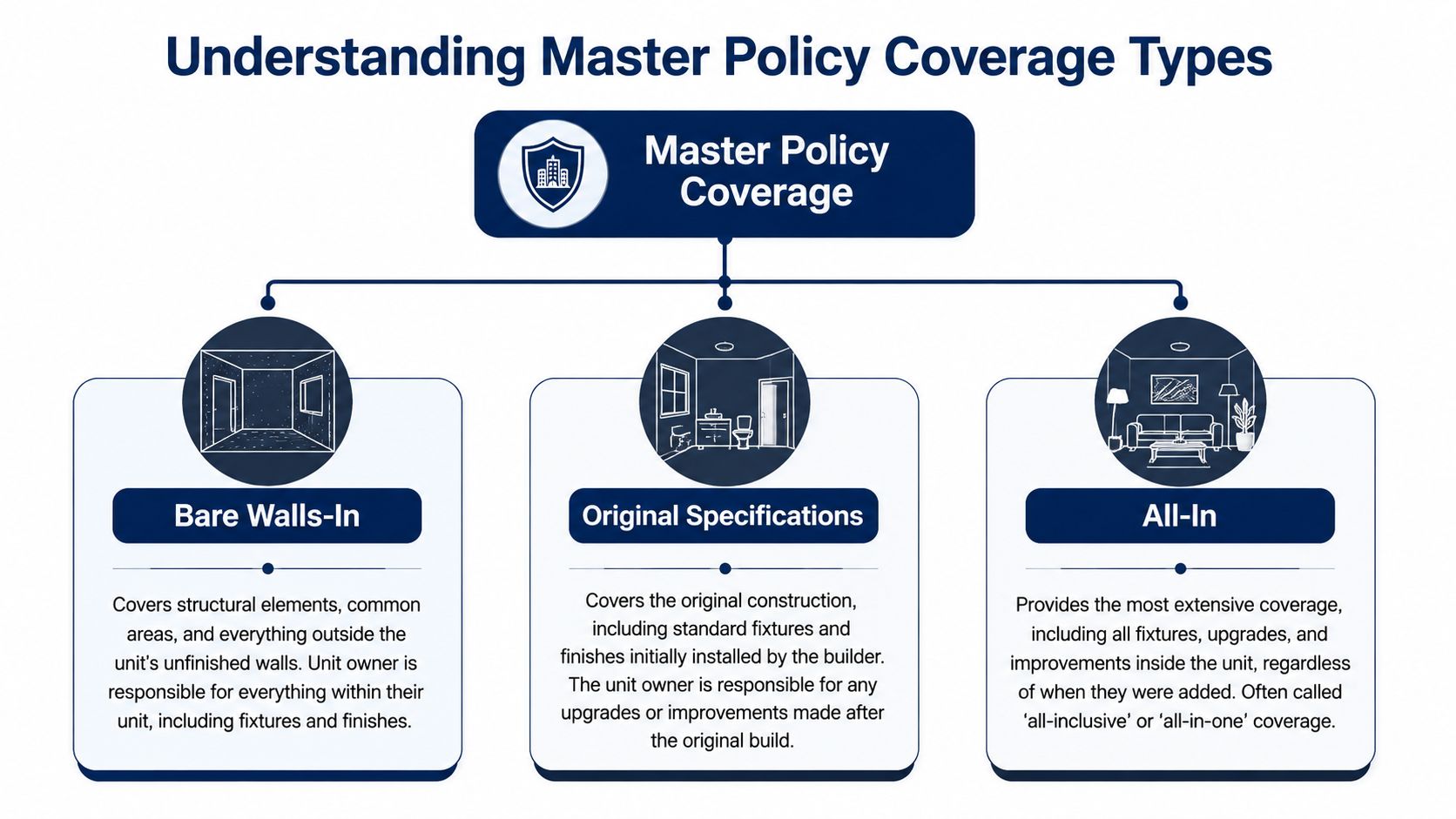
Here's the visual shorthand boards often need when explaining this to owners.
Bare Walls-In
This is the leanest approach. It generally covers basic structural elements and stops short of much of the finished interior.
If a unit is damaged, the owner may be responsible for a large share of what is typically referred to as “the home” inside the unit. That can include interior finishes and fixtures, depending on how the declaration defines the boundary.
A simple way to explain it to owners is this: the association insures the shell, and the owner insures what makes the shell livable.
Single Entity
This is the middle ground and, in practice, the version many communities encounter. Most modern master policies use a Single Entity approach, covering standard interior finishes but excluding unit-specific improvements. The specific approach is dictated by the condo's declaration, which unit owners must provide to their agent to prevent coverage gaps and personal liability, as noted in Walton Insurance's discussion of condo master policy structures.
That means the policy may cover original or standard finishes, but not later upgrades. So if one owner replaced builder-grade flooring with high-end hardwood or remodeled the kitchen, the upgraded portions may fall outside the master coverage.
All-In
This is the broadest form. It can include interior finishes and improvements inside the unit.
From an owner's perspective, that may sound ideal. From a board's perspective, it can create a wider association insurance obligation and more complicated claims administration. Broader coverage can simplify some claim questions, but it also changes where costs land.
Why boards and owners get tripped up
The labels themselves can mislead people. Some owners hear “walls-in” and think everything from paint to personal property is included. It isn't that simple. The declaration controls the coverage approach, and the policy should match it.
A practical owner checklist looks like this:
- Read the declaration first: It determines the interior coverage approach.
- Match the HO-6 to the gap: Owners need their personal policy to pick up what the master policy doesn't.
- Update after remodeling: Renovations can create a larger uninsured gap if the owner doesn't increase dwelling coverage.
A remodeled unit can be underinsured even when the association's master policy is perfectly valid.
Master Policy vs Individual HO-6 Policy
This is the split every board should explain at move-in, at budget time, and again before renewal season. The master policy protects the association's stake in the property. The HO-6 policy protects the owner's personal stake.
If you treat them as overlapping circles, you'll get confusion. It's better to treat them like adjoining rooms with a door between them. Each has a job, and trouble starts when people assume the other room is handling it.
Coverage Responsibility Master Policy vs. HO-6 Policy
| Item/Area | Master Policy Coverage | Individual HO-6 Policy Coverage |
|---|---|---|
| Building exterior | Typically covered | Not typically covered |
| Common areas | Typically covered | Not typically covered |
| Walls, cabinets, flooring, and similar fixtures within units | May be covered depending on the master policy structure | May cover gaps, especially improvements not covered by the master policy |
| Furniture | Not covered | Typically covered |
| Clothing | Not covered | Typically covered |
| Electronics | Not covered | Typically covered |
| Unattached personal belongings | Not covered | Typically covered |
| Owner-added upgrades and betterments | Often not covered under narrower master structures | Typically where owners need coverage |
| Personal liability inside the unit | Not the main purpose of the master policy | Typically covered under the owner's policy |
| Temporary living costs after a covered loss | Not the owner's primary protection | Often addressed by the owner's policy, depending on that policy |
The key factual boundary is straightforward. The master policy covers the building's exterior, common areas, and fixtures within units like walls, cabinets, and flooring. It explicitly excludes unattached fixtures or personal belongings like furniture and electronics, which must be covered by a homeowner's individual HO-6 policy, as outlined by Cragin & Pike's explanation of master policy coverage.
What this means in plain language
If a fire damages a building, the association's policy may handle structural components and certain built-in fixtures. If smoke ruins a resident's sofa, clothing, television, and laptop, the owner's HO-6 is the policy that usually matters.
That's why boards should remind owners that the master policy is not a substitute for personal coverage. It's the foundation for the building, not a complete protection plan for private household losses.
A useful owner conversation
When owners ask what limits they need, the answer isn't one-size-fits-all. It depends on the declaration, the unit's interior condition, and whether the owner has made upgrades. Helpful consumer-oriented reading, such as Schneider & Associates condo insurance, can help owners frame the right questions for their personal agent.
For boards, the bigger point is consistency. If your community says the master policy is “walls-in,” but owners don't know whether their renovations are included, your communication is incomplete.
Who Pays the Master Policy Deductible
This is the friction point that causes some of the hardest conversations in condo communities. A claim gets approved. Repairs begin. Then someone asks the most uncomfortable question in the room: who pays the deductible on the association's policy?
In many communities, owners assume the association pays because it's the association's insurance. That assumption can be expensive.
The direct answer owners often miss
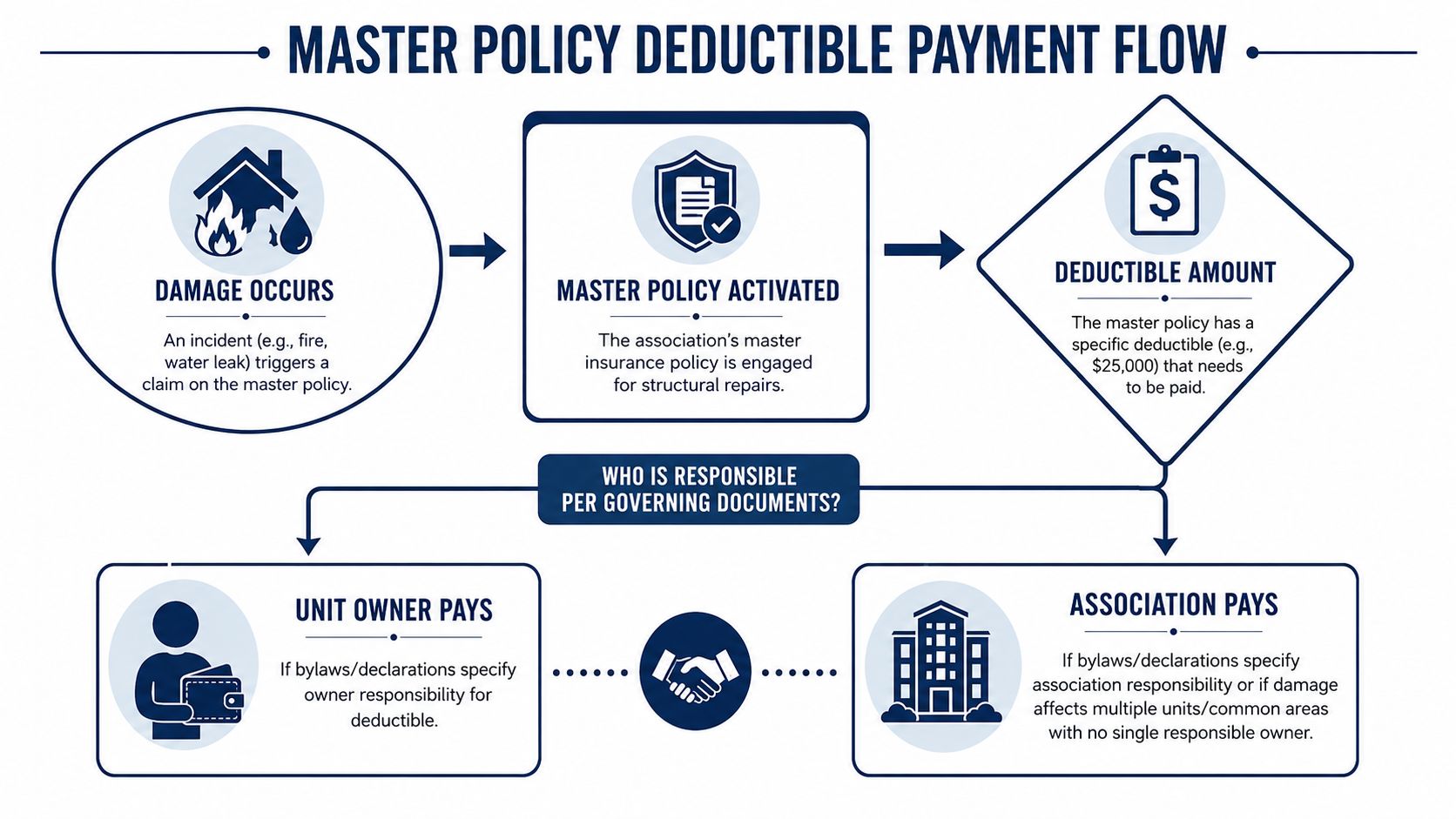
When interior unit damage is covered by the master policy, the owner of the unit that suffers the damage is responsible for the master policy deductible. Many HO-6 policies don't automatically cover that exposure, which creates a serious financial risk for owners, as discussed in the legal analysis from Marcus Errico Emmer Brooks.
That catches people off guard because the logic feels backward at first. If the association's policy is paying for the repair, why would the owner pay the deductible? The answer is that the governing documents and claim structure can allocate that front-end loss to the affected owner.
Why this turns into conflict
Owners usually don't budget for a large deductible obligation tied to a policy they don't personally buy. They may also assume their HO-6 automatically fills that gap. Sometimes it does not.
Boards can reduce this friction by being explicit long before a claim happens. Don't bury this in annual renewal paperwork. Spell it out in owner education, resale packages, and claim notices.
A practical board approach includes:
- Review the declaration and bylaws: Confirm exactly how deductible responsibility is assigned.
- Adopt clear resolutions if needed: Ambiguous language invites disputes.
- Tell owners to review their HO-6: They should ask whether it addresses master policy deductible exposure.
- Plan for claim communication: Owners need immediate, plain-language notice after a loss.
Boards dealing with the possibility of passing insurance-related costs to owners should also understand how special assessment insurance for condo communities fits into the larger risk picture.
Board reminder: Deductible confusion doesn't start after the loss. It starts when documents are vague before the loss.
One example that helps
If a kitchen fire damages one unit's interior and the association turns to the master policy for the covered structural repair, the owner may still be the one responsible for the deductible tied to that claim. That isn't just a technicality. It's a real out-of-pocket exposure that can affect an owner's finances immediately.
For homeowner-focused boards, this is one of the most important educational points to communicate clearly and repeatedly.
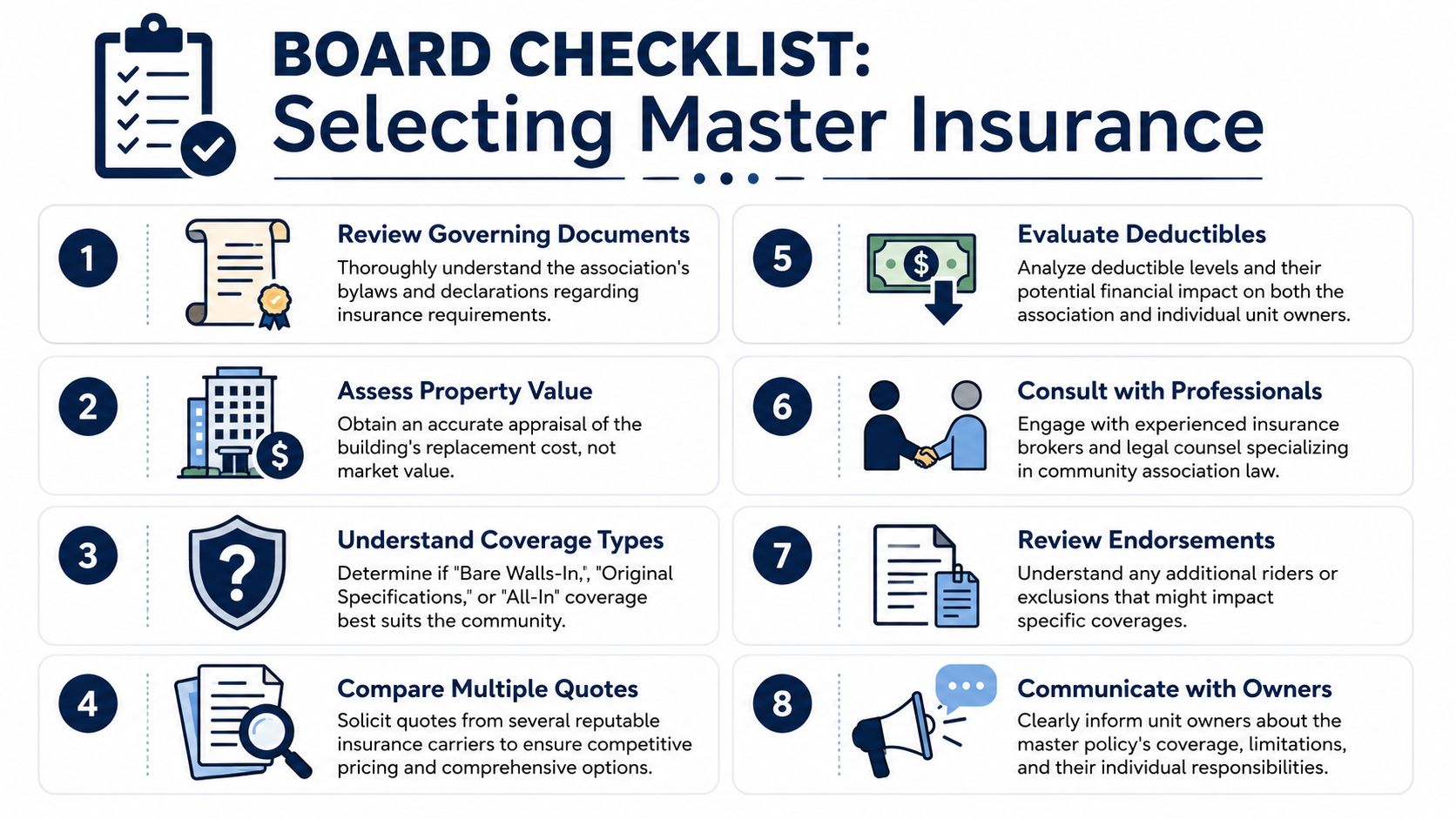
A Board's Checklist for Buying Coverage
Insurance renewal shouldn't be treated like shopping for office supplies. The board is making a decision that can shape post-loss rebuilding, owner costs, and even lender acceptance in the community.
The strongest boards review the condo master insurance policy with the homeowners' interests first. They ask whether the coverage protects the building well, fits the governing documents, and reduces avoidable financial shocks for owners.
Non-negotiable coverage issues
Fannie Mae's project development standards set out several core requirements. The master policy must cover 100% of replacement cost, not actual cash value. It must also include Building Ordinance or Law Coverage, specifically Coverage A for loss to the undamaged portion of a building, Coverage B for demolition costs, and Coverage C for increased construction costs. For developments with central heating or cooling systems, Boiler and Machinery or Equipment Breakdown Coverage is required, with coverage equal to the lesser of $2 million or the building's replacement cost, according to Fannie Mae's master property insurance requirements.
That replacement cost requirement is especially important. Actual cash value leaves depreciation in the equation. Boards don't want a major loss settlement reduced in a way that creates a rebuilding shortfall.
A practical renewal checklist
Use this checklist when evaluating new quotes or renewals:
Start with the declaration
The policy should match the community's insurance obligations and unit boundary definitions.Confirm replacement cost language
If the coverage basis isn't replacement cost, the board should understand the risk immediately.Ask about ordinance or law coverage
Rebuilding after a loss may trigger code upgrades. Those costs can become a major problem if they aren't addressed.Check central system exposure
Buildings with shared heating or cooling systems need the required equipment breakdown protection.Review deductible structure carefully
Lower premium doesn't always mean lower community cost. Deductible strategy can shift meaningful financial burden onto owners.Compare policy form with owner expectations
If the policy is narrower than the community assumes, owner education has to be stronger.Coordinate insurance with reserve thinking
Insurance and reserves are connected. Boards working through condo reserve fund requirements should look at whether reserve planning and deductible strategy fit together.
Questions worth asking the broker
- How does this policy align with our declaration?
- What is excluded inside units?
- How is deductible responsibility typically handled under our documents?
- Does this structure create owner lending or resale concerns?
- Are endorsements changing the practical scope of coverage?
Good insurance decisions aren't only about premium. They're about whether the community can recover cleanly after a loss.
Frequently Asked Questions from Boards
Can a high deductible hurt mortgage approvals
Yes. A master policy with a deductible exceeding 5% of the property value can cause lenders to view units as un-warrantable, which can affect unit sales and financing availability, a problem highlighted in this community discussion about condo master insurance deductibles and lending.
For boards, this is bigger than an insurance issue. It can become a marketability issue. If buyers struggle to finance purchases, current owners may face a smaller buyer pool and harder resale conditions.
What should a board do right after a loss
Act fast and document everything. Mitigate ongoing damage, notify the carrier promptly, preserve photos and reports, and communicate clearly with affected owners. The board should also separate emergency response from final coverage decisions. Cleanup teams, adjusters, counsel, and managers may all need different information.
If the policy is unclear, where should the board look first
Start with the declaration and the full policy, not a summary sheet. Most disputes come from people relying on shorthand labels like “walls-in” without reading how the documents define the responsibility.
What's the real governance lesson here
Boards shouldn't assume that an insurance policy is “good enough” because it renews each year. Policy structure affects deductibles, owner disputes, and even financing outcomes. A careful board explains those effects to homeowners before there's a leak, fire, or sale under contract.
Access Management Group helps condominium and homeowner associations protect, preserve, and enhance their communities through experienced association management. If your board wants practical support with insurance coordination, owner communication, financial planning, and day-to-day governance, learn more about Access Management Group.