You're comparing a condo and a duplex because the listings look similar enough to confuse the issue, but the paperwork, insurance, decision-making, and future obligations feel completely different. A condo may offer shared maintenance and a simpler day-to-day routine. A duplex may give you greater control and another path to rental income, but it also puts more responsibility on the owners.
The mistake is treating a duplex as merely a larger condo or treating a condo as a small apartment building. A condo is primarily a legal ownership structure. A duplex is primarily a building form with two dwelling units. That distinction affects title, voting, assessments, insurance, financing, maintenance, and resale. It also affects how property ownership affects taxes, because the legal form of ownership can shape the obligations attached to the property.
| Factor | Condominium | Duplex |
|---|---|---|
| Core structure | Individual unit ownership plus collectively owned common elements | Two dwelling units, commonly held in one or two fee-simple parcels |
| Governance | Association, board, declaration, bylaws, and recorded allocation formulas | Direct owner decisions, unless a formal common-interest regime exists |
| Shared costs | Common expenses and assessments allocated under governing documents | Private agreements, parcel obligations, or negotiated cost sharing |
| Insurance focus | Unit interior coverage plus association master policy | Whole-structure property and liability coverage |
| Buyer diligence | Unit, association, reserves, insurance, rules, and project eligibility | Title, structure, income assumptions, repairs, and owner coordination |
The difference is also historical. Belgium adopted the first true condominium statute in 1924, the model spread through civil-law countries, Puerto Rico enacted the first U.S. condominium statute in 1958, and the federal government recognized the condominium concept in the National Housing Act of 1961. That legal history helps explain why condo associations have formal governance systems that a typical duplex doesn't automatically have. (Condominiums, Reform, and the Unit Ownership Act)
If you're comparing a condo with a two-unit home, this overview of single-family vs. multi-family homes can help separate architectural design from legal ownership.
Understanding the Core Ownership Difference
A buyer walks into a condo showing and sees a private kitchen, living room, and front door. At a duplex showing, the buyer sees two kitchens, two entrances, and perhaps a shared roof. Visually, both properties can feel like independent homes. Legally, they can be worlds apart.
In a condominium, the buyer owns a defined unit and an associated interest in the common elements. Those common elements can include structural components, roofs, stairs, elevators, parking areas, corridors, and other shared assets. The buyer doesn't receive a physically carved-out piece of the roof or a separately marked fraction of the hallway. The ownership is undivided, which means the owners collectively hold the common elements under the condominium declaration. (California-style condominium materials)
A duplex, by contrast, is usually a two-unit building rather than a statutory ownership regime. Ownership commonly follows one or two fee-simple parcels. The owners might share a wall, driveway, roof, utility line, or yard, but those shared responsibilities don't automatically create a condominium association. The parties generally need a deed, agreement, easement, or other recorded instrument to define who pays and who decides.
Why the legal category matters
The distinction controls more than the closing statement. In a condo, the declaration and bylaws determine how owners vote, how common expenses are allocated, and how the association can maintain or repair shared property. In a duplex, the parties may have more freedom to negotiate, but that freedom can become a liability when a neighbor delays a repair or disputes the cost.
Condominiums expanded into a major housing format as urban markets needed shared ownership models. In Canada, owner-occupied condominiums increased more than five-fold from 1981 to 2006, reaching 916,000 units, according to Canadian housing data. The same data separates condominiums from detached duplex apartments, reinforcing that one category describes ownership and governance while the other describes a building type. (Canadian housing data)
Practical rule: Never identify ownership from the exterior. Read the recorded deed, declaration, master deed, and any condominium instruments before assuming a property is a duplex or a condo.
For a buyer, this means the first question isn't “Which layout do I prefer?” It's “What exactly will I own, and who will control the property outside my unit?” For a board president, the same question determines whether the association has authority to act or whether the matter belongs to individual owners.
Legal Title and Ownership Mechanics
Condo ownership becomes technical at the point where the declaration assigns each unit its share of the common elements. That recorded percentage often controls the unit's share of common expenses and may also influence voting rights. In many statutory systems, the percentages must add up to 100% overall, and the formula used to establish them must appear in the declaration. (Maryland condominium statute
The percentage isn't just a technical line in a schedule. It can affect regular assessments, special assessments, voting weight, resale disclosures, and the financial expectations attached to a unit. A larger unit may carry a larger percentage, but that isn't universal. Some statutes permit an equal fractional allocation, while others require a particular formula.
The declaration is not a casual policy document
Boards often discover the rigidity of these allocations when owners ask for a “fairer” split. Illinois law provides that a unit's percentage interest in the common elements remains constant unless the law permits a change or all unit owners agree. Montana requires agreement from all unit owners with an interest in the common element and a recorded amendment before the percentage can be altered. (Illinois Condominium Property Act)
That means a board generally can't change ownership shares, expense burdens, or vote weights through a routine resolution. A change may require unanimous or near-unanimous owner consent, legal drafting, and a formal amendment to the declaration. The board administers the existing structure. It usually doesn't have power to redesign it.
Florida provides a particularly clear example for residential condominiums created after April 1, 1992. The undivided share assigned to each residential unit must be based either on total unit square footage in a uniform relationship to the other units or on an equal fractional basis. (Florida Statutes Section 718.104)
A duplex normally starts from a simpler premise. If each unit is separately held by fee-simple title, the owners don't automatically have statutory percentage interests in common elements. They may still need an agreement for a shared roof or driveway, but the arrangement is usually private unless the property has been formally converted into a condominium or another common-interest structure.
Governance and Maintenance Responsibilities
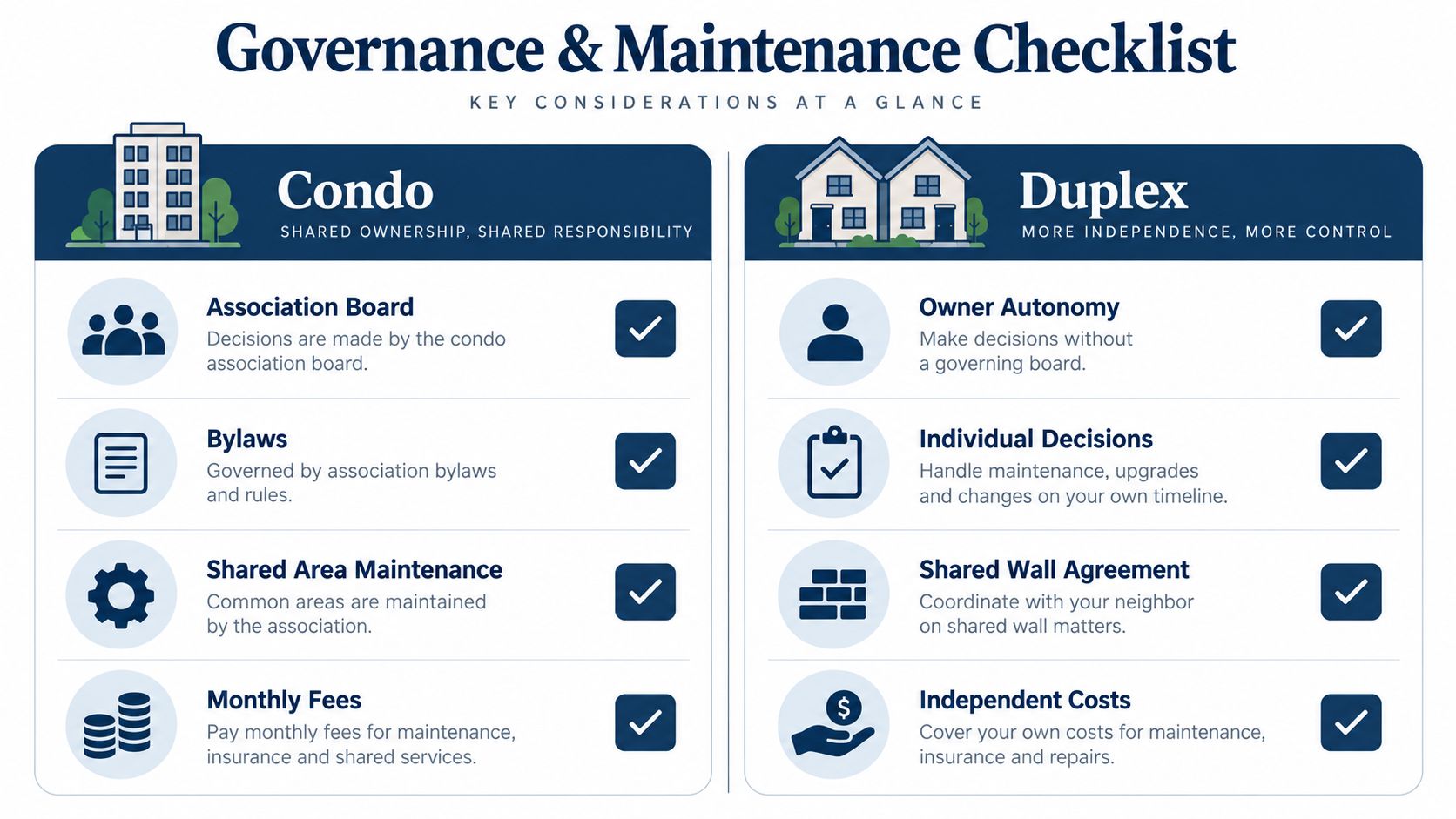
A condo association has authority because the owners created a legal regime that gives the association responsibility for common elements. The board sets priorities within the declaration, bylaws, budget, applicable statutes, and fiduciary duties. It can select vendors, schedule maintenance, administer contracts, enforce rules, and levy assessments for legitimate common expenses.
That authority comes with constraints. Owners collectively own common elements, but they don't own separate physical slices that they can control independently. The association may therefore control roofs, stairs, elevators, parking areas, exterior walls, and similar assets, subject to the governing documents and applicable law. (Condominium common-element explanation)
What the condo board controls
A responsible board president should focus on three things:
- Maintenance authority: Confirm whether the declaration assigns the roof, windows, balconies, plumbing lines, and exterior surfaces to the association or individual owners.
- Reserve responsibility: Match reserve planning to the actual components the association must repair or replace. A low assessment today doesn't prove a healthy financial plan.
- Owner communication: Explain how the recorded allocation formula affects assessments instead of presenting every charge as an equal split.
The association can provide consistency. It can also limit personal control. An owner who wants to replace an exterior door, alter a balcony, rent the unit, or install equipment may need approval even if the work seems confined to that owner's space.
What duplex owners must coordinate
Duplex ownership usually offers more autonomy. Owners can decide directly how to handle a repair, choose their own contractor, and negotiate timing without a board vote. That flexibility is valuable when both owners communicate well.
The downside is direct conflict. One owner may want the least expensive roof repair while the other wants a longer-lasting replacement. One may occupy the property while the other rents a unit. Without clear documents, disagreements can delay work and damage the relationship.
A board or management team that handles multiple communities also needs reliable records for work orders, contracts, invoices, owner requests, and approvals. Choosing the right property management system can help organize those workflows, while the governing documents themselves should remain the controlling authority. Boards can also use this guide to HOA governing documents when reviewing which decisions belong to the board and which require owner action.
Financing, Insurance, and Cost Structures
A condo buyer is underwriting more than a personal residence. The lender may review the association's budget, reserves, master insurance, pending repairs, and owner-occupancy ratios alongside the borrower's finances. Duplex financing usually resembles financing for another one-to-two-unit property, with attention on the entire structure, its condition, replacement cost, insurability, and the owner's ability to manage it.
Insurance follows the title structure. A condo owner's policy generally covers the unit interior, often called a “walls-in” finish package, personal property, and liability. The association's master policy generally covers common areas and shared structures. A duplex owner typically insures the entire building, lot-related exposure, and liability, whether one unit is owner-occupied or both are rented.
The 2026 deductible issue
For 2026 condo financing, the maximum allowable per-unit deductible on a condominium master policy is capped at $50,000. The buyer may also need individual HO-6 coverage at least equal to that deductible, plus protection for any peril excluded from the master policy. (2026 condo insurance requirements)
The deductible creates a direct financing and claims risk. If the master policy carries a large deductible and the unit owner lacks matching HO-6 coverage, a lender may question the loan or a loss may exceed the owner's protection. Board treasurers should review the deductible before renewing the policy, then confirm that owner requirements and association documents align.
| Factor | Condominium | Duplex |
|---|---|---|
| Primary insurance structure | Owner generally insures interior finishes, personal property, and liability; association insures shared structures and common areas | Owner generally insures the entire structure, lot-related exposure, and liability |
| Financing review | Borrower plus association budget, reserves, master insurance, repairs, and owner-occupancy ratios | Borrower plus whole-property condition, replacement-cost valuation, and liability coverage |
| 2026 deductible focus | Master-policy per-unit deductible capped at $50,000, with HO-6 coverage potentially matching it | Lenders commonly focus on whole-structure coverage and replacement cost |
| Liability benchmark | Tied to unit policy and association coverage requirements | Requirements commonly target at least $300,000, often $500,000+, in liability coverage |
| Main financial risk | Special assessments, weak reserves, inadequate master coverage, or project ineligibility | Large repairs, vacancy, direct maintenance, and insufficient whole-property coverage |
For buyers, request the master policy, deductible schedule, association budget, reserve information, and recent assessment history before removing financing conditions. Review Washington condo insurance differences with an insurance professional, because a standard homeowners policy may not match condominium coverage responsibilities.
Association fees also require a service-and-risk review, not just a price comparison. Examine how homeowners association fees for condos fund reserves, insurance, maintenance, and other obligations. A lower fee can indicate fewer services or underfunded future repairs, while a higher fee may reflect scheduled capital work and stronger protection against sudden assessments. Boards should explain that allocation clearly, because owners ultimately pay through regular assessments, insurance premiums, or special assessments.
Market Resilience and Resale Considerations
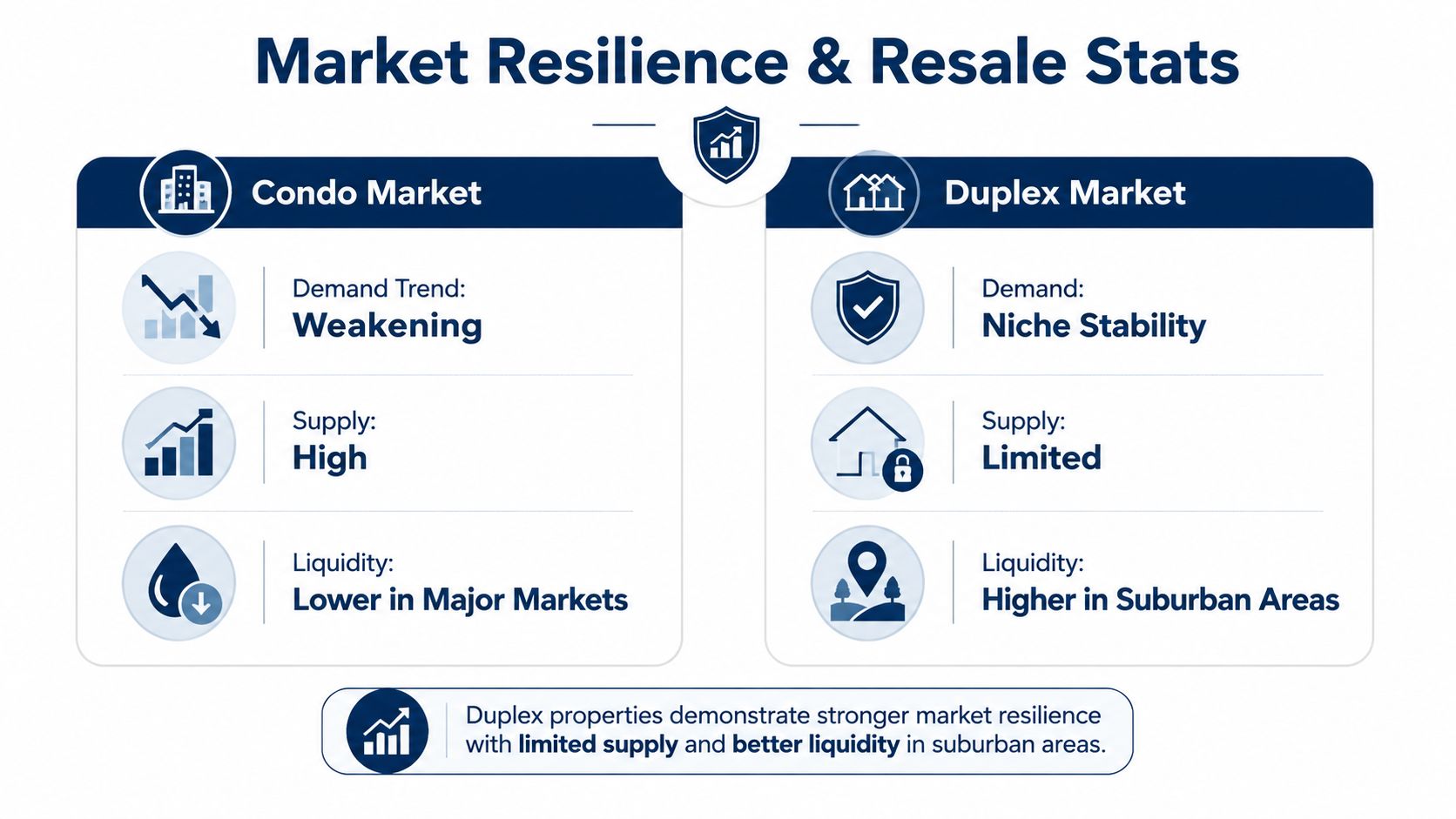
The current market doesn't support a lazy answer that one property type is always safer. Condo pipelines and demand have weakened in several major Canadian markets. Canadian condo apartment starts have declined sharply as presales softened and investors pulled back, while new condo sales in the Greater Toronto and Hamilton Area fell 60% year over year in 2025, reaching the lowest annual level since 1991. (CMHC spring 2026 supply report)
Resale demand has shown a different pattern. A market update reported renewed interest in resale homes in 2025, supported by lower mortgage rates and stronger appetite for detached homes, duplexes, and townhomes. That doesn't make every duplex liquid, and it doesn't make every condo difficult to sell. It does mean buyers and boards should examine local inventory, buyer preferences, insurance costs, and association finances instead of relying on a national slogan. (CMHC spring 2026 supply report)

Why governance affects liquidity
A condo's resale prospects depend partly on the association's condition. Buyers and lenders may scrutinize insurance, reserves, pending repairs, assessment history, rental restrictions, and governance records. A well-run association can make ownership attractive by handling shared maintenance and reducing the owner's time burden. A poorly funded association can make the same physical unit harder to finance and sell.
A duplex gives the owner more control over repairs, leasing, and property presentation. That control may support resale stability in markets where buyers want detached or small multi-family housing. But a duplex buyer must also accept direct exposure to repair costs, tenant management, and coordination with another owner when the title is divided.
For boards: Resale value isn't protected by attractive landscaping alone. Buyers notice clean financial records, credible reserves, adequate insurance, and prompt disclosure of material issues.
Choose the duplex when control and flexibility matter more than convenience, and when the local buyer pool supports the property. Choose the condo when shared maintenance, amenities, and reduced owner involvement carry real value. The stronger choice is the one whose legal and financial structure matches the market you're buying in.
Decision Frameworks for Buyers and Boards
Buyers should treat due diligence as a document exercise before treating it as a lifestyle decision. Start with title and the declaration. Confirm the unit boundaries, common elements, percentage interest, voting rights, assessment formula, leasing rules, alteration restrictions, and responsibility for windows, balconies, plumbing, parking, and exterior components.
Then read the association's financial and insurance materials. Ask for the current budget, reserve information, recent meeting minutes, pending litigation disclosures, master policy, deductible schedule, and records of special assessments. A buyer who skips those documents isn't buying simplicity. They're accepting unknown obligations.
A buyer's practical screening sequence
- Confirm the legal form. Verify whether the property is a condominium unit, a fee-simple duplex, or a duplex placed inside a formal common-interest regime.
- Trace the money. Identify regular common expenses, likely owner-paid repairs, assessment history, and the allocation formula.
- Test insurance. Compare the master policy with the HO-6 requirement for a condo. For a duplex, confirm replacement-cost coverage and whole-structure liability.
- Review control. Decide whether board approvals, rental limits, architectural rules, or neighbor coordination fit your plans.
- Stress the exit. Ask which buyers could finance the property and what unresolved association or structural issue might delay resale.
A duplex buyer should add a property-level inspection, realistic repair planning, title review, and a written agreement covering shared components. If rental income matters, use conservative assumptions and don't treat projected rent as guaranteed cash flow.
A board president's review
Boards should create a document package that answers buyer questions before a resale becomes urgent. Keep governing documents, budgets, insurance certificates, assessment records, meeting minutes, maintenance contracts, and reserve information organized and current.
Use professional management when volunteer directors can't reliably handle owner communication, maintenance coordination, accounting, compliance calendars, and resale requests. Access Management Group provides condominium association management, owner and community portal functions, payment processing, and maintenance or service-request workflows. It should be evaluated alongside other qualified management firms based on the association's needs, governing documents, and budget.
Situational Recommendations and Next Steps
Buy a condo if you want shared maintenance, amenities, and less direct responsibility for the building's exterior. Accept the trade-off: you'll live under recorded rules, depend on association decisions, and carry exposure to assessments and master-policy issues.
Buy a duplex if you want greater control, potential rental flexibility, and the ability to make property decisions without a condominium board. Be prepared to coordinate directly with the other owner, manage more of the structure, and fund repairs that a condo association might distribute across owners.
For a board president, the priority is different. Present the association's value clearly. Explain what assessments fund, show how percentage interests work, disclose insurance and reserve information, and address restrictions before a buyer feels misled. Have counsel review declaration changes, use an insurance professional for coverage questions, and investigate professional management when board workload threatens response times or financial oversight.
Access Management Group helps condominium and homeowner associations manage financial administration, owner communication, maintenance requests, and community operations through structured management services and owner portal support. Visit Access Management Group to discuss how a more organized management approach can protect the association and give buyers clearer confidence in the condo ownership decision.