HOA fees are most often quoted as a monthly amount, with a national median of $135 per month, but the due dates in the association's governing documents and billing statement are the ones that count. So when a listing says $135, are you looking at what you'll pay each month, or at a monthly equivalent for a bill that arrives once a year?
That gap causes most of the confusion around are HOA fees monthly or yearly. A homeowner budgets for $135 a month, then receives a $1,620 annual bill. A board president approves an annual budget, then fields calls from owners who thought annual meant one due date. Separate the annual cost from the billing timing, and both problems get easier to prevent.
Billing Cycles Compared at a Glance
Expect a fee to be quoted monthly, then confirm how your association bills it. According to the U.S. Census Bureau's 2024 American Community Survey, approximately 21.6 million of 86.6 million U.S. owner households paid a condo or HOA fee in 2024, about 24.9% of all owner households. The national median was $135 per month.
That monthly figure is a comparison tool. Annualizing it gives $1,620 per year, but it doesn't prove your association sends twelve invoices. Your declaration, bylaws, or adopted assessment schedule may require quarterly, semiannual, or annual payments instead.
One Fee Under Four Billing Cycles
Billing cycles for the same $135 monthly-equivalent fee
| Billing Cycle | Payment per Installment | Installments per Year | Annual Total |
|---|---|---|---|
| Monthly | $135 | 12 | $1,620 |
| Quarterly | $405 | 4 | $1,620 |
| Semiannual | $810 | 2 | $1,620 |
| Annual | $1,620 | 1 | $1,620 |
Read the last column first. Every row costs the same over a year, before any special assessments or changes. The cycle only changes when money leaves your account, not what the community costs to run.
Practical rule: Compare two communities on annual cost first. Check billing timing second.
For a prospective buyer, that order matters. A $405 quarterly bill can look more expensive than a $135 monthly bill until you annualize both. For a board, the reverse matters for cash flow, because twelve small collections arrive differently from one large collection.
Homeowners should treat the $135 monthly median as a national benchmark, not a prediction for a specific community. Amenities, insurance, utilities, reserves, and the property type move your actual amount well above or below it. The payment statements for your address settle the question.
Why Associations Choose Different Schedules
Two different ideas hide behind the word annual. The assessment period is usually the association's annual operating budget. The payment frequency is how the board collects each owner's share of that budget.
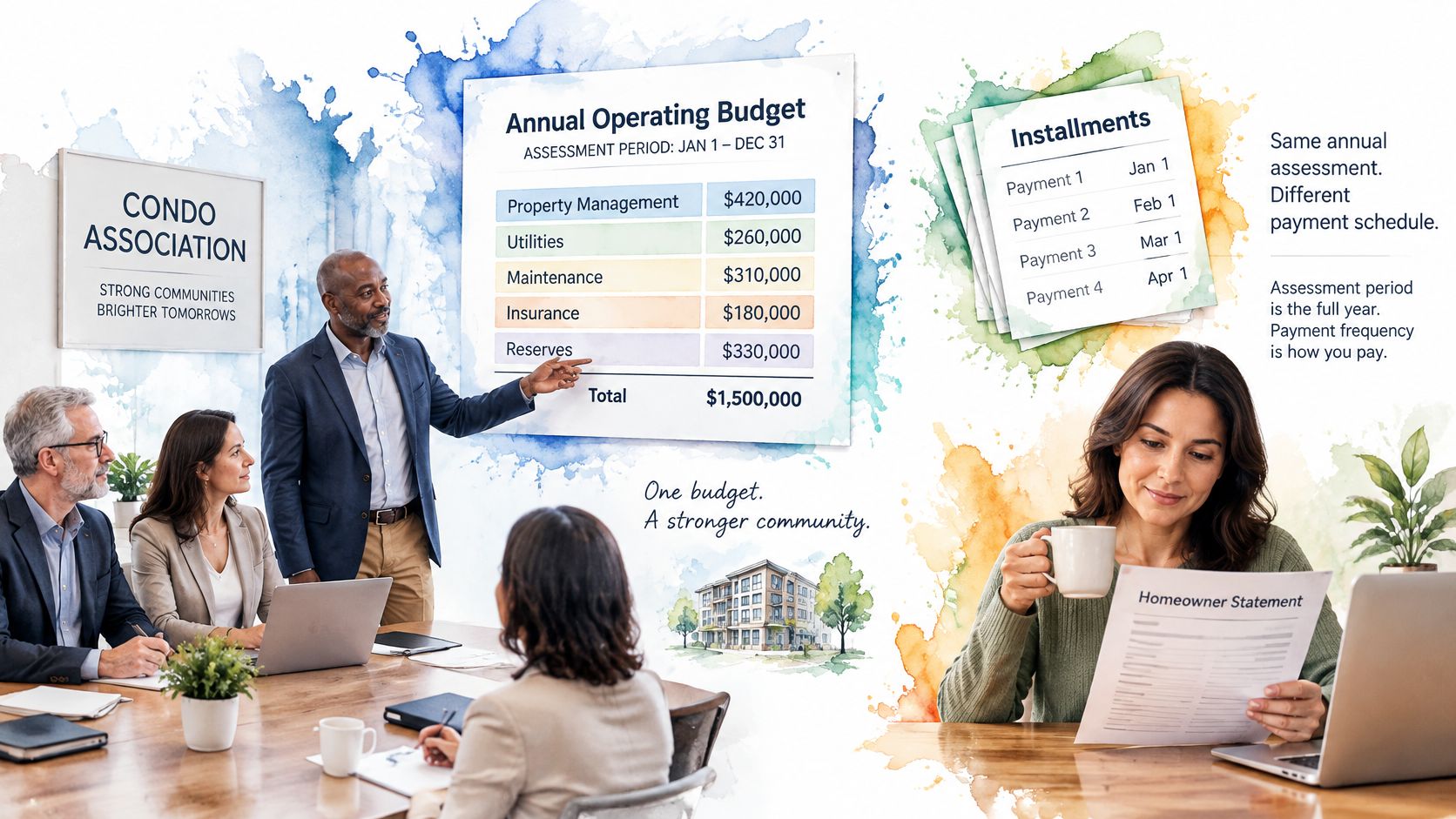
The Colorado Division of Real Estate guidance on assessments notes regular assessments are commonly paid monthly, quarterly, or annually. An association can therefore describe an assessment as annual because it funds a year of operations, while still collecting it in monthly or quarterly installments.
A Worked Example
Say your share of the adopted budget is $1,200 for the year. If the governing documents permit each option, the board could collect it in different ways without changing the annual obligation.
- Monthly installments: Twelve payments of $100
- Quarterly installments: Four payments of $300
- Annual payment: One payment of $1,200
Monthly billing is common because it fits household budgets and gives the association steadier cash flow for landscaping, utilities, insurance, and routine repairs. Quarterly or annual billing can suit a smaller association that wants fewer collection cycles, fewer statements, and a larger payment at the start of a period.
Neither schedule is cheaper or stricter. The controlling sources, in order, are the declaration, the bylaws, the adopted budget, any assessment resolution, and applicable state law.
When a document says annual, ask whether it means the budget period or the due date. They're not the same question.
Boards and presidents should state both figures in every budget notice. Give owners the annual obligation and each installment amount with its due date. That single habit prevents most calls that start with, I thought this was yearly.
How to Find Your Association's Billing Schedule
Your schedule lives in documents and account statements, not in a sales listing or in the word dues. Work through the records in this order, and you'll find the amount, the frequency, and the next due date.
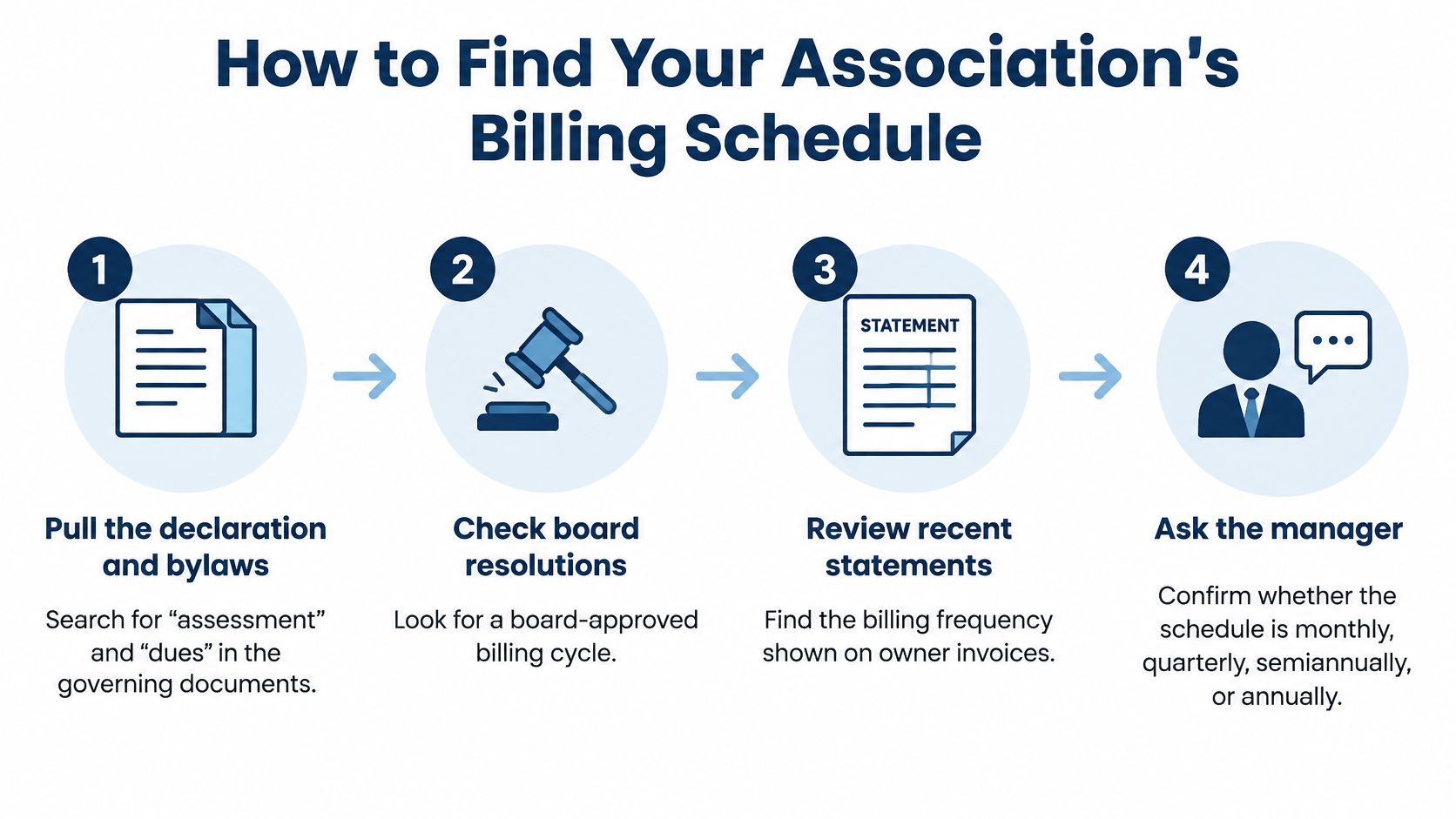
Six Steps to Confirm It
- Pull the declaration and bylaws. Search for assessment, installment, and due date. Our guide to reading HOA governing documents shows where those provisions usually appear.
- Read the adopted annual budget. Confirm the total assessment for the year and how much goes to reserves.
- Check your most recent billing statement. Look for the installment amount, frequency, paid-through date, and next due date.
- Request a resale disclosure or estoppel letter if you're buying or selling. It should show the current balance and any pending special assessments.
- Confirm the details in writing. Ask the board or manager for the due date, grace period, and autopay rules.
- Put it on your calendar. Record the cycle and next due date where you'll see it before the grace period ends.
Documents that confirm your billing schedule
| Document | What It Confirms | Where to Find It |
|---|---|---|
| Declaration and bylaws | Who sets the assessment and whether installments are allowed | Recorded governing documents or the association portal |
| Adopted annual budget | Total assessment for the year and reserve allocation | Board budget package or meeting minutes |
| Owner billing statement | Amount, installment frequency, paid-through date and next due date | Periodic account statement or owner portal |
| Resale disclosure or estoppel letter | Current balance, regular assessment frequency and pending special assessments | Issued by the association or manager during a sale |
If you're new to association living, you can also browse HOA basics articles for plain-language background before you dig into your own documents. Use general reading to learn the vocabulary, then rely on your community's records for the enforceable dates.
With us, owners can communicate through their online account or by email, and all communication stays in one location viewable by the homeowner, the Board, and AMG. That record helps when a statement and a document don't match.
If the documents and the statement disagree, don't budget around the discrepancy. Request written clarification and keep copies of each reply.
What Happens When a Payment Is Late
A missed monthly installment and a missed annual bill don't create the same exposure. A monthly payer may face a late charge soon after one missed installment. An annual payer risks a much larger unpaid balance that can attract interest for longer.
What can be added depends on your governing documents and state law, not on a national standard. A delinquent account may include a late or delinquency charge, interest running from the original due date, and in some cases collection costs and attorney's fees. Our overview of how homeowners association liens work explains why boards treat unpaid assessments as more than a missed utility bill.
One Concrete Comparison
Say a $135 monthly installment is paid 30 days late. The owner may owe the installment plus a late charge and interest for that period. Now say a $1,620 annual bill is missed entirely. The same types of charges can apply to a far larger balance, so the cost of waiting grows faster.
Florida law, for example, allows interest to run from the due date and an administrative late fee for each past-due installment where the governing documents permit it. Your state may handle it differently. Read your documents for the rule that applies to your home, and don't borrow another community's late fee as your estimate.
Three habits prevent most avoidable charges:
- Get the grace period in writing: Ask the manager, don't guess from a prior home.
- Schedule autopay early: Set the draft to clear before the due date, not on it.
- Keep the receipt: Save the confirmation until the payment posts to your account.
Boards should apply the written late-payment policy the same way to every owner. Consistent enforcement protects the association's budget and reduces disputes about favoritism.
Budgeting for Your Real Annual Cost
Start with a simple formula, then add room for change. Installment amount multiplied by installments per year equals your annual regular cost. A planning tool like a homeowners association budget template helps boards show that math clearly, and owners can use the same structure for a household budget.
Fees also tend to rise over time. Realtor.com reported a median HOA fee of $135 per month in 2025, up from $125 in 2024 and $108 in 2019. Budgeting as if this year's amount will stay flat forever invites a surprise.
A Worked Household Example
Use this as an illustration, not a forecast for your community. At $135 per month, your regular cost is $1,620 per year. If it rose 5% next year, the regular cost would be about $1,701, so you'd need roughly $142 per month instead of $135.
Cash flow changes with the cycle. If $1,620 is due in January, you'd need to set aside about $135 a month beforehand to avoid a January squeeze. Monthly billing spreads that saving task for you.
- Regular assessments: Recurring charges that fund operations and reserve contributions
- Special assessments: Separate charges for a specific need, billed as a lump sum or in installments
- Your buffer: Extra savings for increases and for a possible special assessment
The same discipline helps with other home projects, whether you're comparing association dues or reviewing backyard fencing budgets for Connecticut homeowners before committing to a contractor. Annualize the cost, separate recurring from one-time charges, and keep a cushion.
A higher recurring fee backed by healthy reserves can cost you less over time than low dues followed by an emergency assessment.
That's the contrarian point boards need to explain well. Artificially low dues look attractive in a listing, but they can defer roof, paving, or elevator work until owners face a large one-time bill.
Questions to Ask Your Board or Manager
Ask these questions before you buy, before you set autopay, and whenever the board adopts a new budget. Each one closes a specific gap between a quoted fee and what you'll pay.
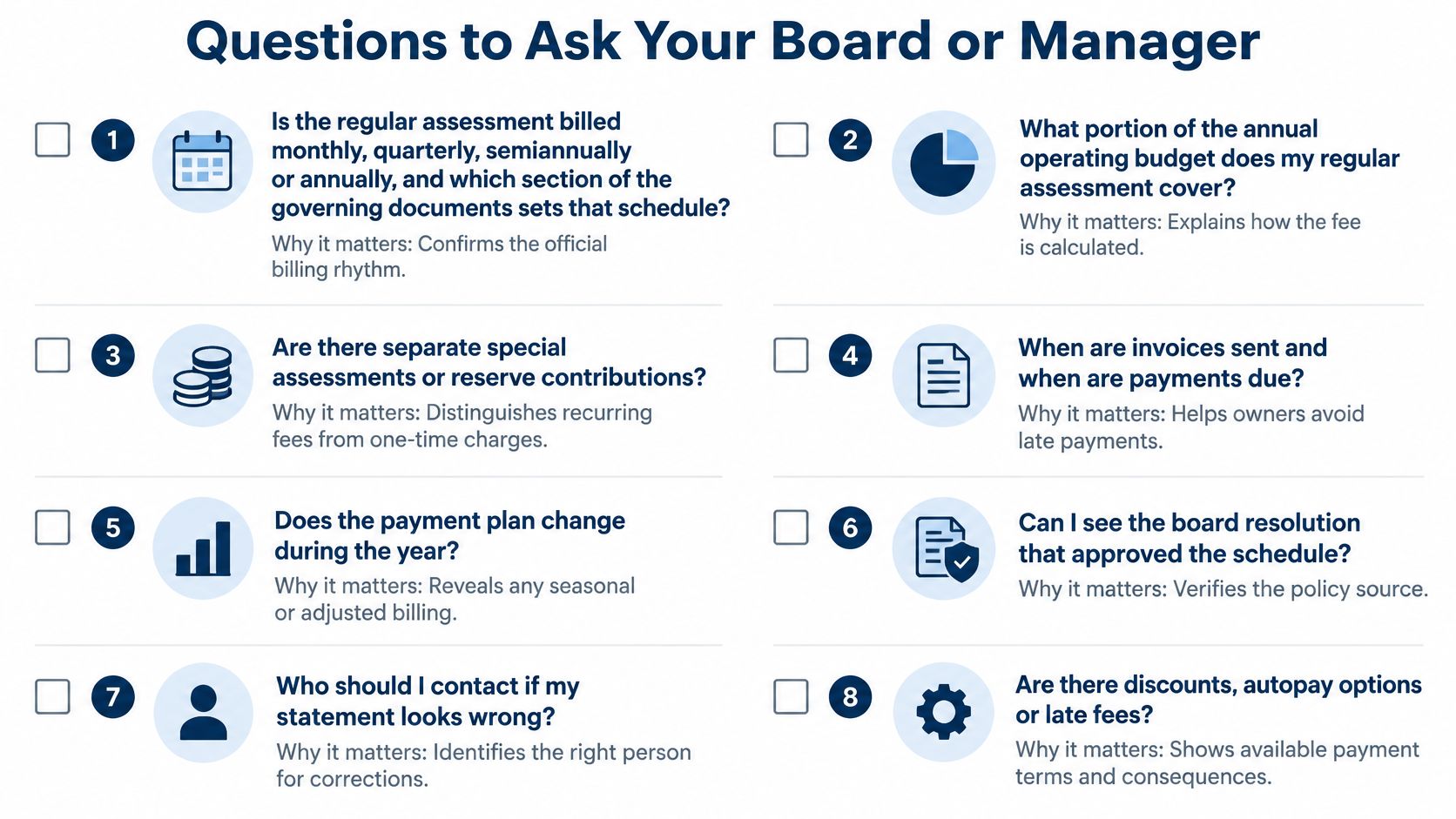
Your Checklist
- Is the regular assessment billed monthly, quarterly, semiannually, or annually, and which section sets that frequency? It fixes the installment you budget for.
- What are the due date and grace period? They determine when a late charge can begin.
- Are late charges and interest set by the documents or a written policy, and how is interest calculated? You can check any charge against a stated rule.
- Is autopay available, and how many days before the due date does the draft clear? A late-clearing draft triggers the same penalty as a missed payment.
- How much of the adopted annual budget goes to reserves? Reserve levels show how likely a future special assessment is.
- Are any special assessments planned or approved, and how will they be billed? A lump sum and an installment plan affect cash flow differently.
- How did the most recent insurance renewal change the budget? Insurance has driven recent increases in regular assessments.
- Who is my assigned community association manager, and what channel should I use for written answers? A written reply creates a record for you, the board, and the manager.
We assign a specific Community Association Manager to each community, and the community Board receives that CAM's contact phone and email. Request every answer in writing and file it with your governing documents.
Confirm Your Schedule Before You Buy or Budget
Before you sign a purchase contract or lock in a household budget, gather three records. Get the declaration and bylaws, the most recent billing statement, and the adopted budget. Buyers reviewing a condominium can also use Royal LePage Brookside Realty's condo guide as general background, then verify every date against the association's own documents.
Convert the regular assessment to an annual figure. At $135 monthly, that's $1,620 per year. Add a buffer of about 5% for increases, plus a separate allowance for any pending special assessment the disclosure reveals.
Confirm the billing cycle, due dates, and pending special assessments with the board or assigned manager in writing. If the documents and statement disagree, request written clarification, keep copies, and treat the governing documents as the final reference. For boards evaluating management costs, a Schedule B showing the cost of each ancillary charge is included with every management agreement with us, and it can be requested at any time.
Keep three lines in mind. The monthly figure is the common quote. The annual total is the cost to plan for. The schedule in the documents is the one that counts.
If your board wants clearer assessment notices, consistent billing, and written answers owners can easily find, we can help you review your current schedule and communication process. Visit Access Management Group to talk with our team about HOA and COA management that puts homeowners, board members, and presidents on the same page.