A board member walks the property after mowing and sees the same thing again. Patches of bright, upright growth are already sticking above the lawn, even though the rest of the turf was cut just days ago. Residents notice it. Many who work with lawns may call it “nutgrass.” The budget starts absorbing repeat visits, repeat treatments, and repeat frustration.
That's usually the point where the question stops being casual. It becomes operational. What does nutsedge look like, and are we treating the right problem?
For an HOA or COA, that distinction matters more than few realize. A weed problem in common areas doesn't stay isolated to a single bed or one strip of turf by the entry monument. It affects curb appeal, owner confidence, and the overall impression of how well the community is maintained. Boards rely on managers, contractors, and maintenance plans to protect that appearance, which is exactly why understanding the role of a community association manager matters when recurring grounds maintenance issues start affecting the community at scale.
The Unwelcome Guest in Your Community's Green Spaces
In community management, nutsedge usually shows up as a pattern before anyone calls it by name. It appears in high-visibility turf first. Around signage, mailbox clusters, pool lawns, clubhouse edges, and open common greens. Then someone asks why the “grass” there looks lighter, shinier, and taller than everything around it.
The first mistake many boards make is treating it like a minor mowing issue. It isn't. If the grounds crew mows on schedule and the same bright clumps still jump out between cuts, the problem isn't cosmetic. It's biological.
Why boards notice it quickly
Boards and residents don't need a horticulture background to recognize when something looks off. Nutsedge disrupts uniform turf. In a neighborhood with otherwise neat lawn lines and consistent maintenance, that contrast stands out immediately.
A few common complaints usually surface at the same time:
- Uneven appearance: Turf looks patchy even when it has been recently maintained.
- Fast regrowth: Problem areas seem to reappear almost as soon as mowing is done.
- Color mismatch: The weed looks brighter than the surrounding lawn.
- Spreading concern: Residents assume the contractor is missing spots or using the wrong materials.
A persistent weed in common areas is never just a weed problem. It's a maintenance communication problem, a budgeting problem, and a curb appeal problem.
Why this isn't just a homeowner issue
In a single yard, a homeowner may decide to live with it for a season. An association doesn't have that luxury in the main entrance, shared lawns, or visible perimeter areas. The appearance of common outdoor areas creates the first impression for owners, guests, buyers, and vendors. When one recurring weed starts to break visual consistency across those spaces, it undercuts the value of every other dollar spent on maintaining the grounds.
That's why accurate identification matters first. Before a board approves more treatment, more labor, or more vendor visits, it needs to know what it's dealing with.
Core Identification What Nutsedge Actually Looks Like
The fastest way to identify nutsedge in a common-area lawn is to stop looking at it like turf and start checking its structure. On a property walk, nutsedge usually shows up as a lighter, shinier, more upright plant that pushes above the mowing line and breaks the uniform finish boards pay to maintain.
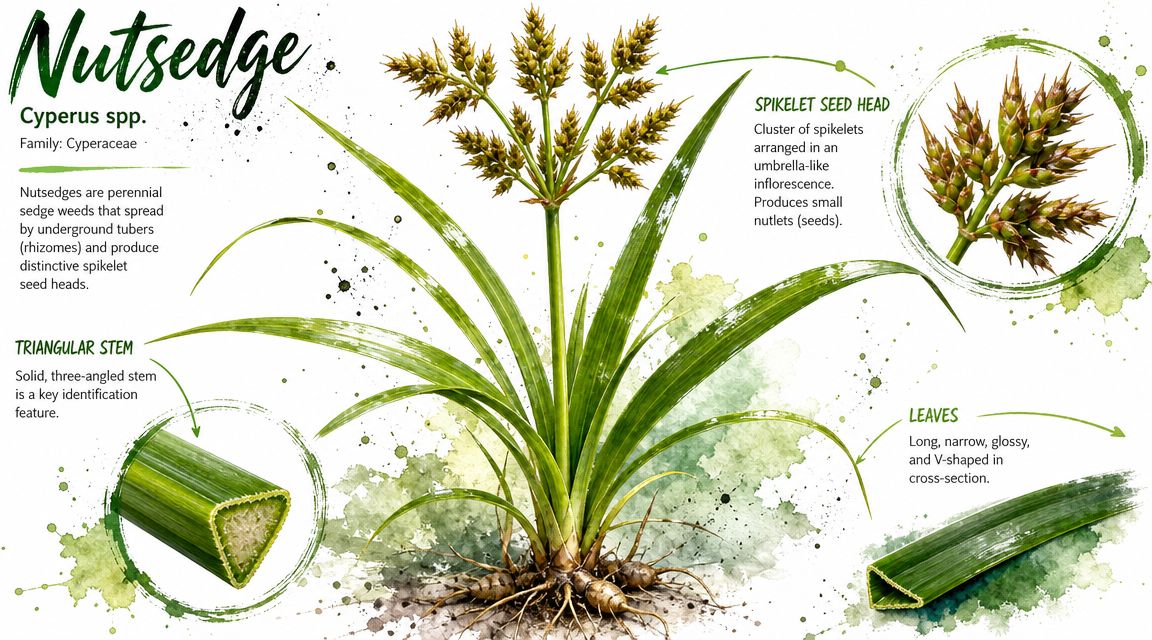
Cornell describes yellow nutsedge as a grass-like perennial with shiny yellowish-green leaves, a triangular stem, shallow rhizomes, and nut-like tubers in its yellow nutsedge weed profile. For HOA and COA properties, those details matter because this weed is often reported as “fast-growing grass” until it has already spread through several visible areas.
The visual signs that matter on a property walk
Start with what crews and managers can see without digging.
- Color: Leaves usually appear yellow-green or bright green compared with the darker, flatter tone of surrounding turf.
- Surface: The blades tend to look glossy or waxy, which makes infested patches stand out in morning light or after mowing.
- Height: Nutsedge commonly grows above the turf canopy quickly, so the area can look uneven only a few days after service.
- Leaf form: The leaves are narrow, sharply pointed, and arranged more stiffly upright than many lawn grasses.
- Seedhead: Mature plants can produce a golden to golden-brown seedhead, which is a strong visual clue in thin turf or bed edges.
At a distance, those patches can look like healthy grass that just grew faster. Up close, the plant has a cleaner, more rigid habit. That upright growth is one reason residents often assume the mowing crew missed spots, when the underlying issue is a sedge coming back through the turf.
Use the stem test, not color alone
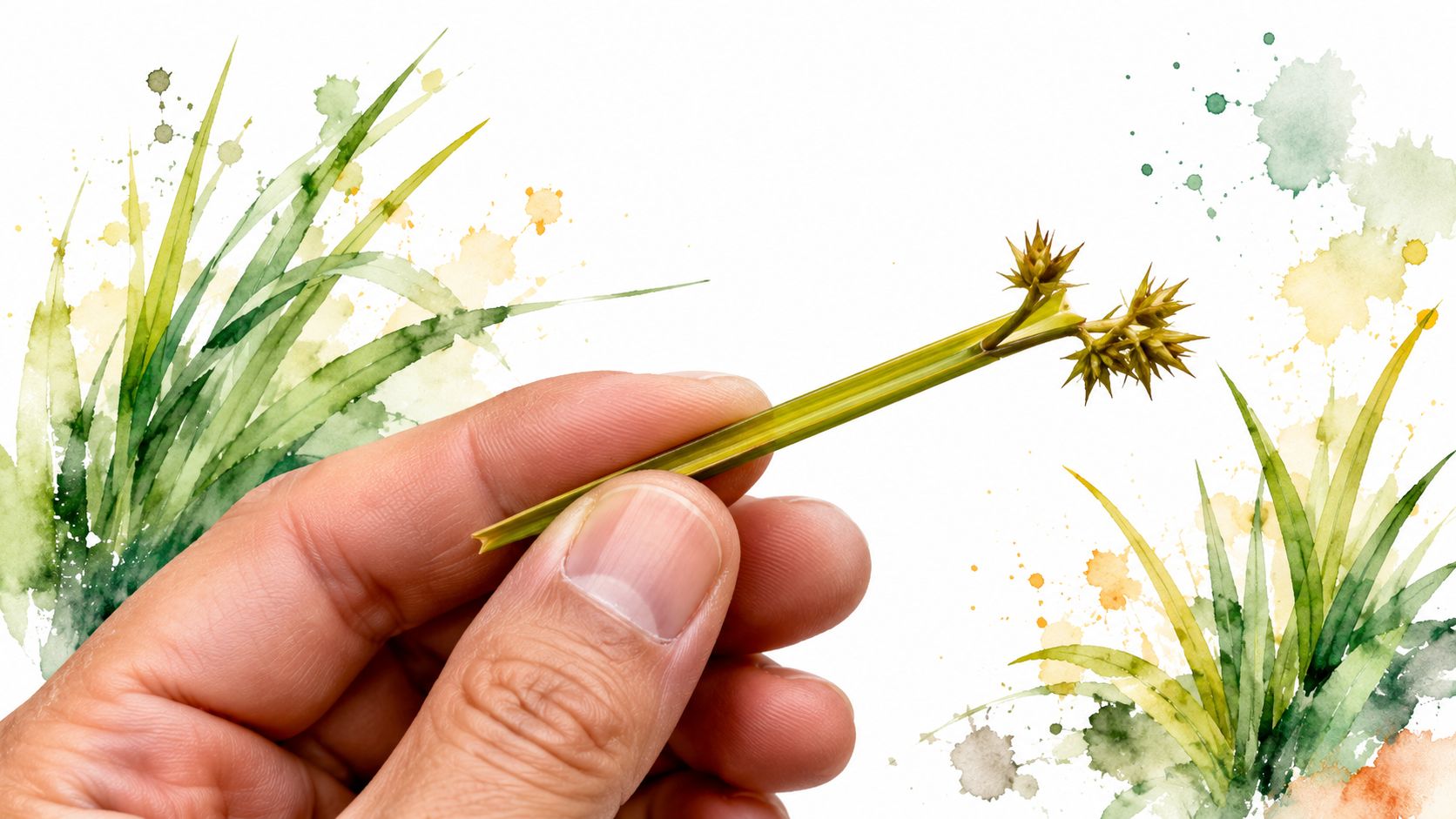
Color helps, but stem shape confirms more. Roll a stem between your fingers. If it feels triangular, you are likely dealing with nutsedge rather than a true grass.
The old phrase “sedges have edges” sticks because it is useful in the field. I tell site teams to use that test before they recommend treatment, especially in entrance lawns, pool surrounds, mailbox clusters, and other areas where repeated misidentification turns into repeated expense.
Practical rule: If the plant is glossy, upright, taller than the surrounding turf after mowing, and has a triangular stem, flag it as nutsedge for follow-up.
What boards should ask vendors to document
Boards get better decisions when inspection notes describe the plant, not just the complaint. “Green weed in lawn” does not help anyone approve the right response or track whether the problem is isolated or spreading across the property.
| What to inspect | What to note |
|---|---|
| Stem | Triangular or not |
| Leaf appearance | Glossy, waxy, bright yellow-green |
| Height | Taller than surrounding turf after mowing |
| Pattern | Single clumps, scattered patches, or repeated zones |
| Site conditions | Wet area, drainage issue, irrigation overspray, or normal turf |
That level of detail protects the association. It gives the grounds contractor a clear basis for treatment, helps management compare recurring trouble spots, and gives the board a factual record when residents question why the same area keeps looking rough.
Is It Nutsedge or Something Else? Spotting Key Lookalikes
At the board level, money is either protected or wasted. A bright green patch near an entry monument or clubhouse lawn gets labeled as nutsedge, a crew is sent out, and the association pays for the wrong treatment because the plant was never identified carefully in the first place.
Hall Stewart points to the field traits that separate sedges from true grasses in its nutsedge identification guidance. The practical takeaway for an HOA or COA is simple. Confirm what you are looking at before you approve a property-wide response.
The quickest comparison
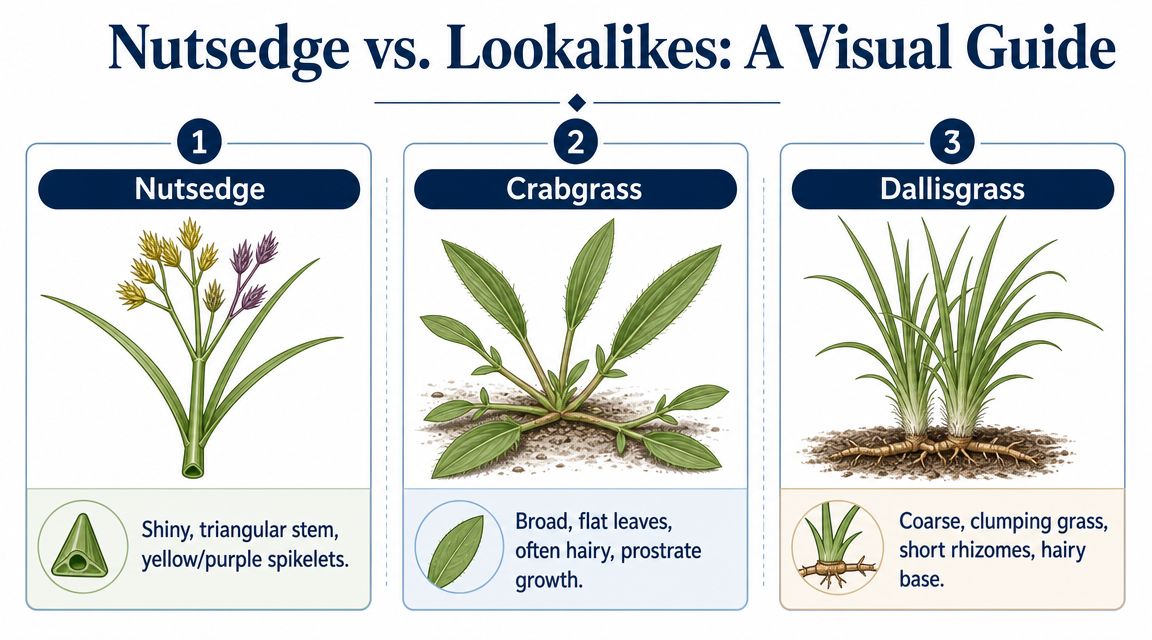
The question for boards is not whether a weed looks ugly. The question is whether it behaves like nutsedge or like a common grassy weed that needs a different plan.
| Plant | What you see first | Texture and habit | How it tends to show up in community turf |
|---|---|---|---|
| Nutsedge | Brighter green shoots rising above the canopy | Smooth, glossy, upright | Scattered clumps or repeat outbreaks, often in the same trouble spots |
| Crabgrass | Low, spreading growth that widens outward | Broader blades, flatter habit | Thin areas, pavement edges, stressed turf |
| Dallisgrass | Coarse bunches that look heavier than surrounding turf | Rougher, thicker clump | Persistent clumps in lawns and open common areas |
| Tall fescue or off-type turf clumps | Isolated bunches that look different from the base turf | More matte, more familiar grass texture | Random clumps that stand out, but still read as grass |
Where misidentification usually happens
From a distance, nutsedge and grassy weeds can blend together. That is why parking-lot islands, perimeter strips, and broad front lawns get misread during quick inspections. Staff see narrow leaves and assume all green shoots belong in the same category.
Closer inspection changes the call.
Crabgrass usually sprawls. Dallisgrass usually looks heavier and more bunchy. Off-type turf clumps usually look like grass that does not match the surrounding stand. Nutsedge tends to present as cleaner, shinier, and more upright, which is why it often catches the eye a day or two after mowing.
That visual difference matters operationally. If a vendor treats a nutsedge outbreak like crabgrass, the board can end up paying for repeat visits, resident complaints, and another month of poor curb appeal.
Yellow nutsedge versus purple nutsedge
Contractors may also note whether the sedge is yellow or purple. In practice, boards do not need to debate the botany on site. The useful distinction is that one may appear lighter and more yellow-green, while the other may read darker and slightly harsher in color and tip shape, as noted earlier.
What matters for the association is consistent documentation across the property. If one crew reports yellow nutsedge at pool fencing, another reports purple nutsedge along building foundations, and neither maps the locations, management loses the ability to see whether the problem is isolated, recurring, or spreading by irrigation zone.
A field check that helps boards make better decisions
During property walks, ask the vendor to identify the lookalike before recommending treatment. A short answer is enough if it is specific.
Ask for:
- The likely weed name, not just “green weed in turf”
- Whether the plant is upright or sprawling
- Whether it appears as a clump, a mat, or scattered repeat shoots
- Whether the outbreak is concentrated in one irrigation or drainage area
- Photos close enough to show structure, not just a wide shot
That level of reporting helps the board approve the right scope of work. It also creates a record that is useful later, especially when the same bed edge, entrance lawn, or mailbox cluster keeps generating complaints.
A board does not need a botany lesson. It needs a reliable distinction between nutsedge, grassy weeds, and off-type turf so treatment dollars go to the right problem.
Why Nutsedge Is So Persistent The Underground Network
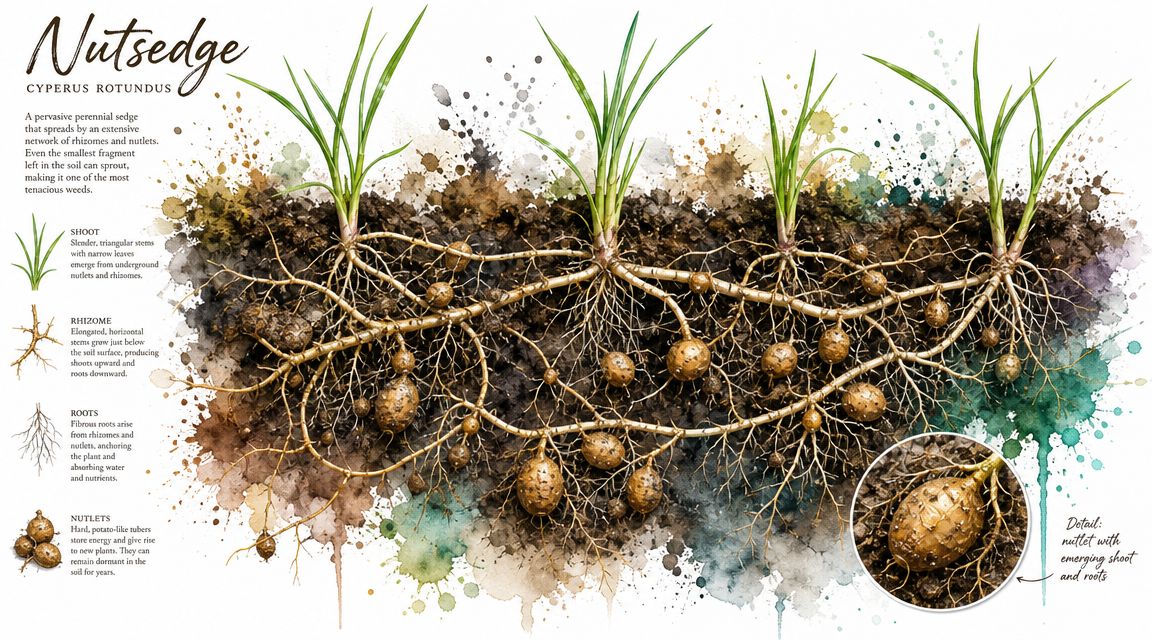
A board sees a few bright shoots near an entry monument and approves a quick touch-up. Two weeks later, the same area shows fresh growth. That cycle frustrates residents because the visible leaves were never the full problem. The problem sits below the surface.
Nutsedge spreads through underground rhizomes and tubers, so a small patch in turf or along a bed edge can be tied to a much larger colony underground. That is why crews can mow it, pull it, or burn back the top growth and still see it return. From a property management standpoint, this is less a simple weed issue and more a recurring site condition plus an incomplete treatment approach.
Why the visible patch is misleading
Above-ground growth can stay small while the underground network keeps expanding. For an HOA or COA, that creates a budgeting problem. The board may approve repeated minor service calls because the outbreak looks limited, while the source remains in place and spreads into adjacent turf, bed lines, fence rows, or drainage swales.
The trade-offs are straightforward:
- Hand-pulling looks inexpensive, but it often leaves tubers behind and disturbs the soil.
- Leaf-only spot treatments can improve appearance for a short time, but they may not stop repeat emergence.
- Delaying action keeps costs low this month, but recurring patches usually spread the work across more areas later.
That is why nutsedge should be tracked by location, irrigation zone, and recurrence pattern, not just by whether it was sprayed once.
Why moist sites keep producing it
Nutsedge favors wet ground and weak drainage. On community property, repeated outbreaks often point to maintenance conditions that are helping it persist.
When the same patch keeps returning, boards should ask whether the site has:
| Site issue | Why it matters |
|---|---|
| Irrigation overspray | Keeps the soil wet longer than the turf needs |
| Drainage failure | Creates saturated conditions that favor sedge growth |
| Compacted soil | Slows infiltration and contributes to standing moisture |
| Low, soggy turf pockets | Produces the repeat pattern residents notice season after season |
Board oversight matters in this context. A weed program by itself will not solve a drainage problem. Associations that want lasting results usually need the grounds vendor and the team handling community maintenance and construction services looking at the same map and the same trouble spots.
What usually underperforms
Boards often approve the response that looks fast in a walkthrough. With nutsedge, visible effort and effective control are not always the same thing.
Surface cleanup can improve appearance for a week while the underground colony stays active.
Methods that often disappoint include casual pulling, repeated mowing with no follow-up, and general weed products that are not intended for sedges. Those choices can still have a place in broader grounds work, but they rarely solve recurring nutsedge on their own. For owners who want a simpler residential overview, these weed control tips for Crown Point homeowners give useful context, though associations usually need tighter coordination across common areas and shared irrigation zones.
The practical takeaway for a board is simple. If nutsedge keeps returning, stop treating each patch as an isolated appearance issue. Treat it as an underground spread issue tied to water, soil conditions, and consistency of execution across the whole property.
A Community-Wide Strategy for Nutsedge Control
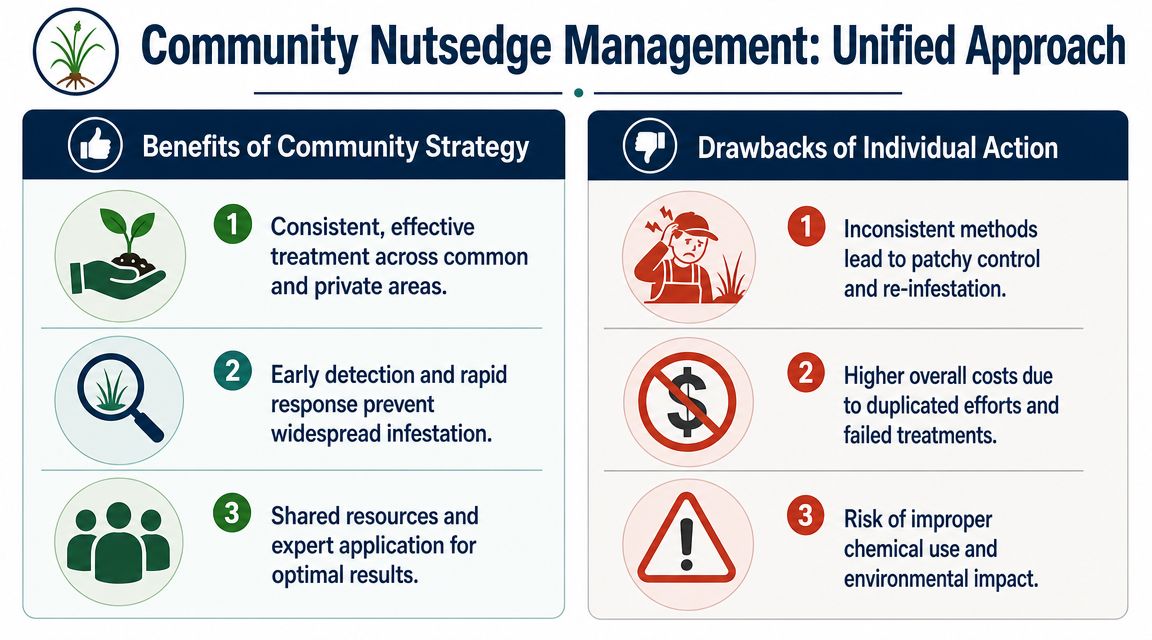
The most expensive way to manage nutsedge is to let everyone handle it differently. One homeowner pulls it. Another sprays a general weed product. The common-area contractor treats visible patches only. A few residents complain that nothing works. All of that creates inconsistency, and inconsistency is exactly what a persistent sedge exploits.
DoMyOwn notes that one key field clue is the triangular stem, and that control is different because patches must be dug thoroughly to remove underground tubers in its nutsedge identification guide. For associations, that means the response has to be coordinated.
What a board should require from its landscape contractor
A workable association plan starts with scope and consistency. The board should ask its contractor for a nutsedge-specific protocol rather than a vague promise to “watch it.”
That protocol should address:
- Confirmed identification: The crew should distinguish sedge from grassy weeds before treatment.
- Targeted post-emergent control: The product selected should be labeled for nutsedge and appropriate for the turf on site.
- Follow-up inspection: Recurring patches need review after treatment, not just a one-time visit.
- Site-condition review: Repeated outbreaks should trigger irrigation and drainage review.
For boards overseeing larger communities, this usually falls under broader maintenance and construction coordination because weed recurrence often intersects with irrigation repairs, grading concerns, or recurring wet spots.
What works better than piecemeal resident action
Residents often want to help, but widespread self-treatment creates uneven results and avoidable risk. The stronger model is for the association to set clear guidance for common areas and, where appropriate, communicate best practices for private lots.
A practical board policy usually looks like this:
- Common areas get one standard treatment approach. That keeps records clean and results easier to evaluate.
- Residents receive identification guidance. If they can recognize nutsedge, they're less likely to use the wrong product.
- Problem zones are tracked. Repeated outbreaks in the same place should prompt root-cause review.
For boards that want homeowner-friendly reading to support those conversations, these weed control tips for Crown Point homeowners offer useful general context on why weed problems need a thoughtful strategy instead of random spot fixes.
What boards should avoid
Not every action that looks proactive is helpful.
- Don't encourage routine pulling in established patches. If tubers remain, the board may end up funding the same problem repeatedly.
- Don't assume one application settles it. With nutsedge, visible top kill and true control aren't always the same thing.
- Don't separate weed control from irrigation review. Persistent outbreaks often point to site conditions that need correction.
Board-level takeaway: A weed plan works when identification, treatment, inspection, and site correction all happen under one management standard.
Long-Term Prevention for Healthier Community Landscapes
The cheapest nutsedge treatment is the one you never have to schedule because the site stopped favoring it. That's why prevention matters more than reaction in association grounds. A board can keep approving repeat weed service, or it can push the grounds program toward conditions that make recurring outbreaks less likely.
Healthy, dense turf is part of that answer. So is moisture control. Nutsedge favors moist, poorly drained conditions, which means the board should look at the grounds as a system, not a series of isolated weed patches.
The preventive practices that matter most
Strong prevention usually comes from ordinary maintenance done well and done consistently.
- Adjust irrigation carefully: Turf needs water, but saturated ground invites problems. Wet spots, overspray, and leaking heads should be corrected quickly.
- Build better turf density: Dense lawn cover leaves fewer openings for opportunistic weeds.
- Mow correctly: Turf that's repeatedly stressed by poor mowing practices won't compete as well.
- Improve drainage where outbreaks repeat: If one strip near an entrance island or a low common lawn keeps producing nutsedge, the board should treat that as a site issue.
Prevention is also a communication issue
Boards get better results when expectations are shared clearly. Residents are less likely to overwater, misidentify weeds, or pressure the contractor into random treatment if the association explains the standards behind the program.
That's one reason a good homeowners association newsletter can help. Property maintenance expectations, seasonal reminders, and notices about irrigation or weed management reduce confusion before complaints pile up.
A smarter long-view for boards
Prevention doesn't mean weeds disappear forever. It means the board shifts from chasing outbreaks to reducing the conditions that support them. Over time, that's the more stable path for community appearance and maintenance planning.
A board that treats nutsedge as a drainage, irrigation, turf-health, and communication issue will usually make better decisions than a board that treats it as a simple spray problem.
Protecting Your Community's Value from Invasive Weeds
Nutsedge becomes expensive when a board mistakes it for ordinary grass, approves generic treatment, and then repeats the cycle when the weed returns. The better path is disciplined and fairly simple. Identify it correctly, understand that the visible plant is only part of the issue, and manage it across the community with a consistent standard.
For boards, the lesson isn't just botanical. It's operational. Grounds quality protects the community's appearance, and the community's appearance supports owner confidence in how the property is being maintained. That's why a recurring weed belongs on the board's maintenance radar, not in the category of minor lawn nuisance.
If your board is building a broader property appearance standard, practical resources on preventing weeds in your yard can also help frame the prevention side of the conversation for residents. The strongest communities align what happens in common areas with what homeowners do on their own lots.
When nutsedge shows up, the right response is not frustration or guesswork. It's a property-wide plan that protects curb appeal, reduces wasted spending, and keeps the community looking cared for.
If your board wants a stronger plan for grounds oversight, vendor coordination, and long-term property care, Access Management Group can help your association protect, preserve, and enhance its real estate investment with experienced community management support.