A new board president usually meets maintenance and construction the hard way. A roof leak shows up after a storm. A balcony inspection raises questions nobody can answer quickly. A paving contractor says the subbase is failing, and the proposal in front of the board is bigger than anyone expected.
That is the moment when volunteer leadership collides with fiduciary duty.
Boards do not need to become contractors, architects, or engineers overnight. They do need a framework for making disciplined decisions, asking the right questions, and protecting the association’s assets for the long term. In community associations, maintenance and construction are not separate topics. Routine care, reserve planning, project scoping, bidding, communication, closeout, and warranty follow-through all affect the same outcome: whether the community preserves property values or pays more later for preventable problems.
Your Roadmap to Successful HOA Maintenance and Construction
A common pattern plays out in aging communities. The board inherits a reserve study, a stack of old vendor invoices, and a few unresolved owner complaints. Nothing looks urgent until one issue becomes impossible to defer. Then the board receives a proposal for a major repair that competes directly with operating needs, reserve cash, and homeowner patience.
That pressure creates bad decisions. Boards rush the scope. They compare bids that are not comparable. They approve a project before confirming who owns the repair responsibility. They treat closeout as a formality. Months later, the association is still arguing over punch list items, invoices, and warranties.
The better path starts earlier and feels slower. That is usually a good sign.
Industry guidance on deferred maintenance notes that boards often understand the general risk but do not model the financial trade-off accurately, even though major construction defect projects can involve substantial sums for a single team and small annual maintenance investments may prevent much larger losses later (Promanage HOA). The lesson for an HOA or COA board is simple. Delaying work is not automatically conservative. In many cases, delay is the higher-risk financial decision.
What new board presidents need to focus on first
The first job is not hiring a contractor. The first job is defining the board’s lane.
That means reviewing governing documents, prior maintenance history, reserve assumptions, and responsibility boundaries before the board commits to a project. If balcony waterproofing, windows, or limited common elements are involved, the board should ground every decision in the community’s actual authority and obligations. A careful review of HOA governing documents often prevents a costly mistake.
A practical mindset for the board table
The most effective boards do three things consistently:
- They treat maintenance as asset protection: The board is preserving roofs, pavement, drainage, building envelopes, mechanical systems, and common amenities that support owner value.
- They separate urgency from panic: Fast action can be appropriate. Unstructured action usually creates more exposure.
- They document the why: Owners may disagree with a project, but they are better served when the board can explain the condition, the cost logic, and the alternatives considered.
A project is healthy when the board can answer three questions clearly: What problem are we solving, who is responsible for it, and how will we measure whether the work was done correctly?
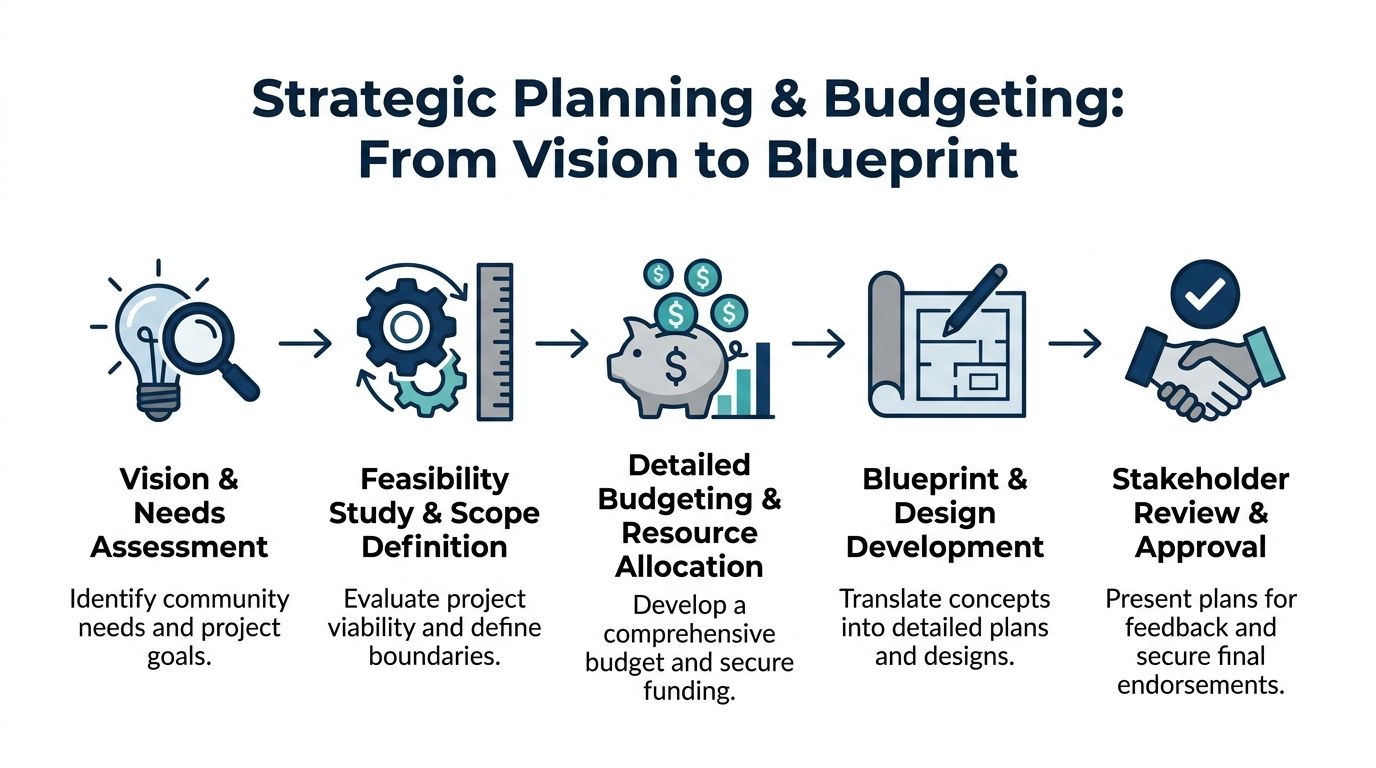
From Vision to Blueprint Strategic Planning and Budgeting
Boards usually get in trouble before a bid ever goes out. The problem starts with a vague goal such as “redo the roofs,” “fix drainage,” or “renovate the clubhouse.” Those phrases are too broad to support sound budgeting or reliable contractor pricing.
A capital project needs a defined scope, a decision record, and a funding plan that can withstand surprises.
Start with the reserve study, then update it with reality
A reserve study is not a permission slip to spend. It is a planning tool.
If the report says siding has remaining life but the field condition shows active failure, the board should not rely on the report blindly. If the report assumes standard replacement but the community now needs code-driven upgrades, accessibility modifications, or phased work due to occupancy constraints, the funding assumptions must change too. Boards that treat reserve studies as living documents make better decisions than boards that file them away after adoption.
A practical first move is to compare the reserve study line item against current site conditions, prior repairs, resident complaints, and any consultant observations. If that review has not happened recently, this overview of what an HOA reserve study is can help frame how the board should use it.
Define the specific scope before discussing price
The board should reduce the project to specific components.
For example, a “balcony project” may involve:
- structural framing review
- waterproofing
- railing replacement
- door threshold corrections
- paint or coating systems
- owner access scheduling
- limited common element responsibility questions
If the board does not define those parts early, contractors will fill in the blanks differently. One proposal may include demolition and substrate repair. Another may assume only surface treatment. The low bid may be the least complete bid.
Resolve maintenance boundaries before they become disputes
Mixed-ownership communities struggle when governing documents are old, inconsistent, or silent on certain components. Windows, doors, balconies, patios, assigned parking, and utility lines often create the most confusion.
Before issuing plans or requesting pricing, the board should create a simple responsibility matrix. It does not need to be fancy. It does need to be explicit.
| Component | Association responsibility | Owner responsibility | Notes |
|---|---|---|---|
| Roof covering | Confirm in governing documents | Usually no | Check any maintenance exceptions |
| Balcony structure | Confirm in governing documents | Sometimes limited common use only | Verify repair and access rights |
| Window glass and frames | Often mixed | Often mixed | Separate maintenance from replacement |
| Interior damage from common element failure | Depends on documents and policy | Depends on policy | Coordinate with insurance counsel if needed |
That matrix prevents boards from approving work under assumptions that later trigger owner disputes.
If the board cannot explain responsibility in one sentence per component, the scope is not ready for bid.
Budget with ranges, not wishful thinking
Construction budgets fail when boards treat the first estimate as a promise. Better practice is to budget in scenarios.
Research on construction cost forecasting found that three-point estimation improves accuracy by an average of 29.8% over single-point estimates when projects use optimistic, pessimistic, and most-likely assumptions (IJAEM research on estimation pitfalls). For community associations, that means the board should stop asking, “What will this cost?” and start asking three separate questions:
What is the best reasonable outcome?
Use this only as the low boundary, not as the working budget.What is the most likely outcome?
This should reflect known field conditions, current project complexity, and normal disruption factors.What is the worst reasonable outcome?
Include hidden substrate issues, access complications, resident protection measures, and material escalation risk.
A board can then align each scenario with a funding response. The most likely case may fit reserves. The pessimistic case may require phasing, a special assessment, financing, or scope prioritization.
Build the board’s internal file before vendors enter the process
The board should assemble one internal project file that includes:
- Condition records: Photos, inspection notes, maintenance history, and prior repair invoices.
- Authority documents: Governing provisions, board resolutions, and approval thresholds.
- Financial assumptions: Reserve balances, funding options, and cash flow timing.
- Decision log: Date, issue, alternatives discussed, and board direction.
That file becomes the foundation for cleaner bidding and stronger oversight later. It also helps new directors understand why the board chose a certain path instead of reopening settled issues every month.
Choosing the Right Partners Bidding and Contractor Vetting
Boards often say they want “three bids.” That is fine as a starting point. It is not a strategy.
Three weak bids on a poorly written request do not protect the association. They just create the appearance of diligence. Good bidding starts with a solid RFP and ends with a contractor selection process that values completeness, capacity, and control.

Write an RFP that forces apples-to-apples bids
A usable RFP should answer basic contractor questions before they ask them. It should also eliminate room for strategic omissions.
Include these items:
- Defined scope documents: Plans, specifications, consultant reports, and any approved alternates.
- Site constraints: Occupancy status, work hours, parking limits, resident access, staging areas, and noise restrictions.
- Administrative requirements: Insurance minimums, licensing expectations, permit responsibility, lien waiver requirements, and meeting cadence.
- Pricing format: Require bidders to break out mobilization, allowances, unit prices, alternates, and exclusions.
- Schedule expectations: Ask for start assumptions, duration, long-lead items, and sequencing.
When all bidders price the same package, the board has a sound basis for comparison. When they do not, the board is comparing writing styles.
Look past the total price
One proposal may be lower because the contractor has stronger vendor relationships. Another may be lower because demolition, substrate repair, temporary weather protection, or finish restoration is excluded.
Read the exclusions line by line. Read the assumptions line by line. Ask who is carrying permit costs, dumpster pulls, traffic control, protection of landscaping, owner notices, and weekend access if needed.
A good comparison sheet typically includes:
| Review area | What the board should verify |
|---|---|
| Scope alignment | Does the bid match the RFP and plans? |
| Exclusions | What is not included, and is it material? |
| Allowances | Are they realistic or likely to trigger change orders? |
| Schedule | Is the timeline credible for the project type? |
| Team | Who will supervise daily work on site? |
Vet the contractor, not just the proposal
A polished bid package can hide a weak operator. Boards should verify the company behind the paper.
Key checks include:
- License and insurance review: Confirm active licensing where applicable and review coverage documents carefully.
- Reference calls: Speak with recent communities, not only old commercial clients.
- Financial stability: Ask direct questions about backlog, staffing, and supplier relationships.
- Project supervision: Identify the specific superintendent or project manager, not just the salesperson.
- Claims and dispute history: Ask how the company handles punch work, warranty calls, and owner-occupied sites.
For boards managing vendor access across active communities, a structured resource such as a contractor management system can also help standardize compliance tracking, document collection, and site-entry controls.
Estimating discipline matters more than most boards realize
Construction estimating mistakes are not minor clerical issues. Industry analysis says estimating errors cost U.S. companies $273 billion annually, and one major cause is reliance on generic spreadsheets that do not handle digital takeoffs or fast-changing material costs well. The same analysis notes that steel product prices saw a 108% increase within one 12-month period, which shows why stale pricing can quickly distort a budget (K-38 Consulting on estimating mistakes).
For an HOA board, that has two practical consequences. First, the proposal based on old assumptions may not be dependable. Second, a contractor with disciplined estimating systems is usually less likely to discover half the project after the contract is signed.
Use your manager to control the process, not to replace board judgment
A strong community manager helps the board gather scope information, organize bid packages, track deadlines, and document decisions. That support is especially useful when the board is balancing owner communication, vendor scheduling, and contract review at the same time. This summary of what a community association manager does is helpful context for new board leaders sorting out which tasks belong with management and which remain board decisions.
Access Management Group can support communities with scope development, RFP distribution, proposal review coordination, and construction oversight as one operational option among others. The board still owns the decision. Management helps the board make that decision on a cleaner record.
The lowest bid is only the best bid when the scope is complete, the assumptions are reasonable, and the contractor has the staff and systems to finish the work correctly.
Active Oversight Managing Construction and Community Communication
A signed contract does not reduce board risk by itself. It changes the type of risk. Planning risk becomes execution risk.
At that point, the board’s success depends on two things happening at the same time. The project must be managed tightly, and residents must know what is happening before disruption reaches them.

Hold a thorough pre-construction meeting
The pre-construction meeting should not be a ceremonial kickoff. It should settle the operating rules of the job.
Get the contractor, manager, board representative, and any consultant in the same conversation. Confirm site access, staging, work hours, resident notices, safety boundaries, protection of common areas, reporting cadence, and the chain of approval for field decisions. If that approval chain is fuzzy, change orders and resident complaints will start flowing to whoever answers email fastest.
The U.S. construction industry employed 8.0 million people and saw spending top $2.1 billion in 2023, according to the industry figures summarized by BigRentz. In a field operating at that scale, project management is not optional for associations trying to protect major capital investments (BigRentz construction statistics).
Separate observation from approval
Boards should stay informed without trying to direct crews in the field.
That means establishing a simple discipline:
- contractor reports progress
- manager or consultant verifies status
- board reviews exceptions, cost impacts, and decisions requiring authority
- all approvals flow through the designated process
If individual directors start giving field instructions, the association invites confusion and weakens accountability. One voice to the contractor. One documented path for approvals.
Change orders require more than a signature
Most change orders are not necessarily bad. Hidden conditions are real. Scope clarifications happen. Material substitutions may be appropriate.
What matters is how the board handles them.
A useful change-order review asks:
- Was this condition reasonably discoverable before contract award?
- Is the change adding scope, clarifying scope, or correcting a bidder assumption?
- What is the schedule effect?
- Does the change affect reserves, owner assessments, or project phasing?
- Has the board recorded the business reason for approval?
A board that answers those questions consistently can defend its decisions later.
Communication is part of project control
Residents tolerate inconvenience better when they receive useful information early and often. They become frustrated when updates arrive after parking is blocked, water is shut off, or access is restricted.
Use plain language in notices. State what is happening, when it starts, who is affected, and what owners need to do. Repeat critical instructions through more than one channel if the community has that capability.
A practical notice often includes:
- Date and time window: Give residents a usable schedule, not a vague reference to “next week.”
- Location impact: Name the building, stack, amenity, or parking zone affected.
- Resident action required: Move vehicles, clear balconies, unlock access points, or prepare for service interruption.
- Contact path: Direct questions to management, not to field crews.
Good communication does not eliminate complaints. It reduces avoidable complaints and keeps the board from losing time to confusion that was preventable.
The Final Stretch Inspections Closeout and Warranty Management
Boards sometimes relax too early. The visible work is done, the site looks cleaner, and everyone wants the project off the agenda. That is exactly when a careful board slows down and checks every document.
Closeout is where the association secures what it paid for.

Walk the work before releasing final payment
The final walkthrough should happen with the right people present. Usually that means the contractor, management, a board representative, and any consultant or design professional who can identify technical deficiencies.
Create a punch list in writing. Be specific. “Touch-up needed” is weak. “Recoat west stair landing at top rail, uneven finish and missed coverage at welds” is usable.
The board should also verify that all contract deliverables have been completed, including cleanup, material removal, signage removal, and restoration of staging areas.
Collect the documents that protect the association
The closeout package matters as much as the physical work. At minimum, the board should collect and organize:
- Final lien waivers: From the contractor and, where appropriate, key subcontractors and suppliers.
- Warranty documents: Manufacturer warranties, contractor workmanship warranties, and any registration paperwork.
- As-built records: Updated drawings or marked plans if field conditions changed.
- Operations materials: Product data, maintenance manuals, finish schedules, and replacement part information.
- Permit closeout: Final inspections, sign-offs, and any required municipal records.
If the board receives partial or unclear documentation, final payment should wait until the file is complete.
Turn the project into a maintenance asset, not a future mystery
A finished project should feed directly into the association’s preventive maintenance calendar. If nobody updates the maintenance schedule, the board will repeat the same pattern that causes early failure.
That risk is real. Maintenance benchmarking summarized by Sockeye reports that 87% of facilities use preventive maintenance, yet 59% spend less than half their maintenance time performing it (Sockeye maintenance statistics). For an HOA or COA, that gap means a new roof, coating system, gate operator, or mechanical upgrade can underperform because post-project care was never assigned, scheduled, or tracked.
Build a simple warranty calendar
A warranty is only valuable if someone knows when it expires and what actions could void it.
Use a basic tracking sheet or management software that records:
- warranty start and end dates
- inspection requirements
- approved maintenance procedures
- responsible party for reporting defects
- photos and notes of any service calls
This is also the right time to brief future board members. A complete closeout file prevents the next board from guessing what was installed, who installed it, and whether the association still has recourse if a problem appears.
Common Questions from HOA and COA Boards
Boards rarely struggle with the obvious problems. They struggle with the gray areas. That is where process, documentation, and discipline protect the community.
Should the board ever choose a higher bid?
Yes. A higher bid may be the better fiduciary choice if it includes fuller scope coverage, better supervision, more credible scheduling, or fewer risky exclusions.
The board’s duty is not to buy the cheapest project. It is to make a reasonable, documented decision in the association’s interest. If the board selects the higher proposal, the minutes should reflect why.
What if owners say the board is overreacting?
That usually means the board has not shown the underlying condition clearly enough.
Use photos, inspection findings, maintenance history, and plain-language explanations. Explain what happens if the work is delayed, what risks are being avoided, and why the timing matters. Owners do not need every technical detail, but they do need a decision trail they can understand.
How should the board handle ambiguous responsibility for repairs?
Do not solve it by intuition. Start with the governing documents, then compare that language to any prior board practice, maintenance policies, and legal guidance if needed.
If the issue affects multiple owners or recurring components, create a written maintenance matrix and adopt a formal interpretation or policy resolution where appropriate. Consistency matters as much as the conclusion.
Is it wise to phase a major project?
Sometimes yes. Sometimes phasing only postpones the hard part and raises total disruption.
Phasing works best when the board is making a deliberate sequencing decision, not just delaying the uncomfortable portion of the work. The board should ask whether each phase can function independently, whether mobilization will repeat unnecessarily, and whether deferring one component could damage a newly completed one.
What if the contractor keeps asking for field decisions?
That often signals one of two issues. The original scope was incomplete, or the communication chain is weak.
Route those requests through the agreed process. Require written backup for cost and schedule impacts. If directors respond individually from the field or from email threads, the board loses control fast.
When should legal counsel be involved?
Bring counsel in when the project touches disputed responsibility boundaries, high-risk contract terms, access rights, major owner claims, or unresolved performance issues. Counsel is also useful when the board expects a contentious vote on funding or significant owner opposition.
Early review usually costs less than fixing a bad contract or a procedural error later.
How detailed should board minutes be during a project?
Detailed enough to show the board acted reasonably, reviewed material information, and approved key decisions through the proper authority.
Minutes should not become a transcript. They should record the issue, the options considered, the basis for the decision, and the final action taken.
How can a new board president keep the process from becoming personal?
Use structure. Use agendas. Use written comparison tools. Use defined approval paths.
Project conflict becomes personal when information is uneven and expectations are unclear. Boards that follow sound governance routines tend to stay focused on the work itself. For directors who want a useful external reference point, this article on board governance best practices is a practical companion to project oversight.
What is the biggest mistake boards make after project completion?
They treat completion as the end of the job.
The actual end point differs. It is when the association has a complete closeout file, a funded maintenance plan, assigned warranty tracking, and clear records for the next board. Without that, the community paid for construction but failed to lock in the long-term benefit.
If your board is preparing for a major maintenance and construction project, Access Management Group can help you organize scope, bidding, oversight, and communication so the board can make informed decisions and protect the community’s investment with a clear process.