A board member gets the email on a Tuesday night. It starts with noise. By Thursday, it includes text messages, security footage, and a resident saying they no longer feel comfortable walking to the mailbox. By the next meeting, two owners are accusing each other, one wants the board to “do something now,” and the manager is trying to figure out whether this is a rules issue, a police matter, or a legal exposure for the association.
That's how many neighbor harassment disputes arrive. They rarely begin with a dramatic event. They begin with friction, then repetition, then retaliation.
For Georgia HOAs and condominium boards, the hard part isn't recognizing that something is wrong. The hard part is knowing where the board's authority starts, where it stops, and what process protects the community without overstepping. Understanding neighbor harassment laws helps boards respond with discipline instead of improvisation.
When Neighbor Disputes Escalate into Harassment
A parking complaint can stay a parking complaint. So can a late-night music issue. The problem changes when the conduct becomes targeted.
One owner complains that the upstairs neighbor is loud. The upstairs neighbor says the downstairs owner bangs on the ceiling in response. Then come repeated confrontations in the hallway, hostile messages, filming at the front door, and allegations that one resident is trying to force the other out. At that point, the board is no longer dealing with routine friction. It's dealing with a risk issue.
Legal scholarship describes neighbor-to-neighbor harassment as generating “thousands” of complaints every year at fair-housing agencies in the United States, which shows the problem is recurring rather than unusual, and that repeated, intentional conduct can alter the lived conditions of housing (fair housing scholarship on neighbor harassment complaints). Boards should take that seriously.
What boards often get wrong
The first mistake is treating every report as “just a neighbor dispute.” The second is treating every complaint as if the board must immediately solve it like a court or police department. Neither approach works.
Boards need a middle position:
- Acknowledge the complaint early: Silence looks like indifference.
- Separate safety from rule enforcement: Threats and stalking belong on a different track than ordinary covenant violations.
- Require facts, not conclusions: “My neighbor is harassing me” is a starting point, not the full record.
- Start documentation at once: Delay weakens the board's ability to act consistently.
A related issue appears in more ordinary nuisance disputes, including noise complaints. Boards that already have a structured approach to community disturbances are in a better position to respond when conduct escalates. This practical discussion of how to deal with a noisy neighbour reflects the kind of early process discipline that often prevents a smaller issue from turning into a legal one.
Boards don't need to predict the final legal outcome on day one. They do need to recognize when repeated conduct may be changing a resident's ability to peacefully enjoy the home.
Why a process matters
Residents want immediate relief. That's understandable. But the board's best defense is a repeatable process that treats similar complaints in a similar way. That protects the complaining resident, gives the accused resident basic fairness, and creates a record showing the association acted reasonably.
When the facts are serious, inaction can become its own problem.
What Legally Constitutes Neighbor Harassment
Not every unpleasant neighbor interaction qualifies as harassment. That distinction matters because boards lose credibility when they label ordinary rudeness as a legal violation, and they create exposure when they dismiss a genuine pattern as “personal.”
The three parts boards should look for
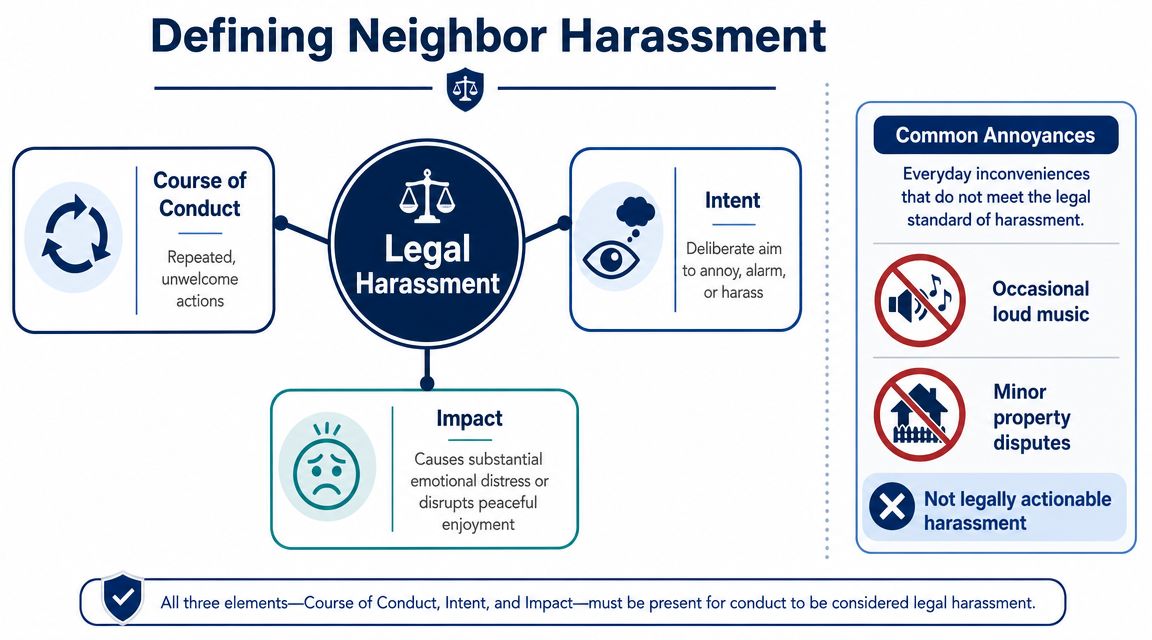
A practical way to evaluate reports is to look at conduct, intent, and impact.
| Element | What it means in plain English | What a board should listen for |
|---|---|---|
| Conduct | More than a single stray event | Repeated acts, follow-up incidents, a pattern over time |
| Intent | Behavior aimed at a specific person, not accidental friction | Deliberate confrontation, targeted noise, surveillance, repeated messages |
| Impact | The conduct materially affects housing enjoyment or causes serious distress | Resident avoids common areas, feels unsafe, changes daily routines, considers moving |
California civil harassment guidance puts this in especially clear operational terms. It describes a knowing and willful course of conduct directed at a specific person, with no legitimate purpose, that would cause a reasonable person substantial emotional distress and causes that distress to the person seeking relief (California civil harassment overview).
Georgia boards shouldn't use California law as Georgia legal advice. They can still use that framework as a useful screening tool because the basic distinction is universal: patterned, targeted conduct is different from occasional annoyance.
Annoyance versus harassment
One loud party is usually a nuisance issue.
A string of late-night noise events aimed at one resident after prior confrontations can look very different, especially if the surrounding facts suggest retaliation or intimidation.
A single rude comment at the pool is unacceptable, but it may not be actionable harassment by itself. Repeated taunts, filming, following, or threats directed at the same owner are much more serious.
Practical rule: Ask whether the conduct appears designed to pressure, alarm, or drive someone out of ordinary use of their home.
Where boards must stay careful
Boards shouldn't diagnose crimes, promise restraining orders, or tell residents that a judge will definitely grant relief. Those are legal calls.
Boards can say this with confidence:
- The association can review whether community rules were violated
- The resident should document a pattern, not just summarize feelings
- Immediate threats or safety concerns belong with law enforcement
- State-specific legal advice should come from a Georgia attorney
Sometimes residents also ask whether yelling, disturbance, or aggressive public behavior might cross into criminal territory. In those situations, it can help to understand how conduct is treated in the criminal system, including how courts and defense counsel analyze public-order allegations such as criminal defense for disorderly conduct. That doesn't replace association enforcement, but it helps boards explain why some behavior belongs outside the HOA process.
Criminal Claims vs Civil Actions
Residents often ask the board the wrong question. They ask, “Can the HOA press charges?” Usually, the better question is, “Is this a criminal matter, a civil matter, or both?”
The answer changes what the board should do next.
The two pathways serve different purposes
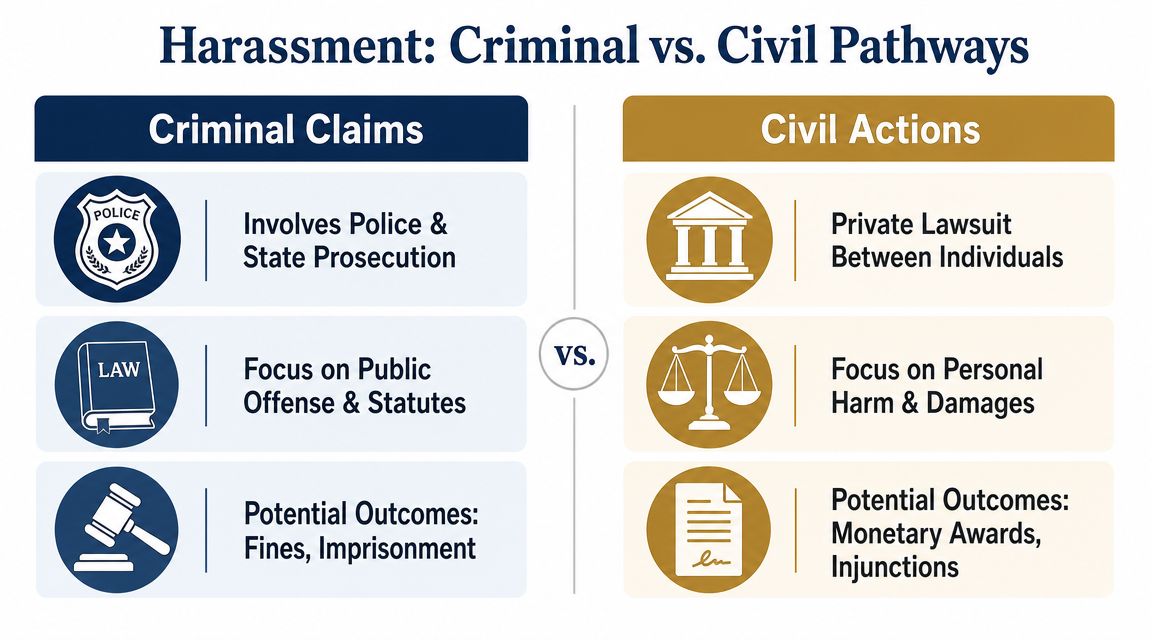
A criminal claim is about public law. Police investigate. A prosecutor decides whether to file charges. The goal is punishment, deterrence, and public safety.
A civil action is about private relief. One person asks a court for protection, damages, or an order requiring the conduct to stop. The goal is to protect the individual and address the harm.
Here's the practical side-by-side view.
| Issue | Criminal path | Civil path |
|---|---|---|
| Who starts it | Law enforcement and the state | The affected resident, usually through private legal action |
| Common triggers | Threats, stalking, assault, property damage, trespass | Harassment claims, restraining order requests, nuisance, invasion of privacy |
| Primary goal | Stop unlawful conduct and punish it | Stop conduct, set boundaries, seek court protection |
| Board's role | Refer resident to police if safety is involved | Refer resident to private counsel while enforcing HOA rules separately |
What the board should say
When a resident reports immediate danger, the board should say so plainly: call law enforcement now.
When the complaint describes repeated intimidation, surveillance, interference, or other targeted conduct without an immediate emergency, the board can guide the resident toward civil options while continuing its own internal process for rule enforcement.
Boards should avoid statements like these:
- “This is only a civil matter.” You may not know that.
- “The police won't do anything.” That's not the board's call.
- “We can't act until a court orders us to.” Often false under governing documents.
- “This is outside the association because it happened between neighbors.” Also often false.
What each path can and cannot do
Criminal law can address dangerous conduct, but it doesn't manage the day-to-day living issues inside a community. A police report doesn't enforce the declaration, the rules, or architectural standards.
Civil relief can create distance and boundaries between residents, but a court order doesn't replace board enforcement either. If a resident violates quiet enjoyment rules, nuisance restrictions, parking rules, or use restrictions, the HOA may still need to act under its own documents.
The board is not the judge, not the prosecutor, and not the sheriff. It is still responsible for making decisions within the association's authority.
That's why experienced boards run parallel tracks. They direct safety issues outward to police and legal counsel, while keeping their own record, notices, hearings, and enforcement steps moving.
Navigating Georgia Specific Harassment Statutes
Georgia boards need local awareness, even if they aren't giving legal advice. Residents expect the association to know whether there are state-law tools beyond HOA violation letters.
One of the most important examples is Georgia's stalking law, O.C.G.A. § 16-5-90, which boards and managers should know exists because neighbor disputes sometimes move into repeated contact, surveillance, following, or intimidating behavior. When the facts suggest stalking-type conduct, the board shouldn't try to translate that into a covenant issue alone. It should direct the resident to law enforcement and qualified Georgia counsel.
State law and local ordinances work differently
Neighbor conflict in Georgia can touch several layers at once:
- Criminal statutes: These may apply to stalking, threats, property damage, trespass, or other conduct that goes beyond rules enforcement.
- Local ordinances: Counties and cities may regulate noise, nuisance conditions, trash, parking, or property maintenance.
- Private community rules: The declaration, bylaws, and rules may prohibit nuisances, abusive conduct in common areas, or interference with residents' use of property.
Each layer has a different decision-maker. Police handle criminal reports. Local code enforcement handles ordinance issues. The board handles the governing documents.
That separation matters because a board can act even when police do not make an arrest, and police can act even when the board hasn't finished its hearing process.
What Georgia boards should do with legal gray areas
Georgia associations get into trouble when they improvise legal conclusions. A board member hears “harassment” and assumes it must be criminal. Another hears “neighbor dispute” and assumes the HOA should stay out of it. Both instincts are risky.
A better board response looks like this:
Identify the behavior
Was there following, threats, repeated contact, surveillance, trespass, or targeted disruption?Identify the location
Did it occur in a unit, on a lot, in common areas, online, or across multiple places?Identify the available channel
Is this best suited for police, code enforcement, internal covenant enforcement, private counsel, or more than one at once?Avoid legal promises
The board can inform. It shouldn't predict whether someone will win a stalking petition or a civil action.
Where boards often overreach
Boards should not write violation notices that sound like criminal indictments. Say what the association can prove and enforce. If the declaration prohibits nuisance behavior, cite nuisance behavior. If a rule prohibits abusive conduct toward staff or residents in common areas, cite the rule.
If the conduct may also violate Georgia law, tell the resident to consult a Georgia attorney and contact law enforcement where appropriate. That protects the resident's options and protects the association from pretending to practice law.
The HOA Board's Role and Legal Responsibilities
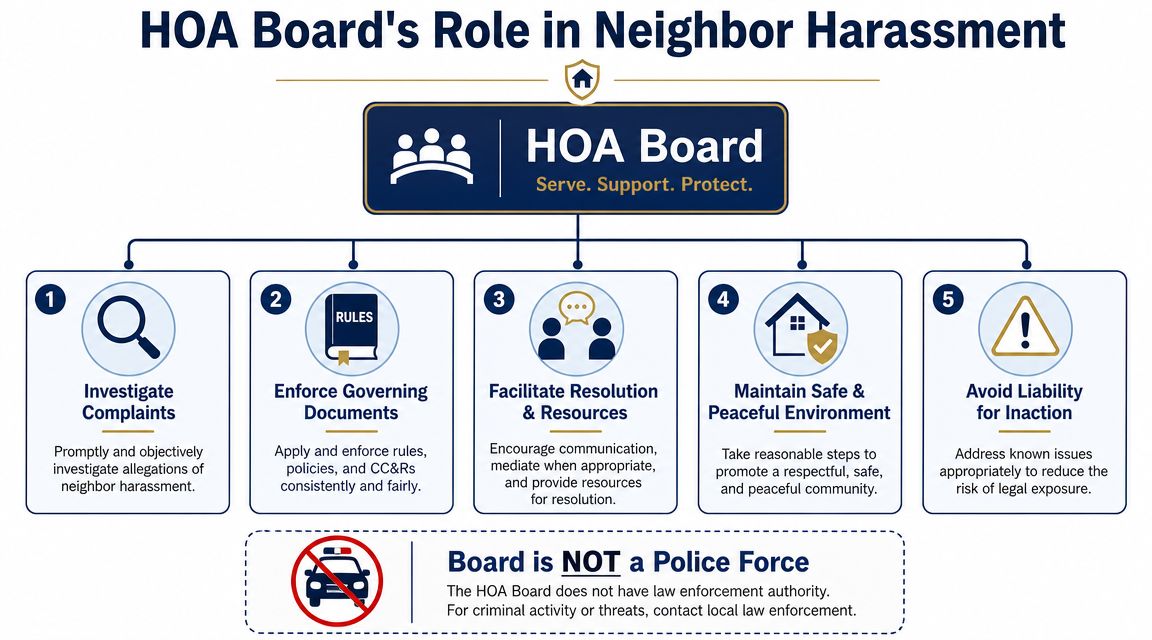
The board is not a police force. It does not issue protective orders, investigate crimes, or decide civil liability between neighbors. But that does not mean the board can remain passive.
In many communities, the association has both contractual duties under the governing documents and operational responsibilities to address conduct that interferes with use of property, common areas, or community safety.
The biggest exposure boards miss
The most serious legal risk appears when harassment is tied to a protected class. Under federal fair housing guidance, an HOA can be liable for neighbor-on-neighbor harassment if the conduct is based on a protected class, the board knew or should have known about it, had the power to stop it, and failed to take effective action. The standard is whether the harassment is so severe or pervasive that it alters the conditions of housing (federal fair housing guidance on neighbor harassment and HOA liability).
That changes the board's risk analysis. Once discriminatory harassment is credibly reported, delay becomes dangerous.
What effective board action usually looks like
Boards don't need to guarantee a perfect result. They do need to show that they responded reasonably and consistently.
A defensible response often includes:
- Prompt intake: Accept the complaint in writing and request dates, locations, witnesses, and supporting material.
- Neutral review: Evaluate facts without taking sides based on board politics or personal familiarity.
- Use of governing documents: Apply nuisance, conduct, use-restriction, and rules-enforcement provisions where supported by the record.
- Written notices and hearings: Follow the association's actual enforcement procedure.
- Targeted action: Cease-and-desist demands, hearing notices, suspension remedies if authorized, and referral to legal counsel when needed.
- Referral outward: Encourage residents to contact police or private counsel where the facts go beyond HOA authority.
A useful foundation is having clear internal procedures for owner complaints and enforcement. Communities with a disciplined approach to homeowners association violations are usually much better positioned when harassment allegations arise.
What doesn't work
Some board responses create more risk than the original complaint.
| Weak response | Why it fails |
|---|---|
| “This is a private dispute. We won't get involved.” | May ignore conduct the HOA has power to address under its documents or fair housing obligations |
| Informal side deals | Produce inconsistent outcomes and no reliable record |
| Board member freelancing | Creates conflicting messages and discoverable statements |
| Demanding court proof before action | Delays enforcement where the board already has rule-based authority |
A board protects itself by documenting what it knew, what authority it had, and what action it took.
The practical boundary line
Boards should stay inside four lanes:
- Receive and document complaints
- Enforce governing documents
- Preserve neutrality and due process
- Escalate to association counsel when facts suggest safety issues, protected-class bias, or potential liability
That's the discipline that protects homeowners, the board president, and the association as a whole.
A Step by Step Guide to Documenting Harassment
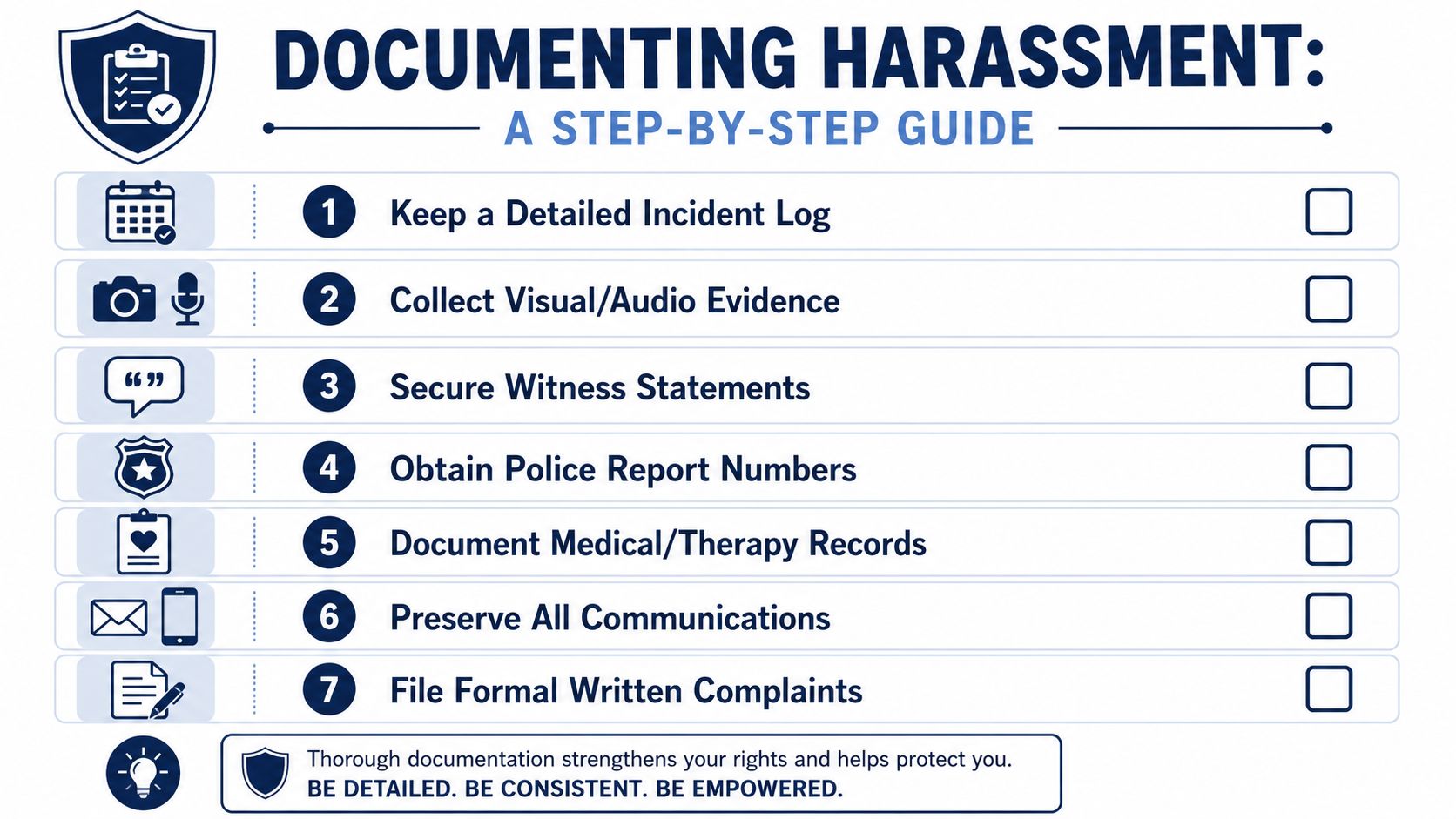
Documentation is where strong complaints and weak complaints separate. Residents often submit conclusions. Boards need evidence.
A defensible harassment record relies on a contemporaneous incident log paired with supporting materials such as photos, videos, and witness statements. That kind of record helps establish the required course of conduct and separates genuine harassment from ordinary friction (guidance on documenting neighbor harassment effectively).
What a useful incident log contains
Boards should ask residents to submit a structured log, not a long emotional narrative. A simple format works best.
| Date | Time | Location | What happened | Witnesses | Evidence saved | Impact |
|---|---|---|---|---|---|---|
| MM/DD/YY | HH:MM | Hallway, parking area, text, doorway | Specific facts only | Names if any | Photo, video, screenshot, email | Missed sleep, felt unsafe, avoided area |
The strongest entries use concrete details. “Neighbor yelled ‘I'm watching you' outside my front door at 9:40 p.m.; Ring video saved” is useful. “Neighbor is always harassing me” is not.
What evidence helps and what weakens the file
Good evidence usually includes:
- Time-stamped media: Doorbell camera clips, phone photos, videos, saved voicemails
- Written communications: Emails, texts, letters, social posts
- Third-party confirmation: Witness statements, police incident numbers, staff observations
- Proof of impact: Missed access, schedule changes, documented damage, professional treatment records if the resident chooses to provide them
Poor evidence usually looks different:
- Edited clips with no date context
- Secondhand rumors
- General character attacks
- Incident summaries written long after the fact
- Audio or video gathered in ways that may create separate privacy disputes
That last point matters more than many boards realize. Surveillance can become part of the conflict. If a resident is collecting footage aggressively, or installing devices in ways that raise privacy concerns, the board should be cautious. For broader privacy compliance context around camera use and data handling, this discussion of Wisenet Security's advice on ICO is a useful reminder that evidence collection isn't automatically risk-free.
Save evidence in original form when possible. Screenshots and edited compilations are helpful, but original files usually carry more weight.
Sample complaint language residents can use
Boards can make reporting easier by giving residents a model.
State the pattern
“I am reporting repeated conduct by Unit/Lot ___ that I believe interferes with my use and enjoyment of my home.”List representative incidents
Include dates, times, locations, and what happened.Attach support
Reference videos, texts, photos, witness names, and police report numbers if any.Describe the impact
Explain changed routines, fear, loss of sleep, inability to use common areas, or other real effects.Request board action
Ask the association to review the conduct under specific nuisance or conduct provisions if known.
What boards should require
Boards help everyone by setting minimum submission standards. Require written complaints. Require dates. Require supporting material where available. Require residents to stick to facts.
That doesn't make the process cold. It makes it usable.
Proactive Strategies and Your Path Forward
The best harassment response starts before the first complaint. Boards reduce risk when they publish conduct expectations, enforce nuisance rules consistently, and give residents a clear reporting path that doesn't depend on which director they happen to know.
Mediation can help in lower-level conflicts where there's no safety threat. It usually fails when one party is using the conflict as a pressure tactic. Boards need to know the difference.
Digital conduct deserves its own attention now. Community disputes don't stay in hallways anymore. They move into text threads, neighborhood platforms, camera feeds, and social media. When online targeting enters the picture, residents may benefit from practical guidance such as ContentRemoval.com's harassment response, while the board stays focused on its own enforcement process.
Boards should also review their own documents regularly. Communities that understand their covenants, rules, notice procedures, and enforcement limits make better decisions under pressure. This overview of HOA governing documents is a useful reminder that the association's authority comes from the documents first, then from disciplined execution.
A calm, documented, consistent process won't eliminate every neighbor conflict. It will put the board in the strongest position to protect homeowners, preserve fairness, and avoid the larger liability that comes from doing too little, too late.
If your board needs experienced guidance on enforcement process, governance, and day-to-day community operations, Access Management Group brings decades of community association management experience in Georgia. Their team works with HOA and condominium boards to help protect, preserve, and enhance community property values while supporting practical, consistent administration.