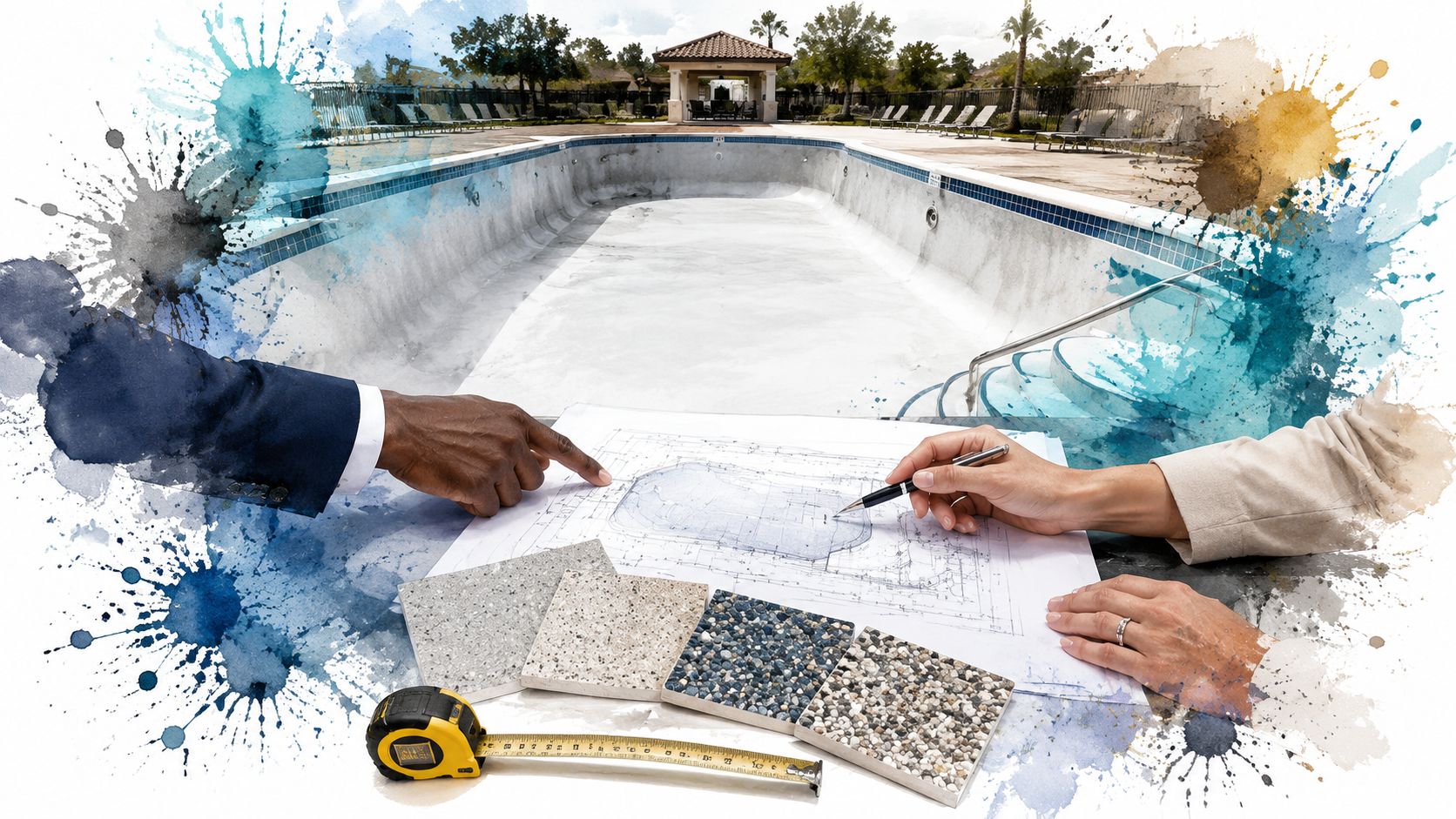
A community pool rarely becomes a board priority at a convenient time. The complaints usually start first. Residents mention rough steps, stains that won't brush out, or a finish that looks tired no matter how clean the water is. Then the board has to decide whether this is routine maintenance, a reserve project, or a sign that a highly visible amenity is starting to become a liability.
That decision carries real weight. The pool affects resident satisfaction, seasonal use, and the association's appearance. It also creates safety, budget, and vendor-risk questions that fall directly within the board's fiduciary duty. Plaster swimming pool resurfacing isn't just a cosmetic upgrade. It's a capital project that needs the same discipline a board would bring to roofing, paving, or structural repairs.
Your Guide to a Major Community Investment
For most associations, the swimming pool is one of the few amenities every owner notices. A worn surface sends a message about deferred maintenance. A properly resurfaced pool sends the opposite message. The community is protecting shared assets and planning ahead.
Boards also have to think beyond appearance. A deteriorated plaster surface can create swimmer discomfort, increase service headaches, and invite constant debate about whether the association is repairing too little or spending too much. The right answer usually comes from disciplined planning, not from reacting to the loudest complaint in the room.
A resurfacing decision belongs in the larger reserve and capital planning conversation. If your board needs to align timing, funding, and useful life assumptions, it helps to review how reserve studies frame major common-area replacements in an HOA reserve study.
Board perspective: The best resurfacing projects start before the pool looks unacceptable. They start when the board decides to manage risk early instead of paying more for delay later.
Plaster remains the baseline finish many communities consider because it balances upfront cost with acceptable durability. But the board's job isn't to buy the cheapest finish. It's to choose the option that protects the association's budget, limits repeat work, and gives residents a safe, attractive amenity for years to come.
Assessing Your Pool's Condition for Resurfacing
A board usually reaches this discussion after a familiar scene: residents complain that the pool looks worn, the maintenance vendor suggests another patch, and someone asks whether full resurfacing is really necessary this year. The board's job is to slow that moment down and make a disciplined call. The wrong decision can waste reserve funds, create avoidable safety complaints, or push the association toward a rushed funding discussion later, including possible special assessment decisions for HOA capital repairs.
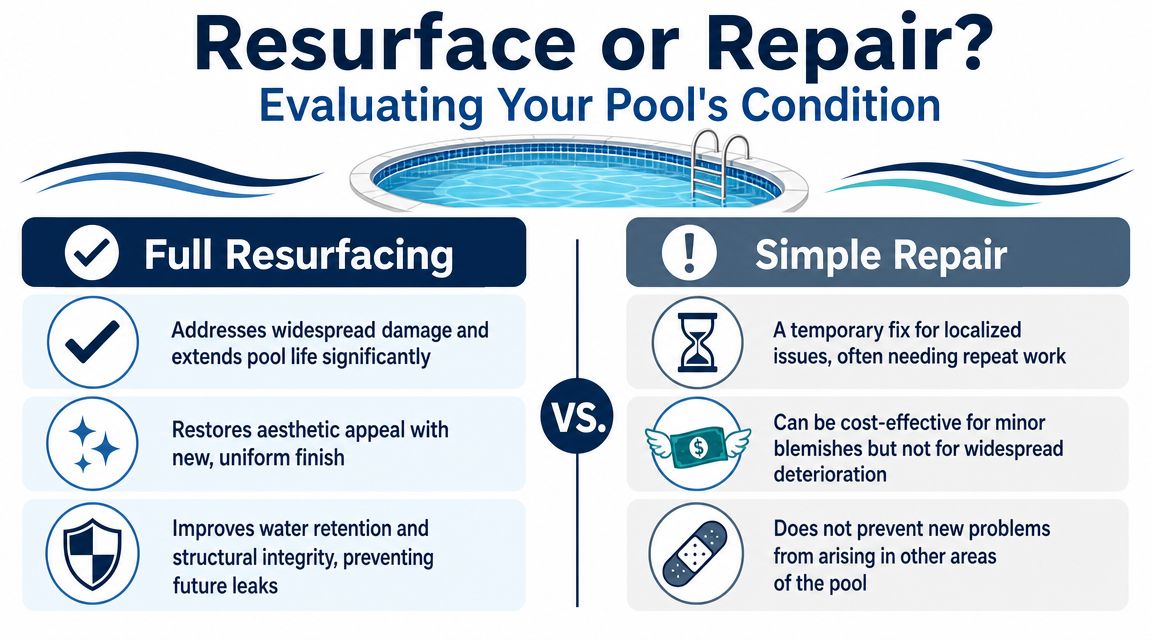
The first step is to determine whether the pool has isolated finish problems or broad surface failure. That sounds simple, but many communities spend too long in the gray area. Small repairs have value when the plaster itself remains sound. They lose value when the board is paying for appearance fixes on a surface that has already reached the end of its useful service life.
Signs that point to full resurfacing
A board should lean toward full plaster swimming pool resurfacing when problems show up across the vessel, not in one isolated spot.
Look for conditions such as:
- Rough texture in multiple areas: If swimmers feel abrasion on steps, benches, shallow areas, and walls, the issue has likely moved beyond cosmetics.
- Cracking throughout the finish: Minor hairline crazing can appear in older plaster, but repeated cracking across broad sections deserves a replacement discussion.
- Stains that return after treatment: Recurring discoloration can signal an aging surface that no longer responds well to routine cleaning.
- Peeling, pop-offs, or delamination: Once plaster begins separating from the substrate, patching often becomes a short-lived fix.
- A long patch history: If the pool interior already shows several repair areas, the board should ask whether it is extending useful life or merely delaying an unavoidable capital project.
Patterns matter more than any single blemish.
When repair may still be reasonable
Repair can still be the right choice when defects are limited, the surrounding plaster remains smooth and bonded, and the maintenance history does not show repeated failure. In that case, the board should define the goal before approving work. Is the association trying to correct one defect, improve appearance for a season, or postpone a larger project to match reserve timing?
That distinction protects the budget. An acid wash may revitalize dull pool surfaces, but boards should ask whether the treatment changes the condition of the plaster or only improves how it looks for a short period. Appearance work has a place. It should not be mistaken for structural correction.
If the board already expects to revisit the same repair next season, the lower bid may be the more expensive decision.
A practical board test
Use this screening table before authorizing repair or bidding full resurfacing:
| Condition | Likely board response |
|---|---|
| Isolated blemish, small smoothable defect, no broad roughness | Compare spot repair and continued monitoring |
| Widespread roughness, visible cracking, repeated staining, multiple prior patches | Obtain bids for full replastering |
| Unclear cause, conflicting vendor opinions | Get an independent technical opinion before approving scope |
Boards do not need to diagnose plaster like a pool consultant. They do need enough discipline to separate maintenance from capital replacement. That is the point where fiduciary duty becomes practical: document observed conditions, compare the cost of another short-term fix against durable work, and make the decision that best protects the asset over time.
Planning Your Resurfacing Project Budget and Materials
Once the board decides resurfacing is warranted, the next job is building a budget that reflects reality. That means pricing the visible work and respecting the possibility of hidden conditions once the pool is drained.
For standard plaster, current market guidance places resurfacing at about $5,000 per 1,000 square feet, with typical project costs in the $6,000 to $15,000 range and an average around $11,000 for a 1,000-square-foot pool in the U.S. market, according to Pool Shark H2O. The same guide notes labor estimates of $45 to $65 per hour and material costs ranging from $1 to $30 per square foot depending on the finish. It also shows why plaster remains the baseline option for many communities, listing replastering at $5,500 per 1,000 sq. ft. compared with $30,000 per 1,000 sq. ft. for tile refinishing.
Build the budget in layers
Boards make better decisions when they separate the project into budget categories instead of looking at one lump-sum proposal.
Start with these buckets:
Base resurfacing scope
This is the drain, prep, bond coat, and new finish work the contractor expects under normal conditions.Shell or substrate repairs
Hidden cracks, hollow areas, or failed prior patches may not be fully known until demolition begins.Peripheral items
Tile line repairs, fittings, lights, and coping transitions can become part of the conversation fast once the pool is empty.Operational impact
Consider resident communication, closure timing, and any temporary adjustments to staffing or amenity scheduling.
If the board may need to fund a project gap beyond reserves or operating cash, it's wise to understand how special assessments are typically approached before the final vote. Even when an assessment isn't necessary, the board should evaluate that possibility early rather than after contracts are signed.
Material choice is a policy choice
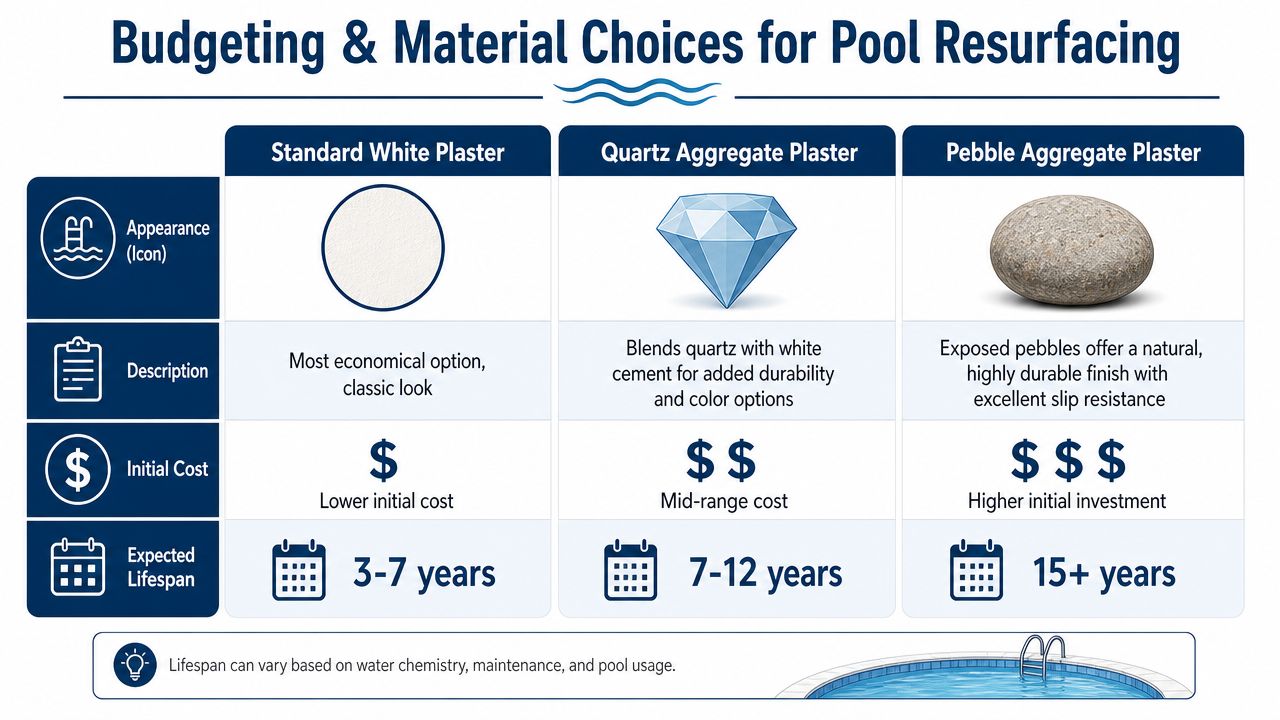
White plaster still deserves consideration because it offers the lowest-cost entry point in many markets. For boards managing reserve pressure, that matters. But lower upfront cost doesn't automatically mean best value.
Recent market guidance increasingly positions blue quartz plaster, pebble finishes, porcelain tile, and glass tile as premium alternatives because of longer life or aesthetic differentiation, as discussed by Allied Outdoor Solutions. The practical lesson for boards is simple. Finish choice affects service life, maintenance sensitivity, and long-term replacement timing, not just color and texture.
Questions boards should ask before selecting a finish
- How visible is this amenity to the community and buyers? A flagship pool may justify a stronger finish package than a secondary amenity.
- How disciplined is ongoing water management? A finish that demands careful chemistry can underperform if operations are inconsistent.
- Will residents accept more texture? Some premium finishes change the underfoot feel.
- What is the reserve planning horizon? The board should compare upfront cost against likely replacement timing, not just this year's budget.
Practical rule: Don't buy a finish based only on showroom appearance. Buy the finish your association can maintain properly.
One more planning issue often gets overlooked. The pool edge and transition details can affect both appearance and scope once resurfacing begins. If the board is evaluating whether coping should be repaired or updated at the same time, an expert guide to Melbourne pool coping is a useful visual reference for understanding edge materials and finish coordination, even if your project is in a different market.
A good board budget doesn't chase the lowest opening number. It asks which option gives the association a clean scope, a maintainable finish, and the fewest reasons to reopen the project discussion too soon.
Selecting and Contracting the Right Pool Professional
The contractor selection process decides whether the board gets a durable result or an expensive lesson. For plaster swimming pool resurfacing, the lowest bid can be the highest-risk choice if the company lacks commercial experience, clear scope language, or enough insurance to protect the association.
Consequently, boards should be deliberate. A residential pool company with attractive pricing may still be the wrong fit for a community pool with higher usage, board oversight, resident communication pressures, and stricter documentation expectations.
What to require before you compare price
The board should insist on basic qualifications before discussing numbers in depth.
Use a screening list like this:
- Licensing and legal standing: Confirm the firm is properly licensed for the work it proposes.
- Insurance coverage: Ask for current certificates showing liability coverage and workers' compensation.
- Relevant project history: Request examples of comparable HOA, COA, apartment, or club pool resurfacing work.
- References from boards or managers: Speak with clients who had to manage resident expectations, not just homeowners with backyard pools.
- Written warranty terms: Get the actual warranty language, including exclusions tied to chemistry, startup, or maintenance.
A contractor can have strong crews and still be a poor board choice if its paperwork is thin or its scope is vague.
Make the RFP detailed enough to prevent confusion
Many bid disputes start because the board asked for “pool resurfacing” and each bidder defined that phrase differently. One proposal may include full surface prep and crack repair review. Another may assume minimal prep and treat repairs as change orders.
A better request for proposal should identify:
| RFP item | Why it matters |
|---|---|
| Existing pool condition | Gives bidders a shared starting point |
| Desired finish type | Prevents apples-to-oranges pricing |
| Scope of prep work | Reduces dispute over demolition and surface treatment |
| Repair allowances or process | Clarifies how hidden conditions will be handled |
| Startup responsibility | Identifies who owns curing-phase tasks |
| Schedule expectations | Helps the board plan closure and resident notice |
Boards also benefit from involving their management partner or project oversight team early, especially if the association needs structured bid review and construction coordination support for maintenance and construction work.
Contract terms that protect the association
A strong contract does more than state a total price. It allocates risk clearly.
Focus on these clauses:
- Detailed scope of work: List demolition method, substrate prep, bond coat requirements, finish specification, startup duties, and cleanup.
- Payment tied to milestones: Avoid front-loaded deposits that leave the board exposed if progress slows.
- Change-order procedure: Require written approval before extra work begins.
- Start and completion expectations: Include what happens if weather or hidden damage affects timing.
- Warranty and owner responsibilities: Spell out what voids coverage, especially chemistry and startup compliance.
A short contract usually means the board is accepting risk the contractor didn't price.
How boards should compare bids
Don't ask which company is cheapest. Ask which proposal is clearest, most complete, and easiest to enforce.
A practical board discussion often sounds like this:
- Which bidder documented the condition of the pool most carefully?
- Which proposal is explicit about prep, not just finish application?
- Which company has completed similar community projects?
- Which contract puts the association in the strongest position if scope or timing slips?
The right contractor isn't the one who says, “Trust us.” It's the one who documents the work so the board doesn't have to rely on trust alone.
Overseeing the Pool Resurfacing Process
Once the contract is signed, oversight becomes a governance task. The board doesn't need to supervise trowel technique or stand over the crew. It does need to monitor milestones, document progress, and keep residents informed about closures and reopening expectations.
Industry guidance describes a technically sound workflow that starts with full drainage, removal of loose or failing material, surface profiling by hydroblasting, sandblasting, or chipping, then a bonding layer before the new finish is applied. It also notes the new plaster layer is roughly 3/8 to 1/2 inch thick, and the work typically takes about 4 to 7 days for an average pool, with projects extending up to 14 days when weather or damage slows the sequence, according to Sublime Pools.
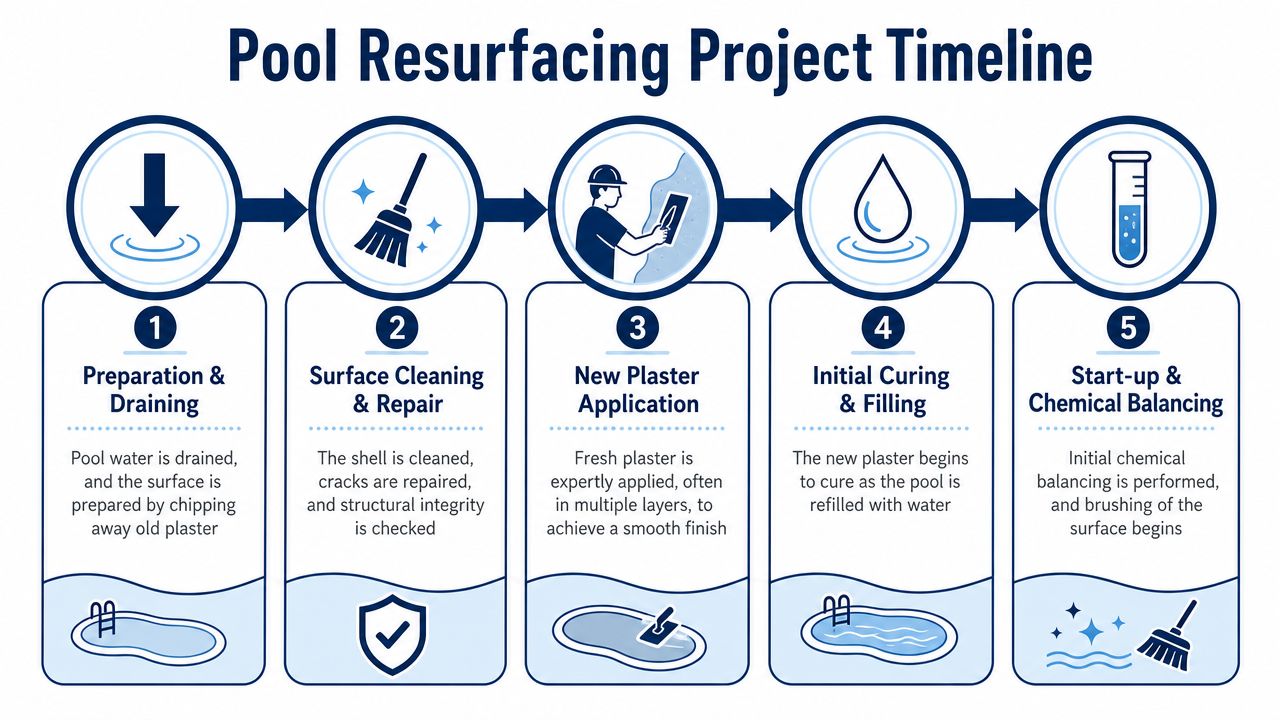
What the board should expect on site
Most projects move through a predictable sequence. Knowing that sequence helps the board ask better questions.
Drain and prep
The pool is emptied and the surface is exposed for inspection. This is often when hidden condition issues become visible.Removal of failing material
Crews remove loose or deteriorated plaster by hydroblasting or chipping. This stage can look messy, but that alone isn't a red flag.Shell review and repair
The contractor should identify cracks, hollow spots, or areas that need corrective work before the finish goes on.Bonding layer and new plaster application
The surface gets prepared to receive the new plaster, then the finish is applied to a uniform thickness.Initial fill and handoff to startup
Once the pool is filled, the project shifts into curing and chemistry control.
What good oversight looks like
Boards often overcorrect in one of two ways. They either disappear and wait for an invoice, or they micromanage field crews. Neither approach works well.
A better approach is structured oversight:
- Use one point of contact: The contractor should know who can approve decisions.
- Request milestone updates: Ask for updates at drain completion, prep completion, repair discovery, finish application, and refill.
- Photograph conditions: Before, during, and after photos help with records and resident communication.
- Track approved changes in writing: Verbal field approvals cause avoidable disputes later.
Residents don't need minute-by-minute construction details. They do need timely, clear communication about closure, progress, and reopening conditions.
Red flags that deserve immediate attention
If the board or manager sees any of these, pause and ask questions:
- Scope suddenly becomes vague: “We'll figure it out later” is not a project-control plan.
- Repairs appear without documentation: Hidden conditions may be legitimate, but they still need written approval.
- Finish expectations shift midstream: Material substitutions should never happen casually.
- Startup responsibility is unclear: The project isn't complete just because the pool is full again.
Good project oversight protects the contractor too. It creates a clean record, avoids miscommunication, and helps the board deliver a more confident explanation to homeowners about what was done and why.
Ensuring Longevity with Post-Resurfacing Care
The pool has been refilled, residents want a reopening date, and the board is ready to close out the project file. That is often the point where risk shifts, not where it ends.
Fresh plaster is vulnerable during startup. If brushing, circulation, and water chemistry are handled poorly in the first few weeks, the association can shorten the life of a surface it just paid to install and weaken its position on any later warranty claim. Boards should treat startup as part of the capital project, with assigned responsibility, written records, and clear acceptance standards.
Guidance tied to National Plasterers Council startup standards explains why this period matters. Eighty-six percent of the cement in pool plaster cures within the first 28 days, filtration should run continuously for at least 72 hours, and the pool should not be shocked for the first 30 days, according to Oles Pool and Spa. The same guidance notes plaster resurfacing commonly lasts 7 to 10 years, while well-maintained pools can last 12 years or more, and some sources cite longer service lives under favorable conditions.
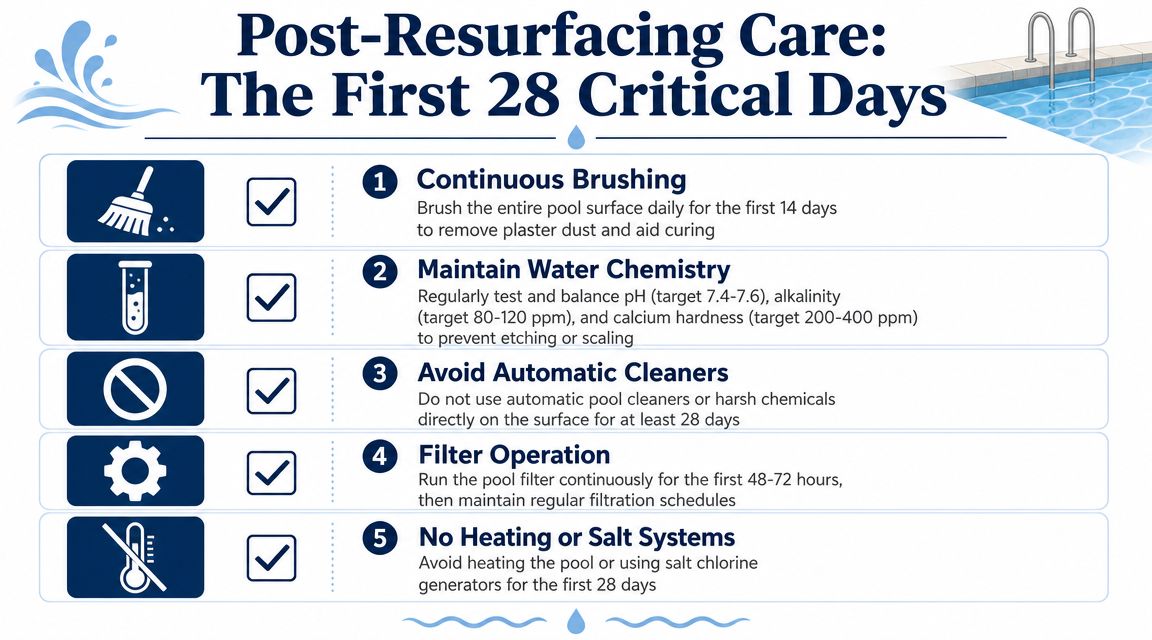
The first month needs board oversight
At this stage, the contractor may be finished with application work, but the association still has an asset-protection job to manage. A startup mistake by the pool service company, maintenance staff, or onsite team can lead to scaling, streaking, plaster dust, or staining that becomes a dispute later. The board does not need to perform the work. It does need to make sure one qualified party is responsible and accountable.
National Plasterers Council startup guidance calls for brushing the entire surface twice per day, continuous filtration for at least 72 hours, holding chlorine off for 48 hours, and then targeting pH 7.2 to 7.6, alkalinity around 70 ppm, and calcium hardness starting at a minimum of 150 ppm while managing it so it does not exceed 200 ppm during the early curing period, according to NPT Pool.
This is also where contract language matters. If the resurfacing agreement is silent on startup, the board can end up with a predictable argument. The contractor says the finish was installed correctly. The service vendor says the plaster crew gave incomplete instructions. The association is left trying to sort out responsibility after the surface already shows problems.
What boards should verify immediately after refill
The safest approach is simple. Confirm startup responsibilities in writing before the pool reopens and before multiple vendors begin making chemical adjustments.
Verify these items:
- Who is brushing the pool and how often: Put the schedule in writing.
- Who is testing and adjusting chemistry: Name the responsible vendor or staff member.
- Who is keeping startup logs: Save test results, brushing records, and adjustment notes.
- When salt systems or other chemistry changes are allowed: Fresh plaster can be damaged by premature changes, especially if different parties are operating from different assumptions.
- Who has authority to approve changes: One decision-maker reduces conflicting instructions and finger-pointing.
As noted earlier, fresh plaster should be protected from avoidable chemical mistakes during the curing period. For community pools, that matters even more because boards often have a contractor, a service company, and onsite staff involved at the same time.
New plaster can be installed correctly and still underperform if the first month is handled carelessly.
A board-level startup checklist
Use a short control list that the manager or designated board liaison can review each day during startup:
| Board checkpoint | What to confirm |
|---|---|
| Written startup plan | Chemistry targets, brushing, filtration, and restrictions are documented |
| Assigned responsibility | Contractor, pool company, and staff roles are clear |
| Daily recordkeeping | Tests, brushing, and adjustments are logged |
| Resident communication | Reopening rules and swim restrictions are communicated clearly |
| Warranty file | Startup records and contractor instructions are saved |
Boards that manage this period well usually avoid the most frustrating resurfacing disputes. They have records, they can show that instructions were followed, and they are in a better position if warranty questions arise. Boards that treat startup as an informal handoff often spend more time arguing over stains, dusting, scaling, and responsibility than they expected.
A resurfaced pool should return to service as a protected community asset. It should not become the next preventable claim on the association's budget.
If your board is weighing a pool resurfacing project, coordinating bids, or trying to align a major amenity upgrade with reserve planning and resident communication, Access Management Group can help your association approach the decision with structure, clarity, and long-term community protection in mind.