You were elected secretary at the annual meeting, the vote moved fast, and now people expect you to know what happens next. The president wants the agenda out. Homeowners want answers. The manager, if you have one, needs decisions documented correctly. Meanwhile, you may still be wondering whether the job is mostly taking notes.
It isn't.
A good board member secretary protects the association in ways homeowners rarely see until something goes wrong. Accurate minutes, proper notice, organized records, and disciplined communication help the board make defensible decisions, avoid procedural fights, and preserve trust in the community. That matters because disputes over process often become disputes over money, repairs, elections, or rule enforcement. In an HOA or COA, that eventually touches property values and neighbor relationships.
The Essential Role of the HOA Board Secretary
The secretary is often treated like the board's administrative helper. In practice, the role is much closer to a risk manager and institutional historian.
When the board follows the governing documents, sends proper notice, keeps complete records, and documents actions clearly, the community runs with less friction. Owners may still disagree with a decision, but they're less likely to argue that the process was unfair or invalid. That distinction matters. Fair process lowers tension. Clear records lower exposure.
The role has also become more demanding. The NACD 2025 Trends and Priorities Survey notes that independent director time commitments have climbed to over 300 hours annually, a sign of how governance work has become more complex, even outside the corporate context, as summarized by Diligent's review of board director trends. HOA and COA boards are volunteer boards, but the pressure is similar. Someone has to keep the board aligned, informed, and procedurally sound. That person is often the secretary.
Why this role affects homeowners directly
A secretary's work protects more than the board. It protects owners who want meetings held properly, records handled responsibly, and decisions made in the open when required. It also protects the board president, who depends on the secretary to keep actions organized and support a meeting process that won't unravel later.
Practical rule: If a board decision can't be traced through proper notice, a clear motion, a recorded vote, and approved minutes, expect trouble later.
Strong secretaries help create a calmer community culture. They reduce confusion about what was decided, when it was decided, and why the board is acting. That kind of clarity doesn't eliminate disagreement, but it keeps disagreement from turning into distrust.
What new secretaries often get wrong
Many new volunteers think their main job is writing down everything said in a meeting. That usually leads to cluttered minutes, missed motions, and records that are less useful than they should be.
The better approach is to think in terms of governance integrity. Your job is to help the board act correctly, document actions accurately, and preserve the association's official record. When you do that well, you are not just serving the board. You are helping protect the community's assets and its working relationships.
Understanding Your Core Responsibilities
The secretary's job makes more sense when you divide it into three pillars. Most day-to-day tasks fall into one of them.
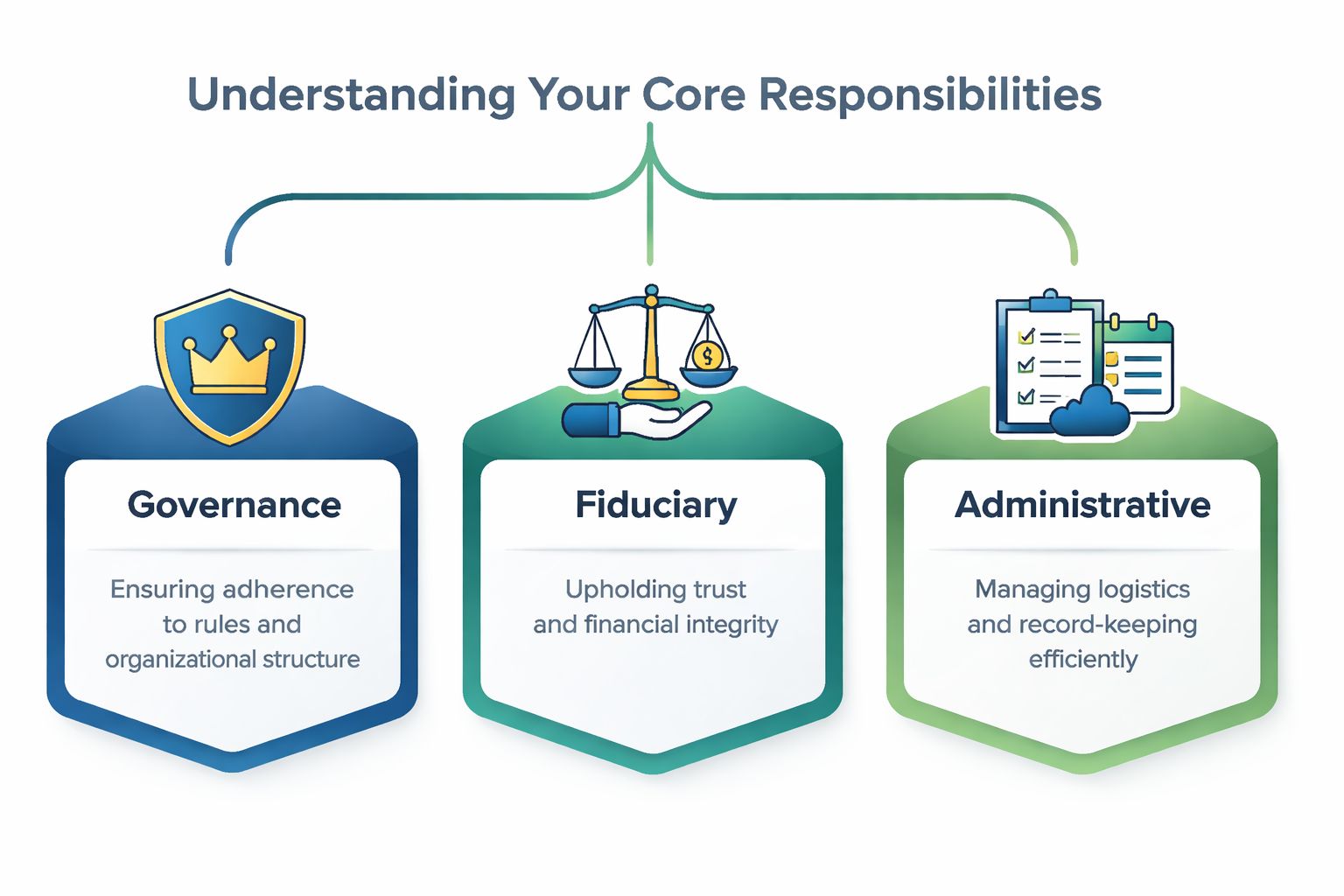
Governance guardian
This pillar is about process. The secretary helps the board act within its bylaws, declarations, rules, and applicable law. That doesn't mean the secretary acts like the community's lawyer. It means the secretary watches the mechanics.
Examples include:
- Checking meeting procedure: confirming the right meeting is being called, the agenda matches the business to be handled, and required notice goes out on time.
- Tracking formal actions: recording motions, seconds when required by the board's practice, and vote outcomes in a way that leaves no ambiguity.
- Supporting the chair or president: helping the meeting stay on agenda so the board doesn't wander into decisions it wasn't prepared to make.
If governance is weak, even sensible decisions can be challenged. A board can be right on substance and still lose ground because it handled procedure poorly.
Records custodian
This is the part many people underestimate. The secretary is the custodian of the association's official memory.
That includes meeting minutes, member rosters, governing documents, policies, election materials, and other records the association must preserve. In many communities, these records become critical when there's a dispute over a vote, a contract, a rule, or a board action from years earlier.
A useful way to think about this duty is simple: if a future board, homeowner, auditor, manager, or attorney needs to know what happened, the record should answer the question without guesswork.
Communication hub
The secretary also functions as a controlled channel for official board communication. This doesn't mean handling every homeowner question personally. It means making sure official notices, agendas, approved minutes, and record requests move through a clear process.
That's where many boards either build confidence or create frustration.
- Notice to owners: timely, complete, and consistent
- Information to directors: organized packets and draft minutes
- Records access: handled according to policy, law, and privacy limits
The secretary shouldn't be the neighborhood rumor filter. The secretary should be the board's official source of accurate process and documentation.
A practical way to prioritize the work
When you're deciding what matters most, use this order:
| Priority | Focus | Why it matters |
|---|---|---|
| First | Valid board action | Protects the association from procedural mistakes |
| Second | Complete official records | Preserves the board's legal and operational history |
| Third | Clear communication | Reduces conflict and owner confusion |
If you keep those three pillars in view, the job becomes more manageable. You stop reacting to random tasks and start seeing how each duty protects the community.
Mastering Meetings from Agenda to Minutes
Most owners will judge the board's professionalism by how meetings are handled. For the secretary, that means success starts before anyone enters the room or logs into the call.
A meeting usually goes wrong for predictable reasons. The notice was late. The agenda was vague. Supporting materials were scattered across emails. Someone made a motion that nobody captured clearly. Then the board leaves with different memories of what it approved. Good secretaries prevent that chain reaction.
A useful starting point is a structured HOA meeting agenda template. Templates don't replace judgment, but they do reduce avoidable mistakes.
Before the meeting
The first job is making sure the meeting is properly set up. That means checking the governing documents and state requirements for notice, then making sure the notice includes the basics the board must communicate.
Precise notice matters. A 2024 Community Associations Institute analysis found that 15% of challenged HOA votes were overturned due to deficient notices, with median settlements of $25,000, according to this summary on HOA secretary duties and notice requirements. For a volunteer board, that's a steep price for a preventable process failure.
Before the meeting, the secretary should handle or confirm these items:
- Set the agenda: Work with the president to list action items, reports, owner forum timing, and any executive session topics that belong outside open session.
- Distribute notice correctly: Use the method required by your documents or law, whether that's posting, email, mail, portal delivery, or a combination.
- Assemble the board packet: Include prior draft minutes, management reports, proposals, contracts, reserve items, and any background needed for decisions.
- Confirm attendance expectations: If quorum may be an issue, find out early, not five minutes after the meeting starts.
During the meeting
Your goal is not to transcribe conversation. Your goal is to capture the official action and enough context to make the record usable later.
A practical minutes structure looks like this:
- Call to order
- Attendance and quorum
- Approval of prior minutes
- Reports
- Motions and actions
- Owner forum summary if applicable
- Executive session notation if applicable
- Adjournment
For each motion, capture:
- The exact action proposed
- Who made the motion
- The outcome of the vote
- Any abstention or recusal that should be recorded
Don't write minutes like a play script. Avoid emotional descriptions, side commentary, and personal opinions. If a director argued forcefully against repainting the clubhouse, that usually doesn't belong in the minutes unless the board needs a concise record of a key rationale.
Write minutes so that a homeowner can understand the action taken and a future board can rely on the record without reliving the entire meeting.
After the meeting
The work isn't finished when adjournment happens. Delays after the meeting create their own problems. People forget what was said, drafts get passed around casually, and unofficial versions start circulating.
Use a simple post-meeting routine:
- Draft promptly: Prepare the draft while the details are still fresh.
- Label it clearly: Mark it as draft until the board approves it.
- Circulate to the right people: Usually the board, manager, or legal counsel if there's a sensitive issue.
- Store the official version properly: Once approved, archive it in the association's records system.
A short sample action entry might read like this:
Motion to approve the pool resurfacing contract with Vendor Name, subject to legal review of final contract terms. Motion passed.
That wording is better than pages of debate notes. It tells the next board what happened, what was approved, and whether conditions applied.
Navigating Legal and Compliance Obligations
Minutes and records often feel routine until a dispute starts. Then they become evidence.

That's why the secretary must treat association records as legal documents, not casual files. In many states, owners have inspection rights to certain records. Attorneys may request them. Boards may need them to defend prior decisions. If records are incomplete, disorganized, or inconsistent, the association starts from a weaker position.
A useful foundation is keeping the board's records tied closely to the community's governing documents for HOAs. Those documents set the rules for meetings, voting, authority, and notice. The secretary should know where they are, which version is current, and how board practices align with them.
What legal custody really means
The secretary doesn't have to do every filing personally, especially if the association has a manager or counsel. But the secretary should know what exists, where it is stored, and whether the board can retrieve it quickly.
Under statutes such as California's Davis-Stirling Act, key records must be retained for at least 7 years, and a 2023 CAI benchmark study found 28% of HOA litigation stemmed directly from record-keeping disputes, as summarized in this overview of HOA secretary record obligations.
That tells you something important. Recordkeeping isn't a back-office chore. It's a legal control.
Sensitive records need extra discipline
Not every document should circulate the same way. Open meeting materials, approved minutes, and routine notices are one category. Executive session records, delinquency matters, legal communications, and owner-sensitive material are another.
If your board shares files electronically, secure transmission matters. For boards sending confidential packets or owner-related documents, this guide on how to secure files with Ellie's advice is a practical resource for password-protected file handling. The point isn't to turn volunteers into IT specialists. It's to avoid careless sharing habits that create privacy problems.
A basic compliance checklist
Use this as a working discipline, not a one-time project:
- Retention: Keep official records according to legal and document-based requirements.
- Access: Separate records owners may inspect from records that are restricted.
- Version control: Preserve final approved documents and avoid mixed draft folders.
- Confidentiality: Store executive session and privileged materials separately.
- Consistency: Use the same naming, filing, and approval conventions each meeting cycle.
Boards get into trouble when records live in personal inboxes, on one volunteer's laptop, or in folders no one can interpret after a turnover. A secretary who imposes order protects the whole association.
Best Practices for Modern Recordkeeping and Communication
Paper binders still have their place. They just shouldn't be your only system.

Today's board member secretary often works across email, portals, PDFs, scanned records, hybrid meetings, and homeowner requests that arrive at all hours. That environment rewards boards that build a clean digital process. It punishes boards that rely on scattered attachments and memory.
The shift is real. A 2025 CAI survey found 70% of HOAs use hybrid or virtual meeting formats, and Gartner reporting summarized by DiliTrust notes that high-quality board packets can improve information access by 56%, helping boards make better-informed decisions through stronger information flow, as discussed in this piece on the modern board secretary's governance role.
What a modern system should do
Good recordkeeping systems don't need to be complicated. They need to be consistent.
The strongest setups usually include:
- Central storage: one official location for minutes, agendas, contracts, policies, and owner notices
- Role-based access: directors see what they need, while confidential materials stay limited
- Searchable naming conventions: for example, year, meeting type, and status
- Packet assembly workflow: agenda, attachments, and draft minutes grouped together
- Communication logs: a record of when official notices or updates went out
For boards building these habits, DigiParser's best practices for documents offers a practical framework for organizing, standardizing, and controlling document flow. Even if your association uses a different toolset, the underlying discipline is the same.
What works and what does not
A lot of volunteer boards buy software mentally before they fix their process. That's backwards.
What works:
- A naming convention everyone follows
- One approved repository
- Clear ownership for uploads and final versions
- Separate folders for open and confidential records
- Regular cleanup of drafts and duplicates
What doesn't:
- Multiple directors keeping their own “official” copy
- Minutes approved from an outdated draft
- Important notices sent from personal accounts with no archive
- Executive session notes mixed into open board files
Clean systems reduce confusion before they reduce work. That alone is worth the effort.
Where management support helps
This is one place where professional support can change the experience for volunteer secretaries. A management company can help with meeting preparation, notice workflows, owner communication, and records handling through a shared operational system instead of disconnected personal files. For communities that want more structured owner updates, an HOA newsletter resource can also support more consistent communication alongside formal notice requirements.
The goal isn't more technology. The goal is fewer preventable mistakes, less confusion during board turnover, and a record system the association can rely on.
Common Pitfalls and How to Avoid Them
The biggest mistakes aren't usually dramatic. They're small habits repeated over time until they create a dispute.
A 2023 Community Associations Institute report noted a 25% increase in litigation against HOA boards since 2020, often involving incomplete or disputed records, according to this summary on nonprofit board secretary risks and records. That's a warning for association secretaries. Sloppy process leaves openings.
Pitfall one: writing minutes like a transcript
New secretaries often try to prove diligence by capturing every comment. That usually creates longer minutes and weaker protection.
Better approach:
- Record actions, not speeches
- Note essential rationale only when it helps explain a decision
- Remove adjectives, personal reactions, and side disputes
Pitfall two: mixing official records with personal notes
A spiral notebook, phone photo, and email draft are not an organized record system. If you keep personal annotations, don't let them become confused with the association's official file.
Use one official draft and one official final version. Anything else should be clearly temporary or clearly separate.
Pitfall three: delaying approval and filing
Minutes lose value when they sit in limbo. Directors forget details, owners hear conflicting versions, and the board starts relying on memory instead of the written record.
A simple routine helps:
- draft soon after the meeting
- circulate in a controlled way
- approve on schedule
- archive immediately after approval
The longer minutes stay unofficial, the more likely the board is to create competing versions of the same event.
Pitfall four: mishandling confidential information
A secretary can create real problems by forwarding delinquency information, legal advice, or executive session material too broadly. Volunteer boards sometimes underestimate how quickly a loose email chain can become a governance issue.
When in doubt, separate confidential material from general board packets and confirm who should receive it. Caution is not overkill in this role. It is good governance.
Frequently Asked Questions for HOA Secretaries
What kind of minutes should I prepare
In most associations, action-oriented minutes work best. They record attendance, motions, votes, and official outcomes without turning the document into a full narrative. Detailed minutes have a place in rare situations, but routine board meetings usually benefit from concise records that clearly show what action the board took.
Can a board member change approved minutes later
Yes, but not informally. Once minutes are approved, they should only be changed by a formal board action that corrects or amends the record. Don't overwrite the old version casually. Preserve the approved record and document the correction through the board's normal process.
What is my role in executive session
Your role is still to document the meeting, but with more restraint and more confidentiality. Executive session records should be limited to the essential actions taken and maintained separately from open meeting materials when appropriate. If legal counsel is involved, follow that guidance carefully.
Do I have to answer every homeowner records question myself
Usually, no. You help ensure the process is handled properly. In many associations, the manager or designated board contact coordinates production. Your responsibility is to help the board maintain organized records so lawful requests can be handled accurately and consistently.
What if I missed something in the meeting
Use your notes, the agenda, and any packet materials to reconstruct the action quickly after the meeting while memories are fresh. If a motion or vote result is unclear, confirm it with the presiding officer or manager promptly. Don't guess. A short delay for verification is better than a permanent error in the record.
If your board wants practical support with meeting preparation, records management, homeowner communication, and day-to-day governance administration, Access Management Group can help your association build cleaner processes that protect the board, serve homeowners well, and support the president's leadership.