You're probably seeing the same pattern many Buckhead boards are seeing. More lease applications. More move-ins. More owners asking whether they can rent “just for a year.” More friction between resident owners and tenants who don't know the rules.
That doesn't mean your building is in trouble. It means your board needs to treat rentals as an operating issue, not a side issue.
Buckhead is one of Atlanta's most active condo environments. That creates opportunity for owners, but it also puts pressure on associations. If your COA doesn't control leasing standards, enforcement, and owner accountability, the rental market will start controlling your building instead.
The Growing Trend of Rentals in Buckhead Condos
Buckhead has the kind of housing mix that naturally produces rental activity. Owners buy to live in the unit, investors buy for income, and some owners become landlords because life changes. Job transfers, marriage, divorce, delayed sales, and rate pressure all push more units into the rental pool.
Boards notice it before anyone else does. The signs are obvious. Elevator reservations increase. Move-in inspections get rushed. Package rooms fill up faster. Front desk staff start asking who lives in the unit. If your board feels like rental activity has become more visible, that reaction is grounded in reality.
Why this matters to a COA board
A condo association isn't in the apartment business. But once more units are leased, the board has to manage many of the same operational risks. Tenant onboarding, rule awareness, parking control, common area wear, security access, amenity misuse, and after-hours complaints all become more frequent.
That matters because the board's job is to protect the entire property, not just process paperwork.
A rental policy isn't about discouraging leasing. It's about protecting owner equity, preserving building standards, and keeping operations predictable.
Buckhead also attracts a wide range of renters. Some are long-term professionals who treat the building with care. Others are temporary occupants who don't understand condo living and don't have much stake in the community. Your documents and enforcement practices need to separate those two outcomes.
What boards should focus on first
If your community has more owners asking about condos in Buckhead Atlanta for rent, don't respond with vague preferences or case-by-case improvisation. Build a structure.
Start with these priorities:
- Track leasing activity: Maintain a current lease roster with unit number, owner contact, tenant names, lease dates, vehicle information, and emergency contacts.
- Define approval steps: Require lease submission, acknowledgment of rules, and move-in scheduling before occupancy.
- Enforce through the owner: Tenants may cause the issue, but the owner is your member. Keep accountability there.
- Protect the resident experience: Noise, hallway clutter, amenity abuse, and access control failures hurt owner satisfaction fast.
- Watch concentration risk: Even when rentals are allowed, unchecked growth can change financing options, buyer perception, and community culture.
Boards that stay passive usually end up reacting to problems one complaint at a time. Boards that lead set standards early, communicate them clearly, and enforce them consistently.
Understanding the Buckhead Condo Rental Market
A board usually sees the problem after the complaints start. An owner says the lease has been sitting for weeks. Another pushes for looser rules because "Buckhead rents itself." Then a vacant unit lingers, a rushed tenant moves in, and staff spends the next six months dealing with access issues, move damage, parking disputes, and rule violations. That is not a leasing problem. It is a board control problem.
Buckhead gives owners pricing power, but it also gives renters and investors plenty of alternatives. Premium pricing does not protect a building from weak operations. It exposes them faster.
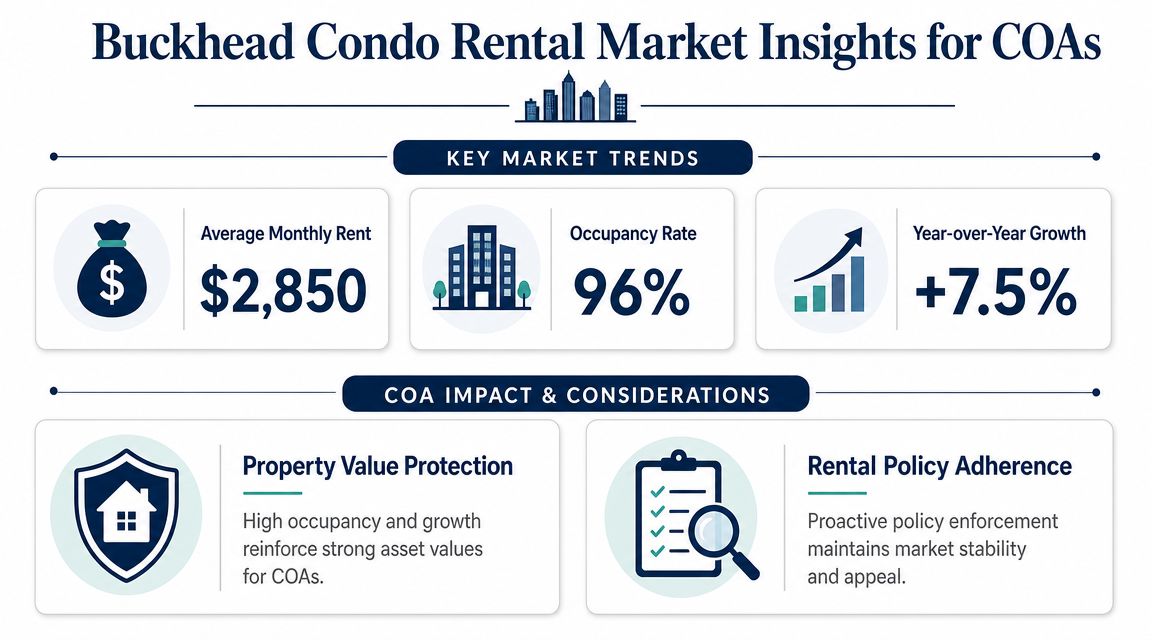
Realtor.com reports the median rental price for condos in Buckhead at $1,971, while Atlanta overall averages $1,635 per month across property types. The same Buckhead condo snapshot shows 13 active condo rentals and an average market time of 92 days, which should get a board's attention. Owners may ask for top-of-market rent, but units still sit when condition, pricing, leasing restrictions, or building reputation do not support the ask (Buckhead condo rental snapshot on Realtor.com).
Premium rents raise the board's operating standard
High rent sets a higher service expectation for everyone involved.
Tenants paying Buckhead rates expect clean common areas, controlled access, reliable elevators, organized move procedures, and amenities that work. Owners expecting Buckhead rent want the association to protect the building's reputation, enforce rules consistently, and avoid the kind of visible disorder that depresses renewal prospects. If your lobby feels unmanaged or your enforcement varies by owner, the market notices.
Board members should read rental market data as a management signal. If units are slow to lease in a high-demand area, the board should examine building condition, leasing friction, rule clarity, and owner compliance before blaming the market.
Competition is constant, even if your building is full
Buckhead is one of Atlanta's most visible condo markets. Buyers, investors, and renters compare buildings side by side. They look at pricing, finishes, amenity quality, parking, security, and online reputation. They also compare how well a property appears to be run.
ApartmentAdvisor places average Buckhead rent around $1,786 to $1,800 per month, notes a range from $999 to $4,086, and reports more than 177 apartments available for rent (Buckhead rent data on ApartmentAdvisor). A COA should read that for what it is. Competition is active, renters have choices, and owners will keep testing your leasing rules against nearby communities.
That has direct board implications:
- Loose administration costs money: Slow approvals, missing lease records, and unmanaged move-ins make your building harder to rent at the price owners expect.
- Inconsistent enforcement hurts value: Buyers and landlords both discount buildings that look selective or disorganized in rule enforcement.
- Investor interest requires control: A building can accept rentals without letting rental activity dictate community culture.
Board-level takeaway: In Buckhead, rental demand is real, but it does not excuse weak policy or weak execution. A well-run association protects pricing power. A poorly run one gives it away.
A Closer Look at Buckhead's Condo Landscape
Your board approves a lease, the tenant moves in, and six months later the complaints start. The issue is not rent demand. The issue is fit. Buckhead rewards buildings that know exactly what they are and screens rental activity accordingly.
Boards get into trouble when they treat Buckhead like a single condo market. It is not. A full-service tower on Peachtree competes on a different standard than a boutique mid-rise in a quieter pocket. Your rental policy, move procedures, finish standards, and enforcement posture should match the building you run.
Unit mix shapes operational pressure
Forget broad market averages here. Focus on your own inventory. A building with mostly one-bedroom units usually deals with faster turnover, more frequent move-ins, heavier loading dock use, and more leasing administration. A community with larger residences tends to see fewer leases but more demanding owners and tenants. They expect better acoustics, stronger access control, cleaner common areas, and less tolerance for disruption.
That difference should drive board decisions.
If your building attracts short-stay professionals, your rules need tight registration, clear occupancy limits, and strict move scheduling. If your building attracts households planning to stay longer, protect quiet enjoyment, parking discipline, and common-area condition. Boards that fail to match operations to resident profile create avoidable conflict.
Location inside Buckhead changes what renters expect
Use a competitive lens that is practical, not theoretical.
| Sub-Neighborhood | Primary Character | Common Condo Type | What Renters Usually Value |
|---|---|---|---|
| Buckhead Village | High-visibility, social, active | Luxury high-rise | Walkability, image, service level |
| Peachtree Road corridor | Professional, polished, convenient | Full-service towers and mid-rises | Commute access, staffed operations, amenities |
| Peachtree Hills area | Residential, quieter, lower traffic | Established mid-rises and boutique buildings | Privacy, neighborhood feel, easier daily living |
| Lenox corridor | Busy, access-focused, retail-oriented | High-rise and mixed-use adjacent inventory | Shopping access, travel convenience, major road access |
This table is a board planning tool. It helps you decide where capital spending supports rental performance and owner value. In one building, the right move is a lobby refresh and better package handling. In another, it is stricter move controls, upgraded hallway finishes, and tougher enforcement for noise, parking, and access misuse. If your board needs a cleaner process for documenting and addressing rule breaches, use a formal HOA violation enforcement process instead of relying on informal warnings.
Finish standards matter more in rental-heavy buildings
Renters judge the building before they judge the unit. Scuffed corridors, worn elevator pads, stained carpet, and chipped thresholds tell prospects and owners that the association accepts decline. That perception lowers pricing power.
Boards should be especially disciplined about surfaces that take repeated turnover damage. Hard-wearing flooring in hallways, vestibules, and units can reduce maintenance calls and shorten make-ready time. For boards advising investor owners on practical interior upgrades, point them to options that hold up better under repeat occupancy and heavy foot traffic. Owners who want durable unit finishes can explore LVP for landlords.
Benchmark the building honestly
Ask direct questions and answer them without excuses:
- Does the property look controlled at first arrival? Entry, lighting, signage, and lobby condition affect who applies and how much owners can ask.
- Do your rules match the product? A staffed high-rise needs tighter guest, delivery, and access protocols than a smaller self-managed building.
- Are amenities maintained well enough to support owner expectations? If they are not, leasing friction increases and resident frustration follows.
- Is the approval and move-in process disciplined? Good controls protect the building. Sloppy administration frustrates everyone and invites workarounds.
A premium rental result starts with a building that looks governed, maintained, and consistent. Boards that understand their building type make better policy decisions and protect values more effectively.
Why Effective Rental Management Is Crucial for COAs

A board meeting gets hijacked by the same problems again. A tenant moved in without registration. A fob still works for a former occupant. The loading dock is blocked during an unapproved move. None of this is random. It is what happens when leasing is treated as an owner-side issue instead of a building control issue.
In Buckhead, owners can lease instead of sell with relative ease. That reality changes how a condominium must be run. If the board does not control leasing activity with clear procedures, consistent records, and real enforcement, rental volume starts controlling the building.
What weak rental oversight actually costs
The first failures are administrative. Tenant rosters go stale. Parking assignments stop matching actual occupancy. Move-in deposits are skipped. Lease files are incomplete. Then the operational strain shows up in places residents see every day.
Common areas take heavier wear. Staff spend more time tracking down owners, occupants, and vehicles. Rule violations rise because occupants were never properly onboarded. Security and front desk teams lose confidence in who belongs in the building and under what authority.
That disorder hurts resale value just as much as it hurts day-to-day operations. Buyers notice when access control is sloppy, hallways look beaten up, and the board appears reactive.
If your property sees frequent turnover, stop treating finish durability as a minor owner choice. It is a building performance issue. Boards and investor owners who want fewer replacement cycles and less visible wear should explore LVP for landlords for units and other high-traffic areas affected by repeated occupancy.
Strong rental management protects the whole association
Good rental controls protect more than rule compliance.
- Owners get a predictable process. They know what must be submitted, when approval is required, and what happens if they ignore the rules.
- Residents get a more stable building. Registered occupants, controlled moves, and enforced lease terms reduce recurring friction.
- Managers and staff work faster. Clean records and standard procedures cut down on fact-finding and repeated follow-up.
- The association protects value. Order, accountability, and better-maintained common areas support pricing and buyer confidence.
Boards should also stop relying on courtesy reminders as their primary enforcement method. Rental violations need the same disciplined process as any other governing document issue. A documented system for notices, hearings, fines, and owner accountability keeps enforcement consistent and defensible. Use this guide to homeowners association violations and enforcement processes as a reference for building that structure.
Leasing problems never stay inside the leased unit. They show up in the lobby, the garage, the service elevator, the budget, and the building's reputation.
Crafting and Enforcing Your Rental Policy
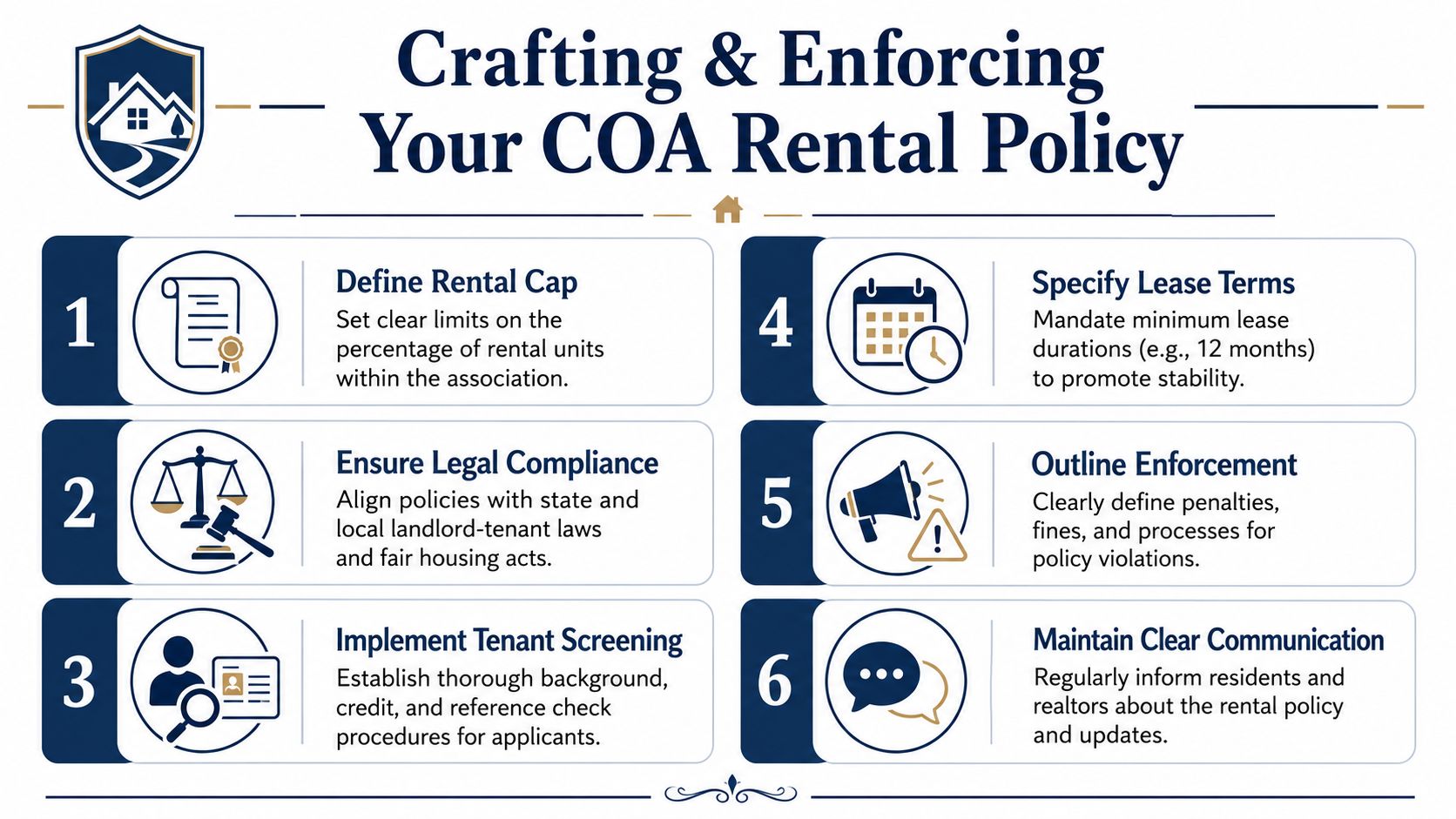
A rental policy has to be readable, enforceable, and aligned with your governing documents. If it's vague, it will fail under pressure. If it's too informal, owners will test it. If it conflicts with your declaration or bylaws, you've created a problem instead of solving one.
Start with authority. Before the board writes or revises anything, confirm what the declaration, bylaws, and rules already permit. Some restrictions belong in rules. Others require an amendment. Don't guess. Review your association governing documents and amendment framework before you adopt new leasing controls.
The clauses every serious policy needs
Your policy should address the basics without leaving room for interpretation.
Rental cap or leasing limit
If your documents allow one, set a clear method for tracking the cap, waitlists, hardship exceptions, and notice requirements.Minimum lease term
Many boards prefer longer lease terms because they reduce churn and discourage transient occupancy. The exact term should be approved with counsel and matched to your documents.Mandatory lease addendum
Require owners to attach a COA addendum that binds the tenant to community rules, move procedures, and enforcement terms.Registration requirements
No lease should begin until the association has the signed lease, tenant contact details, vehicle information, emergency contacts, and acknowledgment of rules.Owner accountability language
State plainly that the owner remains responsible for fines, damage, legal costs where authorized, and tenant compliance.Move-in and move-out procedures
Require scheduling, deposits where authorized, elevator protection, and proof that building procedures were delivered.
Consistency is the real enforcement tool
A weak policy can sometimes survive if enforcement is disciplined. A strong policy will still fail if the board enforces it unevenly.
Practical rule: If the board excuses one owner because they're well connected, it just taught the rest of the building that the policy is negotiable.
Boards should document each step:
- Notice the issue clearly: Identify the unit, conduct, date, and violated provision.
- Send it to the owner first: Copy the tenant if your process allows, but keep the member as the accountable party.
- Follow the same timeline every time: Don't improvise deadlines.
- Escalate according to policy: Warning, hearing, fine, suspension, legal referral, or other remedies authorized by the documents.
- Keep records complete: Lease files, emails, hearing notes, and notices should all be retrievable.
Owners also need current lease language that reflects Georgia practice. For lease structure and drafting considerations, a current 2026 GA lease guide for landlords can help owners understand what belongs in the lease itself versus what belongs in the association addendum.
Navigating Landlord and Tenant Responsibilities
A tenant calls the front desk about a leak, parks in the wrong space again, and props open a side door for movers. By noon, your board president is answering texts as if the association is the landlord. That is how boards in Buckhead lose control of rentals. The fix is simple. Keep responsibility with the owner, keep operations with management, and keep enforcement tied to the governing documents.
The tenant occupies the unit. The owner carries the membership rights and the legal obligations under the declaration, bylaws, and rules. The board governs the condominium and protects the community as a whole. If your board starts filling the landlord's role, you create confusion, invite inconsistent decisions, and waste time on issues the owner should be handling.
That discipline matters more in Buckhead because rental demand shifts, owner expectations change, and tenants often expect hotel-style responsiveness from a condo building. Boards should not match that expectation. Boards should run a controlled process that protects common elements, resident experience, and resale value.
Who is responsible for what
Use a clear division of duties and repeat it often.
- The association maintains common elements: halls, elevators, amenities, entries, shared systems, and any other components assigned by the documents.
- The owner handles the unit as a rental: habitability, repairs assigned to the unit owner, lease terms, deposits, tenant conduct, and turnover standards inside the unit.
- The tenant follows the rules: parking, noise, access control, move procedures, pet restrictions, amenity use, trash handling, and all other applicable community rules.
- The board enforces against the owner: fines, notices, hearing rights, and compliance demands should run through the member of record.
- Management runs the process: a community association manager's role in enforcement and operations should include tracking occupancy, receiving complaints, coordinating access issues, and maintaining a clean record trail for the board.
This structure prevents a common mistake. Staff and directors start solving resident problems informally, then discover they created a side system that ignores the documents.
The situations that create the most confusion
Leaks are the classic example. If the source is a common pipe, roof issue, or another shared component assigned to the association, treat it as a building matter and respond through your normal maintenance process. If the problem comes from an appliance, fixture, or interior component the owner must maintain, send the owner to their plumber or contractor. Do not let tenants redefine the association's maintenance obligations with urgency alone.
Parking violations should be handled the same way every time. The tenant may be the one blocking the fire lane, but the owner should receive the formal notice, the fine notice, and any hearing notice. That keeps accountability where your documents place it.
Move-out condition creates another boundary problem. The board should care about damage to hallways, loading areas, elevators, sanitation concerns, and any condition that affects neighboring units or common areas. The inside of the unit is the landlord's problem unless it creates a nuisance or a maintenance issue the association must address. Owners who need help setting expectations can use this checklist on essential cleaning requirements for tenants.
Communication rules boards should adopt
Use tenants for logistics. Use owners for authority.
Send courtesy reminders to tenants about building access, amenity schedules, or move instructions if that helps operations. Send violations, fines, hearing notices, and compliance deadlines to the owner. Copy the tenant when useful, but do not let the enforcement path drift away from the member relationship.
Boards that hold this line make better decisions. They spend less time mediating personal disputes, they keep records cleaner, and they avoid taking on landlord duties that increase risk without giving the association any real control.
Partnering with a Management Company for Success
Volunteer boards usually don't fail because they don't care. They fail because rental oversight is repetitive, detailed, and confrontational. That's hard to sustain with part-time volunteers.
A professional management company turns rental control from a loose board intention into a working system. The manager can receive lease packages, check them against policy, maintain the occupancy roster, coordinate move procedures, track access credentials, and document violations before they become board-level emergencies.
Where outside management adds the most value
The biggest gain is consistency. Managers don't forget forms, skip deadlines, or soften enforcement because they know the owner socially. They also provide a neutral buffer in disputes that would otherwise land directly on the board president.
Boards that want better execution should expect support in areas like:
- Lease administration: Intake, completeness review, owner follow-up, and file maintenance.
- Compliance tracking: Registered occupants, vehicle records, pet records, and move scheduling.
- Rule enforcement: Written notices, hearing support, fine tracking, and escalation.
- Operational coordination: Concierge, maintenance, vendors, and resident communication all work better when one process owner is in place.
If your board wants to understand the scope of that role more clearly, this overview of what a community association manager does is a useful starting point.
Good policy without administration is just text on paper. In a high-demand Buckhead condo environment, execution is what protects the building.
Frequently Asked Questions for COA Boards
Boards usually don't struggle with the big principle. They struggle with the edge cases. That's where inconsistency starts.
Quick answers boards can act on
| Question | Answer |
|---|---|
| Can our board approve or deny every lease? | Only if your governing documents and adopted policies give that authority. Don't assume. Verify the source of authority before acting. |
| Should we allow short-term rentals? | Most condo boards that want stability should restrict them aggressively or prohibit them if the documents allow. Short stays create turnover, security strain, and enforcement problems. |
| Can we fine a tenant directly? | Usually the cleaner path is to enforce against the owner, because the owner is the member bound directly through the association documents. |
| What if an owner rents without telling the board? | Treat that as a compliance violation. Require registration immediately, assess remedies authorized by the documents, and stop making exceptions. |
| Should we require a minimum lease term? | In most condo settings, yes. Longer lease terms usually support better stability and fewer move-related disruptions. |
| Can we cap rentals? | Possibly, if your documents allow it or can be amended to allow it. Caps need a clear tracking method, fairness in administration, and legal review. |
| Are we responsible for landlord-tenant disputes inside the unit? | No. The board should address community rule violations and common-element issues, not routine private lease disputes. |
| Should tenants get copies of the rules? | Yes. Require written acknowledgment before occupancy. Owners shouldn't be allowed to say the tenant “didn't know.” |
The strongest answer is usually the simplest one
Boards often overcomplicate rental issues because they try to solve them informally. That rarely works for long.
Use this decision filter:
- Is this covered by the governing documents or rules? If yes, enforce it.
- Is the owner the accountable party? In most rental issues, yes.
- Does the association have authority here? If not, don't invent it.
- Will we handle the next owner the same way? If not, stop and fix the process.
Good boards don't try to control everything. They control the parts the documents give them, and they do it every time.
If your board adopts that discipline, rental activity becomes manageable. Without it, every lease becomes a custom negotiation, and that's how standards unravel.
If your board needs experienced help building order around leasing, compliance, and owner accountability, Access Management Group is a strong resource for Georgia condominium associations. Their team has served community associations since the 1970s, with a long-standing focus on protecting, preserving, and enhancing real estate investments through professional association management.