You're in the board meeting when the questions start. One owner wants to know why dues went up, another asks whether the reserve account is really where it should be, and the treasurer is flipping through spreadsheets that don't quite line up. That's the moment hoa audit requirements stop feeling like a technical compliance issue and start looking like a trust issue.
A good audit process answers the questions homeowners are already asking. It also gives the board a defensible record of how money was handled, where controls are tight, and where the next budget needs to change. For a board president, that's not just paperwork, it's protection for the association's investment and for the volunteers making the decisions.

A thoughtful board treats outside guidance as part of that process. If your team also manages mixed-use or international portfolios, Australian audit and compliance advice can be a useful comparison point for how documentation habits and review discipline support better governance. For day-to-day board operations, the treasurer role still depends on clean records and timely reporting, which is why many communities keep a standing reference to treasurer responsibilities.
Why HOA Audit Requirements Matter to Your Community
The homeowner at the mic usually isn't asking for drama. They want confidence that assessments were used properly, that reserves were handled with care, and that the board can account for the numbers it presents. That is the value of HOA Audit Requirements, they turn financial questions into documented answers instead of opinions.
The homeowner's view comes first
Homeowners care about transparency because they live with the consequences of weak financial oversight. If maintenance is deferred, dues rise without a clear explanation, or reserve money looks thin, trust erodes quickly. A formal CPA engagement gives owners something more solid than a verbal reassurance, it provides an independent record of where the money went and whether reporting is reliable.
That matters even more when a community is growing or expenses are rising. States often scale oversight to community size and complexity, and Florida's framework is a good example of how reporting obligations can change as an association gets larger. As a practical matter, homeowners do not need a lecture on accounting standards. They need to know the association is being handled with enough rigor to protect everyone's investment.
Practical rule: the more money flowing through the association, the more important outside financial review becomes.
Boards also benefit when the audit conversation happens before a problem surfaces. A clean process reduces the chance that a frustrated owner turns a routine meeting into a challenge over recordkeeping. It also gives the president a factual basis for explaining reserve decisions, special assessments, or delayed projects.
Why boards should treat the audit as governance, not a chore
A board that understands the reporting requirement early can budget for it, schedule it, and use the findings to improve next year's decisions. That is the difference between a checkbox exercise and a governance tool. When the auditor's work is handled well, the board gets more than a report, it gets a roadmap for controls, reserves, and meeting discipline.
Independent guidance on community financial administration follows the same logic. For example, Access Management Group's accounting guidance for communities reflects how monthly reconciliation, segregation of duties, and board oversight reduce year-end surprises. That kind of discipline does not eliminate audit work, but it does make the process cleaner and less disruptive.
When a community sees the audit as part of its stewardship culture, homeowner trust usually improves because the board can show its work. That approach also sets up better decisions after the auditor leaves, since findings should shape reserve contributions, internal controls, and the next budget cycle. I have seen boards get the most value when they pair that follow-through with practical role clarity, and treasurer responsibilities are a good place to start. Australian audit and compliance advice points in the same direction, careful documentation and consistent review habits make governance stronger long after the engagement ends.
Understanding the Three Types of CPA Engagements
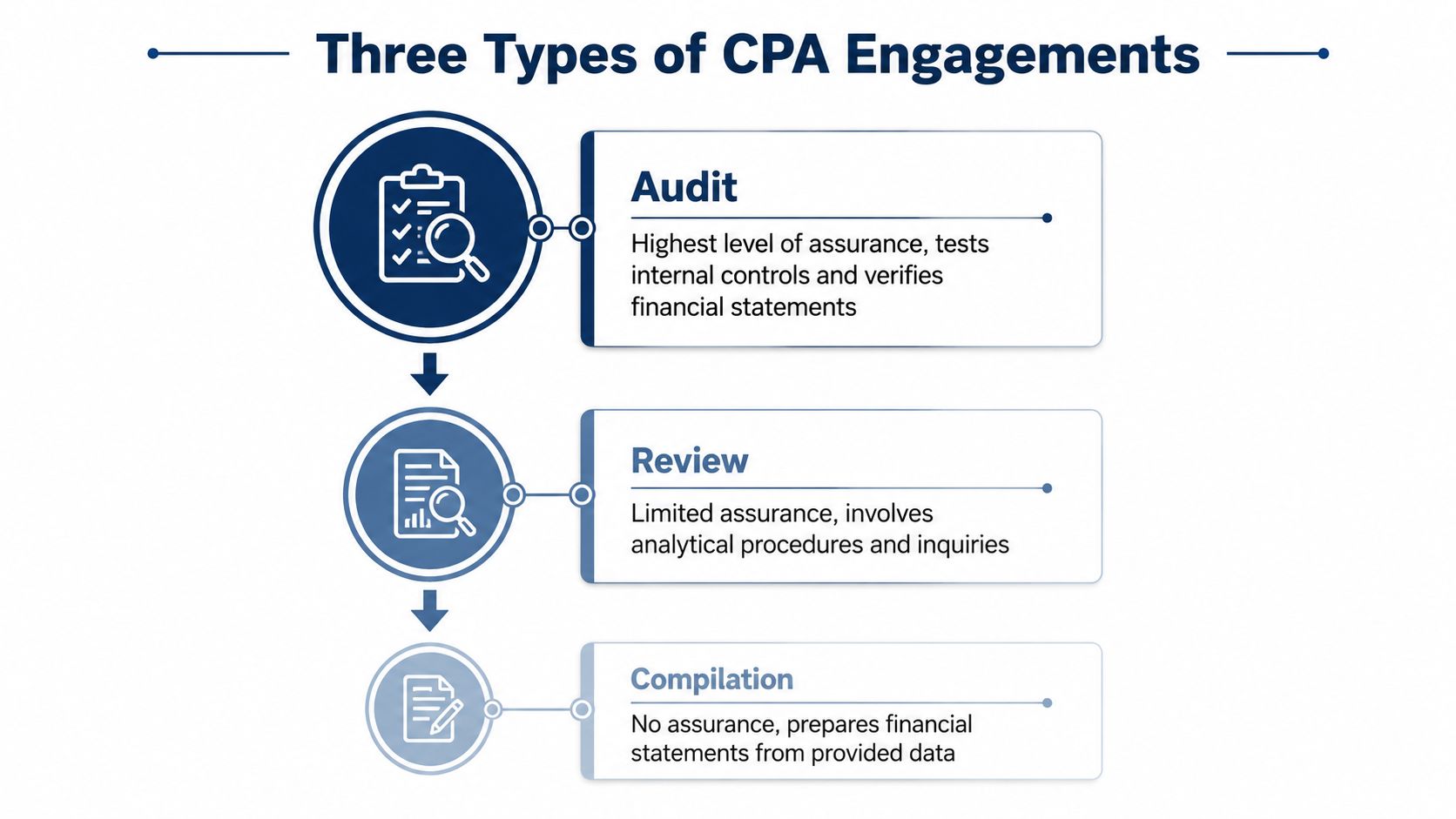
A board usually hears the words audit, review, and compilation in the same conversation, then discovers they do very different jobs. Each engagement gives a different level of assurance, and the practical choice depends on how much independent verification the association needs, how much risk it carries, and what the governing documents or state rules require. For a board trying to make the next budget cycle more useful, that difference matters because the engagement result should feed into reserve planning, internal controls, and board oversight, not just sit in a file.
Audit gives the highest assurance
An audit is the most detailed CPA engagement. The accountant examines records independently, tests transactions, and looks at controls closely enough to give the strongest level of assurance about the financial statements. In association work, that usually means more documentation, more follow-up questions, and more time, but it also gives the board the clearest basis for asking whether bookkeeping, reserve funding, and approval procedures are working the way they should.
That level of scrutiny is the right fit when the association is large, has more moving parts, or is required to undergo full audit treatment by statute or its governing documents. Rather than repeating the threshold rules here, boards should treat those triggers as the starting point and then use the audit results as a management tool. If the auditor identifies weak segregation of duties or reserve shortfalls, the board should be ready to address them in the next budget cycle, and practical accounting habits such as monthly reconciliation and board oversight, the kind discussed in Access Management Group's accounting guidance for communities, help make that follow-through easier.
Review sits in the middle
A review is lighter than an audit. The CPA performs analytical procedures and asks management questions, but does not do the same depth of verification you would see in a full audit. In practical terms, it provides limited assurance, which is often enough for communities that are required to meet a middle-level reporting obligation.
That middle ground has real trade-offs. A review costs less effort than an audit, but it also leaves more dependence on management's numbers and explanations. Boards should be clear with homeowners about that difference before the engagement starts, because a review can meet the rule while still leaving the board with issues to resolve if the findings point to weak controls, inconsistent reserve transfers, or poor support for key balances. That is also where the HireAccountants CPA hiring guide helps directors compare what kind of engagement is expected from state to state.
Compilation is the lightest formal engagement
A compilation is mostly a presentation exercise. The CPA takes the financial data provided by the association and formats it into financial statements, but does not provide assurance about whether the numbers are accurate. That makes it useful for some smaller associations, while still leaving the board responsible for the quality of the underlying records and the internal controls behind them.
A compilation can satisfy a lower reporting requirement when the governing rule calls for that level of formal reporting, but it should never be mistaken for independent verification. In communities where the accountant only compiles the statements, the board should pay close attention to what the engagement does not do. Missing signatures, poor invoice support, weak reconciliations, or unclear reserve transfers will not be fixed by presentation alone, and those are the issues that should shape board decisions after the report is issued.
The value comes after the CPA leaves. If the board treats the engagement result as input for reserve contributions, internal controls, and meeting discipline, the process supports transparency instead of just compliance.
How State Thresholds and Triggers Determine Your Obligation
A board can miss the real question if it starts with “Do we need an audit?” The better question is which trigger applies this year, because that answer may come from revenue, annual assessments, parcel count, member voting rights, or a rule buried in the governing documents. In practice, the obligation is usually determined by the strongest trigger on the books, not by a single statewide label.
Revenue is common, but it is not the only trigger
Florida is often used as the reference point because it uses a tiered approach tied to financial volume. As noted earlier in the article, different levels of receipts can lead to different forms of CPA engagement, and the practical issue for a board is figuring out where the association fits before year-end closes. A separate Florida rule also matters for larger communities, because parcel count can bring an audit obligation even when the dollar threshold alone would not have done so.
That is the part boards sometimes miss. Growth changes the compliance picture, so tracking how many units or parcels the association controls is part of financial oversight, not just membership administration. Once a community crosses the relevant trigger, the board has to plan for the engagement, the cost, and the follow-up work that comes after the CPA report.
Other states use similar trigger logic, even if the mechanics differ. California and Nevada both use financial volume as a way to scale oversight, with requirements tied to income or budget size in the range discussed in the state comparison guide. The practical takeaway is simple, state law is not asking every association to do the same thing, it is asking boards to match the level of reporting to the level of financial activity.
Owner-requested audits change the board's playbook
Colorado adds a trigger that many boards do not expect until a request lands on the agenda. The state's DRE says an audit may be done at the board's discretion or on owner request, but the owner-requested path depends on support from at least one-third of units and applies only when annual revenues or expenditures meet the stated threshold in the Colorado HOA finances guidance. That puts voting power and financial size into the same compliance decision, which is very different from a simple annual deadline.
A board that understands that difference is in a better position to explain the process to owners before frustration builds. It also gives directors a cleaner way to respond when a request comes in, because the board can check both the financial trigger and the membership support requirement instead of treating the request as a surprise.
Boards often assume the statute answers everything for them. In real communities, the governing documents and the members' voting rights can matter just as much as the statute, which is why the HireAccountants CPA hiring guide is useful when directors compare what kind of engagement a state is likely to expect.
Florida condominiums show that structure matters just as much as numbers. The statute summary used in the research describes a separate framework for associations with more than 50 unit owners, including an independent audit by a licensed CPA firm at least once every three years and a review in the intervening year, while smaller associations may satisfy the requirement by resolution in some circumstances (Florida condo statute summary). That means boards cannot rely on a single calendar or a one-size-fits-all rule. The association's size and legal form shape the obligation.
Preparing Your Association for an Audit Engagement
The best audit prep starts months before the CPA asks for the first packet of records. If the board waits until year-end, the process gets slower, more expensive, and more stressful than it needs to be. Strong communities treat the audit like a year-round discipline, not a fire drill.
Start with records, then verify controls
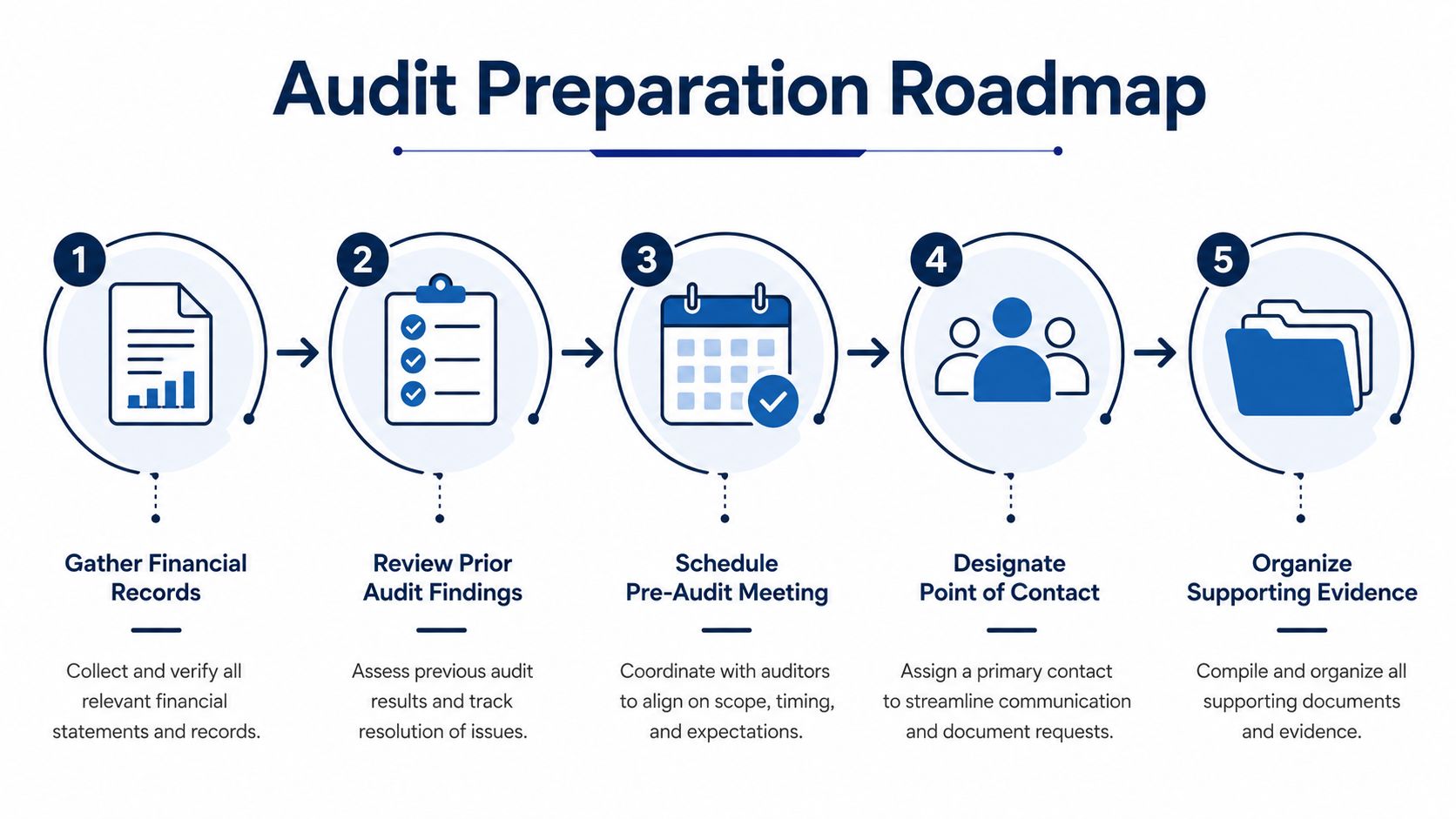
The first job is document readiness. The board or manager should have bank reconciliations, vendor contracts, reserve study support, meeting minutes, and prior-year financial statements organized before the CPA engagement begins. If the auditor has to hunt for basics, the association usually pays for that time.
The second job is internal control review. Separate check-signing authority from invoice approval wherever possible, and make sure the board can see who reviewed what and when. A community can have clean books and still fail an audit conversation if the approval trail is sloppy.
For practical audit trail habits, CEFCore's audit trail best practices are a useful companion resource because they reinforce how consistent documentation shortens the back-and-forth with outside accountants. The same principle shows up in community accounting software selection, where the right system makes recurring reconciliations and document retrieval easier. Access Management Group's HOA accounting software guidance is one example of how boards can think about that choice before problems show up.
Choose the CPA before the clock gets tight
Board presidents should ask for proposals early, compare scope carefully, and avoid assuming every CPA who does tax work understands community association accounting. The better firms know reserve accounting, common-area expenditures, and the governance issues that come with volunteer boards. Credentials matter, but so does direct HOA or COA experience.
A good engagement letter should spell out the service level, the timing, what records the CPA expects, and how questions will be handled. If the proposal is vague about deliverables or deadlines, that's a warning sign. If the firm can't explain how it handles association-specific records, the board should keep looking.
The most efficient boards assign one point of contact for the audit. That keeps requests from getting lost between the president, treasurer, manager, and committee members. It also keeps the CPA from receiving conflicting answers, which is one of the fastest ways to waste time.
Common Audit Findings and How to Turn Them Into Action
An audit report only matters if the board uses it to change something. If the same weakness shows up year after year, the report has become an expensive record of habits the association already knows it has. The better use of the findings is to shape the next budget cycle, tighten controls, and improve how the board oversees the association.
Reserve problems should change the budget, not just the binder
Underfunded associations face a real risk because deferred maintenance turns into a larger bill later. California's Department of Real Estate has warned that underfunded HOAs can postpone maintenance and build risk over time, so reserve-related audit findings should be treated as a budget signal, not a bookkeeping note (California underfunded HOA alert). If the reserve study and the actual contribution pattern do not match, the board needs a correction plan.
That correction does not always need to be dramatic. A phased increase in reserve contributions can be easier for owners to absorb than a sudden jump later, especially when the board explains the reason in plain language and ties it to likely repair needs. The practical goal is to bring future budgets in line with the risk the audit exposed.
Reserve findings also deserve a second look from a governance angle. If the board sees a pattern of delaying contributions, it should ask whether the issue is a policy choice, weak planning, or pressure to keep dues low. Those are different problems, and they call for different fixes.
Weak controls need workflow fixes
If the auditor flags weak segregation of duties, the board should redraw the approval map. One person should not open invoices, approve them, sign checks, and reconcile the bank statement without a second review. In a volunteer association, that concentration often happens by accident, not intent.
A practical fix is to separate authorization, payment, and reconciliation. Another is to require board review of bank statements or monthly management reports in a documented meeting packet. That makes the control visible, and visibility matters because it lets the board confirm the process is happening.
Weak controls also affect trust. Owners do not need to see every internal step, but they do need assurance that no one person can move money without oversight. A board that responds to audit findings by documenting the workflow is doing more than cleaning up accounting, it is reducing the chance that a small error turns into a larger dispute later.
Late reporting and incomplete resolutions need process discipline
Repeated late financial reporting usually points to a management system problem. The board should set internal deadlines that arrive before statutory deadlines, then assign responsibility to one person who can keep the process on track. If the issue keeps happening, the fix is usually a calendar, a checklist, and better accountability, not another reminder email.
Incomplete board resolutions are a different kind of problem. If the minutes do not clearly show approvals, scope changes, or reserve decisions, the board loses its paper trail. That is easy to correct, but only if the secretary and manager treat records as part of the work throughout the year.
These findings matter because they affect the next budget cycle. Missing approvals make it harder to support spending decisions, and weak records make it harder to explain why reserve funding or contract changes were made. Good governance depends on being able to show how the board got from a decision to the final payment or policy.
Vendor issues deserve procurement rules
Vendor or contract irregularities often show up when the board relies on habit instead of bidding discipline. That does not always mean fraud, sometimes it means no one checked whether the contract was renewed properly or whether the price matched the scope. The right response is to tighten procurement review, require documented comparisons for major work, and keep signed contracts in one place.
That also gives the board a cleaner record when owners ask why a project cost what it did. A documented process helps the board show that it compared options, reviewed the scope, and approved the work for a reason tied to the association's needs. Those habits matter as much as the transaction itself because they reduce confusion and give the next board a better starting point.
Board takeaway: every recurring audit finding should become a line item in the next budget cycle, either as a reserve correction, a control change, or a governance process update.
That is the actual value of hoa audit requirements. They do not just tell the board whether the numbers are acceptable, they show whether the association is drifting toward a bigger financial problem that can be addressed now instead of later.
Board Resolution and Solicitation Templates for Audit Compliance
The cleanest boards make their audit decisions in writing. A short resolution protects the association, guides the manager, and gives the CPA a clear scope. The solicitation process should do the same thing, with enough detail that firms can quote apples to apples.
Sample resolution language the board can adapt
Motion to approve audit engagement. The board of directors approves the engagement of an independent CPA firm to perform the financial reporting required for the current fiscal year, consistent with the association's governing documents and applicable state law.
Resolution for committee formation. The board authorizes the treasurer, manager, or audit committee to coordinate record collection, respond to CPA requests, and report progress at regular board meetings.
Timeline language. The CPA shall be engaged early enough to complete the required report within the association's reporting calendar, and management shall provide all requested records promptly to avoid delay.
That language can be adapted to the state requirement, but the structure should stay the same, authority, scope, and timing. Clear resolutions also reduce the risk that the board later disagrees about what it approved.
Solicitation guidance for CPA proposals
When the board asks for bids, the request should be specific. Ask whether the firm has direct community association experience, how many staff members will work on the engagement, what records it expects at the outset, and how it handles questions during fieldwork. A vague proposal is usually a sign that the firm doesn't understand association work well enough to price it properly.
A good solicitation also asks about fee structure and delivery expectations. The board doesn't need the cheapest number on the page, it needs a firm that can complete the work cleanly and communicate with the treasurer and manager without friction. Homeowners benefit when the board chooses competence over guesswork.
A simple preparation checklist helps keep the process moving:
- Financial records: gather bank statements, reconciliations, general ledger reports, and prior-year financials.
- Governance records: confirm minutes, resolutions, and governing documents are easy to produce.
- Reserve support: organize the latest reserve study and any board decisions tied to it.
- Contacts: name one person who will coordinate the CPA's questions.
- Delivery plan: confirm who will receive the final report and when.
The most important point is straightforward. A well-run audit process protects transparency, supports homeowner trust, and gives the board a stronger basis for reserve and control decisions. If your community needs help coordinating the financial review process, organizing records, or building a cleaner accounting workflow, visit Access Management Group to see how a management partner can support your board and keep the next audit cycle under control.
Access Management Group helps associations organize financial records, support board governance, and keep accounting processes audit-ready throughout the year. If your board wants clearer reporting, better document control, and practical help with community management, visit Access Management Group to start a conversation about your association's next audit cycle.