You’re reviewing closing papers, board packets, or community emails, and the same three letters keep showing up: POA. One person is using it to mean a legal signing authority. Another is talking about the association that manages the neighborhood. In a mixed-use community, someone may even mention POA rules while a seller’s agent uses POA to mean a hidden listing price.
That confusion causes real problems. Homeowners sign the wrong forms, boards mishandle authority questions, and community leaders apply the wrong rule to the wrong issue. For homeowners, board members, and especially the HOA or COA president, clarity matters because one acronym can point to very different legal and governance responsibilities.
As a practical matter, POA meaning in real estate usually comes down to two main meanings that affect community operations most often. The first is Power of Attorney, a legal document that lets one person act for another. The second is Property Owners Association, a governing body for a planned community. There is also a third industry use, Price on Application, which appears in listings and advertisements when the seller withholds the asking price until direct inquiry.
Untangling the Acronym POA in Your Community
At a board meeting, a manager might say, “We received a POA for the owner.” At a closing, an agent might say, “This property is listed as POA.” In a master-planned development, the president may tell residents, “The POA will decide that issue, not the sub-association.” Those are three different uses of the same acronym.
For most community association questions, the two meanings that matter are Power of Attorney and Property Owners Association. If you’re a homeowner, the first affects who can sign, vote, or act for you. If you’re on the board, the second defines who governs common areas, enforces restrictions, and collects assessments.
The fast way to identify which POA someone means
Use context first.
- If the discussion is about signatures, legal authority, incapacity, closings, or an agent acting for an owner, it means Power of Attorney.
- If the discussion is about assessments, amenities, rules, covenants, common areas, or the master community, it means Property Owners Association.
- If the discussion is about a listing with no visible asking price, it may mean Price on Application, a real estate pricing term explained by Ooba’s overview of POA as Price on Application.
A board should never assume that “POA on file” answers every question. The document’s meaning depends on whether the issue is governance, voting, contracting, or a property transaction.
The practical challenge is that these meanings often collide. A homeowner in a Property Owners Association may give a child or spouse Power of Attorney. Then the board has to decide what that agent can do. Can they attend a hearing, approve an architectural request, or cast a ballot? That’s where many communities get into avoidable disputes.
Power of Attorney vs Property Owners Association
The cleanest way to understand POA meaning in real estate is to compare the two side by side. They sound similar. They aren’t.
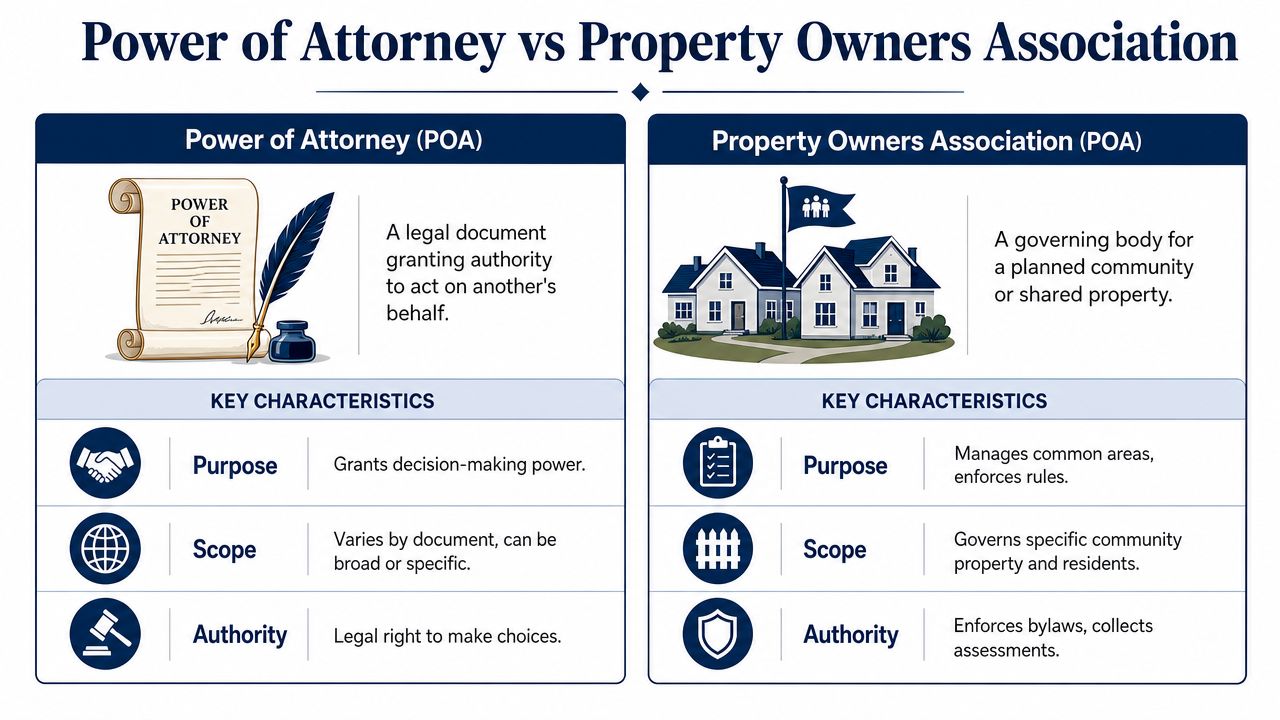
Two very different uses of the same acronym
A Power of Attorney is best understood as lending your signature and decision-making authority, but only within the authority written into the document. It is a legal instrument between people.
A Property Owners Association is closer to a small governing body for a planned development. It exists to manage community property, administer rules, and maintain shared interests across the development. It is an organizational structure.
Side by side comparison
| Issue | Power of Attorney | Property Owners Association |
|---|---|---|
| What it is | A legal document | A community governing body |
| Who creates it | An individual property owner or principal, usually with legal guidance | A developer and governing documents, then the owners and board administer it |
| What it controls | Authority to act for a person | Rules, operations, and shared property in a community |
| Main use | Signing, handling transactions, acting in legal or financial matters | Maintaining common areas, enforcing covenants, collecting assessments |
| Key risk | Overbroad authority or invalid paperwork | Poor governance, weak enforcement, or unclear documents |
Why people mix them up
Boards see “POA” in email subject lines and assume it means a legal document. Owners hear “POA dues” and assume it’s just another way to say HOA fees. Agents use POA in listings and mean something else entirely.
That confusion tends to show up in three recurring situations:
- A closing packet arrives with a Power of Attorney attached
- The master association is called a Property Owners Association
- A listing or classified ad uses POA to hide the price until inquiry
Each one has a different consequence. One determines who can legally sign. One determines who governs the community. One affects how pricing is presented in the market.
The practical distinction boards should use
When an issue lands on the board table, ask one question first: Are we dealing with a person’s authority, or the community’s authority?
- If it’s a person acting for an owner, look for the Power of Attorney
- If it’s a rule, budget, assessment, or amenity issue, look to the Property Owners Association
- If it’s a listing term, confirm whether the broker means Price on Application
Practical rule: A Power of Attorney can authorize a person. It does not rewrite your declaration, bylaws, or election rules. A Property Owners Association can enforce community documents. It does not automatically decide private legal authority between family members.
That distinction solves most POA-related confusion before it turns into conflict.
A Homeowners Guide to Power of Attorney
A Power of Attorney matters most when a homeowner can’t handle a real estate matter in person. The common example is simple. You’re traveling, deployed, ill, relocating early, or helping a parent manage property, and someone else needs authority to sign specific documents for you.

The types homeowners usually encounter
Most owners run into one of these forms:
- Special or limited Power of Attorney. This is used for a narrow job, such as signing documents for one closing or handling one property matter.
- Durable Power of Attorney. This is commonly used for broader financial matters and is often designed to remain effective even if the principal later becomes incapacitated, depending on state law and document language.
For homeowners, limited authority usually works better than broad authority. If the goal is a single closing, deed package, or sale document, a targeted document reduces confusion and risk.
A realistic use case
A homeowner is out of state when the sale closes. The title company needs original signatures. Instead of delaying the transaction, the owner appoints a trusted sibling or attorney to sign the approved documents tied to that property.
That can work well, but only if the paperwork is drafted correctly and accepted by the parties involved. In practice, lenders, title companies, and associations may all review the document differently. That’s why legal review up front is worth the time.
If you want a plain-language legal overview, this essential guide for Texas families gives homeowners a useful starting point before they sign anything.
What works and what causes trouble
Homeowners usually avoid problems when they do a few things early:
- Choose the right person. The agent should be trustworthy, organized, and willing to follow instructions exactly.
- Match the authority to the task. A broad document for a narrow issue invites questions.
- Provide the document before the deadline. Last-minute submissions often trigger rejection or delay.
- Keep copies with the closing file. That helps if the title company, lender, or association asks for proof.
What doesn’t work is using a vague, stale, or overly broad form and assuming every institution has to accept it. They often won’t.
Give the document to the people who must rely on it before the transaction is urgent. Problems are much easier to fix before a signing date is on the calendar.
The risk homeowners underestimate
The biggest mistake isn’t paperwork. It’s trust. A Power of Attorney gives another person real authority. If the agent exceeds instructions or misunderstands the transaction, unwinding the damage can be hard.
For association-related issues, homeowners should also remember this: a legal POA document may let an agent act for you, but it doesn’t automatically override board procedures, election rules, or architectural review requirements. The board can still ask for verification and can still follow the governing documents.
Understanding Your Property Owners Association
When community managers use POA in governance, they usually mean Property Owners Association. This is not always just another label for HOA. In many developments, the scope is broader.
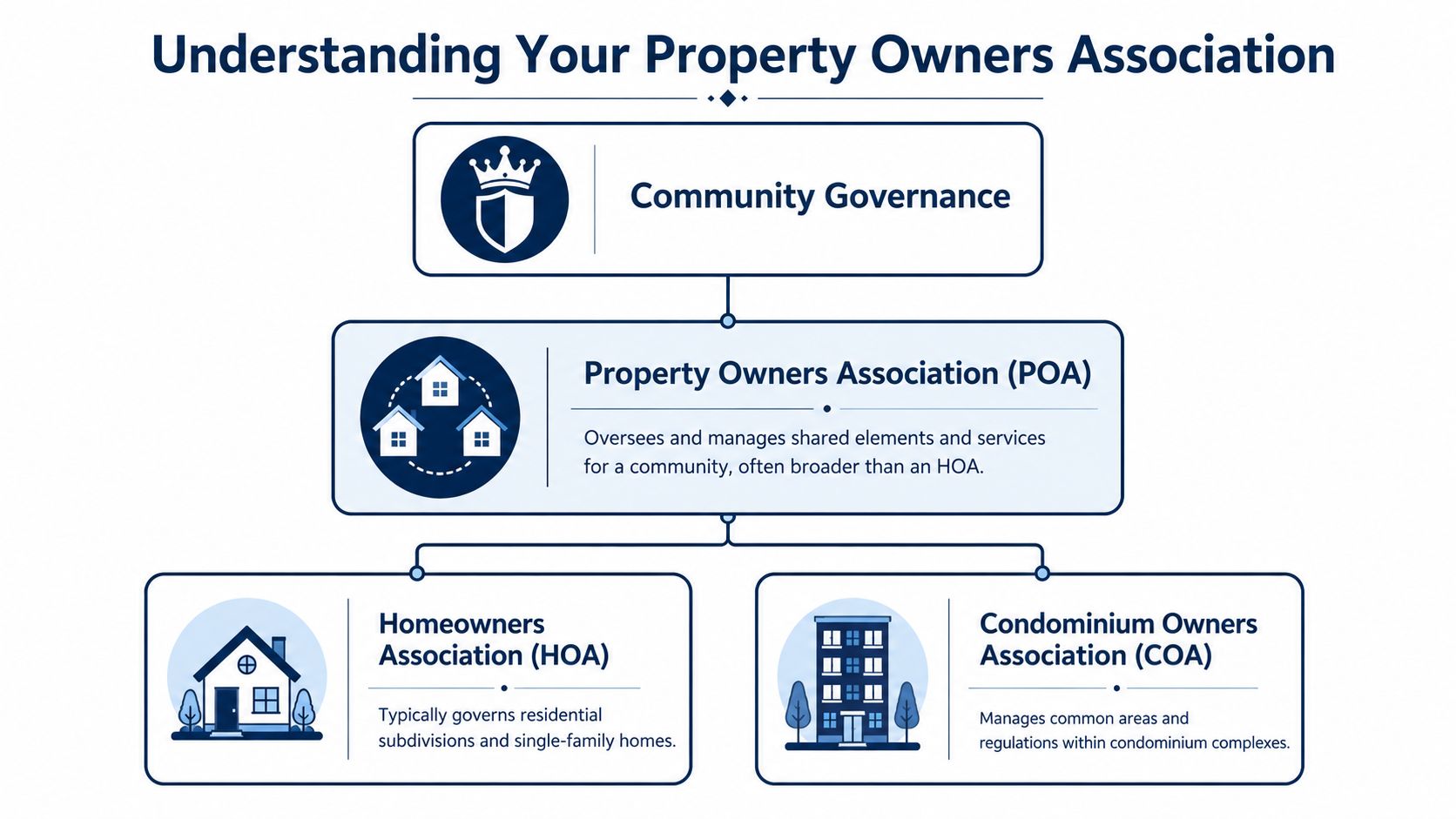
According to this explanation of what a POA is in real estate, a Property Owners Association is broader than an HOA and may govern a mix of single-family residences and commercial properties, including retail areas and mixed-use developments. The same source explains that POAs often act as an umbrella organization over multiple HOAs, and that property owners are typically bound to membership after purchase under Texas property code and similar state frameworks, with collected fees funding maintenance of common areas such as swimming pools, fitness centers, and community facilities.
How a POA differs from an HOA or COA
That broader structure changes how boards and homeowners should think about authority.
A neighborhood HOA often focuses on one residential subdivision. A COA usually manages a condominium property. A POA may sit above both, especially in a large development with shared roads, signage, recreation areas, stormwater systems, and commercial parcels.
For homeowners, that means the POA may handle issues that feel removed from your front door but still affect your daily life, including access control, common amenity maintenance, and development-wide standards.
For board members, it means your decisions may affect more than one residential enclave. If your community has layered governance, it helps to review the hierarchy in the association’s governing documents for HOA communities.
What the fees are really doing
Owners often ask whether POA fees are “worth it.” The better question is whether the association is using them in a disciplined, transparent way.
Well-managed POAs usually direct assessments toward:
- Shared amenities such as pools, fitness centers, clubhouses, and parks
- Infrastructure maintenance including common entries, lighting, landscaping, and other community facilities
- Administrative operations such as management, compliance processes, insurance coordination, and vendor oversight
- Long-range community planning that supports development standards over time
What homeowners and presidents should watch
A healthy POA doesn’t just collect assessments. It communicates clearly about why decisions are made, who has authority, and how owners can participate.
If residents don’t understand whether the master POA or the local HOA controls an issue, frustration follows quickly. Most governance disputes start as communication failures.
For presidents and board members, the practical test is simple. Can an owner easily tell which body approves projects, hears violations, sets budgets, and manages shared assets? If not, the association needs cleaner communication and better document education.
When a Legal POA Document Meets the Association Board
The acronym confusion becomes operational. For example, a homeowner sends an adult child to a meeting and says, “They have my POA.” The board now has to decide what that authority covers.
A careful board doesn’t reject the document out of hand. It also doesn’t accept it blindly. It verifies.
The board’s first questions
Start with scope, not assumptions.
- Is the document a Power of Attorney?
- Does it appear signed and complete?
- Does it cover the type of act the agent is trying to take?
- Do the governing documents impose separate rules for voting, hearings, proxies, or written consents?
Those questions matter because an owner’s agent may be authorized to handle one task but not another. For example, the document may support participation in a property transaction yet say nothing clear about association elections or architectural submissions.
Common board scenarios
A few examples show where boards need discipline.
Meeting attendance. If an owner’s representative appears at an open meeting, the board may permit attendance consistent with meeting rules. Speaking rights may still depend on adopted procedures.
Voting in an election. This is more sensitive. Election procedures often distinguish between a proxy, a ballot, and an agent under legal authority. The board should confirm how its governing documents treat owner representation before accepting a vote.
Architectural applications. If the owner’s agent signs a design request, the board or manager should confirm that the authority extends to property-related decisions and submissions.
Hearings and enforcement matters. An owner may want an agent or attorney-in-fact to appear and communicate on their behalf. That can be reasonable, but the association should document who appeared and under what authority.
A workable board process
Most disputes fade when the board follows a repeatable process instead of improvising.
- Request the document in advance when possible.
- Review only what’s necessary to verify authority.
- Match the stated authority to the requested action.
- Apply the same standard to every owner.
- Record the board’s handling in minutes or management notes.
Boards that want a cleaner meeting framework can also review practical guidance on how to run a board of directors meeting, especially where owner participation and procedural consistency are recurring issues.
The safest board posture is neutral consistency. Verify the document, apply the governing documents, and avoid making legal conclusions beyond what the association needs to decide.
That approach protects homeowners’ rights while protecting the association from selective treatment claims.
Best Practices for Association Boards and POAs
Boards should have a formal policy for handling Power of Attorney documents. Without one, decisions tend to depend on who is in the room, how rushed the matter feels, or how persuasive the owner is. That is not sound governance.
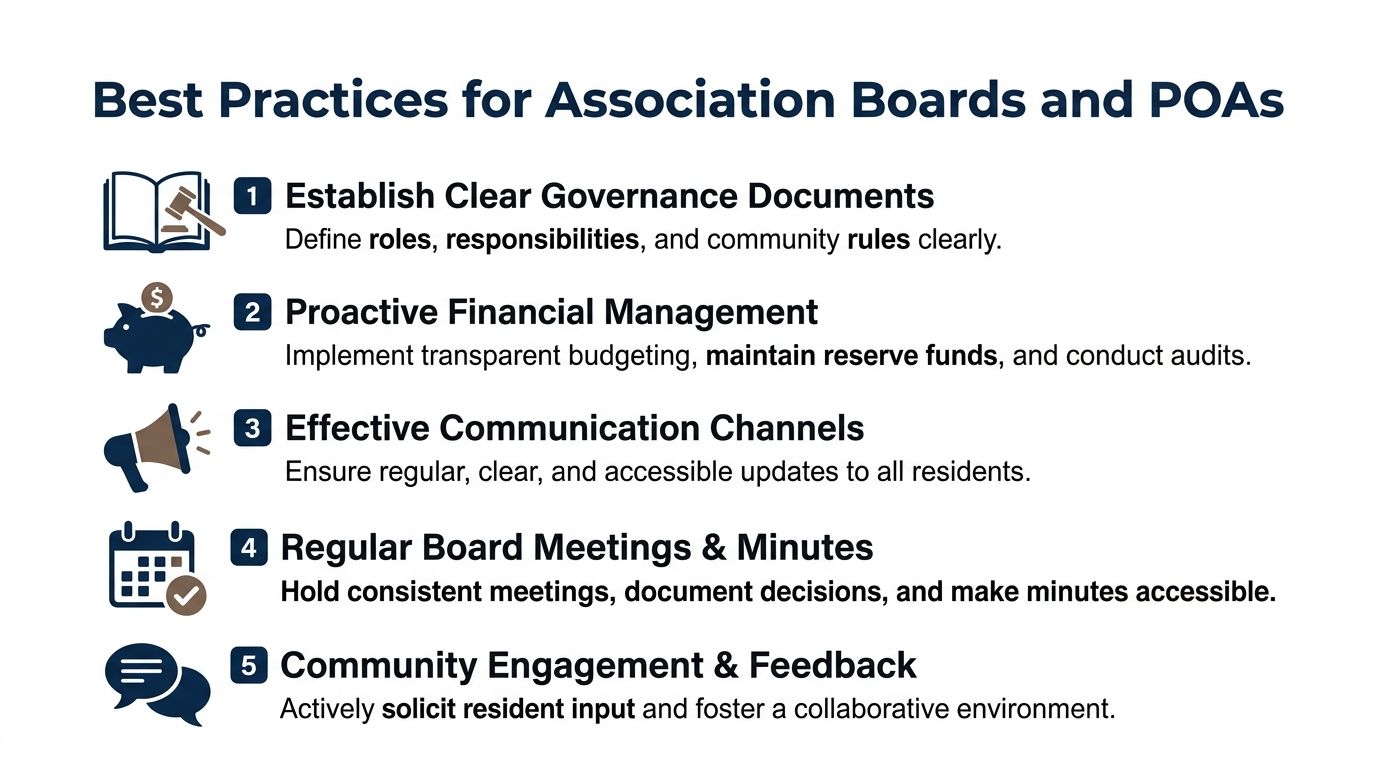
What the policy should include
A practical board policy should spell out:
- Submission timing so owners know when the document must be delivered before a meeting, election, or application deadline
- Review standards limited to authenticity, completeness, and scope relevant to the association’s decision
- Permitted uses such as appearance at hearings, execution of forms, or other owner actions recognized by the governing documents
- Record retention so management keeps the association file orderly and secure
- Escalation points for legal review when the authority is unclear or contested
This is one area where consistency beats improvisation every time. Board members can also sharpen policy thinking by reviewing outside governance resources like GroupOS board governance insights, then adapting those ideas to their own declarations, bylaws, and counsel guidance.
The mixed-use issue many boards still miss
In mixed-use communities, the bigger governance risk may not be a homeowner’s Power of Attorney at all. It may be outdated assumptions about mandatory participation rules for commercial parcels.
According to this discussion of key insights on Property Owners Associations, recent legal developments in Texas (2025) and California (2026) now allow commercial property owners in mixed-use POAs to opt out of specific covenants while retaining amenity access. The same source states that 31% of mixed-use POAs in major markets have implemented opt-out clauses for commercial entities, reducing community financial strain by 18% annually.
That matters because many boards still operate as if every covenant must apply the same way to every parcel type. In a mixed-use setting, that assumption can create friction, distort budgeting, and make negotiations harder than they need to be.
What works for presidents and boards
The better approach is disciplined governance tied to the actual structure of the community.
- Review parcel types carefully before applying residential-style restrictions to commercial owners
- Coordinate with counsel on covenant scope where mixed-use documents are old or internally inconsistent
- Explain decisions to residents so homeowners understand why one parcel category may be treated differently
- Train new directors on role boundaries using the association’s HOA board responsibilities guide
A board that treats legal authority, covenant enforcement, and parcel differences as separate governance questions usually makes better decisions and faces fewer owner challenges.
Frequently Asked Questions About POAs in Real Estate
How do I revoke a Power of Attorney
Usually, the person who created it can revoke it while they still have legal capacity. The safer practice is to do that in writing, follow state formalities, and notify every party that may rely on the old document, including agents, title companies, and the association if it has the document on file. If the POA has been used in a real estate transaction, legal advice is wise.
Does it cost money to create a Power of Attorney
It can. The cost depends on whether you use an attorney, whether notarization is required, and whether the document needs recording or review by a title company or lender. The more property-specific the issue, the more important it is to focus on correct drafting rather than the cheapest form available.
Can a board refuse to accept a Power of Attorney document
Yes, in some situations. A board may reject a document that is incomplete, unclear, outside the scope of the requested act, or inconsistent with the association’s governing documents and procedures. The stronger approach is not a blanket refusal. It’s a written policy, even application, and legal review when authority is uncertain.
If your community needs experienced guidance on governance, board operations, and the day-to-day realities of association management, Access Management Group is a trusted resource for homeowner and condominium associations. Their longstanding work with boards focuses on protecting, preserving, and enhancing community real estate investments while helping directors lead with clarity and confidence.