If you're serving on an HOA or COA board right now, there's a good chance you're already carrying a quiet concern in the back of your mind. The president's term is ending. The treasurer sounds tired. The secretary knows where everything is, but no one else does. Homeowners still expect the pool to open on time, invoices to be paid correctly, and reserve projects to stay on schedule.
We've seen boards treat this as a staffing issue when it's really an asset protection issue. In community associations, leadership succession planning isn't about filling a title for the next meeting. It's about protecting financial controls, preserving vendor relationships, and keeping the community stable enough to support property values and resident confidence.
That matters because volunteer-led boards don't get much room for error. A messy handoff can stall maintenance approvals, confuse accounting access, delay architectural decisions, and create avoidable tension between residents and the board. A disciplined handoff does the opposite. It keeps the association operating like a business, even when leadership changes.
The True Cost of a Leadership Vacuum in Your Community
A board vacancy becomes expensive long before anyone sees a line item for it.
When a president, treasurer, or committee chair leaves without a plan, the first losses usually show up in execution. Vendor approvals sit. Questions go unanswered. Bank access gets sorted out too late. Maintenance priorities become fuzzy because the person who knew the history is gone. Homeowners experience that as inconsistency. Contractors experience it as delay. The association experiences it as risk.
Where the damage shows up first
The broad succession picture is already weak. Only 19% of organizations worldwide have formal, documented leadership succession plans, and more than 50% admit they lack any contingency plan if their CEO leaves unexpectedly, according to ScottMadden's succession planning analysis. HOA and COA boards face the same core problem, except with volunteer leaders, rotating terms, and less institutional redundancy.
In community associations, we've seen the consequences land in four places quickly:
- Maintenance execution: Projects slow down when no one knows which vendor was approved, what scope was negotiated, or why a repair was deferred.
- Accounting continuity: Signer changes, invoice routing, reserve questions, and approval chains become messy when treasury knowledge lives with one person.
- Contract oversight: Landscaping, pool, gate, elevator, roofing, and insurance relationships weaken when the incoming board member inherits incomplete files.
- Resident trust: Homeowners don't always see the back-office issue, but they feel the outcome through delays, conflicting answers, and missed follow-through.
A lot of generic succession planning best practices talk about continuity in abstract terms. For associations, continuity is much more concrete. It means the books reconcile, the manager gets timely direction, the vendors know who's authorized, and the board can still act with confidence.
Property values feel the effects
At this stage, leadership succession planning stops being administrative and becomes fiduciary.
Emerging data from 2025 shows that associations with structured succession protocols reduced asset depreciation by 34% and accounting discrepancies by 52% during leadership changes, according to this leadership succession planning research on transition impacts. That's the clearest reason boards should care. Good transitions don't just make meetings easier. They protect the community's investment.
Practical rule: If a board transition can delay maintenance, confuse finances, or weaken oversight, it's already a property value issue.
Some of the most cautionary examples look ordinary at first. A treasurer resigns mid-budget cycle. A president moves out before a major capital project starts. A secretary leaves with the only organized archive of prior decisions. None of that sounds dramatic until invoice approvals lag, reserve assumptions get questioned, and homeowners start asking why the board seems disorganized. Stories like that are why board members often relate to real HOA governance breakdowns more than abstract policy advice.
A community doesn't need constant turnover to feel this. It only needs one unplanned exit and one missing process.
Creating a Resilient Succession Blueprint for Your Board
The boards that handle transitions well don't rely on luck or personality. They build a repeatable system.
That system doesn't need to be complicated, but it does need to be written down. A strong board succession blueprint tells residents, current directors, and future volunteers how leadership continuity works in this community. It survives election cycles because it isn't trapped in one outgoing president's memory.
Build the plan into the board's operating habits
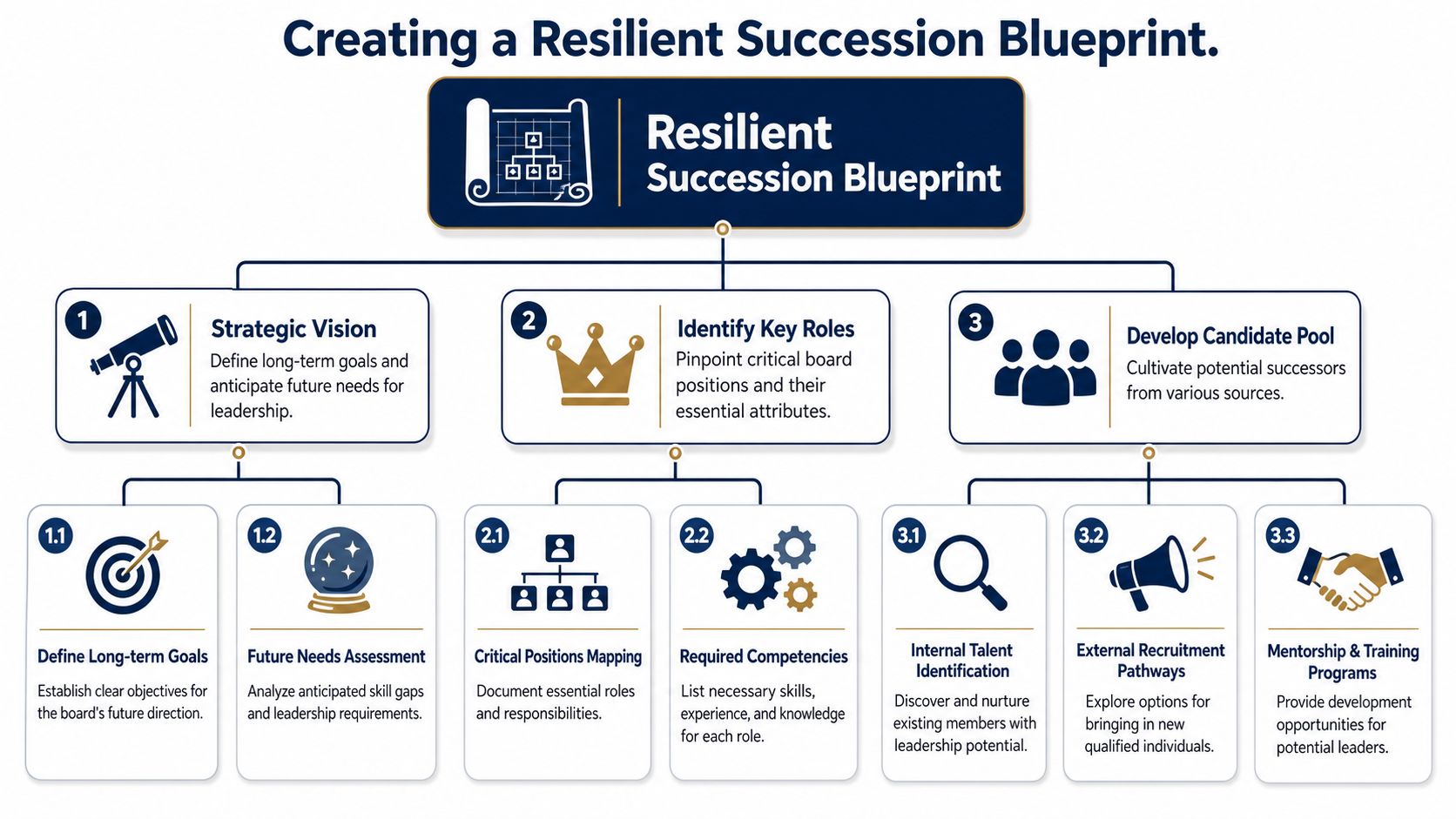
A practical framework for succession planning includes Assessment, Planning, Development, and Monitoring, with development plans extending 3 to 5 years into the future, as described in this step-by-step succession planning methodology. In HOA terms, that means boards should identify critical roles, assess who has capacity to grow into them, create specific development paths, and revisit progress regularly.
Our advice is to anchor that framework in four documents and routines:
| Board element | What it should include | Why it matters |
|---|---|---|
| Board policy | Written expectations for identifying and preparing future leaders | Keeps succession from disappearing after one election |
| Role descriptions | Duties, decisions, recurring deadlines, and required knowledge for each officer role | Removes ambiguity for new volunteers |
| Annual board calendar | Election timing, committee recruitment, onboarding dates, and handoff windows | Turns intention into a schedule |
| Review cadence | A recurring agenda item to discuss pipeline strength and upcoming vacancies | Prevents last-minute scrambling |
Bylaws may not contain every operational detail, but the board's governing framework should support continuity. If your documents are silent on committee formation, officer transitions, interim appointments, or vacancy procedures, work with association counsel before changing course. The point is durability. The process should outlast any one board.
Create a Farm Team before you need one
One mechanic matters more than most boards realize. A dedicated Farm Team Committee, also called a nominating or leadership development committee, actively identifies and engages promising residents who volunteer for community events and encourages them to consider future board service before a vacancy occurs, according to this board governance guidance on building a Farm Team.
That committee should not exist just to find names before an election. It should function year-round.
A capable Farm Team usually does the following:
- Watches for reliable residents: People who attend meetings, ask grounded questions, or help solve problems without escalating every disagreement.
- Matches people to the right entry point: Some residents belong on a landscaping committee first. Others may fit finance, rules, social, or architectural review.
- Keeps the pipeline warm: A short conversation six months early is better than a desperate ask two days before nominations close.
- Protects fit: Not every vocal resident is board-ready. Good boards screen for judgment, follow-through, discretion, and respect for fiduciary duties.
The strongest boards rarely recruit in a panic. They cultivate in advance.
Define the roles like a real job
Volunteer leadership still needs professional clarity.
Write a one-page description for each board position. Include routine responsibilities, key dates, approval authority, systems access, major vendors, and common decision types. A president's role differs from a treasurer's. A secretary's recordkeeping discipline differs from a member-at-large's committee support. If those distinctions stay fuzzy, recruitment gets harder and onboarding gets rougher.
Boards often think succession planning starts with people. It starts with role definition. Until the board knows what each role requires, it can't identify or develop the right successor.
Identifying and Cultivating Future HOA Leaders
Most communities already have future leaders in plain sight. They just haven't been invited in the right way.
We've seen them at budget meetings asking practical questions. They're the residents who volunteer at events and then stay to clean up. They're the owners who can disagree without becoming disruptive. They're often not the loudest person in the room, and that matters. Board service requires steadiness more than performance.
What future leaders usually look like
A strong future board member often shows up through behavior before title. You may notice someone who reads the packet before the meeting, follows through on small commitments, or asks about process instead of personalities. That's the person worth a conversation.
A weak pipeline usually starts with one bad assumption. The board waits for people to nominate themselves. In volunteer communities, that rarely produces the best leadership bench. It often produces the most available person, not the most prepared one.
Here are the residents we've seen grow well into leadership roles:
- The thoughtful attendee: Regularly present, asks clear questions, and listens to answers.
- The committee helper: Willing to own a task, report back, and finish what they started.
- The calm problem-solver: Focuses on solutions when neighbors get emotional.
- The professional volunteer: Brings transferable skills from finance, construction, legal support, administration, or project coordination without overreaching.
Don't promote people by cliff-jump
No volunteer should be expected to jump directly into the role of board president. Associations need a defined path with educational opportunities that moves residents from volunteer status to committee membership, and then to board membership, according to this HOA board succession guidance.
That's one of the biggest practical mistakes boards make. Someone says yes to helping, and within weeks they're asked to chair meetings, manage conflict, and interpret governing documents. They don't fail because they lack commitment. They fail because the board skipped the middle steps.
A community gets better leaders when it offers a runway, not a spotlight.
A better path looks more like this:
- Start with a contained task. Ask a resident to help review a landscaping proposal, assist with a rules communication, or serve on a project committee.
- Add context. Give them governing documents, prior board decisions, and a clear explanation of how authority works.
- Pair them with a current leader. Let them observe the board's rhythm before they carry the board's burden.
- Invite them into a formal committee role. In this role, they learn process, not just opinions.
- Encourage board service when timing is right. By then, the candidate understands expectations and the board understands the candidate.
Onboarding decides whether people stay
Good recruitment without onboarding still fails.
Boards lose promising people when the first ninety days feel chaotic. They get thrown into email chains with no background, receive financial reports with no explanation, and discover that three residents expect immediate personal access. That's how volunteers burn out early.
A better onboarding experience includes a board packet, a glossary of common terms, copies of contracts, current project summaries, and a designated mentor. In other management fields, structured learning matters for the same reason. Even outside community associations, specialized programs like CQC compliance training for managers reflect a simple truth. People perform better when expectations, procedures, and responsibilities are taught instead of assumed.
Boards that want a wider leadership pool should also make service feel possible. That means realistic role descriptions, scheduled support, and visible appreciation. Communities looking to understand the range of skills that can support association leadership can also review homeowner association career paths and responsibilities, because many of the same administrative, financial, and operational strengths translate well to volunteer board service.
The Art of the Handoff A Knowledge Transfer Checklist
A transition fails when the files transfer but the judgment doesn't.
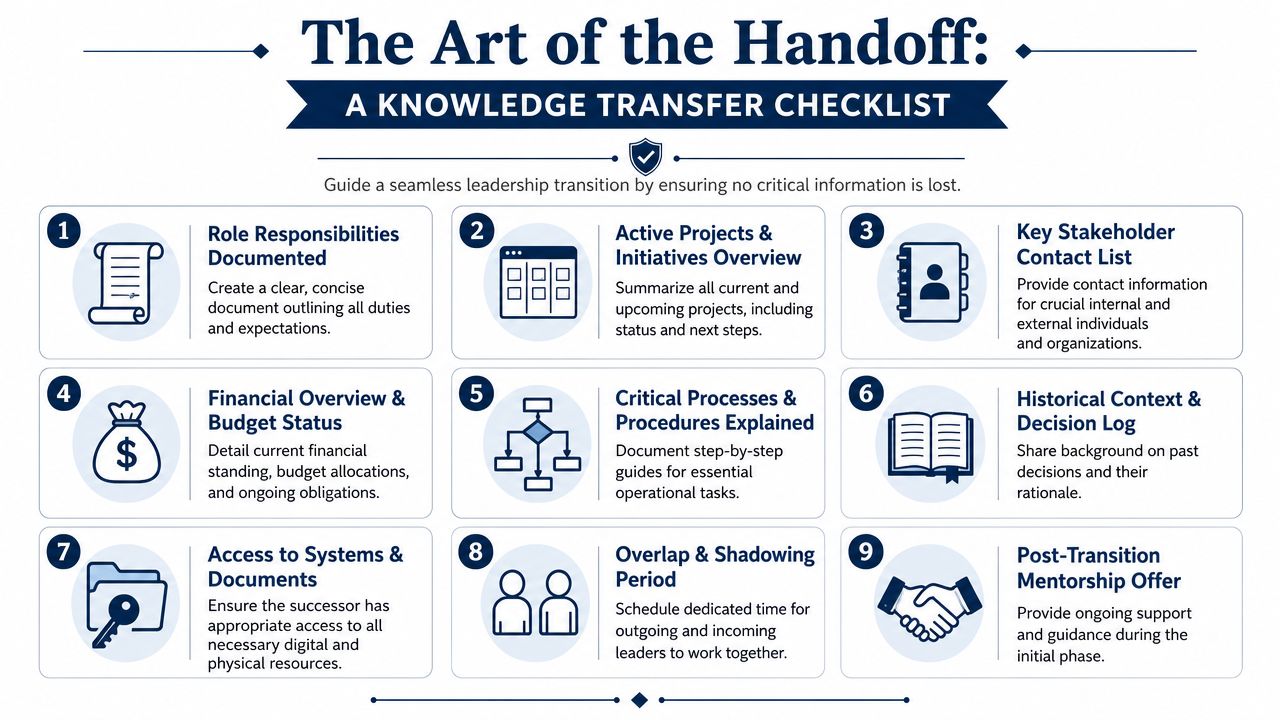
Outgoing board leaders carry two kinds of knowledge. One is easy to see: bank access, contracts, insurance files, reserve schedules, meeting minutes. The other is harder to capture: why the board changed the gardening service, which vendor always needs follow-up, what issue still frustrates residents on Building C, and which annual task gets missed if nobody owns it. Good handoffs transfer both.
The four-part checklist that keeps continuity intact
Boards should keep a living handoff binder, digital or physical, organized around these categories:
Financial records
- Banking authority: Signers, approval rules, reserve account details, and payment workflows.
- Current budget status: Open issues, known overruns, assessment timing, and major upcoming obligations.
- Accounting access: Software credentials, report locations, invoice queues, and who reconciles what.
Legal and governance materials
- Governing documents: Declaration, bylaws, rules, resolutions, and current policy references.
- Insurance and claims: Policy details, renewal dates, broker contact, and any active claim history.
- Pending legal matters: Attorney contacts, deadlines, violation patterns, and board-authorized next steps.
Operational files
- Vendor contracts: Term dates, renewal windows, service issues, pricing notes, and approved scopes.
- Maintenance calendar: Recurring inspections, seasonal tasks, reserve projects, and permit-related obligations.
- System access: Shared drives, portals, archives, and physical keys or storage locations.
Relational and historical context
- Decision log: Why key choices were made, not just what was approved.
- Community dynamics: Known friction points, past communication mistakes, and residents who need extra clarity.
- Manager coordination: Preferred communication rhythm, urgent escalation rules, and standing expectations.
Make the transfer visible and scheduled
Don't rely on a single farewell email. Use a checklist, a meeting, and an overlap period.
The discipline behind The OKR Hub's knowledge transfer is useful here because it treats transfer as a structured process rather than a hopeful conversation. HOA boards need that same mindset. A successor should be able to locate documents, understand current priorities, and explain unresolved issues without searching old inboxes for clues.
Board habit: Document the role, document the current work, then document the history behind the work.
If the secretary role is turning over, the incoming officer should also receive a practical records roadmap. That includes minute format, approval workflow, archive location, and statutory or bylaw-related timing requirements. Boards that want a clearer picture of what that office really carries day to day should review the core duties of an association board secretary, because secretary turnover often exposes just how much institutional memory sits with one person.
A smooth handoff doesn't eliminate every bump. It does prevent the dangerous kind of confusion, where nobody knows what must happen next or who has authority to do it.
Navigating Both Planned and Unplanned Departures
A board president gives notice in September. The treasurer resigns without warning in the middle of budget season. Those two departures create very different risks for an HOA or COA, and boards that treat them the same usually pay for it in delays, confusion, and avoidable strain on the community.
That strain is not abstract. We've seen leadership gaps slow invoice approvals, stall reserve decisions, delay owner communication, and leave managers waiting on direction they need to keep operations steady. In a community association, succession planning protects more than board continuity. It helps protect cash flow, project timelines, and, ultimately, property values.
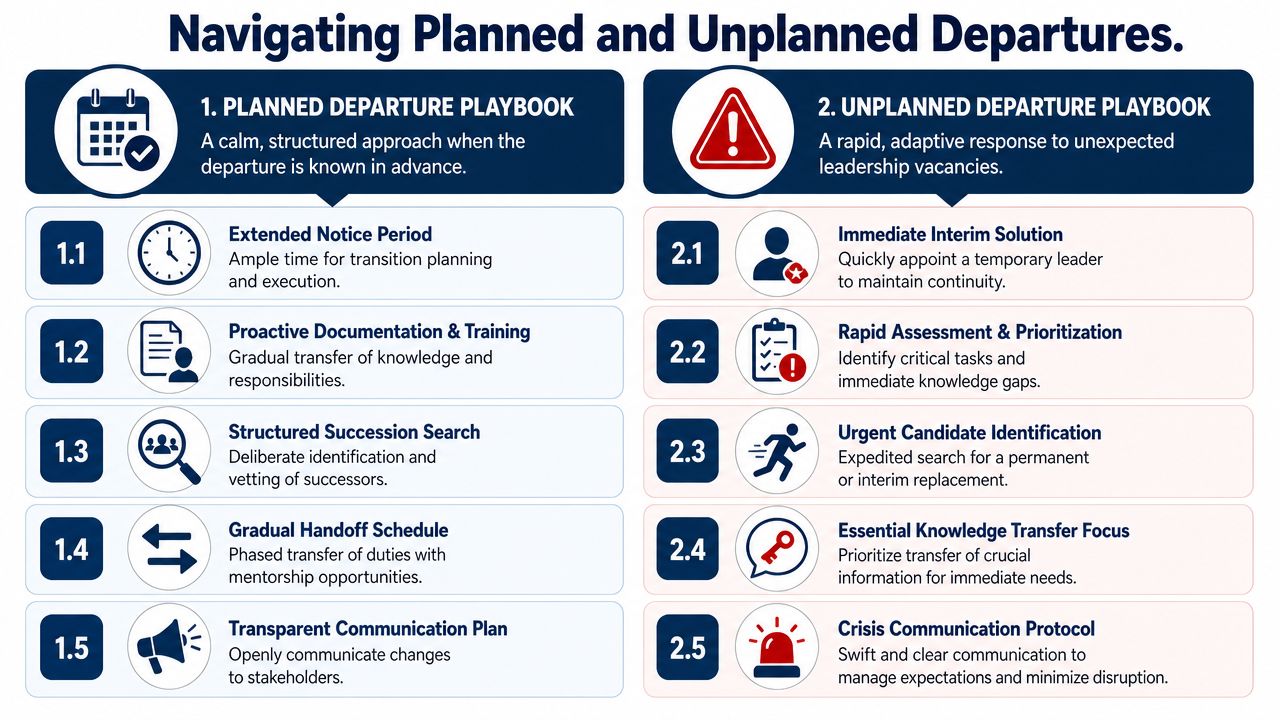
Planned departure playbook
Advance notice gives the board room to act with discipline. According to Neighborly's guidance on nonprofit succession planning, organizations often benefit from starting succession discussions several months before an expected transition. For community associations, our advice is to use that time with a specific goal: preserve decision-making continuity and avoid a drop in operational control.
A planned transition works best when the board follows a clear sequence.
| Timing | Board action | Priority |
|---|---|---|
| Early notice | Confirm the departure date, role responsibilities, and any deadlines tied to the position | Keep the transition defined |
| Recruitment window | Approach qualified committee volunteers, past board members, and engaged owners with the right availability | Build a realistic bench |
| Selection period | Evaluate candidates based on readiness, judgment, and the community's current needs | Choose for fit, not urgency |
| Overlap period | Include the incoming leader in meetings tied to contracts, budgets, projects, or resident issues | Reduce operating risk |
| Formal handoff | Update authority, vendor contacts, bank access, and resident communication | Close the gap cleanly |
Boards also need to manage tone. A known transition should be presented as responsible governance, not as a scramble to replace someone. That distinction matters because residents and business partners take cues from how the board handles change.
Emergency departure playbook
An unexpected resignation, illness, relocation, or incapacity changes the board's priorities immediately. The first question is not who would be the ideal long-term successor. The first question is who has authority to act today.
The National Council of Nonprofits advises organizations to maintain an emergency succession plan that identifies interim leadership authority and immediate operating responsibilities in case a key leader is suddenly unavailable. Their succession planning guidance is aimed at nonprofits broadly, but the lesson applies directly to associations: assign interim authority fast, then stabilize the work that cannot wait.
Use this order of operations:
- Confirm authority. Determine who can approve payments, sign documents, access association systems, and respond to time-sensitive issues.
- Follow the governing documents. Check the bylaws and state requirements before making an interim or permanent appointment.
- Stabilize operations. Identify what must continue without interruption, such as vendor payments, insurance matters, active repairs, hearings, or meeting preparation.
- Coordinate communication. Inform the manager, remaining board members, and residents about the leadership change and the interim point of contact.
- Begin replacement efforts. Start with the existing volunteer pipeline, but keep the immediate focus on continuity rather than perfection.
Residents do not need every internal detail. They need to know the association remains organized, authorized, and capable of making decisions.
The trade-off boards need to understand
Planned departures let the board develop people. Emergency departures force the board to protect continuity first.
That trade-off is where many associations get stuck. Some boards overprocess a normal transition and lose momentum. Others delay action during a sudden vacancy because they want a full solution before making an interim decision. We've seen both mistakes, and both create unnecessary risk.
Our advice is simple. In a planned departure, use the extra time to evaluate judgment, availability, and willingness to serve. In an unplanned departure, appoint interim coverage quickly, communicate clearly, and keep the association's financial and operational obligations on track. The stronger move is the one that keeps the community functioning without confusion.
Your Next Steps in Securing Your Communitys Future
A board president moves out, the treasurer steps down after tax season, and no one is sure who has the banking contacts, reserve history, or vendor renewal dates. We've seen that situation create avoidable stress in otherwise well-run communities. It also puts property values at risk because financial oversight and day-to-day continuity can slip faster than boards expect.
Succession planning belongs on the board's operating agenda, not on a wish list for later. Communities that document key roles, prepare the next group of volunteers, and require a clear handoff protect more than board continuity. They protect collections, contract oversight, budget discipline, project timing, and homeowner confidence.
The broader nonprofit sector still shows uneven preparation. 48.44% of surveyed nonprofits report having a leadership succession plan, while 39.06% report not having one, and nearly 13% are uncertain, according to Teamshares' succession planning statistics. For HOA and COA boards, that should be a caution. In practice, uncertainty usually means important knowledge is undocumented, responsibilities are blurry, and the association is depending too heavily on one volunteer.
What to put on the next board agenda
Start with a short list the board can act on at one meeting:
- Make succession planning a standing governance item: Boards manage it better when it appears regularly on the agenda instead of surfacing only after a resignation.
- List the roles that carry operational or financial risk: President, treasurer, secretary, committee chairs, and any volunteer who controls records, approvals, or specialized history.
- Draft one-page role summaries: Include recurring duties, key deadlines, logins or access points, current projects, and decisions that cannot stall.
- Identify likely future leaders: Look for committee members and residents who show judgment, reliability, discretion, and enough time to serve well.
- Set a handoff requirement: Every outgoing officer should transfer documents, context, contacts, and open issues in a live conversation.
The primary objective
The goal is a board that can absorb change without putting the community's finances or operations at risk.
We've seen boards become more stable once they accept that good governance includes preparing for turnover before it happens. That approach reduces disruption, lowers the chance of missed obligations, and protects the association's ability to preserve and enhance the community's real estate investment.
Our advice is to place leadership succession planning on the next meeting agenda and assign one person to own the first draft before adjournment. Once the board starts documenting roles and successors, the community is in a stronger position.
If your board wants experienced guidance on protecting operations, finances, and continuity during leadership transitions, Access Management Group can help your community build practical processes that serve homeowners first, support board members, and give HOA or COA presidents a steadier path through change.