You open your mailbox, see a payment notice from the association, and your first reaction is simple: What is this for? If you're a homeowner, that question is normal. If you're a new board member, the next question usually follows fast: How do we know the amount is right?
That moment matters because an HOA fee isn't just another bill. It's the funding tool that keeps a shared community running. Lawns get maintained, lights stay on in common areas, insurance stays in force, vendors get paid, and long-term repairs don't get pushed into crisis mode.
This isn't a niche part of housing anymore. The U.S. Census Bureau reported that in 2024, about 21.6 million of the nation's 86.6 million owner-occupied households paid a condo or HOA fee, roughly one in four, with a national median monthly fee of $135 according to the U.S. Census Bureau's review of condo and HOA fees.
For communities and boards, the fee is less about collecting money and more about coordinating shared responsibility. One homeowner can't patch the private road alone. One board member can't privately fund the pool pump, clubhouse insurance, or future roof work on a condominium building. The association collects regular assessments so the whole community can handle shared obligations together.
If you're still learning the language of association living, it also helps to start with what HOA stands for and how these communities operate. Once that clicks, the fee starts to make much more sense.
Your First Look at Community Association Living
A new owner in a condo or planned neighborhood often sees the fee before they understand the system behind it. They notice the amount on a coupon book, portal statement, or closing paperwork, but they don't yet connect it to the gate, the landscaping, the shared roof, the pool furniture, the insurance binder, or the reserve account.
That gap in understanding is where frustration usually begins.
Why the fee exists at all
An HOA fee is a recurring payment used to fund the shared operations of a community. In plain language, neighbors pool money so the association can maintain and protect what everyone uses or benefits from together.
It functions as a shared household budget, except the household is an entire community. Instead of one family planning for lawn care, exterior lighting, sidewalk repairs, and building insurance, the board does that planning for all owners based on the governing documents and the community's real costs.
For homeowners, that means the fee supports day-to-day quality of life. For board members, it means the fee is the financial backbone of the association.
Good communities don't run on good intentions. They run on a realistic budget, steady collections, and clear communication.
Why homeowners and boards need each other
Readers often assume HOA fees are something the board creates and homeowners endure. In healthy associations, that's not how it works. The board approves the budget, but homeowners elect the board, review community information, attend meetings, and ultimately live with the results of those decisions.
That partnership matters because the fee touches nearly every part of community life:
- Owners rely on it to preserve upkeep, safety, and shared services.
- Boards rely on it to meet legal and financial obligations.
- The association relies on it to avoid falling behind on maintenance or future repairs.
The practical way to think about it
If you're asking what is an HOA fee, the simplest answer is this: it's the community's shared operating contribution. It isn't a random charge. It's the mechanism that turns a group of individual homes into a functioning association.
Once you view the fee as a community budget contribution instead of a vague monthly add-on, the next question becomes more useful: what exactly does it pay for?
What Your HOA Fee Actually Pays For
Most confusion disappears when people can connect the fee to visible services and invisible protections. The visible part is easy to spot. Mowed common areas, a clean lobby, pool service, hallway lighting. The invisible part matters just as much. Insurance, accounting, reserve savings, legal compliance, and management support.
An HOA fee is a budget-based assessment designed to fund day-to-day operations, maintenance of common areas, and contributions to reserve funds for future capital replacements according to FirstService Residential's explanation of what HOA fees cover.
Community upkeep and shared appearance
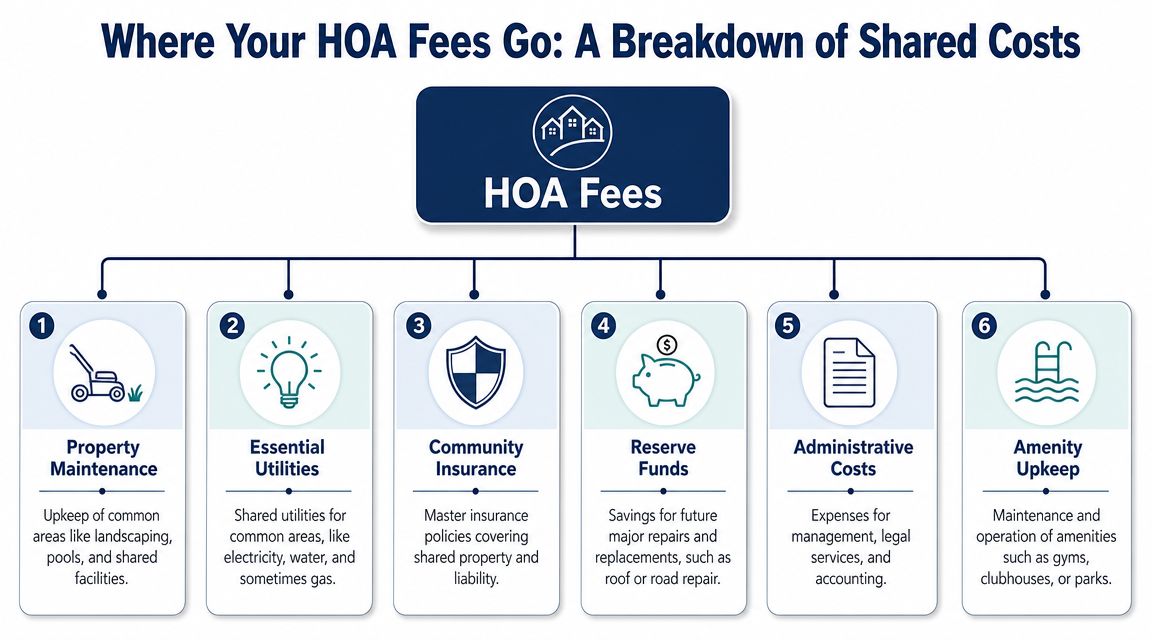
This is the category homeowners usually notice first. It includes the work that keeps common property orderly, functional, and safe.
That can include:
- Landscaping and grounds care for entry features, green space, and common planting areas
- Cleaning and routine maintenance in shared halls, clubhouses, elevators, or sidewalks
- Repairs to common elements that belong to the association rather than an individual owner
In a single-family neighborhood, that might mean common entrance maintenance and irrigation. In a condominium, it might include hallways, roofs, exterior walls, and shared plumbing or mechanical systems, depending on the governing documents.
Amenities and shared-use features
Amenities are where homeowners sometimes ask, "Why is my fee higher here than in the community down the street?" The answer is often simple. More amenities usually mean more upkeep.
A pool needs service. A clubhouse needs utilities and cleaning. A fitness room needs maintenance and replacement planning. If you want a deeper comparison of charges tied specifically to shared features, this article on defining amenity fees for property owners helps clarify how amenity-related costs are often framed.
Practical rule: If the community offers something shared, someone has to maintain it, insure it, clean it, repair it, and eventually replace parts of it.
Operations and protection
This is the less visible side of the budget, but it's often where the board spends the most time.
Common operating costs can include:
- Insurance for common property and liability
- Management and administrative support
- Accounting, audit support, legal review, and records
- Utilities for common areas, such as lighting or water
- Reserve funding for major future repairs and replacements
This is why a fee isn't just a maintenance charge. It's a full community operating assessment, with both present needs and future obligations built into it.
How HOA Boards Calculate and Budget Fees
Boards don't start with a target fee and work backward. They start with the community's obligations. Then they build a budget that reflects what the association must pay to operate responsibly.
That process should feel less like guesswork and more like running a careful household, except the household includes every shared asset in the community.
The budget starts with real obligations
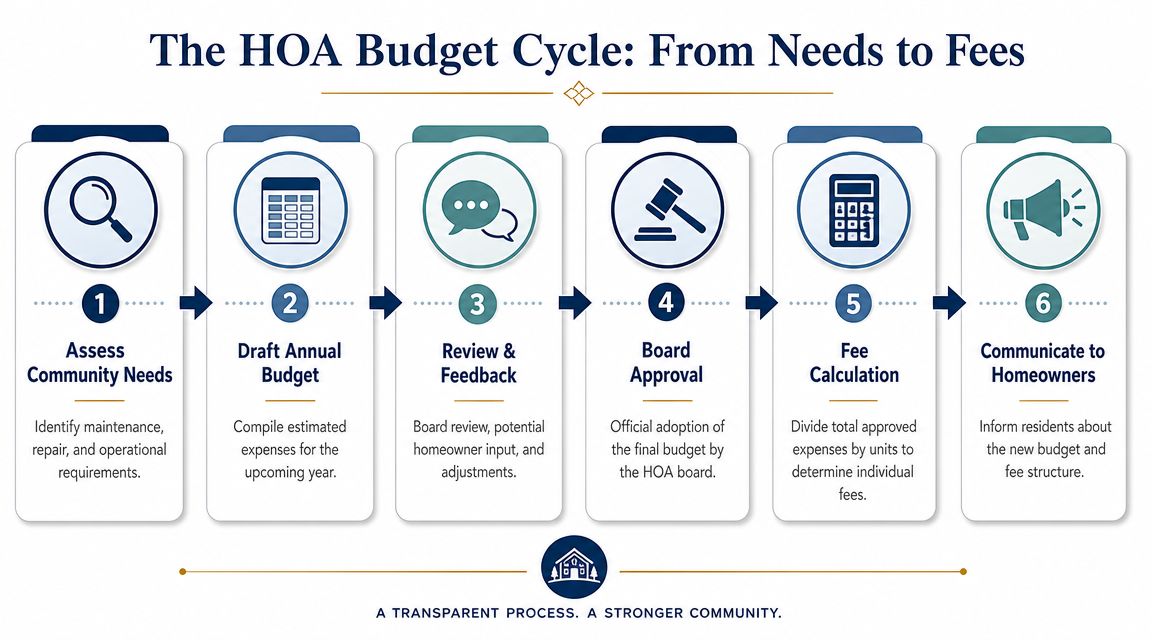
A board usually reviews vendor contracts, recurring bills, maintenance needs, insurance costs, administrative needs, and known repair cycles. Then it estimates what the association needs for the coming budget period.
A useful way to think about this is to separate the budget into three questions:
- What must we pay to operate this year?
- What must we maintain because it's part of common property?
- What should we save now so owners aren't hit later?
That third question is where many communities either build stability or create future stress.
Reserve funding is the community's savings habit
Reserve funding works like a shared savings account for major future expenses. If a condominium roof, private road, elevator, fence line, or pool surface will eventually wear out, the board shouldn't wait until failure to start collecting money for it.
That's why routine dues and special assessments are different. Freedom Mortgage's explanation of HOA fees and special assessments notes that regular fees are used for operations and reserves, while special assessments are one-time charges for unexpected shortfalls. A central goal of good budgeting is to reduce the chance that owners face a sudden, painful bill.
How the fee amount gets set
Once the board has a realistic budget, it allocates that total cost across the owners according to the governing documents. Some communities divide the cost evenly. Others use formulas tied to unit size, type, or ownership interest.
For new board members, this is the point where accounting clarity really matters. A specialized resource such as accounting for homeowners associations can help boards understand how assessments, expenses, reserves, and reporting fit together in practice.
Boards also need workable tools for reviewing financial patterns. Even a general-purpose option like PDF AI's profit analyzer can help volunteers read income and expense trends more efficiently when they're sorting through budget documents and vendor data.
A fee increase isn't always a sign of mismanagement. Sometimes it's the board finally matching the budget to the community's real costs.
Typical Fee Ranges and Payment Structures
Fee amounts vary widely, which is why owners get frustrated when they try to compare communities without comparing what those communities maintain. A neighborhood with an entrance monument and basic landscaping has a very different cost structure from a high-rise with elevators, staffed services, and extensive common elements.
One broad market snapshot illustrates that range. Rocket Mortgage's overview of HOA fees cites an average HOA fee of $191 per month in 2021, with state averages ranging from about $109 per month in Texas to about $999 per month in New York.
Two common ways associations assign fees
The structure matters almost as much as the amount.
| Fee Structure | How it works | When it often appears |
|---|---|---|
| Uniform assessment | Every owner pays the same regular amount | Many single-family HOAs or communities where homes have similar obligations |
| Variable assessment | Owners pay based on unit size, ownership percentage, or another formula in the governing documents | Many condominiums and mixed-unit communities |
A uniform fee is easy to understand and explain. A variable fee is often used when one unit type places different demands on shared systems or has a different ownership interest in common property.
A practical comparison by property type
The exact number in any one community depends on its budget, amenities, age, and legal documents. Instead of pretending there is one standard amount by property type, it's more useful to compare how cost patterns usually behave.
Typical Monthly HOA Fee Ranges by Property Type (2026 Estimates)
| Property Type | Typical Low-End Fee | Typical High-End Fee |
|---|---|---|
| Single-family planned community | Lower than communities with extensive shared amenities | Higher when the association maintains more amenities, private streets, or shared services |
| Townhouse community | Often moderate because exterior or limited common maintenance may be shared | Can rise when roofing, painting, amenities, or insurance obligations are broader |
| Mid-rise or high-rise condominium | Often higher because buildings have more shared systems and service needs | Can be much higher when staffing, elevators, extensive amenities, or large reserve obligations are involved |
This table is intentionally qualitative. Boards shouldn't benchmark by property type alone. They should benchmark by scope of responsibility.
Why payment structure affects owner experience
The method of charging dues shapes how fair the fee feels. Homeowners usually accept a fee more readily when they understand the formula behind it. Boards earn trust when they explain not just the amount, but the reason the amount is split the way it is.
And if the regular fee still isn't enough to cover a major need, owners should understand how that differs from a one-time charge. This overview of what special assessments are in HOAs is useful when you're comparing routine dues to unexpected project funding.
Navigating Your Rights and Responsibilities
An HOA fee works best when everyone treats it as part of a shared agreement, not a standoff between residents and the board. Owners deserve transparency. Boards need timely payment and consistent compliance. Both sides have legitimate responsibilities.
That matters because community associations aren't rare. The Foundation for Community Association Research estimated that in 2025 there were 373,000 community associations housing 78.1 million residents in the United States, according to its statistical review of community associations.

What homeowners should expect
A homeowner shouldn't have to guess where fee money goes. In a well-run association, owners can review the governing documents, understand the budget process, and ask informed questions at meetings or through the proper channels.
That doesn't mean every owner will agree with every expense. It does mean the board should be able to show how the fee connects to actual association obligations.
Homeowners should also understand their own side of the relationship:
- Pay on time so the association can meet its obligations
- Read notices and budget materials instead of waiting until a fee change feels personal
- Raise concerns through the process rather than through rumor or informal pressure
- Review the governing documents before assuming the association is or isn't responsible for an item
What boards must do consistently
Board members have a fiduciary role. In plain language, they have to act in the community's best interest when handling association money. That means collecting assessments, applying rules evenly, and avoiding selective enforcement based on who is popular, vocal, or connected.
Boards also need to communicate with calm precision when collections become necessary. If an owner falls behind, the goal isn't punishment. The goal is to protect the community's finances and treat everyone by the same standards.
Clear records and consistent enforcement protect both the paying owners and the board.
What happens when fees aren't paid
Owners often ask whether the fee is optional if they don't use the pool, dislike the board, or disagree with a project. The short answer is no. If the assessment is valid under the governing documents, payment is part of ownership in the community.
Late fees, interest, collection activity, and legal remedies may follow if an account remains delinquent. The exact process depends on state law and the governing documents, so boards should use established procedures and professional guidance rather than improvising.
Proactive Tips for Managing HOA Fees
The healthiest associations don't wait for a budget fight, a collections problem, or a special assessment scare before people start paying attention. They build habits. Homeowners stay engaged before frustration grows. Boards communicate early, review financials regularly, and plan beyond the next invoice cycle.
That's where the partnership becomes real.
Practical steps for homeowners
If you're an owner, you don't need to become an accountant to understand your fee. You do need to stay involved enough to avoid being surprised.
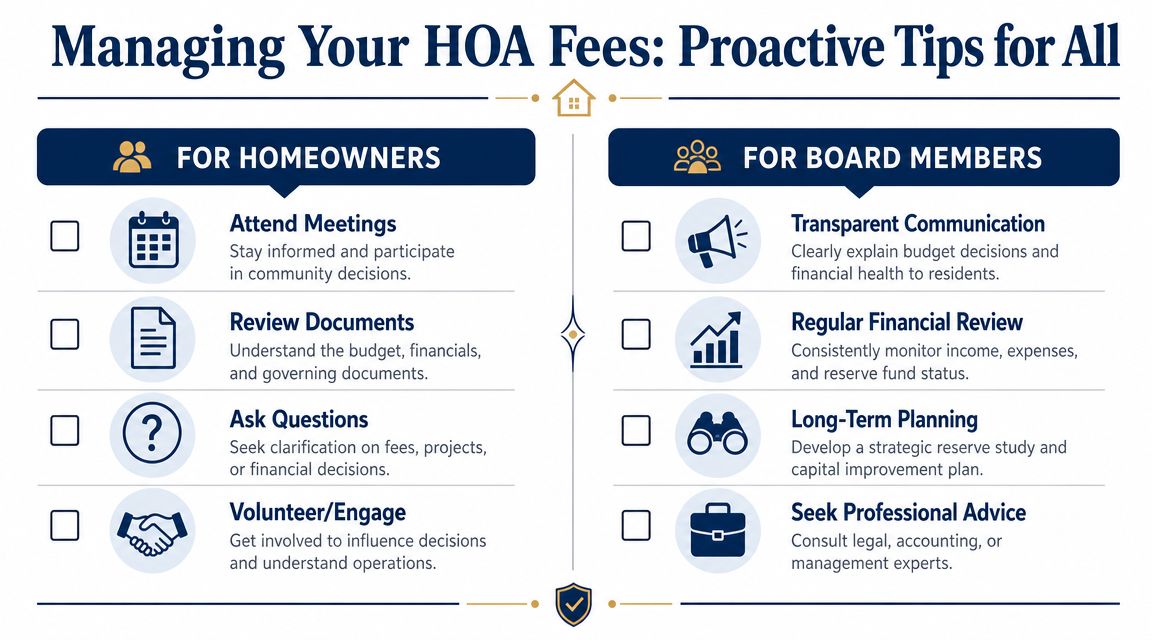
- Read the budget summary: Look for plain signs of change, such as rising contract costs, new projects, or larger reserve contributions.
- Attend meetings when money is on the agenda: Even one budget meeting can answer questions that months of hallway conversation won't.
- Ask focused questions: Instead of "Why are fees so high?" ask "Which expense categories changed most, and are those changes recurring or temporary?"
- Dispute carefully, not casually: If a charge looks wrong, follow the formal process in your documents and keep records of all communication.
Some owners also find it useful to compare how communities organize records and communication. If your association is evaluating digital tools, a guide to community management platforms can help you understand what boards and managers often look for in software that handles notices, payments, and owner access.
Practical steps for board members
Boards set the tone. Even a necessary fee increase goes better when owners can see the logic, timing, and documentation behind it.
Try these habits:
- Explain changes before they take effect: Owners respond better to context than surprise.
- Review reserves and operations together: A low regular fee may look attractive while creating long-term risk.
- Use plain-language budget notes: Many owners aren't resisting the budget. They're resisting a budget they don't understand.
- Standardize collections and payment options: Consistency helps the association and reduces owner confusion.
For communities that need operational support, Access Management Group is one example of a management company that handles HOA assessment services such as invoicing, payment processing, collections follow-up, and online dues support. For many volunteer boards, that kind of structure helps keep financial administration orderly without placing every task on board members themselves.
The mindset that helps most
A strong association treats HOA fees as a shared stewardship issue. Owners shouldn't see themselves as outsiders to the budget. Boards shouldn't act as if financial decisions speak for themselves.
When both sides stay engaged, ask better questions, and respect the process, the fee becomes easier to understand and easier to manage.
If your board or community needs practical support with assessments, budgeting communication, payment processing, or day-to-day association administration, Access Management Group offers community association management services built around the needs of homeowners, board members, and association leaders.