A Capital Improvement Plan is a multi-year roadmap an HOA or COA uses to schedule and fund major repairs, replacements, and upgrades to shared assets, and these plans are typically built as 5-year programs that often extend 5 to 10 years beyond the current capital budget. That kind of structure matters because the broader infrastructure funding gap has reached $2.588 trillion, a 43.6% shortfall, which is a reminder that every board has to prioritize carefully when needs exceed available money (Rimkus on capital improvement planning).
If you're a new board president, this probably feels familiar. A roof issue turns into interior damage after a storm. The pool pump fails in peak season. The pavement starts breaking down faster than anyone expected. Homeowners want answers immediately, vendors want decisions immediately, and the board suddenly has to choose between draining reserves, imposing a special assessment, or delaying something else.
That scramble is exactly what a good capital improvement plan is designed to prevent. For homeowner-focused boards, the point isn't to create another binder for the shelf. It's to protect property values, reduce avoidable surprises, and give homeowners a clear explanation of what the community needs, when it needs it, and how it will be paid for.
Securing Your Community's Future with a CIP
A community can run smoothly for years and still be one failed component away from a crisis. It might be a clubhouse HVAC system in midsummer, a leaking roof over common hallways, or a private road surface that has crossed from worn to unsafe. Boards usually don't get into trouble because they ignored their property. They get into trouble because major assets age all at once, and the association doesn't have a written sequence for what comes first.
That's when meetings get tense. Homeowners ask why the problem wasn't anticipated. The treasurer worries about cash. The manager starts calling vendors for emergency pricing instead of competitive bids. In that environment, even responsible boards can make rushed decisions.
Practical rule: If the board is discussing a major project only after the asset has already failed, the association is already paying the price of not planning.
A capital improvement plan changes that pattern. It takes major community assets, identifies likely future needs, and puts them into a schedule the board can manage. Instead of reacting to the loudest problem, the board works from a structured list of projects, funding options, and timing.
What proactive governance looks like
The strongest boards treat common elements the way a careful owner treats a building they plan to keep for decades. They don't wait for visible failure on every item. They inventory assets, review condition, rank urgency, and decide what belongs in reserves, what needs board action soon, and what can wait.
The municipal world has used this approach for years because large asset portfolios demand discipline. The same logic applies to associations. The difference is that HOA and COA boards have to adapt those planning principles to a resident-led environment where every funding decision lands directly on homeowners.
Why this matters to homeowners first
For homeowners, a CIP isn't an accounting exercise. It's the document that helps the board avoid shock assessments, preserve amenities, and show that decisions are tied to asset needs instead of guesswork. For the board president, it becomes the framework that keeps annual budgeting, reserve planning, and project decisions aligned.
A good plan doesn't eliminate hard choices. It does make those choices defensible.
What Is a Capital Improvement Plan for an HOA
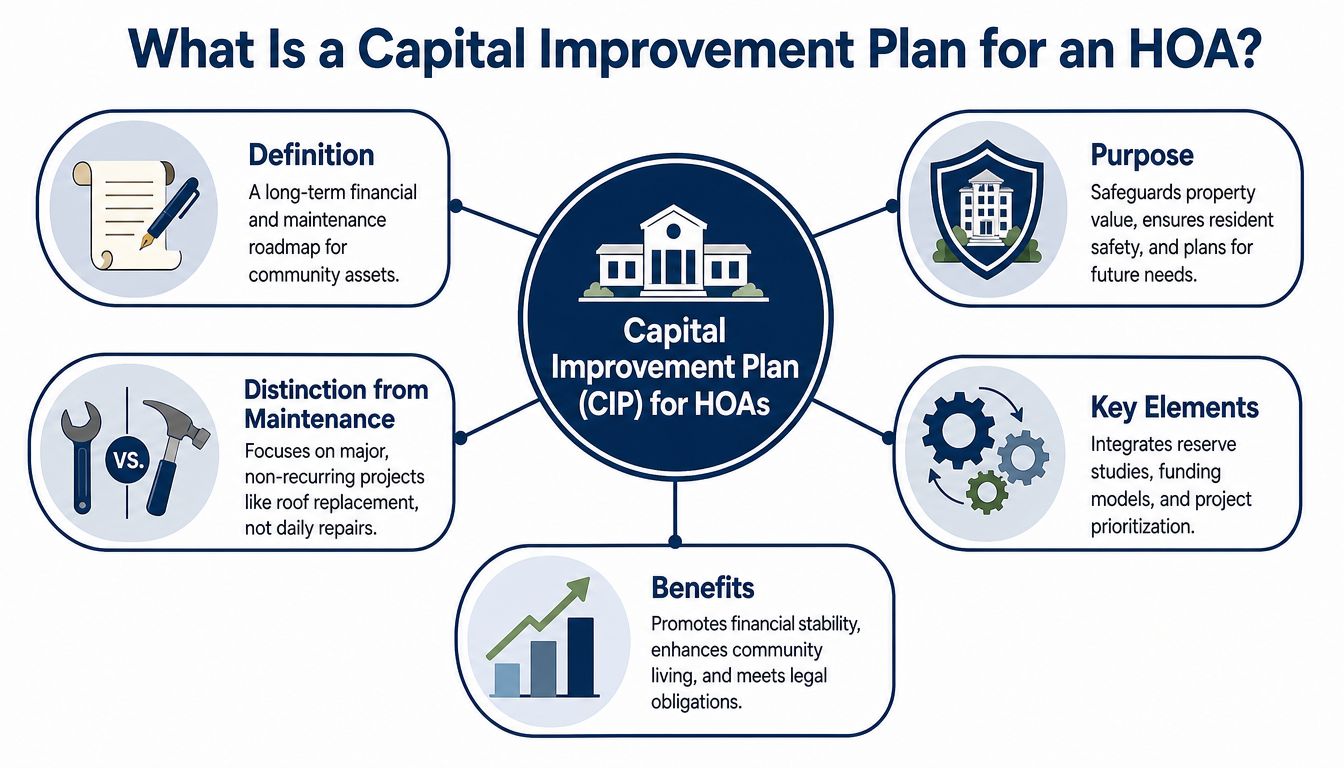
An HOA capital improvement plan is the board's written roadmap for major physical projects over multiple years. It identifies the assets involved, the likely work, the timing, the expected costs, and the funding source. It's broader than a single budget year, and it's more strategic than a maintenance checklist.
What counts as a capital improvement
A capital improvement in an HOA is a substantial upgrade, replacement, or addition to a common area element that adds value, extends useful life, or adapts it to a new use, and it must be permanent or expected to last more than one year, which distinguishes it from routine repairs or cosmetic fixes (Associated Asset definition of HOA capital improvement).
That definition helps boards sort projects into the right bucket.
- Routine maintenance covers the community's day-to-day operating needs. Think landscaping, janitorial service, utility bills, and ordinary service calls.
- Major repair or replacement usually addresses an aging common element that must be restored or replaced, such as roofing, pavement, or mechanical systems.
- Capital improvement often involves a substantial upgrade, addition, or long-life replacement that affects the association's long-term asset condition and value.
A simple way to explain it to homeowners
The easiest analogy is household budgeting.
Your operating budget is groceries, internet service, and the electric bill. Your reserve funding and capital improvement plan are the new roof, a full HVAC replacement, or a major remodel. One keeps the lights on this month. The other prepares for large, nonrecurring costs that have to be handled deliberately.
That distinction matters because boards often blur maintenance, repair, and capital projects in conversation. Once that happens, homeowners hear “expense” and assume the board is lumping everything together. A CIP forces the board to classify projects correctly.
How the CIP relates to the reserve study
A reserve study and a capital improvement plan work together, but they aren't the same document. The reserve study provides technical and financial analysis about major repair and replacement obligations. The CIP uses that information, along with board priorities and practical realities, to decide what the community will do and when.
The reserve study tells you what the property is likely to need. The capital improvement plan tells you how the board intends to act on it.
A useful CIP also works as a communication tool. It lets the board explain why a roof replacement belongs on the schedule before a cosmetic amenity upgrade, or why a drainage fix deserves attention ahead of a new feature homeowners may prefer.
When that logic is written down, boards spend less time debating from memory and more time managing from a plan.
Core Components of a Winning CIP
A workable capital improvement plan doesn't need to be fancy. It needs to answer five practical questions clearly and in writing. If those answers are missing, the board will feel it later during budgeting, owner meetings, or construction.
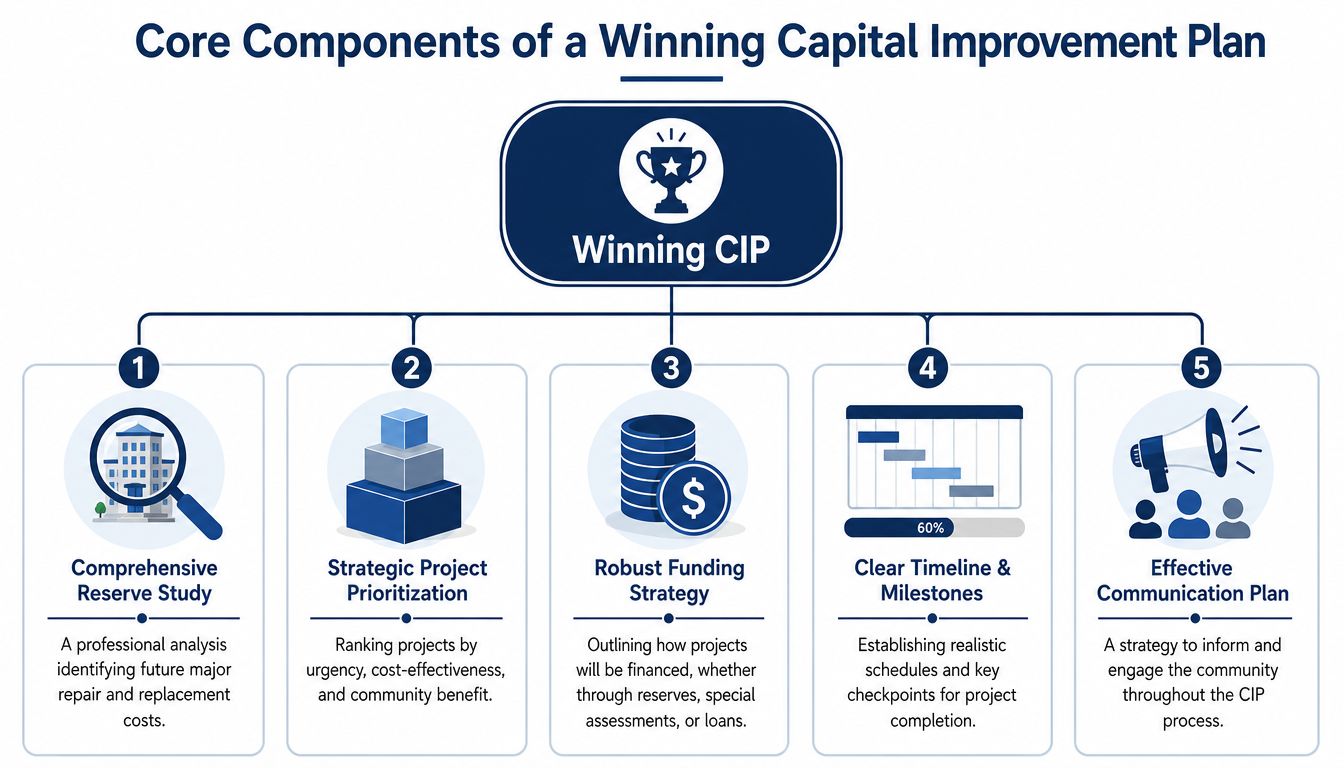
Capital improvement plans are typically structured as 5-year programs and often extend 5 to 10 years beyond the immediate capital budget for substantial, nonrecurring expenditures (ACCG handbook on capital improvement programs). For HOA and COA boards, that time horizon is long enough to be strategic but short enough to manage.
Asset inventory and condition assessment
Start with what the association owns and what condition it's in. Roof systems, pavement, retaining walls, elevators, entry features, lighting, fencing, pool equipment, clubhouse interiors, drainage structures, and utility components should all be visible somewhere in the plan.
Many private communities often fall short. Only 28% of community associations in Georgia report having a formal condition assessment integrated into their CIP, compared with 89% of municipal agencies (Envisio on building a capital improvement plan). If the board doesn't have a clear condition picture, prioritization becomes opinion-driven.
Prioritized project list
Not every legitimate project belongs in the same year. A good plan ranks work by urgency, safety, legal exposure, operational impact, and community value.
A useful ranking list usually separates projects into groups such as:
- Immediate risk items that affect safety, access, water intrusion, or code exposure
- Life-cycle replacements that are due based on age and condition
- Value-add improvements that enhance use or appearance but can wait if funding is tight
That distinction is especially important in communities debating visible amenity upgrades versus hidden infrastructure work.
Cost estimates and technical scope
Boards get into trouble when they budget only for the visible part of the job. The actual number may include design work, permits, demolition, owner notifications, temporary access issues, and post-project punch work.
For technical systems, detail matters. A board planning a piping replacement, for example, shouldn't approve “repiping” as a vague line item. It should understand materials, access assumptions, unit impacts, and project sequencing. When boards need a technical baseline, resources like expert repiping services can help them understand the scope questions they should be asking before they vote.
A reserve study helps inform those estimates, and boards that need a practical overview should review what an HOA reserve study includes.
Timeline and funding strategy
A plan without dates isn't a plan. It's a wish list. Each project should have an anticipated year, dependencies, and a payment method.
Good boards don't just ask, “Can we afford this project?” They ask, “Can we afford this project without undermining the next one?”
Funding should be tied to the project schedule at the same time the board sets priorities. If the roof, pavement, and pool mechanicals are all likely to hit the community within a similar period, the board needs to see those obligations together, not as isolated approvals.
Developing and Implementing Your Capital Improvement Plan
A capital improvement plan works when it moves from analysis to board action to controlled execution. Many associations stop after the planning discussion. That's where projects drift, assumptions age out, and reserve recommendations never become real decisions.
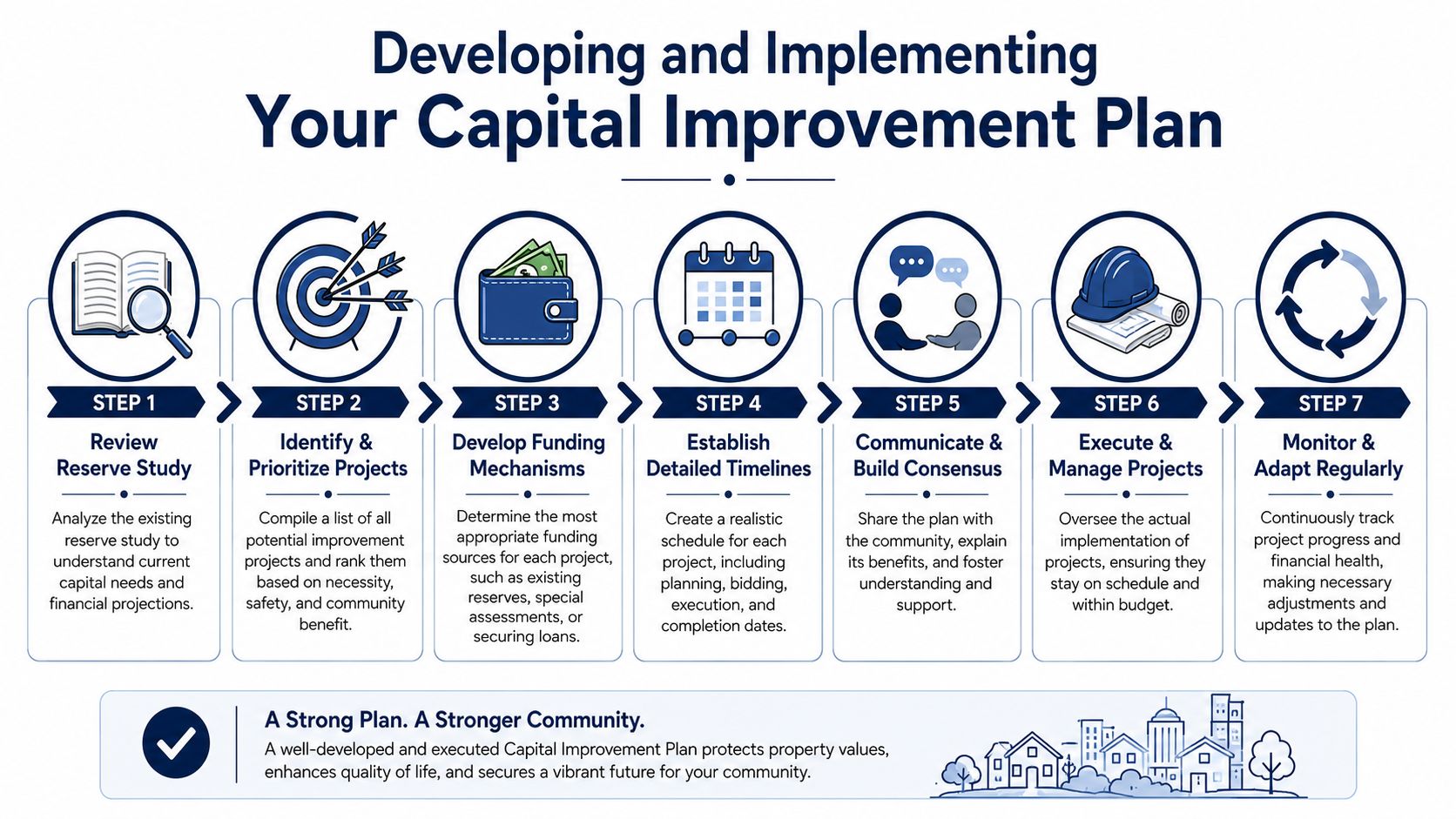
Start with the reserve study and the asset list
The reserve study should be your starting point, not your finished product. Review the components, remaining useful life assumptions, and current funding path. Then compare that information against what the board and manager are seeing in the field.
A mismatch is common. A component may still look acceptable on paper while active complaints, vendor reports, or recurring service calls suggest the board needs to move it up. The reverse also happens. A reserve study may list a project that can reasonably be deferred after fresh inspection.
Build a ranking method the board can defend
A simple matrix works better than a vague discussion. Assign each candidate project practical criteria such as:
Safety and legal exposure
Anything affecting resident safety, structural integrity, access, or code-related risk goes near the top.Operational disruption
If failure would shut down a key system or amenity, the board should account for the actual impact on residents.Financial timing
Some projects become more expensive if delayed because related components fail or temporary repairs start stacking up.Community benefit
Additions or upgrades belong here. They matter, but they shouldn't outrank urgent preservation work unless the facts support it.
Put each project on a real calendar
Boards often approve a concept year without setting a workable schedule. That's not enough. Every major project should have planning milestones, not just a construction target.
Use a sequence like this:
- Preliminary review with professional input
- Scope development with clear specifications
- Bid period with enough time for competitive responses
- Board approval recorded in the minutes
- Owner notice and logistics planning
- Construction window
- Closeout and warranty tracking
This is also where seasonal reality matters. Pool work, paving, roofing, and exterior painting all have timing constraints. So do owner occupancy patterns in condominium communities.
Make formal approval meaningful
A CIP should be adopted by formal board action. That doesn't mean the board locks itself into every future project regardless of conditions. It means the plan becomes the association's governing roadmap for capital decisions, subject to updates as conditions change.
That formal step matters because it ties the plan to budgeting, reserve decisions, owner communications, and meeting minutes. Without that connection, the document has no practical authority.
Execute with controls, not optimism
For implementation, a valid CIP needs a four-step technical control framework: complete and clear specifications, proper bidding with surety bond requirements, a complete contract, and constant monitoring with inspection (CTAS guidance on establishing a capital improvements plan). That final implementation phase affects project quality for years, and sometimes for durations lasting up to fifty years in the cited guidance.
Boards should resist two common mistakes.
- Approving incomplete scopes because the community wants fast action
- Choosing only on price without evaluating contract terms, schedule control, inspection, and owner disruption
A cheap bid with vague specifications can become the most expensive project on the property.
Review and update the plan regularly
A capital improvement plan should be revisited routinely. Asset condition changes. Construction pricing changes. Board priorities change. The plan needs a standing review cycle so the board can move projects up, delay others responsibly, and keep homeowners informed before decisions become emergencies.
Funding Your Community's Vision
Every board eventually asks the same question. If we agree on the project, how are we going to pay for it without creating a revolt? In HOA and COA communities, the answer is usually some mix of reserves, special assessments, or financing.
When reserve funds are insufficient, HOAs may fund capital improvements through special assessments or HOA loans collateralized against future assessments, which allows homeowners to pay over time without necessarily increasing regular dues (Associa on funding capital improvements).
The trade-offs boards should explain clearly
Reserve funding is usually the least disruptive option because homeowners have been contributing over time for future needs. It feels fair when the reserve study and the capital improvement plan have been maintained properly.
Special assessments are often necessary when the project is urgent, reserves are thin, or prior boards underfunded long-term obligations. They can be justified, but they require stronger communication and cleaner documentation because homeowners will ask why regular assessments weren't enough. For boards that need to explain that process clearly, a practical overview of how HOA special assessments work is useful.
Loans can be appropriate when the project must happen now but the board wants to spread the financial impact across time. That can make a large obligation more manageable for owners month to month, but it also commits future assessment revenue and requires disciplined repayment planning.
A helpful way to think about all three is through asset reliability. Associations that budget only for visible, near-term issues often postpone unavoidable system costs. Reliability-centered planning methods used in other asset-heavy environments can sharpen that discussion, and strategies for reliability-focused budgeting offer a useful perspective for boards weighing preventive action against delayed replacement.
Comparison of CIP Funding Methods
| Funding Method | Best For | Homeowner Impact | Board Considerations |
|---|---|---|---|
| Reserve Funds | Planned replacements and long-anticipated major work | Usually the most predictable approach because owners have funded ahead | Requires disciplined reserve contributions and alignment between reserve study and project timing |
| Special Assessments | Urgent projects, underfunded reserves, unexpected capital needs | Can create immediate financial pressure and owner resistance | Demands strong notice, clear justification, and careful review of governing document requirements |
| HOA Loans or Financing | Large projects that can't be delayed but shouldn't be paid in one lump sum | Spreads cost over time instead of requiring one large payment | Adds debt obligations and requires confidence in future assessment collection |
What doesn't work
What fails most often is not the funding tool itself. It's weak preparation. Boards lose support when they announce a special assessment before showing the project logic. They create avoidable conflict when they borrow without explaining total obligation and timing. They damage trust when reserves are used for one project with no clear view of what that does to the next planned replacement.
Homeowners can accept a hard decision faster than they accept a confusing one.
Communicating the Plan to Build Trust
Boards often assume homeowners will support a capital project if the need is obvious. That's rarely enough. Residents don't experience the property the same way the board, manager, engineer, or reserve specialist does. They see dues, disruption, noise, parking changes, construction fencing, and sometimes a feature they never personally use.

That gap is real. 65% of homeowners question CIP costs due to poor visualization of long-term asset lifecycle savings, which signals a communication problem as much as a funding problem (Colorado guidance on capital improvement plans).
Show the reason before the bill
A board builds credibility when it explains the asset problem in plain language before discussing payment. Homeowners need to understand what the component does, what condition it's in, what happens if the board delays action, and why this project ranks above others.
That explanation should avoid jargon. “The membrane has failed at multiple transition points and temporary patching is no longer cost-effective” is better than “the roof is old.” Specificity lowers suspicion.
Use more than one communication channel
One meeting and one email won't do it. Different owners absorb information in different formats and on different schedules.
Use a mix of:
- Board meetings and town halls for live questions
- Newsletter summaries for broad visibility
- Website or portal updates for timelines, notices, and documents
- Visual aids such as annotated photos, simple diagrams, and phasing maps
If owners can't see the problem or the future benefit, many of them will default to seeing only the cost.
Frame the project as preservation, not spending
Boards make avoidable mistakes when they talk only about project price. The better frame is stewardship. A capital improvement plan exists to preserve common assets, reduce surprise failures, and protect the community's overall living environment and market appeal.
That doesn't mean overselling every project. It means being honest about the reason for the work. A new drainage system may not feel exciting, but homeowners will understand it better when the board explains how it protects pavement, landscaping, structures, and future repair budgets.
Invite feedback without surrendering direction
Listening matters. So does governing. Create a clear process for homeowner questions, then respond consistently. Publish FAQs. Summarize recurring concerns. Correct misinformation quickly. If the board changes timing, scope, or funding based on useful feedback, explain that too.
Boards build trust when owners can see that decisions were made through a process, not behind closed doors.
Georgia HOA Considerations and Legal Guardrails
In Georgia communities, the quality of the capital improvement plan matters, but so do the governing documents. Boards can have strong project logic and still hit a procedural wall if the declaration, bylaws, or CC&Rs impose approval limits on capital spending.
Many HOA CC&Rs impose a spending cap on capital improvements, typically set at 5% to 10% of the annual budget, and projects above that threshold often require homeowner approval before the board can proceed (Cedar Management Group on capital improvements). For a new president, that means the first legal question isn't only “Is this project necessary?” It's also “Does the board have authority to approve it on its own?”
Local context matters
Municipal standards can provide useful perspective, but they don't control private associations. In Atlanta, a municipal CIP project must have a value of at least $25,000 and a lifespan longer than 5 years to qualify as a capital improvement (City of Atlanta CIP standards). HOA communities often work at a smaller scale, but the planning discipline should be just as serious.
Boards should also maintain a clean distinction between reserve-funded capital work and operating expenses. A practical benchmark used in HOA guidance is that capital improvement projects usually cost $10,000 or more, have a useful life exceeding one year, and are funded from reserves rather than the operating budget (Clark Simson Miller on maintenance vs capital improvement).
Board habits that reduce legal risk
Georgia boards protect themselves when they:
- Review authority first in the declaration, bylaws, and board resolutions
- Document project purpose clearly in meeting minutes and owner notices
- Match funding decisions to governing documents before announcing collection methods
- Keep reserve practices visible with regular board review of reserve and reserve fund guidance
A disciplined plan doesn't replace legal advice. It gives legal counsel, managers, and the board a cleaner foundation to work from.
If your board wants a steadier approach to reserve planning, project prioritization, homeowner communication, and long-term community stewardship, Access Management Group brings decades of HOA and COA management experience in Georgia. Their team helps associations protect, preserve, and enhance real estate investments with practical guidance that puts homeowners, board members, and community leaders first.