The meeting ended twenty minutes ago, but the disagreement is still going. One director remembers that the board approved a vendor proposal. Another remembers a preliminary discussion. A homeowner believes the board promised a follow-up, while the secretary's notes say only that the issue was “discussed.” Without clear HOA meeting minutes, everyone is left relying on memory, and memory is a poor governance record.
Well-prepared minutes protect homeowners first. They show what the board decided, how directors voted, which actions remain open, and where the board respected the boundary between public business and confidential discussion. They also protect volunteer directors and the HOA president by creating a factual record that can be reviewed long after the meeting ends.
Why HOA Meeting Minutes Matter for Homeowners and Boards
A homeowner questioning a landscaping contract, assessment decision, or rule-enforcement action needs more than “the board handled it.” Approved HOA meeting minutes should identify the motion, result, and assigned action. That record lets the homeowner verify what happened without depending on a director's memory or a hallway conversation.
Minutes protect homeowners by making board authority and follow-through visible. They also give volunteer directors a factual record if the decision is later challenged. The goal is accountability, not paperwork for its own sake.
The same record preserves continuity when board leadership changes. If a new president asks why the association changed a maintenance practice, concise minutes can show the topic considered, motion adopted, vote, and person assigned to follow up. That history helps new volunteers avoid reopening settled issues simply because the association lost the reasoning behind them.

Minutes are records, not transcripts
Minutes should document official business, not reproduce every sentence spoken. A transcript preserves interruptions, speculation, frustration, and remarks that may not have affected the board's action. Including all of that can obscure the decision and create privacy or litigation concerns.
A clear entry says:
The board discussed maintenance concerns related to the north entrance landscaping. Following discussion, Director Lee moved to obtain competitive proposals for the work. Director Patel seconded. The motion passed, with Director Green abstaining.
A weak entry says directors “argued about the landscaping for a long time” or that a homeowner “made an unreasonable complaint.” The first description is subjective. The second records an opinion rather than a governing action.
The HOA president sets the standard by treating minutes as part of governance. The secretary or manager can then apply a repeatable process using the agenda, attendance record, motion log, and approval calendar. Boards reviewing meeting structure can consult this guide on how to run a board of directors meeting.
For broader governance discussions, forums for real estate leaders offer a place to compare administrative practices and community issues with other real estate professionals. The point is not to copy another association's process. Use those conversations to identify questions your own board should ask about transparency, records, and owner communication.
Clear minutes build trust because they show homeowners that directors acted within the meeting's authority. They also give directors a defensible record when people later remember the same meeting differently.
What to Include and What to Leave Out of HOA Meeting Minutes
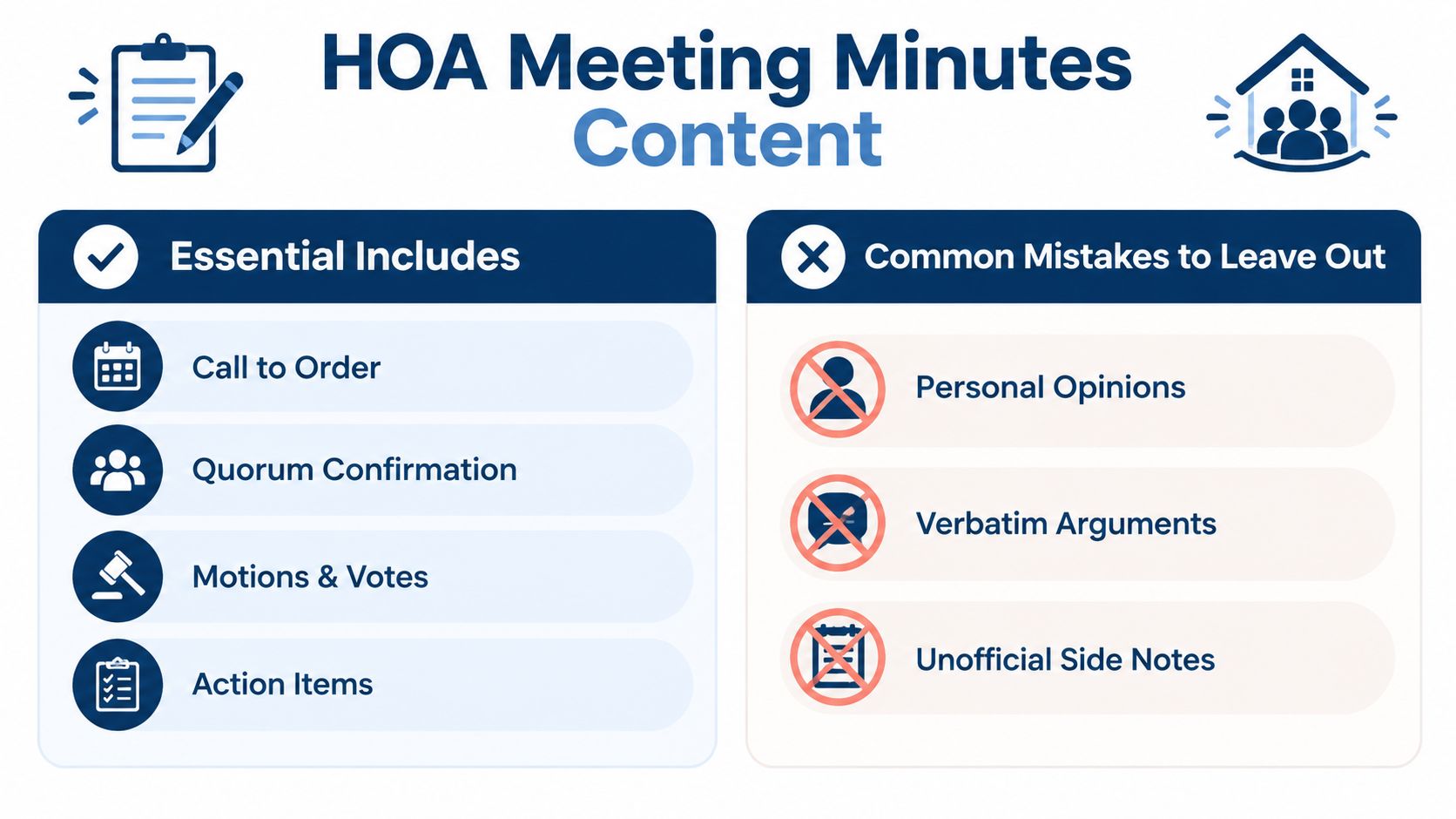
Start with the meeting's basic identity. Use the association's legal name, meeting type, date, start and end times, location or remote platform, and whether the meeting was open or held in executive session. Then record attendance, absences, guests, and whether a quorum was established.
Essential content
Include the following elements in a consistent order:
- Call to order: Identify who called the meeting to order and when.
- Attendance and quorum: List directors by name and position, identify absences, and state whether a quorum was present.
- Prior-minute approval: Record whether earlier minutes were approved as distributed or corrected.
- Reports: Note the presenter and subject, without reproducing the full report.
- Motions and seconds: Capture the motion clearly, the director who made it, and the director who seconded it when a second was required.
- Votes and abstentions: Record the outcome and each director's vote or abstention when applicable. Florida's statutory framework expressly requires the minutes to record each director's vote or abstention on every matter voted upon at board meetings, as summarized in this Florida HOA meeting-minutes guide.
- Action items: Identify the task, responsible person, and any follow-up date the board established.
- Adjournment: Record when the meeting ended and, if known, the next meeting information.
Owner comments require judgment. Don't create a verbatim transcript, but don't erase the existence of meaningful participation either. Summarize comments by topic and identify the speaker when your governing documents or applicable law call for that level of detail. For example: “Owner comments addressed sidewalk lighting, visitor parking, and irrigation repairs. The board received the comments and assigned the lighting concern for review.” If the board took no action, say so rather than suggesting that a decision occurred.
Leave out speculation and protected details
Avoid personal opinions, gossip, unverified accusations, and descriptions of a director's attitude. Don't include detailed delinquency information, private medical information, personal contact details, or unnecessary descriptions of an owner's alleged violation in open minutes.
Executive-session content needs an especially firm boundary. Open minutes can state that the board entered executive session, identify the general permitted category, and record when the board returned to open session. Substantive legal advice, personnel information, owner-specific enforcement details, and confidential negotiations belong in restricted records, subject to the law governing your association.
Remote participation should be documented factually. Identify the platform or remote format, record who participated remotely, and note any vote that was interrupted or repeated because of a connection problem. For topic-specific context, boards handling exterior maintenance can pair their recordkeeping process with an HOA landscaping rules guide, while keeping the minutes focused on the board's actual action.
How to Prepare and Take Accurate Minutes During the Meeting
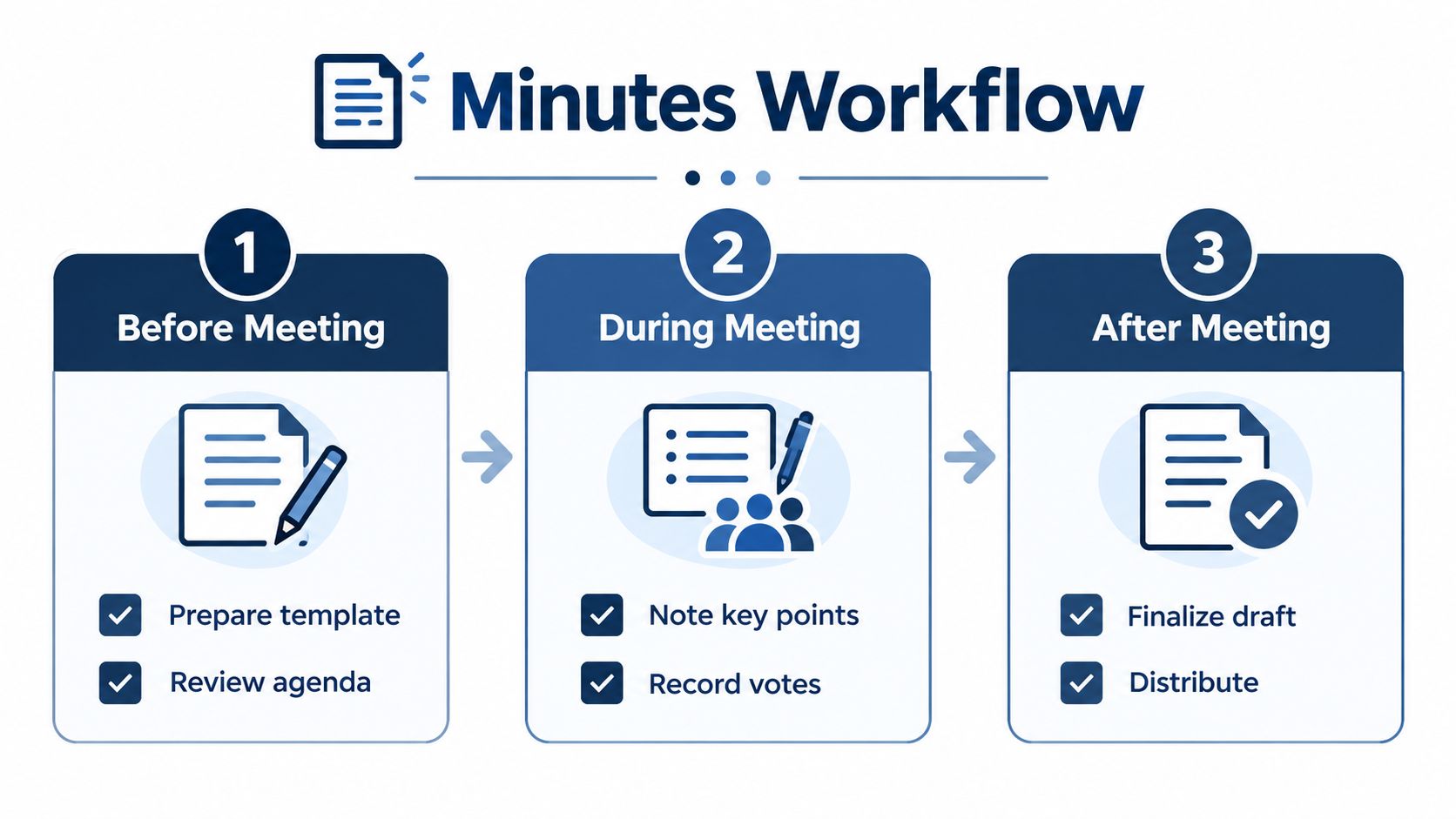
Accuracy improves before anyone calls the meeting to order. The secretary should open a prepared template, load the agenda, review the previous draft, and keep an attendance sheet nearby. A roster with director names and positions prevents the common mistake of identifying someone inconsistently from one meeting to the next.
Assign one note-taker for the full meeting. Splitting the task between directors often creates gaps, especially when the discussion becomes contentious or the board moves quickly from one motion to another. A community manager can prepare the draft, but the secretary should understand the process and review the result before approval.
Before the meeting
Build the document around the agenda. Pre-fill the association name, meeting type, date, location, agenda headings, and expected attendees. Put the prior minutes in a clearly marked approval section so the chair doesn't skip that item.
A practical preparation checklist includes:
- Template: Use the same headings for every meeting.
- Agenda: Leave space below each item for the motion, vote, and action.
- Attendance: Mark present, absent, remote, and guest participants as the meeting begins.
- Motion log: Keep a separate running list of motions so none disappears in hurried notes.
- Technology check: Confirm that the remote platform works and that participants can hear the proceedings.
Boards looking for a repeatable agenda format can use this HOA meeting agenda template. The agenda should guide the secretary's notes, not force the secretary to write every exchange.
During the meeting
Capture decisions as they happen. When a director makes a motion, write the motion in clear language, record the seconder, and ask the chair to confirm the vote before moving to the next item. If the motion is amended, record the amendment and the final wording adopted by the board.
Don't try to write while also interpreting the discussion. Use brief topic notes such as “reserve funding options reviewed” or “vendors compared for entry-gate repair,” then focus closely on the final action. If the chair announces a vote too quickly, ask for the result to be repeated. That small interruption is far safer than reconstructing the vote later.
Owner comments should be logged by subject, speaker, and board response where required. If a remote participant disconnects during a vote, note the interruption and confirm whether the director was present for the vote. The record should reflect participation accurately without turning the meeting into a technical diary.
Immediately afterward
Clean up the draft while the sequence is fresh. Check every motion against the agenda, verify names and vote results, separate open and executive-session material, and identify action items that lack an owner. Mark the document DRAFT until the board approves it.
A short, factual draft is easier for directors to review. It also helps the president spot a missing decision before the next meeting, when the board can correct the draft through the formal approval process.
How to Approve Distribute and Correct HOA Meeting Minutes
A secretary's draft isn't the official record. Approval gives the board the opportunity to confirm that the document accurately reflects the meeting, correct factual errors, and establish which version belongs in the association's records. Hawaii condominium guidance based on Robert's Rules and condominium practice specifically treats approval as the point at which minutes become official, which is why its condominium bulletin on meeting minutes recommends treating approval as a formal step.
The secretary should circulate the draft to the directors for review, but private comments shouldn't rewrite the history. Directors can identify a misspelled name, incorrect vote, omitted action item, or inaccurate motion. The chair then handles those corrections at the next appropriate meeting.
Use a clean approval motion
At the next meeting, the chair should ask whether there are corrections. The secretary records each accepted correction, then the board approves the minutes as distributed or as corrected. The approved document should show the approval status and date, and the secretary should sign or otherwise authenticate it according to the association's established practice.
If directors disagree about what occurred, don't solve the problem by replacing the entire draft with a new narrative. Compare the agenda, contemporaneous notes, attendance information, and any lawful backup record. If the board adopts a correction, preserve the original approved version and add a clear notation identifying the correction and approval date.
Practical rule: Correct the record transparently. Don't silently edit an approved set of minutes.
Executive-session records require separate handling. California guidance explains that executive-session information is excluded from member-inspectable association records, while a matter discussed in executive session must be generally noted in the minutes of the immediately following open meeting. The open entry should identify the general subject or resulting action without revealing confidential details, as described in this California HOA meeting-minutes guidance.
Distribute the approved record
Give homeowners access through the association's established portal, website, email process, or records-request procedure, subject to applicable law and governing documents. Distribute the approved version, not a draft that still contains unresolved corrections.
Maintain secure originals in a controlled association repository. Hawaii guidance recommends retaining two originals in separate secure locations, one with the secretary or manager and one at the attorney's office. That approach illustrates a broader principle, access shouldn't depend on one volunteer's inbox, laptop, or memory. For governance role clarity, boards can also review this resource on the board member and secretary relationship.
How Long to Keep HOA Meeting Minutes and Who Can See Them
Retention rules change the way a board should think about storage. Minutes aren't merely reminders for the next meeting. They can become evidence of authority, participation, and voting history during an audit, dispute, leadership transition, or records request.
Florida's 2026 Florida Statutes require minutes of members' meetings and board meetings to be maintained in written form or in a form convertible to writing within a reasonable time. The minutes must record each director's vote or abstention on every matter voted upon at board meetings, and the records must be retained for at least 7 years. Those requirements make Florida HOA minutes a durable compliance record, not a short-term recap. See the Florida statute on association records.
California takes a more enduring approach. California Civil Code section 5210 treats minutes of member and board meetings as permanently inspectable, and decision-making committee minutes for meetings commencing on or after January 1, 2007, are also permanently inspectable. California Corporations Code section 8320 requires corporations to keep minutes of proceedings of members, the board, and board committees. The statute also includes a January 1, 2006 safe-harbor cutoff concerning liability for certain earlier records, while later records fall under permanent retention expectations.
Ontario condominium guidance likewise says condo corporations must keep meeting minutes indefinitely and that owners can request copies. It distinguishes minutes older than 12 months as non-core records for organization and disclosure purposes, even though the minutes themselves remain retained. Those distinctions matter because “inspectable” doesn't necessarily mean every owner receives unrestricted access to every underlying file.
| Jurisdiction | Retention Requirement | Inspection Access | Key Detail |
|---|---|---|---|
| Florida | At least 7 years | Association records may be inspected under applicable law | Board minutes must record each director's vote or abstention on every matter voted upon |
| California | Permanent inspectability for covered minutes | Members can inspect regular meeting minutes, subject to statutory boundaries | Executive-session information is treated differently, and decision-making committee minutes are included for covered meetings |
| Ontario | Meeting minutes retained indefinitely | Owners can request copies | Minutes older than 12 months are classified as non-core records for practical records handling |
Executive-session materials should be stored separately with restricted access. In California, regular board minutes may be inspectable while executive-session information is excluded from member-inspectable association records. Boards should avoid assuming that a single storage folder and a broad sharing link will satisfy both transparency and confidentiality.
Organize files by association, meeting type, and date. Preserve approved versions, correction notations, attendance records, and restricted executive-session materials in separate permission-controlled locations. A durable naming system helps a new president find the correct record without relying on the former secretary.
A Homeowner First Approach to Better HOA Meeting Minutes
Good minutes answer four homeowner questions without forcing anyone to decode a transcript:
- What meeting occurred, and who participated?
- Did the board have authority to act?
- What motions passed or failed, and how did each director vote or abstain?
- What must happen next, and who owns that task?
The president should keep the meeting moving toward clear decisions. The secretary should record those decisions in neutral language. Homeowners should receive an understandable record that distinguishes board action from owner comment, open-session business from executive-session material, and a draft from an approved document.
A repeatable routine is more valuable than a complicated form. Before the meeting, prepare the agenda-based template and attendance record. During the meeting, confirm quorum, capture motions and vote results, summarize owner comments by topic, and note remote participation. Afterward, complete the draft promptly, circulate it for review, approve it formally, distribute the approved version, and store it where future boards can retrieve it.
For homeowners: Clear minutes aren't just paperwork. They give you a reliable way to verify how community decisions were made.
The best process balances transparency with restraint. A transcript may appear thorough, but it can expose irrelevant personal remarks and make the decision difficult to find. A bare sentence saying “landscaping discussed” avoids detail, but it fails to tell homeowners whether the board authorized work. The useful middle ground is a concise factual summary followed by the motion, vote, and action assignment.
Access Management Group provides community association management support that can include meeting assistance, association communications, and a secure online library where homeowners access governing documents, financial records, forms, and approved meeting minutes. Boards can evaluate that type of managed recordkeeping alongside their own storage controls, especially when volunteer leadership changes.
Adopt these habits at the next meeting:
- Use one approved template: Keep headings and terminology consistent.
- Record the decision: Capture motions, seconds, outcomes, votes, and abstentions.
- Summarize participation carefully: Identify owner comments by topic and speaker when required, without creating a transcript.
- Separate confidential material: Keep executive-session records out of open minutes.
- Approve and preserve: Treat approval as formal, retain correction history, and store records securely for the period required in your jurisdiction.
Access Management Group can help your HOA or COA prepare for board meetings, manage meeting records, and provide homeowners with organized access to approved documents through a secure online library. Visit Access Management Group to discuss a practical meeting-minutes and community-management process for your association.