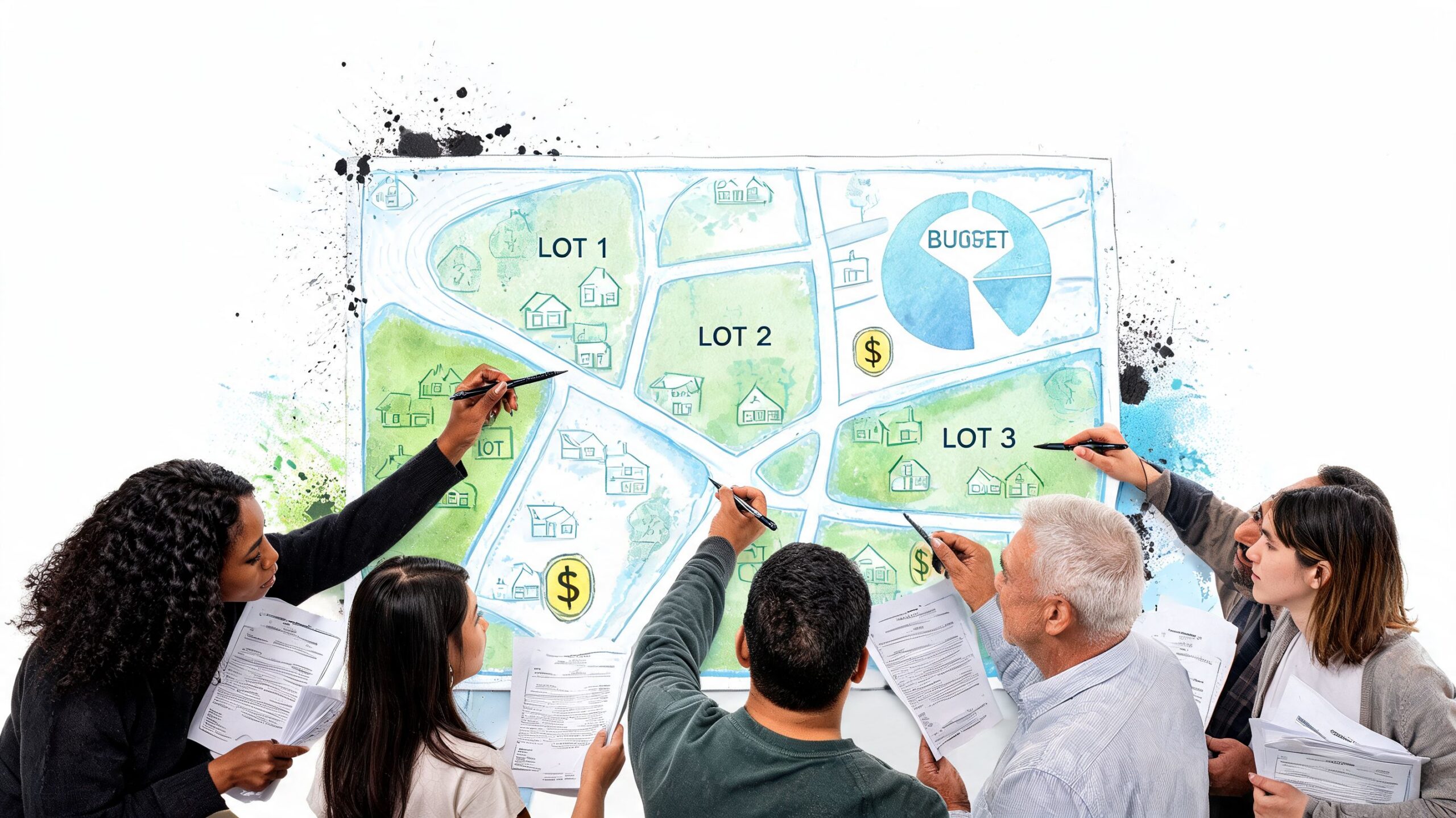
Your neighborhood is probably at a familiar turning point. The entrance sign needs attention. Landscaping looks uneven from one block to the next. A retention area, private road, clubhouse, or pool needs oversight, but no one has clear authority to budget for it, contract for it, or enforce shared standards fairly.
That's usually when homeowners start asking the same question: should we formalize this and create an HOA?
Starting an HOA can absolutely protect the community and make daily operations more manageable. It can also go badly if the group treats it like paperwork instead of what it really is, a long-term governance and financial system for real people living next to each other. The strongest associations start with two priorities at the same time: legal structure and resident trust.
A good new board president should think beyond incorporation forms and elections. The primary job is building a community that owners will support, understand, and fund without constant conflict. That means clear documents, realistic budgeting, transparent meetings, and a governance style that feels consistent instead of arbitrary.
Why Start a Homeowners Association
Most neighborhoods don't start this process because they love rules. They start because shared property needs care and informal cooperation stops working. If your community has common landscaping, stormwater features, lighting, signage, roads, gates, or amenities, someone has to make decisions, collect money, and set maintenance standards. Without a formal association, those tasks often fall to a few volunteers with limited authority and no lasting framework.
That's where starting an HOA becomes practical. An association gives the community a legal structure to maintain common areas, adopt standards, collect assessments, contract with vendors, and speak with one voice when issues affect the neighborhood as a whole.
Why neighbors choose this model
HOAs are no longer unusual. They're a standard part of American housing. In 1970, there were only approximately 10,000 HOA-governed communities in the U.S. By 2024, that number is estimated to be between 369,000 and 374,000, serving over 75 million Americans. Today, 82.4% of new homes sold belong to an HOA community, according to DoorLoop's HOA statistics overview.
That growth matters because it reflects a simple reality. Owners, developers, and municipalities often need a structure that can maintain shared assets and enforce community obligations over time.
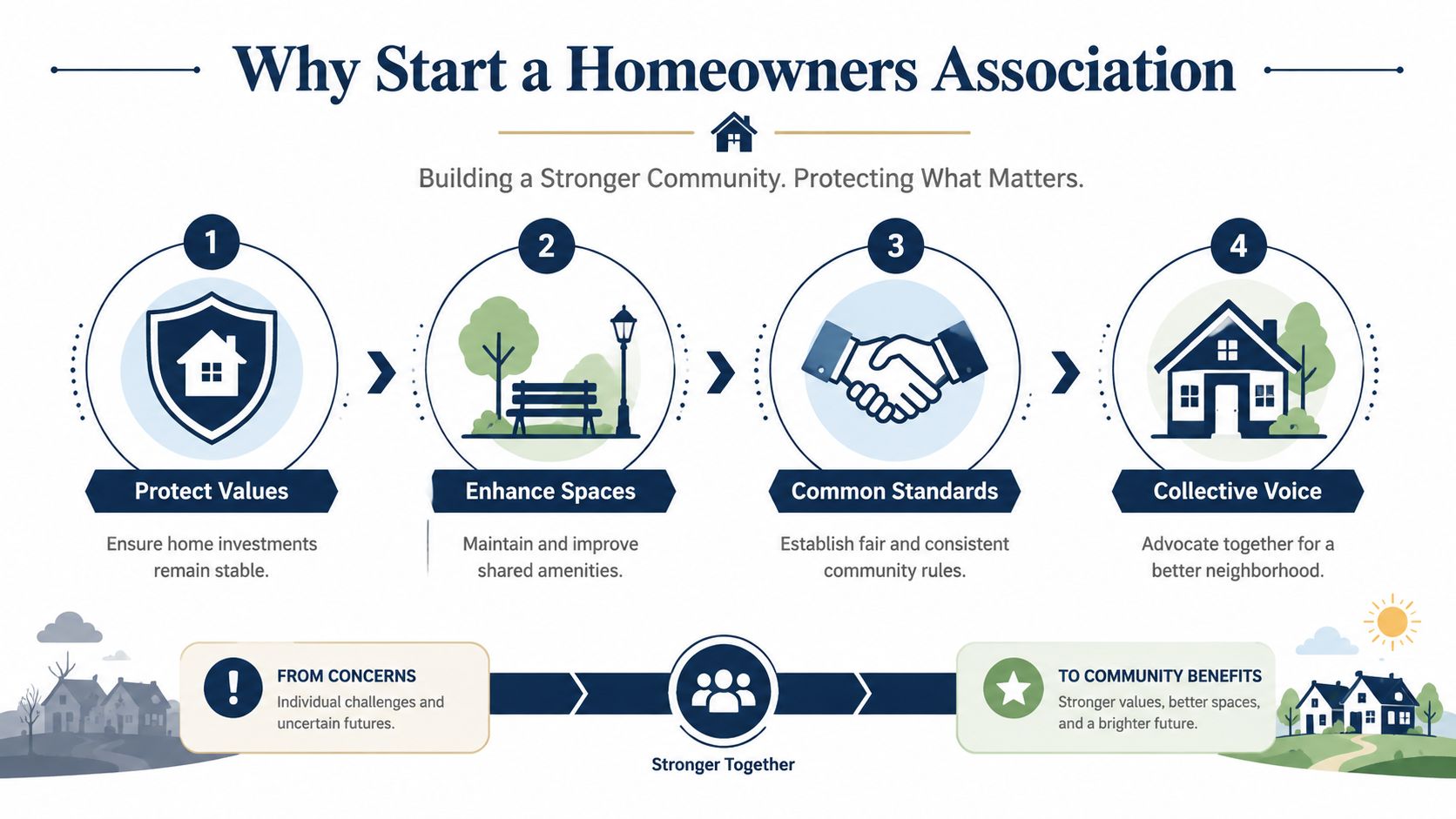
A healthy HOA usually delivers four things:
- Maintenance authority so common property doesn't deteriorate while neighbors debate who should pay
- Consistent standards that reduce selective enforcement and personal disputes
- Budgeting power to fund recurring work instead of scrambling for money after problems become urgent
- Collective representation when the neighborhood needs to work with local government, utilities, insurers, or contractors
A neighborhood without a clear decision-making structure usually drifts into two problems at once. Deferred maintenance and personal conflict.
Start with community support, not just paperwork
The legal filing matters, but homeowner buy-in matters more. If owners think the HOA exists to police them, resistance starts early. If they understand that it exists to preserve shared property, create fair expectations, and protect the community's long-term stability, the launch is much smoother.
This is also the stage to get organized administratively. Founders usually need to collect drafts, meeting notes, maps, owner communications, vendor proposals, and formation records in one secure place. If your group wants a cleaner way to organize approvals and records, tools that Manage real estate documents via API can help streamline document handling while the association is taking shape.
The best reason to start an HOA isn't control. It's clarity. People support associations when they can see what the structure is for, how decisions will be made, and why the money collected will be spent responsibly.
From Neighborhood Idea to Legal Entity
Once the neighborhood agrees that an HOA makes sense, the next challenge is formalizing it properly. This is where many groups stall. They have good intentions, but no one knows which step comes first, what has to be filed, or who should sign what.
The cleanest approach is to treat formation as a sequence of decisions, not a pile of forms.

Confirm whether the neighborhood is truly ready
Before filing anything, determine whether the community has meaningful support for the association. In a new development, that process may already be built into the project. In an existing neighborhood, especially a voluntary conversion, support has to be tested directly.
A practical early checklist looks like this:
- Identify the shared obligation. What exactly will the HOA own, maintain, regulate, or administer?
- Define the proposed membership structure. Will membership be mandatory or voluntary?
- List the expected owner concerns. Dues, architectural control, enforcement, and transparency usually come up first.
- Document preliminary support. Use written interest surveys, neighborhood meetings, and consistent follow-up.
If support is weak, don't rush into formation. A legally formed association without owner confidence becomes difficult to fund and harder to govern.
Incorporate the association correctly
In many states, the association must be established as a nonprofit corporation. That step creates the legal entity that can contract, open bank accounts, hold insurance, and operate as the governing body for the community.
In many states, HOAs must file as nonprofit corporations. For example, the Alabama Homeowners' Association Act requires this, with initial filing fees around $278. Nationally, 60%-70% of the 371,000 HOAs in 2024 rely on professional management companies to manage these legal and operational requirements, as noted by Cedar Management Group's guide to starting an HOA.
That doesn't mean every community needs full-service management on day one, but it does show how often boards decide they need experienced help with setup, filings, records, and compliance.
Practical rule: File only after the community has a clear purpose, an initial governance plan, and legal guidance on the documents that will control the association.
Handle the basic setup in the right order
Boards often try to multitask this stage and create confusion. A more reliable sequence is:
- Reserve the association name if your state requires it
- Form the nonprofit corporation with the Secretary of State or equivalent office
- Obtain tax and banking setup information so the HOA can operate financially
- Coordinate with legal counsel on the declaration and bylaws before owners vote or sign onto the framework
- Create a recordkeeping system from the first day so meeting minutes, approvals, and owner notices are easy to retrieve
This is also when the future president should be careful about expectations. Incorporation doesn't magically solve neighborhood issues. It gives the community a legal shell. The value comes from what you build inside it: enforceable documents, a responsible budget, fair procedures, and steady communication.
Crafting Your Core Governing Documents
The documents you adopt at formation will shape daily life in the neighborhood more than almost anything else. Boards can recover from a messy first meeting. They can recover from a delayed vendor contract. They have a much harder time recovering from badly drafted governing documents that invite disputes for years.
Most communities need two foundational layers. CC&Rs establish the property-based obligations and restrictions that run with the land. Bylaws govern how the association operates as an organization.
Know what each document actually does
Many new boards blur these documents together, and that creates confusion fast.
| Document | Purpose | Key Action |
|---|---|---|
| Declaration of CC&Rs | Establishes the use restrictions, maintenance obligations, and property rights tied to ownership in the community | Draft with legal counsel so obligations are enforceable and aligned with the physical realities of the neighborhood |
| Bylaws | Defines how the association functions, including board roles, meetings, elections, and voting procedures | Build clear operating procedures that volunteers can actually follow |
| Articles of Incorporation | Creates the legal corporate entity for the HOA | File correctly with the state and match the name and corporate purpose to the planned association |
| Rules and Policies | Addresses practical day-to-day standards and procedures after formation | Adopt only after the board has authority and a fair process for notice and enforcement |
The simplest way to explain the difference is this. CC&Rs are the what. Bylaws are the how.
Draft for real life, not for fantasy owners
Weak documents usually fail in one of two ways. They're too vague to enforce, or they're so rigid that the board spends all its time making exceptions. Good documents leave less room for personal interpretation and more room for predictable administration.
That means asking practical questions while drafting:
- Maintenance duties. Who maintains fences, walls, sidewalks, drainage, landscaping, roads, roofs, or amenity areas?
- Architectural standards. What changes require approval, and how quickly must the board respond?
- Enforcement process. How will notices, hearings, and decisions be handled fairly?
- Board authority. What can the board decide on its own, and what requires owner approval?
- Meeting procedures. How are meetings noticed, conducted, and documented?
If you want a useful overview of how these materials fit together, this explanation of HOA governing documents is a helpful reference point.
Clear governing documents reduce the number of times a board has to improvise. That alone prevents a surprising amount of conflict.
Keep the language homeowner-centered
Founders sometimes write documents as if every owner is a future violator. That tone backfires. Rules should protect the community, not punish ordinary living.
A stronger drafting mindset is:
- Write for fairness instead of maximum restriction
- Define standards clearly so enforcement doesn't feel selective
- Match obligations to actual resources because rules that can't be administered become dead weight
- Use counsel who knows association law so the documents work in practice, not just on paper
If your board is reviewing related occupancy or owner-use materials while comparing legal document structures, even a general lease agreement template can be a useful contrast for understanding how rights, duties, and procedures should be spelled out plainly.
The right documents make owners feel that the association is organized and even-handed. The wrong ones make every future decision harder.
Creating Your First HOA Budget and Reserve Study
A new HOA rarely fails because the board doesn't care. It usually fails because the board sets dues too low, guesses at future costs, and treats reserves like something to worry about later.
That approach creates immediate strain. Owners become frustrated when fees rise quickly, maintenance gets postponed, or the board has to explain why the association has money for mowing but none for a major repair.

Use the three-bucket method
The most practical framework for a first budget is the three-bucket system. That means separating money into operating funds, reserve contributions, and contingency reserves. Best practice for a new HOA budget involves a three-bucket system, and a proper reserve study should project capital replacement over a 10-20 year cycle to avoid early special assessments, according to PayHOA's guide to starting an HOA.
That framework works because it forces the board to stop mixing short-term bills with long-term obligations.
Here's how to think about each bucket:
- Operating funds cover recurring expenses such as insurance, utilities, routine landscaping, management fees, and ordinary service contracts.
- Reserve contributions prepare for major repair and replacement projects tied to shared assets like roads, roofing, pools, mechanical systems, structures, or other common components.
- Contingency reserves create breathing room for the unexpected, especially in the first year when actual costs often differ from assumptions.
Build the budget from obligations, not optimism
A first-year HOA budget should begin with an asset and responsibility list, not with a target dues number. Boards get in trouble when they ask, “What will owners tolerate?” before they ask, “What does this community need to operate responsibly?”
Start with two categories:
| Cost type | Typical examples | Why it matters |
|---|---|---|
| Fixed costs | Insurance, contracted management, utilities for common areas, recurring service agreements | These costs anchor your budget because they are predictable and difficult to avoid |
| Variable costs | Seasonal maintenance, repair work, amenity servicing, project-based expenses | These costs shift through the year and need room in the budget so cash flow stays stable |
A reserve study belongs at the beginning of formation, not after the first major repair. If the association is responsible for infrastructure or amenities with meaningful replacement costs, the board needs a disciplined view of what those components will require over time. You can read more about the purpose of an HOA reserve study and why boards rely on it to make more durable budgeting decisions.
The reserve study is not a luxury document. It is the board's reality check.
Set dues with honesty
Owners don't like unnecessary assessments, but they dislike surprise increases and special assessments even more. A realistic first budget often feels slightly uncomfortable because it reflects actual obligations instead of wishful thinking.
For boards that want a simple refresher on disciplined budgeting mechanics, this guide on how to manage your business finances effectively offers useful structure around categories, cash flow, and planning habits that also translate well to association operations.
When the first budget is transparent, owners may not agree with every line item, but they can usually follow the logic. That's a far better foundation than low dues followed by emergency corrections.
Holding Your First Meeting and Electing the Board
The first official membership meeting sets the tone for the association. Owners are deciding whether this new HOA will be organized, transparent, and fair, or whether it will feel improvised from the start.
That's why the first meeting shouldn't be treated as a formality. It's the public launch of the community's governance culture.

What needs to happen at that meeting
The exact agenda depends on state law and your governing documents, but most first meetings need to accomplish several core tasks:
- Confirm notice and quorum requirements so the meeting's actions are valid
- Present the governing framework so owners understand what is being adopted or ratified
- Review the first budget in plain language, especially recurring obligations and reserve planning
- Conduct the board election using a process that is documented, consistent, and easy to explain
- Record minutes carefully because these become part of the association's permanent history
A messy first election creates mistrust that can last for years. A clean one gives even disappointed candidates confidence that the process was legitimate.
How to run the election without creating avoidable tension
The board should communicate early, explain eligibility and voting procedures clearly, and keep the meeting focused. Homeowners don't need a legal lecture. They need confidence that the association is not being captured by a small group behind closed doors.
Use practical habits that lower friction:
- Send meeting notices with enough context so owners know what decisions are coming.
- Distribute candidate information consistently if your documents allow it.
- Use written procedures for ballots and counting so no one has to guess how the process works.
- Announce results and next steps clearly before the meeting closes.
A first meeting works best when owners leave understanding two things. Who is in charge, and how the rules will be applied.
Don't delay insurance and basic protections
As soon as the association is active, the board should work with qualified professionals on insurance. That often includes general liability and board protection such as Directors and Officers coverage, depending on the community and governing structure.
Volunteer directors need to understand this early. Serving on the board is not casual neighborhood volunteering once the association is formed. Directors are making governance and financial decisions on behalf of the corporation. Insurance, sound minutes, and proper procedures all work together to protect both the association and the people serving it.
The best first meeting feels steady, not dramatic. Owners should see a board that is prepared, respectful, and committed to running the community in an orderly way.
Should You Hire a Community Association Manager
Many new boards assume self-management is the sensible starting point. On paper, that can look efficient. In practice, it depends on whether the board has the time, temperament, and technical skill to handle collections, budgeting, records, vendor coordination, meeting administration, owner communication, and compliance work without creating inconsistency.
That's a bigger ask than many volunteers expect.
The real trade-off
Self-management offers direct control. It may also create bottlenecks fast. One or two board members usually end up carrying most of the work, and routine tasks begin to slip. Financial reporting gets delayed. Owner questions sit unanswered. Vendors receive conflicting direction. Enforcement becomes uneven because neighbors don't want to confront neighbors.
Professional management changes that operating model. The board still governs, but the manager handles execution, process discipline, administrative follow-through, and day-to-day coordination. If you want a plain-language look at that role, this overview of a community association manager is a good starting point.
What the risk data tells boards
The financial side is where early mistakes become expensive. A 2024 CAI report found 62% of failed HOA startups from 2019 through 2023 collapsed due to underfunded budgets. Initial startup costs average $15,000-$50,000, and skipping professional management early on leads to a 3x higher failure rate compared to HOAs that invest in expert guidance from the start, according to FirstService Residential's article on starting an HOA in your community.
Those numbers don't mean every association must outsource everything. They do mean boards should be sober about the operational burden.
A manager can help with:
- Budget discipline so dues and reserve planning are based on actual obligations
- Vendor administration including bidding, contract coordination, and service follow-up
- Meeting support such as notices, agendas, minutes, and election procedures
- Owner communication systems that keep records organized and responses consistent
- Collections and compliance processes that are more professional and less personal
When self-management can work, and when it usually doesn't
Self-management tends to work better in very simple communities with limited common property and a board made up of owners who understand finance, administration, and procedural discipline.
It tends to break down when the community has amenities, infrastructure, significant maintenance responsibilities, or a board that already feels stretched before the association fully launches.
The decision shouldn't be ideological. It should be operational. If the board wants to spend its time setting policy and making sound decisions, professional support often makes that possible. If the board wants to answer every owner email, chase every invoice, and manually coordinate every contractor visit, then self-management may fit, but only if the volunteers are ready for that commitment.
A new HOA has one chance to establish good habits. Support at the beginning is often cheaper than cleanup later.
If your board is starting an HOA and wants experienced guidance without losing sight of homeowner needs, Access Management Group can help you build the right foundation. From governance setup and financial structure to day-to-day community operations, the right management partner helps protect property values, reduce friction, and support a stronger community from the very beginning.