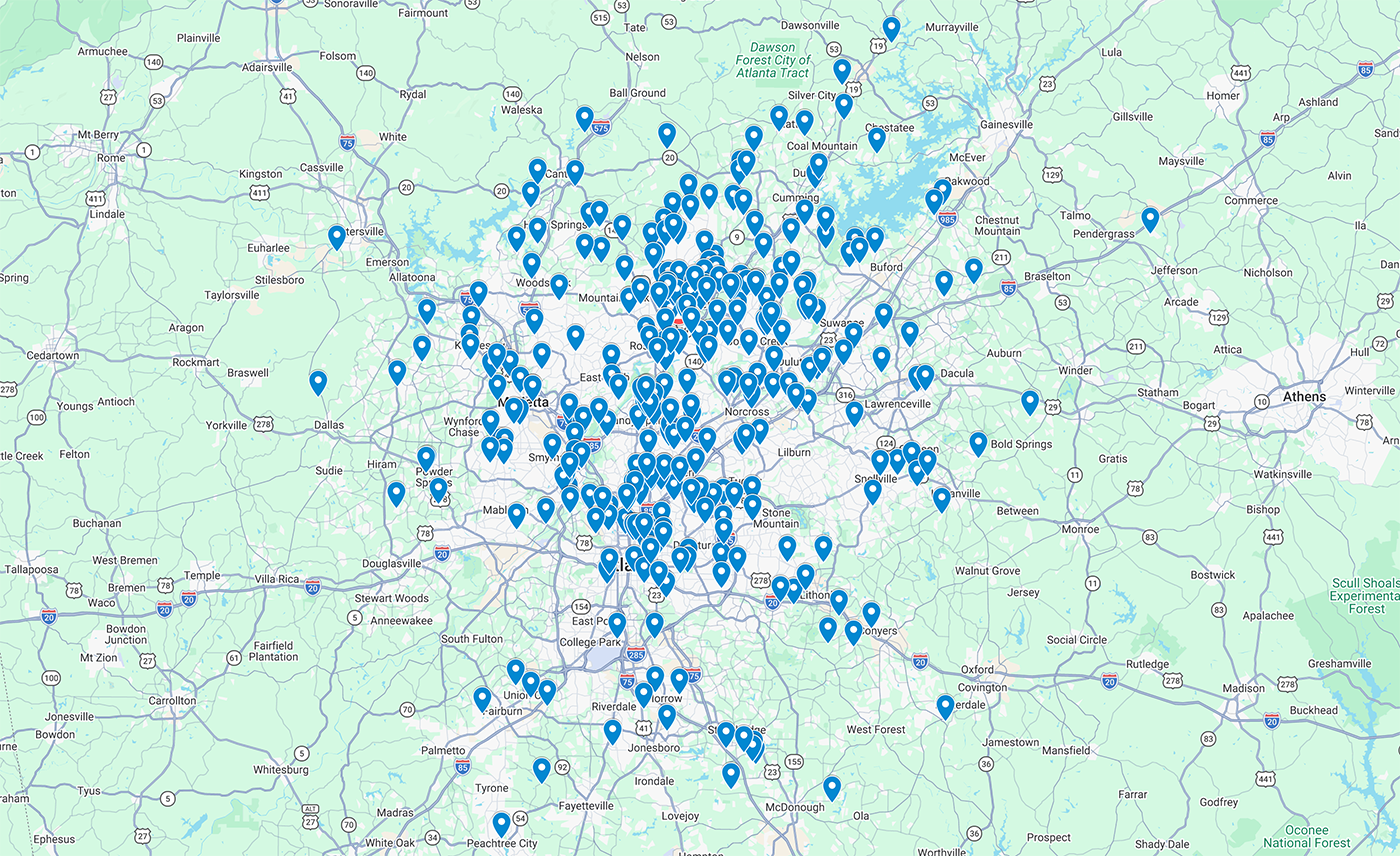
The first thing to understand about Georgia's homeowners association laws is that everything hinges on the legal framework your community falls under. Condominiums typically operate under the Georgia Condominium Act, while planned subdivisions may fall under the Georgia Property Owners' Association Act—commonly called the POAA—but only if your governing documents specifically adopted its powers.
Know Which Georgia HOA Law Applies Before You Act
Here's the practical reality: before a board sends out a violation notice, records a lien, or starts collection proceedings, it absolutely needs to know which statutory framework governs the association. Think of Georgia's various statutes as different toolboxes. Grab the wrong one, and even a perfectly reasonable enforcement decision can become legally shaky—or worse, unenforceable.
Start by pulling together the declaration, any amendments, the bylaws, and formation records. A condominium declaration almost always places the community squarely under the Georgia Condominium Act. A planned subdivision might be subject to the POAA, but here's the catch—POAA protections and powers are generally opt-in, meaning they don't apply automatically. The declaration itself should clearly spell out whether the community adopted that particular framework.
The smartest first move is straightforward: confirm which statute governs before exercising any statutory power.
Getting this distinction right shapes day-to-day decisions for everyone involved—homeowners, board members, and HOA presidents alike. It affects:
- Assessment authority, which may hinge on both statutory coverage and the specific language in your declaration.
- Lien rights and priority, which can vary significantly between condominium and subdivision frameworks.
- Registration duties, especially given recent legislation impacting POAA communities.
- Enforcement procedures, where a wrong assumption can stall collections or open the door to legal challenges.
The infographic below breaks down the key differences between Georgia's two primary governing frameworks, covering assessments, liens, and registration requirements.
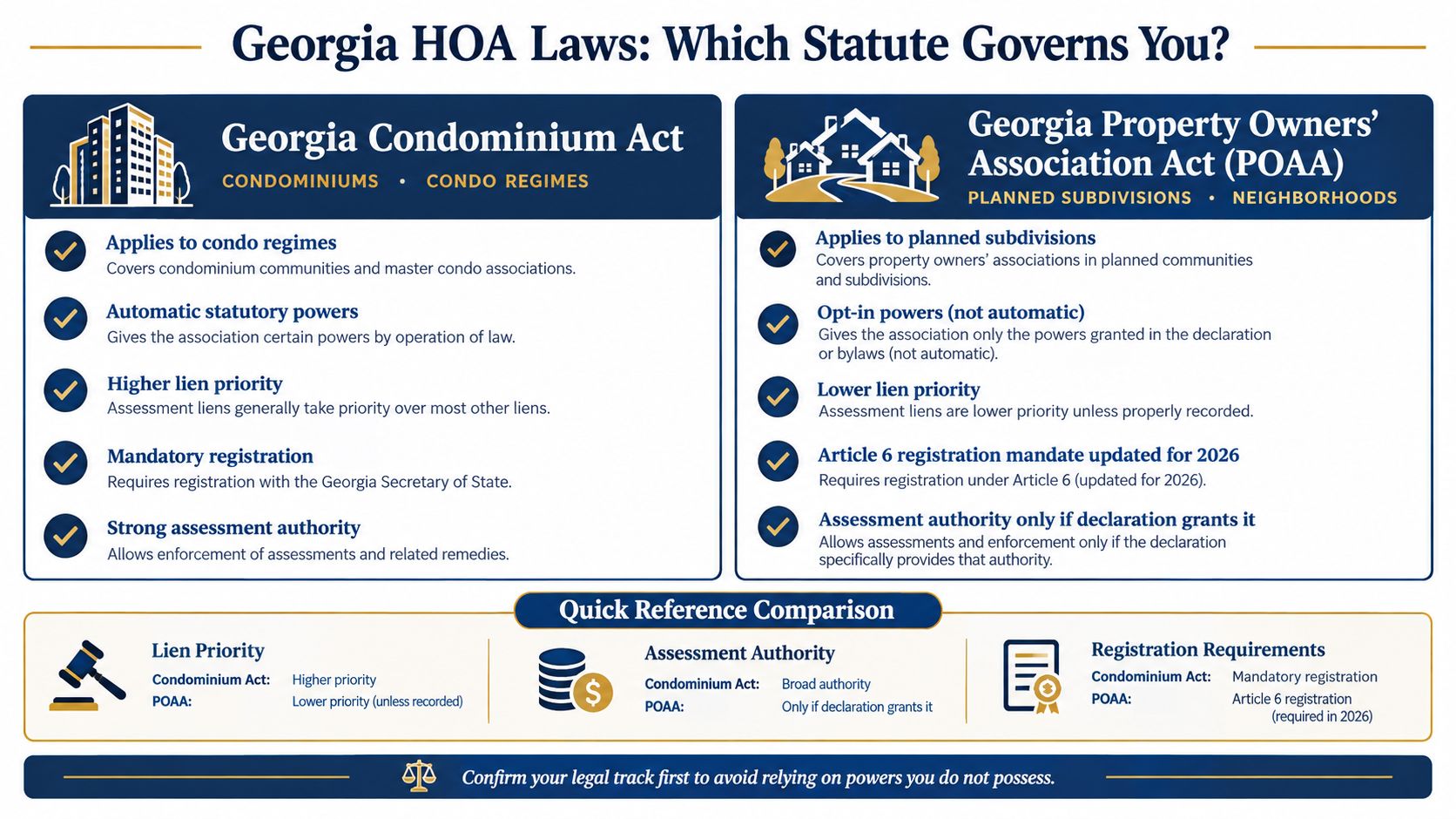
As the comparison illustrates, condominium associations generally enjoy stronger statutory tools for assessments and higher lien priority. POAA communities, on the other hand, need to double-check that powers were properly adopted and that all registration requirements are met.
| Issue | Georgia Condominium Act | Georgia POAA |
|---|---|---|
| Community type | Condominium regimes | Planned subdivisions |
| Statutory powers | Generally automatic | Must be adopted, not automatic |
| Lien position | Typically higher priority | Lower priority unless properly recorded |
| Assessment authority | Strong statutory foundation | Depends heavily on the declaration |
| Registration | Statutory requirements apply | 2026 Article 6 requirements add annual registration duties |
What 2026 Legislation Means for Your Association
Senate Bill 406 was signed into law on May 12, 2026, and it requires covered homeowners associations to register with the Georgia Secretary of State. Most of the major provisions kick in on January 1, 2027, while certain provisions related to attorney fees and judicial review took effect earlier on July 1, 2026, according to this overview of the Georgia Property Owners Bill of Rights Act.
This is serious business. A POAA association that fails to register could lose the ability to collect fines and fees, record liens, or pursue foreclosure. Boards should be adding registration deadlines, renewal reminders, and governing-document reviews to their annual compliance calendars right now—not later.
For a deeper dive into how all of this affects your specific situation, Access Management Group's guide to Georgia homeowners association laws is a solid resource worth bookmarking.
Once your association confirms the correct legal framework, the next responsibility is using its authority carefully. Board members serve as stewards of neighbors' homes and money, not as personal decision-makers. Under the homeowners association Georgia laws that apply to your community, three habits matter most: reasonable care, loyalty to the association, and staying within authorized powers.

Apply Care and Loyalty
The duty of care means making informed decisions rather than approving the first proposal placed on the table. For example, before selecting a landscaping company, directors should compare meaningful bids, review insurance coverage, confirm references, and record why the chosen vendor best serves the community.
The duty of loyalty requires directors to put association interests first. A director whose sibling owns a roofing company should disclose that relationship, avoid influencing the vote, and abstain when appropriate.
A defensible decision does not need to be perfect. It needs to be informed, authorized, consistent, and documented.
Boards should also check their declaration, bylaws, budgets, and applicable statutes before acting. A president may guide discussion, but cannot independently approve an expense or impose a penalty unless the governing documents authorize that power.
Use this simple decision record for significant actions:
- Question: What issue required board action?
- Information: Which bids, records, or professional advice were reviewed?
- Authority: What document or statute permits the decision?
- Vote: Who participated, and what was the result?
- Follow-up: Who will communicate and implement the action?
Build Records That Protect Everyone
Accurate minutes should identify the motion, vote, material discussion, and any disclosed conflict without becoming a transcript. Keep contracts, invoices, bank statements, notices, owner correspondence, and approvals together so homeowners can understand how money and authority were handled.
For instance, if an owner challenges a repair contract, a complete file can show the problem, competing bids, insurance checks, approval, and completed work. That paper trail protects the board, reassures residents, and gives counsel reliable facts if a dispute develops.
Access Management Group helps associations maintain consistent financial and governance procedures through community management and accounting support. Before approving major spending or enforcement action, ask whether a reasonable homeowner could follow the decision from the records alone. If not, improve the process before acting.
When an owner stops paying assessments, the tension cuts both ways. The board needs reliable money coming in for maintenance, insurance, and the shared services everyone depends on. At the same time, that owner deserves clear heads-up notice and a real chance to fix the account before things get heavy.

Under the homeowners association Georgia laws that apply to most communities, the lien itself typically attaches automatically once the declaration is recorded. That sounds straightforward, but it doesn't give the board a blank check to skip the paperwork. Before pursuing any remedy, someone needs to pull the governing documents, check the account records, confirm the board's statutory authority, and make sure the required notices are ready to go.
A lien might lock in the association's claim, but whether that claim actually holds up comes down to procedure.
Before filing for judicial foreclosure, the association has to give the homeowner at least 30 days' notice delivered by certified mail or statutory overnight delivery. That window isn't just a formality. It gives the owner time to pay, point out a billing error, or work out an arrangement before the situation escalates into something that costs everyone more.
Apply Thresholds and Deadlines Carefully
Georgia law draws a hard line on small balances. An association cannot foreclose when the delinquent amount is under $2,000. The rule makes sense when you think about it, no one should risk losing a home over a minor balance, but it also means the board has to know exactly where things stand before deciding what comes next.
The best approach is to keep ordinary collection activity and foreclosure eligibility in two separate lanes:
- Verify the balance. Make sure you're counting assessments and any charges your documents actually authorize.
- Cross-check your governing documents and the statute. Not every community's rules are identical.
- Send the required notice using one of the approved delivery methods, and keep the proof of mailing.
- Document everything. Payments, disputes, phone calls, emails, it all goes in the account file.
- Escalate only after you've confirmed both the threshold and the timeline.
There's a clock running here, too. Georgia's four-year statute of limitations can kill a lien enforcement action if the association waits too long. The moment a delinquency surfaces, someone should set a dated workflow in motion. A file that sits untouched for years is one that may eventually become unenforceable.
On the homeowner's side, reaching out to the board or management company early can make a real difference. Sometimes the issue is a posting mistake. Sometimes a payment arrangement can be worked out before legal costs pile on. For the board president, treating every account the same way eliminates accusations of playing favorites and keeps community cash flow steady.
For a deeper look at how lien rights and collection procedures work in Georgia, check out this resource.
Keep a straightforward paper trail: the assessment ledger, copies of every notice, delivery confirmation, the specific governing-document authority you're relying on, and any board approvals along the way. When the association partners with an experienced community management team, that documentation stays organized and accessible while the directors focus on making fair, consistent calls. It protects the homeowners and makes sure the association has the funds it needs to keep the community running.
Georgia HOA Assessments and Collections: What Every Board Member Should Know
Georgia law draws a firm line around what associations can charge, and that's actually good news for everyone involved. Homeowners get a clear picture of how delinquent accounts work, while boards and HOA presidents get a dependable collection framework — provided billing stays within the boundaries set by governing documents and state law.
Late Fees and Interest Caps
Here's the rule on late fees: they can't exceed the greater of $10 or 10% of the assessment. So if a homeowner owes $150, 10% comes to $15, and that $15 becomes the maximum late fee. But on a $60 assessment, 10% would only be $6, which means the $10 floor kicks in instead.
Interest works similarly. Georgia caps annual interest at 10%. Let's say someone carries a $500 overdue balance. At the maximum allowable rate, that's no more than $50 in yearly interest — though always double-check your community's documents and current statutes for the final word.
A compliant ledger should make every charge easy for a homeowner to verify and every board decision easy to defend.
Keep Billing Clear and Lawful
Before any delinquency notice goes out, take a step back. Compare your software settings, your collection policy, and your declaration against the statutory limits. Here's a common pitfall: a provision that authorizes a higher late fee or interest rate may be unenforceable, even if it's been sitting in the documents for years. Old language doesn't automatically mean valid language.
Try working through this checklist before sending anything:
- Confirm the assessment amount and the payment due date.
- Calculate the late fee using the greater-of-$10-or-10% rule.
- Apply interest at no more than 10% annually.
- Separate authorized charges from anything disputed or unsupported.
- Send an itemized statement that clearly shows payments received, fees assessed, interest applied, and the remaining balance.
This kind of discipline protects owners from surprise charges while keeping the association's cash flow healthy enough to cover insurance, repairs, and common-area upkeep. Nobody wins when billing becomes a guessing game.
Protect Sales and Refinances
Payoff statements deserve the same attention to detail. When a homeowner or a closing professional asks for the amount needed to satisfy an account, the association has five business days to respond with that statement.
That deadline isn't flexible. A delayed or inaccurate payoff can stall a sale or kill a refinance deal. Worse, if administrative delays start interfering with your ability to enforce a lien, the consequences get expensive fast.
Boards should assign one person to handle payoff requests, log the date each request comes in, and file the final statement in the account records. Having a professional management partner like Access Management Group can take a lot of that administrative weight off the board's shoulders, especially around billing controls and owner communication.
The bottom line is straightforward: collect what the association is legally owed, charge only what the law allows, and give homeowners timely information before a manageable balance turns into a full-blown crisis.
Transparent meetings accomplish two things at once: they give homeowners confidence in board decisions, and they give the board a reliable record to fall back on when questions surface months later. Georgia law requires associations to provide fair, reasonable notice of member meetings, consistent with the governing documents and applicable statutes. Members have the right to attend, and under the newer owner-information requirements, the board must hold a member meeting at least annually. You can read more in this overview of Georgia's Property Owners' Bill of Rights Act.
Every notice should spell out the date, time, location, and purpose of the meeting. Send it through whatever method the declaration or bylaws authorize, then keep proof that it actually went out. If the board plans to vote on a budget, contract, rule, or assessment, say so plainly. Tucking a major decision under "old business" is a fast way to lose owner trust.
Run Meetings with a Consistent Process
Think of a repeatable agenda as a traffic signal for the meeting. It keeps discussion moving, gives every owner a fair chance to speak, and helps the president shut down interruptions or surprise votes. Robert's Rules of Order offers a familiar parliamentary framework, but remember: if the governing documents or Georgia law say something different, those control.
Here is a sequence that works well in practice:
- Call the meeting to order and confirm attendance or quorum.
- Approve prior minutes after correcting factual errors.
- Review reports and unfinished business before new motions.
- State each motion clearly, invite discussion, and record the vote.
- Announce assignments and deadlines before adjournment.
Good minutes are not a transcript. They are a clear map of what the board decided, why it had the authority to decide it, and how each director voted.
Organize Records and Owner Requests
Owners generally have the right to inspect and copy association records, accounting records, and other documents through a written demand, subject to the governing documents and state law. They may also request the association's applicable certificates of insurance. Keep a written request log that captures the date received, who is responsible, which documents were located, the response date, and any lawful redactions.
For compliance planning in 2026 and beyond, registered POAA associations should be ready to retain records involving assessments, fines, fees, liens, and foreclosures for at least 10 years, in electronic and other formats. Store minutes, notices, invoices, contracts, financial reports, insurance documents, and correspondence in labeled folders with restricted access.
One last thing: explain response timelines and any withheld material in plain language. Owners who understand the process rarely assume someone is hiding something. If you have questions about proxy participation, read this guide to Georgia proxy voting rules. Access Management Group can also help boards build practical meeting calendars and record systems that support trust without drowning volunteers in paperwork.
Fair enforcement starts with the same principle that runs through every other part of homeowners association Georgia laws: apply the governing documents consistently, act within your authority, and give clear notice every single time. When a board lets one violation slide and then punishes a nearly identical one down the street, it hands that owner a selective-enforcement argument. That kind of inconsistency can undo months of careful work.
Think graduated, not punitive. Before anything else, confirm the rule actually exists, gather the facts, and give the homeowner a genuine chance to explain or fix the problem.
Use a Documented Cure Process
Say a homeowner receives a notice about an unapproved fence. A well-run board identifies the specific covenant, describes what was observed, states what needs to change, and sets a reasonable cure period. If the owner asks for extra time because materials are on backorder, put that request in writing and apply the same standard you've used in comparable cases.
A sequence that works in practice:
- Verify authority. Check the declaration, the rules, and any applicable Georgia statute.
- Document the facts. Dated photos, correspondence, inspection notes, and meeting records all belong in the file.
- Send clear notice. Spell out the violation, the remedy, the deadline, and how the owner can request a hearing or appeal.
- Review consistently. Compare the response against how you've handled similar matters before imposing consequences.
- Escalate carefully. Get legal guidance before fines, liens, or any other formal remedy.
Consistency doesn't mean treating every situation identically. It means running the same decision process for materially similar situations — and writing down any legitimate reason this one differs.
Mediation deserves more attention than it gets. A neutral manager or mediator can help the owner and the board agree on a correction schedule without either side admitting fault. Neighbors stay neighbors, and the community standard gets restored. That's a win most of the time.
Know When to Bring in Help
Formal arbitration, a hearing, or court action makes sense when informal efforts stall, when the violation threatens safety or property values, or when your governing documents mandate a particular process. One caution: the board president should never go it alone. The full board, association counsel, and the management team should follow authorized procedures, keep communications on the record, and protect confidential information.
A professional manager earns their keep here. They coordinate neutral notices, track cure dates, compare enforcement history, and keep the conversation anchored to facts instead of personalities. Access Management Group supports associations with community management, accounting systems, and governance practices built to protect homeowners and volunteer directors alike.
Before closing any case, confirm the correction was actually completed, update the file, and communicate the outcome appropriately. Fair, repeatable enforcement produces compliance people can understand and respect — it protects the neighborhood's character without turning every disagreement into a legal battle.
Georgia HOA compliance questions tend to surface when a board needs to move fast. The answers below are meant as practical reference points, not as a substitute for reading your declaration, bylaws, and the current statute side by side.
Which Law Governs My Community?
Condominiums generally fall under the Georgia Condominium Act. Planned subdivisions, on the other hand, may operate under the Georgia Property Owners' Association Act (POAA), but only if those powers were properly adopted in the governing documents. Think of it like this: the state law provides the toolbox, but your community's documents determine which tools are actually available. Confirming this framework before collecting assessments or enforcing covenants is one of the easiest ways to avoid taking action that could later be deemed invalid.
Can an HOA Foreclose for Any Unpaid Balance?
No, not for just any amount. As outlined in the collection section earlier, foreclosure requires a delinquent balance of at least $2,000. Before escalating to that point, boards should carefully verify the total amount owed, confirm that all charges were properly authorized, ensure notice was correctly delivered, and review the applicable governing documents.
It's also worth noting that legislative changes scheduled for January 1, 2027 may raise that threshold further and extend the required notice period. Associations should stay in close contact with legal counsel to confirm where things stand. For a closer look at what's coming, see this Georgia HOA law update.
How Much Can a Late Fee Be?
Late fees are capped at the greater of $10 or 10% of the overdue assessment. Annual interest on delinquent amounts cannot exceed 10%. So if your regular assessment is $150, the 10% limit means the late fee tops out at $15. Keeping a clean, itemized ledger works in everyone's favor: homeowners can check the math themselves, and the board can demonstrate that billing stayed within lawful bounds.
How Quickly Is a Payoff Statement Due?
Once a homeowner or their representative requests a payoff statement, the association generally has five business days to provide it. In practice, delays here are one of the most common sources of frustration during closings. Assigning one person to log incoming requests and verify balances can keep things moving smoothly and avoid last-minute scrambling.
What Meeting and Registration Dates Matter?
Boards need to give members fair and reasonable notice before meetings, and at least one member meeting must be held each year. On top of that, Senate Bill 406 now requires covered POAA associations to register annually with the Secretary of State, with renewals due by December 31. Most of the new provisions take effect January 1, 2027, so this is not something to put on the back burner.
The best approach is to track every compliance deadline on a shared board calendar and check for updates regularly through resources like FMG's legislation overview.
When a rule, deadline, or calculation gives you pause, stop and get qualified guidance before moving forward.
Access Management Group helps HOAs and COAs stay on top of compliance calendars, records, billing, and owner communication so that nothing falls through the cracks. Learn more about Access Management Group and request support for your community.